



Leadership
INTRODUCTION
   LEADERSHIP- IT IS THE ABILITY TO
    INFLUENCE A GROUP TOWARDS THE
    ACHIEVEMENT OF GOALS.
   CONTINUED TILL LATE 40’S –TRAIT
    THEORIES
   CONTINUED TILL LATE 60’S –
    BEHAVIORAL THEORIES
   PRESENTLY- CONTINGENCY AND
    MODERN THEORIES
DIFFERNCE BETWEEN
         MANAGEMENT AND LEADERSHIP
   MANAGEMENT BRINGS ABOUT ORDER AND
    CONSISTENCY BY DRAWING UP FORMAL
    PLANS, DESIGNING RIGID ORGANIZATIONAL
    STRUCTURES AND MONITORING RESULTS
    AGAINST PLANS
   LEADERSHIP IS ABOUT COPING WITH CHANGE,
    ESTABLISHING DIRECTIONS BY DEVELOPING A
    VISION OF THE FUTURE AND COMMUNCATING
    THIS VISION TO OTHERS AND INSPIRING
    THEM
TRAIT THEORIES


   THEORIES THAT CONSIDER
    PERSONAL QUALITIES AND
     CHARACTERISTICS THAT
  DIFFERENTIATE LEADERS FROM
         NON-LEADERS.
THE DESIRE TO LEAD
HONESTY AND INTERGITY
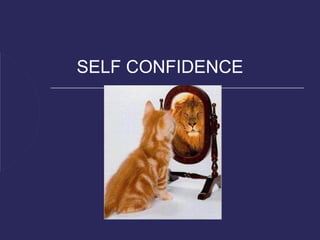
SELF CONFIDENCE
INTELLIGENCE
JOB-RELEVANT KNOWLEDGE
LIMITATIONS
   NO UNIVERSAL TRAIT THAT
    PREDICTS LEADERSHIP IN AN
    INDIVIDUAL
   UNCLEAR AND NOT SEPERATING
    FROM CAUSE AND EFFECT
   DOESN’T DISTINGUISH BETWEEN
    EFFECTIVE AND INEFFECTIVE
    LEADER
BEHAVIORAL THEORIES


  THEORIES PROPOSING THAT
      SPECIFIC BEHAVIORS
  DIFFERENTIATE LEADERS FROM
         NON LEADERS
OHIO STATE STUDIES
INITIATING STRUCTURE
EXTENT TO WHICH A LEADER IS LIKELY
   TO DEFINE AND STRUCTURE HIS OR
        HER ROLE AND THOSE OF
  SUBORDINATES IN THE SEARCH FOR
           GOAL ATTAINMENT
CONSIDERATION- THE EXTENT TO
  WHICH A LEADER IS LIKELY TO
    HAVE JOB RELATIONSHIPS
   CHARACTERIZED BY MUTUAL
      TRUST, RESPECT FOR
   SUBORDINATES IDEAS AND
  REGARD FOR THEIR FEELINGS
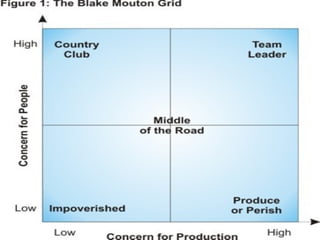
Blake Mouton Managerial Grid
   The Managerial Grid is based on two behavioral
    dimensions:
   Concern for People – This is the degree to
    which a leader considers the needs of team
    members, their interests, and areas of personal
    development when deciding how best to
    accomplish a task
   Concern for Production – This is the degree
    to which a leader emphasizes concrete
    objectives, organizational efficiency and high
    productivity when deciding how best to
    accomplish a task.
Country Club Leadership
   – High People/Low Production

   This style of leader is most concerned
    about the needs and feelings of
    members of his/her team. These people
    operate under the assumption that as
    long as team members are happy and
    secure then they will work hard. But
    production suffers due to lack of
    direction and control.
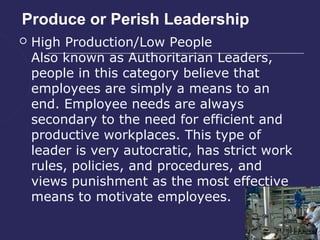
Produce or Perish Leadership
   High Production/Low People
    Also known as Authoritarian Leaders,
    people in this category believe that
    employees are simply a means to an
    end. Employee needs are always
    secondary to the need for efficient and
    productive workplaces. This type of
    leader is very autocratic, has strict work
    rules, policies, and procedures, and
    views punishment as the most effective
    means to motivate employees.
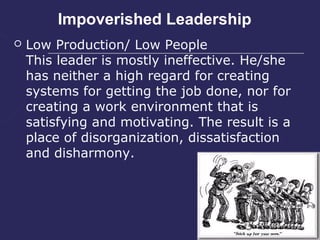
Impoverished Leadership
   Low Production/ Low People
    This leader is mostly ineffective. He/she
    has neither a high regard for creating
    systems for getting the job done, nor for
    creating a work environment that is
    satisfying and motivating. The result is a
    place of disorganization, dissatisfaction
    and disharmony.
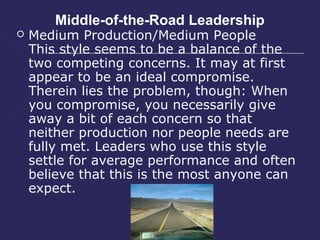
Middle-of-the-Road Leadership
   Medium Production/Medium People
    This style seems to be a balance of the
    two competing concerns. It may at first
    appear to be an ideal compromise.
    Therein lies the problem, though: When
    you compromise, you necessarily give
    away a bit of each concern so that
    neither production nor people needs are
    fully met. Leaders who use this style
    settle for average performance and often
    believe that this is the most anyone can
    expect.
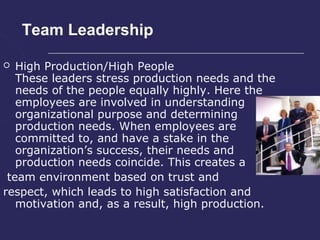
Team Leadership

  High Production/High People
   These leaders stress production needs and the
   needs of the people equally highly. Here the
   employees are involved in understanding
   organizational purpose and determining
   production needs. When employees are
   committed to, and have a stake in the
   organization’s success, their needs and
   production needs coincide. This creates a
 team environment based on trust and
respect, which leads to high satisfaction and
   motivation and, as a result, high production.
CONTINGENCY THEORIES
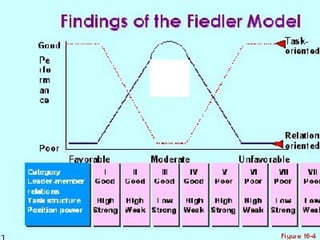
FIEDLER MODEL
   IDENTIFY THE LEADERSHIP STYLE
       TASK ORIENTED
       RELATIONSHIP ORIENTED
   LEAST PREFERRED COWORKER(LPC)
    TEST
   IF THE LPC IS DESCRIBED IN POSITIVE
    TERMS(HIGH SCORE) LEADER IS
    RELATIONSHIP ORIENTED
   IF THE LPC IS DESCRIBED IN
    NEGATIVE TERMS(LOW SCORE)
    LEADER IS TASK ORIENTED
DEFINE THE SITUATION


    LEADER-MEMBER RELATIONS
   DEGREE OF CONFIDENCE, TRUST
   AND RESPECT MEMBERS HAVE IN
           THEIR LEADER
    WILL EITHER BE GOOD OR BAD
TASK STRUCTURE
   DEGRESS TO WHICH THE JOB
ASSIGNMENTS ARE PROCEDURIZED
( STRUCTURED OR UNSTRUCTURED)
  WILL EITHER BE HIGH OR LOW
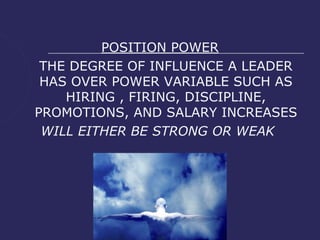
POSITION POWER
 THE DEGREE OF INFLUENCE A LEADER
 HAS OVER POWER VARIABLE SUCH AS
    HIRING , FIRING, DISCIPLINE,
PROMOTIONS, AND SALARY INCREASES
 WILL EITHER BE STRONG OR WEAK
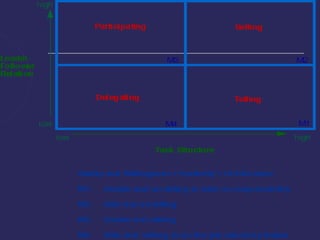
HERSEY AND BLANCHARD’S
        SITUATIONAL THEORY

   A CONTINGENCY THEORY THAT
    FOCUSES ON FOLLOWER’S
    READINESS(WILLINGNESS)
   THE EXTENT TO WHICH PEOPLE
    HAVE THE ABILITY AND
    WILLINGNESS TO ACCOMPLISH A
    SPECIFIC TASK
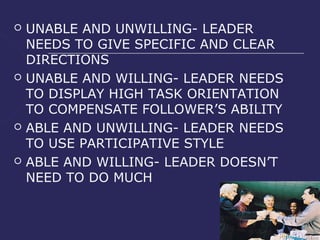
   UNABLE AND UNWILLING- LEADER
    NEEDS TO GIVE SPECIFIC AND CLEAR
    DIRECTIONS
   UNABLE AND WILLING- LEADER NEEDS
    TO DISPLAY HIGH TASK ORIENTATION
    TO COMPENSATE FOLLOWER’S ABILITY
   ABLE AND UNWILLING- LEADER NEEDS
    TO USE PARTICIPATIVE STYLE
   ABLE AND WILLING- LEADER DOESN’T
    NEED TO DO MUCH
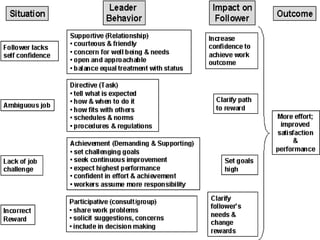
Path-Goal Theory
   Formulated by Robert House proposes
    that the leader can affect the
    performance, satisfaction, and
    motivation of a group in different ways:
    Offering rewards for achieving
    performance goals
   Clarifying paths towards these goals
   Removing obstacles to performance
   Directive leadership: Specific advice is
    given to the group and ground rules and
    structure are established. For example,
    clarifying expectations, specifying or
    assigning certain work tasks to be
    followed.
   Supportive leadership: Good relations
    are promoted with the group and
    sensitivity to subordinates' needs is
    shown.
   Participative leadership: Decision
    making is based on consultation with the
    group and information is shared with
    the group.
   Achievement-oriented leadership:
    Challenging goals are set and high
    performance is encouraged while
    confidence is shown in the groups'
    ability.
Modern theories of leadership

  Charismatic  leadership
  Transformational leadership
  Transactional leadership
  Social cognitive approach
Charismatic leadership
      Charismatic Leadership involves
       creating a self-image so powerful
       that people are naturally drawn to
       you.
The Charismatic Leader gathers
followers through dint of personality and
charm, rather than any form of external
power or authority.
ETHICAL CHARISMATIC LEADER

   Uses power to serve others
   Aligns vision with follower’s needs
    and aspirations
   Considers and learns from criticism
   Open, two- way communication
   Coaches, develops and supports
    followers; shares recognition with
    others
UNETHICAL CHARISMATIC LEADER

   Uses power only for personal gain
    or impact
   Promotes own personal vision
   Demands own decisions be
    accepted without question
   One- way communication
   Insensitive to follower’s needs
Transformational leadership
      Transformational Leaders, by
       definition, seek to transform

Leaders inspire followers to transcend their
own self interests for the good of the
organization, and who possess charisma
Characteristics of transformational leaders

        Provide vision and sense of mission
        Communicates high expectations
        Develop a strategy for maintaining
         the vision
        Promotes intelligence
        Gives personal attention
TRANSACTIONAL LEADERSHIP

      Where leaders guide or motivate
       their followers in the direction of
       established goals by clarifying role
       and task requirement
Characteristics of transactional leader

   Contracts the exchange of rewards for
    efforts, promises rewards for good
    performance, recognizes
    accomplishments.
   Watches and searches for deviations from
    rules and standards, takes corrective
    action.
   Intervenes when standards are not met
   Abdicates responsibilities, avoids making
    decisions.
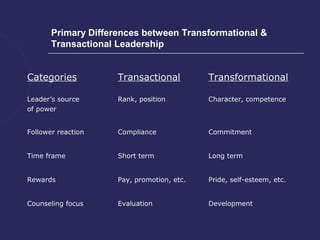
Primary Differences between Transformational &
       Transactional Leadership


Categories           Transactional          Transformational

Leader’s source      Rank, position         Character, competence
of power


Follower reaction    Compliance             Commitment


Time frame           Short term             Long term


Rewards              Pay, promotion, etc.   Pride, self-esteem, etc.


Counseling focus     Evaluation             Development
Cognitive resource theory

        A theory of leadership that states
         that stress unfavorably effects the
         situation, and intelligence and
         experience can lessen the
         influence of stress on the leader.
Cognitive Resource Theory predicts that:

   A leader's cognitive ability contributes to
    the performance of the team only when
    the leader's approach is directive
   Stress affects the relationship between
    intelligence and decision quality.
   Experience is positively related to
    decision quality under high stress
Leadership
            Styles


AUTOCRATIC
DEMOCRATIC
LAISSEZ-FAIRE
Autocratic Leadership Style


 Also known as Authoritarian leadership style
 Manager retains as much power and decision making authority as
possible
 Does not consult staff, nor allowed to give any input
 Staff expected to obey orders without receiving any
explanations
 Structured set of rewards and punishments
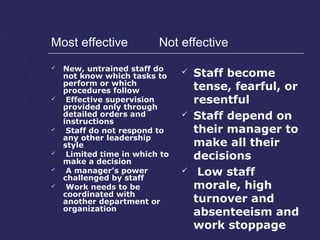
Most effective            Not effective

    New, untrained staff do
                                    Staff become

                                
    not know which tasks to
    perform or which
    procedures follow               tense, fearful, or
    Effective supervision          resentful
    provided only through
    detailed orders and
    instructions
                                   Staff depend on
    Staff do not respond to        their manager to
    any other leadership
    style                           make all their
    Limited time in which to
    make a decision
                                    decisions
    A manager’s power
    challenged by staff
                                    Low staff
    Work needs to be               morale, high
    coordinated with
    another department or           turnover and
    organization
                                    absenteeism and
                                    work stoppage
Democratic Leadership Style
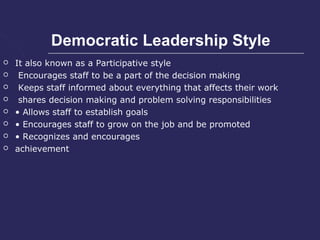
   It also known as a Participative style
    Encourages staff to be a part of the decision making
    Keeps staff informed about everything that affects their work
    shares decision making and problem solving responsibilities
   • Allows staff to establish goals
   • Encourages staff to grow on the job and be promoted
   • Recognizes and encourages
   achievement
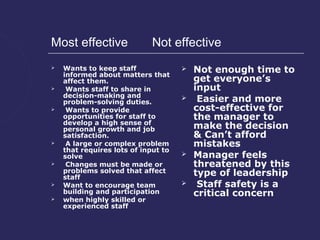
Most effective               Not effective
   Wants to keep staff
    informed about matters that
                                        Not enough time to
    affect them.                         get everyone’s
    Wants staff to share in             input
    decision-making and
    problem-solving duties.
                                         Easier and more
    Wants to provide                    cost-effective for
    opportunities for staff to           the manager to
    develop a high sense of
    personal growth and job              make the decision
    satisfaction.                        & Can’t afford
    A large or complex problem          mistakes
    that requires lots of input to
    solve                               Manager feels
    Changes must be made or             threatened by this
    problems solved that affect          type of leadership
    staff
   Want to encourage team               Staff safety is a
    building and participation           critical concern
   when highly skilled or
    experienced staff
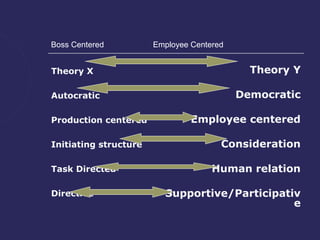
Boss Centered          Employee Centered


Theory X                                     Theory Y

Autocratic                                 Democratic

Production centered             Employee centered

Initiating structure                   Consideration

Task Directed                        Human relation

Directive                Supportive/Participativ
                                               e
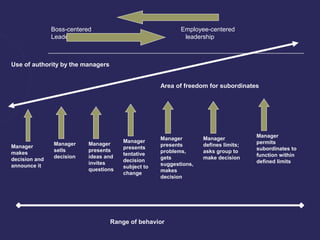
Boss-centered                               Employee-centered
               Leadership                                   leadership


Use of authority by the managers


                                                    Area of freedom for subordinates


                                                                   Manager           Manager
                                       Manager      Manager
               Manager     Manager                  presents       defines limits;   permits
Manager                                presents                                      subordinates to
makes          sells       presents                 problems,      asks group to
                                       tentative                                     function within
               decision    ideas and                gets           make decision
decision and                           decision                                      defined limits
                           invites                  suggestions,
announce it                            subject to
                           questions                makes
                                       change
                                                    decision


                                   Range of behavior
Laissez-faire
 Also known as the “hands-off¨ style
 The manager provides little or no
  direction
 gives staff as much freedom as

possible
 All authority or power given to the staff
  and they determine goals, make
  decisions, and resolve problems on their
  own
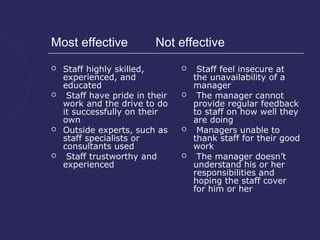
Most effective            Not effective
   Staff highly skilled,            Staff feel insecure at
    experienced, and                 the unavailability of a
    educated                         manager
    Staff have pride in their       The manager cannot
    work and the drive to do         provide regular feedback
    it successfully on their         to staff on how well they
    own                              are doing
   Outside experts, such as         Managers unable to
    staff specialists or             thank staff for their good
    consultants used                 work
    Staff trustworthy and           The manager doesn’t
    experienced                      understand his or her
                                     responsibilities and
                                     hoping the staff cover
                                     for him or her
LEADER ROLES
AND SKILLS
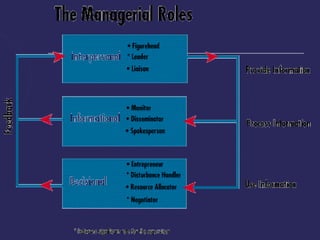
INFORMATIONAL ROLES


  DESCRIBES THE ACTIVITES USED TO
      MAINTAIN AND DEVELOP AN
       INFORMATION NETWORK
   MONITOR: SEEKS AND RECEIVES
    INFORMATION
   DISSEMINATOR- FORWARDS
    INFORMATION TO CONCERNED
    MEMBERS
   SPOKERPERSON- TRANSMITS
    INFORMATION TO OUTSIDER THROUGH
    SPEECHES
INTERPERSONAL ROLES


PERTAINS TO RELATIONSHIPS WITH
   OTHERS AND ARE RELATED TO
          HUMAN SKILLS
   FIGUREHED-PERFORMS CEREMONIES
    AND SYMBOLIC DUTIES
   LIASON- MAINTAINS INFORMATION
    LINKS BOTH INTERNAL AND EXTERNAL
    MEMBERS
   LEADER- MOTIVATING AND DIRECTING
    SUBORDINATES
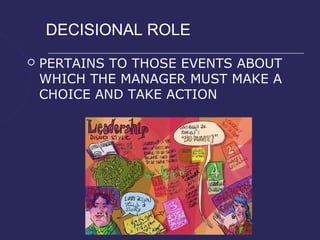
DECISIONAL ROLE
   PERTAINS TO THOSE EVENTS ABOUT
    WHICH THE MANAGER MUST MAKE A
    CHOICE AND TAKE ACTION
   ENTREPRENEUR- CREATES STRATEGIES
    AND PROJECTS
   DISTURBANCE HANDLER- TAKES
    CORRECTIVE ACTION DURING CONFLICT
   RESOURCE ALLOCATOR-SCHEDULING
    BUDGET AND OTHER RESOURCES
   NEGOTIATOR- NEGOTIATIONS DURING
    UNION MEETING, SALES, ETC
LEADERSHIP SKILLS

 CULTURAL FLEXIBILITY
 COMMUNICATION SKILLS

 HRD(HUMAN RESOURCE

DEVELOPMENT) SKILLS
 CREATIVITY

 SELF MANAGEMENT OF LEARNING
Chapter leadership
Chapter leadership
Chapter leadership
Chapter leadership

Chapter leadership

  • 1.
  • 2.
    INTRODUCTION  LEADERSHIP- IT IS THE ABILITY TO INFLUENCE A GROUP TOWARDS THE ACHIEVEMENT OF GOALS.  CONTINUED TILL LATE 40’S –TRAIT THEORIES  CONTINUED TILL LATE 60’S – BEHAVIORAL THEORIES  PRESENTLY- CONTINGENCY AND MODERN THEORIES
  • 3.
    DIFFERNCE BETWEEN MANAGEMENT AND LEADERSHIP  MANAGEMENT BRINGS ABOUT ORDER AND CONSISTENCY BY DRAWING UP FORMAL PLANS, DESIGNING RIGID ORGANIZATIONAL STRUCTURES AND MONITORING RESULTS AGAINST PLANS  LEADERSHIP IS ABOUT COPING WITH CHANGE, ESTABLISHING DIRECTIONS BY DEVELOPING A VISION OF THE FUTURE AND COMMUNCATING THIS VISION TO OTHERS AND INSPIRING THEM
  • 4.
    TRAIT THEORIES THEORIES THAT CONSIDER PERSONAL QUALITIES AND CHARACTERISTICS THAT DIFFERENTIATE LEADERS FROM NON-LEADERS.
  • 6.
  • 7.
  • 8.
  • 9.
  • 10.
  • 11.
    LIMITATIONS  NO UNIVERSAL TRAIT THAT PREDICTS LEADERSHIP IN AN INDIVIDUAL  UNCLEAR AND NOT SEPERATING FROM CAUSE AND EFFECT  DOESN’T DISTINGUISH BETWEEN EFFECTIVE AND INEFFECTIVE LEADER
  • 12.
    BEHAVIORAL THEORIES THEORIES PROPOSING THAT SPECIFIC BEHAVIORS DIFFERENTIATE LEADERS FROM NON LEADERS
  • 13.
  • 14.
    INITIATING STRUCTURE EXTENT TOWHICH A LEADER IS LIKELY TO DEFINE AND STRUCTURE HIS OR HER ROLE AND THOSE OF SUBORDINATES IN THE SEARCH FOR GOAL ATTAINMENT
  • 15.
    CONSIDERATION- THE EXTENTTO WHICH A LEADER IS LIKELY TO HAVE JOB RELATIONSHIPS CHARACTERIZED BY MUTUAL TRUST, RESPECT FOR SUBORDINATES IDEAS AND REGARD FOR THEIR FEELINGS
  • 16.
    Blake Mouton ManagerialGrid  The Managerial Grid is based on two behavioral dimensions:  Concern for People – This is the degree to which a leader considers the needs of team members, their interests, and areas of personal development when deciding how best to accomplish a task  Concern for Production – This is the degree to which a leader emphasizes concrete objectives, organizational efficiency and high productivity when deciding how best to accomplish a task.
  • 18.
    Country Club Leadership  – High People/Low Production  This style of leader is most concerned about the needs and feelings of members of his/her team. These people operate under the assumption that as long as team members are happy and secure then they will work hard. But production suffers due to lack of direction and control.
  • 19.
    Produce or PerishLeadership  High Production/Low People Also known as Authoritarian Leaders, people in this category believe that employees are simply a means to an end. Employee needs are always secondary to the need for efficient and productive workplaces. This type of leader is very autocratic, has strict work rules, policies, and procedures, and views punishment as the most effective means to motivate employees.
  • 20.
    Impoverished Leadership  Low Production/ Low People This leader is mostly ineffective. He/she has neither a high regard for creating systems for getting the job done, nor for creating a work environment that is satisfying and motivating. The result is a place of disorganization, dissatisfaction and disharmony.
  • 21.
    Middle-of-the-Road Leadership  Medium Production/Medium People This style seems to be a balance of the two competing concerns. It may at first appear to be an ideal compromise. Therein lies the problem, though: When you compromise, you necessarily give away a bit of each concern so that neither production nor people needs are fully met. Leaders who use this style settle for average performance and often believe that this is the most anyone can expect.
  • 22.
    Team Leadership  High Production/High People These leaders stress production needs and the needs of the people equally highly. Here the employees are involved in understanding organizational purpose and determining production needs. When employees are committed to, and have a stake in the organization’s success, their needs and production needs coincide. This creates a team environment based on trust and respect, which leads to high satisfaction and motivation and, as a result, high production.
  • 23.
  • 24.
    FIEDLER MODEL  IDENTIFY THE LEADERSHIP STYLE  TASK ORIENTED  RELATIONSHIP ORIENTED  LEAST PREFERRED COWORKER(LPC) TEST  IF THE LPC IS DESCRIBED IN POSITIVE TERMS(HIGH SCORE) LEADER IS RELATIONSHIP ORIENTED  IF THE LPC IS DESCRIBED IN NEGATIVE TERMS(LOW SCORE) LEADER IS TASK ORIENTED
  • 25.
    DEFINE THE SITUATION LEADER-MEMBER RELATIONS DEGREE OF CONFIDENCE, TRUST AND RESPECT MEMBERS HAVE IN THEIR LEADER WILL EITHER BE GOOD OR BAD
  • 26.
    TASK STRUCTURE DEGRESS TO WHICH THE JOB ASSIGNMENTS ARE PROCEDURIZED ( STRUCTURED OR UNSTRUCTURED) WILL EITHER BE HIGH OR LOW
  • 27.
    POSITION POWER THEDEGREE OF INFLUENCE A LEADER HAS OVER POWER VARIABLE SUCH AS HIRING , FIRING, DISCIPLINE, PROMOTIONS, AND SALARY INCREASES WILL EITHER BE STRONG OR WEAK
  • 29.
    HERSEY AND BLANCHARD’S SITUATIONAL THEORY  A CONTINGENCY THEORY THAT FOCUSES ON FOLLOWER’S READINESS(WILLINGNESS)  THE EXTENT TO WHICH PEOPLE HAVE THE ABILITY AND WILLINGNESS TO ACCOMPLISH A SPECIFIC TASK
  • 30.
    UNABLE AND UNWILLING- LEADER NEEDS TO GIVE SPECIFIC AND CLEAR DIRECTIONS  UNABLE AND WILLING- LEADER NEEDS TO DISPLAY HIGH TASK ORIENTATION TO COMPENSATE FOLLOWER’S ABILITY  ABLE AND UNWILLING- LEADER NEEDS TO USE PARTICIPATIVE STYLE  ABLE AND WILLING- LEADER DOESN’T NEED TO DO MUCH
  • 32.
    Path-Goal Theory  Formulated by Robert House proposes that the leader can affect the performance, satisfaction, and motivation of a group in different ways:  Offering rewards for achieving performance goals  Clarifying paths towards these goals  Removing obstacles to performance
  • 33.
    Directive leadership: Specific advice is given to the group and ground rules and structure are established. For example, clarifying expectations, specifying or assigning certain work tasks to be followed.  Supportive leadership: Good relations are promoted with the group and sensitivity to subordinates' needs is shown.
  • 34.
    Participative leadership: Decision making is based on consultation with the group and information is shared with the group.  Achievement-oriented leadership: Challenging goals are set and high performance is encouraged while confidence is shown in the groups' ability.
  • 37.
    Modern theories ofleadership Charismatic leadership Transformational leadership Transactional leadership Social cognitive approach
  • 38.
    Charismatic leadership  Charismatic Leadership involves creating a self-image so powerful that people are naturally drawn to you. The Charismatic Leader gathers followers through dint of personality and charm, rather than any form of external power or authority.
  • 39.
    ETHICAL CHARISMATIC LEADER  Uses power to serve others  Aligns vision with follower’s needs and aspirations  Considers and learns from criticism  Open, two- way communication  Coaches, develops and supports followers; shares recognition with others
  • 40.
    UNETHICAL CHARISMATIC LEADER  Uses power only for personal gain or impact  Promotes own personal vision  Demands own decisions be accepted without question  One- way communication  Insensitive to follower’s needs
  • 41.
    Transformational leadership  Transformational Leaders, by definition, seek to transform Leaders inspire followers to transcend their own self interests for the good of the organization, and who possess charisma
  • 42.
    Characteristics of transformationalleaders  Provide vision and sense of mission  Communicates high expectations  Develop a strategy for maintaining the vision  Promotes intelligence  Gives personal attention
  • 43.
    TRANSACTIONAL LEADERSHIP  Where leaders guide or motivate their followers in the direction of established goals by clarifying role and task requirement
  • 44.
    Characteristics of transactionalleader  Contracts the exchange of rewards for efforts, promises rewards for good performance, recognizes accomplishments.  Watches and searches for deviations from rules and standards, takes corrective action.  Intervenes when standards are not met  Abdicates responsibilities, avoids making decisions.
  • 45.
    Primary Differences betweenTransformational & Transactional Leadership Categories Transactional Transformational Leader’s source Rank, position Character, competence of power Follower reaction Compliance Commitment Time frame Short term Long term Rewards Pay, promotion, etc. Pride, self-esteem, etc. Counseling focus Evaluation Development
  • 46.
    Cognitive resource theory  A theory of leadership that states that stress unfavorably effects the situation, and intelligence and experience can lessen the influence of stress on the leader.
  • 47.
    Cognitive Resource Theorypredicts that:  A leader's cognitive ability contributes to the performance of the team only when the leader's approach is directive  Stress affects the relationship between intelligence and decision quality.  Experience is positively related to decision quality under high stress
  • 48.
    Leadership Styles AUTOCRATIC DEMOCRATIC LAISSEZ-FAIRE
  • 49.
    Autocratic Leadership Style Also known as Authoritarian leadership style  Manager retains as much power and decision making authority as possible  Does not consult staff, nor allowed to give any input  Staff expected to obey orders without receiving any explanations  Structured set of rewards and punishments
  • 50.
    Most effective Not effective New, untrained staff do Staff become   not know which tasks to perform or which procedures follow tense, fearful, or  Effective supervision resentful provided only through detailed orders and instructions  Staff depend on  Staff do not respond to their manager to any other leadership style make all their  Limited time in which to make a decision decisions  A manager’s power challenged by staff  Low staff  Work needs to be morale, high coordinated with another department or turnover and organization absenteeism and work stoppage
  • 51.
    Democratic Leadership Style  It also known as a Participative style  Encourages staff to be a part of the decision making  Keeps staff informed about everything that affects their work  shares decision making and problem solving responsibilities  • Allows staff to establish goals  • Encourages staff to grow on the job and be promoted  • Recognizes and encourages  achievement
  • 52.
    Most effective Not effective  Wants to keep staff informed about matters that  Not enough time to affect them. get everyone’s  Wants staff to share in input decision-making and problem-solving duties.  Easier and more  Wants to provide cost-effective for opportunities for staff to the manager to develop a high sense of personal growth and job make the decision satisfaction. & Can’t afford  A large or complex problem mistakes that requires lots of input to solve  Manager feels  Changes must be made or threatened by this problems solved that affect type of leadership staff  Want to encourage team  Staff safety is a building and participation critical concern  when highly skilled or experienced staff
  • 53.
    Boss Centered Employee Centered Theory X Theory Y Autocratic Democratic Production centered Employee centered Initiating structure Consideration Task Directed Human relation Directive Supportive/Participativ e
  • 54.
    Boss-centered Employee-centered Leadership leadership Use of authority by the managers Area of freedom for subordinates Manager Manager Manager Manager Manager Manager presents defines limits; permits Manager presents subordinates to makes sells presents problems, asks group to tentative function within decision ideas and gets make decision decision and decision defined limits invites suggestions, announce it subject to questions makes change decision Range of behavior
  • 55.
    Laissez-faire  Also knownas the “hands-off¨ style  The manager provides little or no direction  gives staff as much freedom as possible  All authority or power given to the staff and they determine goals, make decisions, and resolve problems on their own
  • 56.
    Most effective Not effective  Staff highly skilled,  Staff feel insecure at experienced, and the unavailability of a educated manager  Staff have pride in their  The manager cannot work and the drive to do provide regular feedback it successfully on their to staff on how well they own are doing  Outside experts, such as  Managers unable to staff specialists or thank staff for their good consultants used work  Staff trustworthy and  The manager doesn’t experienced understand his or her responsibilities and hoping the staff cover for him or her
  • 57.
  • 59.
    INFORMATIONAL ROLES DESCRIBES THE ACTIVITES USED TO MAINTAIN AND DEVELOP AN INFORMATION NETWORK
  • 60.
    MONITOR: SEEKS AND RECEIVES INFORMATION  DISSEMINATOR- FORWARDS INFORMATION TO CONCERNED MEMBERS  SPOKERPERSON- TRANSMITS INFORMATION TO OUTSIDER THROUGH SPEECHES
  • 61.
    INTERPERSONAL ROLES PERTAINS TORELATIONSHIPS WITH OTHERS AND ARE RELATED TO HUMAN SKILLS
  • 62.
    FIGUREHED-PERFORMS CEREMONIES AND SYMBOLIC DUTIES  LIASON- MAINTAINS INFORMATION LINKS BOTH INTERNAL AND EXTERNAL MEMBERS  LEADER- MOTIVATING AND DIRECTING SUBORDINATES
  • 63.
    DECISIONAL ROLE  PERTAINS TO THOSE EVENTS ABOUT WHICH THE MANAGER MUST MAKE A CHOICE AND TAKE ACTION
  • 64.
    ENTREPRENEUR- CREATES STRATEGIES AND PROJECTS  DISTURBANCE HANDLER- TAKES CORRECTIVE ACTION DURING CONFLICT  RESOURCE ALLOCATOR-SCHEDULING BUDGET AND OTHER RESOURCES  NEGOTIATOR- NEGOTIATIONS DURING UNION MEETING, SALES, ETC
  • 65.
    LEADERSHIP SKILLS  CULTURALFLEXIBILITY  COMMUNICATION SKILLS  HRD(HUMAN RESOURCE DEVELOPMENT) SKILLS  CREATIVITY  SELF MANAGEMENT OF LEARNING