Leadership Style and
Organisational
Effectiveness
20 July 2012

SHANMUGA PILLAIYAN (010194)
TAN CHEE HOAW (010120)
KEVIN CHOO (010226)
HELMMY SHAHNY MOHD MUSTAFA (010268)
AMRI MOHD SOFIAN (010563)
GURMEET SINGH (002967)
Agenda
1.

Introduction – What is Leadership?

2. Leadership Models & Styles
3. Case Study – Apple Inc
I.

Historical Milestones

II. Steve Job‟s Management Style
III. Impact on Organisation Behaviour
IV. Evidence of Organizational Effectiveness
4.

Comparisons with Other Leaders

5. Conclusion

Nottingham Malaysia

July 2012
Slide 2
What is Leadership ?

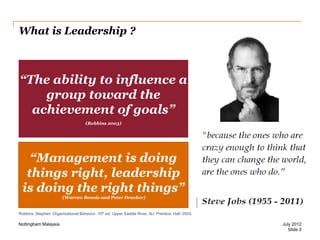
“The ability to influence a
group toward the
achievement of goals”
(Robbins 2003)

“Management is doing
things right, leadership
is doing the right things”
(Warren Bennis and Peter Drucker)

Robbins, Stephen. Organizational Behavior. 10th ed. Upper Saddle River, NJ: Prentice, Hall, 2003.

Nottingham Malaysia

July 2012
Slide 3
Leadership Theory
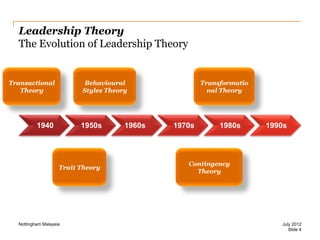
The Evolution of Leadership Theory

Transactional
Theory

Behavioural
Styles Theory

1940

1950s

Trait Theory

Nottingham Malaysia

1960s

Transformatio
nal Theory

1970s

1980s

1990s

Contingency
Theory

July 2012
Slide 4
Leadership Theory
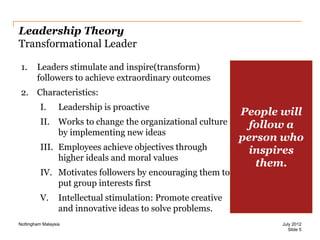
Transformational Leader
1.

Leaders stimulate and inspire(transform)
followers to achieve extraordinary outcomes

2. Characteristics:
I.

Leadership is proactive

II. Works to change the organizational culture
by implementing new ideas
III. Employees achieve objectives through
higher ideals and moral values
IV. Motivates followers by encouraging them to
put group interests first
V.

People will
follow a
person who
inspires
them.

Intellectual stimulation: Promote creative
and innovative ideas to solve problems.

Nottingham Malaysia

July 2012
Slide 5
Leadership Theory
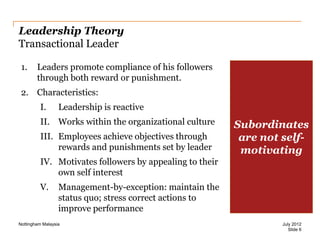
Transactional Leader
1.

Leaders promote compliance of his followers
through both reward or punishment.

2. Characteristics:
I.

Leadership is reactive

II. Works within the organizational culture

III. Employees achieve objectives through
rewards and punishments set by leader

Subordinates
are not selfmotivating

IV. Motivates followers by appealing to their
own self interest
V.

Management-by-exception: maintain the
status quo; stress correct actions to
improve performance

Nottingham Malaysia

July 2012
Slide 6
Leadership Theory
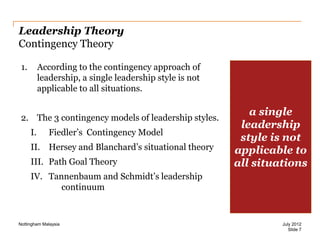
Contingency Theory
1.

According to the contingency approach of
leadership, a single leadership style is not
applicable to all situations.

2. The 3 contingency models of leadership styles.
I.

Fiedler‟s Contingency Model

II. Hersey and Blanchard‟s situational theory
III. Path Goal Theory

a single
leadership
style is not
applicable to
all situations

IV. Tannenbaum and Schmidt‟s leadership
continuum

Nottingham Malaysia

July 2012
Slide 7
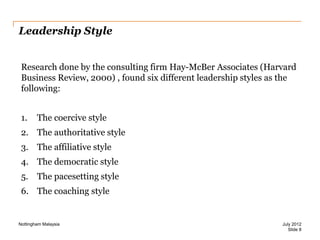
Leadership Style
Research done by the consulting firm Hay-McBer Associates (Harvard
Business Review, 2000) , found six different leadership styles as the
following:
1.

The coercive style

2. The authoritative style
3. The affiliative style
4. The democratic style
5.

The pacesetting style

6. The coaching style

Nottingham Malaysia

July 2012
Slide 8
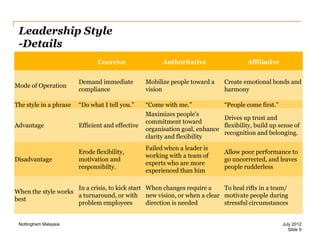
Leadership Style
-Details
Coercive

Authoritative

Affiliative

Mode of Operation

Demand immediate
compliance

Mobilize people toward a
vision

Create emotional bonds and
harmony

The style in a phrase

“Do what I tell you.”

“Come with me.”
Maximizes people's
commitment toward
organisation goal, enhance
clarity and flexibility

“People come first.”

Advantage

Efficient and effective

Disadvantage

Erode flexibility,
motivation and
responsibilty.

Failed when a leader is
working with a team of
experts who are more
experienced than him

Drives up trust and
flexibility, build up sense of
recognition and belonging.

Allow poor performance to
go uncorrected, and leaves
people rudderless

In a crisis, to kick start When changes require a
To heal rifts in a team/
When the style works
a turnaround, or with new vision, or when a clear motivate people during
best
problem employees
direction is needed
stressful circumstances

Nottingham Malaysia

July 2012
Slide 9
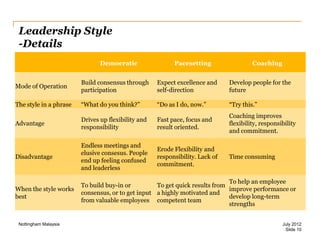
Leadership Style
-Details
Democratic

Pacesetting

Coaching

Mode of Operation

Build consensus through
participation

Expect excellence and
self-direction

Develop people for the
future

The style in a phrase

“What do you think?”

“Do as I do, now.”

“Try this.”

Advantage

Drives up flexibility and
responsibility

Fast pace, focus and
result oriented.

Coaching improves
flexibility, responsibility
and commitment.

Disadvantage

Endless meetings and
elusive consesus. People
end up feeling confused
and leaderless

Erode Flexibility and
responsibility. Lack of
commitment.

Time consuming

When the style works
best

To help an employee
To build buy-in or
To get quick results from
improve performance or
consensus, or to get input a highly motivated and
develop long-term
from valuable employees competent team
strengths

Nottingham Malaysia

July 2012
Slide 10
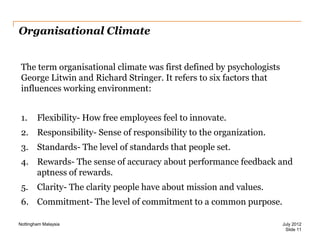
Organisational Climate
The term organisational climate was first defined by psychologists
George Litwin and Richard Stringer. It refers to six factors that
influences working environment:
1.

Flexibility- How free employees feel to innovate.

2. Responsibility- Sense of responsibility to the organization.
3. Standards- The level of standards that people set.
4. Rewards- The sense of accuracy about performance feedback and
aptness of rewards.
5.

Clarity- The clarity people have about mission and values.

6. Commitment- The level of commitment to a common purpose.
Nottingham Malaysia

July 2012
Slide 11
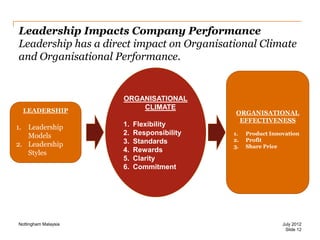
Leadership Impacts Company Performance
Leadership has a direct impact on Organisational Climate
and Organisational Performance.

LEADERSHIP

1. Leadership
Models
2. Leadership
Styles

Nottingham Malaysia

ORGANISATIONAL
CLIMATE
1.
2.
3.
4.
5.
6.

Flexibility
Responsibility
Standards
Rewards
Clarity
Commitment

ORGANISATIONAL
EFFECTIVENESS
1.
2.
3.

Product Innovation
Profit
Share Price

July 2012
Slide 12
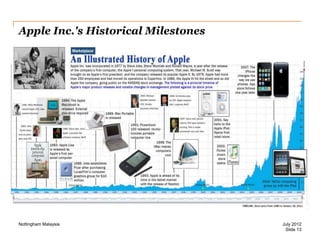
Apple Inc.'s Historical Milestones

Nottingham Malaysia

July 2012
Slide 13
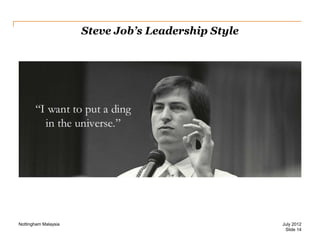
Steve Job’s Leadership Style

Nottingham Malaysia

July 2012
Slide 14
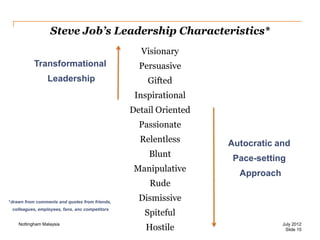
Steve Job’s Leadership Characteristics*
Visionary
Transformational

Persuasive

Leadership

Gifted
Inspirational
Detail Oriented
Passionate
Relentless

Autocratic and

Blunt

Pace-setting

Manipulative

Approach

Rude
*drawn from comments and quotes from friends,
colleagues, employees, fans, anc competitors
Nottingham Malaysia

Dismissive

Spiteful
Hostile

July 2012
Slide 15
Steve Job is a Transformational Leader
• When Jobs returned to Apple in 1997, his assessment was that the company
was ninety days from going bankrupt
• In May 1998, Jobs announced the new direction for Apple to focus on just
four core products: laptops for consumers & professionals & desktops for
consumers & professionals. The direction was simple & clear.
• The high value placed on ideas is one of the things that Steve burned into the
Apple culture & it will likely to continue to guide the company into the future
• Steve Jobs
 became a steward of creative thinking & became its greatest advocate
while expecting such behaviour from each employee
 built an organization that recognized the needs for creativity,

Nottingham Malaysia

July 2012
Slide 16
Impact on Organizational Behaviour
Individual
1.

Emotions: Most employees at Apple are fans of Steve Jobs, and
tend to “hero-worship” him from afar. Senior and middle
management personnel who have regular contact with Steve,
approach him with a mixture of reverence (because of their
immense respect for him and his vision) and fear (because of his
“take-no-prisoners” style of management)

2. Attitudes: Apple sets the tone of the work culture within the
organization from day 1, and focuses on developing the higher
levels of their employees‟ hierarchy of needs, which are Esteem
and Self Actualization.
3. Values: Employees with a high nAch* disposition appear to thrive at
Apple, due to the focus on Motivators instead of Hygiene Factors
* nAch – Need for achievement
Nottingham Malaysia

July 2012
Slide 17
Impact on Organizational Behaviour
Feedback from Apple employees:
“Steve Jobs is revered at the company.” – Apple Employee
“Watching Apple grow in the Steve 2.0 era has been nothing short of astonishing.” – Apple
Network Engineer

“ I am proud to say that I work for Apple. The products speak for themselves and it is great to be
able to use them.” - Apple Project Manager (Austin, TX)
“Great products and phenomenal co-workers! An awesome work environment that
cultivated creativity and competition. I woke up every day and could not wait to get to
work!” – Apple Account Executive (Atlanta, GA)

“Apple is an amazing company with a very successful management. Innovation is at the heart
of all decisions. Successful organization. And great products.” – Apple Employee (location n/a)
“Apple is an amazing company, with cutting edge products, unparalleled customer service focus and
a place that cultivates a family atmosphere. Very enjoyable working environment.” –
Apple Employee (location n/a)
Apple is an amazing place to work. There are so many opportunities to grow and learn. “- Apple
Employee (Cupertino, CA)
Nottingham Malaysia

July 2012
Slide 18
Impact on Organizational Behaviour
Group: Communication
• The approach to management & talent development is top-down
 with an all-knowing CEO aided by a powerful executive team – ET
o the purpose of the ET is to coordinate things & set the tone for
the company through effective communication platforms
• The company maybe top-down, but the executive –team format
engenders a system of managing up
 teams throughout the organization are in a constant state of
communication by preparing their boss or their boss‟s boss to
present at an executive team meeting
Nottingham Malaysia

July 2012
Slide 19
Impact on Organizational Behaviour
Group: Conflict
Given Apple‟s product silo structure in a relatively flat organization,
internal conflicts are usually resolved within the small teams in each
silo independently. The thoroughness of Jobs‟ vision and mandates, as
well as his blunt manner, usually precludes conflicts from significantly
affecting day-to-day operations, leaving the onus of satisfactory conflict
resolution to the various stakeholders of the organization.

Nottingham Malaysia

July 2012
Slide 20
Impact on Organizational Behaviour
Organisation Structure
The Organization

Organizational culture: Loyalty, Evangelistic,
Hero-Worship
Decision Making: Top down approach, tempered
by upwards management
Change: The organization is resilient and adaptable
to changing circumstances due to a strong
structure and culture.
Nottingham Malaysia

July 2012
Slide 21
Job’s Impact on Organizational Behaviour
Organisational Climate
1.

Flexibility- Apple employees are encouraged, even expected to
continually innovate, but always within the boundaries of Steve‟s vision

2.

Responsibility- Most Apple employees proudly feel a deep, abiding sense
of responsibility towards the company and behave accordingly

3.

Standards- Steve sets very high standards for performance and
innovation, and every Apple employee is expected to adhere and exceed
those standards

4.

Rewards- Apple‟s remuneration is on par with market trends, and they do
not seem to be focused on obtaining and retaining talent through hygiene
factors

5.

Clarity- Every Apple employee has a clear sense of what they need to do
on a day-to-day basis

6.

Commitment- Despite his brusque manner, most Apple employees
remain committed to realizing Steve‟s vision

Nottingham Malaysia

July 2012
Slide 22
Evidence of Organizational Effectiveness

Steve Left
For Good

Steve Left

Nottingham Malaysia

Steve Came Back

July 2012
Slide 23
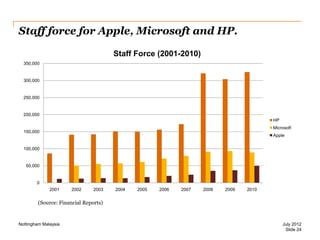
Staff force for Apple, Microsoft and HP.
Staff Force (2001-2010)
350,000

300,000

250,000

200,000
HP
Microsoft

150,000

Apple

100,000

50,000

0
2001

2002

2003

2004

2005

2006

2007

2008

2009

2010

(Source: Financial Reports)

Nottingham Malaysia

July 2012
Slide 24
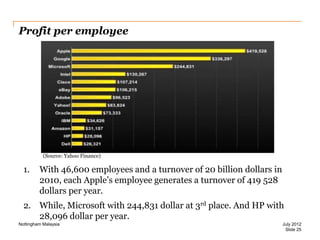
Profit per employee

(Source: Yahoo Finance)

1.

With 46,600 employees and a turnover of 20 billion dollars in
2010, each Apple‟s employee generates a turnover of 419 528
dollars per year.

2. While, Microsoft with 244,831 dollar at 3rd place. And HP with
28,096 dollar per year.
Nottingham Malaysia

July 2012
Slide 25
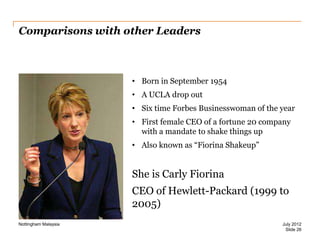
Comparisons with other Leaders

• Born in September 1954
• A UCLA drop out
• Six time Forbes Businesswoman of the year

• First female CEO of a fortune 20 company
with a mandate to shake things up
• Also known as “Fiorina Shakeup”

She is Carly Fiorina
CEO of Hewlett-Packard (1999 to
2005)
Nottingham Malaysia

July 2012
Slide 26
Comparisons with other Leaders
Carly‟s Leadership
Carly’s leadership traits
• Fostered a top-down approach to management (Transactional).
Conflicted with the old-style of HP: a completely decentralised
management approach

• Exhibited a truly coercive – pace-setting leadership style
• Dynamic and headstrong leader
• Highly motivational speaker
• “Consummate” Saleswoman – Customer satisfaction

Nottingham Malaysia

July 2012
Slide 27
Comparisons with other Leaders
Carly‟s Leadership
Carly’s downfall as a leader
• Was not able to delegate tasks

• Move too fast and too drastic with changes for the organization to
cope
• Neglected to foster employee needs resulted in high turnover
• Was not able to form and communicate a cohesive, convincing and
powerful vision of HP‟s future

Nottingham Malaysia

July 2012
Slide 28
Comparisons with other Leaders
Carly‟s Leadership - A Transactional Leader
Conclusion
• Carly failed to execute HP‟s strategy and deliver improvements in
HP‟s profits and stock price
• Was asked by HP‟s BOD to resign due to lack of leadership skills
needed to take advantage of emerging market opportunities
• Indeed, Carly was a very good businesswoman but she could not
prove herself as a leader.
• She saw her downfall when she could not relate to her
employees, and without followers, there cannot be a leader
• Perhaps, Carly could be a successful leader by adding more people
centred leadership skills into her highly dominant job centred
leadership style.
Nottingham Malaysia

July 2012
Slide 29
Comparisons with other Leaders
Carly‟s Leadership
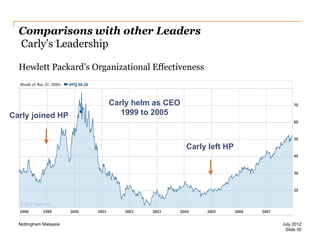
Hewlett Packard‟s Organizational Effectiveness

Carly joined HP

Carly helm as CEO
1999 to 2005

Carly left HP

Nottingham Malaysia

July 2012
Slide 30
Comparisons with other Leaders
Bill Gates‟ Leadership
1. Co-founded Microsoft with Paul Allen
2. Philosophy – his vision turned to his philosophy which ultimately
the focus is about running software in every computer
3. Fast in taking in ideas and turned them into a successful product –
„95 Microsoft response to internet with the launch of MSN
4. Transformational Leader – visionary, and inspirational
5. Authoritative, and Democratic – free hand to research and create
teams for more product development & launches BUT careful in
control and judgement
6. Microsoft 2005 from 7 decentralised business unit converted to 3
centralised units.

Nottingham Malaysia

July 2012
Slide 31
Comparisons with other Leaders
Bill Gates‟ Leadership

Characteristics
1. Intelligent
2. Visionary
3. Passionate
4. Innovative
5. Risk Bearer
6. Continuous Learner

Nottingham Malaysia

July 2012
Slide 32
Comparisons with other Leaders
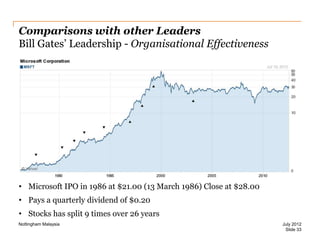
Bill Gates‟ Leadership - Organisational Effectiveness

• Microsoft IPO in 1986 at $21.00 (13 March 1986) Close at $28.00
• Pays a quarterly dividend of $0.20

• Stocks has split 9 times over 26 years
Nottingham Malaysia

July 2012
Slide 33
Comparisons with other Leaders

Nottingham Malaysia

July 2012
Slide 34
Conclusion
1.

Industries that experience a high rate of change and uncertainty (in terms
of products, paradigm shifts, business climate) like computing, internet
services and telecommunications benefit more from transformational
leadership than any other leadership model. The success of an organization
within these industries depend heavily on the vision of its leader to
successfully navigate the inherent uncertainties.

2.

Transformational Leaders who are proven visionaries are able to easily
gather around them people who are willing to buy into their visions and
passionately commit to making them a reality.

3.

Both Jobs and Gates are considered Transformational Leaders because of
their ability to inspire high levels of innovation, creativity and productivity
from their employees through their visions

4.

A leader can afford to be autocratic, even dictatorial and still lead an
organization successfully as long as the leader continues to be successful in
his role as a visionary.

Nottingham Malaysia

July 2012
Slide 35
Thank You

All rights reserved @ 2012

Leadership Style and Organisational Effectiveness

  • 1.
    Leadership Style and Organisational Effectiveness 20July 2012 SHANMUGA PILLAIYAN (010194) TAN CHEE HOAW (010120) KEVIN CHOO (010226) HELMMY SHAHNY MOHD MUSTAFA (010268) AMRI MOHD SOFIAN (010563) GURMEET SINGH (002967)
  • 2.
    Agenda 1. Introduction – Whatis Leadership? 2. Leadership Models & Styles 3. Case Study – Apple Inc I. Historical Milestones II. Steve Job‟s Management Style III. Impact on Organisation Behaviour IV. Evidence of Organizational Effectiveness 4. Comparisons with Other Leaders 5. Conclusion Nottingham Malaysia July 2012 Slide 2
  • 3.
    What is Leadership? “The ability to influence a group toward the achievement of goals” (Robbins 2003) “Management is doing things right, leadership is doing the right things” (Warren Bennis and Peter Drucker) Robbins, Stephen. Organizational Behavior. 10th ed. Upper Saddle River, NJ: Prentice, Hall, 2003. Nottingham Malaysia July 2012 Slide 3
  • 4.
    Leadership Theory The Evolutionof Leadership Theory Transactional Theory Behavioural Styles Theory 1940 1950s Trait Theory Nottingham Malaysia 1960s Transformatio nal Theory 1970s 1980s 1990s Contingency Theory July 2012 Slide 4
  • 5.
    Leadership Theory Transformational Leader 1. Leadersstimulate and inspire(transform) followers to achieve extraordinary outcomes 2. Characteristics: I. Leadership is proactive II. Works to change the organizational culture by implementing new ideas III. Employees achieve objectives through higher ideals and moral values IV. Motivates followers by encouraging them to put group interests first V. People will follow a person who inspires them. Intellectual stimulation: Promote creative and innovative ideas to solve problems. Nottingham Malaysia July 2012 Slide 5
  • 6.
    Leadership Theory Transactional Leader 1. Leaderspromote compliance of his followers through both reward or punishment. 2. Characteristics: I. Leadership is reactive II. Works within the organizational culture III. Employees achieve objectives through rewards and punishments set by leader Subordinates are not selfmotivating IV. Motivates followers by appealing to their own self interest V. Management-by-exception: maintain the status quo; stress correct actions to improve performance Nottingham Malaysia July 2012 Slide 6
  • 7.
    Leadership Theory Contingency Theory 1. Accordingto the contingency approach of leadership, a single leadership style is not applicable to all situations. 2. The 3 contingency models of leadership styles. I. Fiedler‟s Contingency Model II. Hersey and Blanchard‟s situational theory III. Path Goal Theory a single leadership style is not applicable to all situations IV. Tannenbaum and Schmidt‟s leadership continuum Nottingham Malaysia July 2012 Slide 7
  • 8.
    Leadership Style Research doneby the consulting firm Hay-McBer Associates (Harvard Business Review, 2000) , found six different leadership styles as the following: 1. The coercive style 2. The authoritative style 3. The affiliative style 4. The democratic style 5. The pacesetting style 6. The coaching style Nottingham Malaysia July 2012 Slide 8
  • 9.
    Leadership Style -Details Coercive Authoritative Affiliative Mode ofOperation Demand immediate compliance Mobilize people toward a vision Create emotional bonds and harmony The style in a phrase “Do what I tell you.” “Come with me.” Maximizes people's commitment toward organisation goal, enhance clarity and flexibility “People come first.” Advantage Efficient and effective Disadvantage Erode flexibility, motivation and responsibilty. Failed when a leader is working with a team of experts who are more experienced than him Drives up trust and flexibility, build up sense of recognition and belonging. Allow poor performance to go uncorrected, and leaves people rudderless In a crisis, to kick start When changes require a To heal rifts in a team/ When the style works a turnaround, or with new vision, or when a clear motivate people during best problem employees direction is needed stressful circumstances Nottingham Malaysia July 2012 Slide 9
  • 10.
    Leadership Style -Details Democratic Pacesetting Coaching Mode ofOperation Build consensus through participation Expect excellence and self-direction Develop people for the future The style in a phrase “What do you think?” “Do as I do, now.” “Try this.” Advantage Drives up flexibility and responsibility Fast pace, focus and result oriented. Coaching improves flexibility, responsibility and commitment. Disadvantage Endless meetings and elusive consesus. People end up feeling confused and leaderless Erode Flexibility and responsibility. Lack of commitment. Time consuming When the style works best To help an employee To build buy-in or To get quick results from improve performance or consensus, or to get input a highly motivated and develop long-term from valuable employees competent team strengths Nottingham Malaysia July 2012 Slide 10
  • 11.
    Organisational Climate The termorganisational climate was first defined by psychologists George Litwin and Richard Stringer. It refers to six factors that influences working environment: 1. Flexibility- How free employees feel to innovate. 2. Responsibility- Sense of responsibility to the organization. 3. Standards- The level of standards that people set. 4. Rewards- The sense of accuracy about performance feedback and aptness of rewards. 5. Clarity- The clarity people have about mission and values. 6. Commitment- The level of commitment to a common purpose. Nottingham Malaysia July 2012 Slide 11
  • 12.
    Leadership Impacts CompanyPerformance Leadership has a direct impact on Organisational Climate and Organisational Performance. LEADERSHIP 1. Leadership Models 2. Leadership Styles Nottingham Malaysia ORGANISATIONAL CLIMATE 1. 2. 3. 4. 5. 6. Flexibility Responsibility Standards Rewards Clarity Commitment ORGANISATIONAL EFFECTIVENESS 1. 2. 3. Product Innovation Profit Share Price July 2012 Slide 12
  • 13.
    Apple Inc.'s HistoricalMilestones Nottingham Malaysia July 2012 Slide 13
  • 14.
    Steve Job’s LeadershipStyle Nottingham Malaysia July 2012 Slide 14
  • 15.
    Steve Job’s LeadershipCharacteristics* Visionary Transformational Persuasive Leadership Gifted Inspirational Detail Oriented Passionate Relentless Autocratic and Blunt Pace-setting Manipulative Approach Rude *drawn from comments and quotes from friends, colleagues, employees, fans, anc competitors Nottingham Malaysia Dismissive Spiteful Hostile July 2012 Slide 15
  • 16.
    Steve Job isa Transformational Leader • When Jobs returned to Apple in 1997, his assessment was that the company was ninety days from going bankrupt • In May 1998, Jobs announced the new direction for Apple to focus on just four core products: laptops for consumers & professionals & desktops for consumers & professionals. The direction was simple & clear. • The high value placed on ideas is one of the things that Steve burned into the Apple culture & it will likely to continue to guide the company into the future • Steve Jobs  became a steward of creative thinking & became its greatest advocate while expecting such behaviour from each employee  built an organization that recognized the needs for creativity, Nottingham Malaysia July 2012 Slide 16
  • 17.
    Impact on OrganizationalBehaviour Individual 1. Emotions: Most employees at Apple are fans of Steve Jobs, and tend to “hero-worship” him from afar. Senior and middle management personnel who have regular contact with Steve, approach him with a mixture of reverence (because of their immense respect for him and his vision) and fear (because of his “take-no-prisoners” style of management) 2. Attitudes: Apple sets the tone of the work culture within the organization from day 1, and focuses on developing the higher levels of their employees‟ hierarchy of needs, which are Esteem and Self Actualization. 3. Values: Employees with a high nAch* disposition appear to thrive at Apple, due to the focus on Motivators instead of Hygiene Factors * nAch – Need for achievement Nottingham Malaysia July 2012 Slide 17
  • 18.
    Impact on OrganizationalBehaviour Feedback from Apple employees: “Steve Jobs is revered at the company.” – Apple Employee “Watching Apple grow in the Steve 2.0 era has been nothing short of astonishing.” – Apple Network Engineer “ I am proud to say that I work for Apple. The products speak for themselves and it is great to be able to use them.” - Apple Project Manager (Austin, TX) “Great products and phenomenal co-workers! An awesome work environment that cultivated creativity and competition. I woke up every day and could not wait to get to work!” – Apple Account Executive (Atlanta, GA) “Apple is an amazing company with a very successful management. Innovation is at the heart of all decisions. Successful organization. And great products.” – Apple Employee (location n/a) “Apple is an amazing company, with cutting edge products, unparalleled customer service focus and a place that cultivates a family atmosphere. Very enjoyable working environment.” – Apple Employee (location n/a) Apple is an amazing place to work. There are so many opportunities to grow and learn. “- Apple Employee (Cupertino, CA) Nottingham Malaysia July 2012 Slide 18
  • 19.
    Impact on OrganizationalBehaviour Group: Communication • The approach to management & talent development is top-down  with an all-knowing CEO aided by a powerful executive team – ET o the purpose of the ET is to coordinate things & set the tone for the company through effective communication platforms • The company maybe top-down, but the executive –team format engenders a system of managing up  teams throughout the organization are in a constant state of communication by preparing their boss or their boss‟s boss to present at an executive team meeting Nottingham Malaysia July 2012 Slide 19
  • 20.
    Impact on OrganizationalBehaviour Group: Conflict Given Apple‟s product silo structure in a relatively flat organization, internal conflicts are usually resolved within the small teams in each silo independently. The thoroughness of Jobs‟ vision and mandates, as well as his blunt manner, usually precludes conflicts from significantly affecting day-to-day operations, leaving the onus of satisfactory conflict resolution to the various stakeholders of the organization. Nottingham Malaysia July 2012 Slide 20
  • 21.
    Impact on OrganizationalBehaviour Organisation Structure The Organization Organizational culture: Loyalty, Evangelistic, Hero-Worship Decision Making: Top down approach, tempered by upwards management Change: The organization is resilient and adaptable to changing circumstances due to a strong structure and culture. Nottingham Malaysia July 2012 Slide 21
  • 22.
    Job’s Impact onOrganizational Behaviour Organisational Climate 1. Flexibility- Apple employees are encouraged, even expected to continually innovate, but always within the boundaries of Steve‟s vision 2. Responsibility- Most Apple employees proudly feel a deep, abiding sense of responsibility towards the company and behave accordingly 3. Standards- Steve sets very high standards for performance and innovation, and every Apple employee is expected to adhere and exceed those standards 4. Rewards- Apple‟s remuneration is on par with market trends, and they do not seem to be focused on obtaining and retaining talent through hygiene factors 5. Clarity- Every Apple employee has a clear sense of what they need to do on a day-to-day basis 6. Commitment- Despite his brusque manner, most Apple employees remain committed to realizing Steve‟s vision Nottingham Malaysia July 2012 Slide 22
  • 23.
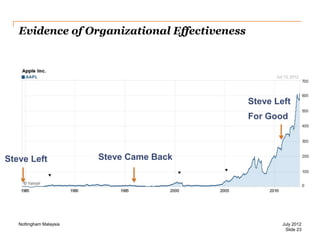
    Evidence of OrganizationalEffectiveness Steve Left For Good Steve Left Nottingham Malaysia Steve Came Back July 2012 Slide 23
  • 24.
    Staff force forApple, Microsoft and HP. Staff Force (2001-2010) 350,000 300,000 250,000 200,000 HP Microsoft 150,000 Apple 100,000 50,000 0 2001 2002 2003 2004 2005 2006 2007 2008 2009 2010 (Source: Financial Reports) Nottingham Malaysia July 2012 Slide 24
  • 25.
    Profit per employee (Source:Yahoo Finance) 1. With 46,600 employees and a turnover of 20 billion dollars in 2010, each Apple‟s employee generates a turnover of 419 528 dollars per year. 2. While, Microsoft with 244,831 dollar at 3rd place. And HP with 28,096 dollar per year. Nottingham Malaysia July 2012 Slide 25
  • 26.
    Comparisons with otherLeaders • Born in September 1954 • A UCLA drop out • Six time Forbes Businesswoman of the year • First female CEO of a fortune 20 company with a mandate to shake things up • Also known as “Fiorina Shakeup” She is Carly Fiorina CEO of Hewlett-Packard (1999 to 2005) Nottingham Malaysia July 2012 Slide 26
  • 27.
    Comparisons with otherLeaders Carly‟s Leadership Carly’s leadership traits • Fostered a top-down approach to management (Transactional). Conflicted with the old-style of HP: a completely decentralised management approach • Exhibited a truly coercive – pace-setting leadership style • Dynamic and headstrong leader • Highly motivational speaker • “Consummate” Saleswoman – Customer satisfaction Nottingham Malaysia July 2012 Slide 27
  • 28.
    Comparisons with otherLeaders Carly‟s Leadership Carly’s downfall as a leader • Was not able to delegate tasks • Move too fast and too drastic with changes for the organization to cope • Neglected to foster employee needs resulted in high turnover • Was not able to form and communicate a cohesive, convincing and powerful vision of HP‟s future Nottingham Malaysia July 2012 Slide 28
  • 29.
    Comparisons with otherLeaders Carly‟s Leadership - A Transactional Leader Conclusion • Carly failed to execute HP‟s strategy and deliver improvements in HP‟s profits and stock price • Was asked by HP‟s BOD to resign due to lack of leadership skills needed to take advantage of emerging market opportunities • Indeed, Carly was a very good businesswoman but she could not prove herself as a leader. • She saw her downfall when she could not relate to her employees, and without followers, there cannot be a leader • Perhaps, Carly could be a successful leader by adding more people centred leadership skills into her highly dominant job centred leadership style. Nottingham Malaysia July 2012 Slide 29
  • 30.
    Comparisons with otherLeaders Carly‟s Leadership Hewlett Packard‟s Organizational Effectiveness Carly joined HP Carly helm as CEO 1999 to 2005 Carly left HP Nottingham Malaysia July 2012 Slide 30
  • 31.
    Comparisons with otherLeaders Bill Gates‟ Leadership 1. Co-founded Microsoft with Paul Allen 2. Philosophy – his vision turned to his philosophy which ultimately the focus is about running software in every computer 3. Fast in taking in ideas and turned them into a successful product – „95 Microsoft response to internet with the launch of MSN 4. Transformational Leader – visionary, and inspirational 5. Authoritative, and Democratic – free hand to research and create teams for more product development & launches BUT careful in control and judgement 6. Microsoft 2005 from 7 decentralised business unit converted to 3 centralised units. Nottingham Malaysia July 2012 Slide 31
  • 32.
    Comparisons with otherLeaders Bill Gates‟ Leadership Characteristics 1. Intelligent 2. Visionary 3. Passionate 4. Innovative 5. Risk Bearer 6. Continuous Learner Nottingham Malaysia July 2012 Slide 32
  • 33.
    Comparisons with otherLeaders Bill Gates‟ Leadership - Organisational Effectiveness • Microsoft IPO in 1986 at $21.00 (13 March 1986) Close at $28.00 • Pays a quarterly dividend of $0.20 • Stocks has split 9 times over 26 years Nottingham Malaysia July 2012 Slide 33
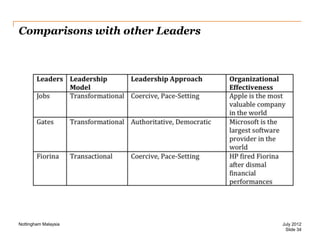
  • 34.
    Comparisons with otherLeaders Nottingham Malaysia July 2012 Slide 34
  • 35.
    Conclusion 1. Industries that experiencea high rate of change and uncertainty (in terms of products, paradigm shifts, business climate) like computing, internet services and telecommunications benefit more from transformational leadership than any other leadership model. The success of an organization within these industries depend heavily on the vision of its leader to successfully navigate the inherent uncertainties. 2. Transformational Leaders who are proven visionaries are able to easily gather around them people who are willing to buy into their visions and passionately commit to making them a reality. 3. Both Jobs and Gates are considered Transformational Leaders because of their ability to inspire high levels of innovation, creativity and productivity from their employees through their visions 4. A leader can afford to be autocratic, even dictatorial and still lead an organization successfully as long as the leader continues to be successful in his role as a visionary. Nottingham Malaysia July 2012 Slide 35
  • 36.
    Thank You All rightsreserved @ 2012