INTERPERSONAL
SKILLS
Chapter 5, Adler
5th Edition
Layout
•   Building Positive Relationships
    –   Communication climate
    –   Giving praise

•   Dealing with Criticism
    –   Offering constructive criticism
    –   Responding non-defensively to criticism

•   Managing Conflict
    –   Approaches to conflict
    –   Handling conflict

•   Negotiating Skills
    –   Negotiation styles and outcomes
    –   Which negotiation style to use
Building Positive Relationships
Communication Climate
•   Quality of personal relationships in an org.
    –   Respected, trust one another, appreciated

•   Individual relationships have microclimate
    –   Feelings about tasks and each other

•   People believe they are valued
    –   Positive climate
    –   Messages that express feelings of value: confirming
        –   vs. disconfirming
   Ways to promote “confirming” climate
       Use descriptive “I” language
       Focus on solving problem, not controlling others
       Be honest: don’t manipulate
       Show concern for others
       Demonstrate an attitude of equality
       Listen with an open mind
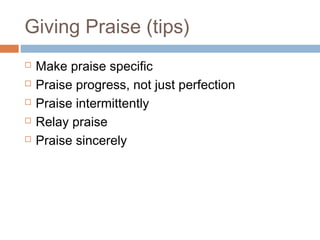
Giving Praise (tips)
   Make praise specific
   Praise progress, not just perfection
   Praise intermittently
   Relay praise
   Praise sincerely
Dealing with Criticism
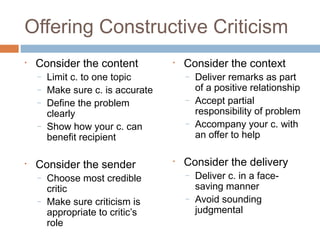
Offering Constructive Criticism
•   Consider the content           •   Consider the context
    –   Limit c. to one topic          –   Deliver remarks as part
    –   Make sure c. is accurate           of a positive relationship
    –   Define the problem             –   Accept partial
        clearly                            responsibility of problem
    –   Show how your c. can           –   Accompany your c. with
        benefit recipient                  an offer to help

•   Consider the sender            •   Consider the delivery
    –   Choose most credible           –   Deliver c. in a face-
        critic                             saving manner
    –   Make sure criticism is         –   Avoid sounding
        appropriate to critic’s            judgmental
        role
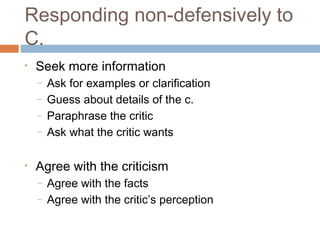
Responding non-defensively to
C.
•   Seek more information
    –   Ask for examples or clarification
    –   Guess about details of the c.
    –   Paraphrase the critic
    –   Ask what the critic wants

•   Agree with the criticism
    –   Agree with the facts
    –   Agree with the critic’s perception
Managing Conflict
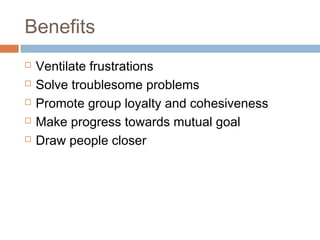
Benefits
   Ventilate frustrations
   Solve troublesome problems
   Promote group loyalty and cohesiveness
   Make progress towards mutual goal
   Draw people closer
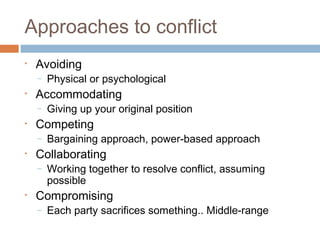
Approaches to conflict
•   Avoiding
    –   Physical or psychological
•   Accommodating
    –   Giving up your original position
•   Competing
    –   Bargaining approach, power-based approach
•   Collaborating
    –   Working together to resolve conflict, assuming
        possible
•   Compromising
    –   Each party sacrifices something.. Middle-range
Handling Conflict Assertively
•   Prepare:
    –   Identify the goal you are seeking
    –   Choose the best time to speak
    –   Rehearse the statement

•   Deliver:
    –   Pinpoint the specific behavior
    –   Explain your reaction – interpretation, feelings
    –   Make a request
    –   Describe the consequences – tangible, intangible
Negotiating Skills
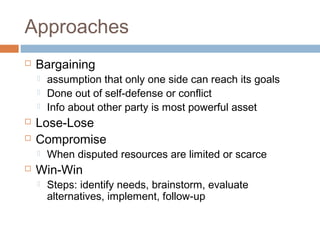
Approaches
   Bargaining
       assumption that only one side can reach its goals
       Done out of self-defense or conflict
       Info about other party is most powerful asset
   Lose-Lose
   Compromise
       When disputed resources are limited or scarce
   Win-Win
       Steps: identify needs, brainstorm, evaluate
        alternatives, implement, follow-up
Which Style to Use
   Win-Win or Bargaining?
       Cooperation vs. competition
       Power vs. trust
       Distorted vs. open communication
       Self-centered vs. mutual concern

12. interpersonal skills

  • 1.
  • 2.
    Layout • Building Positive Relationships – Communication climate – Giving praise • Dealing with Criticism – Offering constructive criticism – Responding non-defensively to criticism • Managing Conflict – Approaches to conflict – Handling conflict • Negotiating Skills – Negotiation styles and outcomes – Which negotiation style to use
  • 3.
  • 4.
    Communication Climate • Quality of personal relationships in an org. – Respected, trust one another, appreciated • Individual relationships have microclimate – Feelings about tasks and each other • People believe they are valued – Positive climate – Messages that express feelings of value: confirming – vs. disconfirming
  • 5.
    Ways to promote “confirming” climate  Use descriptive “I” language  Focus on solving problem, not controlling others  Be honest: don’t manipulate  Show concern for others  Demonstrate an attitude of equality  Listen with an open mind
  • 6.
    Giving Praise (tips)  Make praise specific  Praise progress, not just perfection  Praise intermittently  Relay praise  Praise sincerely
  • 7.
  • 8.
    Offering Constructive Criticism • Consider the content • Consider the context – Limit c. to one topic – Deliver remarks as part – Make sure c. is accurate of a positive relationship – Define the problem – Accept partial clearly responsibility of problem – Show how your c. can – Accompany your c. with benefit recipient an offer to help • Consider the sender • Consider the delivery – Choose most credible – Deliver c. in a face- critic saving manner – Make sure criticism is – Avoid sounding appropriate to critic’s judgmental role
  • 9.
    Responding non-defensively to C. • Seek more information – Ask for examples or clarification – Guess about details of the c. – Paraphrase the critic – Ask what the critic wants • Agree with the criticism – Agree with the facts – Agree with the critic’s perception
  • 10.
  • 11.
    Benefits  Ventilate frustrations  Solve troublesome problems  Promote group loyalty and cohesiveness  Make progress towards mutual goal  Draw people closer
  • 12.
    Approaches to conflict • Avoiding – Physical or psychological • Accommodating – Giving up your original position • Competing – Bargaining approach, power-based approach • Collaborating – Working together to resolve conflict, assuming possible • Compromising – Each party sacrifices something.. Middle-range
  • 13.
    Handling Conflict Assertively • Prepare: – Identify the goal you are seeking – Choose the best time to speak – Rehearse the statement • Deliver: – Pinpoint the specific behavior – Explain your reaction – interpretation, feelings – Make a request – Describe the consequences – tangible, intangible
  • 14.
  • 15.
    Approaches  Bargaining  assumption that only one side can reach its goals  Done out of self-defense or conflict  Info about other party is most powerful asset  Lose-Lose  Compromise  When disputed resources are limited or scarce  Win-Win  Steps: identify needs, brainstorm, evaluate alternatives, implement, follow-up
  • 16.
    Which Style toUse  Win-Win or Bargaining?  Cooperation vs. competition  Power vs. trust  Distorted vs. open communication  Self-centered vs. mutual concern