At the end of class group will be able to know about
 Definition of Leadership
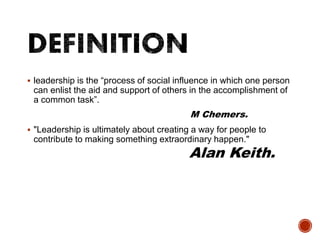
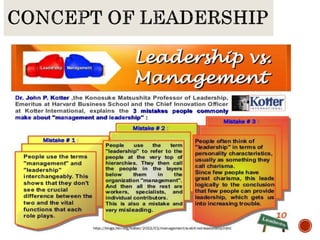
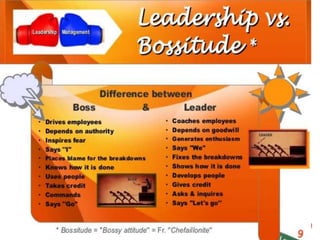
 Concept of Leadership and Management
 Factors affecting Leadership
 Theories of leadership
Monika Thakur
M.Sc Psychiatric Nursing 2nd yr.
King George Medical University
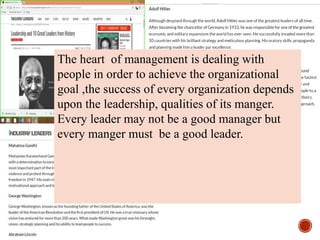
The heart of management is dealing with
people in order to achieve the organizational
goal ,the success of every organization depends
upon the leadership, qualities of its manger.
Every leader may not be a good manager but
every manger must be a good leader.
 leadership is the “process of social influence in which one person
can enlist the aid and support of others in the accomplishment of
a common task”.
M Chemers.
 "Leadership is ultimately about creating a way for people to
contribute to making something extraordinary happen."
Alan Keith.
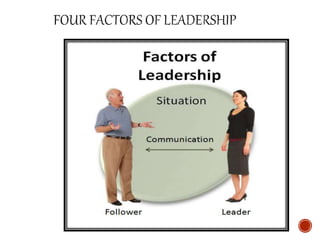
Leader - You must have an honest understanding
of who you are, what you know and what you can
do. To be successful you have to convince your
followers not your superiors, that you are worthy of
being followed.
Follower -You must know your people. The
fundamental starting point is having a good
understanding of human nature, such as needs,
emotions and motivation.
Communication-
The nonverbal communication is leading. Bad
communication harm the relation between leader and
employee.
Situation- We must use our judgment to decide the
best course of action and the leadership style needed
for each situation. What we do in one situation will
not always work in another.
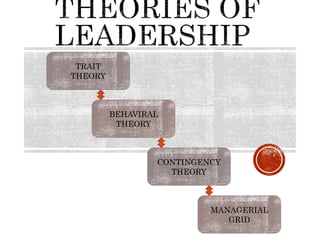
TRAIT
THEORY
CONTINGENCY
THEORY
BEHAVIRAL
THEORY
MANAGERIAL
GRID
.
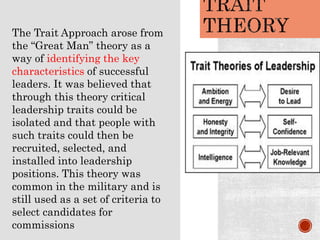
The Trait Approach arose from
the “Great Man” theory as a
way of identifying the key
characteristics of successful
leaders. It was believed that
through this theory critical
leadership traits could be
isolated and that people with
such traits could then be
recruited, selected, and
installed into leadership
positions. This theory was
common in the military and is
still used as a set of criteria to
select candidates for
commissions
 It is naturally pleasing theory.
 It serves as a yardstick against which the leadership traits
of an individual can be assessed.
 It gives a detailed knowledge and understanding of the
leader element in the leadership process.
 There is bound to be some subjective judgment in
determining who is regarded as a ‘good’ or
‘successful’ leader.
 There is also a disagreement over which traits are
the most important for an effective leader
 These theories of leadership are based upon
the belief that great leaders are made, not
born.
Rooted in behaviorism, this leadership theory
focuses on the actions of leaders not on
mental qualities or internal states.
According to this theory, people can learn to
become leaders through teaching and
observation.
The behavior approach says that anyone who
adopts the appropriate behavior can be a
good leader.
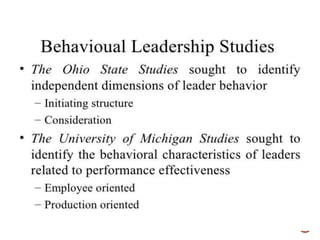
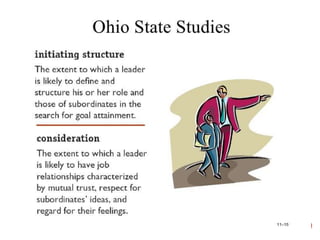
 Ohio state leadership university
studies.
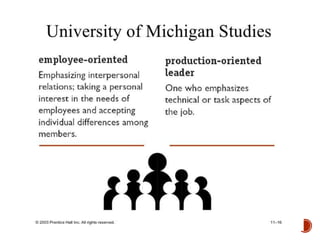
 University of Michigan studies
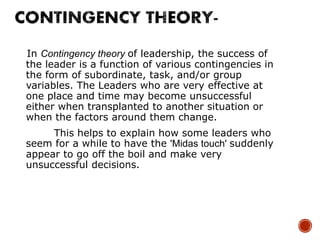
In Contingency theory of leadership, the success of
the leader is a function of various contingencies in
the form of subordinate, task, and/or group
variables. The Leaders who are very effective at
one place and time may become unsuccessful
either when transplanted to another situation or
when the factors around them change.
This helps to explain how some leaders who
seem for a while to have the 'Midas touch' suddenly
appear to go off the boil and make very
unsuccessful decisions.
FIEDLER’S CONTIINGENCY MODEL
HARSEY & BLANCHARD’S SITUATIONAL THEORY
PATH GOAL THEORY
VROOM-JAGO CONTINGENCY MODEL
Fiedler's model assumes that group performance
depends on:
 Leadership style, described in terms of task
motivation and relationship motivation.
Situational favourableness, determined by three
factors:
a) Leader-member relations - Degree to which a leader
is accepted and supported by the group members.
b) Task structure - Extent to which the task is
structured and defined, with clear goals and
procedures.
c) Position power - The ability of a leader to control
subordinates through reward and punishment.
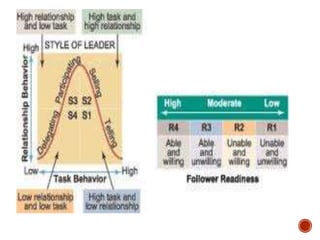
The Hersey-Blanchard Situational Leadership
Theory was created by Dr Paul Hersey and
Ken Blanchard.
The theory states that instead of using just
one style, successful leaders should change
their leadership styles based on the maturity
of the people they're leading and the details
of the task. Using this theory, leaders should
be able to place more or less emphasis on
the task.
According to Hersey and Blanchard, there are four main leadership
styles:
 Telling (S1) – Leaders tell their people exactly what to do, and how to
do it.
 Selling (S2) – Leaders still provide information and direction, but
there's more communication with followers. Leaders "sell" their
message to get the team on board.
 Participating (S3) – Leaders focus more on the relationship and less
on direction. The leader works with the team, and shares decision-
making responsibilities.
 Delegating (S4) – Leaders pass most of the responsibility onto the
follower or group. The leaders still monitor progress, but they're less
involved in decisions.
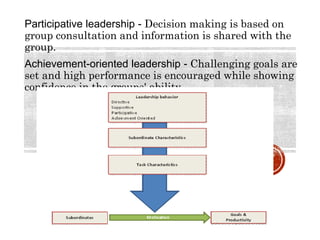
According to path-goal theory, the leader’s
responsibility is to increase subordinates’ motivation to
attain personal and organizational goal. A person may
do these by adopting a certain leadership style,
according to the situation:
Directive leadership – it tells subordinates exactly
what they are supposed to do, which includes planning,
making schedules, setting performance goals and
behaviour standards.
Supportive leadership - it shows concern for
subordinates’ well being and personal needs.
Participative leadership - Decision making is based on
group consultation and information is shared with the
group.
Achievement-oriented leadership - Challenging goals are
set and high performance is encouraged while showing
confidence in the groups' ability.
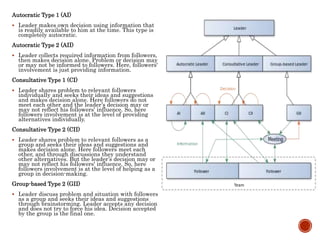
The Vroom–Yetton contingency model is a situational
leadership theory of industrial and organizational
psychology developed by Victor Vroom, in collaboration with
Phillip Yetton (1973) and later with Arthur Jago (1988). The
situational theory argues the best style of leadership is
contingent to the situation. This model suggests the selection a
leadership style for group decision-making
Autocratic Type 1 (AI)
 Leader makes own decision using information that
is readily available to him at the time. This type is
completely autocratic.
Autocratic Type 2 (AII)
 Leader collects required information from followers,
then makes decision alone. Problem or decision may
or may not be informed to followers. Here, followers'
involvement is just providing information.
Consultative Type 1 (CI)
 Leader shares problem to relevant followers
individually and seeks their ideas and suggestions
and makes decision alone. Here followers do not
meet each other and the leader’s decision may or
may not reflect his followers' influence. So, here
followers involvement is at the level of providing
alternatives individually.
Consultative Type 2 (CII)
 Leader shares problem to relevant followers as a
group and seeks their ideas and suggestions and
makes decision alone. Here followers meet each
other, and through discussions they understand
other alternatives. But the leader’s decision may or
may not reflect his followers' influence. So, here
followers involvement is at the level of helping as a
group in decision-making.
Group-based Type 2 (GII)
 Leader discuss problem and situation with followers
as a group and seeks their ideas and suggestions
through brainstorming. Leader accepts any decision
and does not try to force his idea. Decision accepted
by the group is the final one.
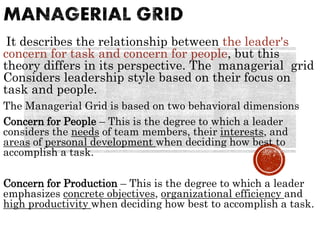
It describes the relationship between the leader's
concern for task and concern for people, but this
theory differs in its perspective. The managerial grid
Considers leadership style based on their focus on
task and people.
The Managerial Grid is based on two behavioral dimensions
Concern for People – This is the degree to which a leader
considers the needs of team members, their interests, and
areas of personal development when deciding how best to
accomplish a task.
Concern for Production – This is the degree to which a leader
emphasizes concrete objectives, organizational efficiency and
high productivity when deciding how best to accomplish a task.
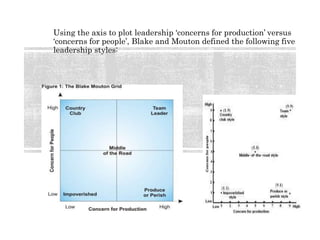
Using the axis to plot leadership ‘concerns for production’ versus
‘concerns for people’, Blake and Mouton defined the following five
leadership styles:
Country Club Leadership –(High People/Low
Production)
Produce or Perish Leadership – High
Production/Low People
Impoverished Leadership – Low Production/Low
People
Middle-of-the-Road Leadership – Medium
Production/Medium People
Team Leadership – High Production/High People
 Leadership , concept
 Theories of Leadership
Objectives for Todays session
Discuss different style of leaderships.
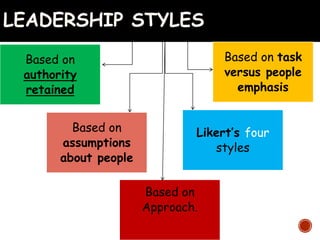
LEADERSHIP STYLES
Based on
authority
retained
Based on task
versus people
emphasis
Based on
assumptions
about people
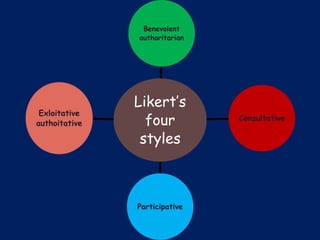
Likert’s four
styles
Based on
Approach.
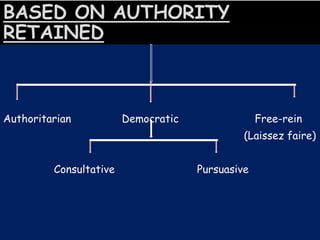
BASED ON AUTHORITY
RETAINED
Authoritarian Democratic Free-rein
(Laissez faire)
Consultative Pursuasive
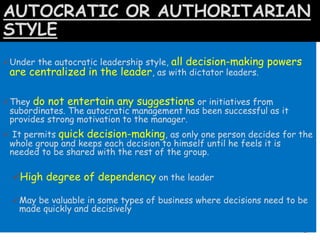
AUTOCRATIC OR AUTHORITARIAN
STYLE
Under the autocratic leadership style, all decision-making powers
are centralized in the leader, as with dictator leaders.
They do not entertain any suggestions or initiatives from
subordinates. The autocratic management has been successful as it
provides strong motivation to the manager.
 It permits quick decision-making, as only one person decides for the
whole group and keeps each decision to himself until he feels it is
needed to be shared with the rest of the group.
High degree of dependency on the leader
May be valuable in some types of business where decisions need to be
made quickly and decisively
PARTICIPATIVE OR DEMOCRATIC
STYLE
 The democratic leadership style favours decision-making by
the group .
 They can win the cooperation of their group and can motivate
them effectively and positively.
 The decisions of the democratic leader are not unilateral as
with the autocrat because they arise from consultation with
the group members and participation by them.
Consultative: process of consultation before decisions
are taken
Persuasive: Leader takes decision and seeks to
persuade others that the decision is correct.
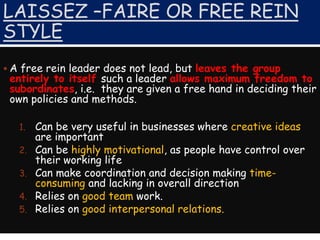
LAISSEZ –FAIRE OR FREE REIN
STYLE
 A free rein leader does not lead, but leaves the group
entirely to itself such a leader allows maximum freedom to
subordinates, i.e. they are given a free hand in deciding their
own policies and methods.
1. Can be very useful in businesses where creative ideas
are important
2. Can be highly motivational, as people have control over
their working life
3. Can make coordination and decision making time-
consuming and lacking in overall direction
4. Relies on good team work.
5. Relies on good interpersonal relations.
BASED ON TASK VERSUS PEOPLE
EMPHASIS
High relationship and low-
task
[ supporting style ]
High task and high relationship
[ participative style]
Low-task and low relationship
[ free rein style ]
High task and low relationship
[ autocratic style ]
Low High
LowHigh
Task Emphasis
PeopleEmphasis
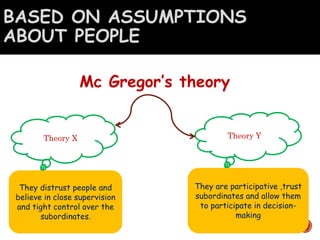
BASED ON ASSUMPTIONS
ABOUT PEOPLE
Mc Gregor’s theory
Theory X Theory Y
They distrust people and
believe in close supervision
and tight control over the
subordinates.
They are participative ,trust
subordinates and allow them
to participate in decision-
making
Likert’s
four
styles
Benevolent
authoritarian
Consultative
Participative
Exloitative
authoitative
Exploitative Authoritative: Responsibility lies in
the hands of the people at the upper echelons of
the hierarchy.
Benevolent Authoritative: The responsibility lies at
the managerial levels but not at the lower levels of
the organizational hierarchy.
Consultative system : The responsibility lies in the
hands of manager only but there is consultation
with the subordinate .
Participative: Responsibility for achieving the
organizational goals is widespread throughout the
organizational hierarchy.
BASED ON APPROACH
 Managers using the transactional leadership style receive
certain tasks to perform and provide rewards or punishments
to team members based on performance results.
 Managers and team members set predetermined goals
together, and employees agree to follow the direction and
leadership of the manager to accomplish those goals.
 The manager possesses power to review results and train or
correct employees when team members fail to meet goals.
Employees receive rewards, such as bonuses, when they
accomplish goals.
 The transformational leadership style depends on
high levels of communication from management to
meet goals. Leaders motivate employees and
enhance productivity and efficiency through
communication and high visibility.
 This style of leadership requires the involvement of
management to meet goals. Leaders focus on the big
picture within an organization and delegate smaller
tasks to the team to accomplish goals.
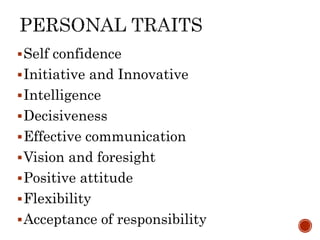
Self confidence
Initiative and Innovative
Intelligence
Decisiveness
Effective communication
Vision and foresight
Positive attitude
Flexibility
Acceptance of responsibility
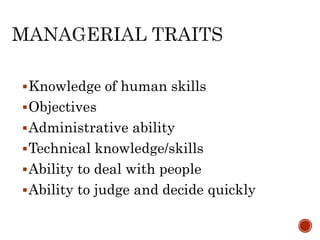
Knowledge of human skills
Objectives
Administrative ability
Technical knowledge/skills
Ability to deal with people
Ability to judge and decide quickly
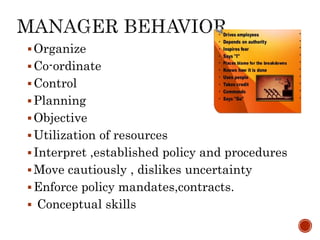
Organize
Co-ordinate
Control
Planning
Objective
Utilization of resources
Interpret ,established policy and procedures
Move cautiously , dislikes uncertainty
Enforce policy mandates,contracts.
 Conceptual skills
THANK YOU
From book of leadership by -
 Richard L.Draft
Craig M.Watson
From Internet -
D.S.Pugh, 'Organization Theory - Selected Readings',
Robert P.Vecchio, 'Organizational Behaviour’
A Practical Overview of Evidence Based Leadership
Theory
By Shaun Killian (MLead, MEd), Australian
Leadership Development Centre
By Linda D. Henman, Ph.D.

Leadership

  • 2.
    At the endof class group will be able to know about  Definition of Leadership  Concept of Leadership and Management  Factors affecting Leadership  Theories of leadership
  • 3.
    Monika Thakur M.Sc PsychiatricNursing 2nd yr. King George Medical University
  • 4.
    The heart ofmanagement is dealing with people in order to achieve the organizational goal ,the success of every organization depends upon the leadership, qualities of its manger. Every leader may not be a good manager but every manger must be a good leader.
  • 5.
     leadership isthe “process of social influence in which one person can enlist the aid and support of others in the accomplishment of a common task”. M Chemers.  "Leadership is ultimately about creating a way for people to contribute to making something extraordinary happen." Alan Keith.
  • 9.
    Leader - Youmust have an honest understanding of who you are, what you know and what you can do. To be successful you have to convince your followers not your superiors, that you are worthy of being followed. Follower -You must know your people. The fundamental starting point is having a good understanding of human nature, such as needs, emotions and motivation.
  • 10.
    Communication- The nonverbal communicationis leading. Bad communication harm the relation between leader and employee. Situation- We must use our judgment to decide the best course of action and the leadership style needed for each situation. What we do in one situation will not always work in another.
  • 11.
  • 12.
    . The Trait Approacharose from the “Great Man” theory as a way of identifying the key characteristics of successful leaders. It was believed that through this theory critical leadership traits could be isolated and that people with such traits could then be recruited, selected, and installed into leadership positions. This theory was common in the military and is still used as a set of criteria to select candidates for commissions
  • 13.
     It isnaturally pleasing theory.  It serves as a yardstick against which the leadership traits of an individual can be assessed.  It gives a detailed knowledge and understanding of the leader element in the leadership process.
  • 14.
     There isbound to be some subjective judgment in determining who is regarded as a ‘good’ or ‘successful’ leader.  There is also a disagreement over which traits are the most important for an effective leader
  • 15.
     These theoriesof leadership are based upon the belief that great leaders are made, not born. Rooted in behaviorism, this leadership theory focuses on the actions of leaders not on mental qualities or internal states. According to this theory, people can learn to become leaders through teaching and observation. The behavior approach says that anyone who adopts the appropriate behavior can be a good leader.
  • 16.
     Ohio stateleadership university studies.  University of Michigan studies
  • 20.
    In Contingency theoryof leadership, the success of the leader is a function of various contingencies in the form of subordinate, task, and/or group variables. The Leaders who are very effective at one place and time may become unsuccessful either when transplanted to another situation or when the factors around them change. This helps to explain how some leaders who seem for a while to have the 'Midas touch' suddenly appear to go off the boil and make very unsuccessful decisions.
  • 21.
    FIEDLER’S CONTIINGENCY MODEL HARSEY& BLANCHARD’S SITUATIONAL THEORY PATH GOAL THEORY VROOM-JAGO CONTINGENCY MODEL
  • 22.
    Fiedler's model assumesthat group performance depends on:  Leadership style, described in terms of task motivation and relationship motivation. Situational favourableness, determined by three factors: a) Leader-member relations - Degree to which a leader is accepted and supported by the group members. b) Task structure - Extent to which the task is structured and defined, with clear goals and procedures. c) Position power - The ability of a leader to control subordinates through reward and punishment.
  • 23.
    The Hersey-Blanchard SituationalLeadership Theory was created by Dr Paul Hersey and Ken Blanchard. The theory states that instead of using just one style, successful leaders should change their leadership styles based on the maturity of the people they're leading and the details of the task. Using this theory, leaders should be able to place more or less emphasis on the task.
  • 24.
    According to Herseyand Blanchard, there are four main leadership styles:  Telling (S1) – Leaders tell their people exactly what to do, and how to do it.  Selling (S2) – Leaders still provide information and direction, but there's more communication with followers. Leaders "sell" their message to get the team on board.  Participating (S3) – Leaders focus more on the relationship and less on direction. The leader works with the team, and shares decision- making responsibilities.  Delegating (S4) – Leaders pass most of the responsibility onto the follower or group. The leaders still monitor progress, but they're less involved in decisions.
  • 26.
    According to path-goaltheory, the leader’s responsibility is to increase subordinates’ motivation to attain personal and organizational goal. A person may do these by adopting a certain leadership style, according to the situation: Directive leadership – it tells subordinates exactly what they are supposed to do, which includes planning, making schedules, setting performance goals and behaviour standards. Supportive leadership - it shows concern for subordinates’ well being and personal needs.
  • 27.
    Participative leadership -Decision making is based on group consultation and information is shared with the group. Achievement-oriented leadership - Challenging goals are set and high performance is encouraged while showing confidence in the groups' ability.
  • 28.
    The Vroom–Yetton contingencymodel is a situational leadership theory of industrial and organizational psychology developed by Victor Vroom, in collaboration with Phillip Yetton (1973) and later with Arthur Jago (1988). The situational theory argues the best style of leadership is contingent to the situation. This model suggests the selection a leadership style for group decision-making
  • 29.
    Autocratic Type 1(AI)  Leader makes own decision using information that is readily available to him at the time. This type is completely autocratic. Autocratic Type 2 (AII)  Leader collects required information from followers, then makes decision alone. Problem or decision may or may not be informed to followers. Here, followers' involvement is just providing information. Consultative Type 1 (CI)  Leader shares problem to relevant followers individually and seeks their ideas and suggestions and makes decision alone. Here followers do not meet each other and the leader’s decision may or may not reflect his followers' influence. So, here followers involvement is at the level of providing alternatives individually. Consultative Type 2 (CII)  Leader shares problem to relevant followers as a group and seeks their ideas and suggestions and makes decision alone. Here followers meet each other, and through discussions they understand other alternatives. But the leader’s decision may or may not reflect his followers' influence. So, here followers involvement is at the level of helping as a group in decision-making. Group-based Type 2 (GII)  Leader discuss problem and situation with followers as a group and seeks their ideas and suggestions through brainstorming. Leader accepts any decision and does not try to force his idea. Decision accepted by the group is the final one.
  • 30.
    It describes therelationship between the leader's concern for task and concern for people, but this theory differs in its perspective. The managerial grid Considers leadership style based on their focus on task and people. The Managerial Grid is based on two behavioral dimensions Concern for People – This is the degree to which a leader considers the needs of team members, their interests, and areas of personal development when deciding how best to accomplish a task. Concern for Production – This is the degree to which a leader emphasizes concrete objectives, organizational efficiency and high productivity when deciding how best to accomplish a task.
  • 31.
    Using the axisto plot leadership ‘concerns for production’ versus ‘concerns for people’, Blake and Mouton defined the following five leadership styles:
  • 32.
    Country Club Leadership–(High People/Low Production) Produce or Perish Leadership – High Production/Low People Impoverished Leadership – Low Production/Low People Middle-of-the-Road Leadership – Medium Production/Medium People Team Leadership – High Production/High People
  • 33.
     Leadership ,concept  Theories of Leadership Objectives for Todays session Discuss different style of leaderships.
  • 35.
    LEADERSHIP STYLES Based on authority retained Basedon task versus people emphasis Based on assumptions about people Likert’s four styles Based on Approach.
  • 36.
    BASED ON AUTHORITY RETAINED AuthoritarianDemocratic Free-rein (Laissez faire) Consultative Pursuasive
  • 37.
    AUTOCRATIC OR AUTHORITARIAN STYLE Underthe autocratic leadership style, all decision-making powers are centralized in the leader, as with dictator leaders. They do not entertain any suggestions or initiatives from subordinates. The autocratic management has been successful as it provides strong motivation to the manager.  It permits quick decision-making, as only one person decides for the whole group and keeps each decision to himself until he feels it is needed to be shared with the rest of the group. High degree of dependency on the leader May be valuable in some types of business where decisions need to be made quickly and decisively
  • 38.
    PARTICIPATIVE OR DEMOCRATIC STYLE The democratic leadership style favours decision-making by the group .  They can win the cooperation of their group and can motivate them effectively and positively.  The decisions of the democratic leader are not unilateral as with the autocrat because they arise from consultation with the group members and participation by them. Consultative: process of consultation before decisions are taken Persuasive: Leader takes decision and seeks to persuade others that the decision is correct.
  • 39.
    LAISSEZ –FAIRE ORFREE REIN STYLE  A free rein leader does not lead, but leaves the group entirely to itself such a leader allows maximum freedom to subordinates, i.e. they are given a free hand in deciding their own policies and methods. 1. Can be very useful in businesses where creative ideas are important 2. Can be highly motivational, as people have control over their working life 3. Can make coordination and decision making time- consuming and lacking in overall direction 4. Relies on good team work. 5. Relies on good interpersonal relations.
  • 40.
    BASED ON TASKVERSUS PEOPLE EMPHASIS High relationship and low- task [ supporting style ] High task and high relationship [ participative style] Low-task and low relationship [ free rein style ] High task and low relationship [ autocratic style ] Low High LowHigh Task Emphasis PeopleEmphasis
  • 41.
    BASED ON ASSUMPTIONS ABOUTPEOPLE Mc Gregor’s theory Theory X Theory Y They distrust people and believe in close supervision and tight control over the subordinates. They are participative ,trust subordinates and allow them to participate in decision- making
  • 42.
  • 43.
    Exploitative Authoritative: Responsibilitylies in the hands of the people at the upper echelons of the hierarchy. Benevolent Authoritative: The responsibility lies at the managerial levels but not at the lower levels of the organizational hierarchy. Consultative system : The responsibility lies in the hands of manager only but there is consultation with the subordinate . Participative: Responsibility for achieving the organizational goals is widespread throughout the organizational hierarchy.
  • 44.
    BASED ON APPROACH Managers using the transactional leadership style receive certain tasks to perform and provide rewards or punishments to team members based on performance results.  Managers and team members set predetermined goals together, and employees agree to follow the direction and leadership of the manager to accomplish those goals.  The manager possesses power to review results and train or correct employees when team members fail to meet goals. Employees receive rewards, such as bonuses, when they accomplish goals.
  • 45.
     The transformationalleadership style depends on high levels of communication from management to meet goals. Leaders motivate employees and enhance productivity and efficiency through communication and high visibility.  This style of leadership requires the involvement of management to meet goals. Leaders focus on the big picture within an organization and delegate smaller tasks to the team to accomplish goals.
  • 48.
    Self confidence Initiative andInnovative Intelligence Decisiveness Effective communication Vision and foresight Positive attitude Flexibility Acceptance of responsibility
  • 49.
    Knowledge of humanskills Objectives Administrative ability Technical knowledge/skills Ability to deal with people Ability to judge and decide quickly
  • 51.
    Organize Co-ordinate Control Planning Objective Utilization of resources Interpret,established policy and procedures Move cautiously , dislikes uncertainty Enforce policy mandates,contracts.  Conceptual skills
  • 53.
  • 54.
    From book ofleadership by -  Richard L.Draft Craig M.Watson From Internet - D.S.Pugh, 'Organization Theory - Selected Readings', Robert P.Vecchio, 'Organizational Behaviour’ A Practical Overview of Evidence Based Leadership Theory By Shaun Killian (MLead, MEd), Australian Leadership Development Centre By Linda D. Henman, Ph.D.