PRESENTATION ON
LEADERSHIP
INTRODUCTION
• Leadership is the ability to develop a vision
that motivates others to move with a
passion toward a common goal. So
leadership is a process by which a person
influences others to accomplish an
objective and directs the organization in a
way that makes it more cohesive and
coherent.
DEFINITION
• leadership is the “process of social influence in
which one person can enlist the aid and support
of others in the accomplishment of a common
task”.
M Chemers.
• "Leadership is ultimately about creating a way
for people to contribute to making something
extraordinary happen."
Alan Keith.
LEADERSHIP SIMPLY REFERS TO
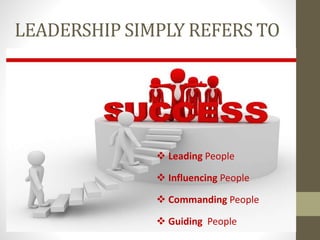
 Leading People
 Influencing People
 Commanding People
 Guiding People
CHARACTERISTICS OF LEADERSHIP
• Leader must have followers
• It is working relationship between leader and
followers
• Purpose is to achieve some common goal or
goals
• A leader influences his followers willingly not by
force
• Leadership is exercised in a given situation
• Leadership is a power relationship
• It is a continuous process
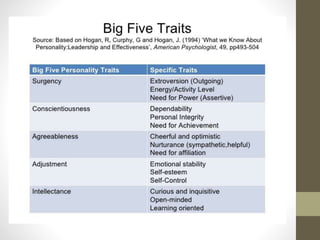
LEADERSHIP TRAIT
• Trait leadership is defined as integrated
patterns of personal characteristics that
reflect a range of individual differences
and foster consistent leader effectiveness
across a variety of group and
organizational situations
FOUR FACTORS OF LEADERSHIP
• Leader - You must have an honest understanding
of who you are, what you know and what you
can do. To be successful you have to convince
your followers not your superiors, that you are
worthy of being followed.
• Follower -You must know your people. The
fundamental starting point is having a good
understanding of human nature, such as needs,
emotions and motivation.
• Communication-The nonverbal communication
is leading. E.g.- when you set example that
communicates to your people that you
would not ask them to perform anything
that you would not be willing to do. Bad
communication harm the relation between
leader and employee.
• Situation-We must use our judgment to
decide the best course of action and the
leadership style needed for each situation.
What we do in one situation will not always
work in another.
LEADERSHIP STYLES
Authoritarian or autocratic
Participative or democratic
Delegative or Free Reign
AUTOCRATIC
o Leader makes decisions without reference to anyone
else
o High degree of dependency on the leader
o Can create de-motivation and alienation
of staff
o May be valuable in some types of business where
decisions need to be made quickly and decisively
DEMOCRATIC
• Encourages decision making
from different perspectives –
leadership may be emphasised
throughout the organisation
• Consultative: process of
consultation before decisions are
taken
• Persuasive: Leader takes decision
and seeks to persuade others that
the decision is correct
LAISSEZ-FAIRE
1. ‘Let it be’ – the leadership
responsibilities
are shared by all
2. Can be very useful in businesses
where creative ideas are important
3. Can be highly motivational,
as people have control over their
working life
4. Can make coordination and decision
making
time-consuming and lacking in overall
direction
5. Relies on good team work
6. Relies on good interpersonal relations
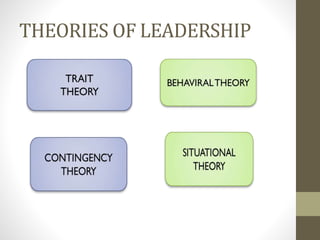
THEORIES OF LEADERSHIP
TRAIT THEORY
• Early on, it was thought that leaders were born with
inherent physiological and personality traits
• Age
• Height
• Intelligence
• Academic achievements
• Stogdill (1974) – identified several general factors that
differentiate leaders from non-leaders…
• Capacity: problem-solving capabilities, making judgments and
working hard
• Achievements: accomplishments such as academic record,
knowledge and sports
• Responsibility: dependability, reliability, self-drive,
perseverance, aggressiveness and self-confidence
• Participation and involvement: highly developed social
interaction, popularity, swift adaptation to changing
situations, and easier cooperation compared to non-leaders
• Socio-economic status: effective leaders usually belong to
higher socio-economic classes
BEHAVIOURAL THOERY
• Ohio State studies focused on task and social behavior of
leaders
• Identified two dimensions of leader behavior
• Initiating Structure: role of leader in defining his/her role and
roles of group members
• Consideration: leader’s mutual trust and respect for group
members’ ideas and feelings
• Two different behavioral theories:
• Role Theory
• Managerial Grid
ROLE THEORY
• Assumptions about leaders’ in organizations are shaped by
culture, training sessions, modeling by senior managers, etc.
• People define roles for themselves and others based on social
learning and reading.
• People form expectations about the roles that they and others
will play.
• People subtly encourage others to act within the role
expectations they have for them.
• People will act within the roles they adopt.
MANAGERIAL GRID
• Developed by Drs. Robert R. Blake and Jane S. Mouton
• Believed managers have different leadership styles which led
to two different dimensions of leadership:
• Concern for Production: manager who is task-oriented and
focuses on getting results or accomplishing the mission (X-axis
of grid)
• Concern for People: manager who avoids conflicts and strives
for friendly relations with subordinates (Y-axis of grid)
CONTINGENCY THEORY
• In Contingency theory of leadership, the success of the leader
is a function of various contingencies in the form of
subordinate, task, and/or group variables. The Leaders who
are very effective at one place and time may become
unsuccessful either when transplanted to another situation or
when the factors around them change.
• This helps to explain how some leaders who seem for a
while to have the 'Midas touch' suddenly appear to go off the
boil and make very unsuccessful decisions
Different Sets/theories of contingency
theory :
• Different Sets/theories of contingency theory :
• FIEDLER’S CONTIINGENCY MODEL
• HARSEY & BLANCHARD’S SITUATIONAL THEORY
• PATH GOAL THEORY
• VROOM-JAGO CONTINGENCY MODEL
SITUATIONAL THEORY
• The Hersey-Blanchard Situational Leadership
Theory was created by Dr Paul Hersey and Ken
Blanchard. The theory states that instead of
using just one style, successful leaders should
change their leadership styles based on the
maturity of the people they're leading and the
details of the task. Using this theory, leaders
should be able to place more or less emphasis
on the task.
CONCLUSION
• To create organisation effectiveness and
ensure sustainability , business leaders
need to focus their attention on aligning
their people , the system the structure and
the roles with organisation’s strategy ,
while engaging the employees with the
jobs and the organisation
Presented by :
• Aditya Narayan (BBA/4564/16)
• Akhil Kumar Jha (BBA/4582/16)
• Jayendra Kashyap (BBA/4537/16)
• Utkarsh Bisht (BBA/4560/16)
under supervision of :
Harpreet mam