ON THE JOB TRAINING
DIVYA CHHABRA
GBPUA&T, Pantnagar
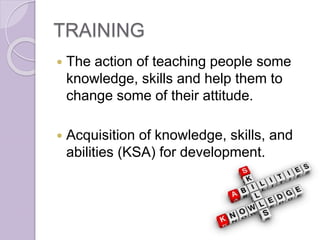
TRAINING
 The action of teaching people some
knowledge, skills and help them to
change some of their attitude.
 Acquisition of knowledge, skills, and
abilities (KSA) for development.
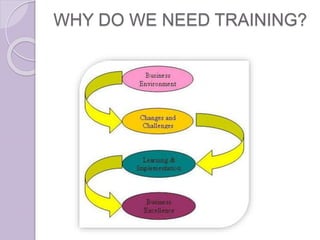
WHY DO WE NEED TRAINING?
RELATED TERMS
 EDUCATION- imparting/absorbing
theoretical teaching in classrooms.
Generalized kind of knowledge.
 TRAINING- process of imparting the
skills
Specialized kind of knowledge
 DEVELOPMENT- exposure of
employees to general
subject/knowledge & attitudinal aspect
of overall self improvement
Contd..
 Training and development input 3 types
of skills:
 TECHNICAL: required to do the job.
Example: machine operation, computer
usage, safe working skills
 CONCEPTUAL: basic fundamental
knowledge of the subject
 INTERPERSONAL: to understand
people better, to communicate well for
decision making process.
TRAINING NEED
ASSESSMENT
 The gap between the present status and
desired status may indicate problems that
in turn can be translated into a training
need.
 A need is not a want or desire. It is a gap
between “what is” and “what ought to be”
 method of determining if a training need
exists and, if it does, what training is
required to fill the gap.
METHODS OF TNA
 GROUP ANALYSIS
 Organizational goals
 Skill inventories
 Organizational climate
indices
 Efficiency indices
 Customer survey
 INDIVIDUAL ANALYSIS
 Performance appraisal
 Work sampling
 Interviews
 Questionnaires
 Attitude surveys
ON THE JOB TRAINING
 Employee training at the place of work
while he or she is doing the actual job.
 Professional trainer acts as trainer.
 ADVANTAGES: effective method
 Least expensive
 Free from artificial classroom
 DISADVANTAGES: Professional
trainer may lack expertise
 Not systematically organized.
METHODS
Job rotation
Job-instruction
Committee assignment
Apprenticeships
Coaching
Mentoring
Under study/ Internship
JOB ROTATION
 A job design technique in which
employees are moved between two or
more jobs in a planned manner.
 Job rotation is a well-planned practice
to reduce the boredom of doing same
type of job everyday and explore the
hidden potential of an employee.
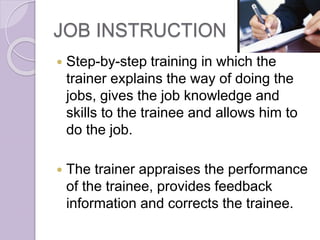
JOB INSTRUCTION
 Step-by-step training in which the
trainer explains the way of doing the
jobs, gives the job knowledge and
skills to the trainee and allows him to
do the job.
 The trainer appraises the performance
of the trainee, provides feedback
information and corrects the trainee.
COMMITTEE
ASSIGNMENTS
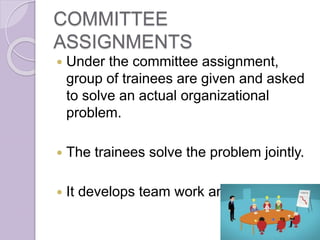
 Under the committee assignment,
group of trainees are given and asked
to solve an actual organizational
problem.
 The trainees solve the problem jointly.
 It develops team work and improve it.
APPRENTICESHIPS
 Apprenticeship is a formalized method
of training curriculum program that
combines classroom education with
on-the-job work under close
supervision.
 The training curriculum is planned in
advance and conducted in careful
steps from day to day.
 They have to work in direct
association with and also under the
direct supervision of their masters.
COACHING
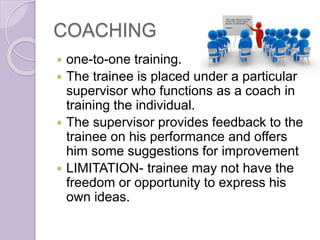
 one-to-one training.
 The trainee is placed under a particular
supervisor who functions as a coach in
training the individual.
 The supervisor provides feedback to the
trainee on his performance and offers
him some suggestions for improvement
 LIMITATION- trainee may not have the
freedom or opportunity to express his
own ideas.
MENTORING
Job mentoring involves providing an
employee with an experienced coach
to oversee his or her learning
experience.
The trainee employee learns the job
firsthand and may consult the mentor
or coach at any time for assistance.
The focus in this training is on the
development of attitude.
DIFFERENCE BETWEEN
MENTORING AND COACHING
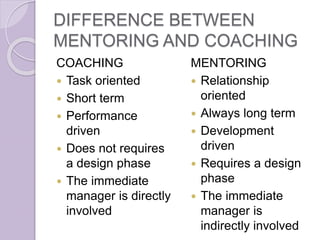
COACHING
 Task oriented
 Short term
 Performance
driven
 Does not requires
a design phase
 The immediate
manager is directly
involved
MENTORING
 Relationship
oriented
 Always long term
 Development
driven
 Requires a design
phase
 The immediate
manager is
indirectly involved
UNDERSTUDY
 A superior gives training to a
subordinate as his understudy like an
assistant to a manager or director.
 The subordinate learns through
experience and observation by
participating in handling day to day
problems.
On the job training

On the job training

  • 1.
    ON THE JOBTRAINING DIVYA CHHABRA GBPUA&T, Pantnagar
  • 2.
    TRAINING  The actionof teaching people some knowledge, skills and help them to change some of their attitude.  Acquisition of knowledge, skills, and abilities (KSA) for development.
  • 3.
    WHY DO WENEED TRAINING?
  • 4.
    RELATED TERMS  EDUCATION-imparting/absorbing theoretical teaching in classrooms. Generalized kind of knowledge.  TRAINING- process of imparting the skills Specialized kind of knowledge  DEVELOPMENT- exposure of employees to general subject/knowledge & attitudinal aspect of overall self improvement
  • 5.
    Contd..  Training anddevelopment input 3 types of skills:  TECHNICAL: required to do the job. Example: machine operation, computer usage, safe working skills  CONCEPTUAL: basic fundamental knowledge of the subject  INTERPERSONAL: to understand people better, to communicate well for decision making process.
  • 6.
    TRAINING NEED ASSESSMENT  Thegap between the present status and desired status may indicate problems that in turn can be translated into a training need.  A need is not a want or desire. It is a gap between “what is” and “what ought to be”  method of determining if a training need exists and, if it does, what training is required to fill the gap.
  • 7.
    METHODS OF TNA GROUP ANALYSIS  Organizational goals  Skill inventories  Organizational climate indices  Efficiency indices  Customer survey  INDIVIDUAL ANALYSIS  Performance appraisal  Work sampling  Interviews  Questionnaires  Attitude surveys
  • 8.
    ON THE JOBTRAINING  Employee training at the place of work while he or she is doing the actual job.  Professional trainer acts as trainer.  ADVANTAGES: effective method  Least expensive  Free from artificial classroom  DISADVANTAGES: Professional trainer may lack expertise  Not systematically organized.
  • 9.
  • 10.
    JOB ROTATION  Ajob design technique in which employees are moved between two or more jobs in a planned manner.  Job rotation is a well-planned practice to reduce the boredom of doing same type of job everyday and explore the hidden potential of an employee.
  • 11.
    JOB INSTRUCTION  Step-by-steptraining in which the trainer explains the way of doing the jobs, gives the job knowledge and skills to the trainee and allows him to do the job.  The trainer appraises the performance of the trainee, provides feedback information and corrects the trainee.
  • 12.
    COMMITTEE ASSIGNMENTS  Under thecommittee assignment, group of trainees are given and asked to solve an actual organizational problem.  The trainees solve the problem jointly.  It develops team work and improve it.
  • 13.
    APPRENTICESHIPS  Apprenticeship isa formalized method of training curriculum program that combines classroom education with on-the-job work under close supervision.  The training curriculum is planned in advance and conducted in careful steps from day to day.  They have to work in direct association with and also under the direct supervision of their masters.
  • 14.
    COACHING  one-to-one training. The trainee is placed under a particular supervisor who functions as a coach in training the individual.  The supervisor provides feedback to the trainee on his performance and offers him some suggestions for improvement  LIMITATION- trainee may not have the freedom or opportunity to express his own ideas.
  • 15.
    MENTORING Job mentoring involvesproviding an employee with an experienced coach to oversee his or her learning experience. The trainee employee learns the job firsthand and may consult the mentor or coach at any time for assistance. The focus in this training is on the development of attitude.
  • 16.
    DIFFERENCE BETWEEN MENTORING ANDCOACHING COACHING  Task oriented  Short term  Performance driven  Does not requires a design phase  The immediate manager is directly involved MENTORING  Relationship oriented  Always long term  Development driven  Requires a design phase  The immediate manager is indirectly involved
  • 17.
    UNDERSTUDY  A superiorgives training to a subordinate as his understudy like an assistant to a manager or director.  The subordinate learns through experience and observation by participating in handling day to day problems.