LEADERSHIP
LEADERSHIP


    There is nothing more difficult to take in hand, more
    perilous to conduct, or more uncertain in its success,
    than to take the lead in the introduction of a new order
    of things.
                                                   Machiavelli
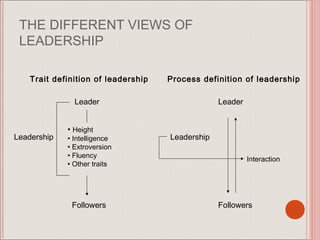
THE DIFFERENT VIEWS OF
 LEADERSHIP

    Trait definition of leadership   Process definition of leadership

               Leader                             Leader


             • Height
Leadership   • Intelligence          Leadership
             • Extroversion
             • Fluency
                                                           Interaction
             • Other traits


              Followers                           Followers
A LEADERSHIP STORY:


 “Management   is doing things right,
 leadership is doing the right things”
 (Warren Bennis and Peter Drucker)
FUNCTIONS OF MANAGEMENT VERSUS
LEADERSHIP 1/2


   Management produces                   Leadership produces
    Order and Consistency                  Change and Movement
   Planning / Budgeting                  Establishing Direction
       Establish agendas                     Create a vision
       Set time tables                       Clarify big picture
       Allocate resources                    Set strategies

     Organizing / Staffing                 Aligning People
       Provide structure                     Communicate goals
       Make job placements                   Seek commitment
       Establish rules and procedures        Build teams and coalitions
FUNCTIONS OF MANAGEMENT VERSUS
LEADERSHIP 2/2


     Management                         Leadership
     Controlling / Problem              Motivating and Inspiring
      Solving                                Inspire and energize
         Develop incentives                 Empower subordinates
         Generate creative solutions        Satisfy unmet needs
         Take corrective action


                                                 John P. Kotter 1990
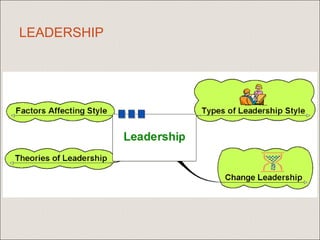
LEADERSHIP
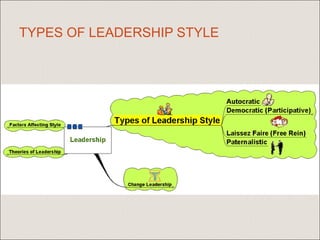
TYPES OF LEADERSHIP STYLE
 Autocratic:
   Leader   makes decisions without reference to anyone
    else
   High degree of dependency on the leader
   Can create de-motivation and alienation
    of staff
   May be valuable in some types of business where
    decisions need to be made quickly and decisively
TYPES OF LEADERSHIP STYLE
 Democratic:
 Encourages decision making
 from different perspectives – leadership may be
 emphasised throughout
 the organisation
   Consultative:   process of consultation before decisions
    are taken
   Persuasive: Leader takes decision and seeks to
    persuade others that the decision
    is correct
TYPES OF LEADERSHIP STYLE
   Democratic:
     May  help motivation and involvement
     Workers feel ownership of the firm and its ideas
     Improves the sharing of ideas
      and experiences within the business
     Can delay decision making
TYPES OF LEADERSHIP STYLE

  Laissez-Faire:
    ‘Let it be’ – the leadership responsibilities
     are shared by all
    Can be very useful in businesses
     where creative ideas are important
    Can be highly motivational,
     as people have control over their working life
    Can make coordination and decision making
     time-consuming and lacking in overall direction
    Relies on good team work
    Relies on good interpersonal relations
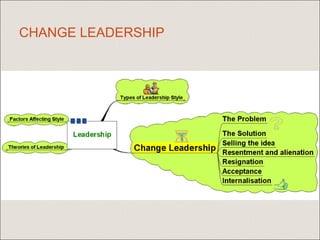
CHANGE LEADERSHIP
CHANGE LEADERSHIP
 The most challenging aspect of business is leading
  and managing change
 The business environment is subject to fast-paced
  economic and social change
 Modern business must adapt
  and be flexible to survive
 Problems in leading change stem mainly from human
  resource management
 Leaders need to be aware of how change impacts on
  workers
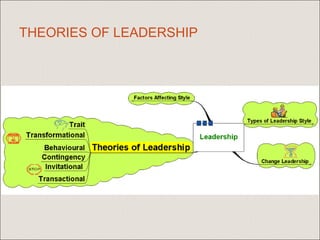
THEORIES OF LEADERSHIP
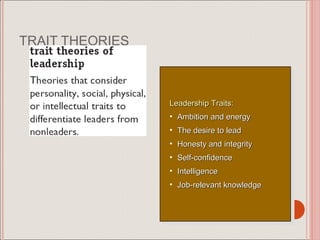
TRAIT THEORIES


                 Leadership Traits: :
                   Leadership Traits
                 • • Ambition and energy
                      Ambition and energy
                 • • The desire to lead
                      The desire to lead
                 • • Honesty and integrity
                      Honesty and integrity
                 • • Self-confidence
                      Self-confidence
                 • • Intelligence
                      Intelligence
                 • • Job-relevant knowledge
                      Job-relevant knowledge
TRAIT THEORIES


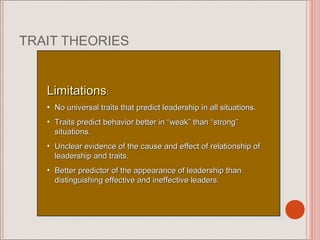
   Limitations: :
    Limitations
   • • No universal traits that predict leadership in all situations.
        No universal traits that predict leadership in all situations.
   • • Traits predict behavior better in “weak” than “strong”
        Traits predict behavior better in “weak” than “strong”
       situations.
        situations.
   • • Unclear evidence of the cause and effect of relationship of
        Unclear evidence of the cause and effect of relationship of
       leadership and traits.
        leadership and traits.
   • • Better predictor of the appearance of leadership than
        Better predictor of the appearance of leadership than
       distinguishing effective and ineffective leaders.
        distinguishing effective and ineffective leaders.
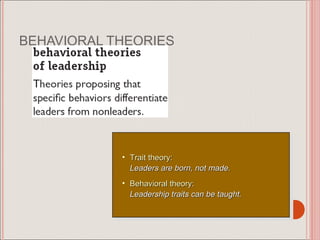
BEHAVIORAL THEORIES


            • • Trait theory:
                 Trait theory:
                Leaders are born, not made.
                 Leaders are born, not made.
            • • Behavioral theory:
                 Behavioral theory:
                Leadership traits can be taught.
                 Leadership traits can be taught.
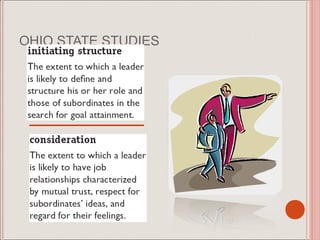
OHIO STATE STUDIES
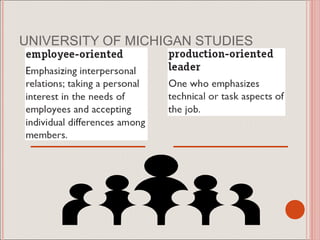
UNIVERSITY OF MICHIGAN STUDIES
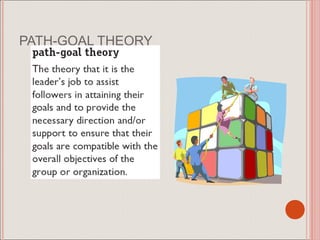
PATH-GOAL THEORY
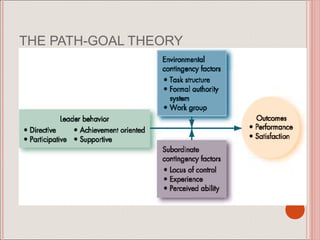
THE PATH-GOAL THEORY
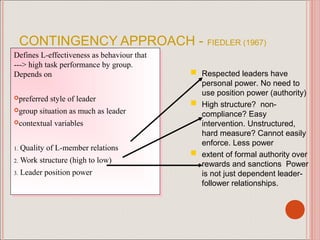
CONTINGENCY APPROACH - FIEDLER (1967)
Defines L-effectiveness as behaviour that
 Defines L-effectiveness as behaviour that
---> high task performance by group.
 ---> high task performance by group.
Depends on
 Depends on                                   Respected leaders have to
                                               personal power. No need
                                                 use position power (authority)
preferred style of leader
group situation as much as leader
                                                High structure? non-
                                                 compliance? Easy
contextual variables
contextual variables                            intervention. Unstructured,
                                                 hard measure? Cannot easily
                                                 enforce. Less power
1. Quality of L-member relations
 1. Quality of L-member relations
2. Work structure (high to low)
 2. Work structure (high to low)
                                                extent of formal authority over
                                                 rewards and sanctions Power
3. Leader position power
 3. Leader position power                        is not just dependent leader-
                                                 follower relationships.
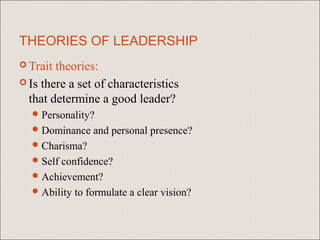
THEORIES OF LEADERSHIP
 Trait theories:
 Is there a set of characteristics
  that determine a good leader?
   Personality?
   Dominance   and personal presence?
   Charisma?
   Selfconfidence?
   Achievement?
   Ability to formulate a clear vision?
THEORIES OF LEADERSHIP
   Trait theories:
     Are  such characteristics
      inherently gender biased?
     Do such characteristics
      produce good leaders?
     Is leadership more than
      just bringing about change?
     Does this imply that leaders are born not bred?
THEORIES OF LEADERSHIP
 Behavioural:

 Implythat leaders can be trained – focus on the
 way of doing things
   Structure based behavioural theories – focus on the
    leader instituting structures – task orientated
   Relationship based behavioural theories – focus on
    the development and maintenance of relationships –
    process orientated
THEORIES OF LEADERSHIP
 Contingency   Theories:
 Leadership as being more flexible – different
  leadership styles used at different times
  depending on the circumstance.
 Suggests leadership is not a fixed series of
  characteristics that can be transposed into
  different contexts
THEORIES OF LEADERSHIP
   May depend on:
     Type of staff
     History of the business
     Culture of the business
     Quality of the relationships
     Nature of the changes needed
     Accepted norms within the institution
THEORIES OF LEADERSHIP
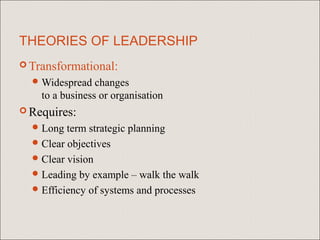
 Transformational:
   Widespread   changes
    to a business or organisation
 Requires:
   Long  term strategic planning
   Clear objectives
   Clear vision
   Leading by example – walk the walk
   Efficiency of systems and processes
THEORIES OF LEADERSHIP
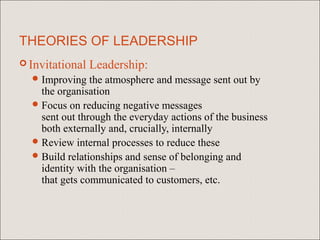
 Invitational   Leadership:
   Improving   the atmosphere and message sent out by
    the organisation
   Focus on reducing negative messages
    sent out through the everyday actions of the business
    both externally and, crucially, internally
   Review internal processes to reduce these
   Build relationships and sense of belonging and
    identity with the organisation –
    that gets communicated to customers, etc.
THEORIES OF LEADERSHIP
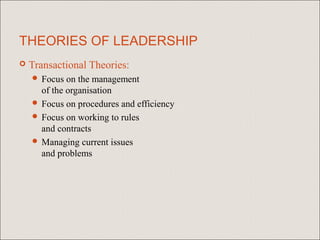
   Transactional Theories:
     Focus  on the management
      of the organisation
     Focus on procedures and efficiency
     Focus on working to rules
      and contracts
     Managing current issues
      and problems
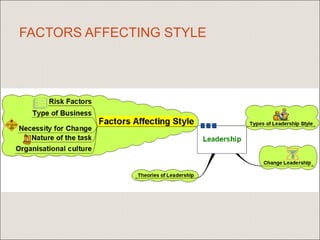
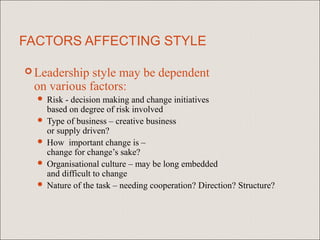
FACTORS AFFECTING STYLE

 Leadership style may be dependent
 on various factors:
   Risk - decision making and change initiatives
    based on degree of risk involved
   Type of business – creative business
    or supply driven?
   How important change is –
    change for change’s sake?
   Organisational culture – may be long embedded
    and difficult to change
   Nature of the task – needing cooperation? Direction? Structure?

Leadership

  • 1.
  • 2.
    LEADERSHIP There is nothing more difficult to take in hand, more perilous to conduct, or more uncertain in its success, than to take the lead in the introduction of a new order of things. Machiavelli
  • 3.
    THE DIFFERENT VIEWSOF LEADERSHIP Trait definition of leadership Process definition of leadership Leader Leader • Height Leadership • Intelligence Leadership • Extroversion • Fluency Interaction • Other traits Followers Followers
  • 4.
    A LEADERSHIP STORY: “Management is doing things right, leadership is doing the right things” (Warren Bennis and Peter Drucker)
  • 5.
    FUNCTIONS OF MANAGEMENTVERSUS LEADERSHIP 1/2  Management produces  Leadership produces Order and Consistency Change and Movement  Planning / Budgeting  Establishing Direction  Establish agendas  Create a vision  Set time tables  Clarify big picture  Allocate resources  Set strategies  Organizing / Staffing  Aligning People  Provide structure  Communicate goals  Make job placements  Seek commitment  Establish rules and procedures  Build teams and coalitions
  • 6.
    FUNCTIONS OF MANAGEMENTVERSUS LEADERSHIP 2/2  Management  Leadership  Controlling / Problem  Motivating and Inspiring Solving  Inspire and energize  Develop incentives  Empower subordinates  Generate creative solutions  Satisfy unmet needs  Take corrective action John P. Kotter 1990
  • 7.
  • 8.
  • 9.
    TYPES OF LEADERSHIPSTYLE  Autocratic:  Leader makes decisions without reference to anyone else  High degree of dependency on the leader  Can create de-motivation and alienation of staff  May be valuable in some types of business where decisions need to be made quickly and decisively
  • 10.
    TYPES OF LEADERSHIPSTYLE  Democratic:  Encourages decision making from different perspectives – leadership may be emphasised throughout the organisation  Consultative: process of consultation before decisions are taken  Persuasive: Leader takes decision and seeks to persuade others that the decision is correct
  • 11.
    TYPES OF LEADERSHIPSTYLE  Democratic:  May help motivation and involvement  Workers feel ownership of the firm and its ideas  Improves the sharing of ideas and experiences within the business  Can delay decision making
  • 12.
    TYPES OF LEADERSHIPSTYLE  Laissez-Faire:  ‘Let it be’ – the leadership responsibilities are shared by all  Can be very useful in businesses where creative ideas are important  Can be highly motivational, as people have control over their working life  Can make coordination and decision making time-consuming and lacking in overall direction  Relies on good team work  Relies on good interpersonal relations
  • 13.
  • 14.
    CHANGE LEADERSHIP  Themost challenging aspect of business is leading and managing change  The business environment is subject to fast-paced economic and social change  Modern business must adapt and be flexible to survive  Problems in leading change stem mainly from human resource management  Leaders need to be aware of how change impacts on workers
  • 15.
  • 16.
    TRAIT THEORIES Leadership Traits: : Leadership Traits • • Ambition and energy Ambition and energy • • The desire to lead The desire to lead • • Honesty and integrity Honesty and integrity • • Self-confidence Self-confidence • • Intelligence Intelligence • • Job-relevant knowledge Job-relevant knowledge
  • 17.
    TRAIT THEORIES Limitations: : Limitations • • No universal traits that predict leadership in all situations. No universal traits that predict leadership in all situations. • • Traits predict behavior better in “weak” than “strong” Traits predict behavior better in “weak” than “strong” situations. situations. • • Unclear evidence of the cause and effect of relationship of Unclear evidence of the cause and effect of relationship of leadership and traits. leadership and traits. • • Better predictor of the appearance of leadership than Better predictor of the appearance of leadership than distinguishing effective and ineffective leaders. distinguishing effective and ineffective leaders.
  • 18.
    BEHAVIORAL THEORIES • • Trait theory: Trait theory: Leaders are born, not made. Leaders are born, not made. • • Behavioral theory: Behavioral theory: Leadership traits can be taught. Leadership traits can be taught.
  • 19.
  • 20.
  • 21.
  • 22.
  • 23.
    CONTINGENCY APPROACH -FIEDLER (1967) Defines L-effectiveness as behaviour that Defines L-effectiveness as behaviour that ---> high task performance by group. ---> high task performance by group. Depends on Depends on  Respected leaders have to personal power. No need use position power (authority) preferred style of leader preferred style of leader group situation as much as leader group situation as much as leader  High structure? non- compliance? Easy contextual variables contextual variables intervention. Unstructured, hard measure? Cannot easily enforce. Less power 1. Quality of L-member relations 1. Quality of L-member relations 2. Work structure (high to low) 2. Work structure (high to low)  extent of formal authority over rewards and sanctions Power 3. Leader position power 3. Leader position power is not just dependent leader- follower relationships.
  • 24.
    THEORIES OF LEADERSHIP Trait theories:  Is there a set of characteristics that determine a good leader?  Personality?  Dominance and personal presence?  Charisma?  Selfconfidence?  Achievement?  Ability to formulate a clear vision?
  • 25.
    THEORIES OF LEADERSHIP  Trait theories:  Are such characteristics inherently gender biased?  Do such characteristics produce good leaders?  Is leadership more than just bringing about change?  Does this imply that leaders are born not bred?
  • 26.
    THEORIES OF LEADERSHIP Behavioural:  Implythat leaders can be trained – focus on the way of doing things  Structure based behavioural theories – focus on the leader instituting structures – task orientated  Relationship based behavioural theories – focus on the development and maintenance of relationships – process orientated
  • 27.
    THEORIES OF LEADERSHIP Contingency Theories:  Leadership as being more flexible – different leadership styles used at different times depending on the circumstance.  Suggests leadership is not a fixed series of characteristics that can be transposed into different contexts
  • 28.
    THEORIES OF LEADERSHIP  May depend on:  Type of staff  History of the business  Culture of the business  Quality of the relationships  Nature of the changes needed  Accepted norms within the institution
  • 29.
    THEORIES OF LEADERSHIP Transformational:  Widespread changes to a business or organisation  Requires:  Long term strategic planning  Clear objectives  Clear vision  Leading by example – walk the walk  Efficiency of systems and processes
  • 30.
    THEORIES OF LEADERSHIP Invitational Leadership:  Improving the atmosphere and message sent out by the organisation  Focus on reducing negative messages sent out through the everyday actions of the business both externally and, crucially, internally  Review internal processes to reduce these  Build relationships and sense of belonging and identity with the organisation – that gets communicated to customers, etc.
  • 31.
    THEORIES OF LEADERSHIP  Transactional Theories:  Focus on the management of the organisation  Focus on procedures and efficiency  Focus on working to rules and contracts  Managing current issues and problems
  • 32.
  • 33.
    FACTORS AFFECTING STYLE Leadership style may be dependent on various factors:  Risk - decision making and change initiatives based on degree of risk involved  Type of business – creative business or supply driven?  How important change is – change for change’s sake?  Organisational culture – may be long embedded and difficult to change  Nature of the task – needing cooperation? Direction? Structure?