
LEADERSHIP
CONTENT
 LEADER
 LEADERSHIP
 LEADER VS MANAGER
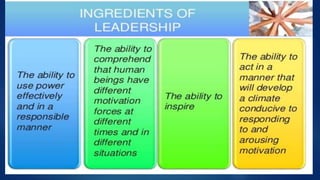
 INGREDIENTS OF LEADERSHIP
 HISTORICALLY IMPORTANT STUDIES ON LEADERSHIP
 TRADITIONAL THEORIES OF LEADRESHIP
 MODERN THEORIES OF LEADERSHIP
 STYLES OF LEADERSHIP
 LEADERSHIP DEVELOPMENT
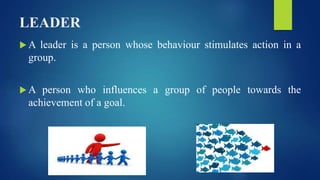
LEADER
 A leader is a person whose behaviour stimulates action in a
group.
 A person who influences a group of people towards the
achievement of a goal.
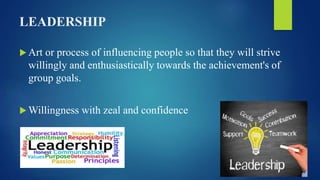
LEADERSHIP
 Art or process of influencing people so that they will strive
willingly and enthusiastically towards the achievement's of
group goals.
 Willingness with zeal and confidence
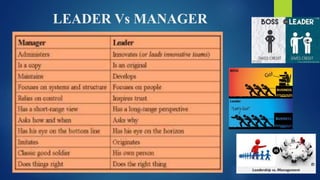
LEADER Vs MANAGER
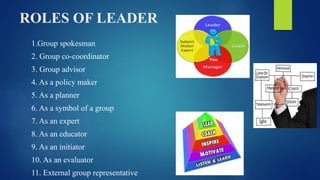
ROLES OF LEADER
1.Group spokesman
2. Group co-coordinator
3. Group advisor
4. As a policy maker
5. As a planner
6. As a symbol of a group
7. As an expert
8. As an educator
9. As an initiator
10. As an evaluator
11. External group representative
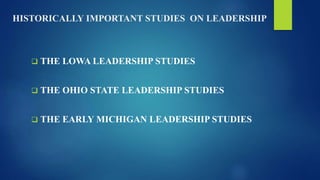
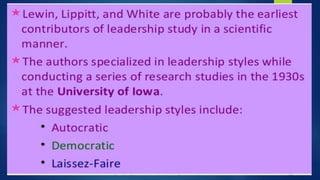
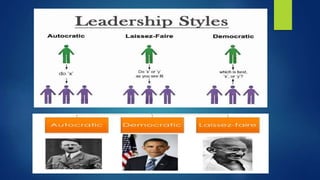
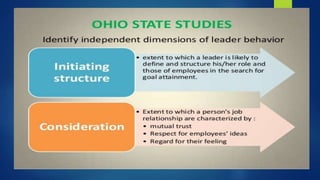
HISTORICALLY IMPORTANT STUDIES ON LEADERSHIP
 THE LOWA LEADERSHIP STUDIES
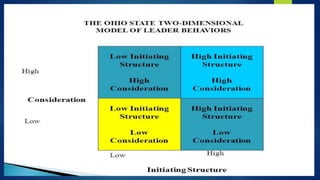
 THE OHIO STATE LEADERSHIP STUDIES
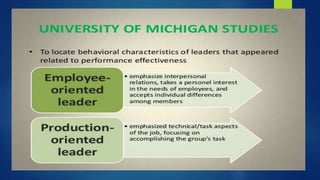
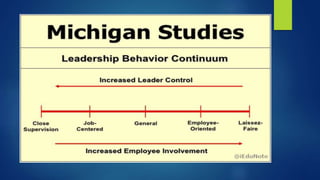
 THE EARLY MICHIGAN LEADERSHIP STUDIES
TRADITIONAL THEORIES OF LEADERSHIP
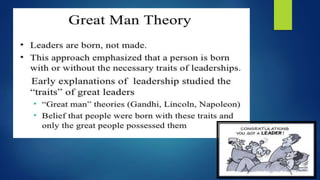
 GREAT MAN THEORY
 TRAIT THEORY
 GROUP AND EXCHANGE THEORY
 CONTIGENCY THEORY
 PATH GOAL THEORY
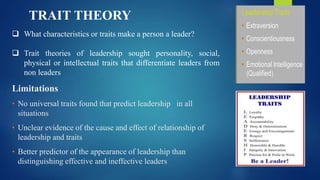
 What characteristics or traits make a person a leader?
 Trait theories of leadership sought personality, social,
physical or intellectual traits that differentiate leaders from
non leaders
Limitations
• No universal traits found that predict leadership in all
situations
• Unclear evidence of the cause and effect of relationship of
leadership and traits
• Better predictor of the appearance of leadership than
distinguishing effective and ineffective leaders
TRAIT THEORY
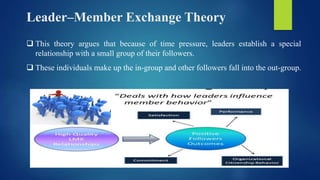
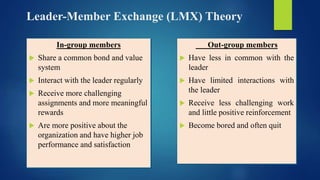
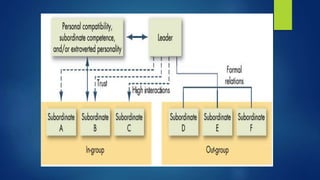
Leader–Member Exchange Theory
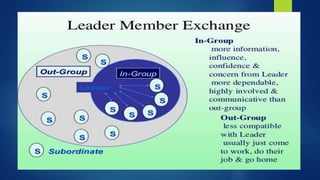
 This theory argues that because of time pressure, leaders establish a special
relationship with a small group of their followers.
 These individuals make up the in-group and other followers fall into the out-group.
Leader-Member Exchange (LMX) Theory
In-group members
 Share a common bond and value
system
 Interact with the leader regularly
 Receive more challenging
assignments and more meaningful
rewards
 Are more positive about the
organization and have higher job
performance and satisfaction
Out-group members
 Have less in common with the
leader
 Have limited interactions with
the leader
 Receive less challenging work
and little positive reinforcement
 Become bored and often quit
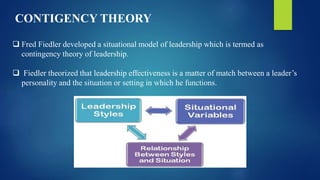
 Fred Fiedler developed a situational model of leadership which is termed as
contingency theory of leadership.
 Fiedler theorized that leadership effectiveness is a matter of match between a leader’s
personality and the situation or setting in which he functions.
CONTIGENCY THEORY
 Least Preferred Co-Worker (LPC) Questionnaire
An instrument that purports to measure whether a person is task- or relationship-oriented.
 He distinguished two leadership personalities which are poles apart:
1.Task oriented leaders and
2. Human relations oriented leaders
 He further classified that:
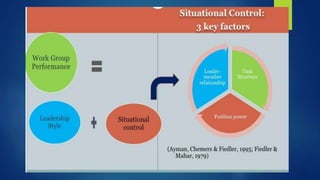
1. Leader-member relations may be: good or poor
2. Task structure may be :high or low
3. Position power may be :strong or weak.
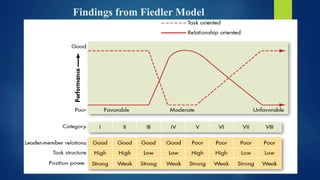
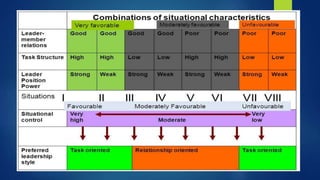
 By mixing these three contingency variables, there are different eight situations in which a
leader can find him self.
 He further classified these eight situations as
 very favorable,
 moderately favorable
 very unfavorable
Findings from Fiedler Model
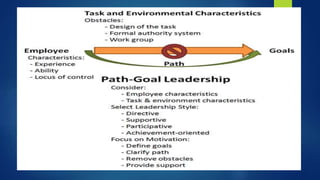
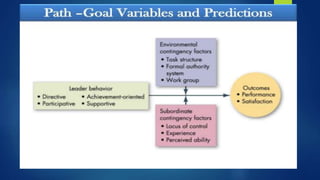
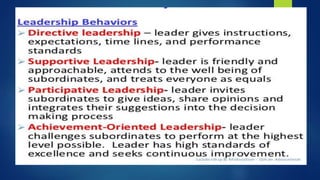
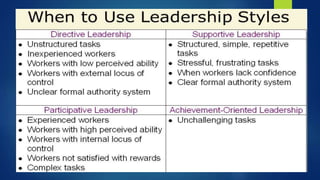
Path-Goal Theory
 based on specifying a leader's style or behavior that best fits the employee and work
environment in order to achieve a goal (House, Mitchell, 1974).
 The goal is to increase your employees' motivation, empowerment, and satisfaction
so they become productive members of the organization.
 Path-Goal is based on Vroom's (1964) expectancy theory in which an individual will
act in a certain way based on the expectation that the act will be followed by a given
outcome and on the attractiveness of that outcome to the individual. The path-goal
theory was first introduced by Martin Evans (1970) and then further developed by
House (1971).
 It best be thought of as a process in which leaders select specific behaviors that are
best suited to the employees' needs and the working environment so that they may
best guide the employees through their path in the obtainment of their daily work
activities (goals) (Northouse, 2013).
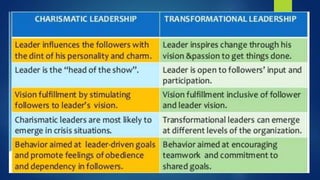
 CHRISMATIC LEADERSHIP
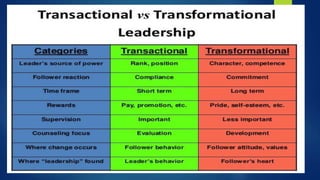
 TRANSFORMATIONAL LEADERSHIP
 TRANSACTIONAL LEADERSHIP
 AUTHENTIC LEADERSHIP
MODERN THEORIES OF LEADERSHIP
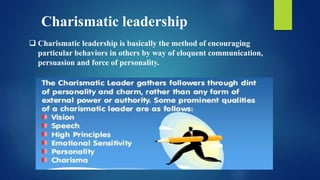
 Charismatic leadership is basically the method of encouraging
particular behaviors in others by way of eloquent communication,
persuasion and force of personality.
Charismatic leadership
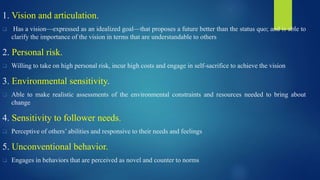
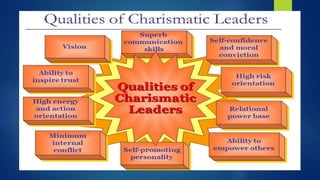
1. Vision and articulation.
 Has a vision—expressed as an idealized goal—that proposes a future better than the status quo; and is able to
clarify the importance of the vision in terms that are understandable to others
2. Personal risk.
 Willing to take on high personal risk, incur high costs and engage in self-sacrifice to achieve the vision
3. Environmental sensitivity.
 Able to make realistic assessments of the environmental constraints and resources needed to bring about
change
4. Sensitivity to follower needs.
 Perceptive of others’ abilities and responsive to their needs and feelings
5. Unconventional behavior.
 Engages in behaviors that are perceived as novel and counter to norms
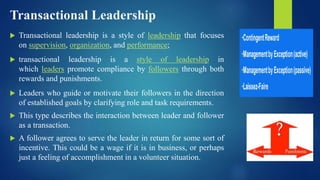
Transactional Leadership
 Transactional leadership is a style of leadership that focuses
on supervision, organization, and performance;
 transactional leadership is a style of leadership in
which leaders promote compliance by followers through both
rewards and punishments.
 Leaders who guide or motivate their followers in the direction
of established goals by clarifying role and task requirements.
 This type describes the interaction between leader and follower
as a transaction.
 A follower agrees to serve the leader in return for some sort of
incentive. This could be a wage if it is in business, or perhaps
just a feeling of accomplishment in a volunteer situation.
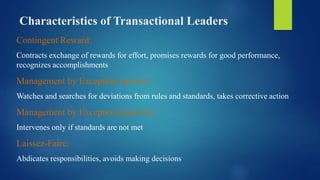
Characteristics of Transactional Leaders
Contingent Reward:
Contracts exchange of rewards for effort, promises rewards for good performance,
recognizes accomplishments
Management by Exception (active):
Watches and searches for deviations from rules and standards, takes corrective action
Management by Exception (passive):
Intervenes only if standards are not met
Laissez-Faire:
Abdicates responsibilities, avoids making decisions
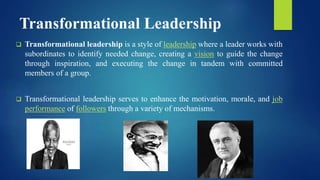
Transformational Leadership
 Transformational leadership is a style of leadership where a leader works with
subordinates to identify needed change, creating a vision to guide the change
through inspiration, and executing the change in tandem with committed
members of a group.
 Transformational leadership serves to enhance the motivation, morale, and job
performance of followers through a variety of mechanisms.
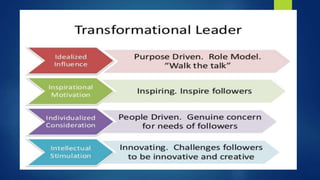
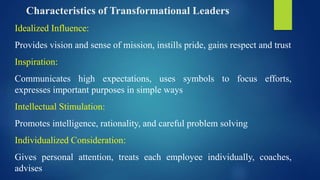
Characteristics of Transformational Leaders
Idealized Influence:
Provides vision and sense of mission, instills pride, gains respect and trust
Inspiration:
Communicates high expectations, uses symbols to focus efforts,
expresses important purposes in simple ways
Intellectual Stimulation:
Promotes intelligence, rationality, and careful problem solving
Individualized Consideration:
Gives personal attention, treats each employee individually, coaches,
advises
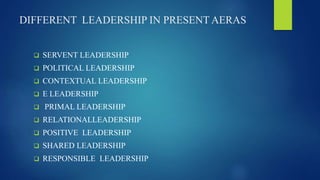
DIFFERENT LEADERSHIP IN PRESENT AERAS
 SERVENT LEADERSHIP
 POLITICAL LEADERSHIP
 CONTEXTUAL LEADERSHIP
 E LEADERSHIP
 PRIMAL LEADERSHIP
 RELATIONALLEADERSHIP
 POSITIVE LEADERSHIP
 SHARED LEADERSHIP
 RESPONSIBLE LEADERSHIP
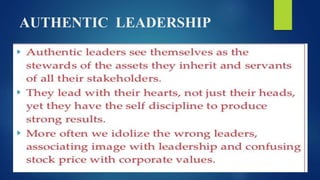
AUTHENTIC LEADERSHIP
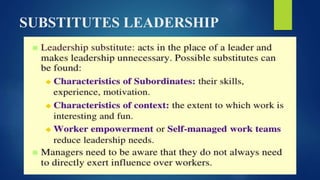
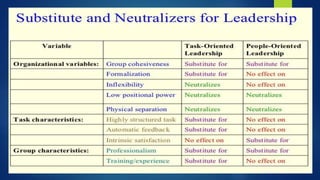
SUBSTITUTES LEADERSHIP
LEADERSHIP STYLES
MANAGERIAL GRID
LIKERTS LEADERSHIP STYLE
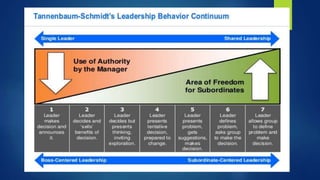
TANNENBAUM & SCHMIDT STYLE
HERSEY AND BLANCHARD’S SITUATIONAL
LEADERSHIP
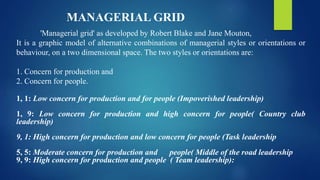
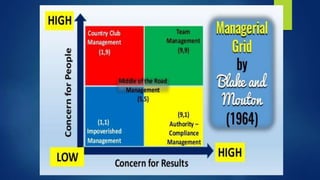
'Managerial grid' as developed by Robert Blake and Jane Mouton,
It is a graphic model of alternative combinations of managerial styles or orientations or
behaviour, on a two dimensional space. The two styles or orientations are:
1. Concern for production and
2. Concern for people.
1, 1: Low concern for production and for people (Impoverished leadership)
1, 9: Low concern for production and high concern for people( Country club
leadership)
9, 1: High concern for production and low concern for people (Task leadership
5, 5: Moderate concern for production and people( Middle of the road leadership
9, 9: High concern for production and people ( Team leadership):
MANAGERIAL GRID
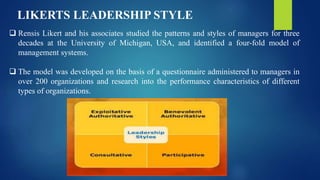
 Rensis Likert and his associates studied the patterns and styles of managers for three
decades at the University of Michigan, USA, and identified a four-fold model of
management systems.
 The model was developed on the basis of a questionnaire administered to managers in
over 200 organizations and research into the performance characteristics of different
types of organizations.
LIKERTS LEADERSHIP STYLE
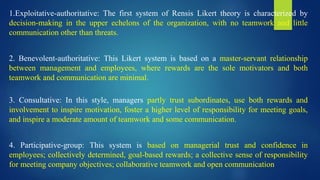
1.Exploitative-authoritative: The first system of Rensis Likert theory is characterized by
decision-making in the upper echelons of the organization, with no teamwork and little
communication other than threats.
2. Benevolent-authoritative: This Likert system is based on a master-servant relationship
between management and employees, where rewards are the sole motivators and both
teamwork and communication are minimal.
3. Consultative: In this style, managers partly trust subordinates, use both rewards and
involvement to inspire motivation, foster a higher level of responsibility for meeting goals,
and inspire a moderate amount of teamwork and some communication.
4. Participative-group: This system is based on managerial trust and confidence in
employees; collectively determined, goal-based rewards; a collective sense of responsibility
for meeting company objectives; collaborative teamwork and open communication
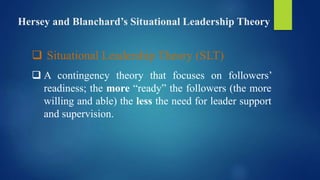
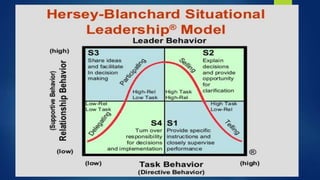
Hersey and Blanchard’s Situational Leadership Theory
 Situational Leadership Theory (SLT)
 A contingency theory that focuses on followers’
readiness; the more “ready” the followers (the more
willing and able) the less the need for leader support
and supervision.
Finding and Creating Effective Leaders
 Selection
 Review specific requirements for the job
 Use tests that identify personal traits associated with leadership, measure self-
monitoring, and assess emotional intelligence
 Conduct personal interviews to determine candidate’s fit with the job
 Training
 Recognize that all people are not equally trainable
 Teach skills that are necessary for employees to become effective leaders
 Provide behavioral training to increase the development potential of nascent
charismatic employees
Leadership

Leadership

  • 1.
  • 2.
    CONTENT  LEADER  LEADERSHIP LEADER VS MANAGER  INGREDIENTS OF LEADERSHIP  HISTORICALLY IMPORTANT STUDIES ON LEADERSHIP  TRADITIONAL THEORIES OF LEADRESHIP  MODERN THEORIES OF LEADERSHIP  STYLES OF LEADERSHIP  LEADERSHIP DEVELOPMENT
  • 3.
    LEADER  A leaderis a person whose behaviour stimulates action in a group.  A person who influences a group of people towards the achievement of a goal.
  • 4.
    LEADERSHIP  Art orprocess of influencing people so that they will strive willingly and enthusiastically towards the achievement's of group goals.  Willingness with zeal and confidence
  • 5.
  • 7.
    ROLES OF LEADER 1.Groupspokesman 2. Group co-coordinator 3. Group advisor 4. As a policy maker 5. As a planner 6. As a symbol of a group 7. As an expert 8. As an educator 9. As an initiator 10. As an evaluator 11. External group representative
  • 8.
    HISTORICALLY IMPORTANT STUDIESON LEADERSHIP  THE LOWA LEADERSHIP STUDIES  THE OHIO STATE LEADERSHIP STUDIES  THE EARLY MICHIGAN LEADERSHIP STUDIES
  • 15.
    TRADITIONAL THEORIES OFLEADERSHIP  GREAT MAN THEORY  TRAIT THEORY  GROUP AND EXCHANGE THEORY  CONTIGENCY THEORY  PATH GOAL THEORY
  • 17.
     What characteristicsor traits make a person a leader?  Trait theories of leadership sought personality, social, physical or intellectual traits that differentiate leaders from non leaders Limitations • No universal traits found that predict leadership in all situations • Unclear evidence of the cause and effect of relationship of leadership and traits • Better predictor of the appearance of leadership than distinguishing effective and ineffective leaders TRAIT THEORY
  • 18.
    Leader–Member Exchange Theory This theory argues that because of time pressure, leaders establish a special relationship with a small group of their followers.  These individuals make up the in-group and other followers fall into the out-group.
  • 20.
    Leader-Member Exchange (LMX)Theory In-group members  Share a common bond and value system  Interact with the leader regularly  Receive more challenging assignments and more meaningful rewards  Are more positive about the organization and have higher job performance and satisfaction Out-group members  Have less in common with the leader  Have limited interactions with the leader  Receive less challenging work and little positive reinforcement  Become bored and often quit
  • 22.
     Fred Fiedlerdeveloped a situational model of leadership which is termed as contingency theory of leadership.  Fiedler theorized that leadership effectiveness is a matter of match between a leader’s personality and the situation or setting in which he functions. CONTIGENCY THEORY
  • 24.
     Least PreferredCo-Worker (LPC) Questionnaire An instrument that purports to measure whether a person is task- or relationship-oriented.  He distinguished two leadership personalities which are poles apart: 1.Task oriented leaders and 2. Human relations oriented leaders  He further classified that: 1. Leader-member relations may be: good or poor 2. Task structure may be :high or low 3. Position power may be :strong or weak.  By mixing these three contingency variables, there are different eight situations in which a leader can find him self.  He further classified these eight situations as  very favorable,  moderately favorable  very unfavorable
  • 25.
  • 27.
    Path-Goal Theory  basedon specifying a leader's style or behavior that best fits the employee and work environment in order to achieve a goal (House, Mitchell, 1974).  The goal is to increase your employees' motivation, empowerment, and satisfaction so they become productive members of the organization.  Path-Goal is based on Vroom's (1964) expectancy theory in which an individual will act in a certain way based on the expectation that the act will be followed by a given outcome and on the attractiveness of that outcome to the individual. The path-goal theory was first introduced by Martin Evans (1970) and then further developed by House (1971).  It best be thought of as a process in which leaders select specific behaviors that are best suited to the employees' needs and the working environment so that they may best guide the employees through their path in the obtainment of their daily work activities (goals) (Northouse, 2013).
  • 32.
     CHRISMATIC LEADERSHIP TRANSFORMATIONAL LEADERSHIP  TRANSACTIONAL LEADERSHIP  AUTHENTIC LEADERSHIP MODERN THEORIES OF LEADERSHIP
  • 33.
     Charismatic leadershipis basically the method of encouraging particular behaviors in others by way of eloquent communication, persuasion and force of personality. Charismatic leadership
  • 34.
    1. Vision andarticulation.  Has a vision—expressed as an idealized goal—that proposes a future better than the status quo; and is able to clarify the importance of the vision in terms that are understandable to others 2. Personal risk.  Willing to take on high personal risk, incur high costs and engage in self-sacrifice to achieve the vision 3. Environmental sensitivity.  Able to make realistic assessments of the environmental constraints and resources needed to bring about change 4. Sensitivity to follower needs.  Perceptive of others’ abilities and responsive to their needs and feelings 5. Unconventional behavior.  Engages in behaviors that are perceived as novel and counter to norms
  • 36.
    Transactional Leadership  Transactionalleadership is a style of leadership that focuses on supervision, organization, and performance;  transactional leadership is a style of leadership in which leaders promote compliance by followers through both rewards and punishments.  Leaders who guide or motivate their followers in the direction of established goals by clarifying role and task requirements.  This type describes the interaction between leader and follower as a transaction.  A follower agrees to serve the leader in return for some sort of incentive. This could be a wage if it is in business, or perhaps just a feeling of accomplishment in a volunteer situation.
  • 37.
    Characteristics of TransactionalLeaders Contingent Reward: Contracts exchange of rewards for effort, promises rewards for good performance, recognizes accomplishments Management by Exception (active): Watches and searches for deviations from rules and standards, takes corrective action Management by Exception (passive): Intervenes only if standards are not met Laissez-Faire: Abdicates responsibilities, avoids making decisions
  • 38.
    Transformational Leadership  Transformationalleadership is a style of leadership where a leader works with subordinates to identify needed change, creating a vision to guide the change through inspiration, and executing the change in tandem with committed members of a group.  Transformational leadership serves to enhance the motivation, morale, and job performance of followers through a variety of mechanisms.
  • 40.
    Characteristics of TransformationalLeaders Idealized Influence: Provides vision and sense of mission, instills pride, gains respect and trust Inspiration: Communicates high expectations, uses symbols to focus efforts, expresses important purposes in simple ways Intellectual Stimulation: Promotes intelligence, rationality, and careful problem solving Individualized Consideration: Gives personal attention, treats each employee individually, coaches, advises
  • 43.
    DIFFERENT LEADERSHIP INPRESENT AERAS  SERVENT LEADERSHIP  POLITICAL LEADERSHIP  CONTEXTUAL LEADERSHIP  E LEADERSHIP  PRIMAL LEADERSHIP  RELATIONALLEADERSHIP  POSITIVE LEADERSHIP  SHARED LEADERSHIP  RESPONSIBLE LEADERSHIP
  • 44.
  • 45.
  • 47.
    LEADERSHIP STYLES MANAGERIAL GRID LIKERTSLEADERSHIP STYLE TANNENBAUM & SCHMIDT STYLE HERSEY AND BLANCHARD’S SITUATIONAL LEADERSHIP
  • 48.
    'Managerial grid' asdeveloped by Robert Blake and Jane Mouton, It is a graphic model of alternative combinations of managerial styles or orientations or behaviour, on a two dimensional space. The two styles or orientations are: 1. Concern for production and 2. Concern for people. 1, 1: Low concern for production and for people (Impoverished leadership) 1, 9: Low concern for production and high concern for people( Country club leadership) 9, 1: High concern for production and low concern for people (Task leadership 5, 5: Moderate concern for production and people( Middle of the road leadership 9, 9: High concern for production and people ( Team leadership): MANAGERIAL GRID
  • 50.
     Rensis Likertand his associates studied the patterns and styles of managers for three decades at the University of Michigan, USA, and identified a four-fold model of management systems.  The model was developed on the basis of a questionnaire administered to managers in over 200 organizations and research into the performance characteristics of different types of organizations. LIKERTS LEADERSHIP STYLE
  • 51.
    1.Exploitative-authoritative: The firstsystem of Rensis Likert theory is characterized by decision-making in the upper echelons of the organization, with no teamwork and little communication other than threats. 2. Benevolent-authoritative: This Likert system is based on a master-servant relationship between management and employees, where rewards are the sole motivators and both teamwork and communication are minimal. 3. Consultative: In this style, managers partly trust subordinates, use both rewards and involvement to inspire motivation, foster a higher level of responsibility for meeting goals, and inspire a moderate amount of teamwork and some communication. 4. Participative-group: This system is based on managerial trust and confidence in employees; collectively determined, goal-based rewards; a collective sense of responsibility for meeting company objectives; collaborative teamwork and open communication
  • 53.
    Hersey and Blanchard’sSituational Leadership Theory  Situational Leadership Theory (SLT)  A contingency theory that focuses on followers’ readiness; the more “ready” the followers (the more willing and able) the less the need for leader support and supervision.
  • 55.
    Finding and CreatingEffective Leaders  Selection  Review specific requirements for the job  Use tests that identify personal traits associated with leadership, measure self- monitoring, and assess emotional intelligence  Conduct personal interviews to determine candidate’s fit with the job  Training  Recognize that all people are not equally trainable  Teach skills that are necessary for employees to become effective leaders  Provide behavioral training to increase the development potential of nascent charismatic employees