HRM HUMAN  RESOURCE  OR  HUMAN  RELATIONS  MANAGEMENT Personnel Management is a function of managing people.  PM  is also called  HRM.
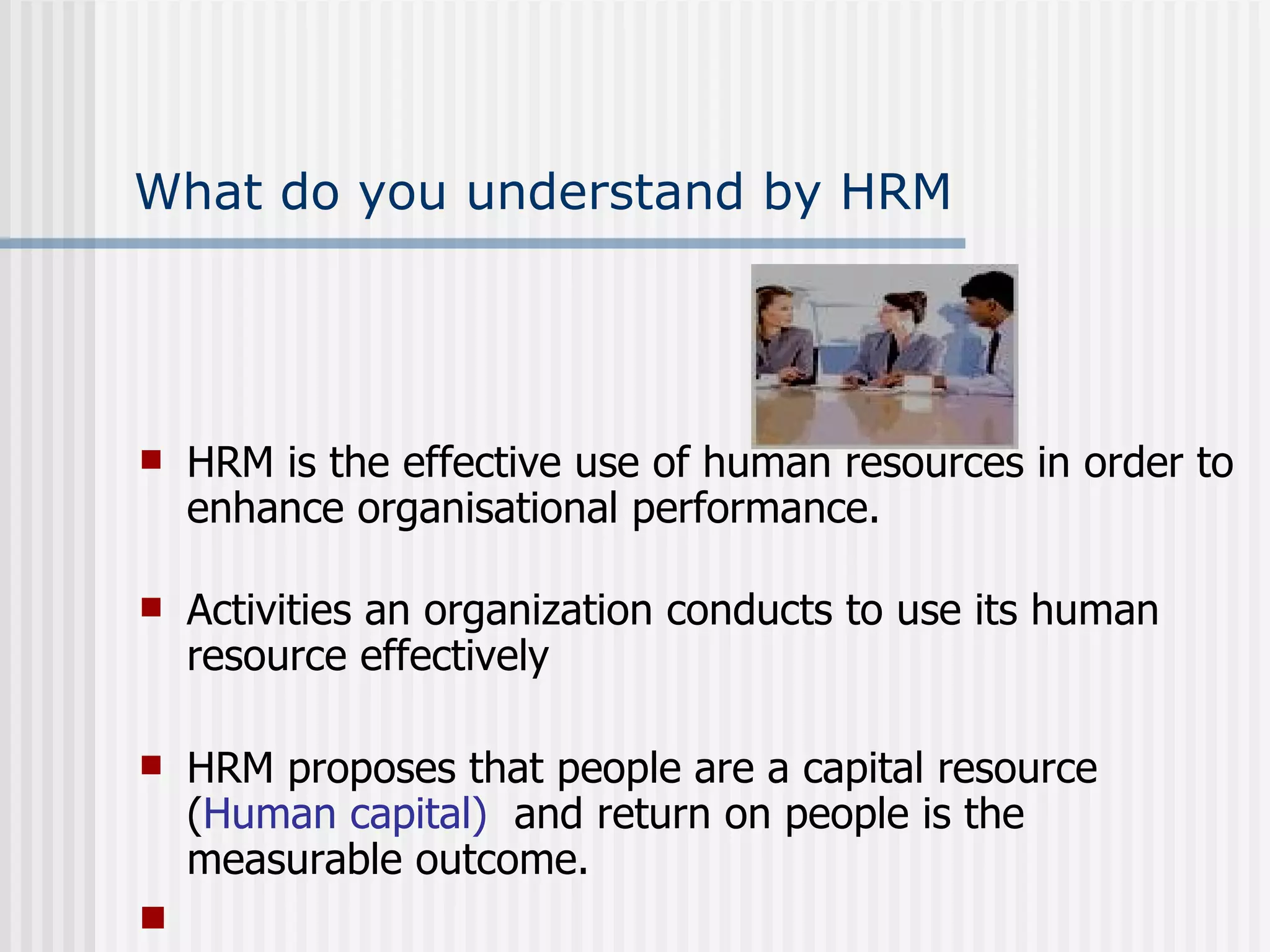
What do you understand by HRM HRM is the effective use of human resources in order to enhance organisational performance. Activities an organization conducts to use its human resource effectively HRM proposes that people are a capital resource ( Human capital)  and return on people is the measurable outcome.  
What is  HRM ? Origins . - HRM-type themes, including ‘ human capital theory’ and 'human asset accounting',  can be found in the literature from the 1970s.  The modern view of HRM gained prominence in 1981 - introduction in the prestigious MBA course at  Harvard Business School.  Simultaneously, other interpretations were being developed in Michigan and New York
Brief History of HRM.  History of HRM can be characterized in two ways   (1) as moving through 4 broad phases. (2) Through the 20 th  century. (1)  as moving through 4 broad phases  : A . The craft system:   Craft guilds supervised quality,production,methods,conditions of employment. Senior (master) worker controlled guilds-recruit entered after long-rigorous training. Best suited for domestic industry.  Mass production deteriorated craft guilds.
Brief History of HRM.  History of HRM can be characterized in two ways ( B) Scientific Management  : Early 20 th  century. Tasks were divided into parts among unskilled workers. Large hierarchy of supervisors and managers became necessary. Along came assembly line and a scientific approach to an analysis of working terms of its constituent parts.  Founder – American Mechanical Engineer  Fredrick Taylor.
Brief History of HRM.  History of HRM can be characterized in two ways ( C ) Human  Relations  Approach :  “in order to be productive and satisfied employees need to be understood”. Hawthorne studies: Elton Mayo and associates (1880-1949).Conducted at Western Electrical,Chicago. Studied effect of illumination on productivity-one group was told lighting is going to be changed –but not changed-workers were satisfied and productivity increased. Finding: significant variable was not physical but psychological.These findings led to lot of research on the social factors associated with work results-led to  Human Relations Movement.
Organizational Science  –Human  Resource  Approach: ( D )  Current organizational Science  –Human  Resource  Approach:  Focuses on total organization. Grew out of organizational science trend and combines learning from the previous movements with current research on  behavioural science.
Before we go on… Contents Module 1 Introduction  Nature and scope of HRM and HRD PM v/s HRM  Features and Role of HRM Managerial functions and operative functions Objectives of HRM policies-procedures and programmes. Line and staff and personnel management. Role and qualities of HR Manager
Objective of this module Objective of this module is To familiarize  students with various with various HRM terms. Introduce students  to fundamentals and importance of HRM. Duration…
Introduction HRM   starts from organization needs for HR with demand rather than supply. PM  is designed to achieve organizational objective-like profit maximization. HRM   gives equal importance to individual and organizational development.  HRM is dedicated to develop a suitable corporate culture. Programmes are designed and implemented to reflect the core values of the enterprises.
Introduction HRM  is deep rooted comprehensive activity taken up to improve the quality of human beings who are vital assets of the organization.  PM  is subsystem  of general management system. It concentrates on managing human element and other allied aspects HRM   is directed towards managerial needs for resource in organization, with greater emphasis on planning, monitoring and control rather than problem solving and mediation. A detailed study of people is the main function of HRM. !!!!!!
Introduction Study of HRM in college or reading  number of books  will not magically change one into an effective HR Manager.  A practical approach to human and organizational problems, clear analysis of  issues and thinking is what makes one an effective PM .  PM has to keep his head above water while moving ahead
Introduction P Management  is   one of the most challenging and complex  fields of study and work.  Firms requirement for an effective work force has to be met  and should be concerned with welfare of employee and society .
Books Personnel Management - Edwin Flippo 6 th  Edition Human resource management – Cynthia Fisher Personnel and HR Management – P.Subba Rao (Latest Edition) A good dictionary
What you have to do  Use a dictionary Listen carefully Serious Pre-class reading
What is human resource management?   The effective use of people to achieve both organizational and individual goals    The effective recruitment, selection, development, compensation, and utilization of human resources by organizations     The Harvard interpretation sees  employees as   resources.  They are fundamentally different from other resources - they cannot be managed in the same way.  The stress is on people as human resources.          
Why care about  HRM ? Impact on you as employees  Impact on you as managers  Potential future roles as HR professionals  Impact of  HRM  on organizations   
HRM   has increased in importance since the 1980s.  Why? People determine the success and failure of organizations and projects.  Globalization  Government regulation  Stronger knowledge/research base  Changing role for labor unions  Challenge of matching worker expectations with competitive demands   
Importance of HRM PERSONNEL – EMPLOYEES – STAFF  Organizations create rules or guidelines to encourage people working to accomplish organizational goals. To accomplish the objectives there is need to create good Industrial Relation.  For this Management has to  manage / lead   people effectively.  Cost reduction-down sizing are major concerns , but not at the cost of quality and losing out  to  competition.  Every Manager wants to deliver  quality goods and services . For this We  require  quality workforce. People and the way  they are managed are the major sources of competitive advantage.
Importance of HRM Personnel Management helps- build an effective and satisfied working team. “ “  Human factor of production “- skills, knowledge, physical , mental energy etc are given due consideration. Dale Yoder  said “ managing people is the heart and essence of being a manager. Success or progress  of an organization depends on how manager can motivate, understand, lead, inspire and activate them ”.
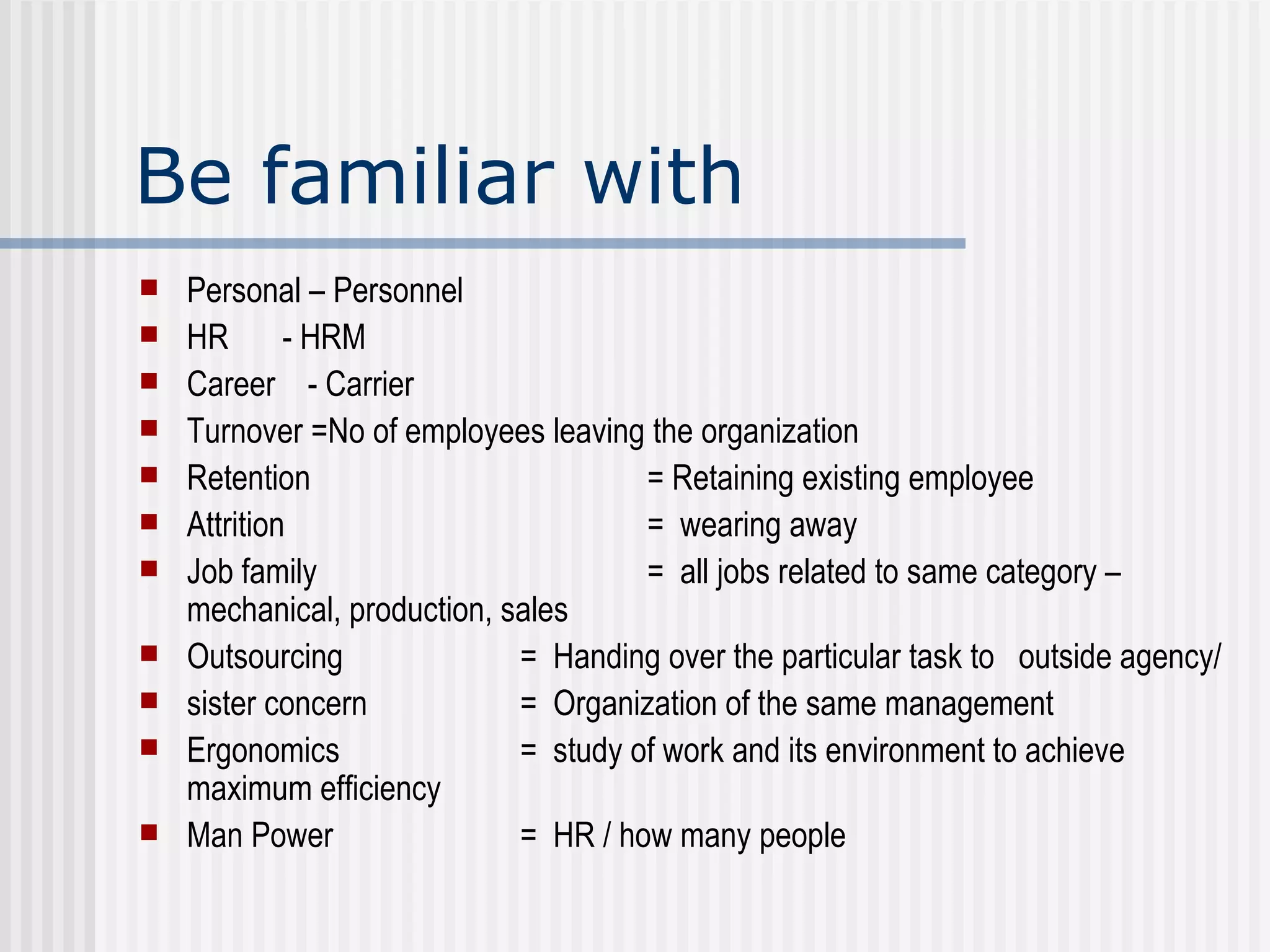
Be familiar with  Personal – Personnel HR   - HRM Career  - Carrier Turnover =No of employees leaving the organization Retention  = Retaining existing employee Attrition  =  wearing away Job family =  all jobs related to same category –   mechanical, production, sales  Outsourcing =  Handing over the particular task to  outside agency/ sister concern  =  Organization of the same management  Ergonomics =  study of work and its environment to achieve maximum efficiency Man Power  =  HR / how many people
Be familiar with HR = Human Resource HRM = Human Resource    Management HRP = Human Resource    Planning  MP =  Manpower Planning PBC =  Performance Based    Compensation NEP =  New Economic Policy GE =  Global Economy MBO =  Management By    Objective MBE =  Management By Exception  WPM =  Workers Participation
Definitions of HRM Definitions: D.  YODER and others “ HRM is the phase of the management , which deals with the effective control and use of manpower as distinguished from other sources of power.”.  “ The management of HR is a system - participants seek to attain both individual  and  group goals “ .  National Institute of PM “ it is that part of PM function which is primarily concerned with the human relationship within an organization. “
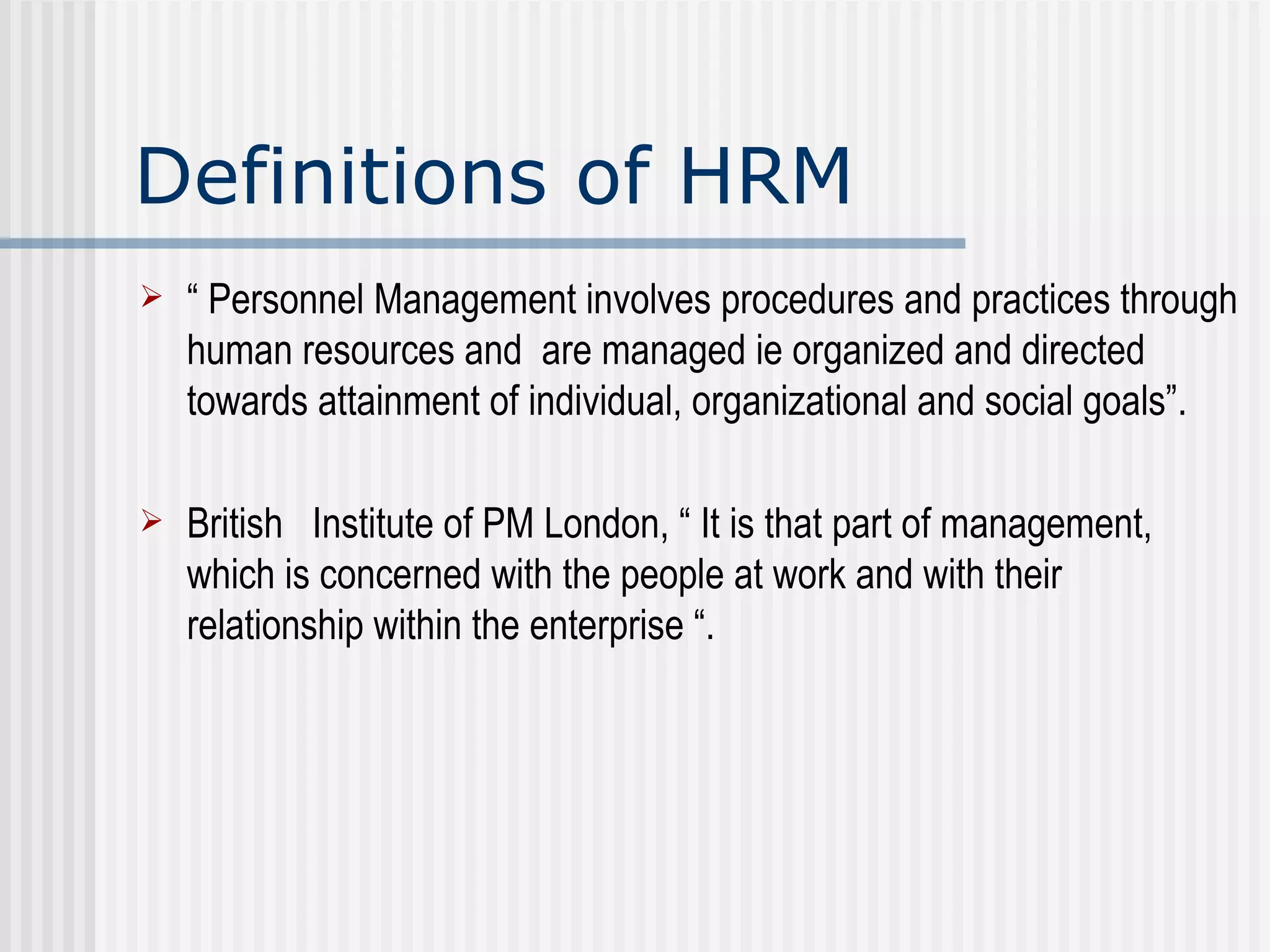
Definitions of HRM “  Personnel Management involves procedures and practices through human resources and  are managed ie organized and directed towards attainment of individual, organizational and social goals”.  British  Institute of PM London, “ It is that part of management, which is concerned with the people at work and with their relationship within the enterprise “.
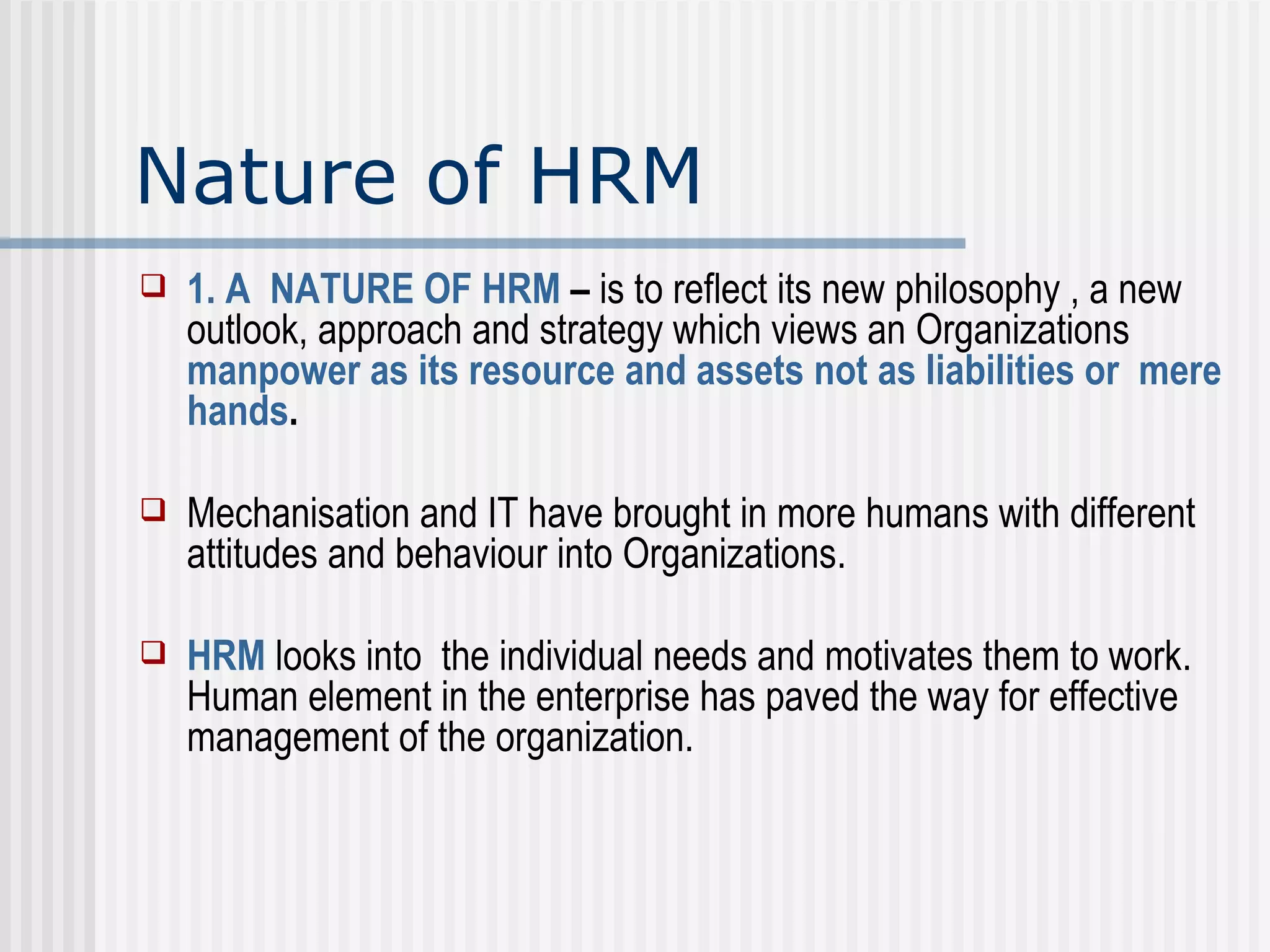
Nature of HRM 1. A  NATURE OF HRM  –  is to reflect its new philosophy , a new outlook, approach and strategy which views an Organizations  manpower as its resource   and assets not as liabilities or  mere hands .  Mechanisation and IT have brought in more humans with different attitudes and behaviour into Organizations.  HRM  looks into  the individual needs and motivates them to work. Human element in the enterprise has paved the way for effective management of the organization.
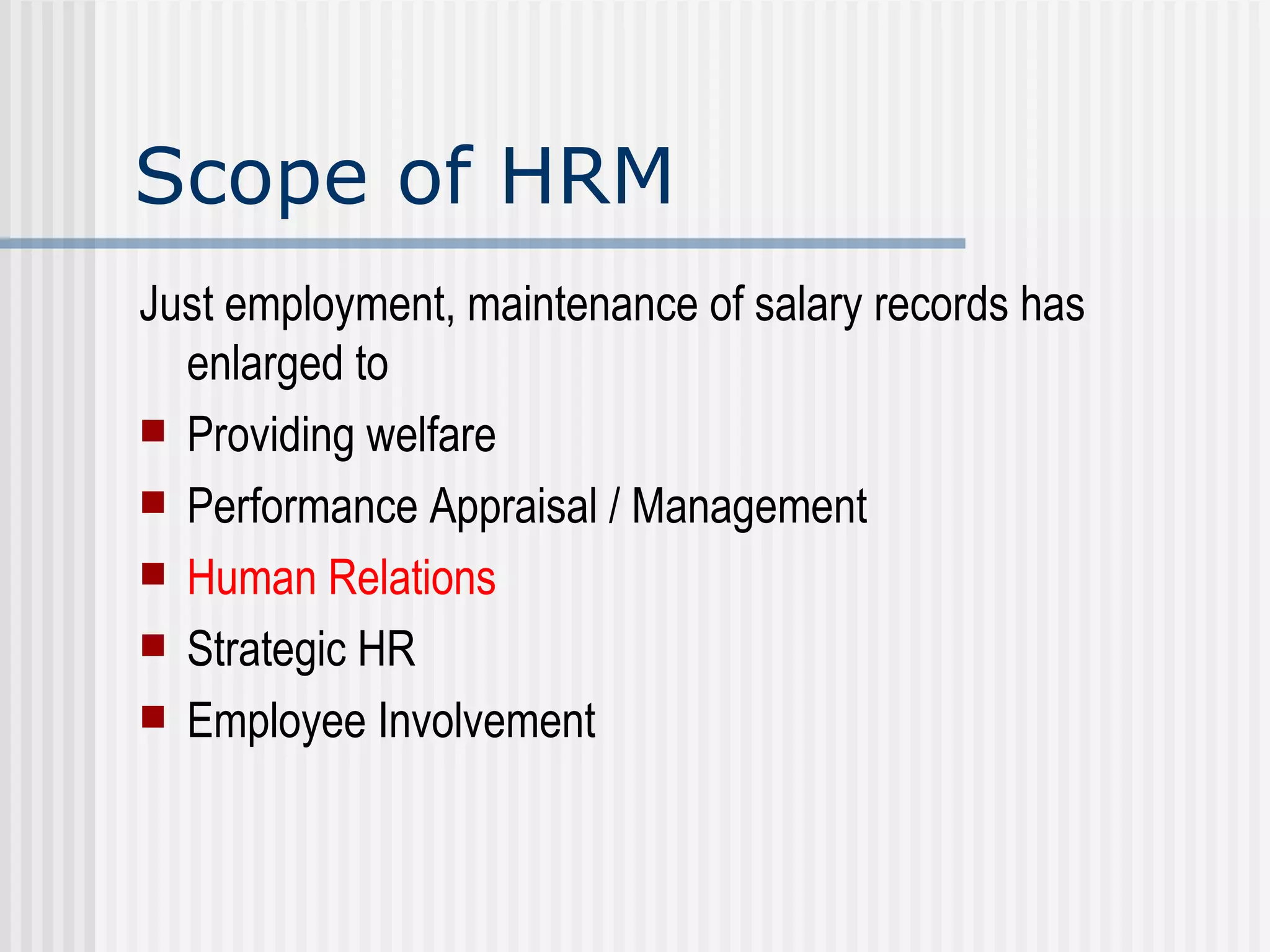
Scope of HRM Just employment, maintenance of salary records has enlarged to Providing welfare Performance Appraisal / Management Human Relations Strategic HR  Employee Involvement
Scope of HRM Manager’s job is administering a “  social system “. Personnel records is becoming more and more important so as to ensure the adaptability of personnel / employees. Labour Relations, Public Relations  and plant  security are Personnel sub areas – not left to be the sole  responsibility of Personnel Department. The scope is wide and varied  “ P. Department and P.Mnagers perform a variety of roles in accordance with the needs of a situation”. Personnel Managers play multiple roles –bargainers, conscience keepers, peace makers, counselors, Company spokespersons, problem solvers and  change managers.
Scope of HRM include Objectives of HRM Organization of HRM Employment & Development Wages, Salary, compensation –Administration Motivation Industrial Relations Participative Management
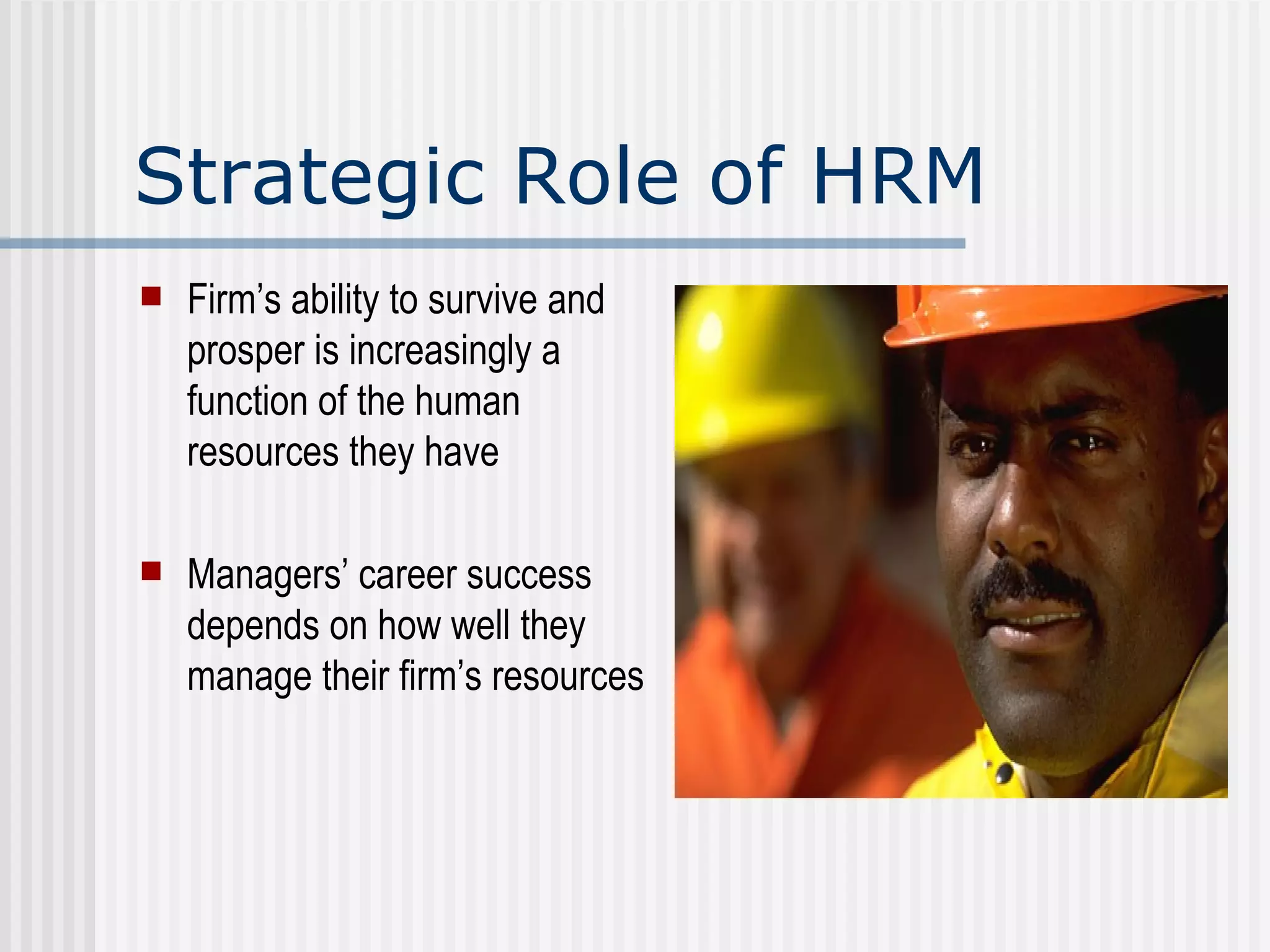
Strategic Role of HRM Firm’s ability to survive and prosper is increasingly a function of the human resources they have Managers’ career success depends on how well they manage their firm’s resources
HRM  v/s  PM HRM is proactive than reactive. Is goal oriented.  Treats labour as social capital  HRM  - starts from organization needs for HR with demand rather than supply.  PM  -  is directed  at the employees of the organization Finding, training, arranging pay and contracts of employment Explaining what is expected of them. justifying what management is doing. Trying to modify management action that could produce  an unwelcome response from the employees.
HRM  v/s  PM In modern HRM  principles and theories from  Psychology ,  Sociology , philosophy, economics and Management are combined. P Manager  ( worst  stage )  has to act as organizations social conscience. P Manager  ( best  stage  )  works as  a well informed specialist , with all members of the organization,  in determining and meeting the demands of the social role.
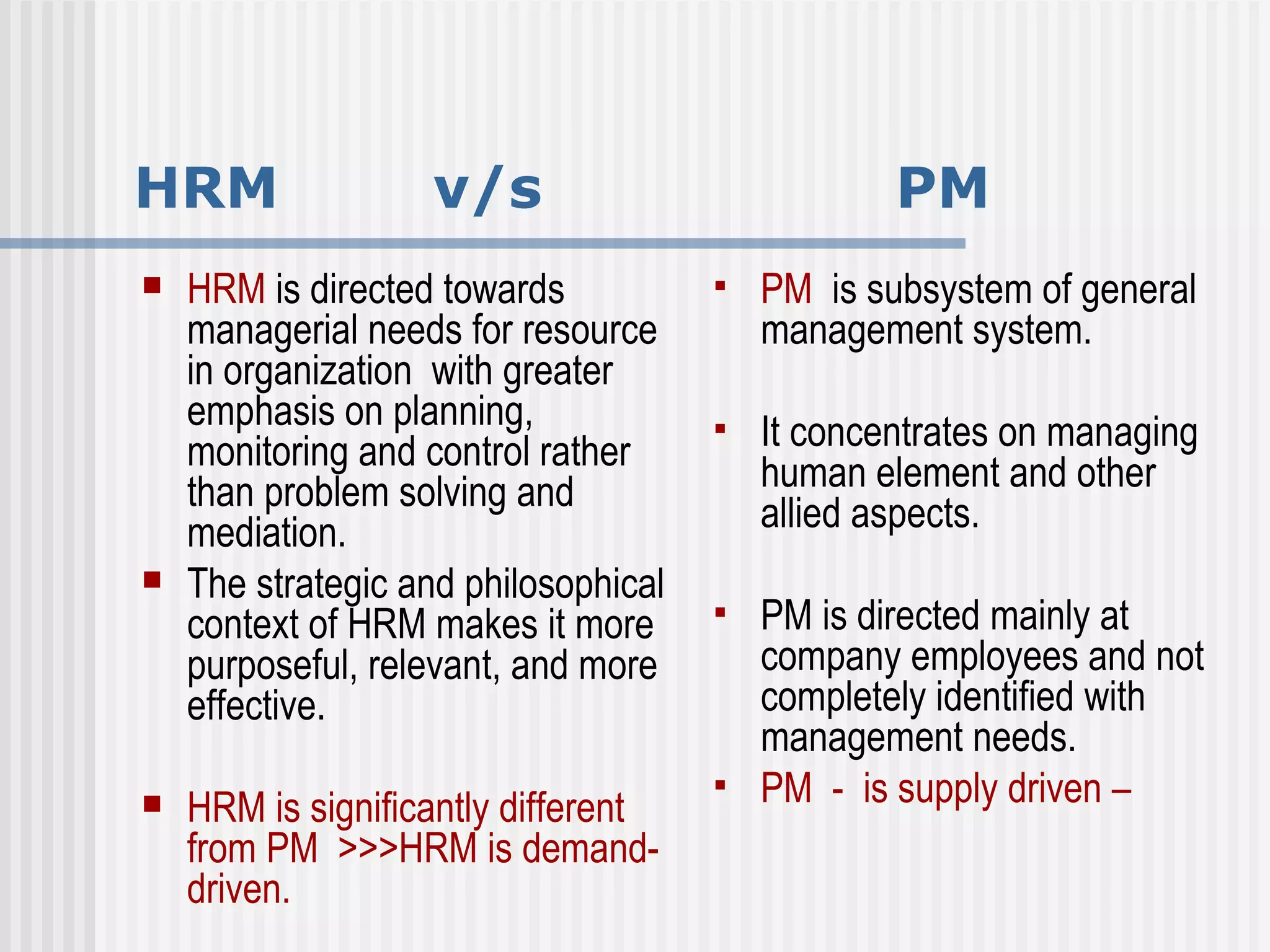
HRM  v/s  PM HRM  is directed towards managerial needs for resource in organization  with greater emphasis on planning, monitoring and control rather than problem solving and mediation.  The strategic and philosophical context of HRM makes it more purposeful, relevant, and more effective.  HRM is significantly different from PM  >>>HRM is demand-driven. PM  is subsystem of general management system.  It concentrates on managing human element and other allied aspects.  PM is directed mainly at company employees and not completely identified with management needs.  PM  -  is supply driven –
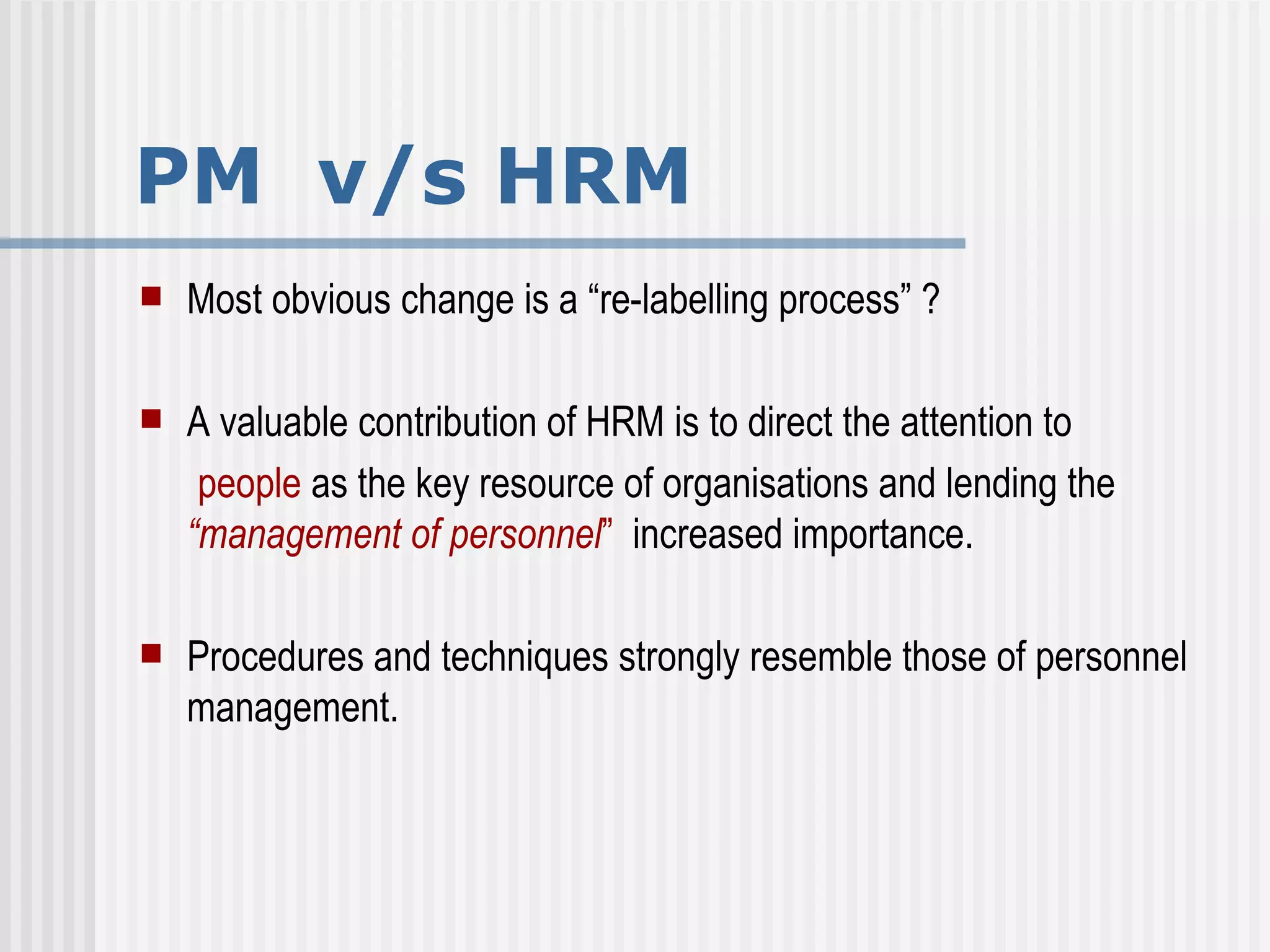
PM  v/s HRM Most obvious change is a “re-labelling process” ? A valuable contribution of HRM is to direct the attention to  people  as the key resource of organisations and lending the  “management of personnel ”   increased importance. Procedures and techniques strongly resemble those of personnel management.
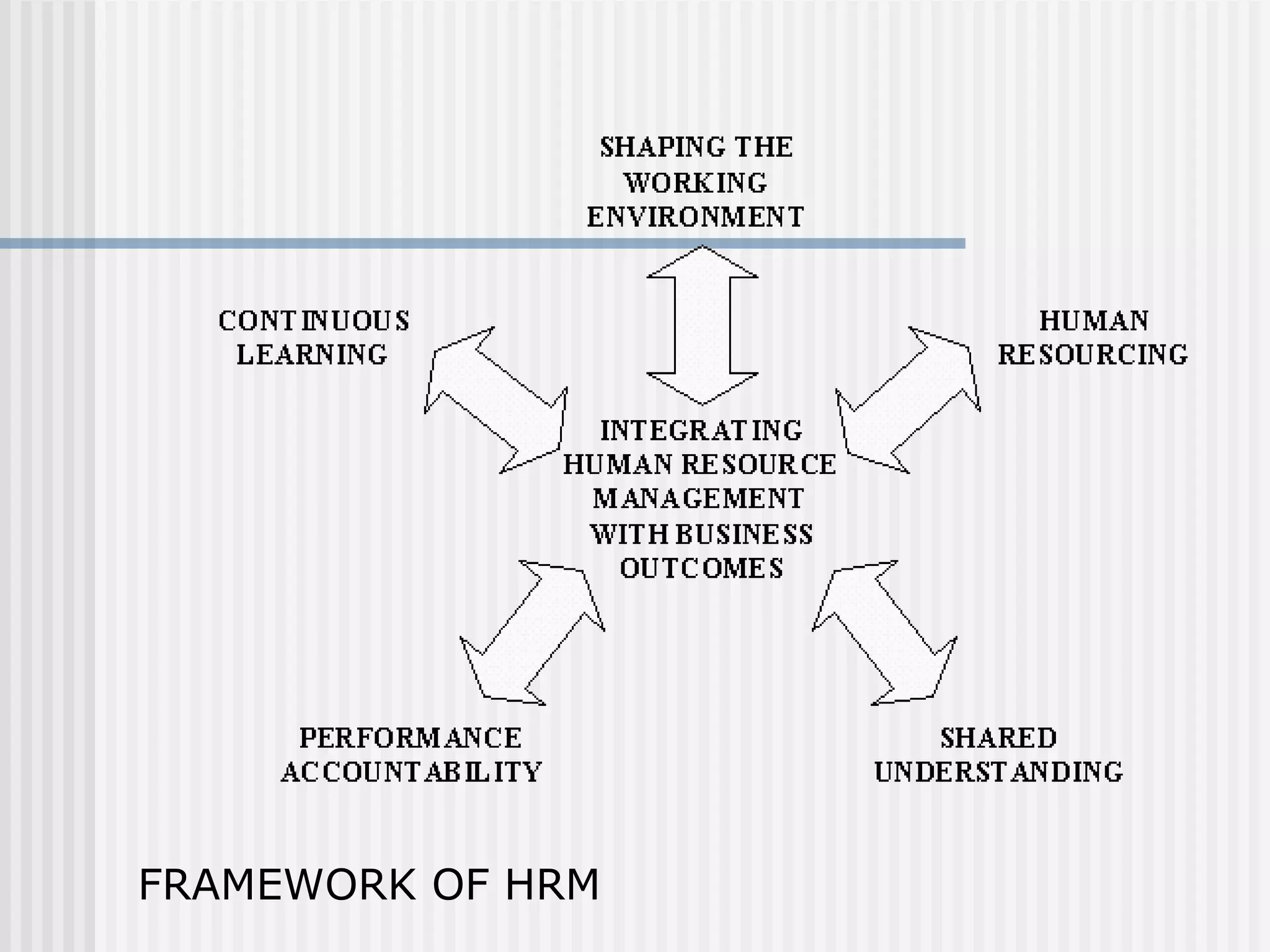
FRAMEWORK OF HRM
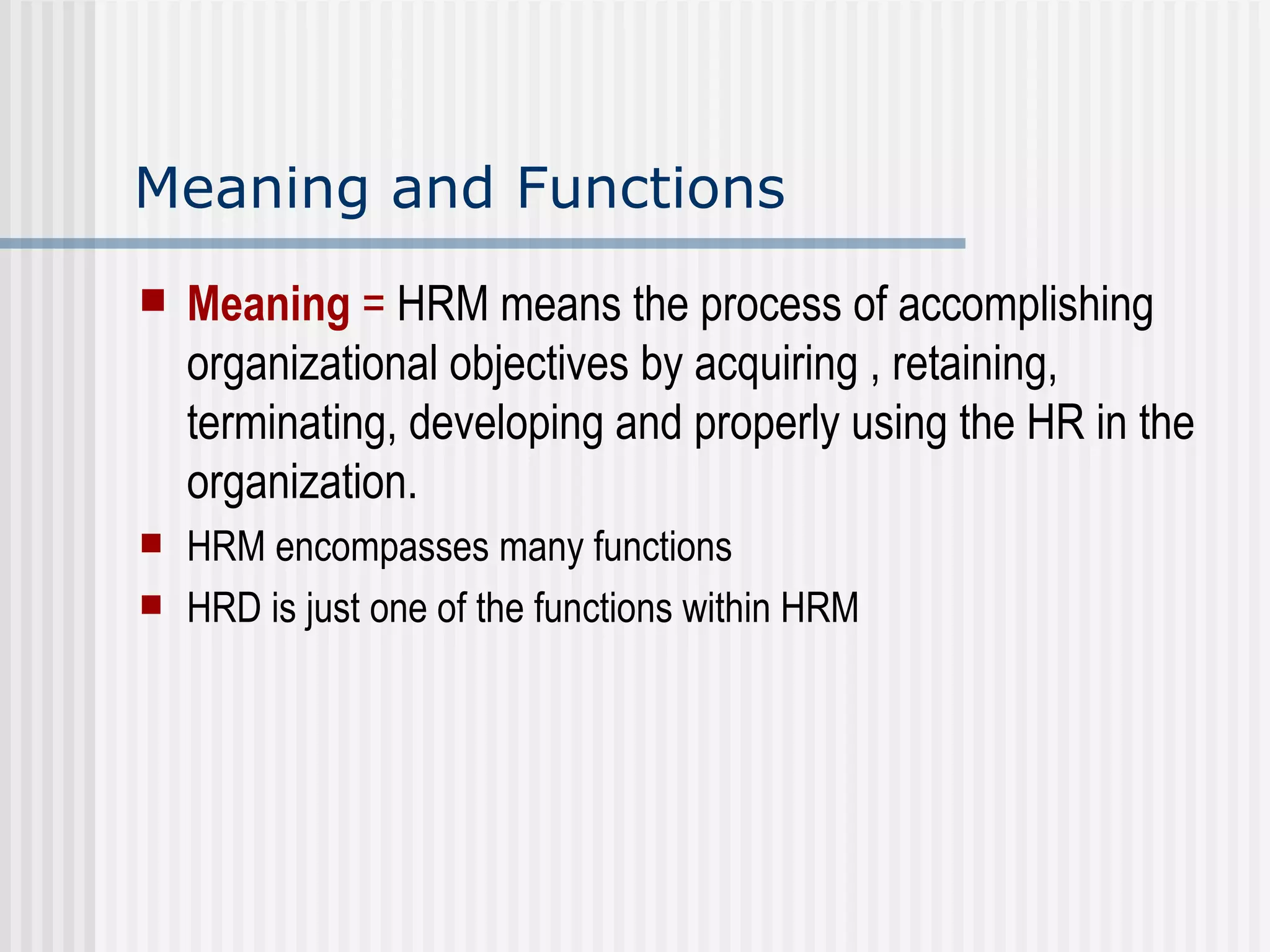
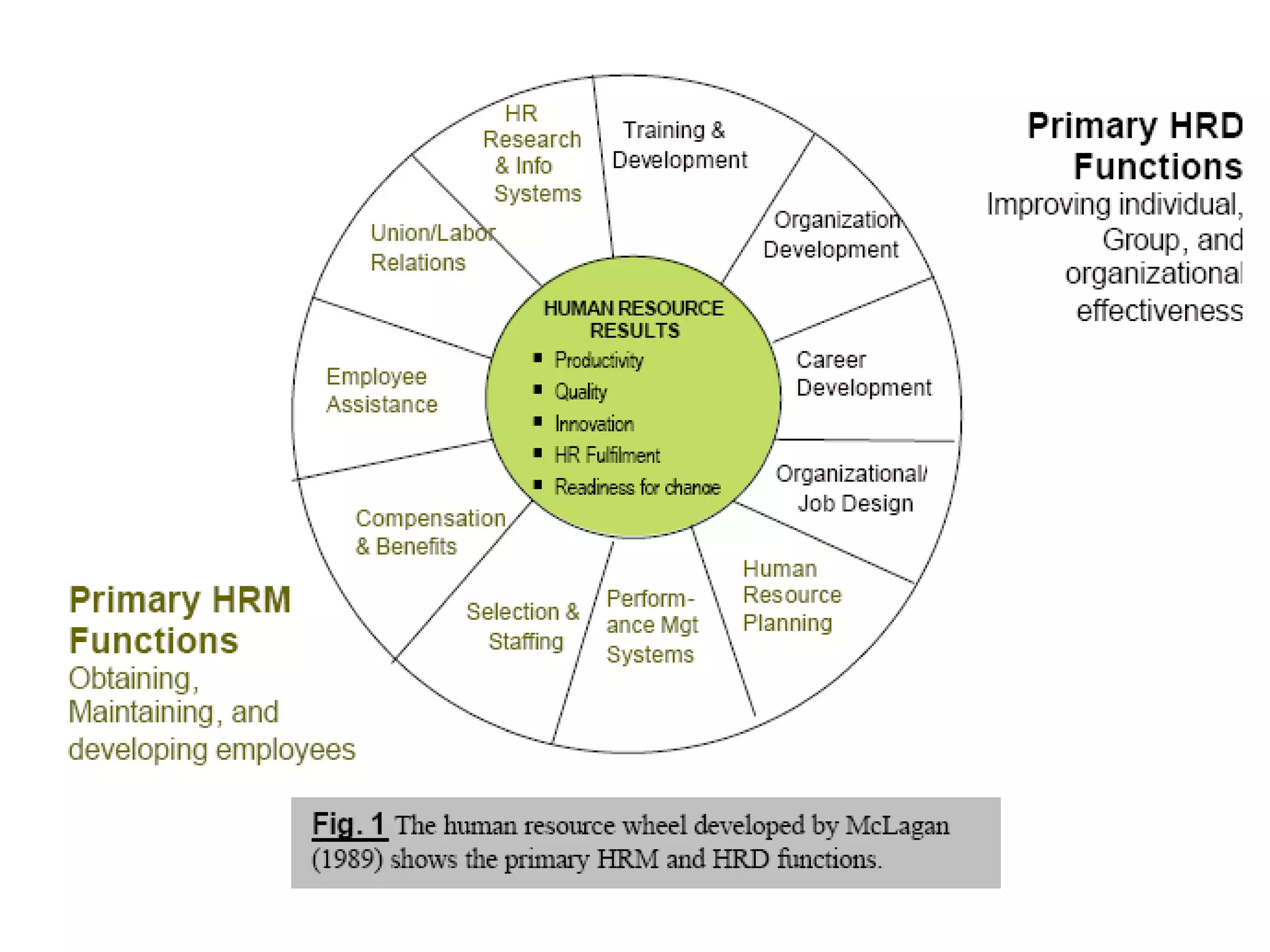
Meaning and Functions Meaning  =  HRM means the process of accomplishing organizational objectives by acquiring , retaining, terminating, developing and properly using the HR in the organization.  HRM encompasses many functions HRD is just one of the functions within HRM
Meaning and Functions HRM  People  Functions Include:   Performance  Management Communication   Training  and Development   Employee commitment   Equal opportunity   Health and safety   Grievances/labor relations Job analysis   Labour needs   Recruit ment Selection Orientation  and training   Wages and salaries   Incentives and benefits
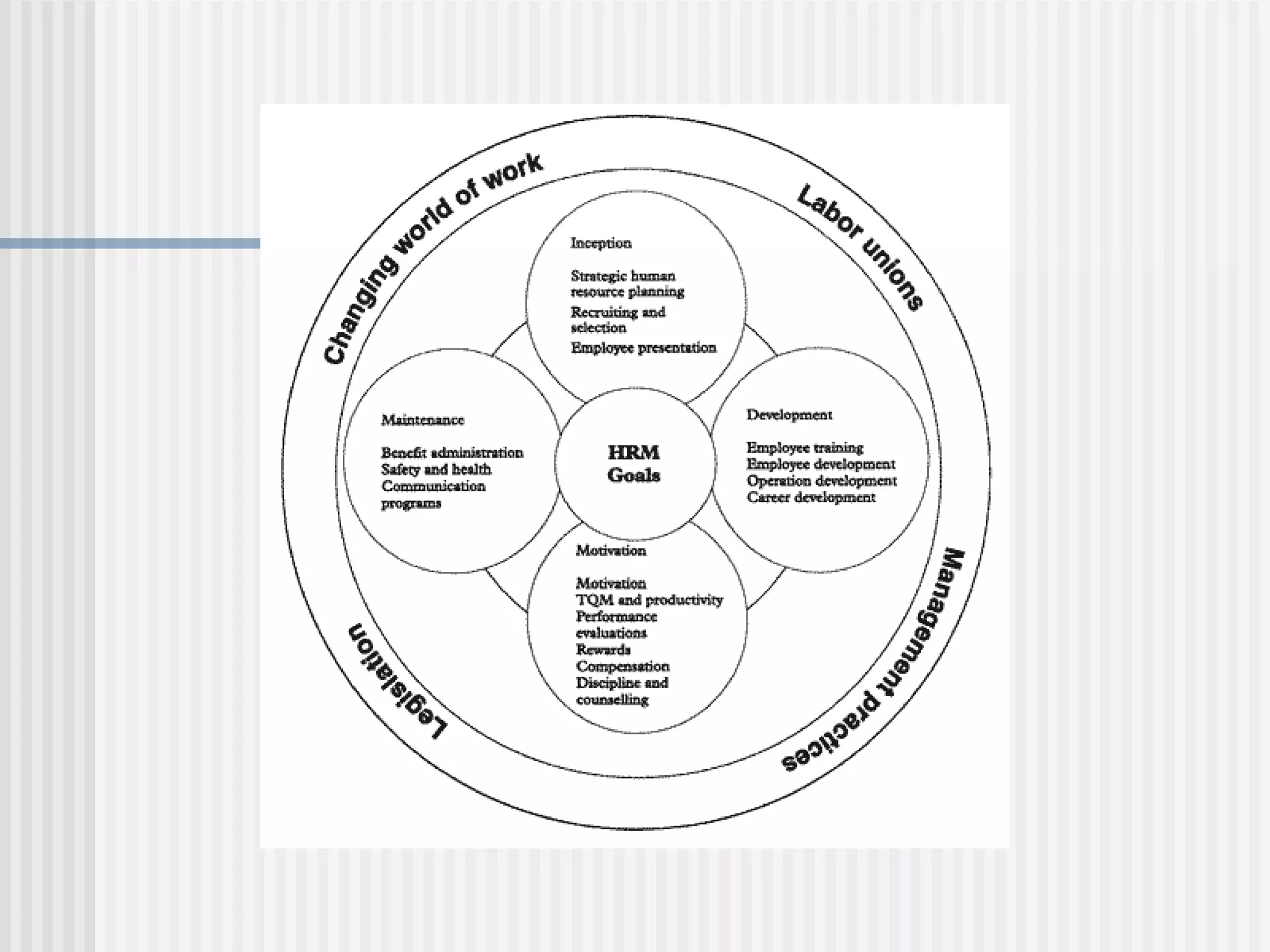
HRM FUNCTIONS   Primary   Secondary Human resource planning  Equal employment opportunity Staffing (recruitment and selection) Compensation and benefits Employee and labor relations Health, safety, and security Human resource development  Organization and job design Performance management/ performance appraisal systems Research and information systems
MEANING-FUNCTIONS OF HRM   Functions as per  George Strauss and  Leonard Sayels   .  1. Recruitment (Acquiring people,  selection(with talent , skill, will  and motivation), Job analysis , job description , and job evaluation 2.   Increasing organizational efficiency,  . Establishing healthy relationship  between Mgmt and workers and workers themselves.  3. Retaining   -  there should  not  be high manpower turnover. Recruited HR should remain in the organization for a long time. 4.Training and educational   programmes. helping employee identify with the organization. 5. Developing  – involves educating , training , and making HR accept any  type of current or future work.
Functions of HRM 6. Terminating  – Employees who are unruly, unproductive , expensive should be made to retire. They are a strain on the finance and bad influence on other employees.  7  .  Labour Relations   (  collection of information, preparation, arbitration etc (  The maintenance and effective use of facilities for joint consultation between employer and employee to settle all disputes effectively.  8 .  Personnel planning and Evaluation .:.  A detailed study of people is the main function of HRM. 10.   Preparation and  implementation of compensation and appraisal plans 11.   Employees Record  ,   Employees benefits services and programmes  12.   Special services  such as safety , communication etc HRM encompasses every activity relating to HR in an organization and communication system which reduces militancy.
Functions of HRM All activities connected with the employees of an organization and all decisions reflected to the human relations come within the functional areas of HR management. Functions may vary according to situations and nature of work,  the organization and attitude of Mgmt. Functions of HRM seek to secure the maximum return with minimum investment on HR. Physical assets loose their  value by constant and regular use due to wear and tear.  Value of HR increases through appropriate utilization and proper development. ***** IMPORTANT
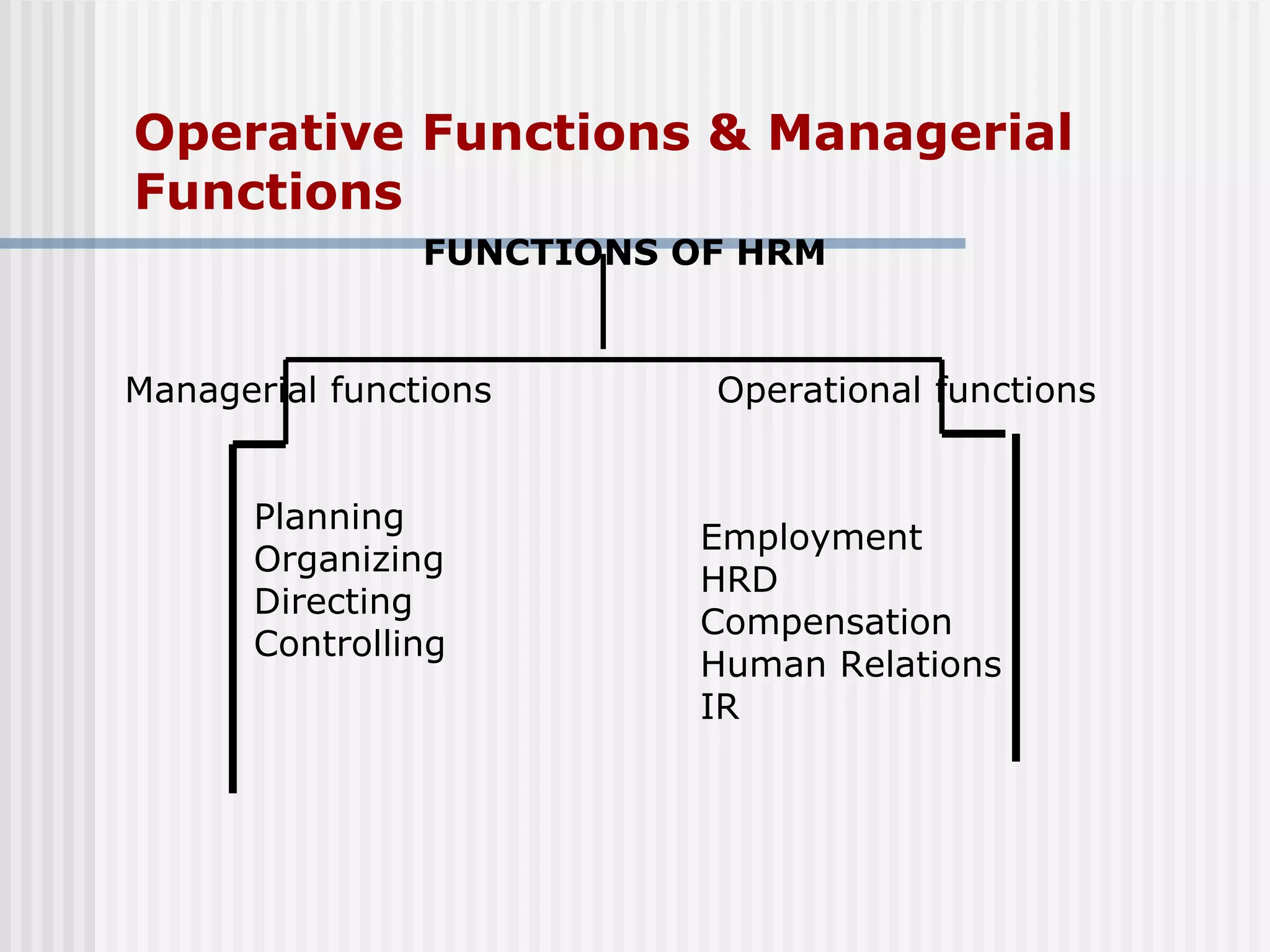
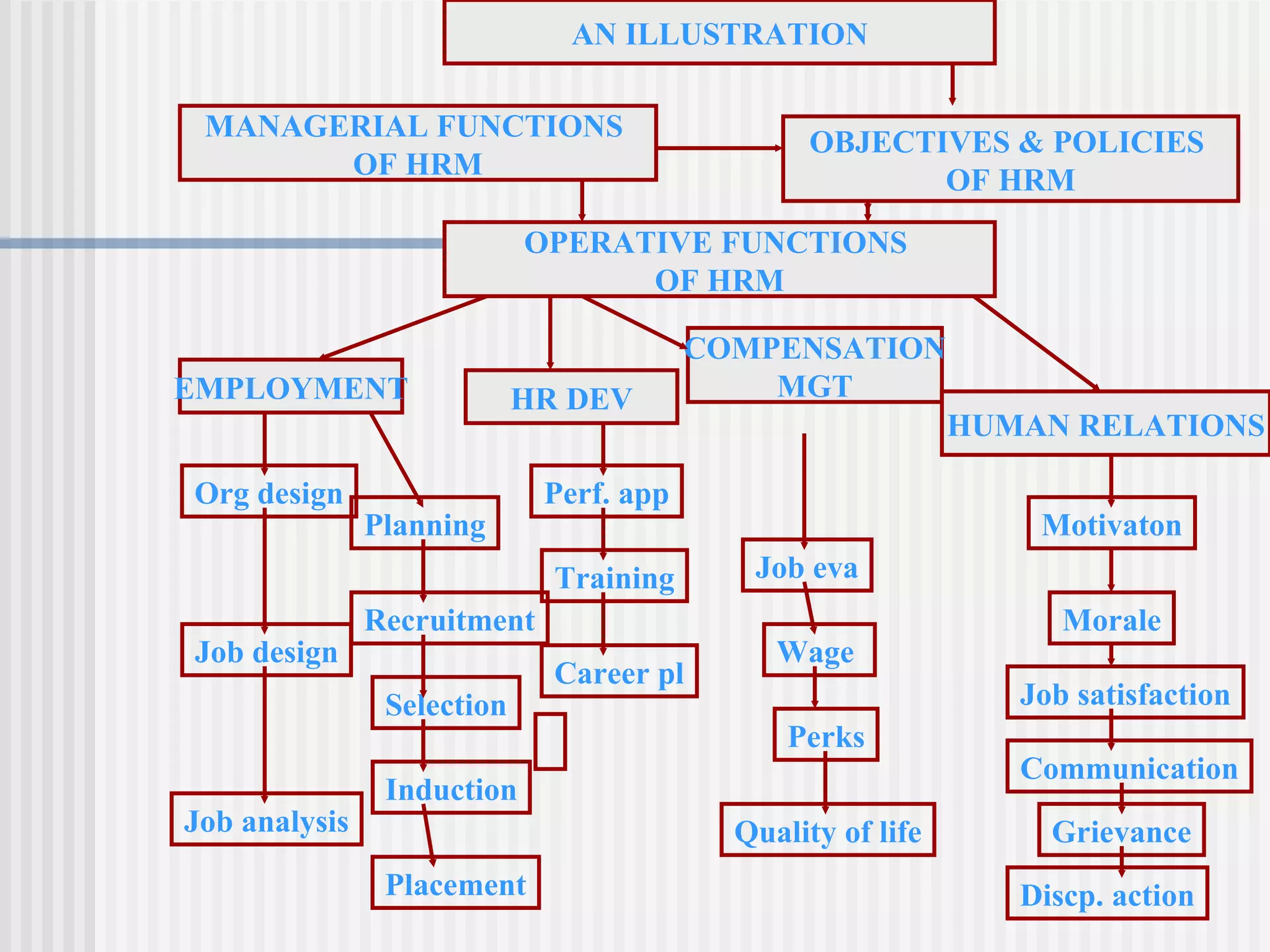
Functions of HRM Managerial and Operational  MANAGERIAL FUNCTIONS   :  One  function cannot work without the other.  A good blend of the two ensures the efficiency and success of the organization.  Managerial functions of HRM:  give right directions and motivate the Operation  managers  to  put forth their best efforts.  Planning , organizing ,  coordinating, controlling , directing work of those persons looking after operative functions.
Operative Functions & Managerial Functions Functions of HR Department can be categorized into  -  Operative Functions & Managerial Functions OPERATIVE FUNCTIONS are related to specific activities  :  Procuring  Developing  Relations Utilizing and maintaining an efficient  work force.  Operation  managers  are more concerned about the efficient and effective i mplementation  of the plan given by the top management.
Operative Functions & Managerial Functions FUNCTIONS OF HRM  Managerial functions  Operational functions   Planning Organizing Directing Controlling Employment HRD Compensation Human Relations IR
 
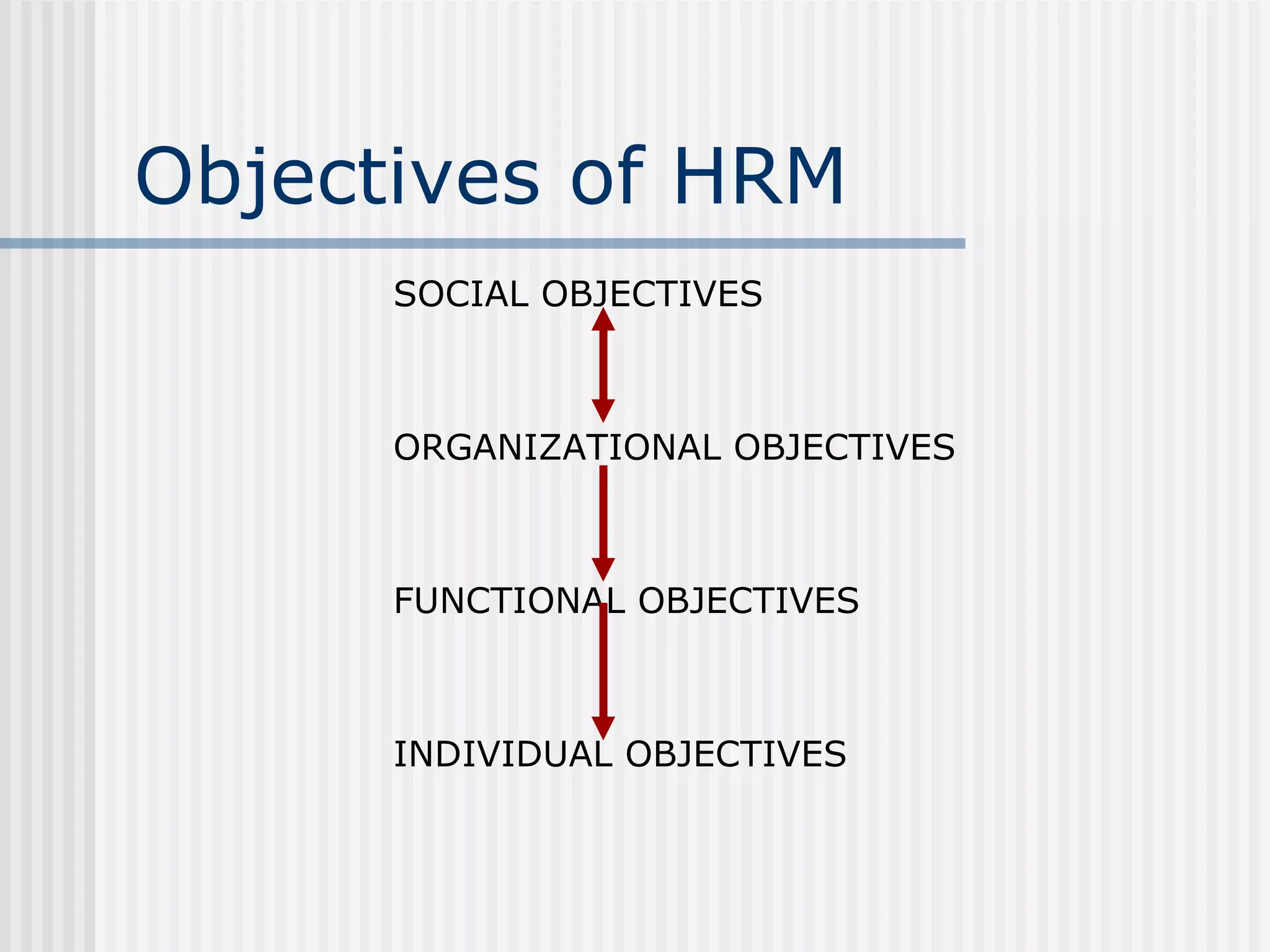
Objectives of HRM SOCIAL OBJECTIVES ORGANIZATIONAL OBJECTIVES FUNCTIONAL OBJECTIVES INDIVIDUAL OBJECTIVES
EMPLOYMENT HR DEV COMPENSATION MGT HUMAN RELATIONS Org design Job design Job analysis Perf. app Training Career pl Job eva Wage  Perks Motivaton Morale Job satisfaction Communication Grievance Discp. action Planning Recruitment Selection Induction Placement Quality of life AN ILLUSTRATION OBJECTIVES & POLICIES  OF HRM OPERATIVE FUNCTIONS  OF HRM MANAGERIAL FUNCTIONS  OF HRM
Objectives of HRM To  maximise commitment of people by organising work and creating attitudes and behaviour which generate best outcomes. To create and utilize an able and motivated workforce. To accomplish the basic organizational goals. To establish and maintain sound organizational structure and desirable working relationships among organizational members. To create facilities and opportunities for individuals or group development and to match with growth of the organization.  HRM is basically a search for “best practices” to generate high levels of employee commitment and performance.
Primary Objectives of HRM To identify and satisfy individual and group needs by providing adequate and equitable wages, incentives, employee benefits and social security measures for challenging work,prestige,recognition security,status. Primary Objectives of HRM Relate  goods and services to Society. HRdepartment has to create workforce with proper ability and motivation to accomplish the basic organizational goals. Utilize HR effectively. Satisfaction of the  personal  objectives of the members of an organization through monetary and  non monetary devices. Bring about maximum individual development of Organization members. Satisfaction of the community and social objectives.
Secondary Objectives of HRM  - Secondary  -  Fulfillment of primary objectives is contingent upon Secondary Objectives. Usefulness of the goods and services required by the society. Pick up capable and right people on the basis of qualification and background. Condition of employment for all members which motivates them to work better towards target . Effective utilization of people and materials in productive work. The continuity of the enterprise.  Means adopted in achieving the primary objectives shall be consistent with the ethical and moral values of society and with the policies and regulations established by legislative action. Control the cost of labour  Facilitate technological progress
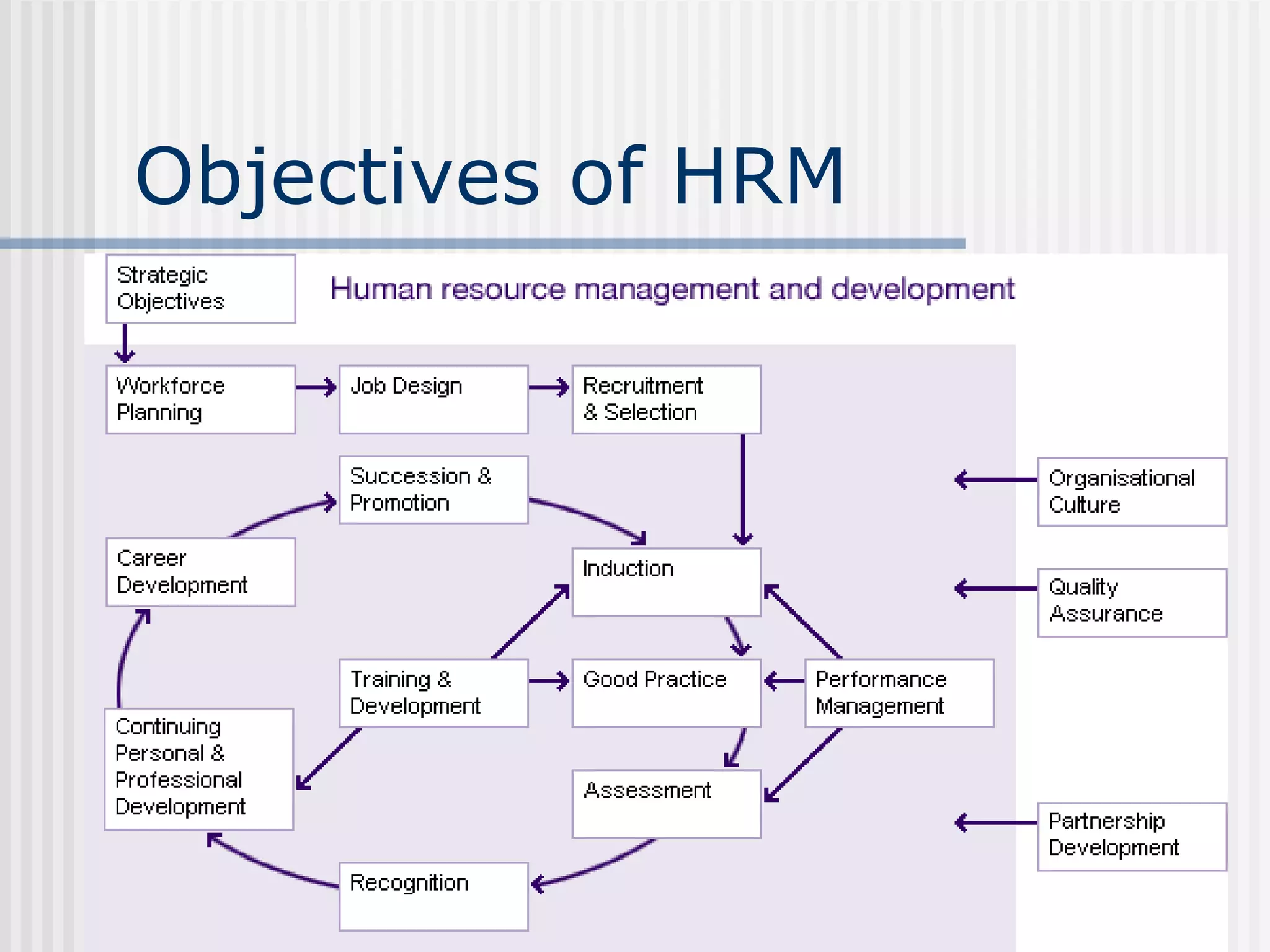
Objectives of HRM
OBJECTVIES OF HRM  POLICIES , PROCEDURES & PROGRAMME Objectives  are predetermined ends of goals at which individual or group activity in an organization is aimed. Human beings are goal directed.  Objectives serve as standards against which performance is measured. Setting of goals and their acceptance by employees promotes voluntary cooperation and coordination .
OBJECTVIES OF HRM  POLICIES , PROCEDURES & PROGRAMME A policy is a plan of action . BREWSTEW & RICHBELL defined HRM policies as “ a set of proposals  and action that act as a reference point for  managers in their dealings with employees” “  Personnel Policies constitute guides to action. They furnish the general standards or bases on which decisions are reached. Their origin lies in an organization’s values, philosophy, concepts and  principles”.
OBJECTVIES OF HRM  POLICIES , PROCEDURES & PROGRAMME Policy : Personnel Policies guide the course of action intended to accomplish personnel objectives. Personnel policies are designed to ensure healthy  conditions of work , employee participation ,  recognition of trade union , motivation of employees etc.
Need for HR Policy –  Need for HR Policy –  To have formal statement on corporate thinking which will serve as a guideline for action. To establish consistency in the application of the policies over a period. To accord consistent treatment to all the employees  -to avoid favouritism and discrimination. To assure certainty of action and promote stability in an organization. To serve as standard for evaluating performance. To provide just and fair treatment. Policies build employee enthusiasm and loyalty.
Principles of HR policy 1.   Put right means in the right place. 2.   Train everyone for the job to be  done. 3 .  Make the organization a coordinated team 4. Supply the right tool and condition of work 5.   Give security with opportunity , incentives , recognition to all employees. 6.  Look ahead, plan ahead for more and better things.
Classification of HR policies 3 major classifications: 1. Basic organizational policies  :   relating to the principles, managerial philosophy and fundamental objectives of the organization. 2. General policies :   relating to organizational activities  personnel development &  creation of appropriate work climate . 3. Specific policies :   relating to job description , analysis & evaluation of fundamental objectives, proper communication system , determination  of wage rates on the basis of performance.
HR Policies HR Policies include :  History  of  company’s growth -  Employment practices and conditions of employment  -  Grievances redressal  ( amends/alteration/)  procedure Safety rules and regulations and responsibilities of employees Need for cooperation between management  and employees  - employee financial aids, educational opportunities
HR Policies HR Policies include  :  Employees news letters and house journals – communication media and suggestion system Health and hospitalization Vacation with pay Sickness death and maternity benefits Company stores, social security Collective bargaining , discipline Encashments , PR, Labour Relations Prohibited activities
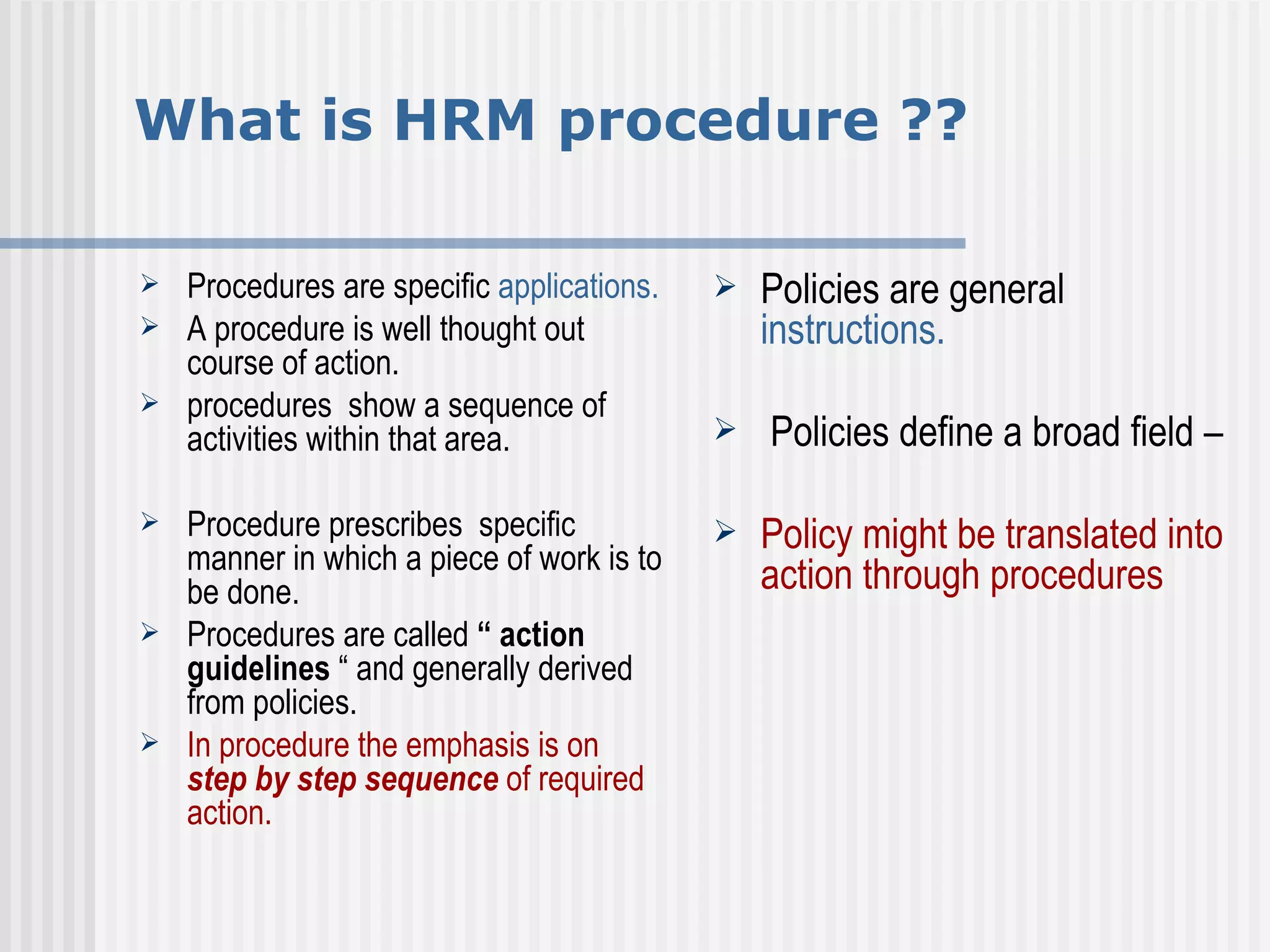
What is HRM procedure ?? Procedures are specific  applications. A procedure is well thought out course of action.  procedures  show a sequence of activities within that area. Procedure prescribes  specific manner in which a piece of work is to be done.  Procedures are called  “ action guidelines  “ and generally derived from policies.  In procedure the emphasis is on  step by step sequence  of required action. Policies are general  instructions. Policies define a broad field – Policy might be translated into  action through procedures
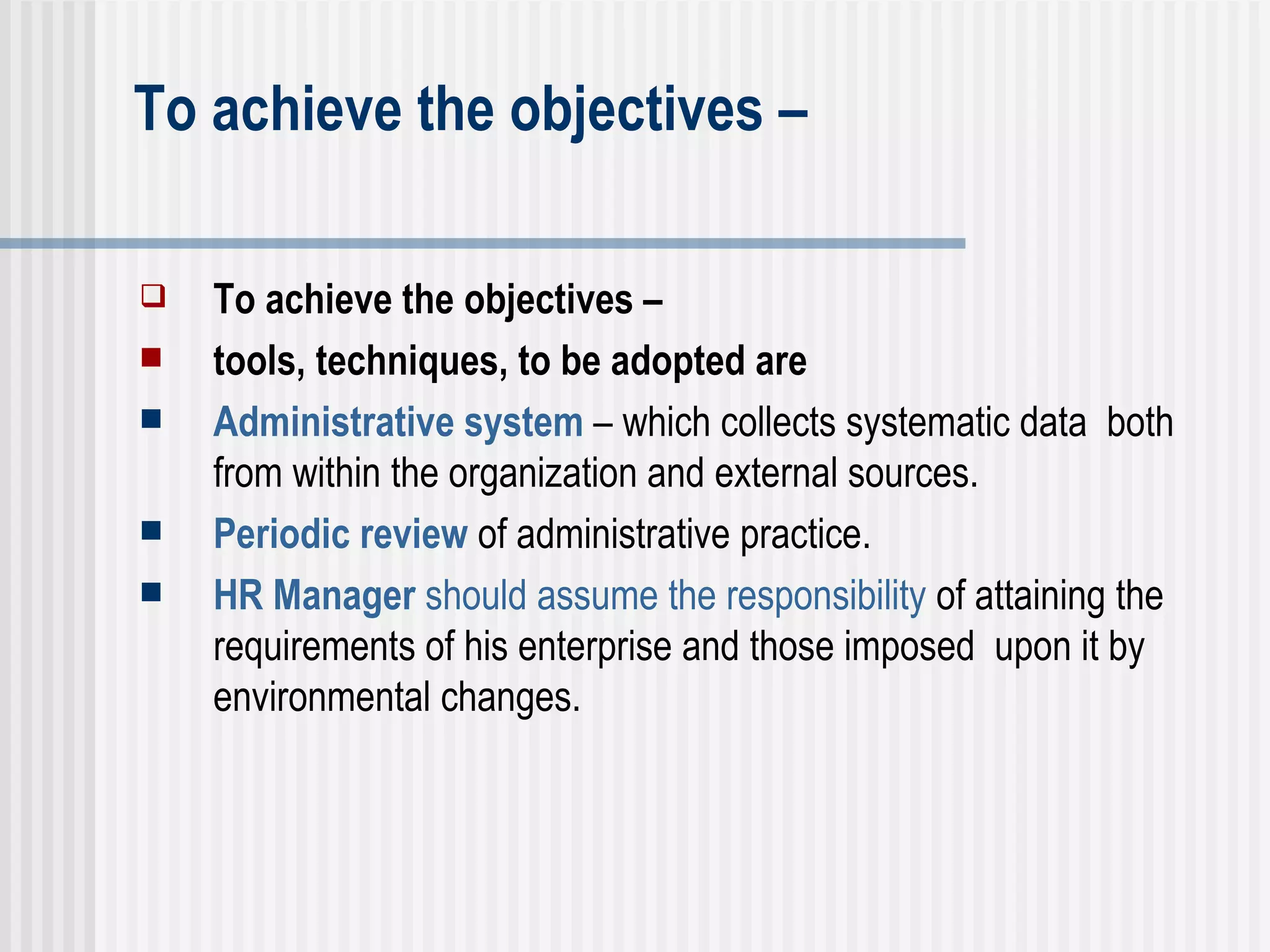
To achieve the objectives –  To achieve the objectives –  tools, techniques, to be adopted are Administrative system  – which collects systematic data  both from within the organization and external sources. Periodic review  of administrative practice. HR Manager  should assume the responsibility  of attaining the requirements of his enterprise and those imposed  upon it by environmental changes.
HR Manager’s Responsibilities Restoring Trust in the HR Profession   Building a New Social Contract at Work   Opening the Door to the Next Generation of HR Leaders    
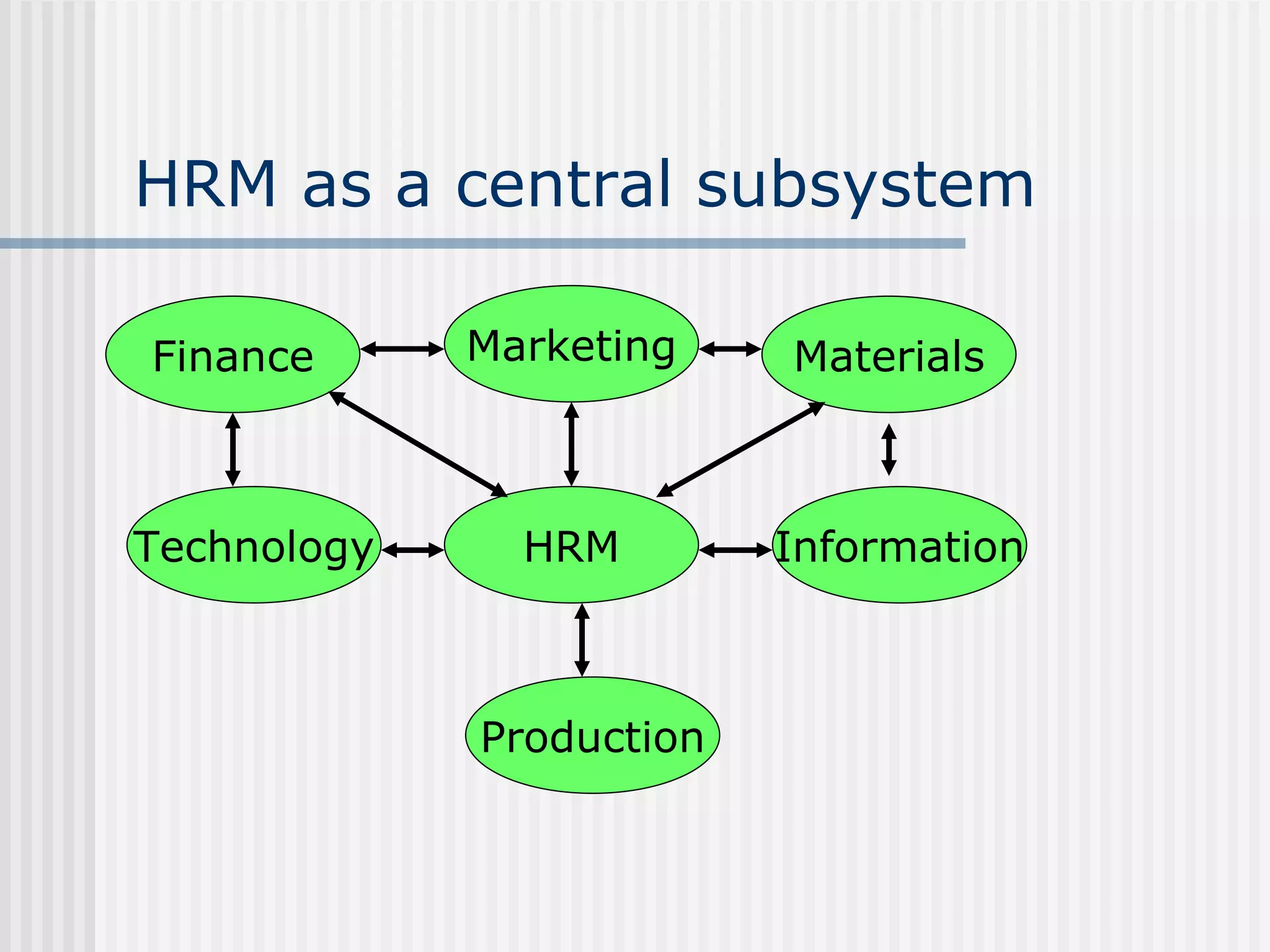
HRM as a central subsystem Finance Marketing Materials Technology HRM Information Production
ORGANIZATION & HRM Organizations   are effective instruments in helping individuals accomplish , personal  objectives that they cannot achieve alone. Organizations are formed to satisfy objectives that can be best met collectively  Organizations   are means to an end .  Organization design  deals with structural aspects of organizations.  Organizational design  aims  at analyzing roles and relationships so that collective effort can be explicitly organized to achieve specific ends
ORGANIZATIONAL STRUCTURE STRUCTURE :  Efficiency with which an organization is able to achieve its goal are determined by the organizational structure. STRUCTURE   is the pattern of  formal relationships  and duties –  activities or tasks are assigned to different departments  and people -Co-ordination of  these tasks – Hierarchical relationships within the organization  Policies , procedures, standards, evaluation systems etc  guide the activities and relationships of people in the organization.
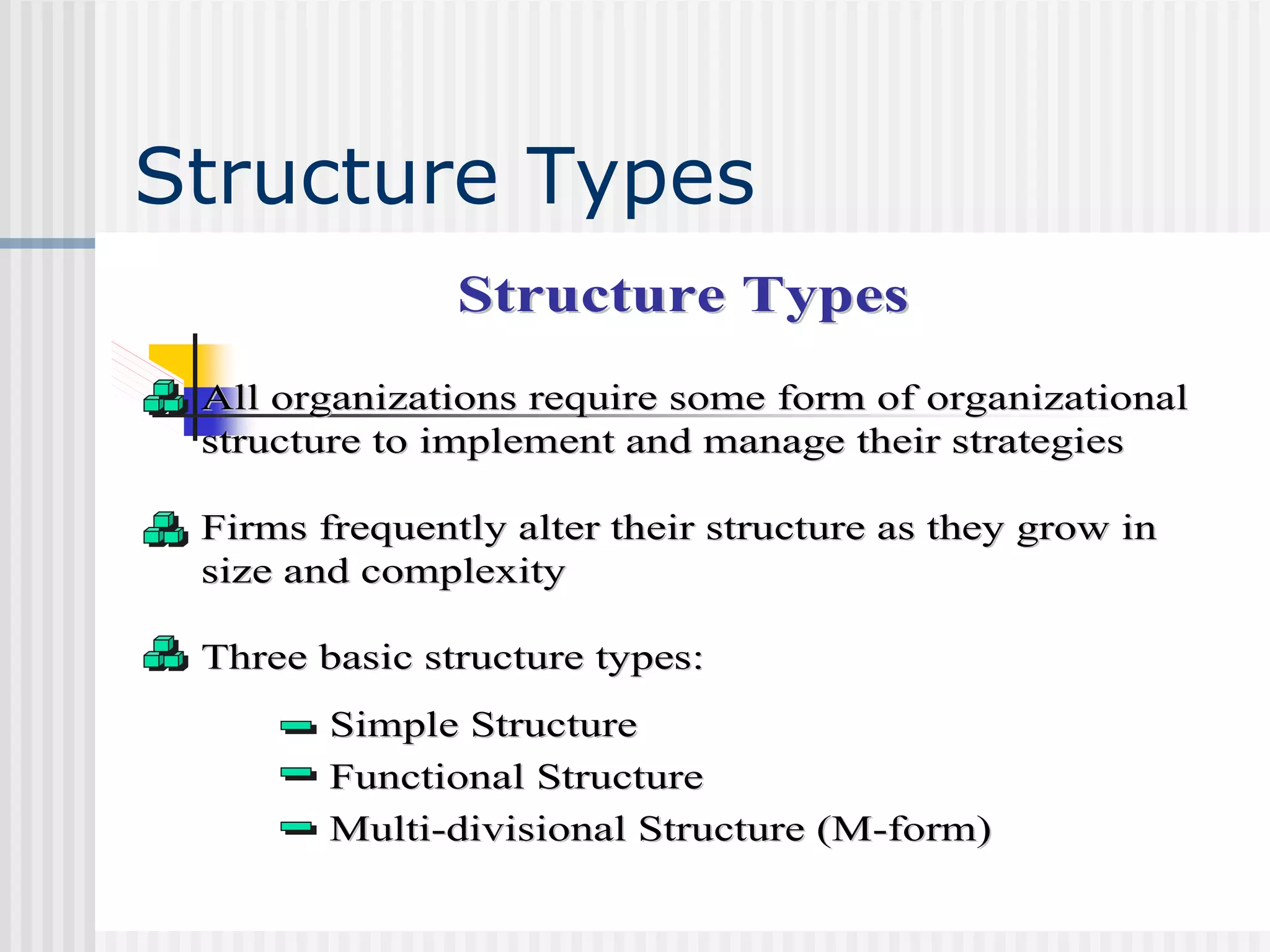
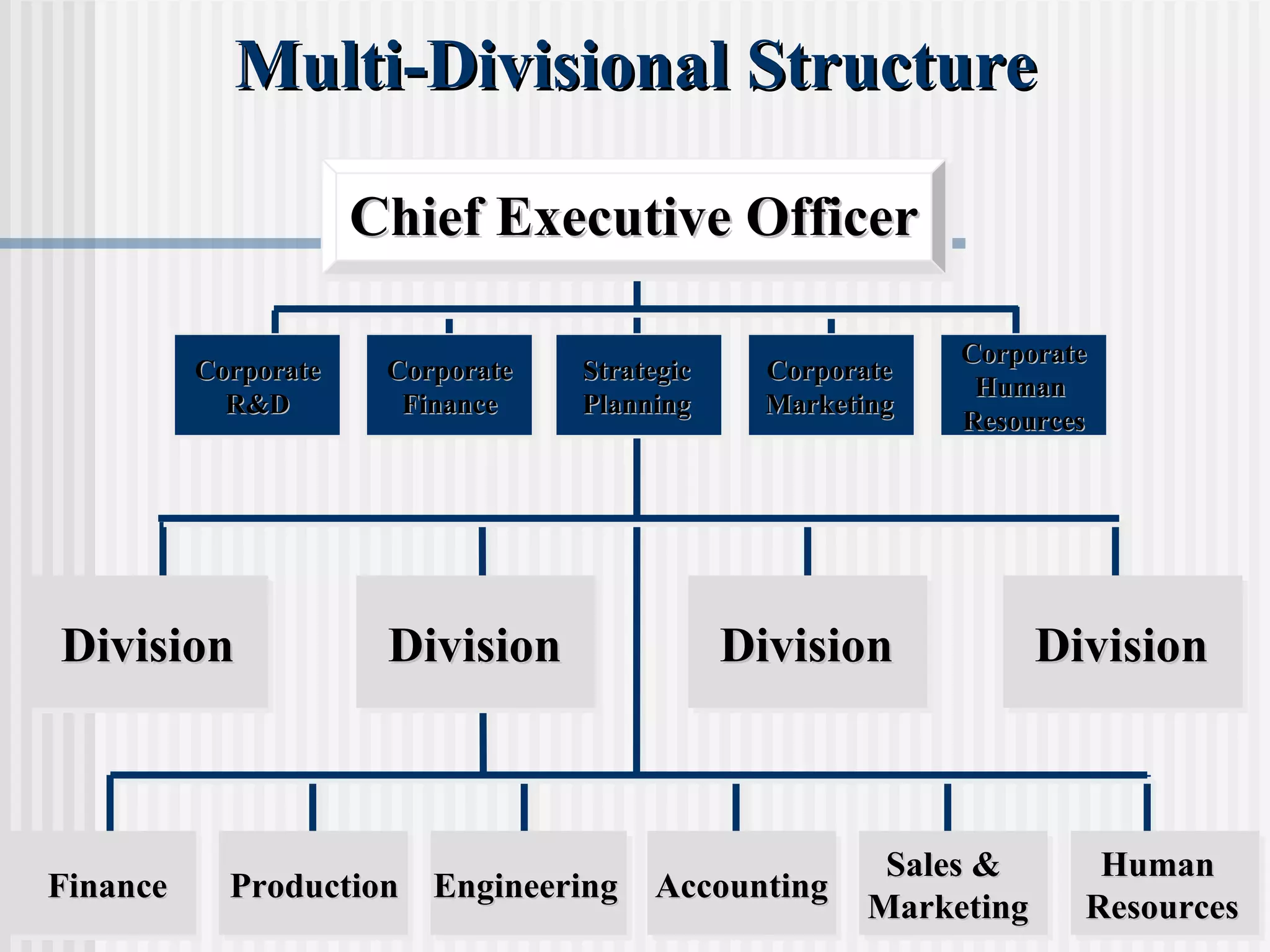
Structure Types
 
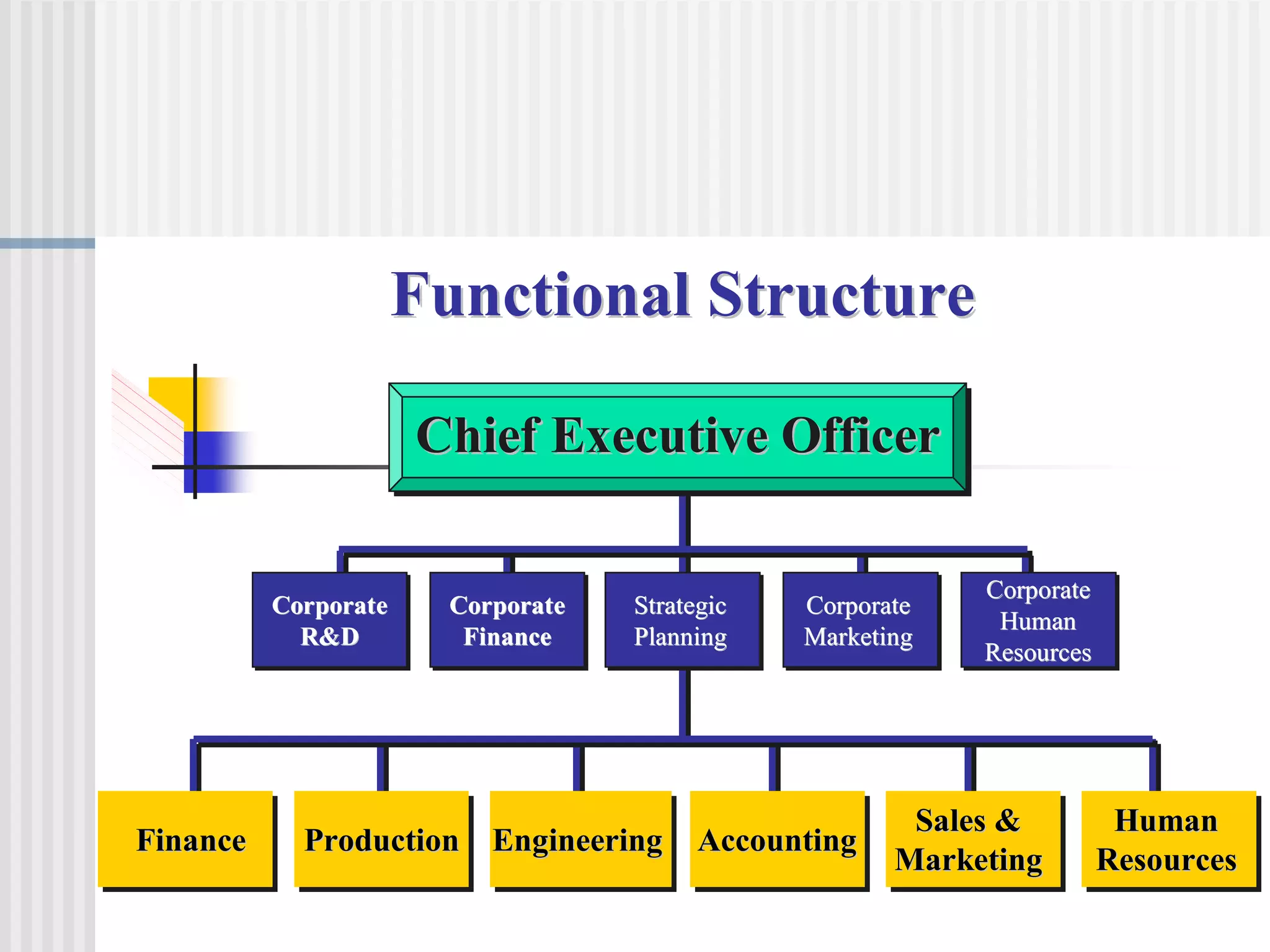
Multi-Divisional Structure Division Division Division Division Production Finance Engineering Accounting Sales &  Marketing Human  Resources Chief Executive Officer Corporate Finance Corporate R&D Corporate Marketing Strategic Planning Corporate Human  Resources
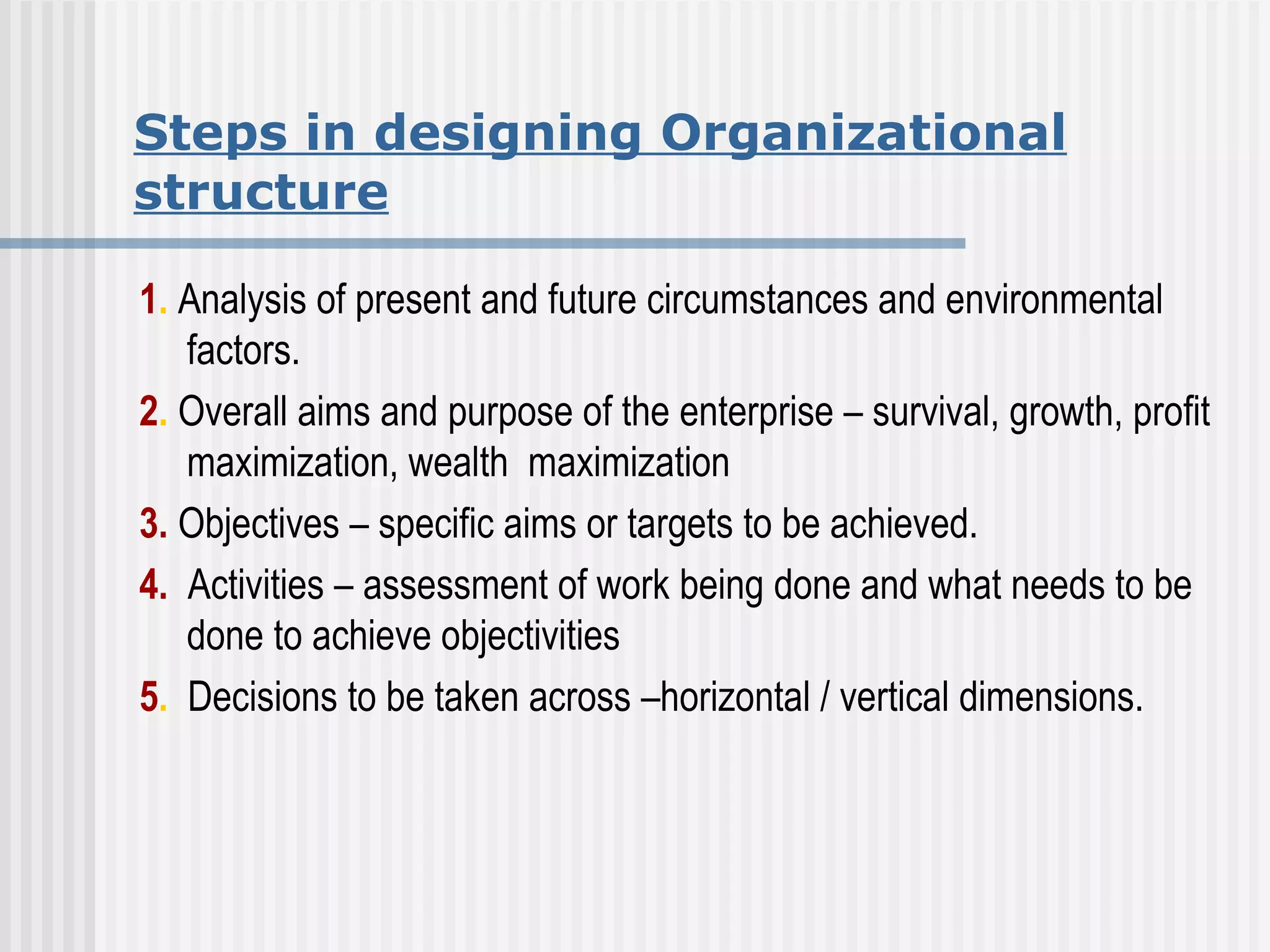
Steps in designing Organizational structure 1 .  Analysis of present and future circumstances and environmental factors. 2 .  Overall aims and purpose of the enterprise – survival, growth, profit maximization, wealth  maximization 3.  Objectives – specific aims or targets to be achieved. 4.   Activities – assessment of work being done and what needs to be done to achieve objectivities 5 .   Decisions to be taken across –horizontal / vertical dimensions.
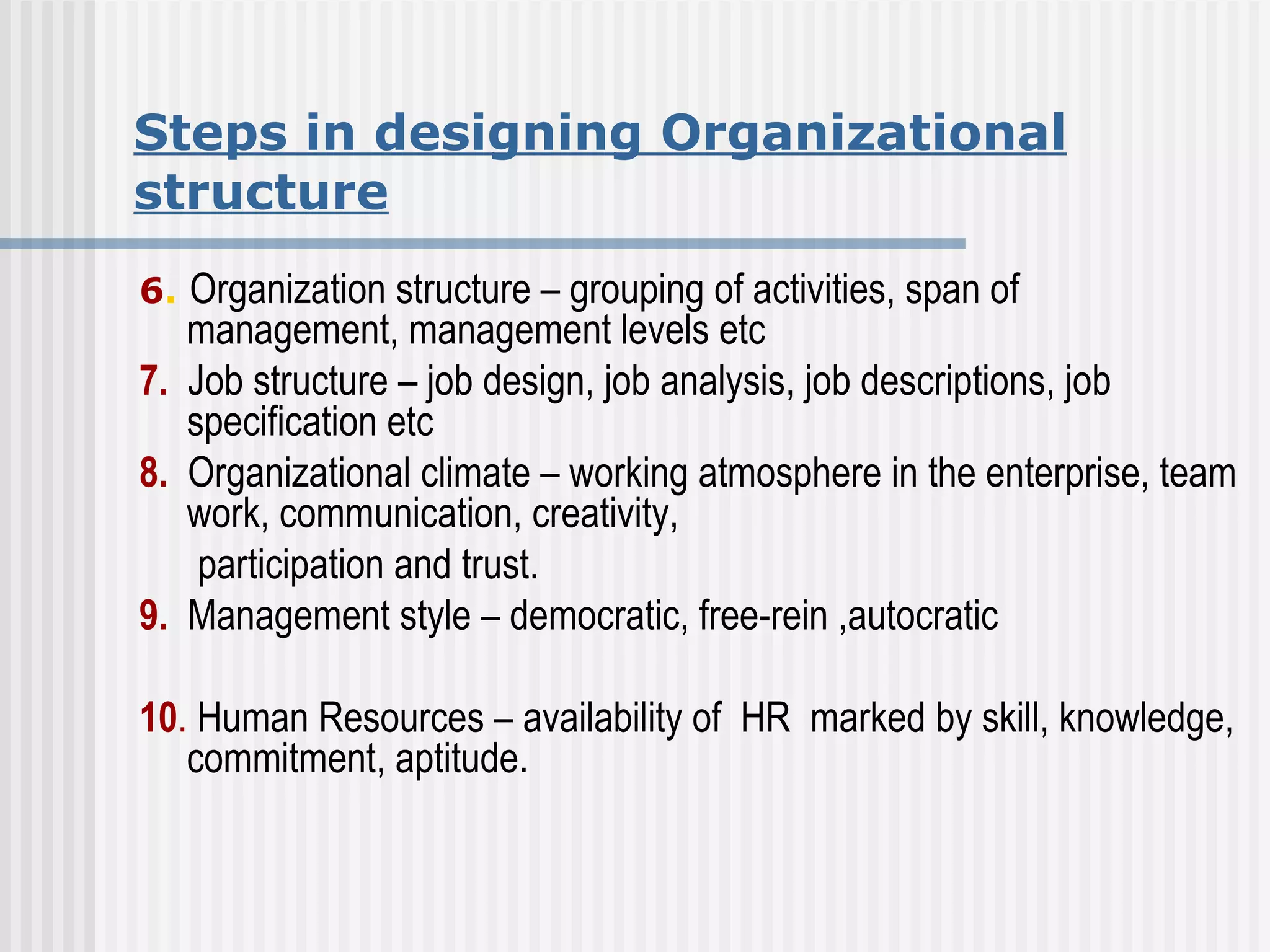
Steps in designing Organizational structure 6 .   Organization structure – grouping of activities, span of management, management levels etc 7.   Job structure – job design, job analysis, job descriptions, job specification etc 8.   Organizational climate – working atmosphere in the enterprise, team work, communication, creativity, participation and trust.  9.   Management style – democratic, free-rein ,autocratic  10 .  Human Resources – availability of  HR  marked by skill, knowledge, commitment, aptitude.
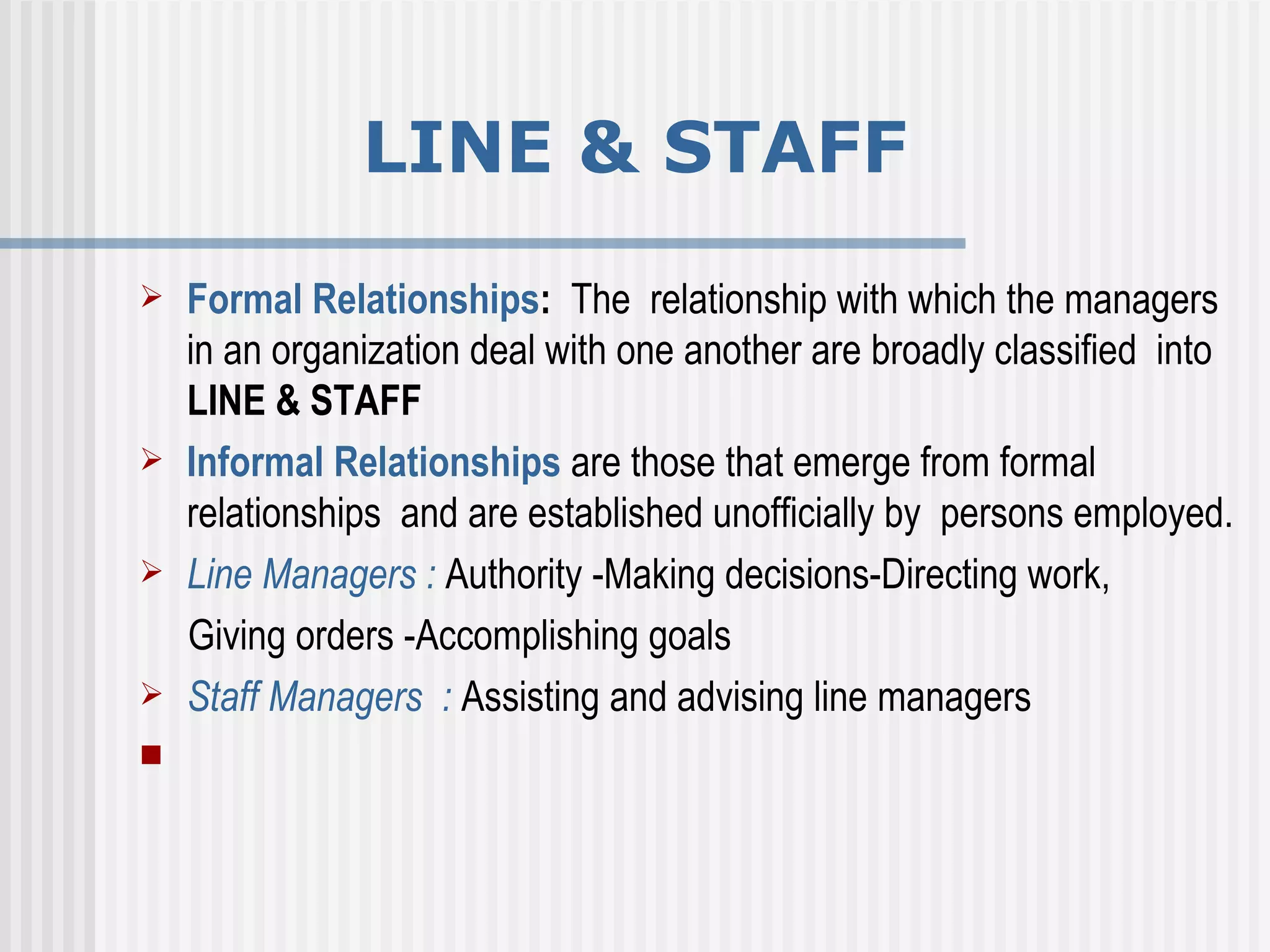
Formal Relationships :  The  relationship with which the managers in an organization deal with one another are broadly classified  into  LINE & STAFF  Informal Relationships   are those that emerge from formal relationships  and are established unofficially by  persons employed. Line Managers :  Authority -Making decisions-Directing work,   Giving orders  - Accomplishing goals   Staff Managers  :  Assisting and advising line managers   LINE & STAFF
STAFF RELATIONS STAFF RELATIONS :  The  staff concept is an old / ancient one.  Line has to perform all their functions and concentrate on  management  of people and activities. This gives rise to securing advice and help from specialists.  -  This creates staff relationships.- The relationships between two managers  when it is created for Taking/giving advice,  information,  counseling etc for achieving organizational goals is called staff relations. Staff Managers  analyze problems, collect information and develop alternative suggestions and help the line managers to make right decisions. Staff responsibility   is monitoring and reporting ---results and  information to  the line managers to reduce their work load.
Line Manager’s HRM Jobs   The right person Orientation   Training   Performance Creativity   Working relationships   Policies and procedures   Labour costs   Development Morale   Protecting    
Exact activities of Line and staff managers?? There is no single division of responsibility applied to all organizations   Eg: Recruiting & hiring of employees Usually the line manager specifies the qualifications needed to fill specific positions.   Then the HR manager develops sources of qualified candidates, conducts initial screening (tests) and sends those filtered to line manager. Line manager conducts the final technical screening tests and selects the one to hire or requests new applicants
Some activities tend to be split between line & HR managers   Employee interviews Performance appraisal Skills training   Job analysis & descriptions     Changing Environment of HR Management Globalization Technological Advances   Exporting Jobs   The Nature of Work   Workforce Diversity    
Line and staff relations STAFF :   Operational – functional managers who carry out the decisions  The relationships  that are established among the components of organization are of two types Formal  and  Informal.  Line & Staff Relations   Formal relationships  are those officially established and prescribed in the manual, charts and job descriptions.  The three basic relationships of this category  are responsibility, authority, and accountability. Line Relationship  :   Relationship existing between managers due to delegation of authority and responsibility and giving or receiving instructions or orders is called  LINE RELATIONSHIP
HRM is a staff function Organizational ability depends on sound management of HR. HR  Provides specialized assistance to line managers through Personnel Managers. Line Managers may not have the time to manage HR and it is HR Manager who provides  training , grievance redressed and  motivation. PM performs certain staff functions relating management of personnel  like  Advice, guidance, counseling. and providing necessary information.  HRM is a staff function, but responsibility for the management of personnel rests with Line Managers. HRM is a  A LINE responsibility but STAFF  but staff function.
Line versus Staff Authority Line Authority – given to managers directly responsible for the production of goods and services (direct function) Staff Authority – given to units that advise and consult line units  Limits of Authority HRM & HRD units have  staff  authority (Overhead function) Line authority takes precedence Scope of authority – how far (how much) can you authorize?
ROLE OF HR MANAGER HR Manager contributes  a lot to organizational effectiveness.  The conscience Role –  that of humanitarian who reminds management  of its morals and obligation to employees and society. The counselor  – for  job related , professional and personal problems. The Mediator  -  peace maker  settles disputes between employees & management  and between employees,-works as  a communication  link. The Spokesperson –  Spokesperson  OF or FOR the company. The problem –solver :   with respect to the issues that involve HR Management and overall long range organizational planning. The change Agent  _   Introduces changes in various existing programmes.  Other Roles  :  Welfare  Roles, clerical role and  fire fighting role-
HRM Activities Two main HRM goals Getting the right people HRM activities must be aligned with corporate    strategy Maximizing their performance and potential Failure of either goal can influence the success or failure of the other
 
HRM Activities Planning Forecasting demand Assessing supply Formulating fulfillment plans Job analysis (assessing the job)  Scope and depth of jobs Requisite skills, abilities, and knowledge that people need to perform their jobs successfully Job description Job specification Getting the Right People
ACTIVITY OF HR MANAGER/DEPARTMENT Recruitment / interview / hiring Pre-employment Testing Induction / Orientation, Promotion/ transfer Personnel records / reports Personnel Research  Insurance benefits-  Administration ( ESI )  Unemployment -  Administration EEO compliance –affirmative action  Wages /  salary / compensation   Education aid – scholarship Job Evaluation Health and Medical Services
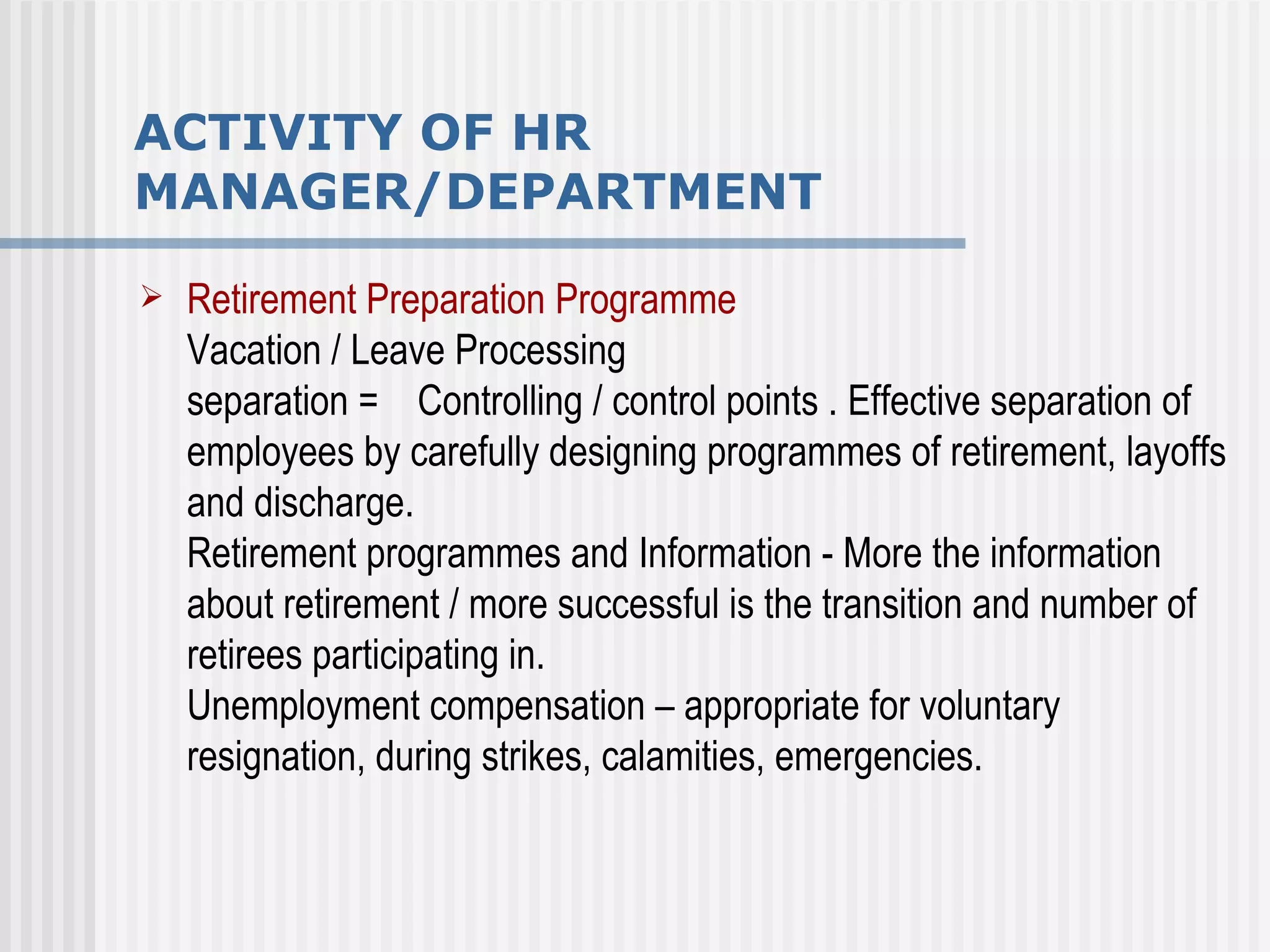
ACTIVITY OF HR MANAGER/DEPARTMENT Retirement Preparation Programme Vacation / Leave Processing separation =  Controlling / control points . Effective separation of employees by carefully designing programmes of retirement, layoffs and discharge.  Retirement programmes and Information - More the information about retirement / more successful is the transition and number of retirees participating in. Unemployment compensation – appropriate for voluntary resignation, during strikes, calamities, emergencies.
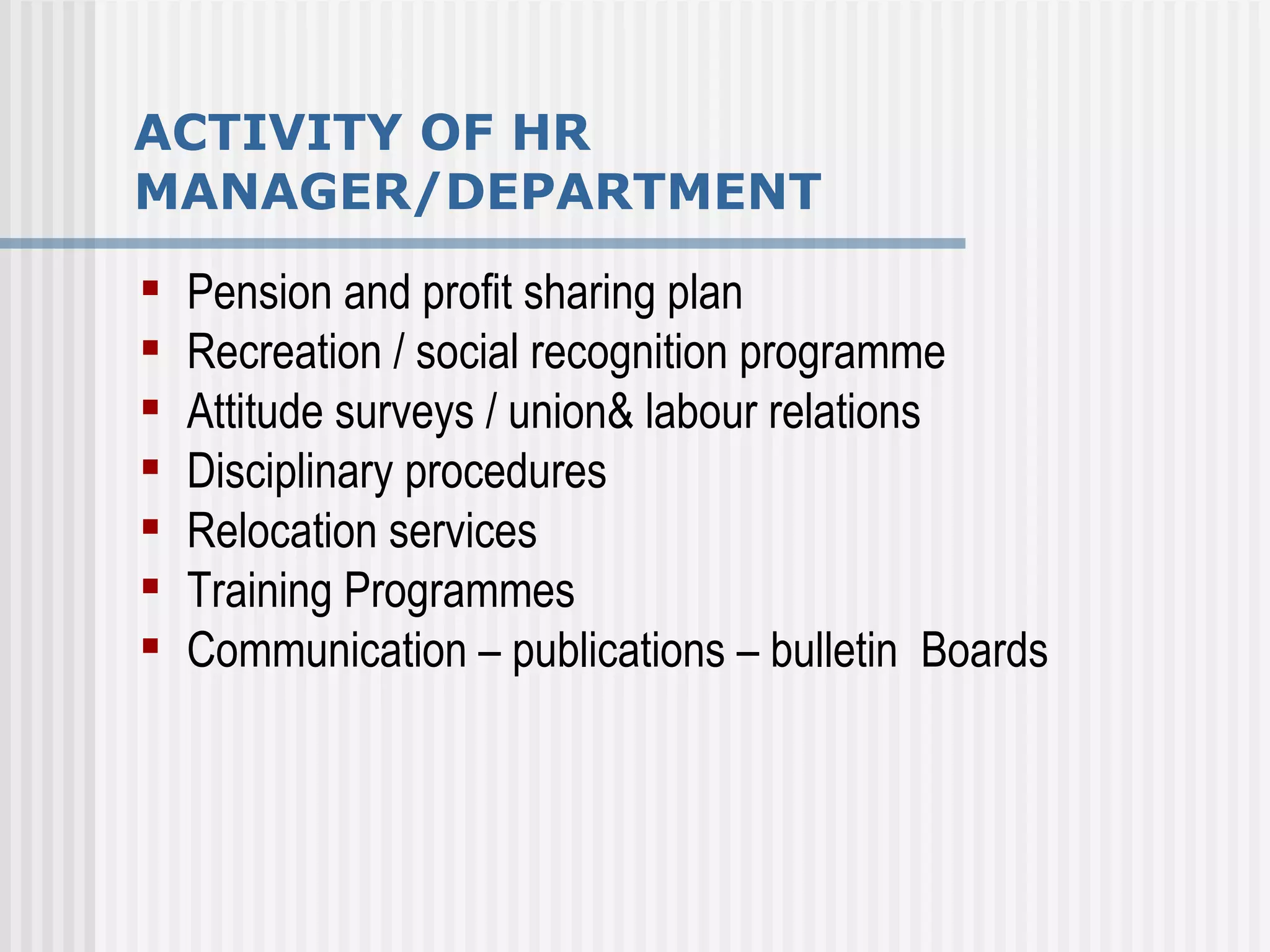
ACTIVITY OF HR MANAGER/DEPARTMENT Pension and profit sharing plan Recreation / social recognition programme Attitude surveys / union& labour relations Disciplinary procedures Relocation services Training Programmes Communication – publications – bulletin  Boards
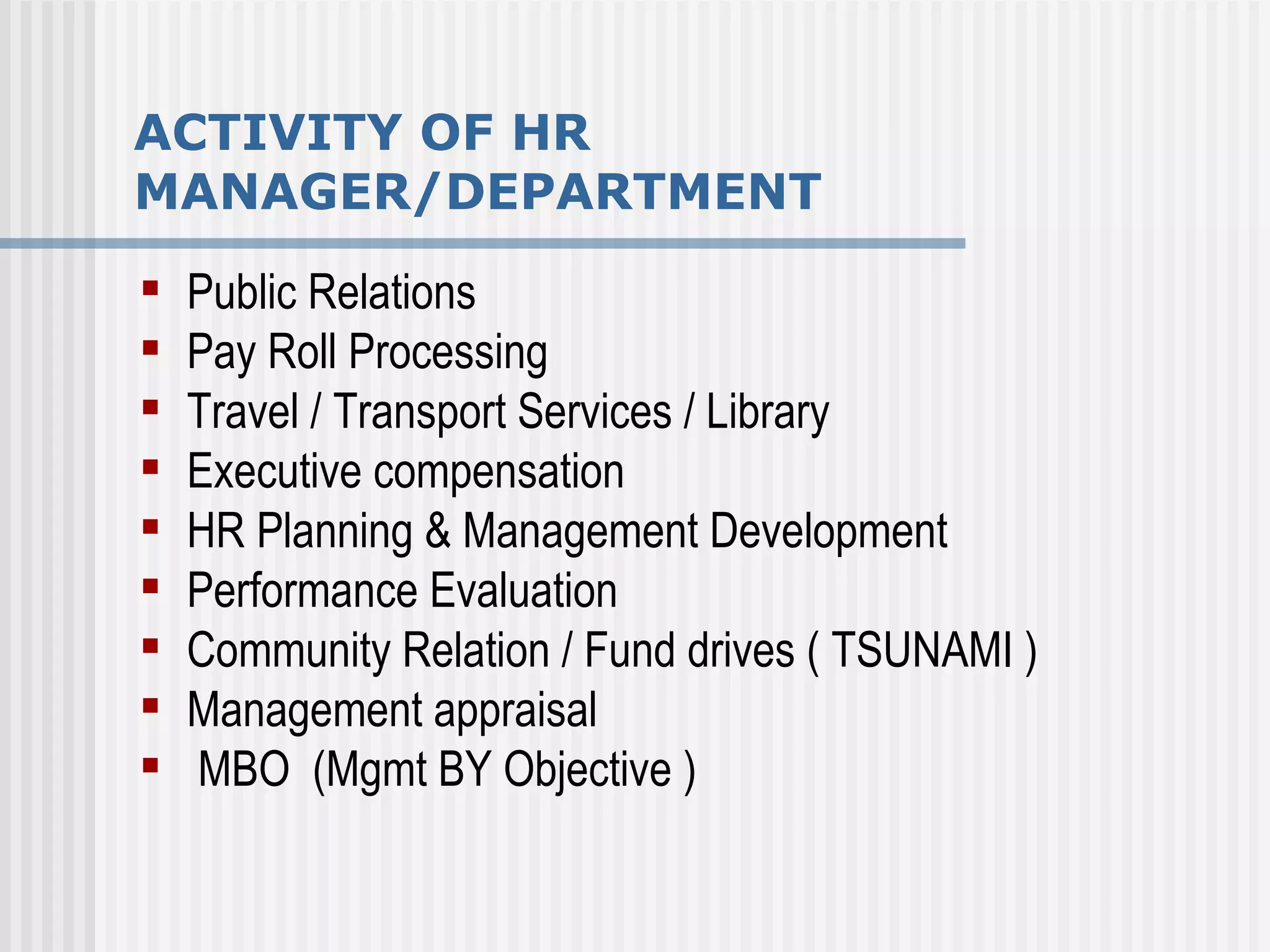
ACTIVITY OF HR MANAGER/DEPARTMENT Public Relations Pay Roll Processing Travel / Transport Services / Library Executive compensation  HR Planning & Management Development Performance Evaluation Community Relation / Fund drives ( TSUNAMI )  Management appraisal  MBO  (Mgmt BY Objective )
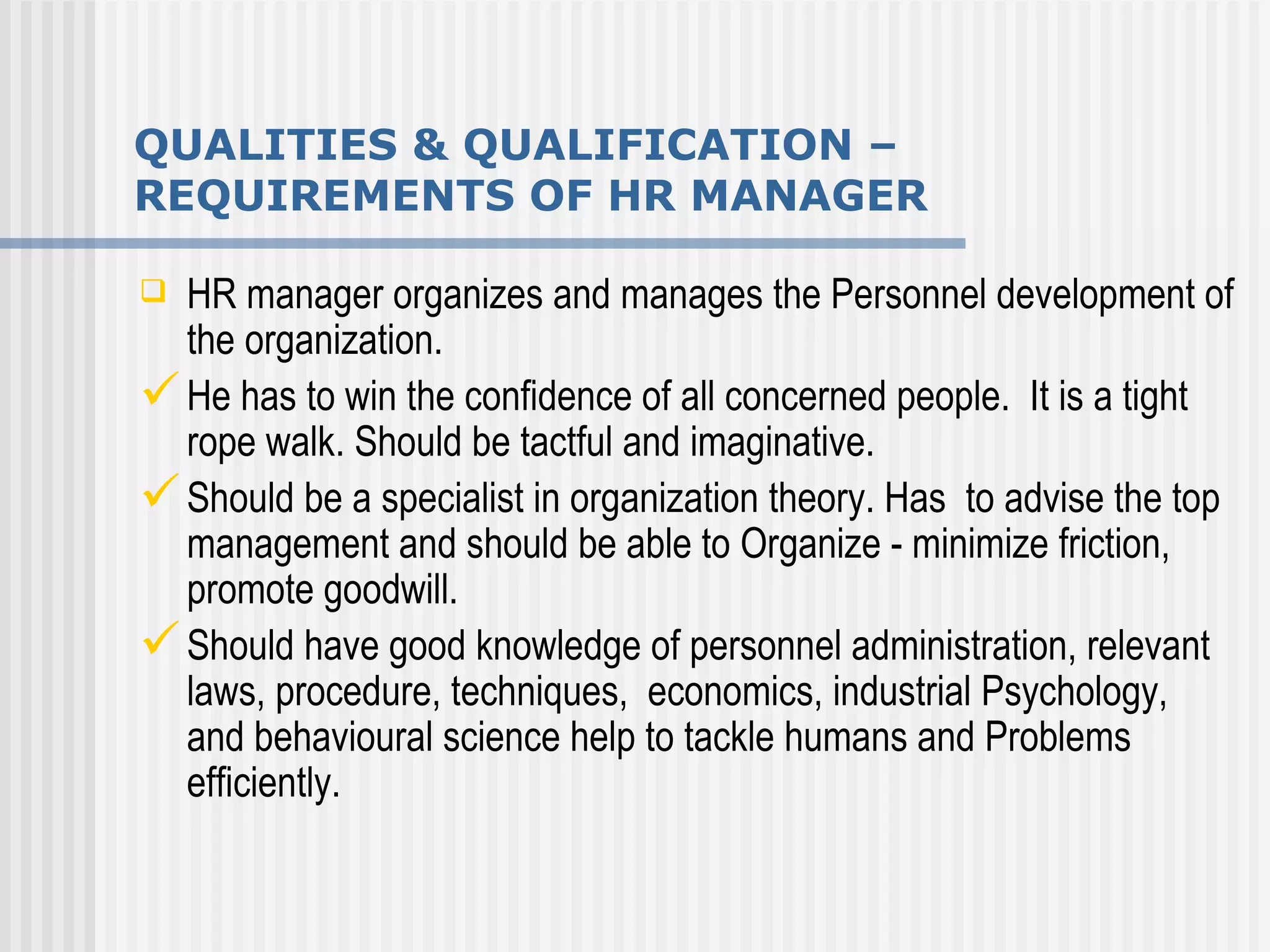
QUALITIES & QUALIFICATION – REQUIREMENTS OF HR MANAGER HR manager organizes and manages the Personnel development of the organization.  He has to win the confidence of all concerned people.  It is a tight rope walk. Should be tactful and imaginative.  Should be a specialist in organization theory. Has  to advise the top management and should be able to Organize - minimize friction, promote goodwill. Should have good knowledge of personnel administration, relevant laws, procedure, techniques,  economics, industrial Psychology,  and behavioural science help to tackle humans and Problems efficiently.
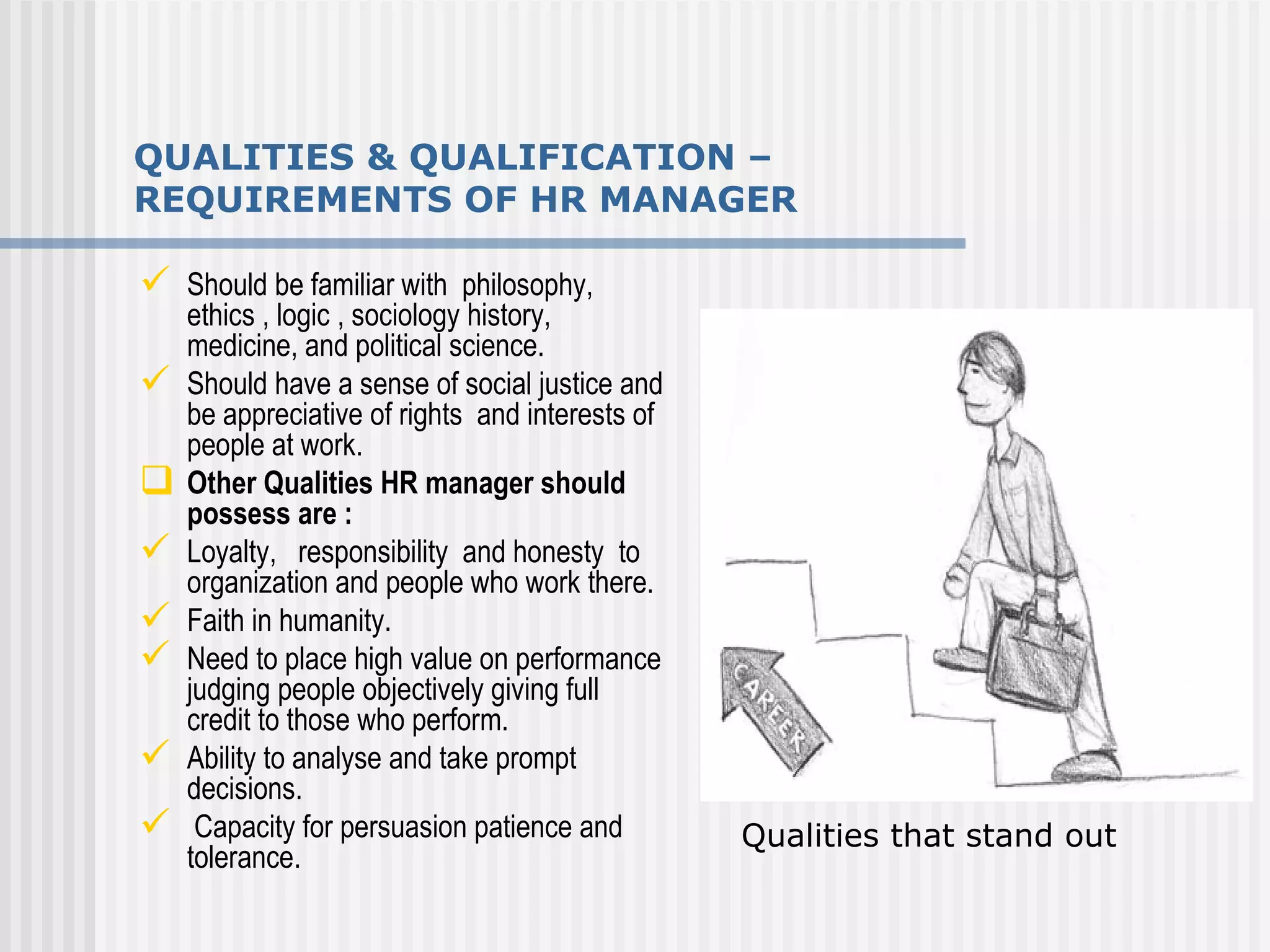
QUALITIES & QUALIFICATION – REQUIREMENTS OF HR MANAGER Should be familiar with  philosophy, ethics , logic , sociology history, medicine, and political science. Should have a sense of social justice and be appreciative of rights  and interests of people at work. Other Qualities HR manager should possess are : Loyalty,  responsibility  and honesty  to organization and people who work there.  Faith in humanity. Need to place high value on performance judging people objectively giving full credit to those who perform. Ability to analyse and take prompt  decisions.  Capacity for persuasion patience and tolerance. Qualities that stand out
Concept of HR Concept of HR : A . Industry is a partnership between Management  and  other employees whose objective is to earn profit through services  B .  Industry can earn profit by developing and coordinating the capacities, the interests and opportunities of each worker and management .
ASSIGNMENT 1. What are the essential qualities of an HR Manager? What are her/his functions? 2.  Explain meaning of HRM. How does it differ from PM?  3. PM is paid by the company. How should he act? As representative of management or employees?  Discuss.  4. Explain in detail the steps in designing organizational structure. 5. Explain the various strategic roles of the HR Manager. 6. Identify and discuss managerial and operative functions of HR department. 7. Personnel  administration is a line responsibility but a staff function. Discuss 8. Explain the qualities and qualifications necessary to be a successful or a HR manager.  DUE DATE ---- Next week same day
A new model of  HRM  is needed   More strategic (not strictly focused on day-to-day operational needs)   More proactive (less reactive)   More of a consultant to line management (less of a bureaucratic specialist)   More of an “employee champion” (less of an organizational “cop”)    
Competencies needed for  HRM   Personal credibility   Business mastery   HR mastery     Change mastery
Development of HRM in India 1. 1947 – Industrial disputes act passed  Functions of labour officer were defined 1948 – Factories Act 1959  -  Employment Exchange  Act 1961  - Maternity Benefit Act  1970  - Contract Labour (regulation&abolishment) 1972  - Payment of Gratuity Act 1985  - Ministry of HRD-PM to HRM to HRD  1995  - Emphasis shifted to modern techniques 2001  - smart sizing of the organization 2002  - Emphasis on positive attitude rather than skill & knowledge – shift Intelligence quotient to emotional quotient
Modern HRM is a combination of principles Psychology Sociology Philosophy Economics  and  Management
HRM Involves Procedures and practices  through which Human Resource is managed  Ie organized and directed towards attainment  of Individual goals Organizational goals Social  goals
CHALLENGES OF  MODERN HR MANAGEMENT   Changing mix of the work force – Changes brought by women workers  Changing personal values of the work force Changing  expectations of citizen –employees Changing levels of productivity  - ( Reason :  IT,  ( Globalization,  economic policies and world politics)  Changing demands of government.( civil rights, equal employment , minimum wages, )
Environmental influence HRM cannot exist in vacuum.It is an  interdependent   activity.  Environmental factors that influence the organization through HR is called in  STEPIN S ocial T echnological E conomic P olitical I nternational N atural
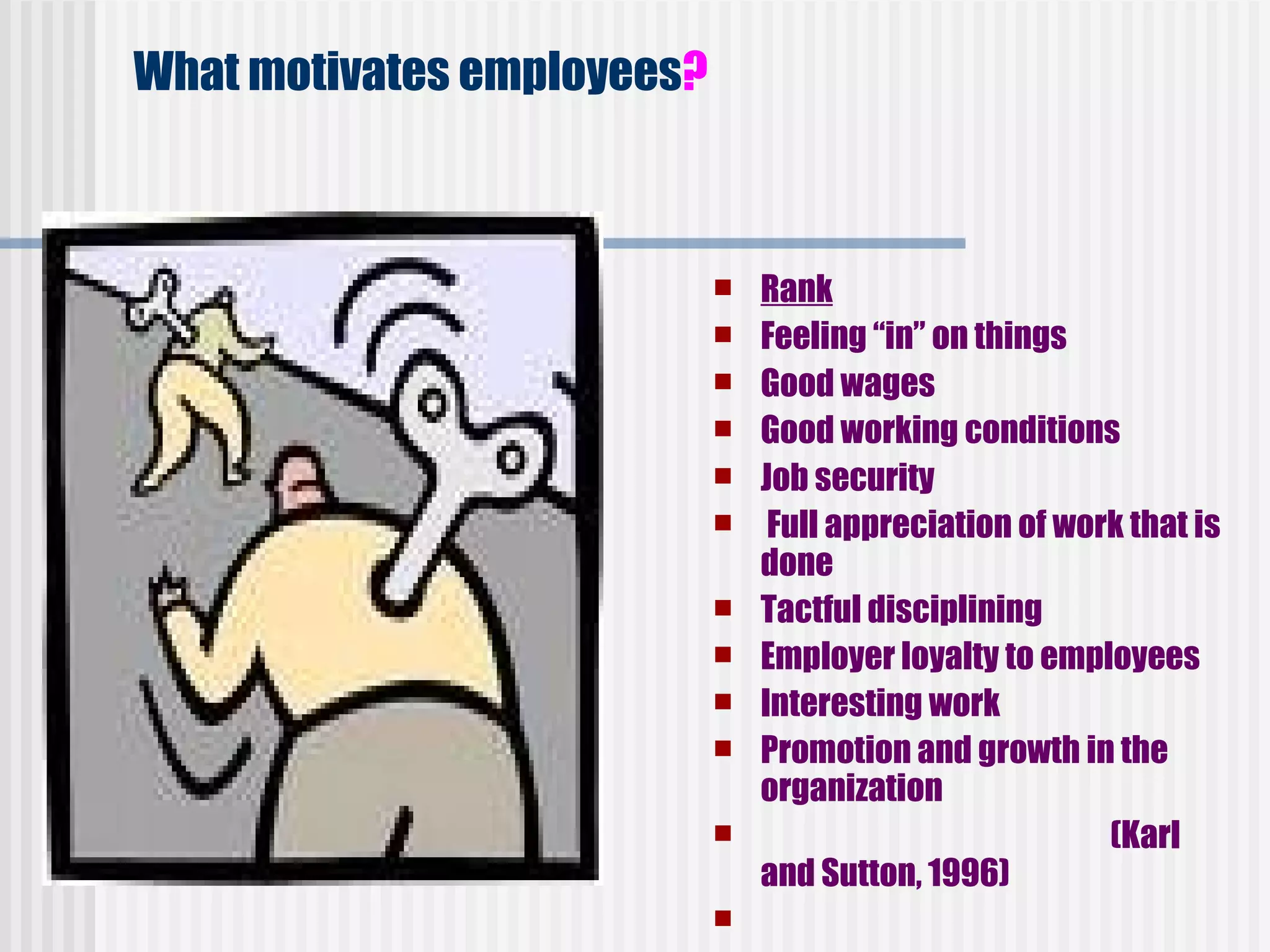
What motivates employees ?     Rank Feeling “in” on things          Good wages      Good working conditions       Job security    Full appreciation of work that is done   Tactful disciplining     Employer loyalty to employees    Interesting work   Promotion and growth in the organization                               (Karl and Sutton, 1996)    
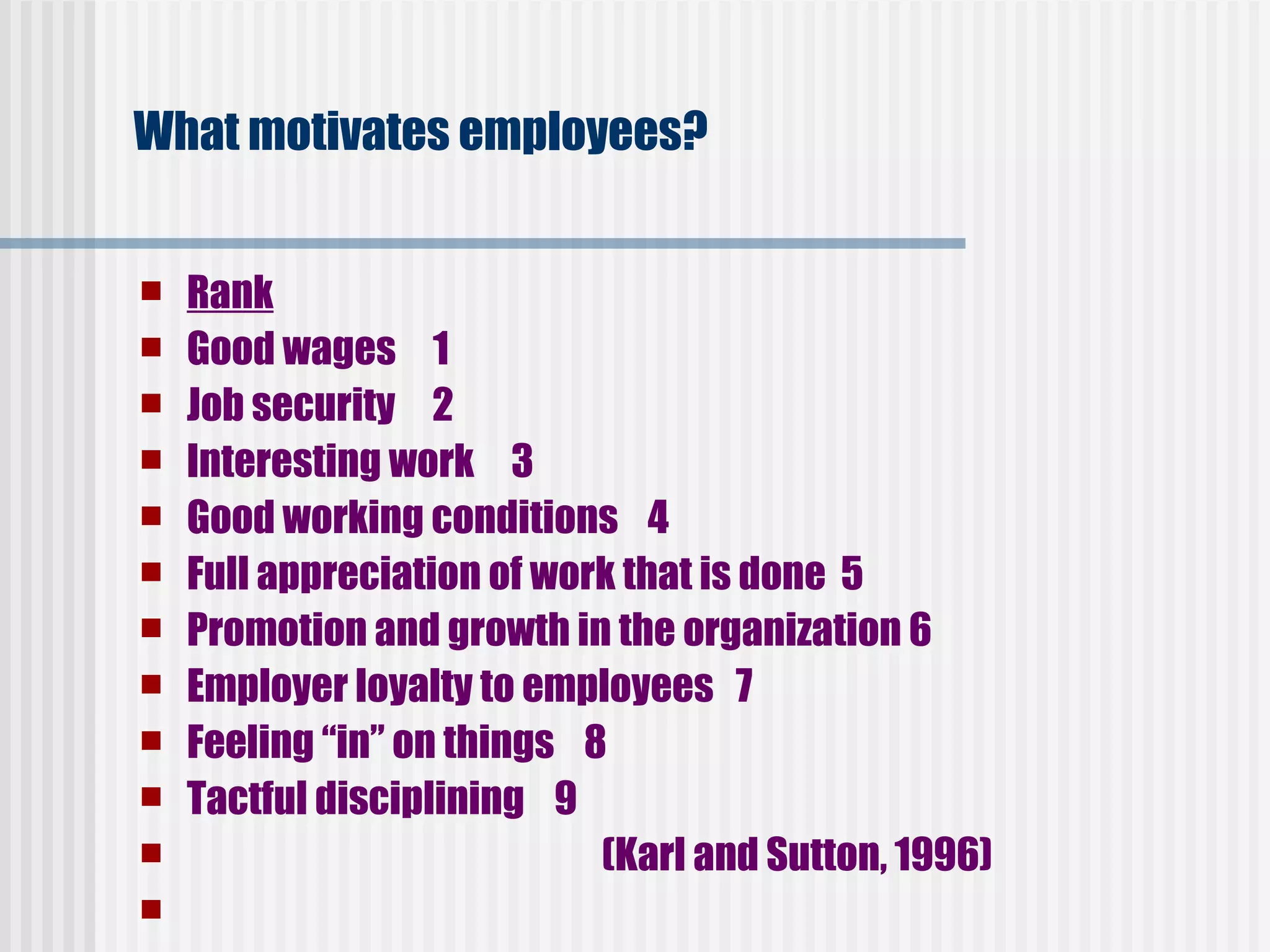
What motivates employees?   Rank Good wages     1   Job security     2   Interesting work     3   Good working conditions    4   Full appreciation of work that is done  5   Promotion and growth in the organization 6   Employer loyalty to employees   7   Feeling “in” on things    8    Tactful disciplining    9                                (Karl and Sutton, 1996)   LINE   refers to those positions of the organization which have responsibility , authority and are accountable for accomplishments of objectives.  Managers identified as LINE are not   subject to command by staff position. In case of disagreements between line and staff , line manager has the right to make final operating decision. Line authority   represents uninterrupted series of authority and responsibility delegating down the management hierarchy .  Though authority is delegated responsibility for action taken by subordinate still rests with the Line manager.

Hrm 1 vtu_sem_2

  • 1.
  • 2.
    HRM HUMAN RESOURCE OR HUMAN RELATIONS MANAGEMENT Personnel Management is a function of managing people. PM is also called HRM.
  • 3.
    What do youunderstand by HRM HRM is the effective use of human resources in order to enhance organisational performance. Activities an organization conducts to use its human resource effectively HRM proposes that people are a capital resource ( Human capital) and return on people is the measurable outcome.  
  • 4.
    What is HRM ? Origins . - HRM-type themes, including ‘ human capital theory’ and 'human asset accounting', can be found in the literature from the 1970s. The modern view of HRM gained prominence in 1981 - introduction in the prestigious MBA course at Harvard Business School. Simultaneously, other interpretations were being developed in Michigan and New York
  • 5.
    Brief History ofHRM. History of HRM can be characterized in two ways (1) as moving through 4 broad phases. (2) Through the 20 th century. (1) as moving through 4 broad phases : A . The craft system: Craft guilds supervised quality,production,methods,conditions of employment. Senior (master) worker controlled guilds-recruit entered after long-rigorous training. Best suited for domestic industry. Mass production deteriorated craft guilds.
  • 6.
    Brief History ofHRM. History of HRM can be characterized in two ways ( B) Scientific Management : Early 20 th century. Tasks were divided into parts among unskilled workers. Large hierarchy of supervisors and managers became necessary. Along came assembly line and a scientific approach to an analysis of working terms of its constituent parts. Founder – American Mechanical Engineer Fredrick Taylor.
  • 7.
    Brief History ofHRM. History of HRM can be characterized in two ways ( C ) Human Relations Approach : “in order to be productive and satisfied employees need to be understood”. Hawthorne studies: Elton Mayo and associates (1880-1949).Conducted at Western Electrical,Chicago. Studied effect of illumination on productivity-one group was told lighting is going to be changed –but not changed-workers were satisfied and productivity increased. Finding: significant variable was not physical but psychological.These findings led to lot of research on the social factors associated with work results-led to Human Relations Movement.
  • 8.
    Organizational Science –Human Resource Approach: ( D ) Current organizational Science –Human Resource Approach: Focuses on total organization. Grew out of organizational science trend and combines learning from the previous movements with current research on behavioural science.
  • 9.
    Before we goon… Contents Module 1 Introduction Nature and scope of HRM and HRD PM v/s HRM Features and Role of HRM Managerial functions and operative functions Objectives of HRM policies-procedures and programmes. Line and staff and personnel management. Role and qualities of HR Manager
  • 10.
    Objective of thismodule Objective of this module is To familiarize students with various with various HRM terms. Introduce students to fundamentals and importance of HRM. Duration…
  • 11.
    Introduction HRM starts from organization needs for HR with demand rather than supply. PM is designed to achieve organizational objective-like profit maximization. HRM gives equal importance to individual and organizational development. HRM is dedicated to develop a suitable corporate culture. Programmes are designed and implemented to reflect the core values of the enterprises.
  • 12.
    Introduction HRM is deep rooted comprehensive activity taken up to improve the quality of human beings who are vital assets of the organization. PM is subsystem of general management system. It concentrates on managing human element and other allied aspects HRM is directed towards managerial needs for resource in organization, with greater emphasis on planning, monitoring and control rather than problem solving and mediation. A detailed study of people is the main function of HRM. !!!!!!
  • 13.
    Introduction Study ofHRM in college or reading number of books will not magically change one into an effective HR Manager. A practical approach to human and organizational problems, clear analysis of issues and thinking is what makes one an effective PM . PM has to keep his head above water while moving ahead
  • 14.
    Introduction P Management is one of the most challenging and complex fields of study and work. Firms requirement for an effective work force has to be met and should be concerned with welfare of employee and society .
  • 15.
    Books Personnel Management- Edwin Flippo 6 th Edition Human resource management – Cynthia Fisher Personnel and HR Management – P.Subba Rao (Latest Edition) A good dictionary
  • 16.
    What you haveto do Use a dictionary Listen carefully Serious Pre-class reading
  • 17.
    What is humanresource management?   The effective use of people to achieve both organizational and individual goals   The effective recruitment, selection, development, compensation, and utilization of human resources by organizations   The Harvard interpretation sees employees as resources. They are fundamentally different from other resources - they cannot be managed in the same way. The stress is on people as human resources.          
  • 18.
    Why care about HRM ? Impact on you as employees Impact on you as managers Potential future roles as HR professionals Impact of HRM on organizations  
  • 19.
    HRM has increased in importance since the 1980s.  Why? People determine the success and failure of organizations and projects. Globalization Government regulation Stronger knowledge/research base Changing role for labor unions Challenge of matching worker expectations with competitive demands  
  • 20.
    Importance of HRMPERSONNEL – EMPLOYEES – STAFF Organizations create rules or guidelines to encourage people working to accomplish organizational goals. To accomplish the objectives there is need to create good Industrial Relation. For this Management has to manage / lead people effectively. Cost reduction-down sizing are major concerns , but not at the cost of quality and losing out to competition. Every Manager wants to deliver quality goods and services . For this We require quality workforce. People and the way they are managed are the major sources of competitive advantage.
  • 21.
    Importance of HRMPersonnel Management helps- build an effective and satisfied working team. “ “ Human factor of production “- skills, knowledge, physical , mental energy etc are given due consideration. Dale Yoder said “ managing people is the heart and essence of being a manager. Success or progress of an organization depends on how manager can motivate, understand, lead, inspire and activate them ”.
  • 22.
    Be familiar with Personal – Personnel HR - HRM Career - Carrier Turnover =No of employees leaving the organization Retention = Retaining existing employee Attrition = wearing away Job family = all jobs related to same category – mechanical, production, sales Outsourcing = Handing over the particular task to outside agency/ sister concern = Organization of the same management Ergonomics = study of work and its environment to achieve maximum efficiency Man Power = HR / how many people
  • 23.
    Be familiar withHR = Human Resource HRM = Human Resource Management HRP = Human Resource Planning MP = Manpower Planning PBC = Performance Based Compensation NEP = New Economic Policy GE = Global Economy MBO = Management By Objective MBE = Management By Exception WPM = Workers Participation
  • 24.
    Definitions of HRMDefinitions: D. YODER and others “ HRM is the phase of the management , which deals with the effective control and use of manpower as distinguished from other sources of power.”. “ The management of HR is a system - participants seek to attain both individual and group goals “ . National Institute of PM “ it is that part of PM function which is primarily concerned with the human relationship within an organization. “
  • 25.
    Definitions of HRM“ Personnel Management involves procedures and practices through human resources and are managed ie organized and directed towards attainment of individual, organizational and social goals”. British Institute of PM London, “ It is that part of management, which is concerned with the people at work and with their relationship within the enterprise “.
  • 26.
    Nature of HRM1. A NATURE OF HRM – is to reflect its new philosophy , a new outlook, approach and strategy which views an Organizations manpower as its resource and assets not as liabilities or mere hands . Mechanisation and IT have brought in more humans with different attitudes and behaviour into Organizations. HRM looks into the individual needs and motivates them to work. Human element in the enterprise has paved the way for effective management of the organization.
  • 27.
    Scope of HRMJust employment, maintenance of salary records has enlarged to Providing welfare Performance Appraisal / Management Human Relations Strategic HR Employee Involvement
  • 28.
    Scope of HRMManager’s job is administering a “ social system “. Personnel records is becoming more and more important so as to ensure the adaptability of personnel / employees. Labour Relations, Public Relations and plant security are Personnel sub areas – not left to be the sole responsibility of Personnel Department. The scope is wide and varied “ P. Department and P.Mnagers perform a variety of roles in accordance with the needs of a situation”. Personnel Managers play multiple roles –bargainers, conscience keepers, peace makers, counselors, Company spokespersons, problem solvers and change managers.
  • 29.
    Scope of HRMinclude Objectives of HRM Organization of HRM Employment & Development Wages, Salary, compensation –Administration Motivation Industrial Relations Participative Management
  • 30.
    Strategic Role ofHRM Firm’s ability to survive and prosper is increasingly a function of the human resources they have Managers’ career success depends on how well they manage their firm’s resources
  • 31.
    HRM v/s PM HRM is proactive than reactive. Is goal oriented. Treats labour as social capital HRM - starts from organization needs for HR with demand rather than supply. PM - is directed at the employees of the organization Finding, training, arranging pay and contracts of employment Explaining what is expected of them. justifying what management is doing. Trying to modify management action that could produce an unwelcome response from the employees.
  • 32.
    HRM v/s PM In modern HRM principles and theories from Psychology , Sociology , philosophy, economics and Management are combined. P Manager ( worst stage ) has to act as organizations social conscience. P Manager ( best stage ) works as a well informed specialist , with all members of the organization, in determining and meeting the demands of the social role.
  • 33.
    HRM v/s PM HRM is directed towards managerial needs for resource in organization with greater emphasis on planning, monitoring and control rather than problem solving and mediation. The strategic and philosophical context of HRM makes it more purposeful, relevant, and more effective. HRM is significantly different from PM >>>HRM is demand-driven. PM is subsystem of general management system. It concentrates on managing human element and other allied aspects. PM is directed mainly at company employees and not completely identified with management needs. PM - is supply driven –
  • 34.
    PM v/sHRM Most obvious change is a “re-labelling process” ? A valuable contribution of HRM is to direct the attention to people as the key resource of organisations and lending the “management of personnel ” increased importance. Procedures and techniques strongly resemble those of personnel management.
  • 35.
  • 36.
    Meaning and FunctionsMeaning = HRM means the process of accomplishing organizational objectives by acquiring , retaining, terminating, developing and properly using the HR in the organization. HRM encompasses many functions HRD is just one of the functions within HRM
  • 37.
    Meaning and FunctionsHRM People Functions Include:   Performance Management Communication Training and Development Employee commitment Equal opportunity Health and safety Grievances/labor relations Job analysis Labour needs Recruit ment Selection Orientation and training Wages and salaries Incentives and benefits
  • 38.
    HRM FUNCTIONS Primary Secondary Human resource planning Equal employment opportunity Staffing (recruitment and selection) Compensation and benefits Employee and labor relations Health, safety, and security Human resource development Organization and job design Performance management/ performance appraisal systems Research and information systems
  • 39.
    MEANING-FUNCTIONS OF HRM Functions as per George Strauss and Leonard Sayels . 1. Recruitment (Acquiring people, selection(with talent , skill, will and motivation), Job analysis , job description , and job evaluation 2. Increasing organizational efficiency, . Establishing healthy relationship between Mgmt and workers and workers themselves. 3. Retaining - there should not be high manpower turnover. Recruited HR should remain in the organization for a long time. 4.Training and educational programmes. helping employee identify with the organization. 5. Developing – involves educating , training , and making HR accept any type of current or future work.
  • 40.
    Functions of HRM6. Terminating – Employees who are unruly, unproductive , expensive should be made to retire. They are a strain on the finance and bad influence on other employees. 7 . Labour Relations ( collection of information, preparation, arbitration etc ( The maintenance and effective use of facilities for joint consultation between employer and employee to settle all disputes effectively. 8 . Personnel planning and Evaluation .:. A detailed study of people is the main function of HRM. 10. Preparation and implementation of compensation and appraisal plans 11. Employees Record , Employees benefits services and programmes 12. Special services such as safety , communication etc HRM encompasses every activity relating to HR in an organization and communication system which reduces militancy.
  • 41.
    Functions of HRMAll activities connected with the employees of an organization and all decisions reflected to the human relations come within the functional areas of HR management. Functions may vary according to situations and nature of work, the organization and attitude of Mgmt. Functions of HRM seek to secure the maximum return with minimum investment on HR. Physical assets loose their value by constant and regular use due to wear and tear. Value of HR increases through appropriate utilization and proper development. ***** IMPORTANT
  • 42.
    Functions of HRMManagerial and Operational MANAGERIAL FUNCTIONS : One function cannot work without the other. A good blend of the two ensures the efficiency and success of the organization. Managerial functions of HRM: give right directions and motivate the Operation managers to put forth their best efforts. Planning , organizing , coordinating, controlling , directing work of those persons looking after operative functions.
  • 43.
    Operative Functions &Managerial Functions Functions of HR Department can be categorized into - Operative Functions & Managerial Functions OPERATIVE FUNCTIONS are related to specific activities : Procuring Developing Relations Utilizing and maintaining an efficient work force. Operation managers are more concerned about the efficient and effective i mplementation of the plan given by the top management.
  • 44.
    Operative Functions &Managerial Functions FUNCTIONS OF HRM Managerial functions Operational functions Planning Organizing Directing Controlling Employment HRD Compensation Human Relations IR
  • 45.
  • 46.
    Objectives of HRMSOCIAL OBJECTIVES ORGANIZATIONAL OBJECTIVES FUNCTIONAL OBJECTIVES INDIVIDUAL OBJECTIVES
  • 47.
    EMPLOYMENT HR DEVCOMPENSATION MGT HUMAN RELATIONS Org design Job design Job analysis Perf. app Training Career pl Job eva Wage Perks Motivaton Morale Job satisfaction Communication Grievance Discp. action Planning Recruitment Selection Induction Placement Quality of life AN ILLUSTRATION OBJECTIVES & POLICIES OF HRM OPERATIVE FUNCTIONS OF HRM MANAGERIAL FUNCTIONS OF HRM
  • 48.
    Objectives of HRMTo maximise commitment of people by organising work and creating attitudes and behaviour which generate best outcomes. To create and utilize an able and motivated workforce. To accomplish the basic organizational goals. To establish and maintain sound organizational structure and desirable working relationships among organizational members. To create facilities and opportunities for individuals or group development and to match with growth of the organization. HRM is basically a search for “best practices” to generate high levels of employee commitment and performance.
  • 49.
    Primary Objectives ofHRM To identify and satisfy individual and group needs by providing adequate and equitable wages, incentives, employee benefits and social security measures for challenging work,prestige,recognition security,status. Primary Objectives of HRM Relate goods and services to Society. HRdepartment has to create workforce with proper ability and motivation to accomplish the basic organizational goals. Utilize HR effectively. Satisfaction of the personal objectives of the members of an organization through monetary and non monetary devices. Bring about maximum individual development of Organization members. Satisfaction of the community and social objectives.
  • 50.
    Secondary Objectives ofHRM - Secondary - Fulfillment of primary objectives is contingent upon Secondary Objectives. Usefulness of the goods and services required by the society. Pick up capable and right people on the basis of qualification and background. Condition of employment for all members which motivates them to work better towards target . Effective utilization of people and materials in productive work. The continuity of the enterprise. Means adopted in achieving the primary objectives shall be consistent with the ethical and moral values of society and with the policies and regulations established by legislative action. Control the cost of labour Facilitate technological progress
  • 51.
  • 52.
    OBJECTVIES OF HRM POLICIES , PROCEDURES & PROGRAMME Objectives are predetermined ends of goals at which individual or group activity in an organization is aimed. Human beings are goal directed. Objectives serve as standards against which performance is measured. Setting of goals and their acceptance by employees promotes voluntary cooperation and coordination .
  • 53.
    OBJECTVIES OF HRM POLICIES , PROCEDURES & PROGRAMME A policy is a plan of action . BREWSTEW & RICHBELL defined HRM policies as “ a set of proposals and action that act as a reference point for managers in their dealings with employees” “ Personnel Policies constitute guides to action. They furnish the general standards or bases on which decisions are reached. Their origin lies in an organization’s values, philosophy, concepts and principles”.
  • 54.
    OBJECTVIES OF HRM POLICIES , PROCEDURES & PROGRAMME Policy : Personnel Policies guide the course of action intended to accomplish personnel objectives. Personnel policies are designed to ensure healthy conditions of work , employee participation , recognition of trade union , motivation of employees etc.
  • 55.
    Need for HRPolicy – Need for HR Policy – To have formal statement on corporate thinking which will serve as a guideline for action. To establish consistency in the application of the policies over a period. To accord consistent treatment to all the employees -to avoid favouritism and discrimination. To assure certainty of action and promote stability in an organization. To serve as standard for evaluating performance. To provide just and fair treatment. Policies build employee enthusiasm and loyalty.
  • 56.
    Principles of HRpolicy 1. Put right means in the right place. 2. Train everyone for the job to be done. 3 . Make the organization a coordinated team 4. Supply the right tool and condition of work 5. Give security with opportunity , incentives , recognition to all employees. 6. Look ahead, plan ahead for more and better things.
  • 57.
    Classification of HRpolicies 3 major classifications: 1. Basic organizational policies : relating to the principles, managerial philosophy and fundamental objectives of the organization. 2. General policies : relating to organizational activities personnel development & creation of appropriate work climate . 3. Specific policies : relating to job description , analysis & evaluation of fundamental objectives, proper communication system , determination of wage rates on the basis of performance.
  • 58.
    HR Policies HRPolicies include : History of company’s growth - Employment practices and conditions of employment - Grievances redressal ( amends/alteration/) procedure Safety rules and regulations and responsibilities of employees Need for cooperation between management and employees - employee financial aids, educational opportunities
  • 59.
    HR Policies HRPolicies include : Employees news letters and house journals – communication media and suggestion system Health and hospitalization Vacation with pay Sickness death and maternity benefits Company stores, social security Collective bargaining , discipline Encashments , PR, Labour Relations Prohibited activities
  • 60.
    What is HRMprocedure ?? Procedures are specific applications. A procedure is well thought out course of action. procedures show a sequence of activities within that area. Procedure prescribes specific manner in which a piece of work is to be done. Procedures are called “ action guidelines “ and generally derived from policies. In procedure the emphasis is on step by step sequence of required action. Policies are general instructions. Policies define a broad field – Policy might be translated into action through procedures
  • 61.
    To achieve theobjectives – To achieve the objectives – tools, techniques, to be adopted are Administrative system – which collects systematic data both from within the organization and external sources. Periodic review of administrative practice. HR Manager should assume the responsibility of attaining the requirements of his enterprise and those imposed upon it by environmental changes.
  • 62.
    HR Manager’s ResponsibilitiesRestoring Trust in the HR Profession Building a New Social Contract at Work Opening the Door to the Next Generation of HR Leaders  
  • 63.
    HRM as acentral subsystem Finance Marketing Materials Technology HRM Information Production
  • 64.
    ORGANIZATION & HRMOrganizations are effective instruments in helping individuals accomplish , personal objectives that they cannot achieve alone. Organizations are formed to satisfy objectives that can be best met collectively Organizations are means to an end . Organization design deals with structural aspects of organizations. Organizational design aims at analyzing roles and relationships so that collective effort can be explicitly organized to achieve specific ends
  • 65.
    ORGANIZATIONAL STRUCTURE STRUCTURE: Efficiency with which an organization is able to achieve its goal are determined by the organizational structure. STRUCTURE is the pattern of formal relationships and duties – activities or tasks are assigned to different departments and people -Co-ordination of these tasks – Hierarchical relationships within the organization Policies , procedures, standards, evaluation systems etc guide the activities and relationships of people in the organization.
  • 66.
  • 67.
  • 68.
    Multi-Divisional Structure DivisionDivision Division Division Production Finance Engineering Accounting Sales & Marketing Human Resources Chief Executive Officer Corporate Finance Corporate R&D Corporate Marketing Strategic Planning Corporate Human Resources
  • 69.
    Steps in designingOrganizational structure 1 . Analysis of present and future circumstances and environmental factors. 2 . Overall aims and purpose of the enterprise – survival, growth, profit maximization, wealth maximization 3. Objectives – specific aims or targets to be achieved. 4. Activities – assessment of work being done and what needs to be done to achieve objectivities 5 . Decisions to be taken across –horizontal / vertical dimensions.
  • 70.
    Steps in designingOrganizational structure 6 . Organization structure – grouping of activities, span of management, management levels etc 7. Job structure – job design, job analysis, job descriptions, job specification etc 8. Organizational climate – working atmosphere in the enterprise, team work, communication, creativity, participation and trust. 9. Management style – democratic, free-rein ,autocratic 10 . Human Resources – availability of HR marked by skill, knowledge, commitment, aptitude.
  • 71.
    Formal Relationships : The relationship with which the managers in an organization deal with one another are broadly classified into LINE & STAFF Informal Relationships are those that emerge from formal relationships and are established unofficially by persons employed. Line Managers : Authority -Making decisions-Directing work, Giving orders - Accomplishing goals Staff Managers : Assisting and advising line managers   LINE & STAFF
  • 72.
    STAFF RELATIONS STAFFRELATIONS : The staff concept is an old / ancient one. Line has to perform all their functions and concentrate on management of people and activities. This gives rise to securing advice and help from specialists. - This creates staff relationships.- The relationships between two managers when it is created for Taking/giving advice, information, counseling etc for achieving organizational goals is called staff relations. Staff Managers analyze problems, collect information and develop alternative suggestions and help the line managers to make right decisions. Staff responsibility is monitoring and reporting ---results and information to the line managers to reduce their work load.
  • 73.
    Line Manager’s HRMJobs   The right person Orientation Training Performance Creativity Working relationships Policies and procedures Labour costs Development Morale Protecting  
  • 74.
    Exact activities ofLine and staff managers?? There is no single division of responsibility applied to all organizations Eg: Recruiting & hiring of employees Usually the line manager specifies the qualifications needed to fill specific positions. Then the HR manager develops sources of qualified candidates, conducts initial screening (tests) and sends those filtered to line manager. Line manager conducts the final technical screening tests and selects the one to hire or requests new applicants
  • 75.
    Some activities tendto be split between line & HR managers Employee interviews Performance appraisal Skills training Job analysis & descriptions   Changing Environment of HR Management Globalization Technological Advances Exporting Jobs The Nature of Work Workforce Diversity  
  • 76.
    Line and staffrelations STAFF : Operational – functional managers who carry out the decisions The relationships that are established among the components of organization are of two types Formal and Informal. Line & Staff Relations Formal relationships are those officially established and prescribed in the manual, charts and job descriptions. The three basic relationships of this category are responsibility, authority, and accountability. Line Relationship : Relationship existing between managers due to delegation of authority and responsibility and giving or receiving instructions or orders is called LINE RELATIONSHIP
  • 77.
    HRM is astaff function Organizational ability depends on sound management of HR. HR Provides specialized assistance to line managers through Personnel Managers. Line Managers may not have the time to manage HR and it is HR Manager who provides training , grievance redressed and motivation. PM performs certain staff functions relating management of personnel like Advice, guidance, counseling. and providing necessary information. HRM is a staff function, but responsibility for the management of personnel rests with Line Managers. HRM is a A LINE responsibility but STAFF but staff function.
  • 78.
    Line versus StaffAuthority Line Authority – given to managers directly responsible for the production of goods and services (direct function) Staff Authority – given to units that advise and consult line units Limits of Authority HRM & HRD units have staff authority (Overhead function) Line authority takes precedence Scope of authority – how far (how much) can you authorize?
  • 79.
    ROLE OF HRMANAGER HR Manager contributes a lot to organizational effectiveness. The conscience Role – that of humanitarian who reminds management of its morals and obligation to employees and society. The counselor – for job related , professional and personal problems. The Mediator - peace maker settles disputes between employees & management and between employees,-works as a communication link. The Spokesperson – Spokesperson OF or FOR the company. The problem –solver : with respect to the issues that involve HR Management and overall long range organizational planning. The change Agent _ Introduces changes in various existing programmes. Other Roles : Welfare Roles, clerical role and fire fighting role-
  • 80.
    HRM Activities Twomain HRM goals Getting the right people HRM activities must be aligned with corporate strategy Maximizing their performance and potential Failure of either goal can influence the success or failure of the other
  • 81.
  • 82.
    HRM Activities PlanningForecasting demand Assessing supply Formulating fulfillment plans Job analysis (assessing the job) Scope and depth of jobs Requisite skills, abilities, and knowledge that people need to perform their jobs successfully Job description Job specification Getting the Right People
  • 83.
    ACTIVITY OF HRMANAGER/DEPARTMENT Recruitment / interview / hiring Pre-employment Testing Induction / Orientation, Promotion/ transfer Personnel records / reports Personnel Research Insurance benefits- Administration ( ESI ) Unemployment - Administration EEO compliance –affirmative action Wages / salary / compensation Education aid – scholarship Job Evaluation Health and Medical Services
  • 84.
    ACTIVITY OF HRMANAGER/DEPARTMENT Retirement Preparation Programme Vacation / Leave Processing separation = Controlling / control points . Effective separation of employees by carefully designing programmes of retirement, layoffs and discharge. Retirement programmes and Information - More the information about retirement / more successful is the transition and number of retirees participating in. Unemployment compensation – appropriate for voluntary resignation, during strikes, calamities, emergencies.
  • 85.
    ACTIVITY OF HRMANAGER/DEPARTMENT Pension and profit sharing plan Recreation / social recognition programme Attitude surveys / union& labour relations Disciplinary procedures Relocation services Training Programmes Communication – publications – bulletin Boards
  • 86.
    ACTIVITY OF HRMANAGER/DEPARTMENT Public Relations Pay Roll Processing Travel / Transport Services / Library Executive compensation HR Planning & Management Development Performance Evaluation Community Relation / Fund drives ( TSUNAMI ) Management appraisal MBO (Mgmt BY Objective )
  • 87.
    QUALITIES & QUALIFICATION– REQUIREMENTS OF HR MANAGER HR manager organizes and manages the Personnel development of the organization. He has to win the confidence of all concerned people. It is a tight rope walk. Should be tactful and imaginative. Should be a specialist in organization theory. Has to advise the top management and should be able to Organize - minimize friction, promote goodwill. Should have good knowledge of personnel administration, relevant laws, procedure, techniques, economics, industrial Psychology, and behavioural science help to tackle humans and Problems efficiently.
  • 88.
    QUALITIES & QUALIFICATION– REQUIREMENTS OF HR MANAGER Should be familiar with philosophy, ethics , logic , sociology history, medicine, and political science. Should have a sense of social justice and be appreciative of rights and interests of people at work. Other Qualities HR manager should possess are : Loyalty, responsibility and honesty to organization and people who work there. Faith in humanity. Need to place high value on performance judging people objectively giving full credit to those who perform. Ability to analyse and take prompt decisions. Capacity for persuasion patience and tolerance. Qualities that stand out
  • 89.
    Concept of HRConcept of HR : A . Industry is a partnership between Management and other employees whose objective is to earn profit through services B . Industry can earn profit by developing and coordinating the capacities, the interests and opportunities of each worker and management .
  • 90.
    ASSIGNMENT 1. Whatare the essential qualities of an HR Manager? What are her/his functions? 2. Explain meaning of HRM. How does it differ from PM? 3. PM is paid by the company. How should he act? As representative of management or employees? Discuss. 4. Explain in detail the steps in designing organizational structure. 5. Explain the various strategic roles of the HR Manager. 6. Identify and discuss managerial and operative functions of HR department. 7. Personnel administration is a line responsibility but a staff function. Discuss 8. Explain the qualities and qualifications necessary to be a successful or a HR manager. DUE DATE ---- Next week same day
  • 91.
    A new modelof HRM is needed   More strategic (not strictly focused on day-to-day operational needs) More proactive (less reactive) More of a consultant to line management (less of a bureaucratic specialist) More of an “employee champion” (less of an organizational “cop”)  
  • 92.
    Competencies needed for HRM   Personal credibility Business mastery HR mastery   Change mastery
  • 93.
    Development of HRMin India 1. 1947 – Industrial disputes act passed Functions of labour officer were defined 1948 – Factories Act 1959 - Employment Exchange Act 1961 - Maternity Benefit Act 1970 - Contract Labour (regulation&abolishment) 1972 - Payment of Gratuity Act 1985 - Ministry of HRD-PM to HRM to HRD 1995 - Emphasis shifted to modern techniques 2001 - smart sizing of the organization 2002 - Emphasis on positive attitude rather than skill & knowledge – shift Intelligence quotient to emotional quotient
  • 94.
    Modern HRM isa combination of principles Psychology Sociology Philosophy Economics and Management
  • 95.
    HRM Involves Proceduresand practices through which Human Resource is managed Ie organized and directed towards attainment of Individual goals Organizational goals Social goals
  • 96.
    CHALLENGES OF MODERN HR MANAGEMENT Changing mix of the work force – Changes brought by women workers Changing personal values of the work force Changing expectations of citizen –employees Changing levels of productivity - ( Reason : IT, ( Globalization, economic policies and world politics) Changing demands of government.( civil rights, equal employment , minimum wages, )
  • 97.
    Environmental influence HRMcannot exist in vacuum.It is an interdependent activity. Environmental factors that influence the organization through HR is called in STEPIN S ocial T echnological E conomic P olitical I nternational N atural
  • 98.
    What motivates employees?   Rank Feeling “in” on things      Good wages      Good working conditions     Job security    Full appreciation of work that is done   Tactful disciplining     Employer loyalty to employees    Interesting work   Promotion and growth in the organization                               (Karl and Sutton, 1996)    
  • 99.
    What motivates employees?  Rank Good wages     1 Job security     2 Interesting work     3 Good working conditions    4 Full appreciation of work that is done  5 Promotion and growth in the organization 6 Employer loyalty to employees   7 Feeling “in” on things    8  Tactful disciplining    9                              (Karl and Sutton, 1996)   LINE refers to those positions of the organization which have responsibility , authority and are accountable for accomplishments of objectives. Managers identified as LINE are not subject to command by staff position. In case of disagreements between line and staff , line manager has the right to make final operating decision. Line authority represents uninterrupted series of authority and responsibility delegating down the management hierarchy . Though authority is delegated responsibility for action taken by subordinate still rests with the Line manager.