Presentation
of Data
Quantitative Method
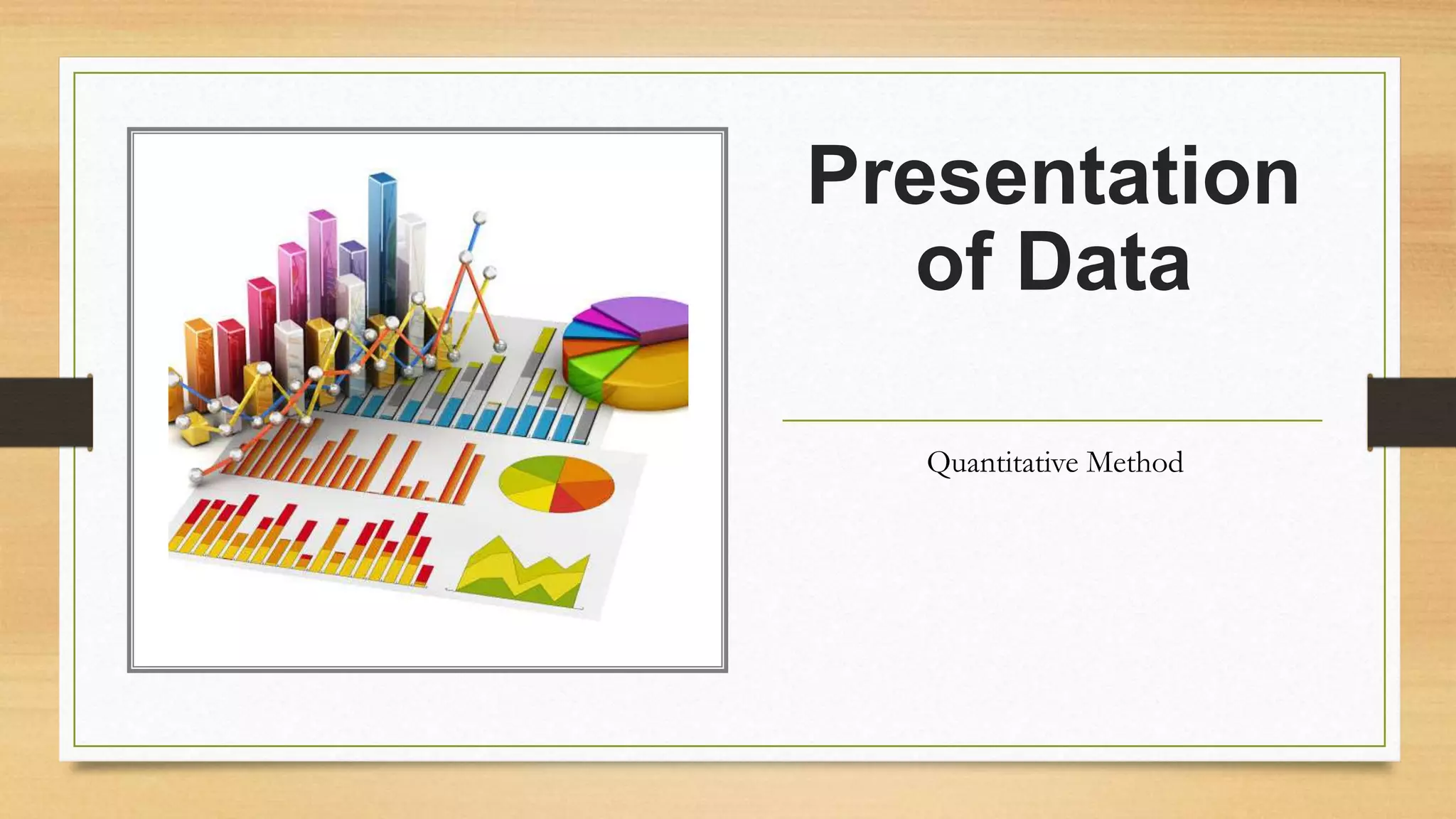
Presentation of Data
•Method by which the people organize,
summarize and communicate
information using variety of tools such
as tables, graphs, and diagrams.
USES OF PRESENTATION
Easy and better understanding of the subject
Provide first hand information about data
Helpful in future analysis
Easy of making comparisons
Very attractive
PRINCIPLES IN PRESENTATION
• Data should be presented in simple form
• Arose interest in a reader
• Should be concise but without losing impact details
• Facilitate further statistical analysis
• Define problem and should suggest its solutions.
Significance of Tabulation
• Simplifies complex data
• Unnecessary details and repetitions of data avoided in
tabulation
• Facilitates comparison
• Gives identity to data
• Reveals pattern with in the figures which cannot be seen in
the narrative form
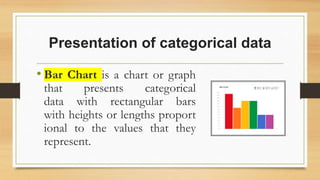
Presentation of categorical data
• Bar Chart is a chart or graph
that presents categorical
data with rectangular bars
with heights or lengths proport
ional to the values that they
represent.
Presentation of categorical data
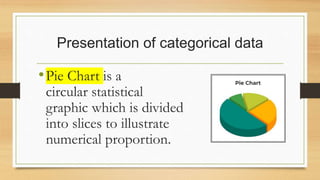
•Pie Chart is a
circular statistical
graphic which is divided
into slices to illustrate
numerical proportion.
Presentation of categorical data
Pictograms
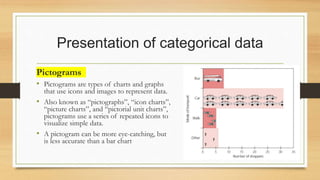
• Pictograms are types of charts and graphs
that use icons and images to represent data.
• Also known as “pictographs”, “icon charts”,
“picture charts”, and “pictorial unit charts”,
pictograms use a series of repeated icons to
visualize simple data.
• A pictogram can be more eye-catching, but
is less accurate than a bar chart
Presentation of continuous data
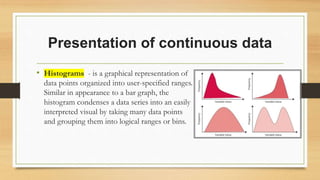
• Histograms - is a graphical representation of
data points organized into user-specified ranges.
Similar in appearance to a bar graph, the
histogram condenses a data series into an easily
interpreted visual by taking many data points
and grouping them into logical ranges or bins.
Presentation of continuous data
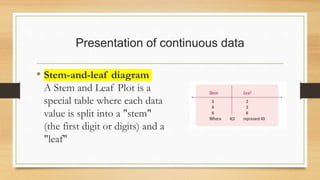
• Stem-and-leaf diagram
A Stem and Leaf Plot is a
special table where each data
value is split into a "stem"
(the first digit or digits) and a
"leaf"

Chapter IV -Presentation of Data.pptx

  • 1.
  • 2.
    Presentation of Data •Methodby which the people organize, summarize and communicate information using variety of tools such as tables, graphs, and diagrams.
  • 3.
    USES OF PRESENTATION Easyand better understanding of the subject Provide first hand information about data Helpful in future analysis Easy of making comparisons Very attractive
  • 4.
    PRINCIPLES IN PRESENTATION •Data should be presented in simple form • Arose interest in a reader • Should be concise but without losing impact details • Facilitate further statistical analysis • Define problem and should suggest its solutions.
  • 6.
    Significance of Tabulation •Simplifies complex data • Unnecessary details and repetitions of data avoided in tabulation • Facilitates comparison • Gives identity to data • Reveals pattern with in the figures which cannot be seen in the narrative form
  • 7.
    Presentation of categoricaldata • Bar Chart is a chart or graph that presents categorical data with rectangular bars with heights or lengths proport ional to the values that they represent.
  • 8.
    Presentation of categoricaldata •Pie Chart is a circular statistical graphic which is divided into slices to illustrate numerical proportion.
  • 9.
    Presentation of categoricaldata Pictograms • Pictograms are types of charts and graphs that use icons and images to represent data. • Also known as “pictographs”, “icon charts”, “picture charts”, and “pictorial unit charts”, pictograms use a series of repeated icons to visualize simple data. • A pictogram can be more eye-catching, but is less accurate than a bar chart
  • 10.
    Presentation of continuousdata • Histograms - is a graphical representation of data points organized into user-specified ranges. Similar in appearance to a bar graph, the histogram condenses a data series into an easily interpreted visual by taking many data points and grouping them into logical ranges or bins.
  • 11.
    Presentation of continuousdata • Stem-and-leaf diagram A Stem and Leaf Plot is a special table where each data value is split into a "stem" (the first digit or digits) and a "leaf"