Statistical tests for categorical data
Dr. S. A. Rizwan, M.D.
Public	Health	Specialist
SBCM,	Joint	Program	– Riyadh
Ministry	of	Health,	Kingdom	of	Saudi	Arabia
Learning	objectives
Demystifying statistics! SBCM, Joint Program – RiyadhSBCM, Joint Program – Riyadh
• Examine	the	relationship	between	categorical	
variables
• Construct	a	contingency	table	for	two	categorical	
variables
• Describe	the	approach	to	statistical	testing	of	
categorical	variables
Revise:	Categorical	variables
Demystifying statistics! SBCM, Joint Program – RiyadhSBCM, Joint Program – Riyadh
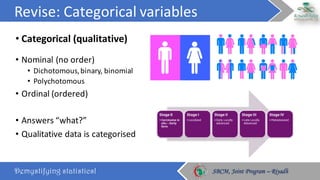
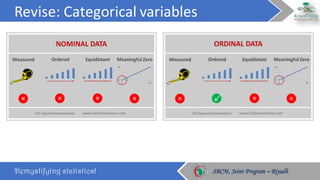
• Categorical	(qualitative)
• Nominal	(no	order)
• Dichotomous,	binary,	binomial
• Polychotomous
• Ordinal	(ordered)
• Answers	“what?”
• Qualitative	data	is	categorised
Revise:	Categorical	variables
Demystifying statistics! SBCM, Joint Program – RiyadhSBCM, Joint Program – Riyadh
Revise:	Prerequisites	for	a	test
Demystifying statistics! SBCM, Joint Program – RiyadhSBCM, Joint Program – Riyadh
• How	many	variables	are	there?
• What	is	the	nature	of	dependent	and	
independent	variable?
• How	many	categories	are	there	in	the	
categorical	variable?
• Does	the	continuous	variable	follow	normal	
distribution?
• Is	there	any	pairing	in	the	data/variables?
Revise:	DV,	IV,	Paired	data
Demystifying statistics! SBCM, Joint Program – RiyadhSBCM, Joint Program – Riyadh
Statistical	tests:	Bivariate
SBCM, Joint Program – RiyadhSBCM, Joint Program – RiyadhDemystifying statistics!
For	unpaired	data For	paired	data
• If	assumptions	for	Chi	square	are	met
• Chi-square	(>=	2	levels)
• If	assumptions	for	Chi	square	NOT	met
• Fisher’s	exact	(>=	2	levels)
• If	the	groups	are	paired
• McNemar (if	2	levels)
• RM	logistic	regression	(if	>2	levels)
• Interrater reliability	analysis
Statistical	tests:	Multivariate
SBCM, Joint Program – RiyadhSBCM, Joint Program – Riyadh
For	unpaired	data For	matched	data
Demystifying statistics!
• If	DV	is	binary	and	>1	IV
• Binary	logistic	regression
• If	DV	is	polychotomousand	>1	IV
• Multinomial	logistic	regression
• If	DV	is	ordinal	and	>1	IV
• Ordinal	regression
• If	the	groups	are	matched	
• Conditional	logistic	regression
• If	repeated	measurements
• RM	logistic	regression
Statistical	tests:	Special
SBCM, Joint Program – RiyadhSBCM, Joint Program – RiyadhDemystifying statistics!
For	stratified	data
• Cochran-Mantel-Haenszel test
Statistical	tests:	Special
SBCM, Joint Program – RiyadhSBCM, Joint Program – RiyadhDemystifying statistics!
For	ordered	categorical	variable
• Chi	square	test	for	trend
Passed Failed Total
R1	 100 78 178
R2 175 173 348
R3 42 59 101
Total 317 310 627
Measures	of	association
SBCM, Joint Program – RiyadhSBCM, Joint Program – RiyadhDemystifying statistics!
• Odds	ratio
• Relative	risk
• Interrater reliability	analysis
Contingency	table
SBCM, Joint Program – RiyadhSBCM, Joint Program – RiyadhDemystifying statistics!
• Used	in	bivariate	situations
• Use	counts,	not	percentages	
• No	one-sided	tests
• Each	subject	counted	only	once
• Explain	significant	findings
Some	selected	topics
SBCM, Joint Program – RiyadhSBCM, Joint Program – RiyadhDemystifying statistics!
• Covered	in	other	classes
• Chi	square	test
• Cochran-Mantel-Haenszel test
• Regression
• In	this	class	we	will	cover	basics	of:
• Fisher’s	exact	test
• McNemar test
• Interrater reliability	analysis	(Agreement	statistics)
Thought	exercise	1
SBCM, Joint Program – RiyadhSBCM, Joint Program – RiyadhDemystifying statistics!
• In	a	study	a	researcher	tested	a	perfume	on	9	rats	and	used	water	as	
the	control	on	9	other	rats.	Among	the	perfume	group	1	rat	showed	
restlessness	whereas	among	the	control	group	4	rats	showed	
restlessness.	Determine	if	there	is	an	association	between	perfume	
and	restlessness.
Thought	exercise	2
SBCM, Joint Program – RiyadhSBCM, Joint Program – RiyadhDemystifying statistics!
• 22	pairs	of	twins	were	enrolled	in	the	study.	One	of	the	twins	
smoked,	the	other	didn’t.	The	twins	were	followed	to	see	which	twin	
died	first.	For	17	pairs	of	twins,	the	smoking	twin	died	first	and	for	5	
pairs	of	twins,	the	non-smoking	twin	died	first.
Thought	exercise	3
SBCM, Joint Program – RiyadhSBCM, Joint Program – RiyadhDemystifying statistics!
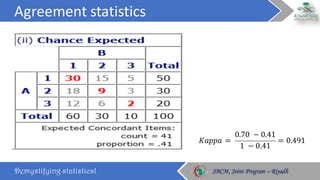
• All	100	pathological	slides	were	observed	by	2	pathologists.	The	
were	supposed	to	classify	the	disease	as	mild,	moderate	and	severe.	
Pathologist	1	classified	60,	30,	10	and	pathologist	2	classified	50,	30,	
20	as	mild,	moderate	and	severe.	Both	pathologists	agreed	that	44	
were	mild,	20	were	moderate	and	6	were	severe	and	disagreed	on	
the	remaining	slides.	Calculate	the	agreement	between	the	two	
pathologists.
Fisher’s	exact	test
SBCM, Joint Program – RiyadhSBCM, Joint Program – RiyadhDemystifying statistics!
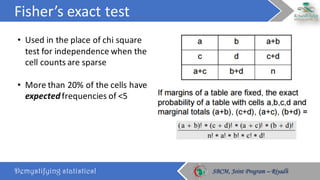
• Used	in	the	place	of	chi	square	
test	for	independence	when	the	
cell	counts	are	sparse
• More	than	20%	of	the	cells	have	
expected frequencies	of	<5
Fisher’s	exact	test
SBCM, Joint Program – RiyadhSBCM, Joint Program – RiyadhDemystifying statistics!
Fisher’s	exact	test
SBCM, Joint Program – RiyadhSBCM, Joint Program – RiyadhDemystifying statistics!
• 6	possible	tables	for	the	observed	
marginal	totals:	9,	9,	5,	13.
• p-value	is	calculated	by	summing	
all	probabilities	less	than	or	equal	
to	the	probability	of	the	observed	
table
Fisher’s	exact	test
SBCM, Joint Program – RiyadhSBCM, Joint Program – RiyadhDemystifying statistics!
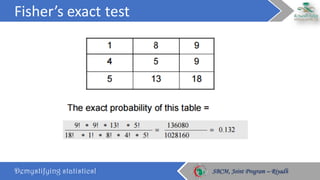
• The	observed	table	(Table	II)	has	
probability	=	0.132	
• P-value	for	the	Fisher’s	exact	test	=	
Pr (Table	II)	+	Pr (Table	V)	+	Pr
(Table	I)	+	Pr (Table	VI)
• =	0.132	+	0.132	+	0.0147	+	0.0147	
=	0.293
McNemar test
SBCM, Joint Program – RiyadhSBCM, Joint Program – RiyadhDemystifying statistics!
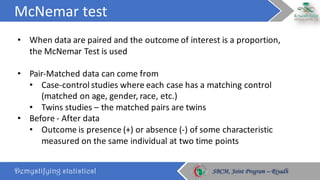
• When	data	are	paired	and	the	outcome	of	interest	is	a	proportion,	
the	McNemar Test	is	used
• Pair-Matched	data	can	come	from
• Case-control	studies	where	each	case	has	a	matching	control	
(matched	on	age,	gender,	race,	etc.)
• Twins	studies	– the	matched	pairs	are	twins
• Before	- After	data
• Outcome	is	presence	(+)	or	absence	(-)	of	some	characteristic	
measured	on	the	same	individual	at	two	time	points
McNemar test:	matched	case-control	
SBCM, Joint Program – RiyadhSBCM, Joint Program – RiyadhDemystifying statistics!
• a	- number	of	case-control	pairs	where	both	are	exposed
• b	- number	of	case-control	pairs	where	the	case	is	exposed	and	the	
control	is	unexposed
• c	- number	of	case-control	pairs	where	the	case	is
• unexposed	and	the	control	is	exposed
• d	- number	of	case-control	pairs	where	both	are	unexposed
• The	counts	in	the	table	for	a	case-control	study	are	numbers	of	pairs	
not	numbers	of	individuals.
McNemar test:	before-after	study
SBCM, Joint Program – RiyadhSBCM, Joint Program – RiyadhDemystifying statistics!
• a	- number	of	subjects	with	characteristic	present	both	
before	and	after	treatment
• b	- number	of	subjects	where	characteristic	is	present	
before	but	not	after
• c	- number	of	subjects	where	characteristic	is	present	
after	but	not	before
• d	- number	of	subjects	with	the	characteristic	absent	
both	before	and	after	treatment.
McNemar test
SBCM, Joint Program – RiyadhSBCM, Joint Program – RiyadhDemystifying statistics!
• Calculated	using	the	counts	in	the	‘b’	and	
‘c’	cells	of	the	table
• The	sampling	distribution	Chi-square	
distribution,	the	degrees	of	freedom	=	1
• For	a	test	with	alpha	=	0.05,	the	critical	
value	for	the	McNemar statistic	=	3.84.
McNemar test
SBCM, Joint Program – RiyadhSBCM, Joint Program – RiyadhDemystifying statistics!
McNemar test
SBCM, Joint Program – RiyadhSBCM, Joint Program – RiyadhDemystifying statistics!
• Critical	value	for	Chi-square	
distribution	with	1	df =	3.84,	p
value	=	0.01
• Conclusion:	A	significantly	different	
proportion	of	smoking	twins	died	
first	compared	to	their	non-
smoking	twin	indicating	a	different	
risk	of	death	associated	with	
smoking	(p	=	0.01)
Agreement	statistics
SBCM, Joint Program – RiyadhSBCM, Joint Program – RiyadhDemystifying statistics!
• Many	types	of	agreement	statistics depending	on
• Data	type
• Type	of	repetition
• Internal	consistency
Agreement	statistics
SBCM, Joint Program – RiyadhSBCM, Joint Program – RiyadhDemystifying statistics!
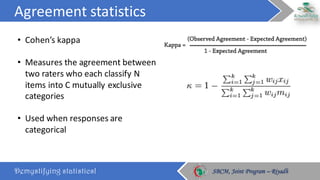
• Cohen’s	kappa
• Measures	the	agreement	between	
two	raters who	each	classify	N	
items	into	C	mutually	exclusive	
categories
• Used	when	responses	are	
categorical
Agreement	statistics
SBCM, Joint Program – RiyadhSBCM, Joint Program – RiyadhDemystifying statistics!
Agreement	statistics
SBCM, Joint Program – RiyadhSBCM, Joint Program – RiyadhDemystifying statistics!
𝐾𝑎𝑝𝑝𝑎 =	
0.70	 − 0.41
1	 − 0.41
= 0.491
Advanced	learning
Demystifying statistics! SBCM, Joint Program – RiyadhSBCM, Joint Program – Riyadh
• Chi	square	test	for	trend
• Special	cases	of	logistic	regression
• Repeated	measures	logistic	regression
• Weighted	kappa
• Other	measures	of	agreement	analysis
Take	home	messages
Demystifying statistics! SBCM, Joint Program – RiyadhSBCM, Joint Program – Riyadh
• Many	approaches	are	available	for	analysing	categorical	data
• Choose	a	method	appropriate	for	your	problem
• Check	that	the	assumptions	of	the	method	are	valid
• Make	conclusions	based	on	the	results	of	the	test
Thank	you!
Email	your	queries	to	sarizwan1986@outlook.com

Statistical tests for categorical data

  • 1.
    Statistical tests forcategorical data Dr. S. A. Rizwan, M.D. Public Health Specialist SBCM, Joint Program – Riyadh Ministry of Health, Kingdom of Saudi Arabia
  • 2.
    Learning objectives Demystifying statistics! SBCM,Joint Program – RiyadhSBCM, Joint Program – Riyadh • Examine the relationship between categorical variables • Construct a contingency table for two categorical variables • Describe the approach to statistical testing of categorical variables
  • 3.
    Revise: Categorical variables Demystifying statistics! SBCM,Joint Program – RiyadhSBCM, Joint Program – Riyadh • Categorical (qualitative) • Nominal (no order) • Dichotomous, binary, binomial • Polychotomous • Ordinal (ordered) • Answers “what?” • Qualitative data is categorised
  • 4.
    Revise: Categorical variables Demystifying statistics! SBCM,Joint Program – RiyadhSBCM, Joint Program – Riyadh
  • 5.
    Revise: Prerequisites for a test Demystifying statistics! SBCM,Joint Program – RiyadhSBCM, Joint Program – Riyadh • How many variables are there? • What is the nature of dependent and independent variable? • How many categories are there in the categorical variable? • Does the continuous variable follow normal distribution? • Is there any pairing in the data/variables?
  • 6.
    Revise: DV, IV, Paired data Demystifying statistics! SBCM,Joint Program – RiyadhSBCM, Joint Program – Riyadh
  • 7.
    Statistical tests: Bivariate SBCM, Joint Program– RiyadhSBCM, Joint Program – RiyadhDemystifying statistics! For unpaired data For paired data • If assumptions for Chi square are met • Chi-square (>= 2 levels) • If assumptions for Chi square NOT met • Fisher’s exact (>= 2 levels) • If the groups are paired • McNemar (if 2 levels) • RM logistic regression (if >2 levels) • Interrater reliability analysis
  • 8.
    Statistical tests: Multivariate SBCM, Joint Program– RiyadhSBCM, Joint Program – Riyadh For unpaired data For matched data Demystifying statistics! • If DV is binary and >1 IV • Binary logistic regression • If DV is polychotomousand >1 IV • Multinomial logistic regression • If DV is ordinal and >1 IV • Ordinal regression • If the groups are matched • Conditional logistic regression • If repeated measurements • RM logistic regression
  • 9.
    Statistical tests: Special SBCM, Joint Program– RiyadhSBCM, Joint Program – RiyadhDemystifying statistics! For stratified data • Cochran-Mantel-Haenszel test
  • 10.
    Statistical tests: Special SBCM, Joint Program– RiyadhSBCM, Joint Program – RiyadhDemystifying statistics! For ordered categorical variable • Chi square test for trend Passed Failed Total R1 100 78 178 R2 175 173 348 R3 42 59 101 Total 317 310 627
  • 11.
    Measures of association SBCM, Joint Program– RiyadhSBCM, Joint Program – RiyadhDemystifying statistics! • Odds ratio • Relative risk • Interrater reliability analysis
  • 12.
    Contingency table SBCM, Joint Program– RiyadhSBCM, Joint Program – RiyadhDemystifying statistics! • Used in bivariate situations • Use counts, not percentages • No one-sided tests • Each subject counted only once • Explain significant findings
  • 13.
    Some selected topics SBCM, Joint Program– RiyadhSBCM, Joint Program – RiyadhDemystifying statistics! • Covered in other classes • Chi square test • Cochran-Mantel-Haenszel test • Regression • In this class we will cover basics of: • Fisher’s exact test • McNemar test • Interrater reliability analysis (Agreement statistics)
  • 14.
    Thought exercise 1 SBCM, Joint Program– RiyadhSBCM, Joint Program – RiyadhDemystifying statistics! • In a study a researcher tested a perfume on 9 rats and used water as the control on 9 other rats. Among the perfume group 1 rat showed restlessness whereas among the control group 4 rats showed restlessness. Determine if there is an association between perfume and restlessness.
  • 15.
    Thought exercise 2 SBCM, Joint Program– RiyadhSBCM, Joint Program – RiyadhDemystifying statistics! • 22 pairs of twins were enrolled in the study. One of the twins smoked, the other didn’t. The twins were followed to see which twin died first. For 17 pairs of twins, the smoking twin died first and for 5 pairs of twins, the non-smoking twin died first.
  • 16.
    Thought exercise 3 SBCM, Joint Program– RiyadhSBCM, Joint Program – RiyadhDemystifying statistics! • All 100 pathological slides were observed by 2 pathologists. The were supposed to classify the disease as mild, moderate and severe. Pathologist 1 classified 60, 30, 10 and pathologist 2 classified 50, 30, 20 as mild, moderate and severe. Both pathologists agreed that 44 were mild, 20 were moderate and 6 were severe and disagreed on the remaining slides. Calculate the agreement between the two pathologists.
  • 17.
    Fisher’s exact test SBCM, Joint Program– RiyadhSBCM, Joint Program – RiyadhDemystifying statistics! • Used in the place of chi square test for independence when the cell counts are sparse • More than 20% of the cells have expected frequencies of <5
  • 18.
    Fisher’s exact test SBCM, Joint Program– RiyadhSBCM, Joint Program – RiyadhDemystifying statistics!
  • 19.
    Fisher’s exact test SBCM, Joint Program– RiyadhSBCM, Joint Program – RiyadhDemystifying statistics! • 6 possible tables for the observed marginal totals: 9, 9, 5, 13. • p-value is calculated by summing all probabilities less than or equal to the probability of the observed table
  • 20.
    Fisher’s exact test SBCM, Joint Program– RiyadhSBCM, Joint Program – RiyadhDemystifying statistics! • The observed table (Table II) has probability = 0.132 • P-value for the Fisher’s exact test = Pr (Table II) + Pr (Table V) + Pr (Table I) + Pr (Table VI) • = 0.132 + 0.132 + 0.0147 + 0.0147 = 0.293
  • 21.
    McNemar test SBCM, JointProgram – RiyadhSBCM, Joint Program – RiyadhDemystifying statistics! • When data are paired and the outcome of interest is a proportion, the McNemar Test is used • Pair-Matched data can come from • Case-control studies where each case has a matching control (matched on age, gender, race, etc.) • Twins studies – the matched pairs are twins • Before - After data • Outcome is presence (+) or absence (-) of some characteristic measured on the same individual at two time points
  • 22.
    McNemar test: matched case-control SBCM, JointProgram – RiyadhSBCM, Joint Program – RiyadhDemystifying statistics! • a - number of case-control pairs where both are exposed • b - number of case-control pairs where the case is exposed and the control is unexposed • c - number of case-control pairs where the case is • unexposed and the control is exposed • d - number of case-control pairs where both are unexposed • The counts in the table for a case-control study are numbers of pairs not numbers of individuals.
  • 23.
    McNemar test: before-after study SBCM, JointProgram – RiyadhSBCM, Joint Program – RiyadhDemystifying statistics! • a - number of subjects with characteristic present both before and after treatment • b - number of subjects where characteristic is present before but not after • c - number of subjects where characteristic is present after but not before • d - number of subjects with the characteristic absent both before and after treatment.
  • 24.
    McNemar test SBCM, JointProgram – RiyadhSBCM, Joint Program – RiyadhDemystifying statistics! • Calculated using the counts in the ‘b’ and ‘c’ cells of the table • The sampling distribution Chi-square distribution, the degrees of freedom = 1 • For a test with alpha = 0.05, the critical value for the McNemar statistic = 3.84.
  • 25.
    McNemar test SBCM, JointProgram – RiyadhSBCM, Joint Program – RiyadhDemystifying statistics!
  • 26.
    McNemar test SBCM, JointProgram – RiyadhSBCM, Joint Program – RiyadhDemystifying statistics! • Critical value for Chi-square distribution with 1 df = 3.84, p value = 0.01 • Conclusion: A significantly different proportion of smoking twins died first compared to their non- smoking twin indicating a different risk of death associated with smoking (p = 0.01)
  • 27.
    Agreement statistics SBCM, Joint Program– RiyadhSBCM, Joint Program – RiyadhDemystifying statistics! • Many types of agreement statistics depending on • Data type • Type of repetition • Internal consistency
  • 28.
    Agreement statistics SBCM, Joint Program– RiyadhSBCM, Joint Program – RiyadhDemystifying statistics! • Cohen’s kappa • Measures the agreement between two raters who each classify N items into C mutually exclusive categories • Used when responses are categorical
  • 29.
    Agreement statistics SBCM, Joint Program– RiyadhSBCM, Joint Program – RiyadhDemystifying statistics!
  • 30.
    Agreement statistics SBCM, Joint Program– RiyadhSBCM, Joint Program – RiyadhDemystifying statistics! 𝐾𝑎𝑝𝑝𝑎 = 0.70 − 0.41 1 − 0.41 = 0.491
  • 31.
    Advanced learning Demystifying statistics! SBCM,Joint Program – RiyadhSBCM, Joint Program – Riyadh • Chi square test for trend • Special cases of logistic regression • Repeated measures logistic regression • Weighted kappa • Other measures of agreement analysis
  • 32.
    Take home messages Demystifying statistics! SBCM,Joint Program – RiyadhSBCM, Joint Program – Riyadh • Many approaches are available for analysing categorical data • Choose a method appropriate for your problem • Check that the assumptions of the method are valid • Make conclusions based on the results of the test
  • 33.