Situational LeadershipThis is an extra slide to elongate my presentation.
How using situtational leadership can make you a better leaderMiqdaad DohadwalaShruti Nambiar
Introduction to leadershipTheoretical definitions of leadershipLeadership DiamondCritical competencies of a leaderIntroduction to Situational LeadershipS1 – DirectiveS2 – Coaching S3 – Supporting S4 – Delegating The Leadership quizLeadership AnswersQuestions?Flow
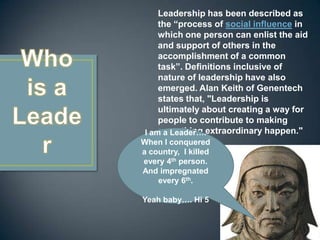
Leadership has been described as the “process of social influence in which one person can enlist the aid and support of others in the accomplishment of a common task”. Definitions inclusive of nature of leadership have also emerged. Alan Keith of Genentech states that, "Leadership is ultimately about creating a way for people to contribute to making something extraordinary happen."Who is a LeaderI am a Leader…. When I conquered a country,  I killed every 4th person. And impregnated every 6th.Yeah baby…. Hi 5
Leadership Definition : The Collins English Dictionary. ( © 1998 HarperCollins Publishers ) leadership (n) 1. The position or function of a leader. 2. the period during which a person occupies the position of leader: during her leadership very little was achieved.
Leadership Definition : Peter Drucker : The forward to the Drucker Foundation's "The Leader of the Future" sums up leadership : "The only definition of a leader is someone who has followers.“
Leadership Definition : Warren Bennis :  Warren Bennis' definition of leadership is focused much more on the individual capability of the leader : "Leadership is a function of knowing yourself, having a vision that is well communicated, building trust among colleagues, and taking effective action to realize your own leadership potential." Traditional Definitions of LeadershipNo Genghis Khan Jokes this time.
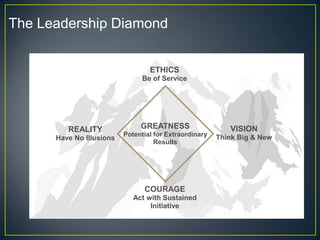
The Leadership DiamondETHICSBe of ServiceGREATNESSPotential for Extraordinary ResultsVISIONThink Big & NewREALITYHave No IllusionsCOURAGEAct with Sustained Initiative
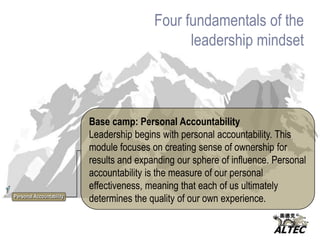
Four fundamentals of the leadership mindset Base camp: Personal AccountabilityLeadership begins with personal accountability. This module focuses on creating sense of ownership for results and expanding our sphere of influence. Personal accountability is the measure of our personal effectiveness, meaning that each of us ultimately determines the quality of our own experience.Personal Accountability
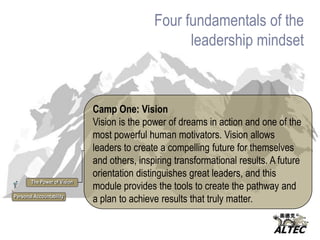
Four fundamentals of the leadership mindset Camp One: VisionVision is the power of dreams in action and one of the most powerful human motivators. Vision allows leaders to create a compelling future for themselves and others, inspiring transformational results. A future orientation distinguishes great leaders, and this module provides the tools to create the pathway and a plan to achieve results that truly matter.The Power of VisionPersonal Accountability
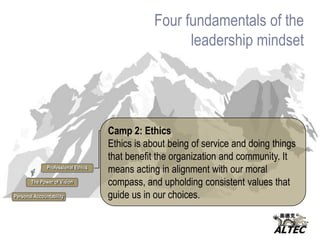
Four fundamentals of the leadership mindset Camp 2: EthicsEthics is about being of service and doing things that benefit the organization and community. It means acting in alignment with our moral compass, and upholding consistent values that guide us in our choices. Professional EthicsThe Power of VisionPersonal Accountability
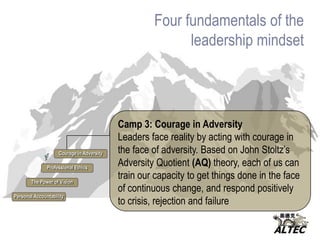
Four fundamentals of the leadership mindset Camp 3: Courage in AdversityLeaders face reality by acting with courage in the face of adversity. Based on John Stoltz’s Adversity Quotient (AQ) theory, each of us can train our capacity to get things done in the face of continuous change, and respond positively to crisis, rejection and failure Courage in AdversityProfessional EthicsThe Power of VisionPersonal Accountability
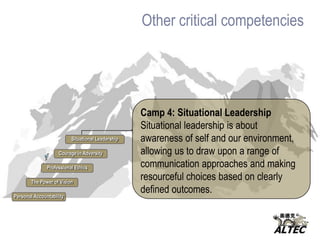
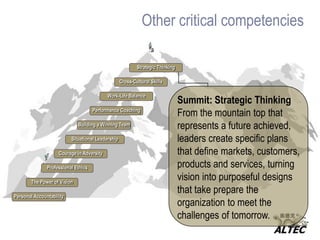
Other critical competencies Camp 4: Situational LeadershipSituational leadership is about awareness of self and our environment, allowing us to draw upon a range of communication approaches and making resourceful choices based on clearly defined outcomes.Situational LeadershipCourage in AdversityProfessional EthicsThe Power of VisionPersonal Accountability
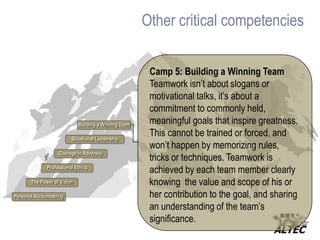
Other critical competencies Camp 5: Building a Winning TeamTeamwork isn’t about slogans or motivational talks, it’s about a commitment to commonly held, meaningful goals that inspire greatness. This cannot be trained or forced, and won’t happen by memorizing rules, tricks or techniques. Teamwork is achieved by each team member clearly knowing  the value and scope of his or her contribution to the goal, and sharing an understanding of the team’s significance.Building a Winning TeamSituational LeadershipCourage in AdversityProfessional EthicsThe Power of VisionPersonal Accountability
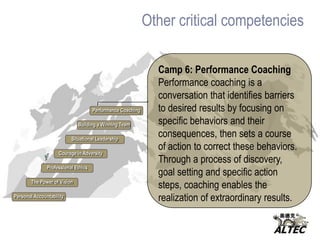
Other critical competencies Camp 6: Performance CoachingPerformance coaching is a conversation that identifies barriers to desired results by focusing on specific behaviors and their consequences, then sets a course of action to correct these behaviors. Through a process of discovery, goal setting and specific action steps, coaching enables the realization of extraordinary results.Performance CoachingBuilding a Winning TeamSituational LeadershipCourage in AdversityProfessional EthicsThe Power of VisionPersonal Accountability
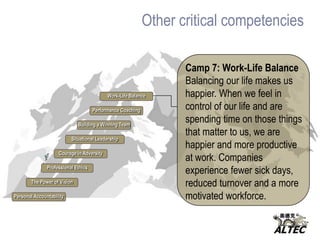
Other critical competencies Camp 7: Work-Life BalanceBalancing our life makes us happier. When we feel in control of our life and are spending time on those things that matter to us, we are happier and more productive at work. Companies experience fewer sick days, reduced turnover and a more motivated workforce.Work-Life BalancePerformance CoachingBuilding a Winning TeamSituational LeadershipCourage in AdversityProfessional EthicsThe Power of VisionPersonal Accountability
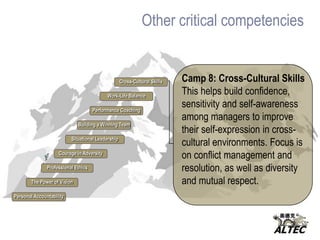
Other critical competencies Camp 8: Cross-Cultural SkillsThis helps build confidence, sensitivity and self-awareness among managers to improve their self-expression in cross-cultural environments. Focus is on conflict management and resolution, as well as diversity and mutual respect.Cross-Cultural SkillsWork-Life BalancePerformance CoachingBuilding a Winning TeamSituational LeadershipCourage in AdversityProfessional EthicsThe Power of VisionPersonal Accountability
Other critical competencies Strategic ThinkingCross-Cultural SkillsSummit: Strategic ThinkingFrom the mountain top that represents a future achieved, leaders create specific plans that define markets, customers, products and services, turning vision into purposeful designs that take prepare the organization to meet the challenges of tomorrow.Work-Life BalancePerformance CoachingBuilding a Winning TeamSituational LeadershipCourage in AdversityProfessional EthicsThe Power of VisionPersonal Accountability
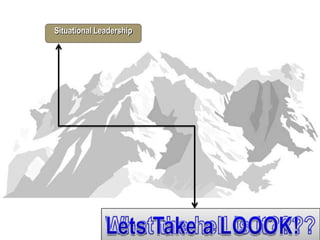
Situational Leadership What the hell is it????Lets Take a LOOOK!
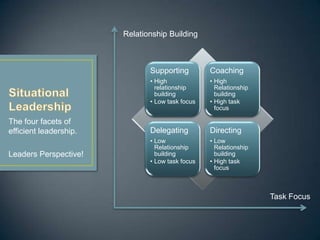
Situational LeadershipThe four facets of efficient leadership.Leaders Perspective!Relationship BuildingTask Focus
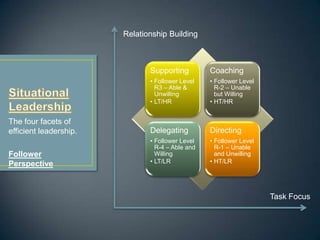
Situational LeadershipThe four facets of efficient leadership.Follower PerspectiveRelationship BuildingTask Focus
Assumes that managers are capable of controlling their own behaviorAssumes that people can and want to developAssumes that people thrive on involvement and communicationAssumptions of Situational Leadership
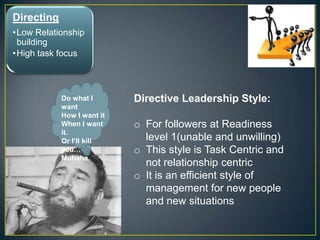
DirectingLow Relationship building
High task focusDirective Leadership Style:For followers at Readiness level 1(unable and unwilling)
This style is Task Centric and not relationship centric
It is an efficient style of management for new people and new situationsDo what I wantHow I want itWhen I want it.Or I’ll kill you…Muhaha.
Directive LeadershipAutocratic/DictatorialKarate Kid 1 – Mr. Miyagi forms a pact to teach karate to Daniel
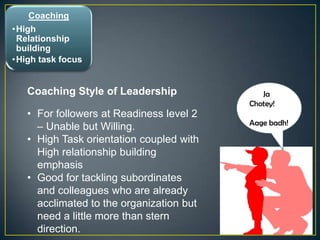
CoachingHigh Relationship building
High task focussfsdfJaChotey!Aagebadh!Coaching Style of LeadershipFor followers at Readiness level 2 – Unable but Willing.
High Task orientation coupled with High relationship building emphasis
Good for tackling subordinates and colleagues who are already acclimated to the organization but need a little more than stern direction.Coaching Style of LeadershipDaniel tires of tasks assigned to him, and demands an explanation. Follower readiness level 2

Situational Leadership

  • 1.
    Situational LeadershipThis isan extra slide to elongate my presentation.
  • 2.
    How using situtationalleadership can make you a better leaderMiqdaad DohadwalaShruti Nambiar
  • 3.
    Introduction to leadershipTheoreticaldefinitions of leadershipLeadership DiamondCritical competencies of a leaderIntroduction to Situational LeadershipS1 – DirectiveS2 – Coaching S3 – Supporting S4 – Delegating The Leadership quizLeadership AnswersQuestions?Flow
  • 4.
    Leadership has beendescribed as the “process of social influence in which one person can enlist the aid and support of others in the accomplishment of a common task”. Definitions inclusive of nature of leadership have also emerged. Alan Keith of Genentech states that, "Leadership is ultimately about creating a way for people to contribute to making something extraordinary happen."Who is a LeaderI am a Leader…. When I conquered a country, I killed every 4th person. And impregnated every 6th.Yeah baby…. Hi 5
  • 5.
    Leadership Definition :The Collins English Dictionary. ( © 1998 HarperCollins Publishers ) leadership (n) 1. The position or function of a leader. 2. the period during which a person occupies the position of leader: during her leadership very little was achieved.
  • 6.
    Leadership Definition :Peter Drucker : The forward to the Drucker Foundation's "The Leader of the Future" sums up leadership : "The only definition of a leader is someone who has followers.“
  • 7.
    Leadership Definition :Warren Bennis :  Warren Bennis' definition of leadership is focused much more on the individual capability of the leader : "Leadership is a function of knowing yourself, having a vision that is well communicated, building trust among colleagues, and taking effective action to realize your own leadership potential." Traditional Definitions of LeadershipNo Genghis Khan Jokes this time.
  • 8.
    The Leadership DiamondETHICSBeof ServiceGREATNESSPotential for Extraordinary ResultsVISIONThink Big & NewREALITYHave No IllusionsCOURAGEAct with Sustained Initiative
  • 9.
    Four fundamentals ofthe leadership mindset Base camp: Personal AccountabilityLeadership begins with personal accountability. This module focuses on creating sense of ownership for results and expanding our sphere of influence. Personal accountability is the measure of our personal effectiveness, meaning that each of us ultimately determines the quality of our own experience.Personal Accountability
  • 10.
    Four fundamentals ofthe leadership mindset Camp One: VisionVision is the power of dreams in action and one of the most powerful human motivators. Vision allows leaders to create a compelling future for themselves and others, inspiring transformational results. A future orientation distinguishes great leaders, and this module provides the tools to create the pathway and a plan to achieve results that truly matter.The Power of VisionPersonal Accountability
  • 11.
    Four fundamentals ofthe leadership mindset Camp 2: EthicsEthics is about being of service and doing things that benefit the organization and community. It means acting in alignment with our moral compass, and upholding consistent values that guide us in our choices. Professional EthicsThe Power of VisionPersonal Accountability
  • 12.
    Four fundamentals ofthe leadership mindset Camp 3: Courage in AdversityLeaders face reality by acting with courage in the face of adversity. Based on John Stoltz’s Adversity Quotient (AQ) theory, each of us can train our capacity to get things done in the face of continuous change, and respond positively to crisis, rejection and failure Courage in AdversityProfessional EthicsThe Power of VisionPersonal Accountability
  • 13.
    Other critical competenciesCamp 4: Situational LeadershipSituational leadership is about awareness of self and our environment, allowing us to draw upon a range of communication approaches and making resourceful choices based on clearly defined outcomes.Situational LeadershipCourage in AdversityProfessional EthicsThe Power of VisionPersonal Accountability
  • 14.
    Other critical competenciesCamp 5: Building a Winning TeamTeamwork isn’t about slogans or motivational talks, it’s about a commitment to commonly held, meaningful goals that inspire greatness. This cannot be trained or forced, and won’t happen by memorizing rules, tricks or techniques. Teamwork is achieved by each team member clearly knowing the value and scope of his or her contribution to the goal, and sharing an understanding of the team’s significance.Building a Winning TeamSituational LeadershipCourage in AdversityProfessional EthicsThe Power of VisionPersonal Accountability
  • 15.
    Other critical competenciesCamp 6: Performance CoachingPerformance coaching is a conversation that identifies barriers to desired results by focusing on specific behaviors and their consequences, then sets a course of action to correct these behaviors. Through a process of discovery, goal setting and specific action steps, coaching enables the realization of extraordinary results.Performance CoachingBuilding a Winning TeamSituational LeadershipCourage in AdversityProfessional EthicsThe Power of VisionPersonal Accountability
  • 16.
    Other critical competenciesCamp 7: Work-Life BalanceBalancing our life makes us happier. When we feel in control of our life and are spending time on those things that matter to us, we are happier and more productive at work. Companies experience fewer sick days, reduced turnover and a more motivated workforce.Work-Life BalancePerformance CoachingBuilding a Winning TeamSituational LeadershipCourage in AdversityProfessional EthicsThe Power of VisionPersonal Accountability
  • 17.
    Other critical competenciesCamp 8: Cross-Cultural SkillsThis helps build confidence, sensitivity and self-awareness among managers to improve their self-expression in cross-cultural environments. Focus is on conflict management and resolution, as well as diversity and mutual respect.Cross-Cultural SkillsWork-Life BalancePerformance CoachingBuilding a Winning TeamSituational LeadershipCourage in AdversityProfessional EthicsThe Power of VisionPersonal Accountability
  • 18.
    Other critical competenciesStrategic ThinkingCross-Cultural SkillsSummit: Strategic ThinkingFrom the mountain top that represents a future achieved, leaders create specific plans that define markets, customers, products and services, turning vision into purposeful designs that take prepare the organization to meet the challenges of tomorrow.Work-Life BalancePerformance CoachingBuilding a Winning TeamSituational LeadershipCourage in AdversityProfessional EthicsThe Power of VisionPersonal Accountability
  • 19.
    Situational Leadership Whatthe hell is it????Lets Take a LOOOK!
  • 20.
    Situational LeadershipThe fourfacets of efficient leadership.Leaders Perspective!Relationship BuildingTask Focus
  • 21.
    Situational LeadershipThe fourfacets of efficient leadership.Follower PerspectiveRelationship BuildingTask Focus
  • 22.
    Assumes that managersare capable of controlling their own behaviorAssumes that people can and want to developAssumes that people thrive on involvement and communicationAssumptions of Situational Leadership
  • 23.
  • 24.
    High task focusDirectiveLeadership Style:For followers at Readiness level 1(unable and unwilling)
  • 25.
    This style isTask Centric and not relationship centric
  • 26.
    It is anefficient style of management for new people and new situationsDo what I wantHow I want itWhen I want it.Or I’ll kill you…Muhaha.
  • 27.
    Directive LeadershipAutocratic/DictatorialKarate Kid1 – Mr. Miyagi forms a pact to teach karate to Daniel
  • 28.
  • 29.
    High task focussfsdfJaChotey!Aagebadh!CoachingStyle of LeadershipFor followers at Readiness level 2 – Unable but Willing.
  • 30.
    High Task orientationcoupled with High relationship building emphasis
  • 31.
    Good for tacklingsubordinates and colleagues who are already acclimated to the organization but need a little more than stern direction.Coaching Style of LeadershipDaniel tires of tasks assigned to him, and demands an explanation. Follower readiness level 2