Leadership
Leadership
 Leadership is the art of motivating a group of people to act towards achieving a
common goal.
 The process of encouraging and helping others to work enthusiastically towards
objectives .
 Alan Keith stated that, "Leadership is ultimately about creating a way for people
to contribute to making something extraordinary happen.
The essence of leadership
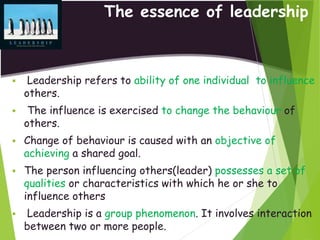
 Leadership refers to ability of one individual to influence
others.
 The influence is exercised to change the behaviour of
others.
 Change of behaviour is caused with an objective of
achieving a shared goal.
 The person influencing others(leader) possesses a set of
qualities or characteristics with which he or she to
influence others
 Leadership is a group phenomenon. It involves interaction
between two or more people.
Leadership & management
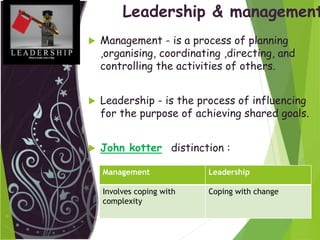
 Management - is a process of planning
,organising, coordinating ,directing, and
controlling the activities of others.
 Leadership - is the process of influencing
for the purpose of achieving shared goals.
 John kotter distinction :
Management Leadership
Involves coping with
complexity
Coping with change
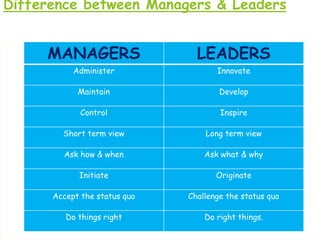
Difference between Managers & Leaders
MANAGERS LEADERS
Administer Innovate
Maintain Develop
Control Inspire
Short term view Long term view
Ask how & when Ask what & why
Initiate Originate
Accept the status quo Challenge the status quo
Do things right Do right things.
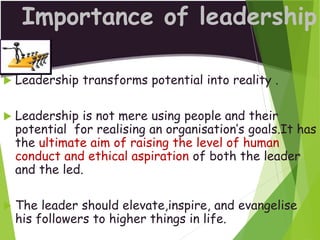
Importance of leadership
 Leadership transforms potential into reality .
 Leadership is not mere using people and their
potential for realising an organisation’s goals.It has
the ultimate aim of raising the level of human
conduct and ethical aspiration of both the leader
and the led.
 The leader should elevate,inspire, and evangelise
his followers to higher things in life.
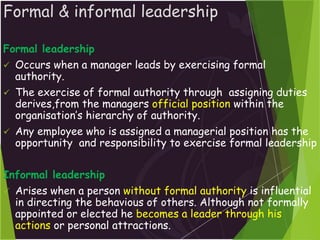
Formal & informal leadership
Formal leadership
 Occurs when a manager leads by exercising formal
authority.
 The exercise of formal authority through assigning duties
derives,from the managers official position within the
organisation’s hierarchy of authority.
 Any employee who is assigned a managerial position has the
opportunity and responsibility to exercise formal leadership
Informal leadership
 Arises when a person without formal authority is influential
in directing the behavious of others. Although not formally
appointed or elected he becomes a leader through his
actions or personal attractions.
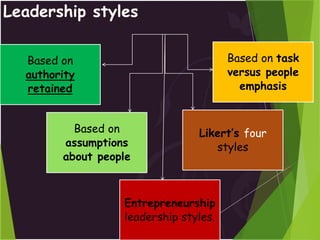
Leadership styles
Based on
authority
retained
Based on task
versus people
emphasis
Based on
assumptions
about people
Likert’s four
styles
Entrepreneurship
leadership styles.
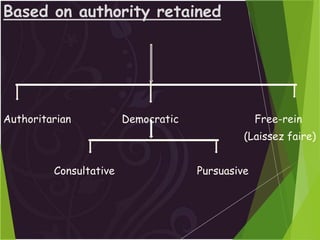
Based on authority retained
Authoritarian Democratic Free-rein
(Laissez faire)
Consultative Pursuasive
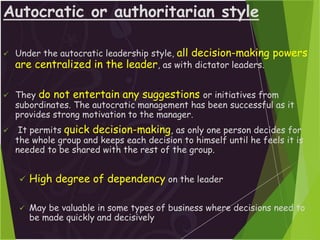
Autocratic or authoritarian style
 Under the autocratic leadership style, all decision-making powers
are centralized in the leader, as with dictator leaders.
 They do not entertain any suggestions or initiatives from
subordinates. The autocratic management has been successful as it
provides strong motivation to the manager.
 It permits quick decision-making, as only one person decides for
the whole group and keeps each decision to himself until he feels it is
needed to be shared with the rest of the group.
 High degree of dependency on the leader
 May be valuable in some types of business where decisions need to
be made quickly and decisively
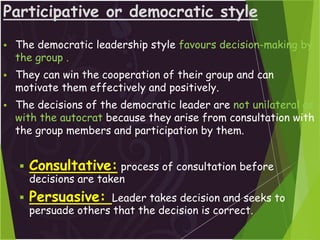
Participative or democratic style
 The democratic leadership style favours decision-making by
the group .
 They can win the cooperation of their group and can
motivate them effectively and positively.
 The decisions of the democratic leader are not unilateral as
with the autocrat because they arise from consultation with
the group members and participation by them.
 Consultative: process of consultation before
decisions are taken
 Persuasive: Leader takes decision and seeks to
persuade others that the decision is correct.
Laissez –Faire or free rein style
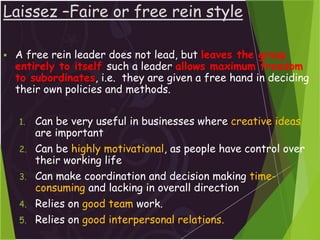
 A free rein leader does not lead, but leaves the group
entirely to itself such a leader allows maximum freedom
to subordinates, i.e. they are given a free hand in deciding
their own policies and methods.
1. Can be very useful in businesses where creative ideas
are important
2. Can be highly motivational, as people have control over
their working life
3. Can make coordination and decision making time-
consuming and lacking in overall direction
4. Relies on good team work.
5. Relies on good interpersonal relations.
Based on task versus people Emphasis
High relationship and low-
task
[ supporting style ]
High task and high relationship
[ participative style]
Low-task and low relationship
[ free rein style ]
High task and low relationship
[ autocratic style ]
Low High
LowHigh
Task Emphasis
PeopleEmphasis
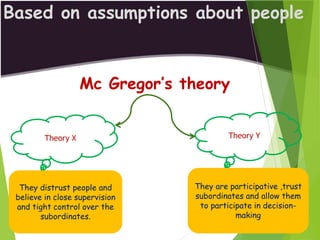
Based on assumptions about people
Mc Gregor’s theory
Theory X Theory Y
They distrust people and
believe in close supervision
and tight control over the
subordinates.
They are participative ,trust
subordinates and allow them
to participate in decision-
making
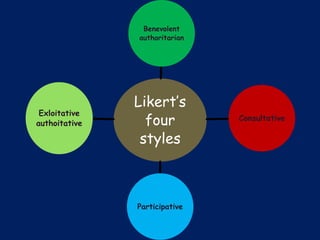
Likert’s
four
styles
Benevolent
authoritarian
Consultative
Participative
Exloitative
authoitative
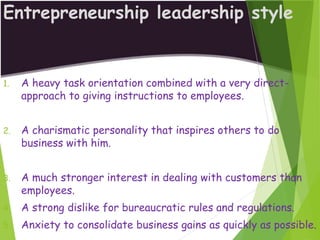
Entrepreneurship leadership style
1. A heavy task orientation combined with a very direct-
approach to giving instructions to employees.
2. A charismatic personality that inspires others to do
business with him.
3. A much stronger interest in dealing with customers than
employees.
4. A strong dislike for bureaucratic rules and regulations.
5. Anxiety to consolidate business gains as quickly as possible.
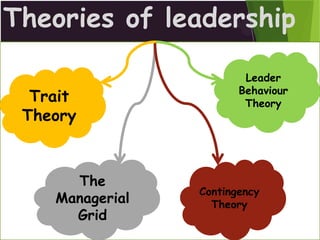
Theories of leadership
Trait
Theory
Contingency
Theory
The
Managerial
Grid
Leader
Behaviour
Theory
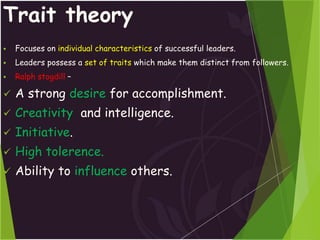
Trait theory
 Focuses on individual characteristics of successful leaders.
 Leaders possess a set of traits which make them distinct from followers.
 Ralph stogdill –
 A strong desire for accomplishment.
 Creativity and intelligence.
 Initiative.
 High tolerence.
 Ability to influence others.
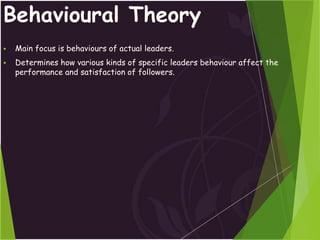
Behavioural Theory
 Main focus is behaviours of actual leaders.
 Determines how various kinds of specific leaders behaviour affect the
performance and satisfaction of followers.
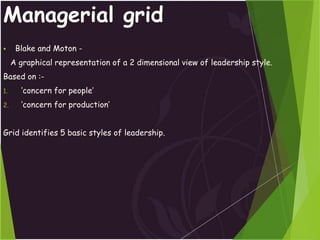
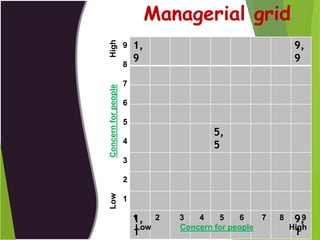
Managerial grid
 Blake and Moton -
A graphical representation of a 2 dimensional view of leadership style.
Based on :-
1. ‘concern for people’
2. ‘concern for production’
Grid identifies 5 basic styles of leadership.
1,
9
9,
9
5,
5
1,
1
9,
1
LowConcernforpeopleHigh
1 2 3 4 5 6 7 8 9
Low Concern for people High
9
8
7
6
5
4
3
2
1
Managerial grid
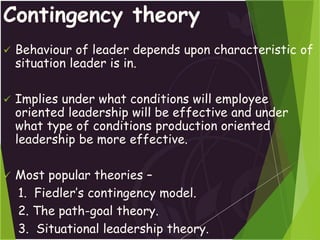
Contingency theory
 Behaviour of leader depends upon characteristic of
situation leader is in.
 Implies under what conditions will employee
oriented leadership will be effective and under
what type of conditions production oriented
leadership be more effective.
 Most popular theories –
1. Fiedler’s contingency model.
2. The path-goal theory.
3. Situational leadership theory.
Fiedler’s theory
Effectiveness of leadership depends upon-
1. His motivational style.
2. The favourableness of situation.
Path – goal theory
Leader’s job is to use structure,support and rewards to create a work environvent
that helps employees reach the organisation’s goals.
Situational leadership theory
Paul hershey and Kenneth blanchard :
 Maturity of followers as a contingency variable.
 Situational leadership requires leader’s emphasis on task behaviours and
relationship behaviour according to maturity of followers in performing their
tasks.

Leadership

  • 1.
  • 2.
    Leadership  Leadership isthe art of motivating a group of people to act towards achieving a common goal.  The process of encouraging and helping others to work enthusiastically towards objectives .  Alan Keith stated that, "Leadership is ultimately about creating a way for people to contribute to making something extraordinary happen.
  • 3.
    The essence ofleadership  Leadership refers to ability of one individual to influence others.  The influence is exercised to change the behaviour of others.  Change of behaviour is caused with an objective of achieving a shared goal.  The person influencing others(leader) possesses a set of qualities or characteristics with which he or she to influence others  Leadership is a group phenomenon. It involves interaction between two or more people.
  • 4.
    Leadership & management Management - is a process of planning ,organising, coordinating ,directing, and controlling the activities of others.  Leadership - is the process of influencing for the purpose of achieving shared goals.  John kotter distinction : Management Leadership Involves coping with complexity Coping with change
  • 5.
    Difference between Managers& Leaders MANAGERS LEADERS Administer Innovate Maintain Develop Control Inspire Short term view Long term view Ask how & when Ask what & why Initiate Originate Accept the status quo Challenge the status quo Do things right Do right things.
  • 6.
    Importance of leadership Leadership transforms potential into reality .  Leadership is not mere using people and their potential for realising an organisation’s goals.It has the ultimate aim of raising the level of human conduct and ethical aspiration of both the leader and the led.  The leader should elevate,inspire, and evangelise his followers to higher things in life.
  • 7.
    Formal & informalleadership Formal leadership  Occurs when a manager leads by exercising formal authority.  The exercise of formal authority through assigning duties derives,from the managers official position within the organisation’s hierarchy of authority.  Any employee who is assigned a managerial position has the opportunity and responsibility to exercise formal leadership Informal leadership  Arises when a person without formal authority is influential in directing the behavious of others. Although not formally appointed or elected he becomes a leader through his actions or personal attractions.
  • 8.
    Leadership styles Based on authority retained Basedon task versus people emphasis Based on assumptions about people Likert’s four styles Entrepreneurship leadership styles.
  • 9.
    Based on authorityretained Authoritarian Democratic Free-rein (Laissez faire) Consultative Pursuasive
  • 10.
    Autocratic or authoritarianstyle  Under the autocratic leadership style, all decision-making powers are centralized in the leader, as with dictator leaders.  They do not entertain any suggestions or initiatives from subordinates. The autocratic management has been successful as it provides strong motivation to the manager.  It permits quick decision-making, as only one person decides for the whole group and keeps each decision to himself until he feels it is needed to be shared with the rest of the group.  High degree of dependency on the leader  May be valuable in some types of business where decisions need to be made quickly and decisively
  • 11.
    Participative or democraticstyle  The democratic leadership style favours decision-making by the group .  They can win the cooperation of their group and can motivate them effectively and positively.  The decisions of the democratic leader are not unilateral as with the autocrat because they arise from consultation with the group members and participation by them.  Consultative: process of consultation before decisions are taken  Persuasive: Leader takes decision and seeks to persuade others that the decision is correct.
  • 12.
    Laissez –Faire orfree rein style  A free rein leader does not lead, but leaves the group entirely to itself such a leader allows maximum freedom to subordinates, i.e. they are given a free hand in deciding their own policies and methods. 1. Can be very useful in businesses where creative ideas are important 2. Can be highly motivational, as people have control over their working life 3. Can make coordination and decision making time- consuming and lacking in overall direction 4. Relies on good team work. 5. Relies on good interpersonal relations.
  • 13.
    Based on taskversus people Emphasis High relationship and low- task [ supporting style ] High task and high relationship [ participative style] Low-task and low relationship [ free rein style ] High task and low relationship [ autocratic style ] Low High LowHigh Task Emphasis PeopleEmphasis
  • 14.
    Based on assumptionsabout people Mc Gregor’s theory Theory X Theory Y They distrust people and believe in close supervision and tight control over the subordinates. They are participative ,trust subordinates and allow them to participate in decision- making
  • 15.
  • 16.
    Entrepreneurship leadership style 1.A heavy task orientation combined with a very direct- approach to giving instructions to employees. 2. A charismatic personality that inspires others to do business with him. 3. A much stronger interest in dealing with customers than employees. 4. A strong dislike for bureaucratic rules and regulations. 5. Anxiety to consolidate business gains as quickly as possible.
  • 17.
  • 18.
    Trait theory  Focuseson individual characteristics of successful leaders.  Leaders possess a set of traits which make them distinct from followers.  Ralph stogdill –  A strong desire for accomplishment.  Creativity and intelligence.  Initiative.  High tolerence.  Ability to influence others.
  • 19.
    Behavioural Theory  Mainfocus is behaviours of actual leaders.  Determines how various kinds of specific leaders behaviour affect the performance and satisfaction of followers.
  • 20.
    Managerial grid  Blakeand Moton - A graphical representation of a 2 dimensional view of leadership style. Based on :- 1. ‘concern for people’ 2. ‘concern for production’ Grid identifies 5 basic styles of leadership.
  • 21.
    1, 9 9, 9 5, 5 1, 1 9, 1 LowConcernforpeopleHigh 1 2 34 5 6 7 8 9 Low Concern for people High 9 8 7 6 5 4 3 2 1 Managerial grid
  • 22.
    Contingency theory  Behaviourof leader depends upon characteristic of situation leader is in.  Implies under what conditions will employee oriented leadership will be effective and under what type of conditions production oriented leadership be more effective.  Most popular theories – 1. Fiedler’s contingency model. 2. The path-goal theory. 3. Situational leadership theory.
  • 23.
    Fiedler’s theory Effectiveness ofleadership depends upon- 1. His motivational style. 2. The favourableness of situation.
  • 24.
    Path – goaltheory Leader’s job is to use structure,support and rewards to create a work environvent that helps employees reach the organisation’s goals.
  • 25.
    Situational leadership theory Paulhershey and Kenneth blanchard :  Maturity of followers as a contingency variable.  Situational leadership requires leader’s emphasis on task behaviours and relationship behaviour according to maturity of followers in performing their tasks.