LEADERSHIP 
ORGANIZATIONAL COMMUNICATION 
MONIK VINUEZA 
PUCESI 
2014
Please write a One Sentence 
Definition 
for 
LEADERSHIP.
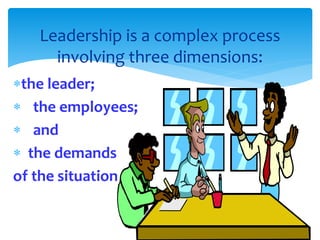
Leadership is a complex process 
involving three dimensions: 
the leader; 
 the employees; 
 and 
 the demands 
of the situation
What is leadership? 
 Influencing others to do as desired. 
 Leadership is the initiation of action to solve a problem 
 Leadership is directing or controlling the activity of a 
group 
 Leadership is influencing the activities of group as it 
moves toward its goals. 
 A person who leads others along a way; a guide
What is leadership? 
 Leadership is power, But power is not 
necessarily leadership. 
 Power is the ability to get others to do what 
you want them to do
WHO IS A LEADER? 
A leader is the one who 
knows the way 
goes the way 
& shows 
the way
Leadership - Key Terms 
 Leadership: The exercise of influence by one member 
of a group or organization over other members to 
help the group or organization achieve its goals. 
 Leader: An individual who is able to influence group 
or organizational members to help the group or 
organization achieve its goals. 
 Leader Effectiveness: The extent to which a leader 
helps a group or organization to achieve its goals.
Formal and Informal Leaders 
•Formal Leader: A member of an organization 
who is given authority to influence other 
organizational members to achieve 
organizational goals. 
• Informal Leader: An organizational member 
with no formal authority to influence others, 
but who has special skills or talents to 
influence others.
Characteristics of Leadership 
 Existence of followers 
 Willing acceptance 
 Representation 
Working relations 
 Existence of common interest 
 Situational approach
Functions of Leadership 
Representation 
Communication 
Motivation 
Integration 
Guidance 
Interpretation 
Maintain Discipline
Styles of Leadership 
Autocratic 
Participative 
Free Rein
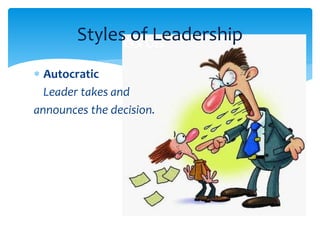
Styles of Leadership 
 Autocratic 
Leader takes and 
announces the decision.
Styles of Leadership 
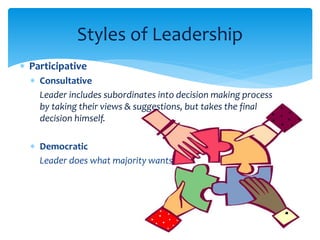
 Participative 
 Consultative 
Leader includes subordinates into decision making process 
by taking their views & suggestions, but takes the final 
decision himself. 
 Democratic 
Leader does what majority wants.
Styles of Leadership 
 Free Rein 
Leader allows the subordinates to 
function within organisational limits by 
taking their own decisions.
Qualities of a Good Leader 
 Energy 
Always ready to go, full of enthusiasm. 
 Empathy 
Understands other’s point of view. 
 Emotional Stability 
Balanced behaviour in extreme situation
Qualities of a Good Leader 
 Positive Attitude 
See the Brighter side. 
 Self Confidence 
Believes in his abilities. 
 Self Motivated 
Derives power from within. 
 Initiatives 
Self Starter
Qualities of a Good Leader 
 Communication skills 
 Social Skills 
Understands humanity & value of relations. 
 Entrepreneurial Skills 
Ambitious & Ready to take Risk.
Qualities of a Good Leader 
 Personal Traits 
Vision, values, foresightedness. 
 Technical Competence 
Performer himself. 
 Transformer 
Ability to motivate and train subordinates to 
get the results.
Qualities of a Good Leader 
 Personal Traits 
Vision, values, foresightedness. 
 Technical Competence 
Performer himself. 
 Transformer 
Ability to motivate and train subordinates 
to get the results.
Leader follower dyad 
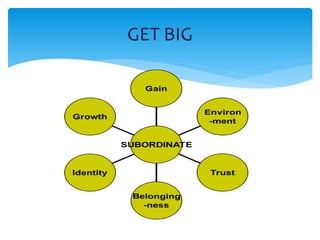
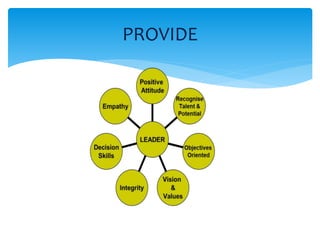
 Every subordinate wants to GET BIG. 
 A good leader must PROVIDE him that 
opportunity
GET BIG
PROVIDE
TEORIES OF LEADERSHIP 
 Trait Approach 
 Management Grid 
 Path Goal Theory 
 Leadership Continuum 
 Contingency Model 
 Normative Theory 
 Situational Leadership 
 Transformation or Charismatic Leadership
Trait Approach 
by F. W. Gluck & Edwin Ghiselle 
 This is the most traditional theory of 
leadership which emphasises on the 
personality traits of the leader to get the 
results. 
 Leader’s decision quality depends on his 
personal ability, likes & dislikes, gut 
feelings, foresightedness, vision & values. 
 Common believe is: 
“Leaders are born, not made”.
Management Grid 
by Robert Blake & Jane Mouton 
 Two dimensions of leadership have 
been identified as 
 Concern for task 
 Concern for people 
 Leader may show high or low concern 
for task and/or relations.
Trait Theory Applied 
 Paul Von Hindenburg 
 First Chancellor of Germany, post WWI 
 Used the trait theory for selecting and developing 
military leaders 
 Primary qualities for leadership ability 
 Intelligence (bright vs. dull) 
 Vitality (energetic vs. lazy)
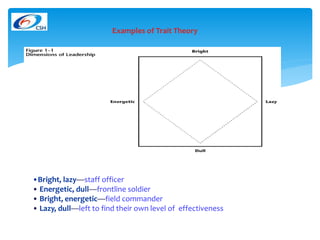
Examples of Trait Theory 
•Bright, lazy—staff officer 
• Energetic, dull—frontline soldier 
• Bright, energetic—field commander 
• Lazy, dull—left to find their own level of effectiveness
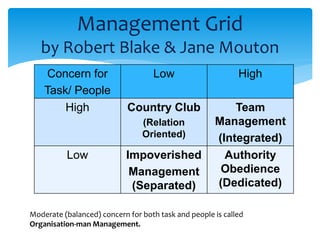
Management Grid 
by Robert Blake & Jane Mouton 
Concern for 
Task/ People 
Low High 
High Country Club 
(Relation 
Oriented) 
Team 
Management 
(Integrated) 
Low Impoverished 
Management 
(Separated) 
Authority 
Obedience 
(Dedicated) 
Moderate (balanced) concern for both task and people is called 
Organisation-man Management.
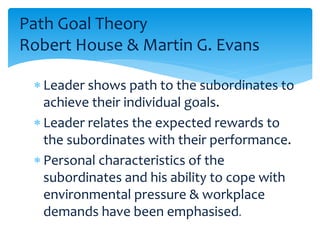
Path Goal Theory 
Robert House & Martin G. Evans 
 Leader shows path to the subordinates to 
achieve their individual goals. 
 Leader relates the expected rewards to 
the subordinates with their performance. 
 Personal characteristics of the 
subordinates and his ability to cope with 
environmental pressure & workplace 
demands have been emphasised.
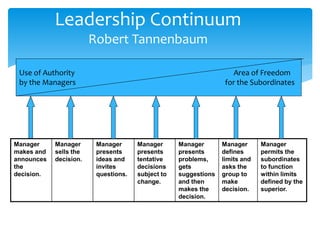
Leadership Continuum 
Robert Tannenbaum 
Use of Authority Area of Freedom 
by the Managers for the Subordinates 
Manager 
makes and 
announces 
the 
decision. 
Manager 
sells the 
decision. 
Manager 
presents 
ideas and 
invites 
questions. 
Manager 
presents 
tentative 
decisions 
subject to 
change. 
Manager 
presents 
problems, 
gets 
suggestions 
and then 
makes the 
decision. 
Manager 
defines 
limits and 
asks the 
group to 
make 
decision. 
Manager 
permits the 
subordinates 
to function 
within limits 
defined by the 
superior.
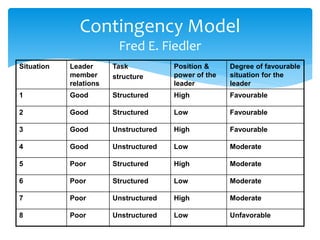
Contingency Model 
Fred E. Fiedler 
Situation Leader 
member 
relations 
Task 
structure 
Position & 
power of the 
leader 
Degree of favourable 
situation for the 
leader 
1 Good Structured High Favourable 
2 Good Structured Low Favourable 
3 Good Unstructured High Favourable 
4 Good Unstructured Low Moderate 
5 Poor Structured High Moderate 
6 Poor Structured Low Moderate 
7 Poor Unstructured High Moderate 
8 Poor Unstructured Low Unfavorable
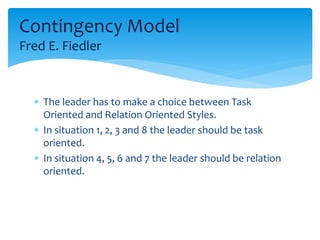
Contingency Model 
Fred E. Fiedler 
 The leader has to make a choice between Task 
Oriented and Relation Oriented Styles. 
 In situation 1, 2, 3 and 8 the leader should be task 
oriented. 
 In situation 4, 5, 6 and 7 the leader should be relation 
oriented.
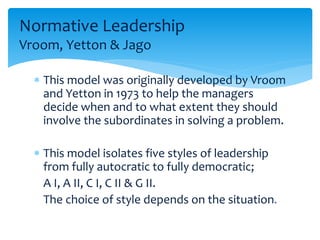
Normative Leadership 
Vroom, Yetton & Jago 
 This model was originally developed by Vroom 
and Yetton in 1973 to help the managers 
decide when and to what extent they should 
involve the subordinates in solving a problem. 
 This model isolates five styles of leadership 
from fully autocratic to fully democratic; 
A I, A II, C I, C II & G II. 
The choice of style depends on the situation.
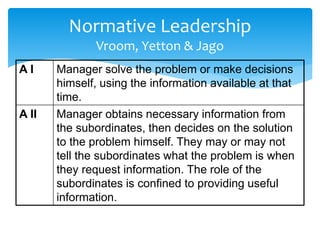
Normative Leadership 
Vroom, Yetton & Jago 
A I Manager solve the problem or make decisions 
himself, using the information available at that 
time. 
A II Manager obtains necessary information from 
the subordinates, then decides on the solution 
to the problem himself. They may or may not 
tell the subordinates what the problem is when 
they request information. The role of the 
subordinates is confined to providing useful 
information.
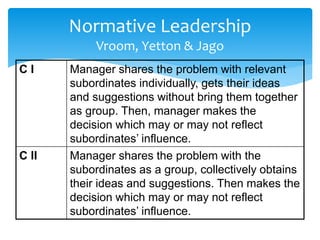
Normative Leadership 
Vroom, Yetton & Jago 
C I Manager shares the problem with relevant 
subordinates individually, gets their ideas 
and suggestions without bring them together 
as group. Then, manager makes the 
decision which may or may not reflect 
subordinates’ influence. 
C II Manager shares the problem with the 
subordinates as a group, collectively obtains 
their ideas and suggestions. Then makes the 
decision which may or may not reflect 
subordinates’ influence.
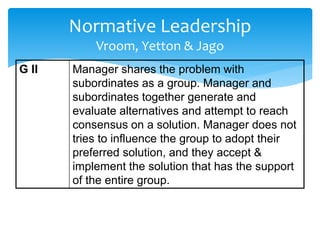
Normative Leadership 
Vroom, Yetton & Jago 
G II Manager shares the problem with 
subordinates as a group. Manager and 
subordinates together generate and 
evaluate alternatives and attempt to reach 
consensus on a solution. Manager does not 
tries to influence the group to adopt their 
preferred solution, and they accept & 
implement the solution that has the support 
of the entire group.
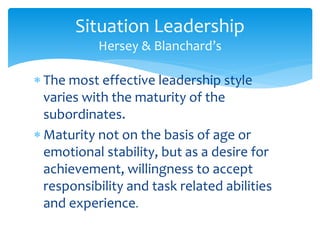
Situation Leadership 
Hersey & Blanchard’s 
 The most effective leadership style 
varies with the maturity of the 
subordinates. 
 Maturity not on the basis of age or 
emotional stability, but as a desire for 
achievement, willingness to accept 
responsibility and task related abilities 
and experience.
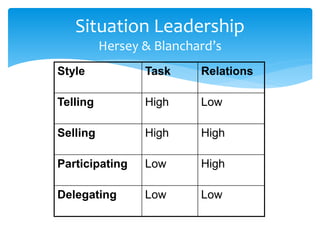
Situation Leadership 
Hersey & Blanchard’s 
Style Task Relations 
Telling High Low 
Selling High High 
Participating Low High 
Delegating Low Low
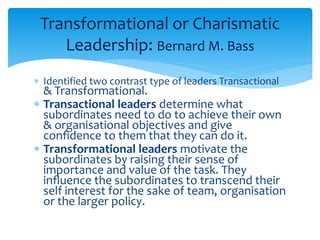
Transformational or Charismatic 
Leadership: Bernard M. Bass 
 Identified two contrast type of leaders Transactional 
& Transformational. 
 Transactional leaders determine what 
subordinates need to do to achieve their own 
& organisational objectives and give 
confidence to them that they can do it. 
 Transformational leaders motivate the 
subordinates by raising their sense of 
importance and value of the task. They 
influence the subordinates to transcend their 
self interest for the sake of team, organisation 
or the larger policy.
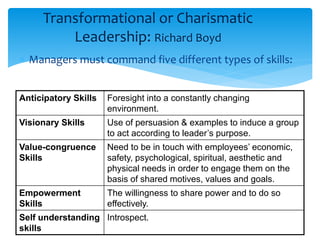
Transformational or Charismatic 
Leadership: Richard Boyd 
 Managers must command five different types of skills: 
Anticipatory Skills Foresight into a constantly changing 
environment. 
Visionary Skills Use of persuasion & examples to induce a group 
to act according to leader’s purpose. 
Value-congruence 
Skills 
Need to be in touch with employees’ economic, 
safety, psychological, spiritual, aesthetic and 
physical needs in order to engage them on the 
basis of shared motives, values and goals. 
Empowerment 
Skills 
The willingness to share power and to do so 
effectively. 
Self understanding 
skills 
Introspect.
Transformational or Charismatic 
Leadership: Robert J. House 
 The charismatic leader has extremely high 
levels of self-confidence, dominance and a 
strong conviction in the moral righteousness 
of his/her beliefs. 
 They communicate a vision or a high level 
goal that captures the commitment and 
energies of followers.
Transformational or Charismatic 
Leadership: Robert J. House 
 They are careful to create an image of 
success & competence and to exemplify in 
their own behaviour the values they 
espouse. 
 They also communicate high expectations to 
the followers and confidence that they will 
perform up to those expectations.
SOURCES: 
 Dr. Atul Pandey 
 Leadership 
 Follow 
 by Hassan Ayub, Job at CSH 
 on Apr 13, 2010

Leadership review

  • 1.
    LEADERSHIP ORGANIZATIONAL COMMUNICATION MONIK VINUEZA PUCESI 2014
  • 2.
    Please write aOne Sentence Definition for LEADERSHIP.
  • 3.
    Leadership is acomplex process involving three dimensions: the leader;  the employees;  and  the demands of the situation
  • 4.
    What is leadership?  Influencing others to do as desired.  Leadership is the initiation of action to solve a problem  Leadership is directing or controlling the activity of a group  Leadership is influencing the activities of group as it moves toward its goals.  A person who leads others along a way; a guide
  • 5.
    What is leadership?  Leadership is power, But power is not necessarily leadership.  Power is the ability to get others to do what you want them to do
  • 6.
    WHO IS ALEADER? A leader is the one who knows the way goes the way & shows the way
  • 7.
    Leadership - KeyTerms  Leadership: The exercise of influence by one member of a group or organization over other members to help the group or organization achieve its goals.  Leader: An individual who is able to influence group or organizational members to help the group or organization achieve its goals.  Leader Effectiveness: The extent to which a leader helps a group or organization to achieve its goals.
  • 8.
    Formal and InformalLeaders •Formal Leader: A member of an organization who is given authority to influence other organizational members to achieve organizational goals. • Informal Leader: An organizational member with no formal authority to influence others, but who has special skills or talents to influence others.
  • 9.
    Characteristics of Leadership  Existence of followers  Willing acceptance  Representation Working relations  Existence of common interest  Situational approach
  • 10.
    Functions of Leadership Representation Communication Motivation Integration Guidance Interpretation Maintain Discipline
  • 11.
    Styles of Leadership Autocratic Participative Free Rein
  • 12.
    Styles of Leadership  Autocratic Leader takes and announces the decision.
  • 13.
    Styles of Leadership  Participative  Consultative Leader includes subordinates into decision making process by taking their views & suggestions, but takes the final decision himself.  Democratic Leader does what majority wants.
  • 14.
    Styles of Leadership  Free Rein Leader allows the subordinates to function within organisational limits by taking their own decisions.
  • 15.
    Qualities of aGood Leader  Energy Always ready to go, full of enthusiasm.  Empathy Understands other’s point of view.  Emotional Stability Balanced behaviour in extreme situation
  • 16.
    Qualities of aGood Leader  Positive Attitude See the Brighter side.  Self Confidence Believes in his abilities.  Self Motivated Derives power from within.  Initiatives Self Starter
  • 17.
    Qualities of aGood Leader  Communication skills  Social Skills Understands humanity & value of relations.  Entrepreneurial Skills Ambitious & Ready to take Risk.
  • 18.
    Qualities of aGood Leader  Personal Traits Vision, values, foresightedness.  Technical Competence Performer himself.  Transformer Ability to motivate and train subordinates to get the results.
  • 19.
    Qualities of aGood Leader  Personal Traits Vision, values, foresightedness.  Technical Competence Performer himself.  Transformer Ability to motivate and train subordinates to get the results.
  • 20.
    Leader follower dyad  Every subordinate wants to GET BIG.  A good leader must PROVIDE him that opportunity
  • 21.
  • 22.
  • 23.
    TEORIES OF LEADERSHIP  Trait Approach  Management Grid  Path Goal Theory  Leadership Continuum  Contingency Model  Normative Theory  Situational Leadership  Transformation or Charismatic Leadership
  • 24.
    Trait Approach byF. W. Gluck & Edwin Ghiselle  This is the most traditional theory of leadership which emphasises on the personality traits of the leader to get the results.  Leader’s decision quality depends on his personal ability, likes & dislikes, gut feelings, foresightedness, vision & values.  Common believe is: “Leaders are born, not made”.
  • 25.
    Management Grid byRobert Blake & Jane Mouton  Two dimensions of leadership have been identified as  Concern for task  Concern for people  Leader may show high or low concern for task and/or relations.
  • 26.
    Trait Theory Applied  Paul Von Hindenburg  First Chancellor of Germany, post WWI  Used the trait theory for selecting and developing military leaders  Primary qualities for leadership ability  Intelligence (bright vs. dull)  Vitality (energetic vs. lazy)
  • 27.
    Examples of TraitTheory •Bright, lazy—staff officer • Energetic, dull—frontline soldier • Bright, energetic—field commander • Lazy, dull—left to find their own level of effectiveness
  • 28.
    Management Grid byRobert Blake & Jane Mouton Concern for Task/ People Low High High Country Club (Relation Oriented) Team Management (Integrated) Low Impoverished Management (Separated) Authority Obedience (Dedicated) Moderate (balanced) concern for both task and people is called Organisation-man Management.
  • 29.
    Path Goal Theory Robert House & Martin G. Evans  Leader shows path to the subordinates to achieve their individual goals.  Leader relates the expected rewards to the subordinates with their performance.  Personal characteristics of the subordinates and his ability to cope with environmental pressure & workplace demands have been emphasised.
  • 30.
    Leadership Continuum RobertTannenbaum Use of Authority Area of Freedom by the Managers for the Subordinates Manager makes and announces the decision. Manager sells the decision. Manager presents ideas and invites questions. Manager presents tentative decisions subject to change. Manager presents problems, gets suggestions and then makes the decision. Manager defines limits and asks the group to make decision. Manager permits the subordinates to function within limits defined by the superior.
  • 31.
    Contingency Model FredE. Fiedler Situation Leader member relations Task structure Position & power of the leader Degree of favourable situation for the leader 1 Good Structured High Favourable 2 Good Structured Low Favourable 3 Good Unstructured High Favourable 4 Good Unstructured Low Moderate 5 Poor Structured High Moderate 6 Poor Structured Low Moderate 7 Poor Unstructured High Moderate 8 Poor Unstructured Low Unfavorable
  • 32.
    Contingency Model FredE. Fiedler  The leader has to make a choice between Task Oriented and Relation Oriented Styles.  In situation 1, 2, 3 and 8 the leader should be task oriented.  In situation 4, 5, 6 and 7 the leader should be relation oriented.
  • 33.
    Normative Leadership Vroom,Yetton & Jago  This model was originally developed by Vroom and Yetton in 1973 to help the managers decide when and to what extent they should involve the subordinates in solving a problem.  This model isolates five styles of leadership from fully autocratic to fully democratic; A I, A II, C I, C II & G II. The choice of style depends on the situation.
  • 34.
    Normative Leadership Vroom,Yetton & Jago A I Manager solve the problem or make decisions himself, using the information available at that time. A II Manager obtains necessary information from the subordinates, then decides on the solution to the problem himself. They may or may not tell the subordinates what the problem is when they request information. The role of the subordinates is confined to providing useful information.
  • 35.
    Normative Leadership Vroom,Yetton & Jago C I Manager shares the problem with relevant subordinates individually, gets their ideas and suggestions without bring them together as group. Then, manager makes the decision which may or may not reflect subordinates’ influence. C II Manager shares the problem with the subordinates as a group, collectively obtains their ideas and suggestions. Then makes the decision which may or may not reflect subordinates’ influence.
  • 36.
    Normative Leadership Vroom,Yetton & Jago G II Manager shares the problem with subordinates as a group. Manager and subordinates together generate and evaluate alternatives and attempt to reach consensus on a solution. Manager does not tries to influence the group to adopt their preferred solution, and they accept & implement the solution that has the support of the entire group.
  • 37.
    Situation Leadership Hersey& Blanchard’s  The most effective leadership style varies with the maturity of the subordinates.  Maturity not on the basis of age or emotional stability, but as a desire for achievement, willingness to accept responsibility and task related abilities and experience.
  • 38.
    Situation Leadership Hersey& Blanchard’s Style Task Relations Telling High Low Selling High High Participating Low High Delegating Low Low
  • 39.
    Transformational or Charismatic Leadership: Bernard M. Bass  Identified two contrast type of leaders Transactional & Transformational.  Transactional leaders determine what subordinates need to do to achieve their own & organisational objectives and give confidence to them that they can do it.  Transformational leaders motivate the subordinates by raising their sense of importance and value of the task. They influence the subordinates to transcend their self interest for the sake of team, organisation or the larger policy.
  • 40.
    Transformational or Charismatic Leadership: Richard Boyd  Managers must command five different types of skills: Anticipatory Skills Foresight into a constantly changing environment. Visionary Skills Use of persuasion & examples to induce a group to act according to leader’s purpose. Value-congruence Skills Need to be in touch with employees’ economic, safety, psychological, spiritual, aesthetic and physical needs in order to engage them on the basis of shared motives, values and goals. Empowerment Skills The willingness to share power and to do so effectively. Self understanding skills Introspect.
  • 41.
    Transformational or Charismatic Leadership: Robert J. House  The charismatic leader has extremely high levels of self-confidence, dominance and a strong conviction in the moral righteousness of his/her beliefs.  They communicate a vision or a high level goal that captures the commitment and energies of followers.
  • 42.
    Transformational or Charismatic Leadership: Robert J. House  They are careful to create an image of success & competence and to exemplify in their own behaviour the values they espouse.  They also communicate high expectations to the followers and confidence that they will perform up to those expectations.
  • 43.
    SOURCES:  Dr.Atul Pandey  Leadership  Follow  by Hassan Ayub, Job at CSH  on Apr 13, 2010