N.G.Palit
Leadership
Leadership
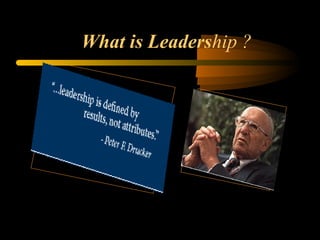
What is Leadership ?
Leadership
• Leadership is ”the
ability to get
extraordinary things
done --- by ordinary
people”.
Leadership
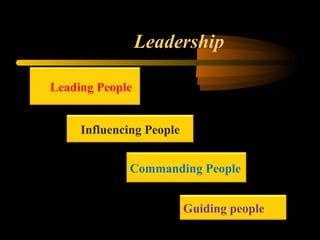
• Leading People
Influencing People
Commanding People
Guiding people
Leadership
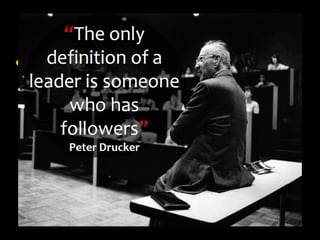
Who is a Leader?
A leader is a person
others opt to follow to a
place they would not
have gone by themselves.
- BarkerBarker
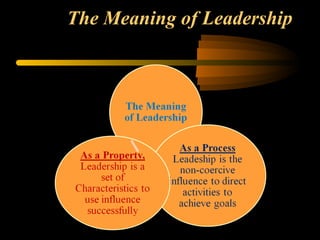
The Meaning of Leadership
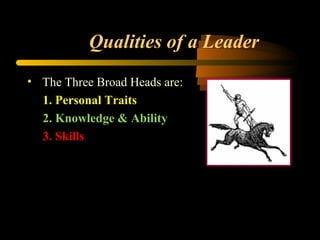
Qualities of a Leader
• The Three Broad Heads are:
1. Personal Traits
2. Knowledge & Ability
3. Skills
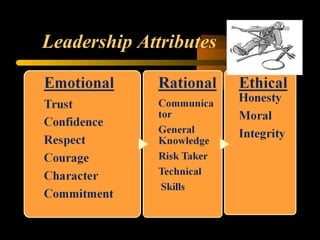
Leadership Attributes
Leadership Qualities
• ”Leadership is the
activity of influencing
people to strive
willingly for group
objectives”.
- Georgy R Terry
Leaders As Role Models
• Team members copy and imbibe
some of the qualities of their leader.
• Teams look up to their leaders very
much like a child looks upto parents.
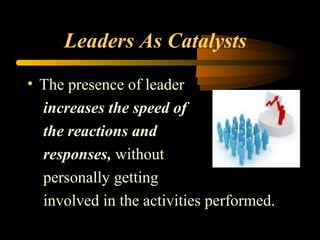
Leaders As Catalysts
• The presence of leader
increases the speed of
the reactions and
responses, without
personally getting
involved in the activities performed.
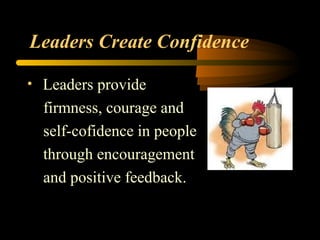
Leaders Create Confidence
• Leaders provide
firmness, courage and
self-cofidence in people
through encouragement
and positive feedback.
Effective Leadership
• Essential Factors for effective leadership
are:
• 1. Set crystal clear Goals
• 2. Select people carefully to attain the Goal.
• 3. Use good interpersonal skills with
encouraging communication to motivate.
Characteristics of a Leader
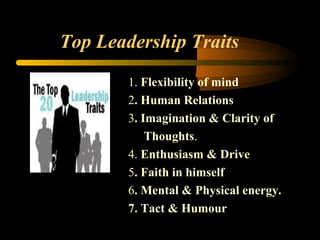
Top Leadership Traits
1. Flexibility of mind
2. Human Relations
3. Imagination & Clarity of
Thoughts.
4. Enthusiasm & Drive
5. Faith in himself
6. Mental & Physical energy.
7. Tact & Humour
Good Interpersonal Skills
• Good Interpersonal skills
is the key to getting
along well with people.
• This is an art mastered by
all successful leaders.
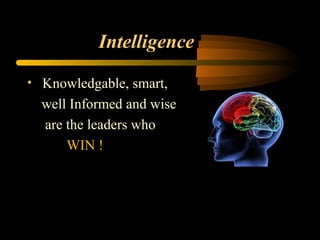
Intelligence
• Knowledgable, smart,
well Informed and wise
are the leaders who
WIN !
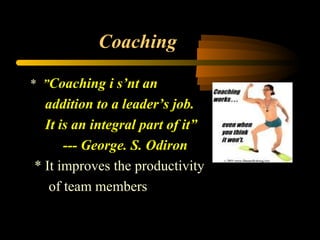
Coaching
* ”Coaching i s’nt an
addition to a leader’s job.
It is an integral part of it”
--- George. S. Odiron
* It improves the productivity
of team members
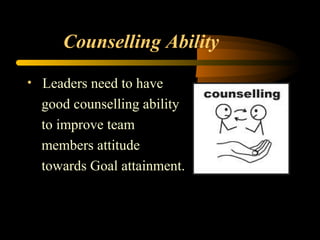
Counselling Ability
• Leaders need to have
good counselling ability
to improve team
members attitude
towards Goal attainment.
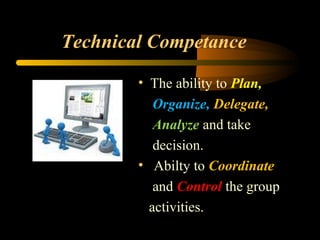
Technical Competance
• The ability to Plan,
Organize, Delegate,
Analyze and take
decision.
• Abilty to Coordinate
and Control the group
activities.
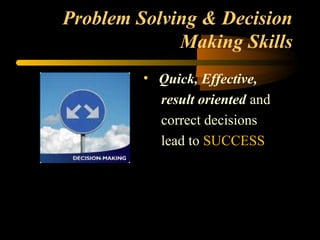
Problem Solving & Decision
Making Skills
• Quick, Effective,
result oriented and
correct decisions
lead to SUCCESS
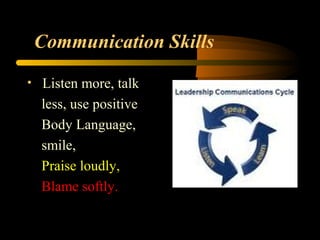
Communication Skills
• Listen more, talk
less, use positive
Body Language,
smile,
Praise loudly,
Blame softly.
Objectivity
• Leaders never lose
sight of their goals,
even against all
odds.
Ten Functions of Leadership
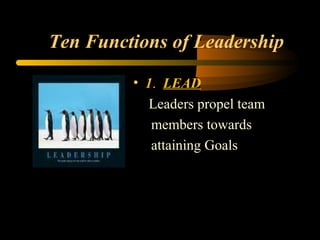
• 1. LEAD
Leaders propel team
members towards
attaining Goals
2. Motivate
• Leaders assure and
propel their teams
and themselves to
achieve set goals.
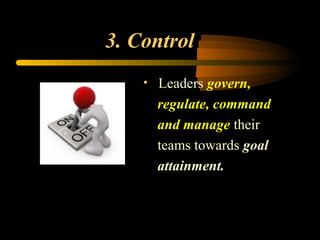
3. Control
• Leaders govern,
regulate, command
and manage their
teams towards goal
attainment.
4. Stimulate
• Leaders excite, urge,
provoke and charge
the team.
• Leaders stimulate
them to go all out,
towards goal
attainment.
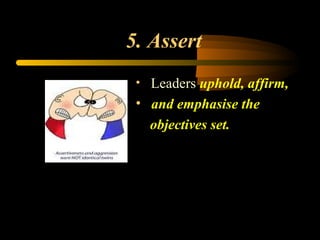
5. Assert
• Leaders uphold, affirm,
• and emphasise the
objectives set.
6.Goal Setting for the team
* Setting goal &
clarifying.
* Making Plan.
* Defining the task.
* Allocating work &
resources.
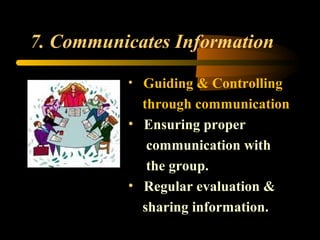
7. Communicates Information
• Guiding & Controlling
through communication
• Ensuring proper
communication with
the group.
• Regular evaluation &
sharing information.
8.Builds Effective Team
• Builds a strong
Team spirit
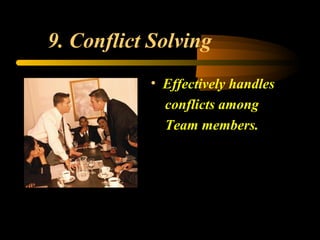
9. Conflict Solving
• Effectively handles
conflicts among
Team members.
10. Leads his Team to Success
• Improving both
Task achievement
and Job satisfaction
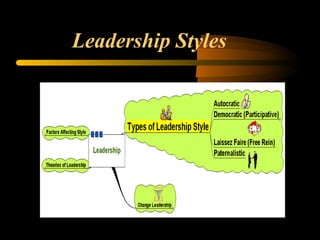
Leadership Styles
Structural Vs Situational
Leadership
• 1. The Bison Herd Model.
• 2. The Bird Model
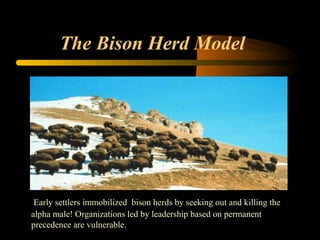
The Bison Herd Model
Early settlers immobilized bison herds by seeking out and killing the
alpha male! Organizations led by leadership based on permanent
precedence are vulnerable.
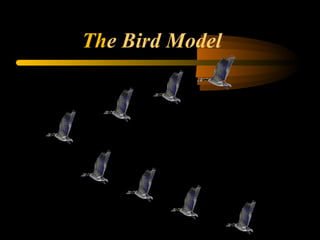
The Bird Model
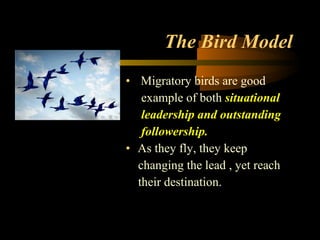
The Bird Model
• Migratory birds are good
example of both situational
leadership and outstanding
followership.
• As they fly, they keep
changing the lead , yet reach
their destination.
Leadership Styles
• Leadership Style depends upon:
1. The situation (Appropriate for the
situation)
2. Leader’s personality.
3. Team members’ maturity level &
needs.
The Management & Leadership
Styles
• All leaders have two
important priorities
and these are:
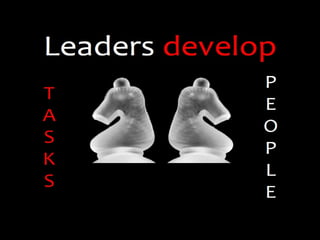
1. The Task &
2. The People to
perform the task
Classification of Leadership
Styles
1. TASK ORIENTED:
• Also called work centered
leadership.
• Leader shows greater concern for
work than the workers.
• Uses maximum authority ,
direction and controll.
Classification of Leadership
• 2. PEOPLE ORIENTED:
• Leader shows greater concern for his
people than the task (work)
• Democratic in controll & decision
making.
Another Type of Classification
1. AUTOCRATIC:
• Leader dictates what he wants.
• Is strict.
• Doesn’t delegate authority.
• Is a one-man show.
Types of Classification
2. PERSUASIVE:
• Sells his ideas,
• Using moral and enthusiasm of members
3. CONSULTATIVE:
• Discusses with team members.
• Then, takes his decision himself.
Types of Classification
4. DEMOCRATIC:
• Involves team members
in discussion & also in
decision-making.
Another Type of Classification
1. DIRECTING:
• Leader instructs.
• Then, closely supervises task
accomplishment
Another Type of Classification
2. COACHING:
• The leader continues to direct and
closely supervises.
• But, also explains decisions.
• Solicits suggestions.
• Supports progress.
Types of Classification
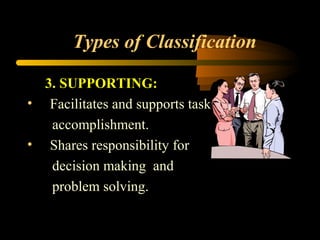
3. SUPPORTING:
• Facilitates and supports task
accomplishment.
• Shares responsibility for
decision making and
problem solving.
Types of Classification
4. DELEGATING:
• Turns over responsibilities to team
members for decision-making and
problem solving.
Which Leadership to be
Adopted?
• The leader has to adapt his style to a given
situation.
• It is called ” Situational Adaptable
Leadership (SAL).
A good leader will find him- or herself switching instinctively
between styles according to the people and work they are
dealing with.
A good leader will find him- or herself switching instinctively
between styles according to the people and work they are
dealing with.
Situational Leadership Style
SAL takes into account the following:
• Leader’s awareness of self.
• His natural style.
• Situation.
• Organizational culture.
• Group characteristics & age of the team.
• Motivation level.
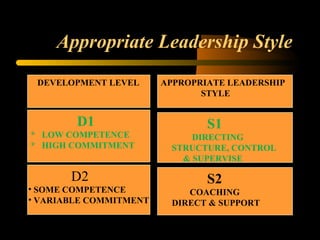
Appropriate Leadership Style
DEVELOPMENT LEVEL APPROPRIATE LEADERSHIP
STYLE
D1
* LOW COMPETENCE
* HIGH COMMITMENT
S1
DIRECTING
STRUCTURE, CONTROL
& SUPERVISE
D2
• SOME COMPETENCE
• VARIABLE COMMITMENT
S2
COACHING
DIRECT & SUPPORT
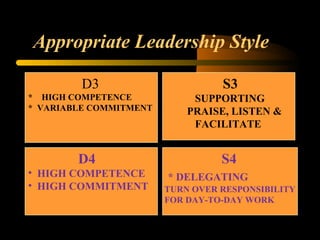
Appropriate Leadership Style
D3
* HIGH COMPETENCE
* VARIABLE COMMITMENT
S3
SUPPORTING
PRAISE, LISTEN &
FACILITATE
D4
• HIGH COMPETENCE
• HIGH COMMITMENT
S4
* DELEGATING
TURN OVER RESPONSIBILITY
FOR DAY-TO-DAY WORK
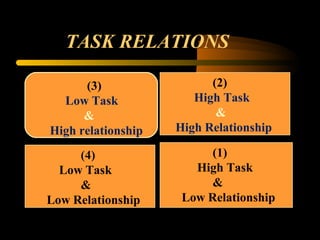
TASK RELATIONS
(4)
Low Task
&
Low Relationship
(3)
Low Task
&
High relationship
(2)
High Task
&
High Relationship
(1)
High Task
&
Low Relationship
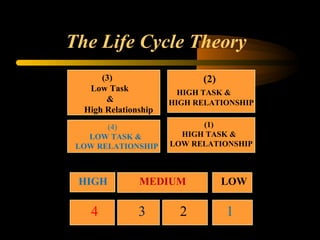
The Life Cycle Theory
(3)
Low Task
&
High Relationship
(4)
LOW TASK &
LOW RELATIONSHIP
(2)
HIGH TASK &
HIGH RELATIONSHIP
(1)
HIGH TASK &
LOW RELATIONSHIP
HIGH
4
MEDIUM
3 2
LOW
1
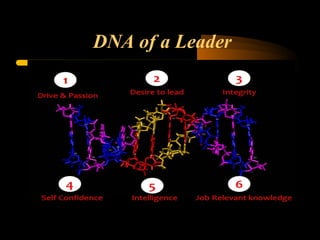
DNA of a Leader
Management & Leadership
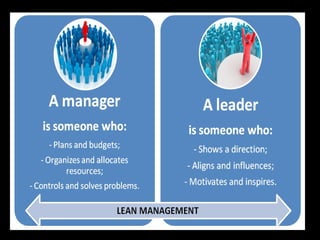
• The organization of resources is -
Management.
• The organization of people is -
Leadership.
MANAGEMENT
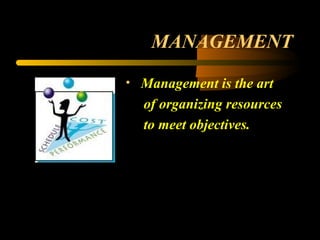
• Management is the art
of organizing resources
to meet objectives.
Leadership
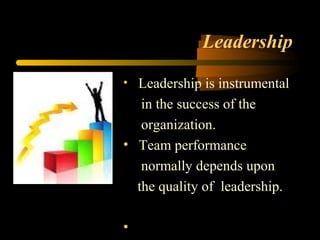
• • Leadership is instrumental
in the success of the
organization.
• Team performance
normally depends upon
the quality of leadership.
•
Management & Leadership
• Management of
things is relatively
easy –
• They don’t answer
back
• The leadership of
people is much
more difficult –
• They do.
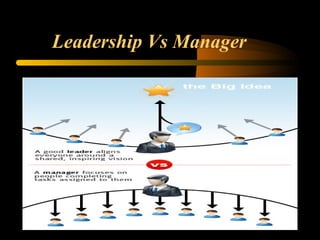
Leadership Vs Manager
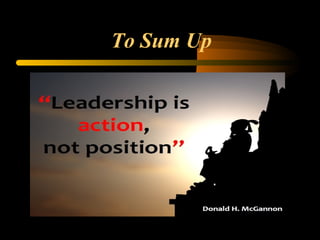
To Sum Up
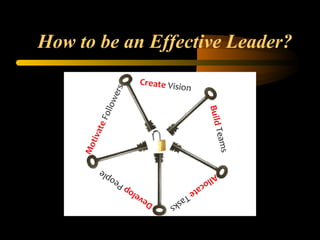
How to be an Effective Leader?
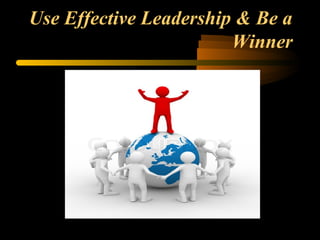
Use Effective Leadership & Be a
Winner
Excel As A Leader
QUESTIONS
Thank You
- N.G.Palit
At the end
• If you liked this presentation, please feel
free to send your valuable feedback and
suggestions to me at the following
address:
nandapalit@yahoo.co.in or through
facebook.

Leadership

  • 1.
  • 2.
  • 5.
  • 7.
    Leadership • Leadership is”the ability to get extraordinary things done --- by ordinary people”.
  • 8.
    Leadership • Leading People InfluencingPeople Commanding People Guiding people
  • 9.
  • 10.
    Who is aLeader? A leader is a person others opt to follow to a place they would not have gone by themselves. - BarkerBarker
  • 12.
    The Meaning ofLeadership
  • 13.
    Qualities of aLeader • The Three Broad Heads are: 1. Personal Traits 2. Knowledge & Ability 3. Skills
  • 14.
  • 15.
    Leadership Qualities • ”Leadershipis the activity of influencing people to strive willingly for group objectives”. - Georgy R Terry
  • 17.
    Leaders As RoleModels • Team members copy and imbibe some of the qualities of their leader. • Teams look up to their leaders very much like a child looks upto parents.
  • 18.
    Leaders As Catalysts •The presence of leader increases the speed of the reactions and responses, without personally getting involved in the activities performed.
  • 19.
    Leaders Create Confidence •Leaders provide firmness, courage and self-cofidence in people through encouragement and positive feedback.
  • 20.
    Effective Leadership • EssentialFactors for effective leadership are: • 1. Set crystal clear Goals • 2. Select people carefully to attain the Goal. • 3. Use good interpersonal skills with encouraging communication to motivate.
  • 21.
  • 22.
    Top Leadership Traits 1.Flexibility of mind 2. Human Relations 3. Imagination & Clarity of Thoughts. 4. Enthusiasm & Drive 5. Faith in himself 6. Mental & Physical energy. 7. Tact & Humour
  • 23.
    Good Interpersonal Skills •Good Interpersonal skills is the key to getting along well with people. • This is an art mastered by all successful leaders.
  • 25.
    Intelligence • Knowledgable, smart, wellInformed and wise are the leaders who WIN !
  • 26.
    Coaching * ”Coaching is’nt an addition to a leader’s job. It is an integral part of it” --- George. S. Odiron * It improves the productivity of team members
  • 27.
    Counselling Ability • Leadersneed to have good counselling ability to improve team members attitude towards Goal attainment.
  • 28.
    Technical Competance • Theability to Plan, Organize, Delegate, Analyze and take decision. • Abilty to Coordinate and Control the group activities.
  • 29.
    Problem Solving &Decision Making Skills • Quick, Effective, result oriented and correct decisions lead to SUCCESS
  • 30.
    Communication Skills • Listenmore, talk less, use positive Body Language, smile, Praise loudly, Blame softly.
  • 31.
    Objectivity • Leaders neverlose sight of their goals, even against all odds.
  • 35.
    Ten Functions ofLeadership • 1. LEAD Leaders propel team members towards attaining Goals
  • 36.
    2. Motivate • Leadersassure and propel their teams and themselves to achieve set goals.
  • 37.
    3. Control • Leadersgovern, regulate, command and manage their teams towards goal attainment.
  • 38.
    4. Stimulate • Leadersexcite, urge, provoke and charge the team. • Leaders stimulate them to go all out, towards goal attainment.
  • 39.
    5. Assert • Leadersuphold, affirm, • and emphasise the objectives set.
  • 40.
    6.Goal Setting forthe team * Setting goal & clarifying. * Making Plan. * Defining the task. * Allocating work & resources.
  • 41.
    7. Communicates Information •Guiding & Controlling through communication • Ensuring proper communication with the group. • Regular evaluation & sharing information.
  • 42.
    8.Builds Effective Team •Builds a strong Team spirit
  • 43.
    9. Conflict Solving •Effectively handles conflicts among Team members.
  • 44.
    10. Leads hisTeam to Success • Improving both Task achievement and Job satisfaction
  • 45.
  • 46.
    Structural Vs Situational Leadership •1. The Bison Herd Model. • 2. The Bird Model
  • 47.
    The Bison HerdModel Early settlers immobilized bison herds by seeking out and killing the alpha male! Organizations led by leadership based on permanent precedence are vulnerable.
  • 48.
  • 49.
    The Bird Model •Migratory birds are good example of both situational leadership and outstanding followership. • As they fly, they keep changing the lead , yet reach their destination.
  • 50.
    Leadership Styles • LeadershipStyle depends upon: 1. The situation (Appropriate for the situation) 2. Leader’s personality. 3. Team members’ maturity level & needs.
  • 51.
    The Management &Leadership Styles • All leaders have two important priorities and these are: 1. The Task & 2. The People to perform the task
  • 52.
    Classification of Leadership Styles 1.TASK ORIENTED: • Also called work centered leadership. • Leader shows greater concern for work than the workers. • Uses maximum authority , direction and controll.
  • 53.
    Classification of Leadership •2. PEOPLE ORIENTED: • Leader shows greater concern for his people than the task (work) • Democratic in controll & decision making.
  • 54.
    Another Type ofClassification 1. AUTOCRATIC: • Leader dictates what he wants. • Is strict. • Doesn’t delegate authority. • Is a one-man show.
  • 55.
    Types of Classification 2.PERSUASIVE: • Sells his ideas, • Using moral and enthusiasm of members 3. CONSULTATIVE: • Discusses with team members. • Then, takes his decision himself.
  • 56.
    Types of Classification 4.DEMOCRATIC: • Involves team members in discussion & also in decision-making.
  • 57.
    Another Type ofClassification 1. DIRECTING: • Leader instructs. • Then, closely supervises task accomplishment
  • 58.
    Another Type ofClassification 2. COACHING: • The leader continues to direct and closely supervises. • But, also explains decisions. • Solicits suggestions. • Supports progress.
  • 59.
    Types of Classification 3.SUPPORTING: • Facilitates and supports task accomplishment. • Shares responsibility for decision making and problem solving.
  • 60.
    Types of Classification 4.DELEGATING: • Turns over responsibilities to team members for decision-making and problem solving.
  • 61.
    Which Leadership tobe Adopted? • The leader has to adapt his style to a given situation. • It is called ” Situational Adaptable Leadership (SAL). A good leader will find him- or herself switching instinctively between styles according to the people and work they are dealing with. A good leader will find him- or herself switching instinctively between styles according to the people and work they are dealing with.
  • 62.
    Situational Leadership Style SALtakes into account the following: • Leader’s awareness of self. • His natural style. • Situation. • Organizational culture. • Group characteristics & age of the team. • Motivation level.
  • 63.
    Appropriate Leadership Style DEVELOPMENTLEVEL APPROPRIATE LEADERSHIP STYLE D1 * LOW COMPETENCE * HIGH COMMITMENT S1 DIRECTING STRUCTURE, CONTROL & SUPERVISE D2 • SOME COMPETENCE • VARIABLE COMMITMENT S2 COACHING DIRECT & SUPPORT
  • 64.
    Appropriate Leadership Style D3 *HIGH COMPETENCE * VARIABLE COMMITMENT S3 SUPPORTING PRAISE, LISTEN & FACILITATE D4 • HIGH COMPETENCE • HIGH COMMITMENT S4 * DELEGATING TURN OVER RESPONSIBILITY FOR DAY-TO-DAY WORK
  • 65.
    TASK RELATIONS (4) Low Task & LowRelationship (3) Low Task & High relationship (2) High Task & High Relationship (1) High Task & Low Relationship
  • 66.
    The Life CycleTheory (3) Low Task & High Relationship (4) LOW TASK & LOW RELATIONSHIP (2) HIGH TASK & HIGH RELATIONSHIP (1) HIGH TASK & LOW RELATIONSHIP HIGH 4 MEDIUM 3 2 LOW 1
  • 68.
    DNA of aLeader
  • 69.
    Management & Leadership •The organization of resources is - Management. • The organization of people is - Leadership.
  • 70.
    MANAGEMENT • Management isthe art of organizing resources to meet objectives.
  • 71.
    Leadership • • Leadershipis instrumental in the success of the organization. • Team performance normally depends upon the quality of leadership. •
  • 72.
    Management & Leadership •Management of things is relatively easy – • They don’t answer back • The leadership of people is much more difficult – • They do.
  • 74.
  • 75.
  • 84.
    How to bean Effective Leader?
  • 85.
  • 86.
    Excel As ALeader
  • 87.
  • 88.
  • 89.
    At the end •If you liked this presentation, please feel free to send your valuable feedback and suggestions to me at the following address: nandapalit@yahoo.co.in or through facebook.