Energy, Work &
Power
Work
Lesson Objectives
O Recall and apply the relationship work
done = force x distance moved in the
direction of the force to new situations or
to solve related problems.
Work Done
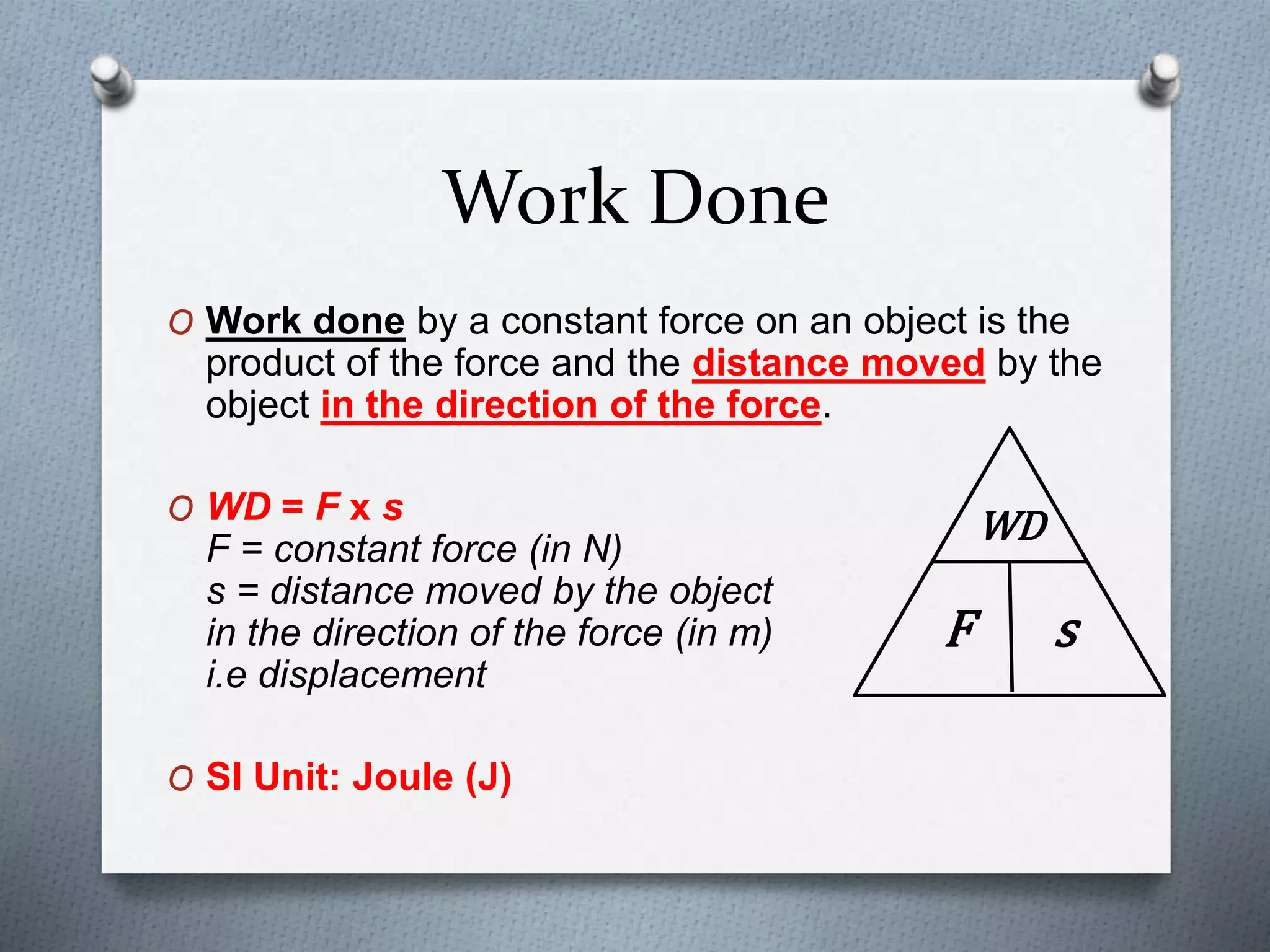
O Work done by a constant force on an object is the
product of the force and the distance moved by the
object in the direction of the force.
O WD = F x s
F = constant force (in N)
s = distance moved by the object
in the direction of the force (in m)
i.e displacement
O SI Unit: Joule (J)
WD
F s
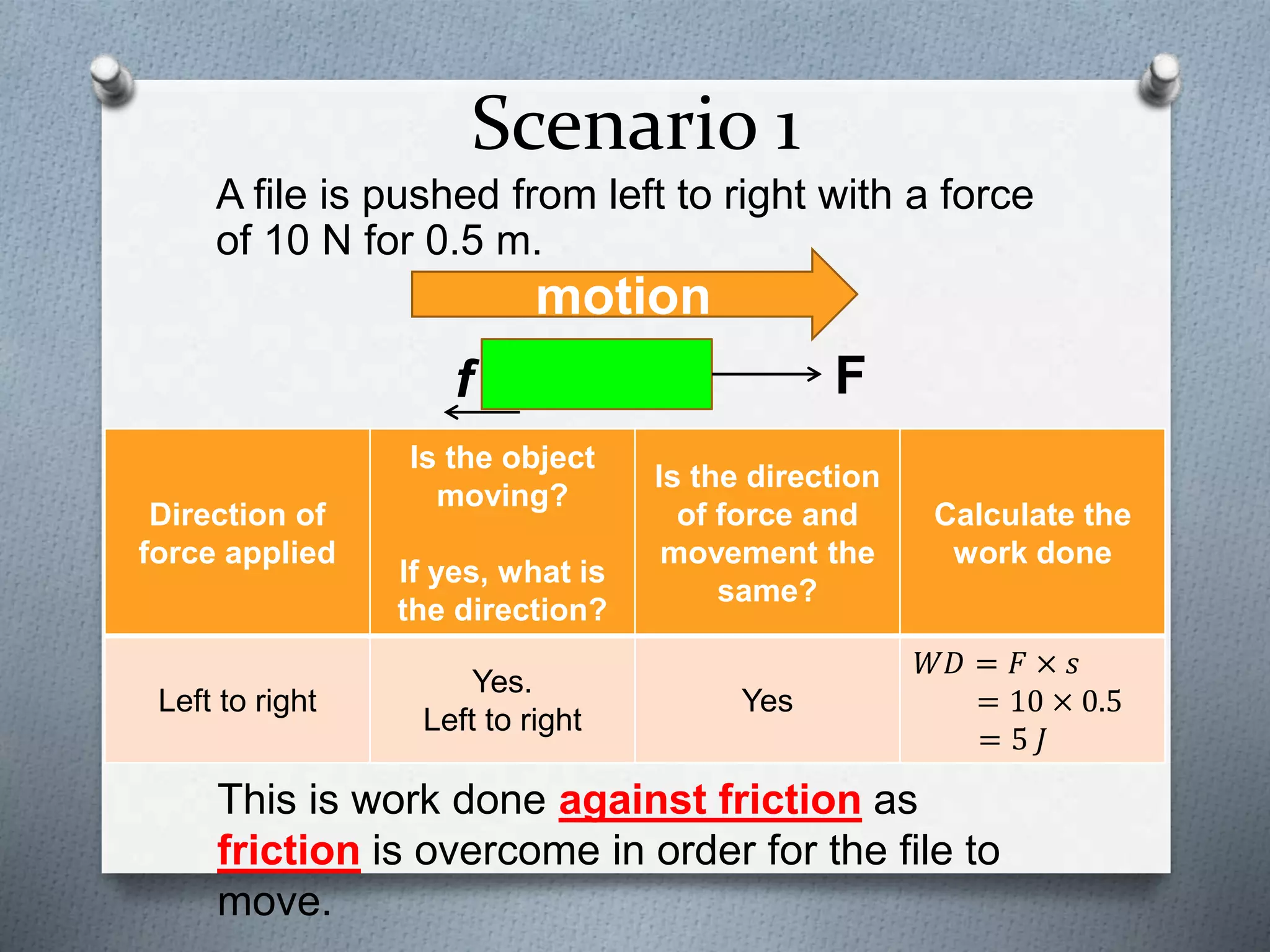
Scenario 1
A file is pushed from left to right with a force
of 10 N for 0.5 m.
Direction of
force applied
Is the object
moving?
If yes, what is
the direction?
Is the direction
of force and
movement the
same?
Calculate the
work done
Left to right
Yes.
Left to right
Yes
𝑊𝐷 = 𝐹 × 𝑠
= 10 × 0.5
= 5 𝐽
This is work done against friction as
friction is overcome in order for the file to
move.
motion
Ff
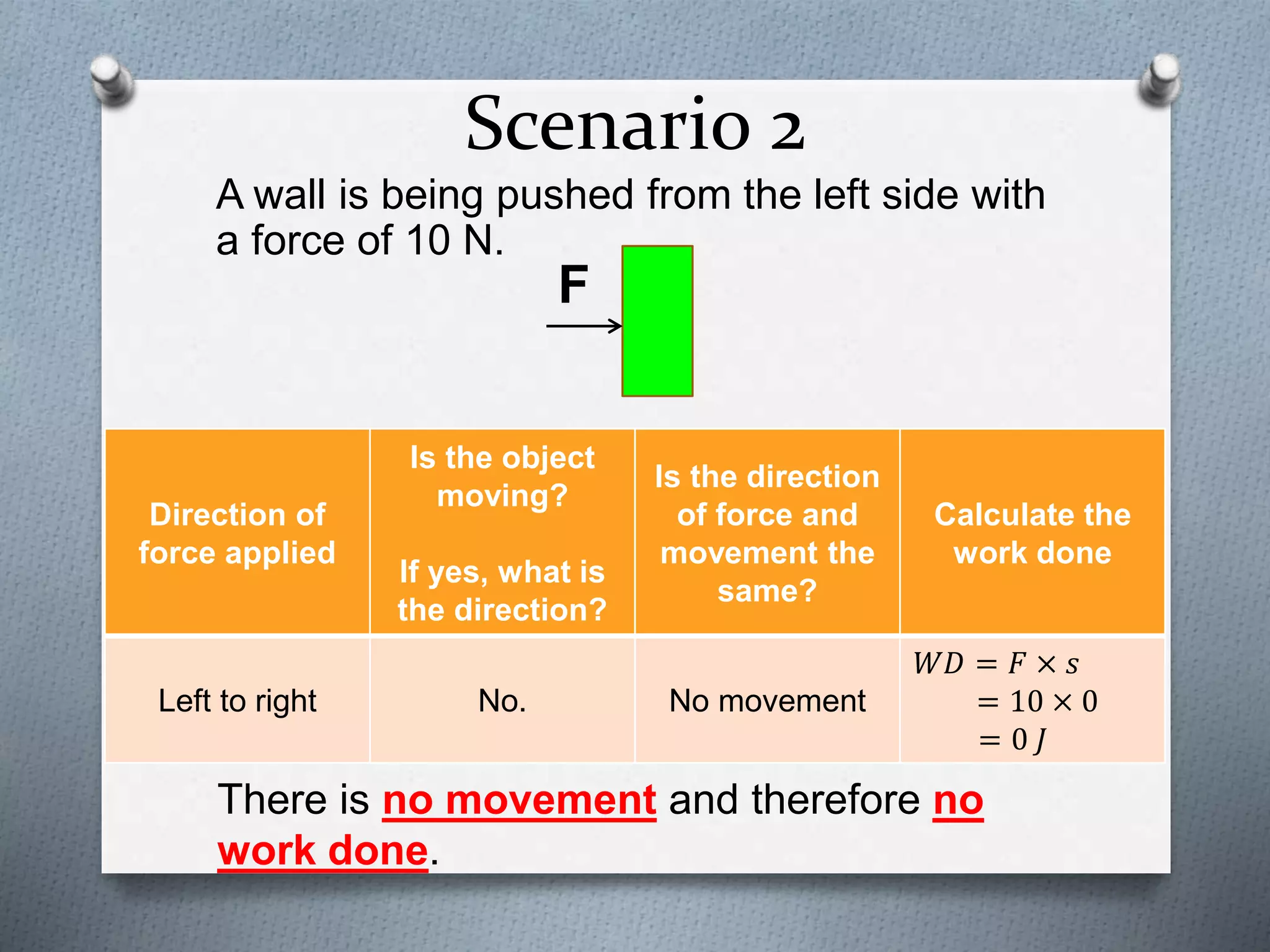
Scenario 2
A wall is being pushed from the left side with
a force of 10 N.
Direction of
force applied
Is the object
moving?
If yes, what is
the direction?
Is the direction
of force and
movement the
same?
Calculate the
work done
Left to right No. No movement
𝑊𝐷 = 𝐹 × 𝑠
= 10 × 0
= 0 𝐽
There is no movement and therefore no
work done.
F
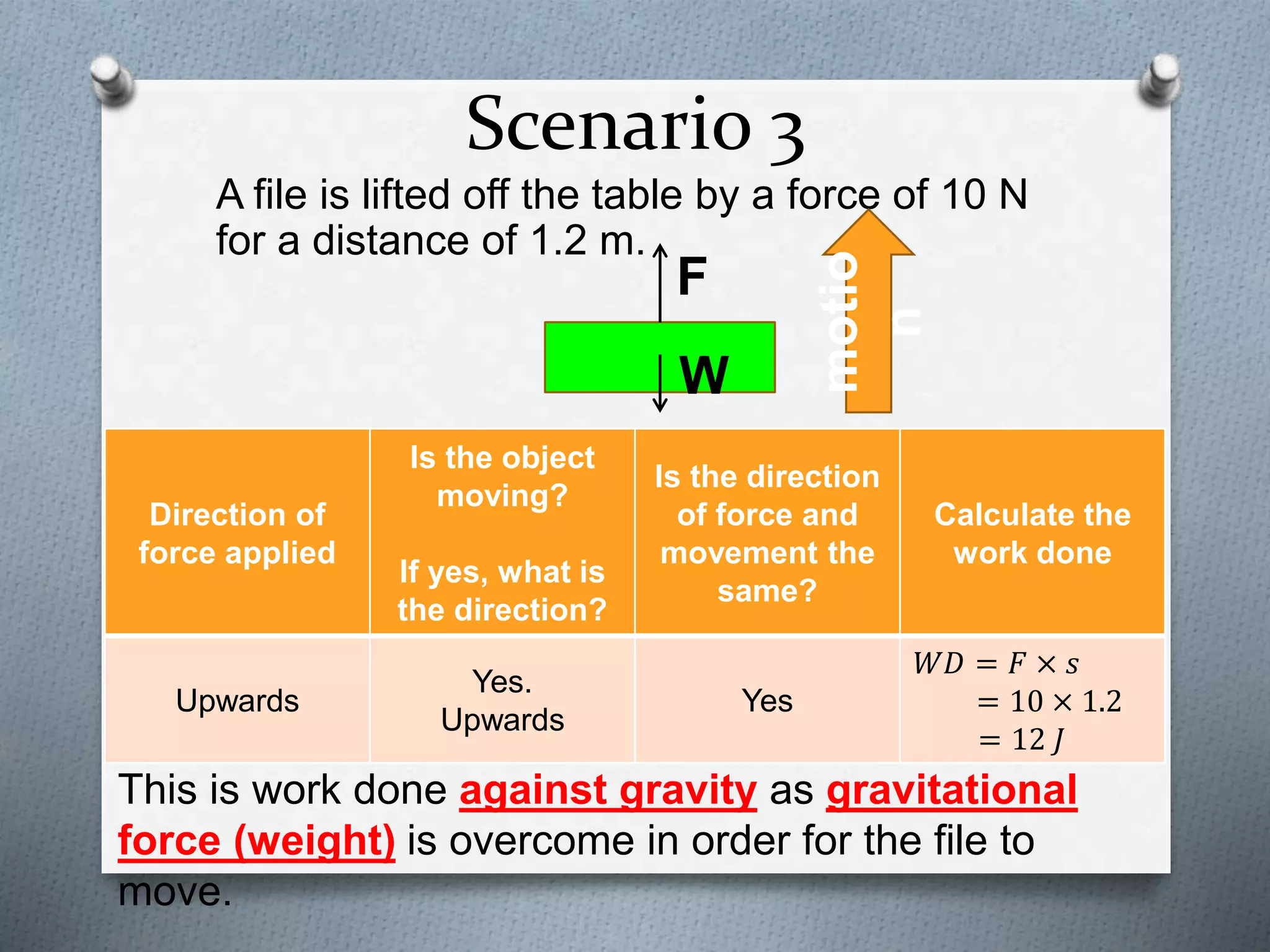
Scenario 3
A file is lifted off the table by a force of 10 N
for a distance of 1.2 m.
Direction of
force applied
Is the object
moving?
If yes, what is
the direction?
Is the direction
of force and
movement the
same?
Calculate the
work done
Upwards
Yes.
Upwards
Yes
𝑊𝐷 = 𝐹 × 𝑠
= 10 × 1.2
= 12 𝐽
This is work done against gravity as gravitational
force (weight) is overcome in order for the file to
move.
motio
n
F
W
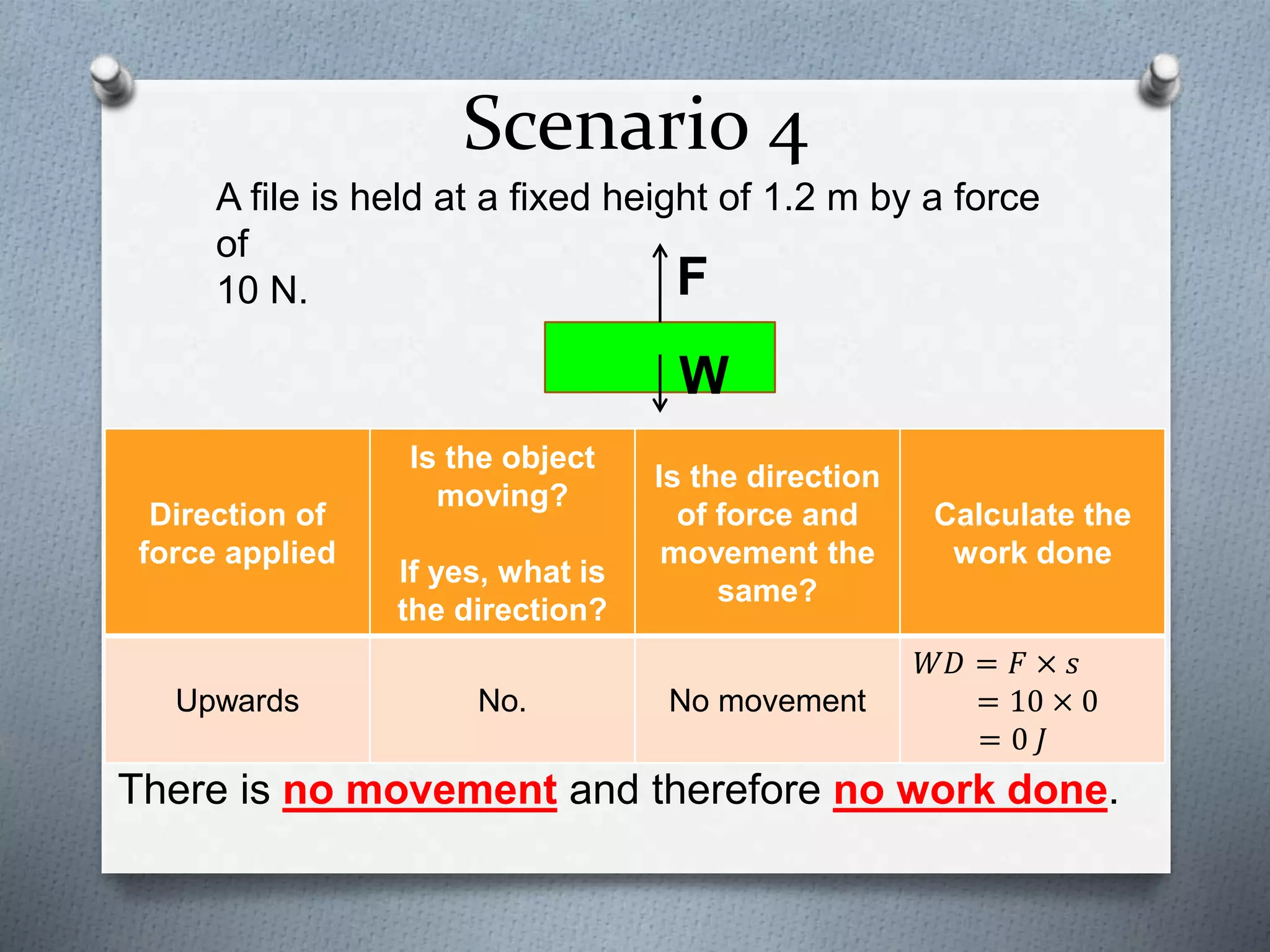
Scenario 4
A file is held at a fixed height of 1.2 m by a force
of
10 N.
Direction of
force applied
Is the object
moving?
If yes, what is
the direction?
Is the direction
of force and
movement the
same?
Calculate the
work done
Upwards No. No movement
𝑊𝐷 = 𝐹 × 𝑠
= 10 × 0
= 0 𝐽
There is no movement and therefore no work done.
F
W
Work Done
O No work is done if:
 No applied force
 No motion
 No motion in the direction of the force
Practice
O Complete the practice questions for work done.
Lesson Objectives
O Show understanding that kinetic energy,
potential energy (chemical, gravitational,
elastic), light energy, thermal energy,
electrical energy and nuclear energy are
examples of different forms of energy.
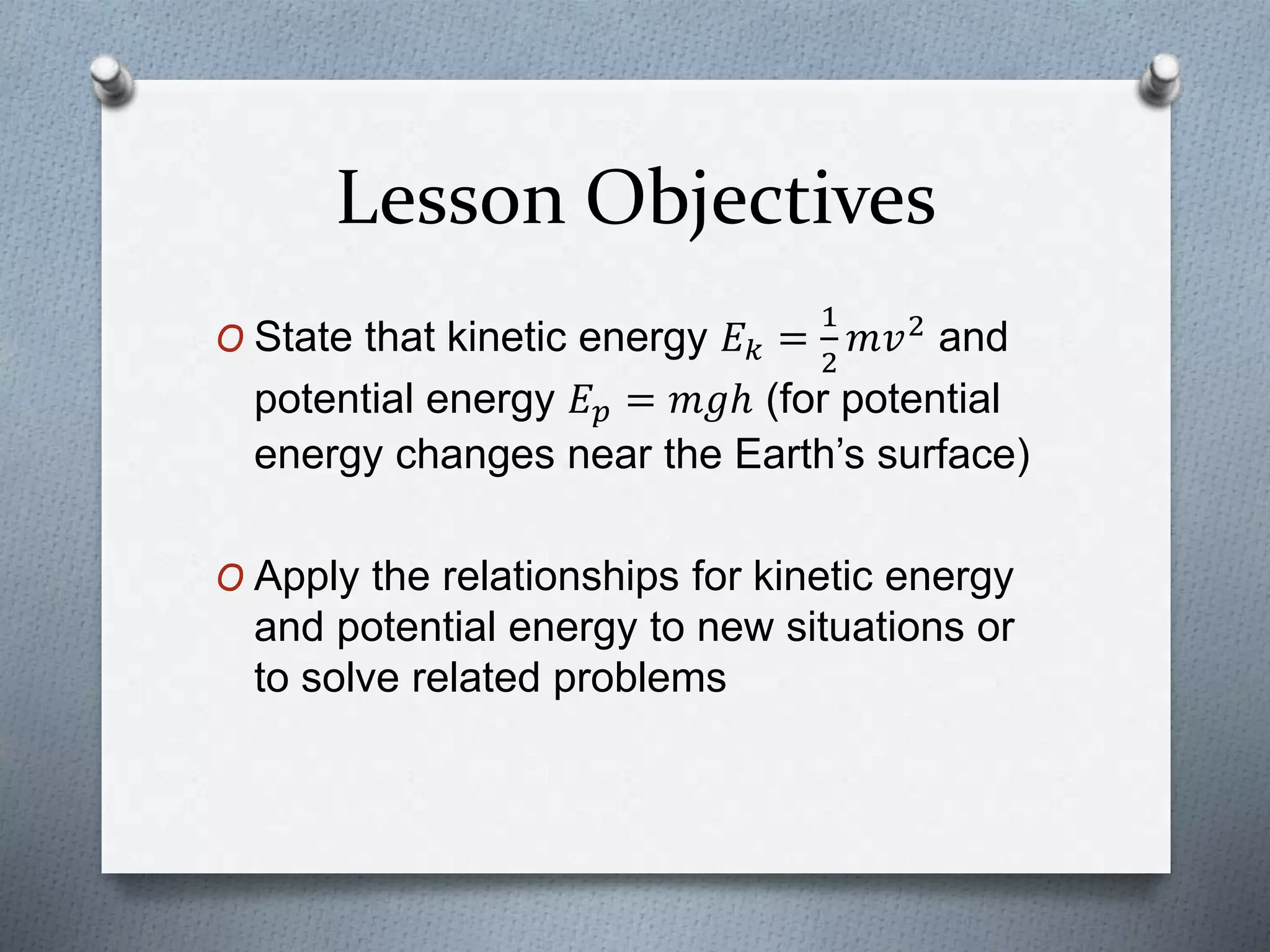
Lesson Objectives
O State that kinetic energy 𝐸 𝑘 =
1
2
𝑚𝑣2
and
potential energy 𝐸 𝑝 = 𝑚𝑔ℎ (for potential
energy changes near the Earth’s surface)
O Apply the relationships for kinetic energy
and potential energy to new situations or
to solve related problems
Energy
O Energy is defined as the capacity to do
work.
O SI Unit: joule (J)
O Energy is a scalar quantity.
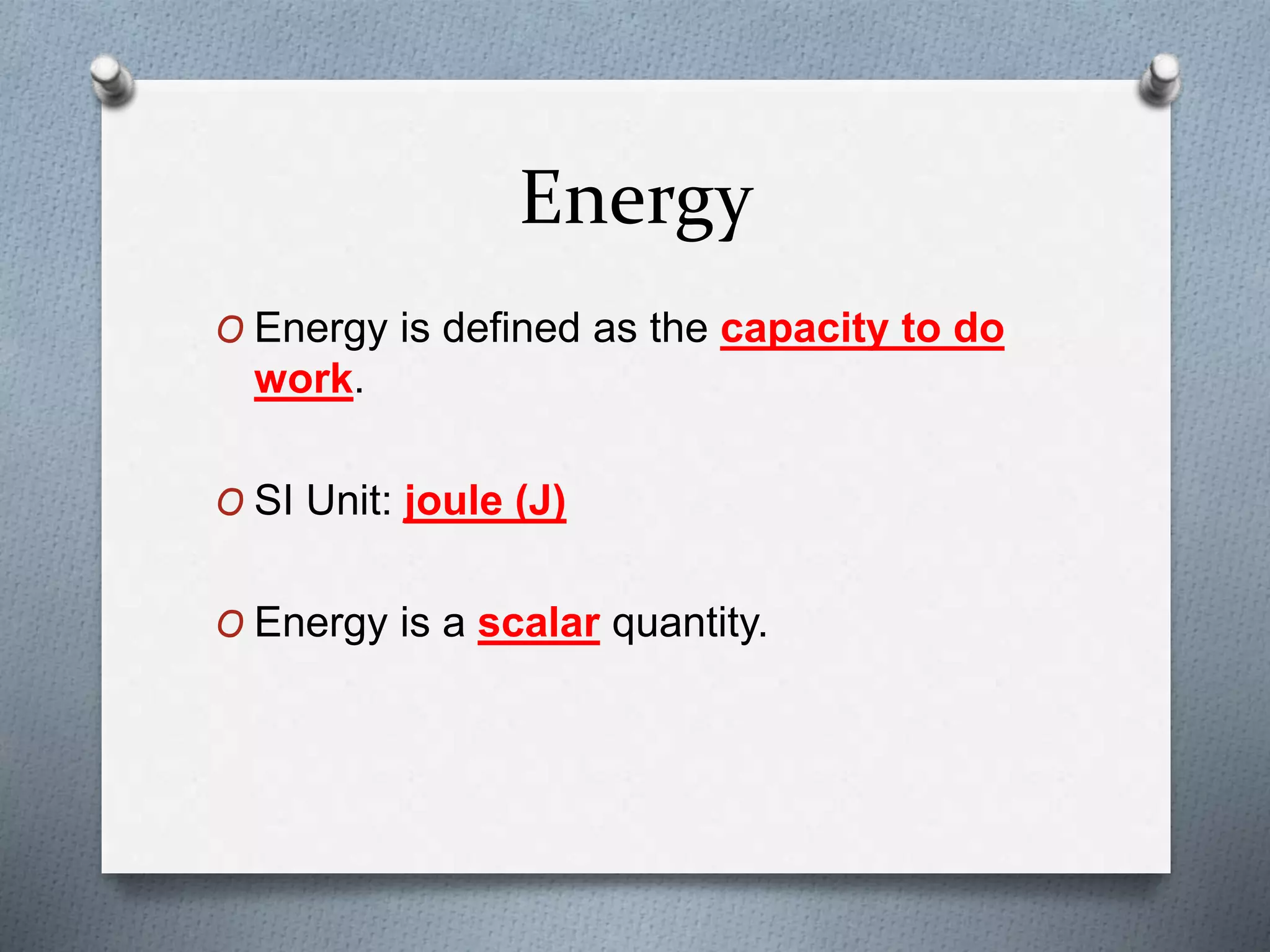
Electrical energy
(covered in Ch 16 –
22)
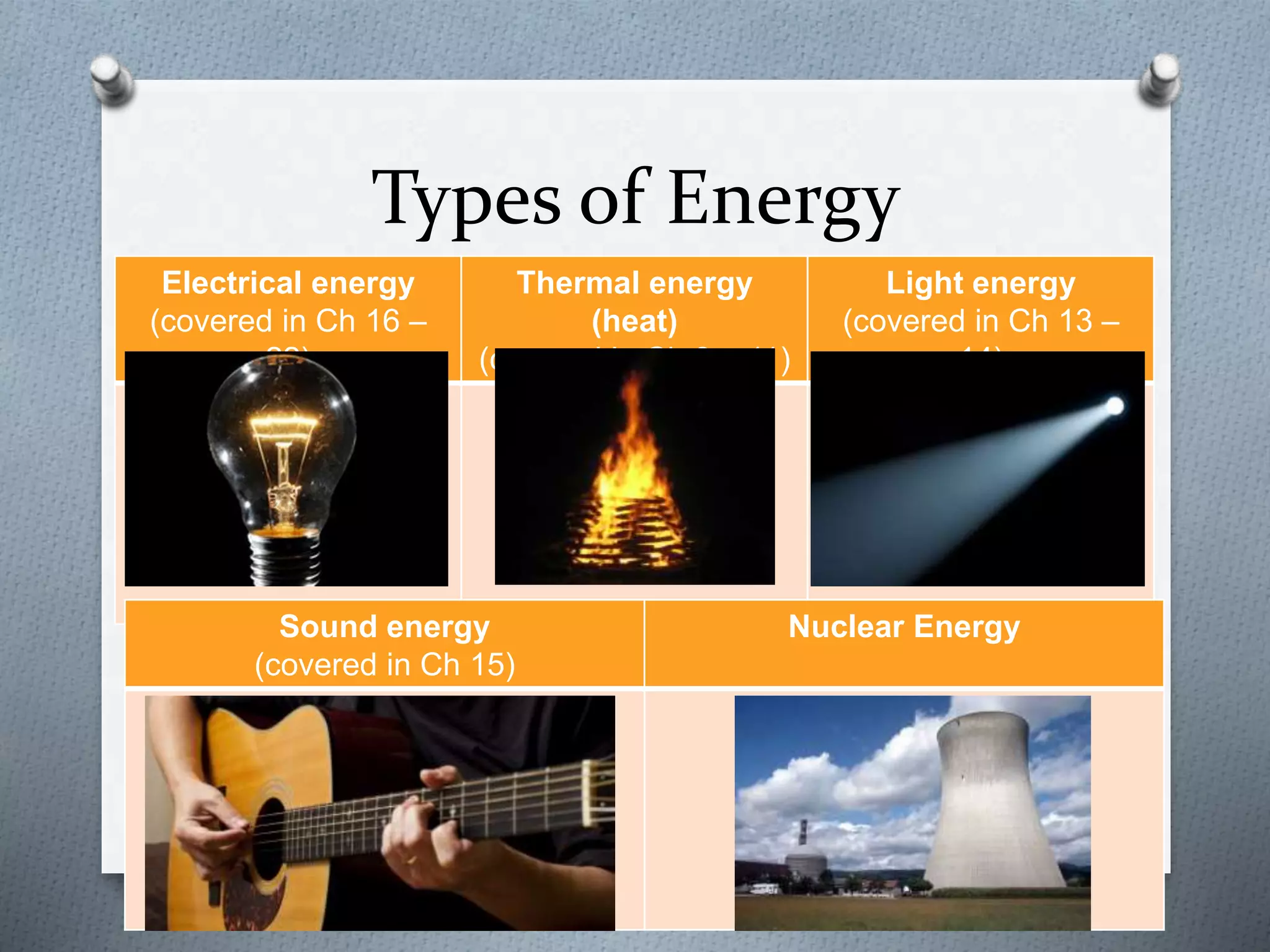
Thermal energy
(heat)
(covered in Ch 9 – 11)
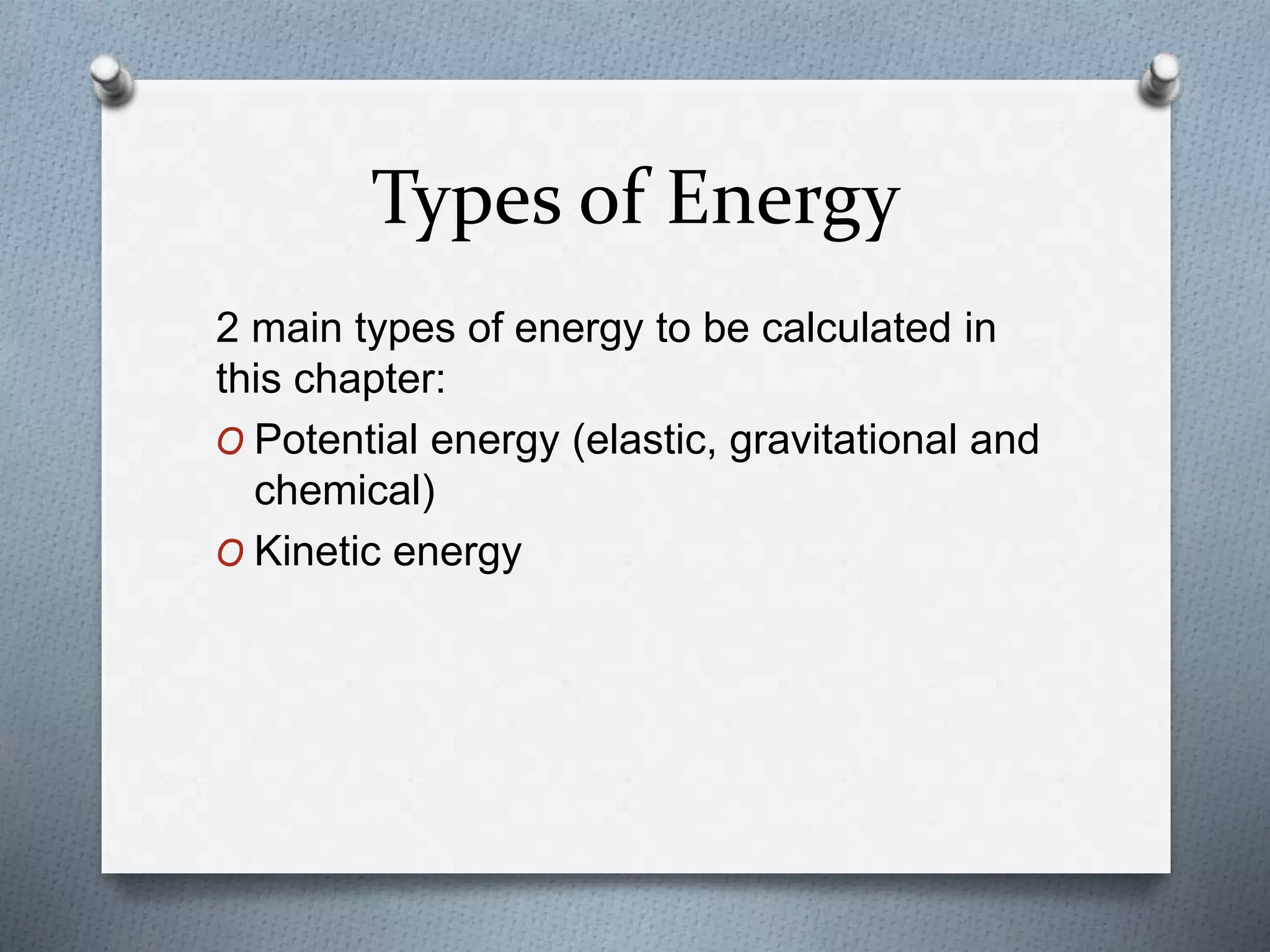
Light energy
(covered in Ch 13 –
14)
Sound energy
(covered in Ch 15)
Nuclear Energy
Types of Energy
Types of Energy
2 main types of energy to be calculated in
this chapter:
O Potential energy (elastic, gravitational and
chemical)
O Kinetic energy
Potential Energy
O Potential Energy is the energy stored in
an object due to its position, state or
shape.
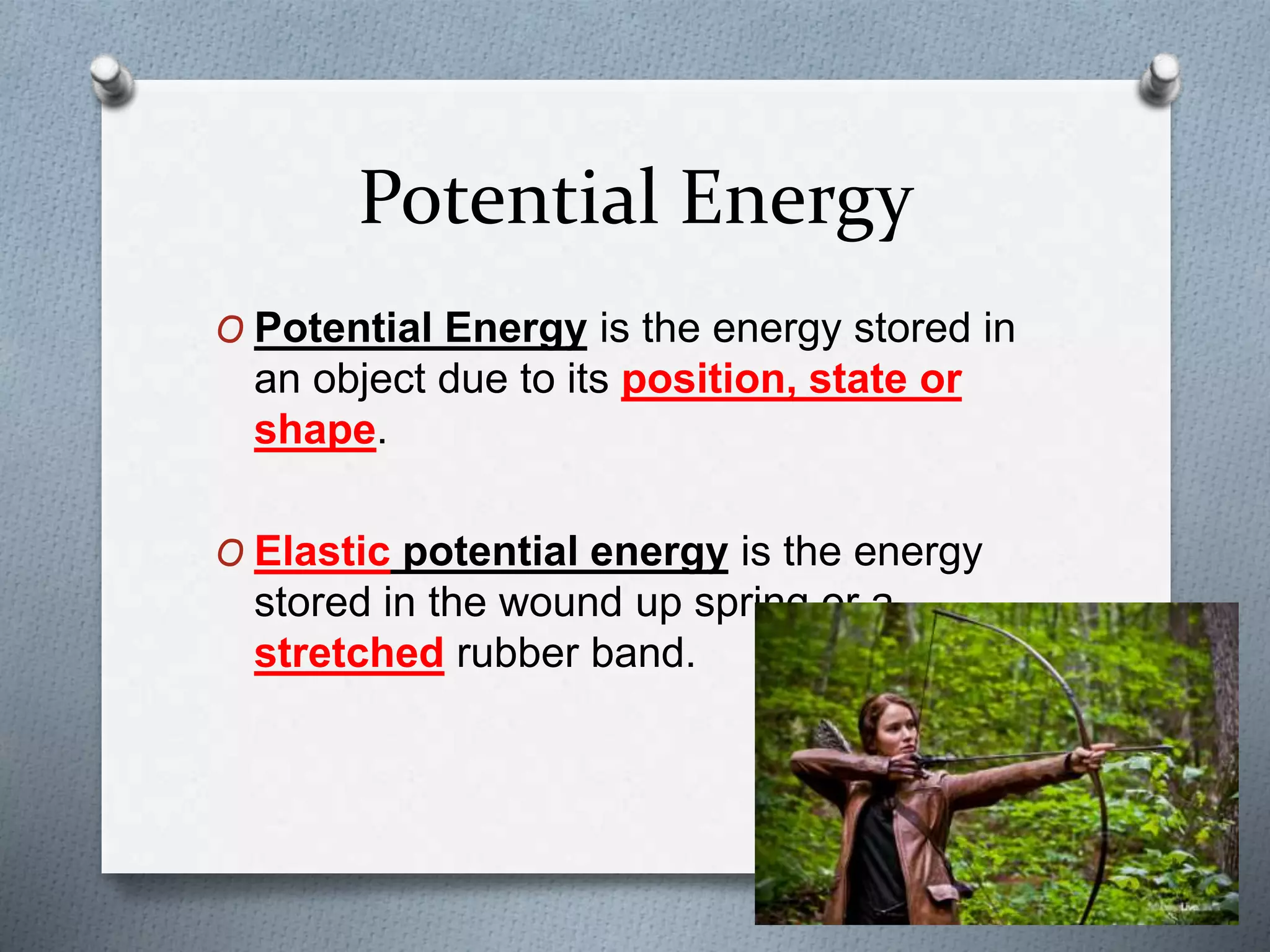
O Elastic potential energy is the energy
stored in the wound up spring or a
stretched rubber band.
Potential Energy
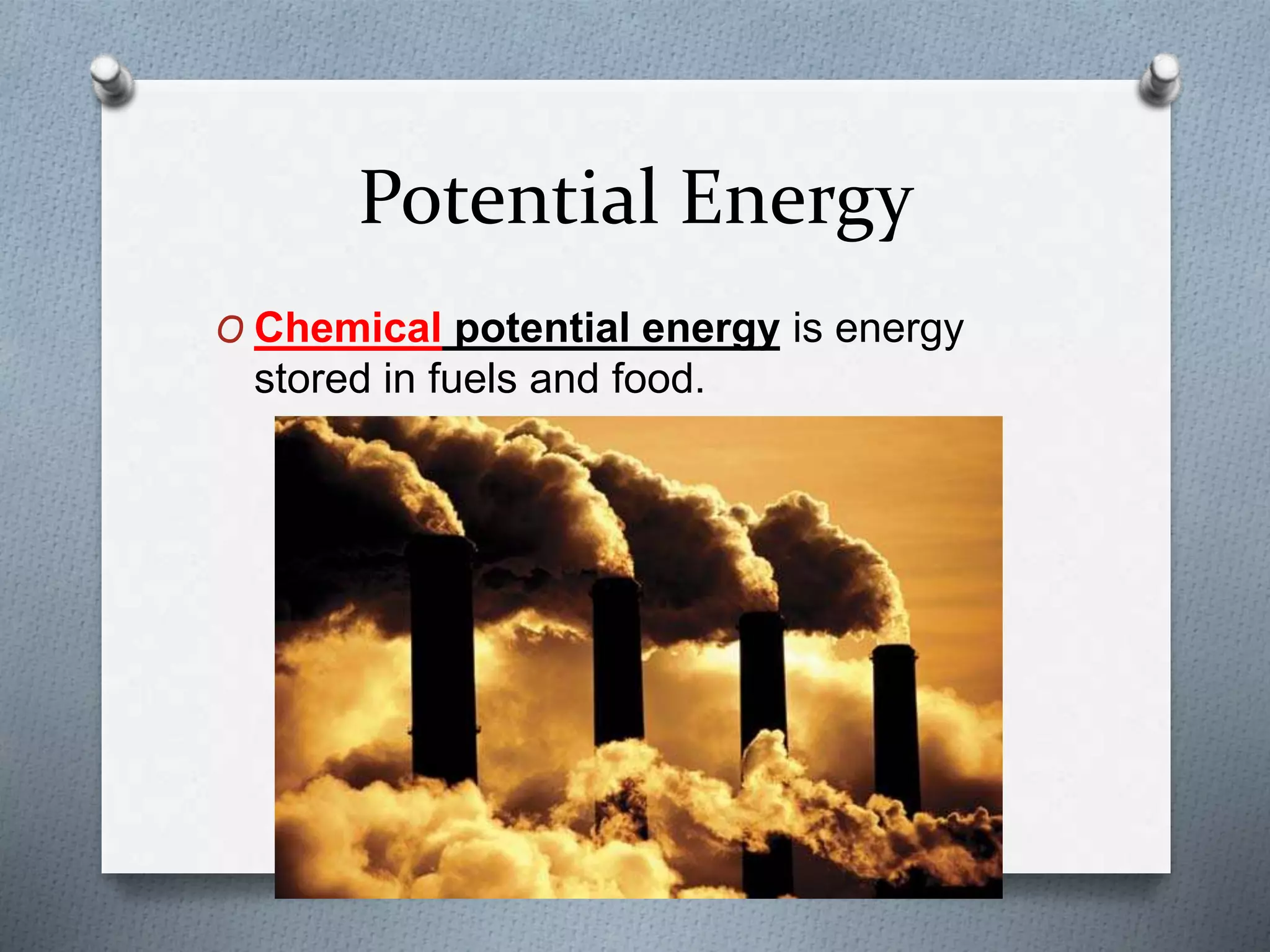
O Chemical potential energy is energy
stored in fuels and food.
Gravitational Potential Energy
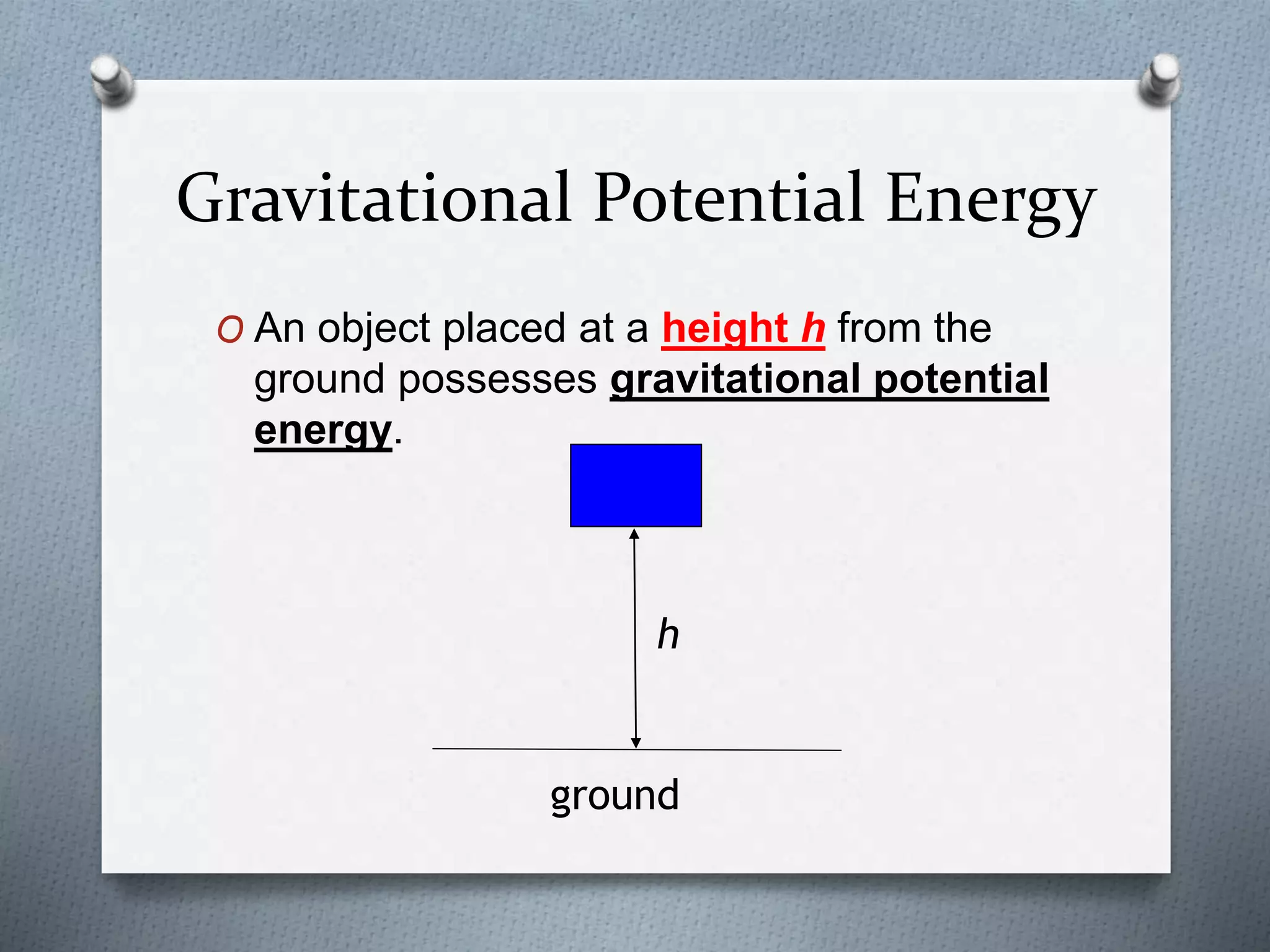
O An object placed at a height h from the
ground possesses gravitational potential
energy.
h
ground
Gravitational Potential Energy
O Gravitational potential energy is the
energy which a body possesses because
of its position relative to the ground.
O Formula: 𝑮𝑷𝑬 = 𝒎𝒈𝒉
O m = mass of the object (kg)
g = acceleration due to gravity (10 N/kg)
h = height above the ground (m)
Gravitational Potential Energy
Practice Qn 1
A girl lifts her school bag of mass 3 kg from the floor
onto her lap through a height of 0.5 m. What is the
gravitational potential energy gained by the bag?
𝐆𝐏𝐄 = 𝒎𝒈𝒉
= 𝟑 × 𝟏𝟎 × 𝟎. 𝟓
= 𝟏𝟓 𝐉
Gravitational Potential Energy
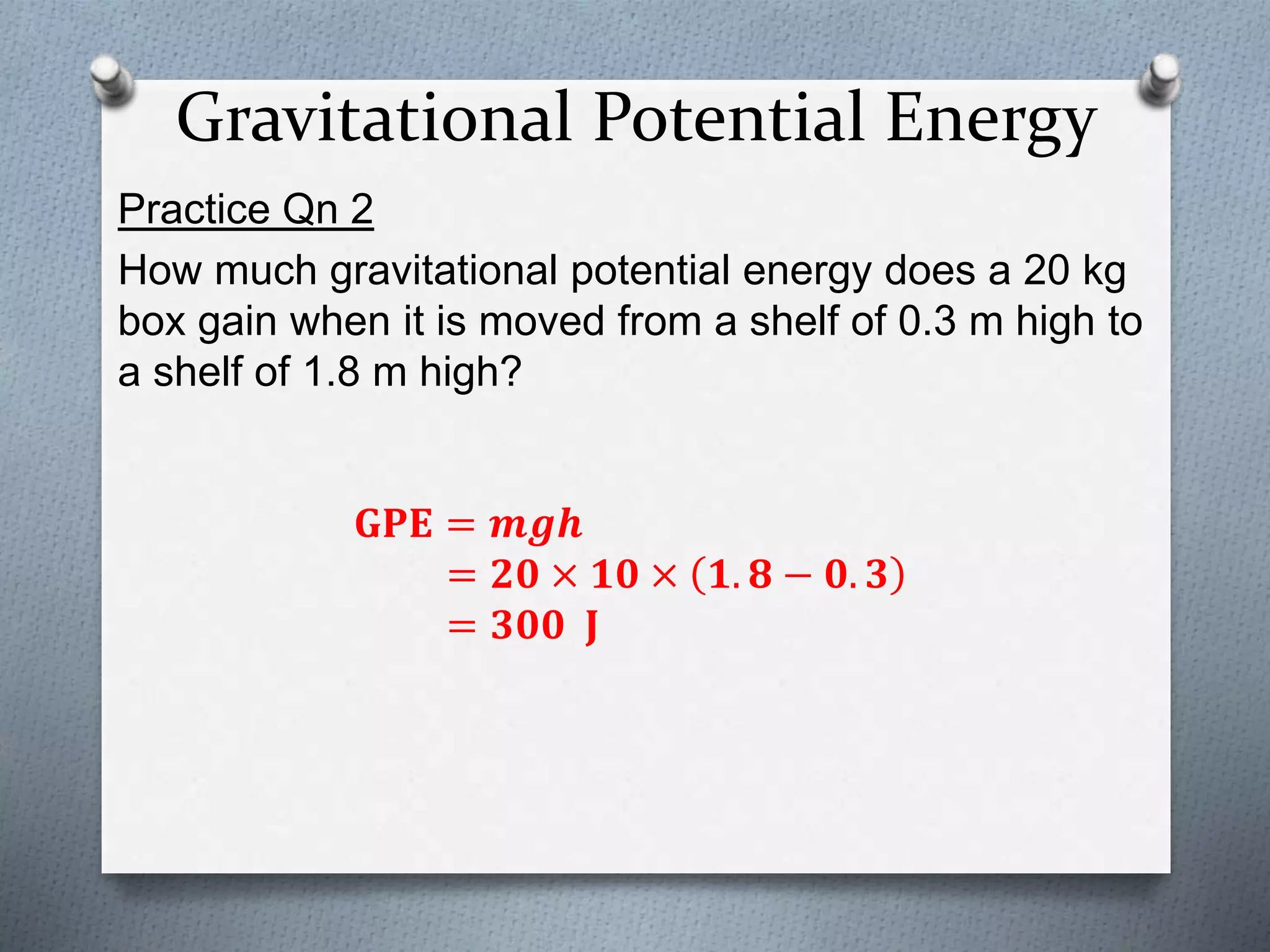
Practice Qn 2
How much gravitational potential energy does a 20 kg
box gain when it is moved from a shelf of 0.3 m high to
a shelf of 1.8 m high?
𝐆𝐏𝐄 = 𝒎𝒈𝒉
= 𝟐𝟎 × 𝟏𝟎 × 𝟏. 𝟖 − 𝟎. 𝟑
= 𝟑𝟎𝟎 𝐉
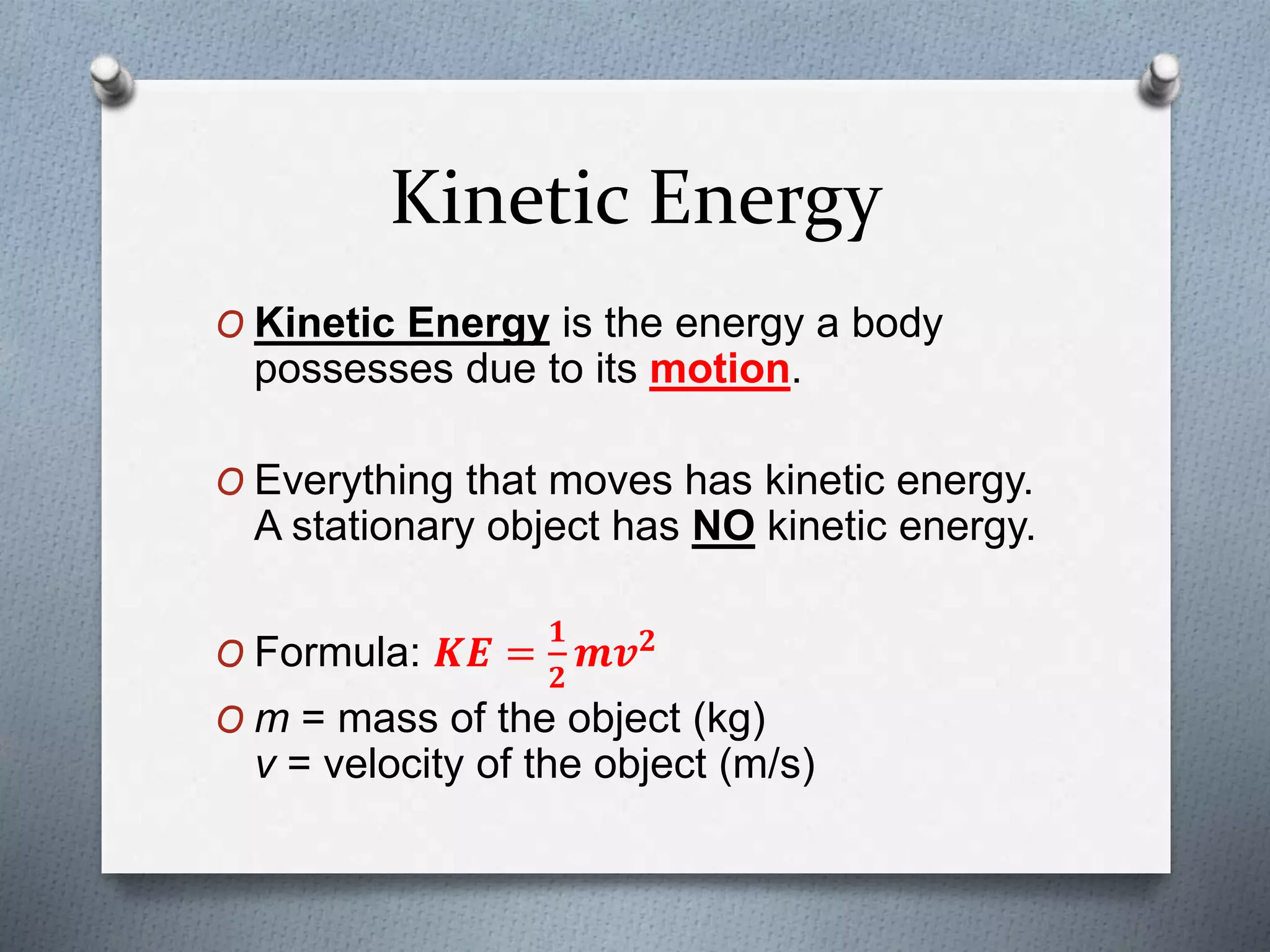
Kinetic Energy
O Kinetic Energy is the energy a body
possesses due to its motion.
O Everything that moves has kinetic energy.
A stationary object has NO kinetic energy.
O Formula: 𝑲𝑬 =
𝟏
𝟐
𝒎𝒗 𝟐
O m = mass of the object (kg)
v = velocity of the object (m/s)
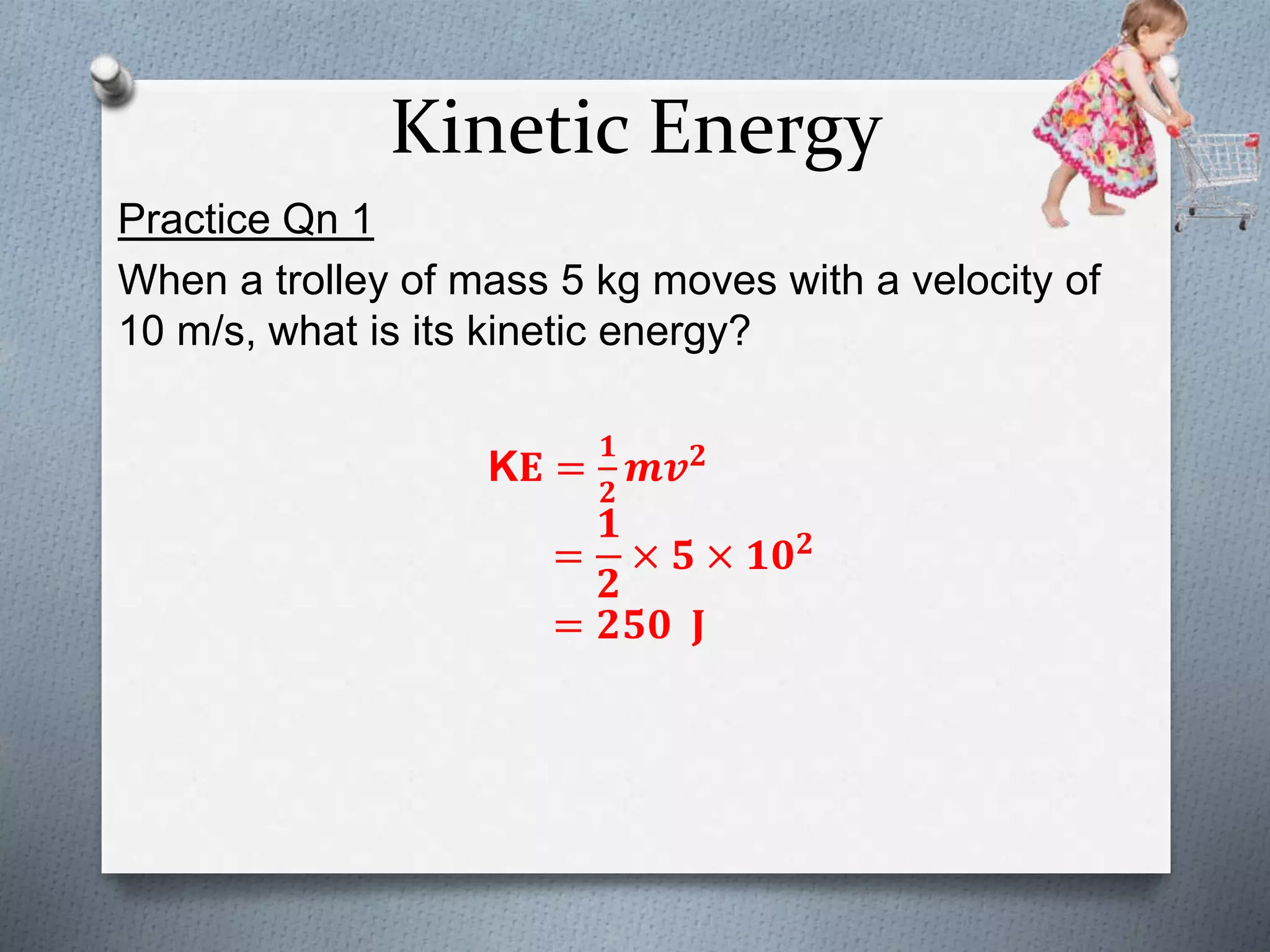
Kinetic Energy
Practice Qn 1
When a trolley of mass 5 kg moves with a velocity of
10 m/s, what is its kinetic energy?
K𝐄 =
𝟏
𝟐
𝒎𝒗 𝟐
=
𝟏
𝟐
× 𝟓 × 𝟏𝟎 𝟐
= 𝟐𝟓𝟎 𝐉
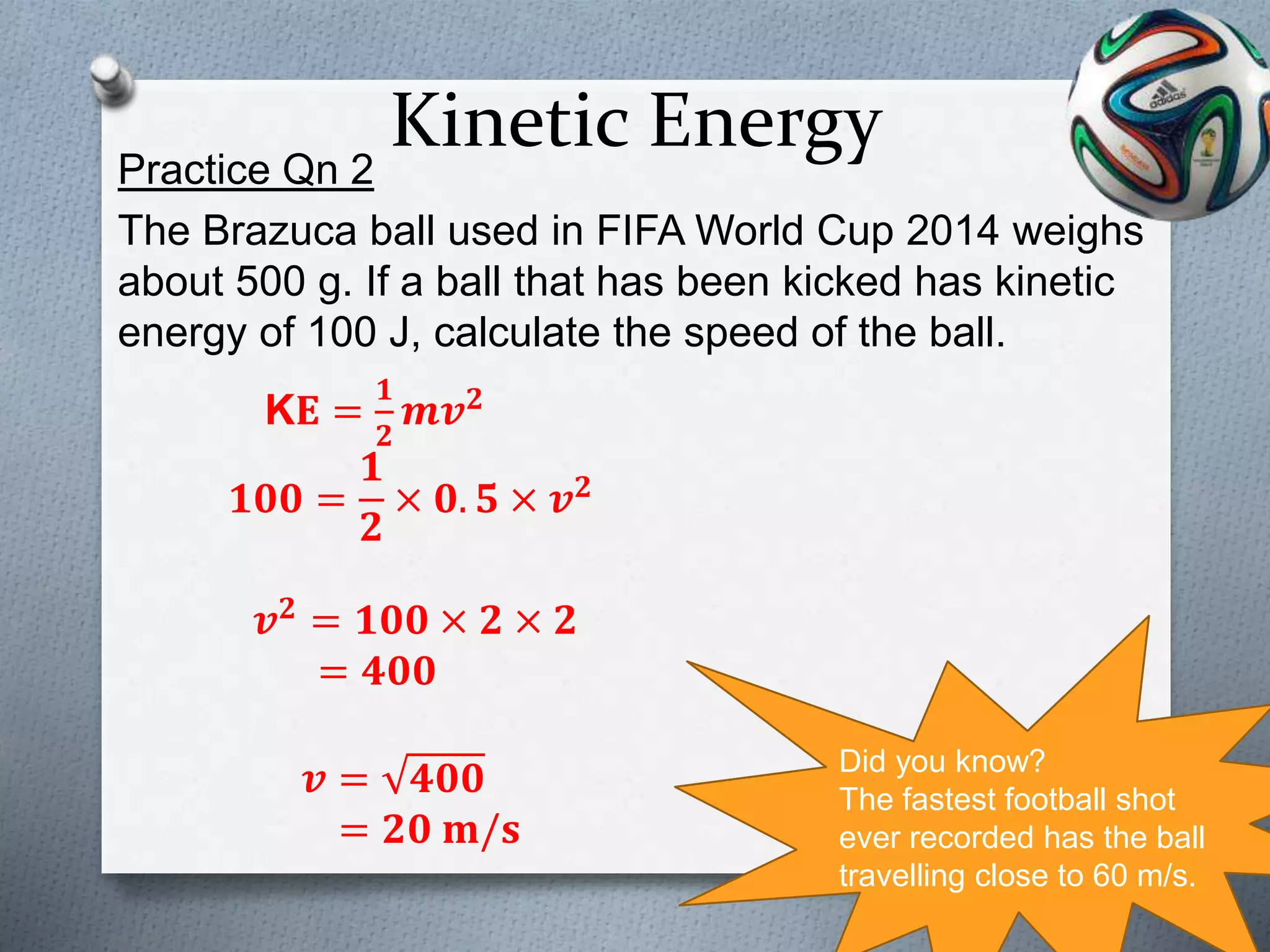
Kinetic EnergyPractice Qn 2
The Brazuca ball used in FIFA World Cup 2014 weighs
about 500 g. If a ball that has been kicked has kinetic
energy of 100 J, calculate the speed of the ball.
Did you know?
The fastest football shot
ever recorded has the ball
travelling close to 60 m/s.
K𝐄 =
𝟏
𝟐
𝒎𝒗 𝟐
𝟏𝟎𝟎 =
𝟏
𝟐
× 𝟎. 𝟓 × 𝒗 𝟐
𝒗 𝟐 = 𝟏𝟎𝟎 × 𝟐 × 𝟐
= 𝟒𝟎𝟎
𝒗 = 𝟒𝟎𝟎
= 𝟐𝟎 𝐦/𝐬

Exp SPA - Chp 7 Energy, Work and Power E-learning

  • 1.
  • 2.
  • 3.
    Lesson Objectives O Recalland apply the relationship work done = force x distance moved in the direction of the force to new situations or to solve related problems.
  • 4.
    Work Done O Workdone by a constant force on an object is the product of the force and the distance moved by the object in the direction of the force. O WD = F x s F = constant force (in N) s = distance moved by the object in the direction of the force (in m) i.e displacement O SI Unit: Joule (J) WD F s
  • 5.
    Scenario 1 A fileis pushed from left to right with a force of 10 N for 0.5 m. Direction of force applied Is the object moving? If yes, what is the direction? Is the direction of force and movement the same? Calculate the work done Left to right Yes. Left to right Yes 𝑊𝐷 = 𝐹 × 𝑠 = 10 × 0.5 = 5 𝐽 This is work done against friction as friction is overcome in order for the file to move. motion Ff
  • 6.
    Scenario 2 A wallis being pushed from the left side with a force of 10 N. Direction of force applied Is the object moving? If yes, what is the direction? Is the direction of force and movement the same? Calculate the work done Left to right No. No movement 𝑊𝐷 = 𝐹 × 𝑠 = 10 × 0 = 0 𝐽 There is no movement and therefore no work done. F
  • 7.
    Scenario 3 A fileis lifted off the table by a force of 10 N for a distance of 1.2 m. Direction of force applied Is the object moving? If yes, what is the direction? Is the direction of force and movement the same? Calculate the work done Upwards Yes. Upwards Yes 𝑊𝐷 = 𝐹 × 𝑠 = 10 × 1.2 = 12 𝐽 This is work done against gravity as gravitational force (weight) is overcome in order for the file to move. motio n F W
  • 8.
    Scenario 4 A fileis held at a fixed height of 1.2 m by a force of 10 N. Direction of force applied Is the object moving? If yes, what is the direction? Is the direction of force and movement the same? Calculate the work done Upwards No. No movement 𝑊𝐷 = 𝐹 × 𝑠 = 10 × 0 = 0 𝐽 There is no movement and therefore no work done. F W
  • 9.
    Work Done O Nowork is done if:  No applied force  No motion  No motion in the direction of the force
  • 10.
    Practice O Complete thepractice questions for work done.
  • 11.
    Lesson Objectives O Showunderstanding that kinetic energy, potential energy (chemical, gravitational, elastic), light energy, thermal energy, electrical energy and nuclear energy are examples of different forms of energy.
  • 12.
    Lesson Objectives O Statethat kinetic energy 𝐸 𝑘 = 1 2 𝑚𝑣2 and potential energy 𝐸 𝑝 = 𝑚𝑔ℎ (for potential energy changes near the Earth’s surface) O Apply the relationships for kinetic energy and potential energy to new situations or to solve related problems
  • 13.
    Energy O Energy isdefined as the capacity to do work. O SI Unit: joule (J) O Energy is a scalar quantity.
  • 14.
    Electrical energy (covered inCh 16 – 22) Thermal energy (heat) (covered in Ch 9 – 11) Light energy (covered in Ch 13 – 14) Sound energy (covered in Ch 15) Nuclear Energy Types of Energy
  • 15.
    Types of Energy 2main types of energy to be calculated in this chapter: O Potential energy (elastic, gravitational and chemical) O Kinetic energy
  • 16.
    Potential Energy O PotentialEnergy is the energy stored in an object due to its position, state or shape. O Elastic potential energy is the energy stored in the wound up spring or a stretched rubber band.
  • 17.
    Potential Energy O Chemicalpotential energy is energy stored in fuels and food.
  • 18.
    Gravitational Potential Energy OAn object placed at a height h from the ground possesses gravitational potential energy. h ground
  • 19.
    Gravitational Potential Energy OGravitational potential energy is the energy which a body possesses because of its position relative to the ground. O Formula: 𝑮𝑷𝑬 = 𝒎𝒈𝒉 O m = mass of the object (kg) g = acceleration due to gravity (10 N/kg) h = height above the ground (m)
  • 20.
    Gravitational Potential Energy PracticeQn 1 A girl lifts her school bag of mass 3 kg from the floor onto her lap through a height of 0.5 m. What is the gravitational potential energy gained by the bag? 𝐆𝐏𝐄 = 𝒎𝒈𝒉 = 𝟑 × 𝟏𝟎 × 𝟎. 𝟓 = 𝟏𝟓 𝐉
  • 21.
    Gravitational Potential Energy PracticeQn 2 How much gravitational potential energy does a 20 kg box gain when it is moved from a shelf of 0.3 m high to a shelf of 1.8 m high? 𝐆𝐏𝐄 = 𝒎𝒈𝒉 = 𝟐𝟎 × 𝟏𝟎 × 𝟏. 𝟖 − 𝟎. 𝟑 = 𝟑𝟎𝟎 𝐉
  • 22.
    Kinetic Energy O KineticEnergy is the energy a body possesses due to its motion. O Everything that moves has kinetic energy. A stationary object has NO kinetic energy. O Formula: 𝑲𝑬 = 𝟏 𝟐 𝒎𝒗 𝟐 O m = mass of the object (kg) v = velocity of the object (m/s)
  • 23.
    Kinetic Energy Practice Qn1 When a trolley of mass 5 kg moves with a velocity of 10 m/s, what is its kinetic energy? K𝐄 = 𝟏 𝟐 𝒎𝒗 𝟐 = 𝟏 𝟐 × 𝟓 × 𝟏𝟎 𝟐 = 𝟐𝟓𝟎 𝐉
  • 24.
    Kinetic EnergyPractice Qn2 The Brazuca ball used in FIFA World Cup 2014 weighs about 500 g. If a ball that has been kicked has kinetic energy of 100 J, calculate the speed of the ball. Did you know? The fastest football shot ever recorded has the ball travelling close to 60 m/s. K𝐄 = 𝟏 𝟐 𝒎𝒗 𝟐 𝟏𝟎𝟎 = 𝟏 𝟐 × 𝟎. 𝟓 × 𝒗 𝟐 𝒗 𝟐 = 𝟏𝟎𝟎 × 𝟐 × 𝟐 = 𝟒𝟎𝟎 𝒗 = 𝟒𝟎𝟎 = 𝟐𝟎 𝐦/𝐬