Work Energy Power
Before we move on, We have… Representing the video clips available Representing the websites available Representing the applets available
Pupils should be able to define work done as work done = force    distance moved in the direction of the force. apply the relationship between work done, force and distance moved in the direction of the force to new situations or to solve related problems.  Work, Energy & Power                                                                                         Lesson objectives
Lesson Trigger Class, have you done your work? I have done my work, Teacher.                                                                                         
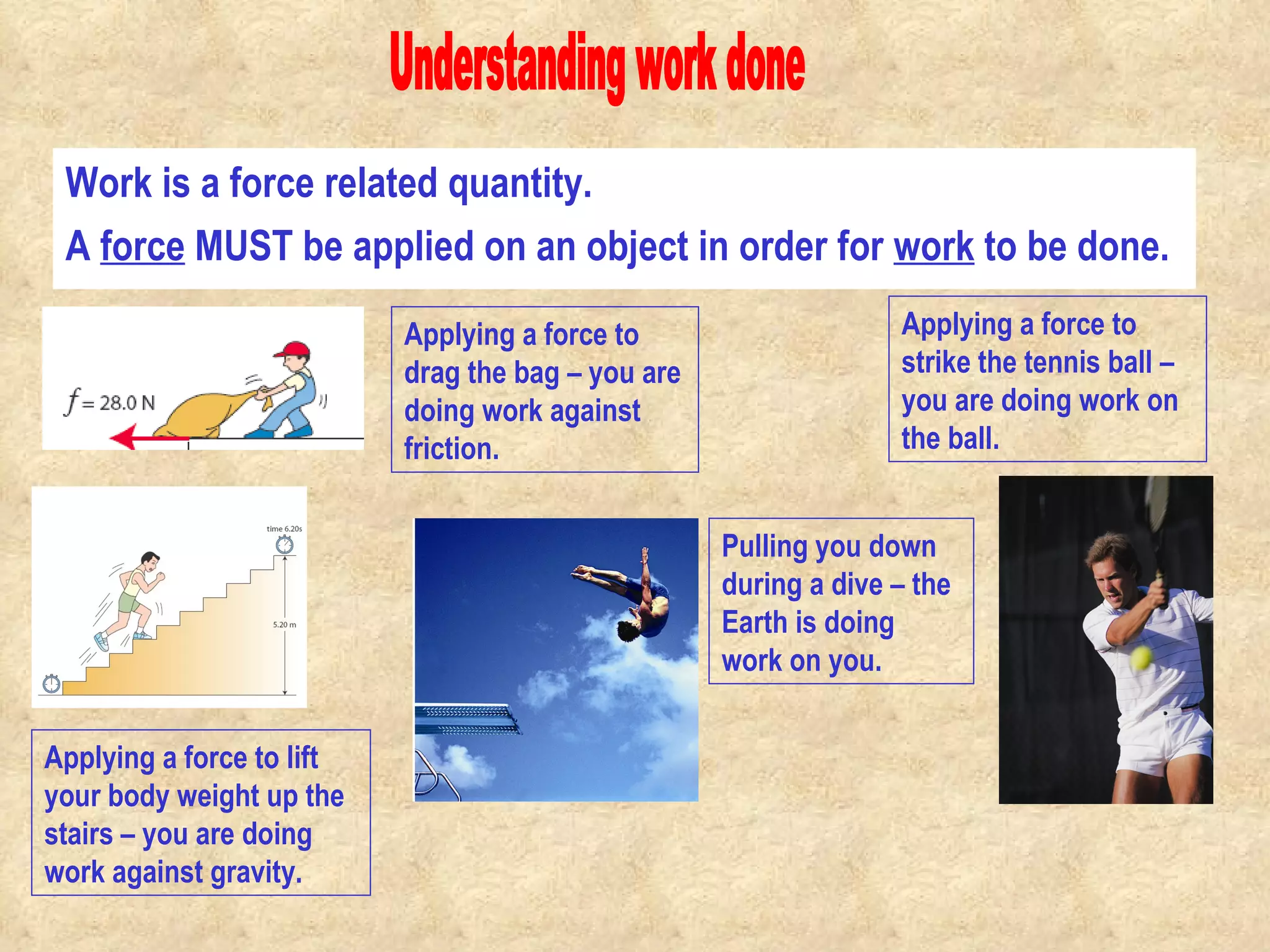
Work is a force related quantity. Understanding work done A  force  MUST be applied on an object in order for  work  to be done.                                            Applying a force to strike the tennis ball – you are doing work on the ball. Applying a force to lift your body weight up the stairs – you are doing work against gravity. Pulling you down during a dive – the Earth is doing work on you. Applying a force to drag the bag – you are doing work against friction.
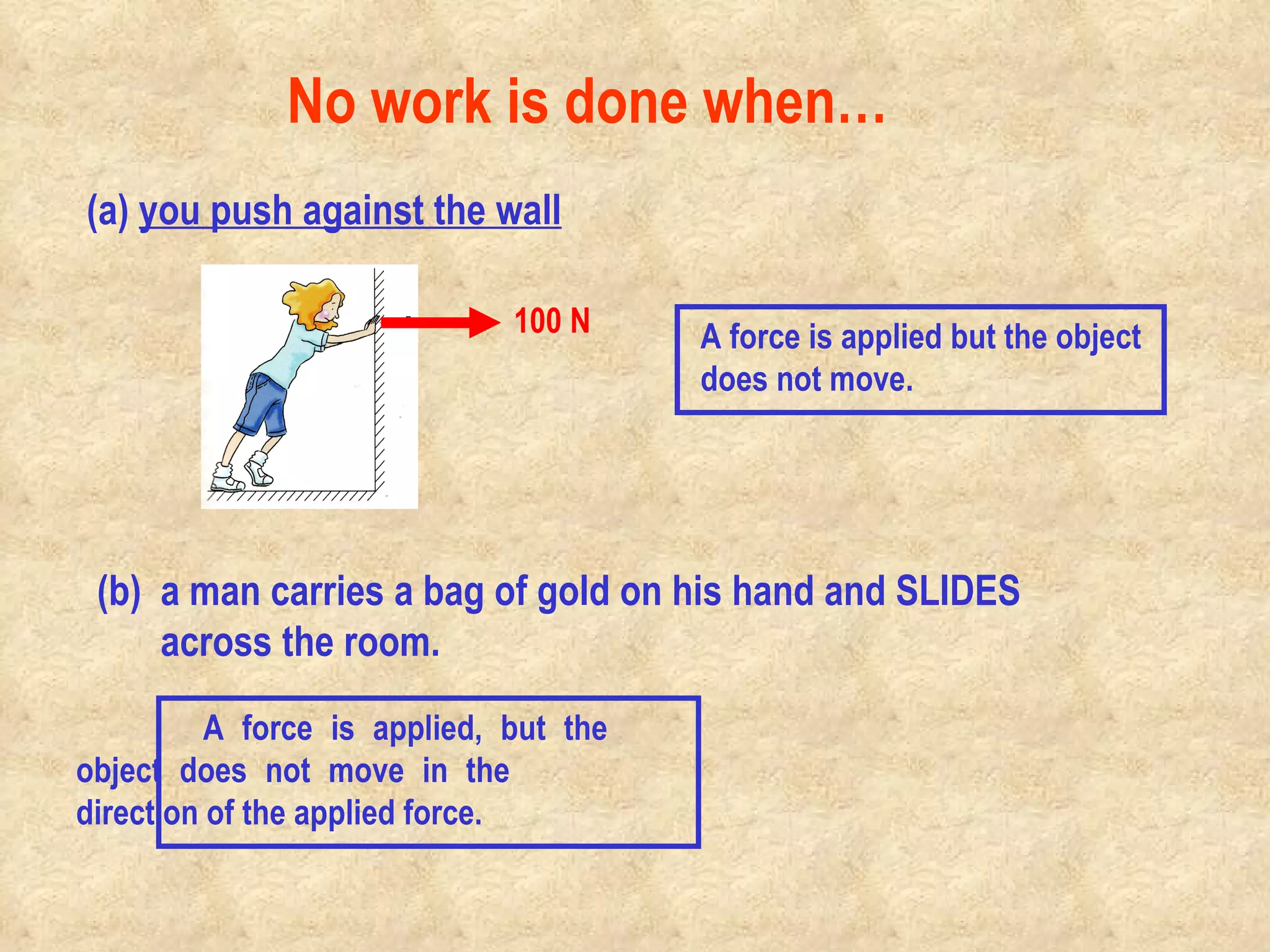
(a)  you push against the wall (b)  a man carries a bag of gold on his hand and SLIDES across the room. No work is done when…                                            100 N A force is applied but the object  does not move. A force is applied, but the  object does not move in the  direction of the applied force.
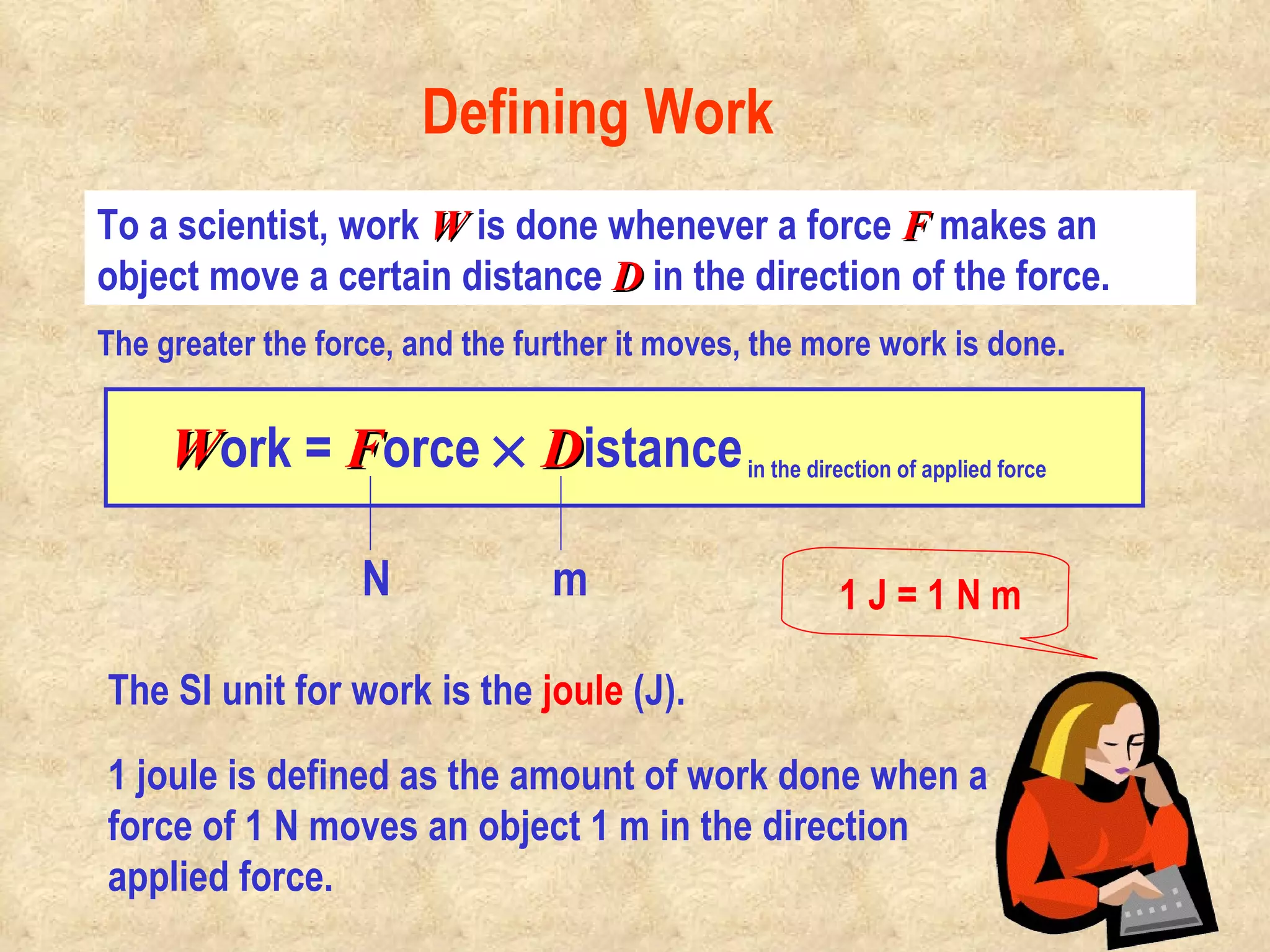
The SI unit for work is the  joule  (J).    To a scientist, work  W  is done whenever a force  F   makes an object move a certain distance  D  in the direction of the force.  The greater the force, and the further it moves, the more work is done . Defining Work 1 joule is defined as the amount of work done when a force of 1 N moves an object 1 m in the direction applied force.                                              W ork =  F orce     D istance   in the direction of applied force 1 J = 1 N m N m
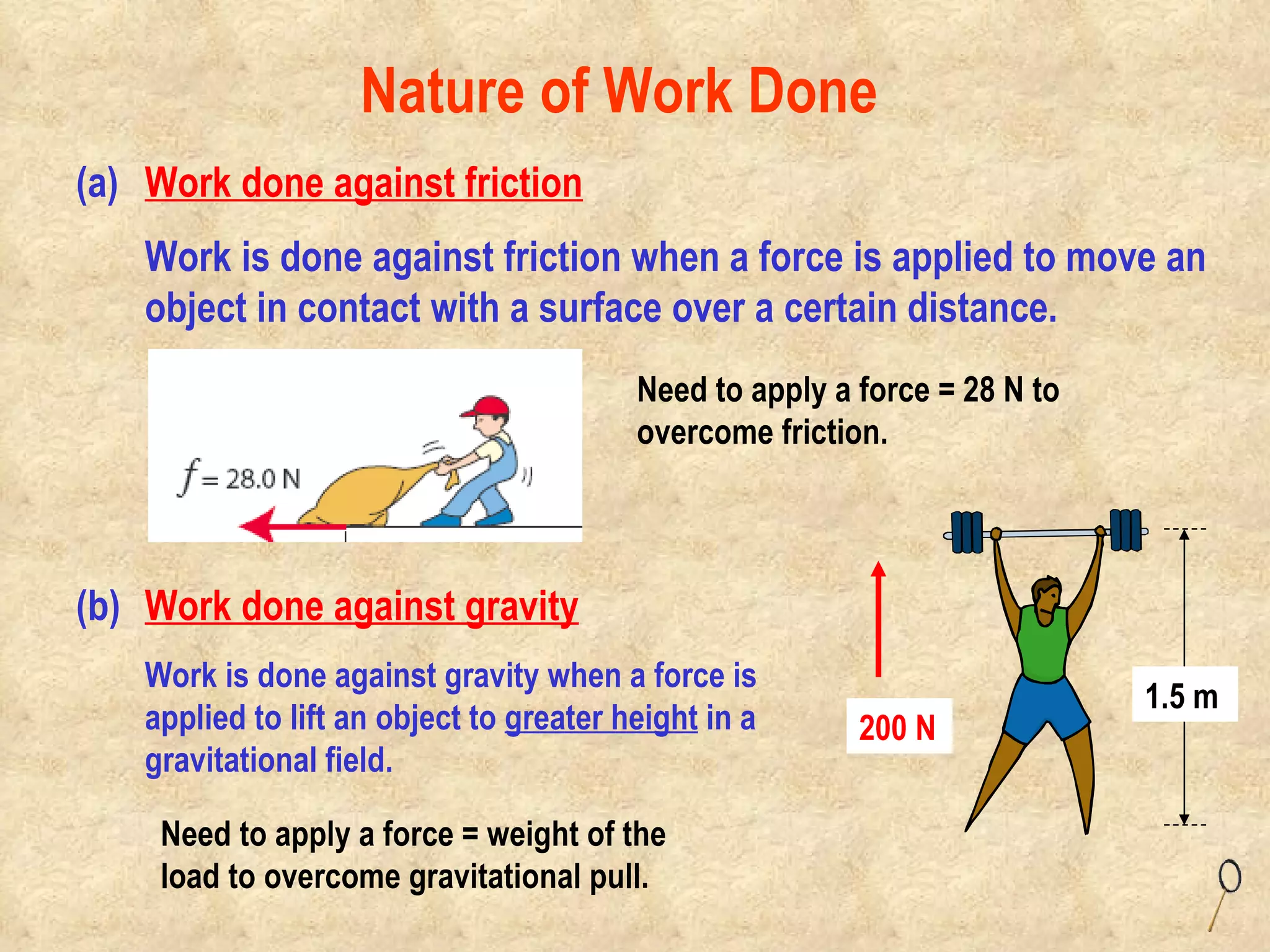
(a) Work done against friction Work is done against friction when a force is applied to move an object in contact with a surface over a certain distance. Need to apply a force = 28 N to overcome friction. Nature of Work Done Need to apply a force = weight of the load to overcome gravitational pull. (b) Work done against gravity Work is done against gravity when a force is   applied to lift an object to  greater height  in a    gravitational field. 1.5 m 200 N
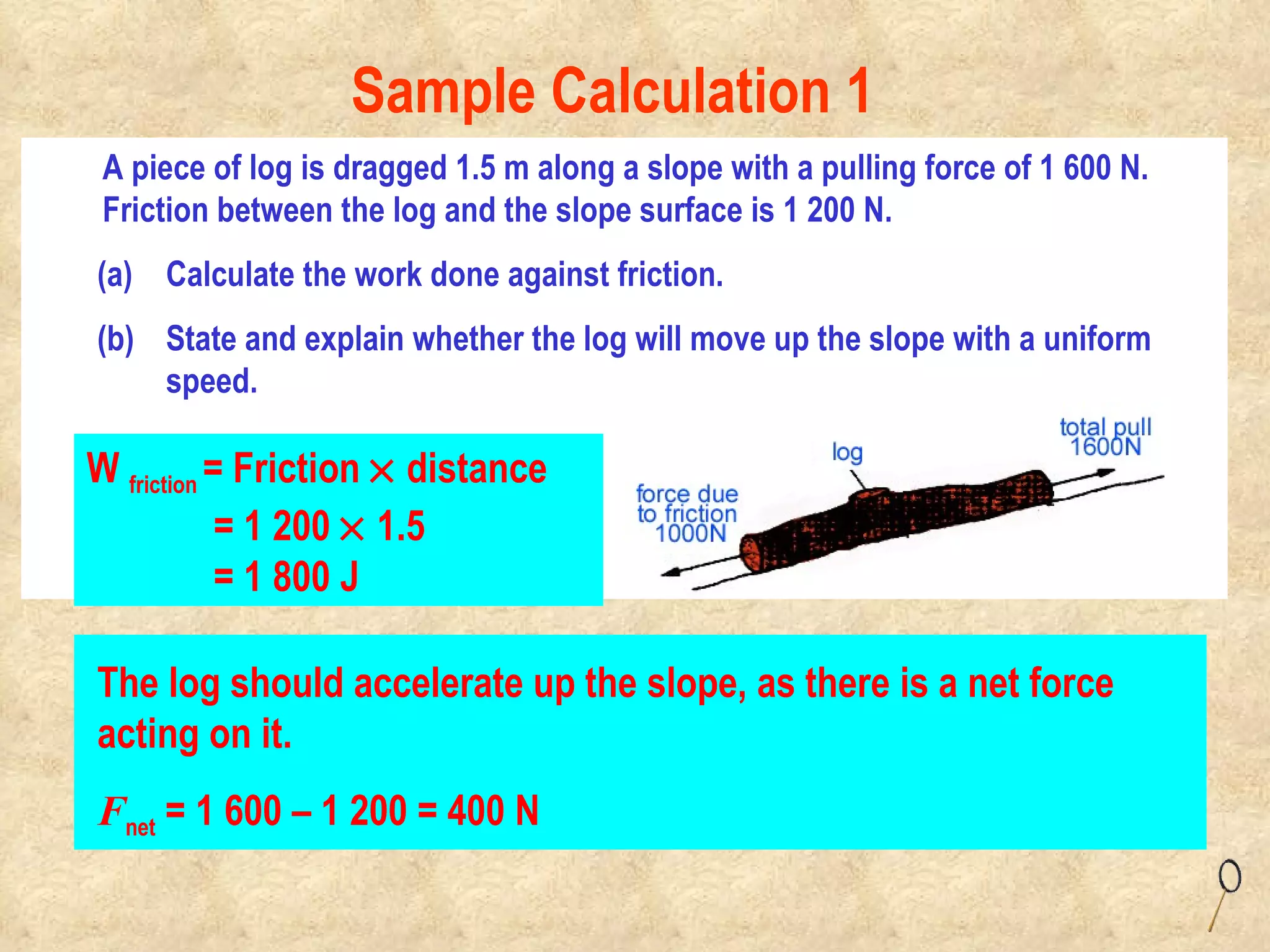
A piece of log is dragged 1.5 m along a slope with a pulling force of 1 600 N. Friction between the log and the slope surface is 1 200 N.   Calculate the work done against friction. State and explain whether the log will move up the slope with a uniform speed. W  friction  = Friction    distance = 1 200    1.5 = 1 800 J Sample Calculation 1 The log should accelerate up the slope, as there is a net force acting on it. F net  = 1 600 – 1 200 = 400 N
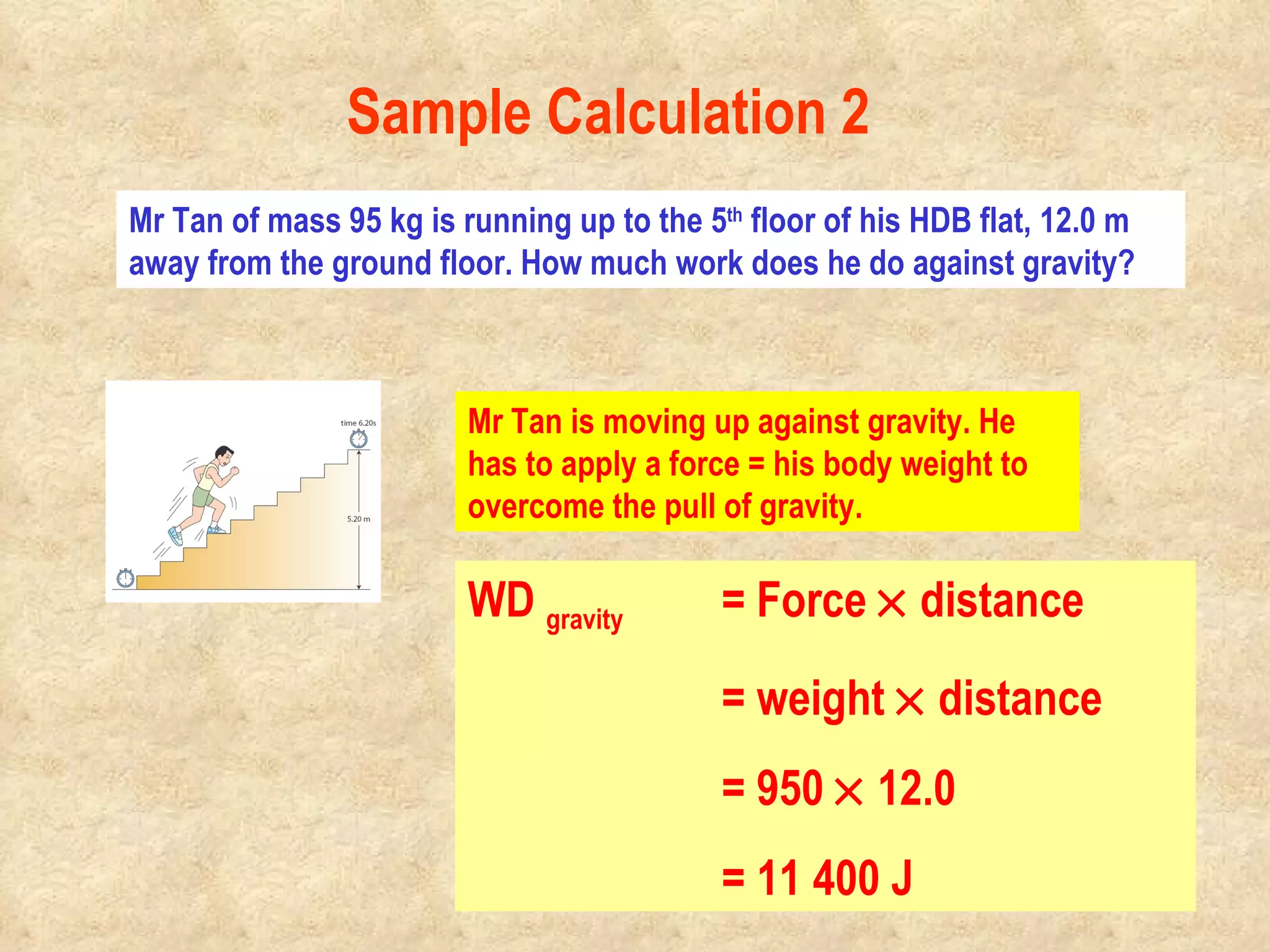
Mr Tan of mass 95 kg is running up to the 5 th  floor of his HDB flat, 12.0 m away from the ground floor. How much work does he do against gravity? Mr Tan is moving up against gravity. He has to apply a force = his body weight to overcome the pull of gravity. WD  gravity   = Force    distance = weight    distance = 950    12.0 = 11 400 J Sample Calculation 2                                                                                        
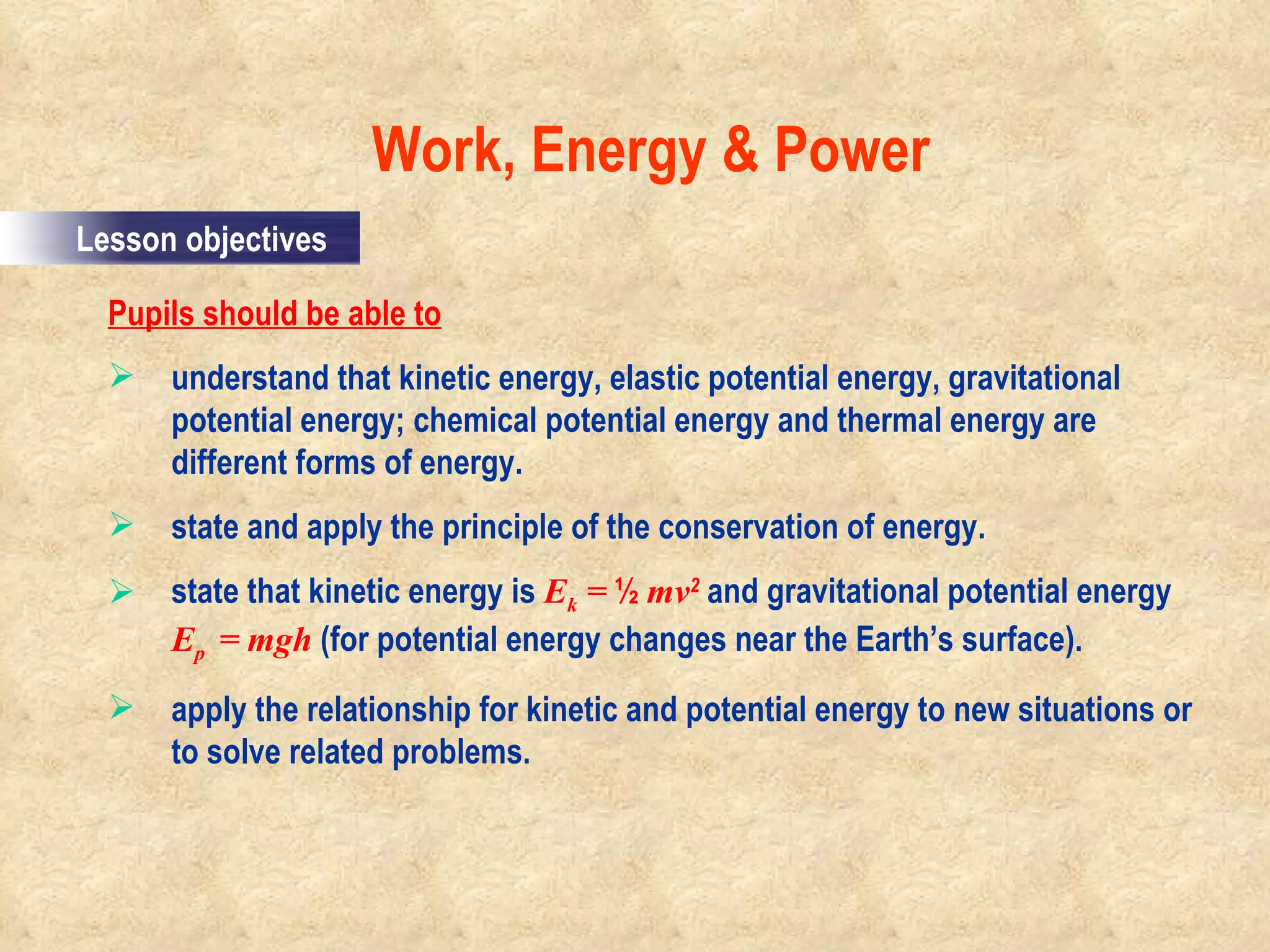
Pupils should be able to understand that kinetic energy, elastic potential energy, gravitational potential energy; chemical potential energy and thermal energy are different forms of energy. state and apply the principle of the conservation of energy. state that kinetic energy is  E k  =  ½  mv 2  and gravitational potential energy  E p  =   mgh   (for potential energy changes near the Earth’s surface). apply the relationship for kinetic and potential energy to new situations or to solve related problems. Work, Energy & Power                                                                                         Lesson objectives
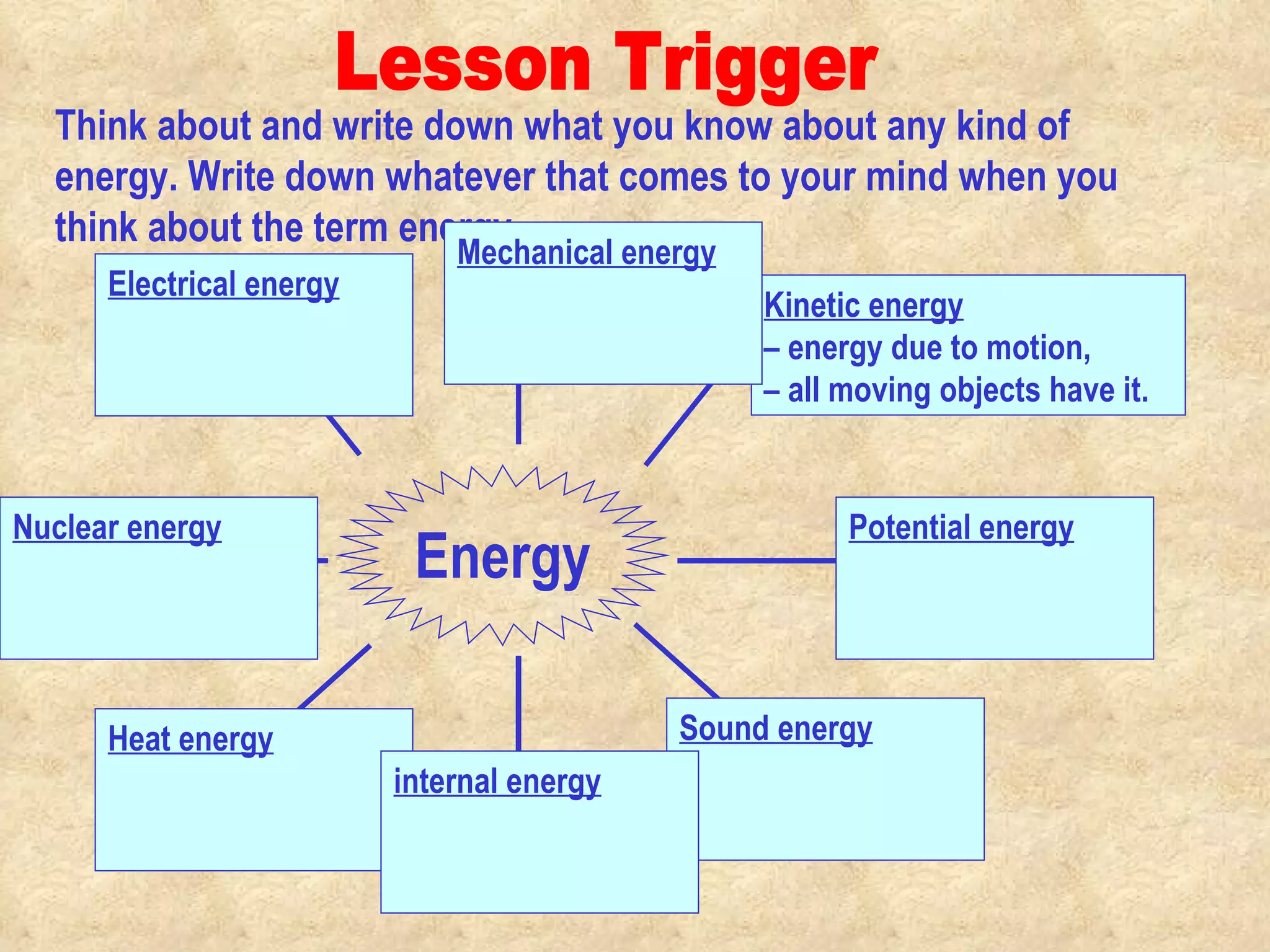
Think about and write down what you know about any kind of energy. Write down whatever that comes to your mind when you think about the term energy. Lesson Trigger Energy Kinetic energy   – energy due to motion,  – all moving objects have it. Potential energy   Electrical energy   Nuclear energy   Sound energy   Heat energy   Mechanical energy   internal energy
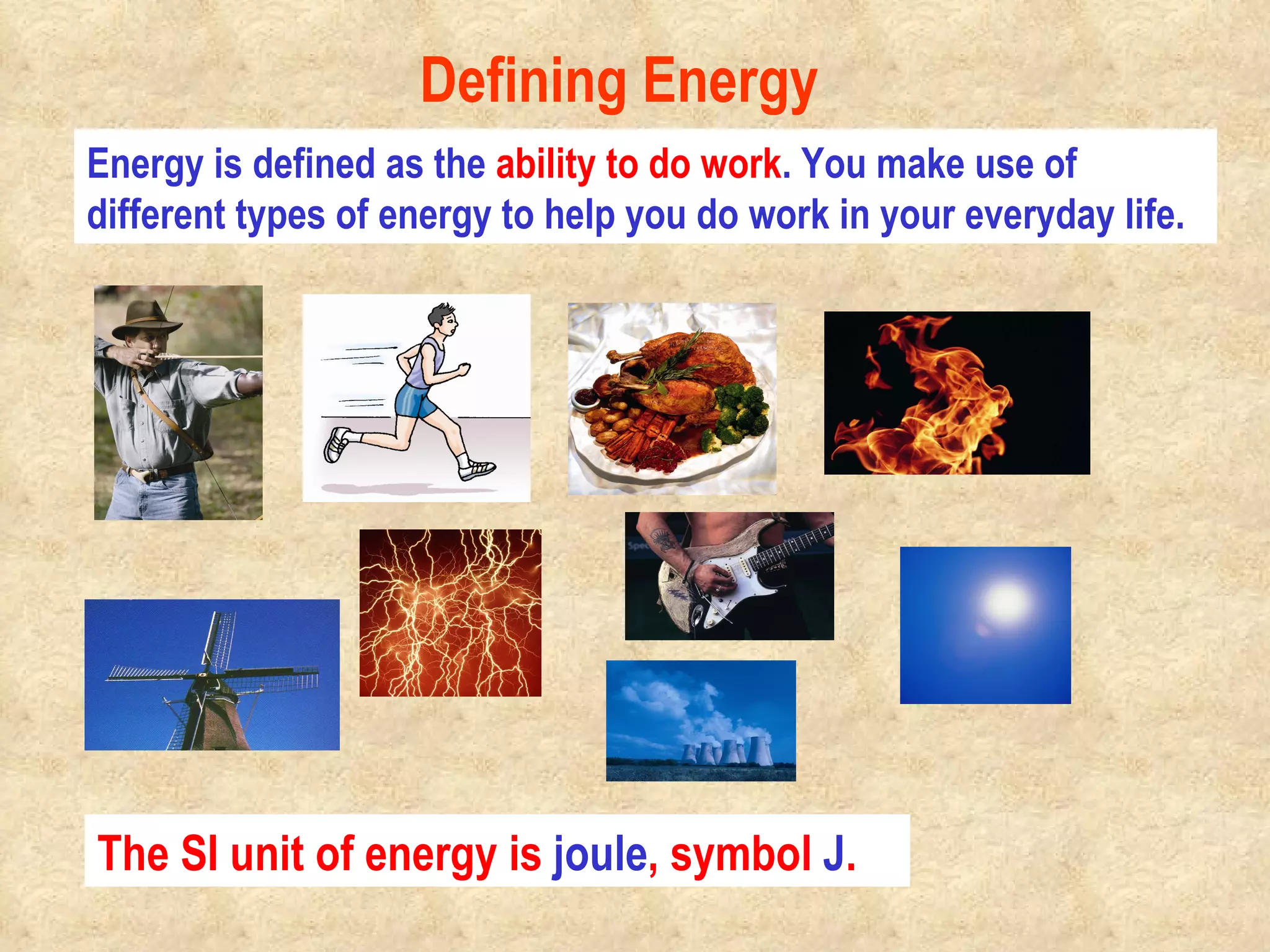
Energy is defined as the  ability to do work . You make use of different types of energy to help you do work in your everyday life. Defining Energy The SI unit of energy is  joule , symbol  J .                                           
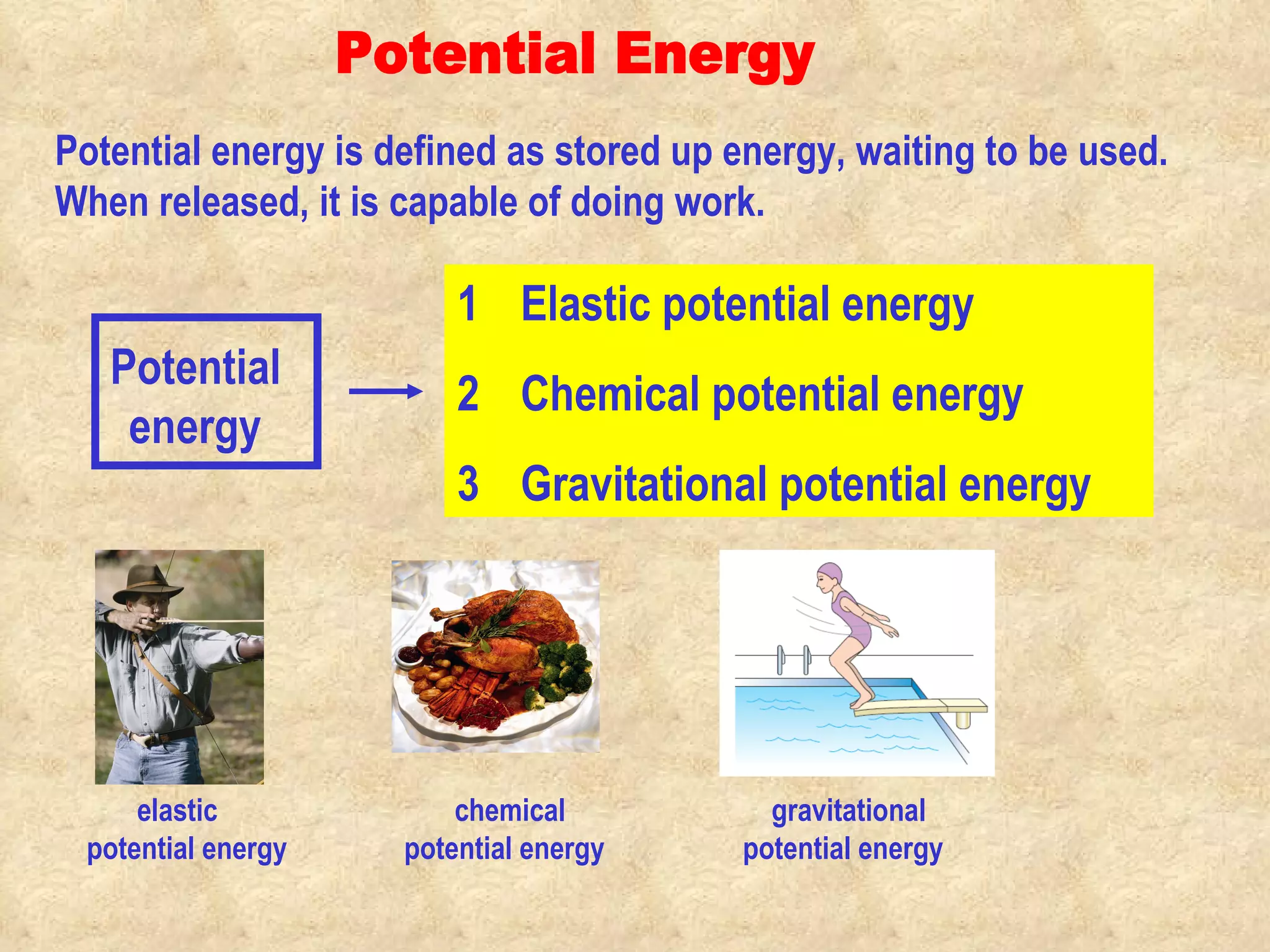
Potential energy is defined as stored up energy, waiting to be used. When released, it is capable of doing work.  Potential Energy                                            Potential energy Elastic  potential energy Chemical potential energy Gravitational  potential energy gravitational potential energy elastic potential energy chemical potential energy
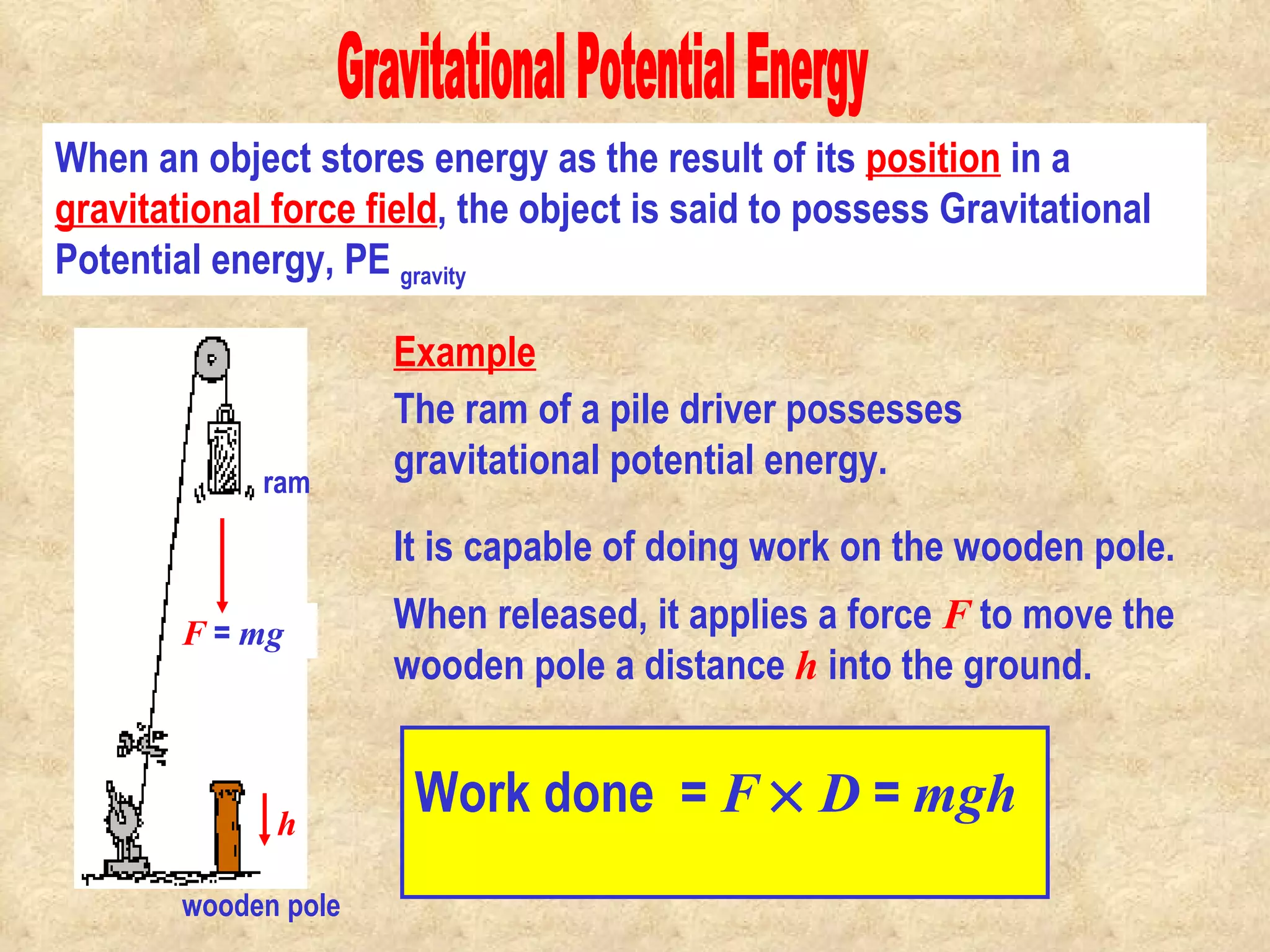
When an object stores energy as the result of its  position  in a  gravitational force field , the object is said to possess Gravitational Potential energy, PE  gravity The ram of a pile driver possesses gravitational potential energy.  It is capable of doing work on the wooden pole.  When released, it applies a force  F  to move the wooden pole a distance  h   into the ground. Work done  =  F      D  =  mgh =  mg Gravitational Potential Energy Example ram wooden pole h F
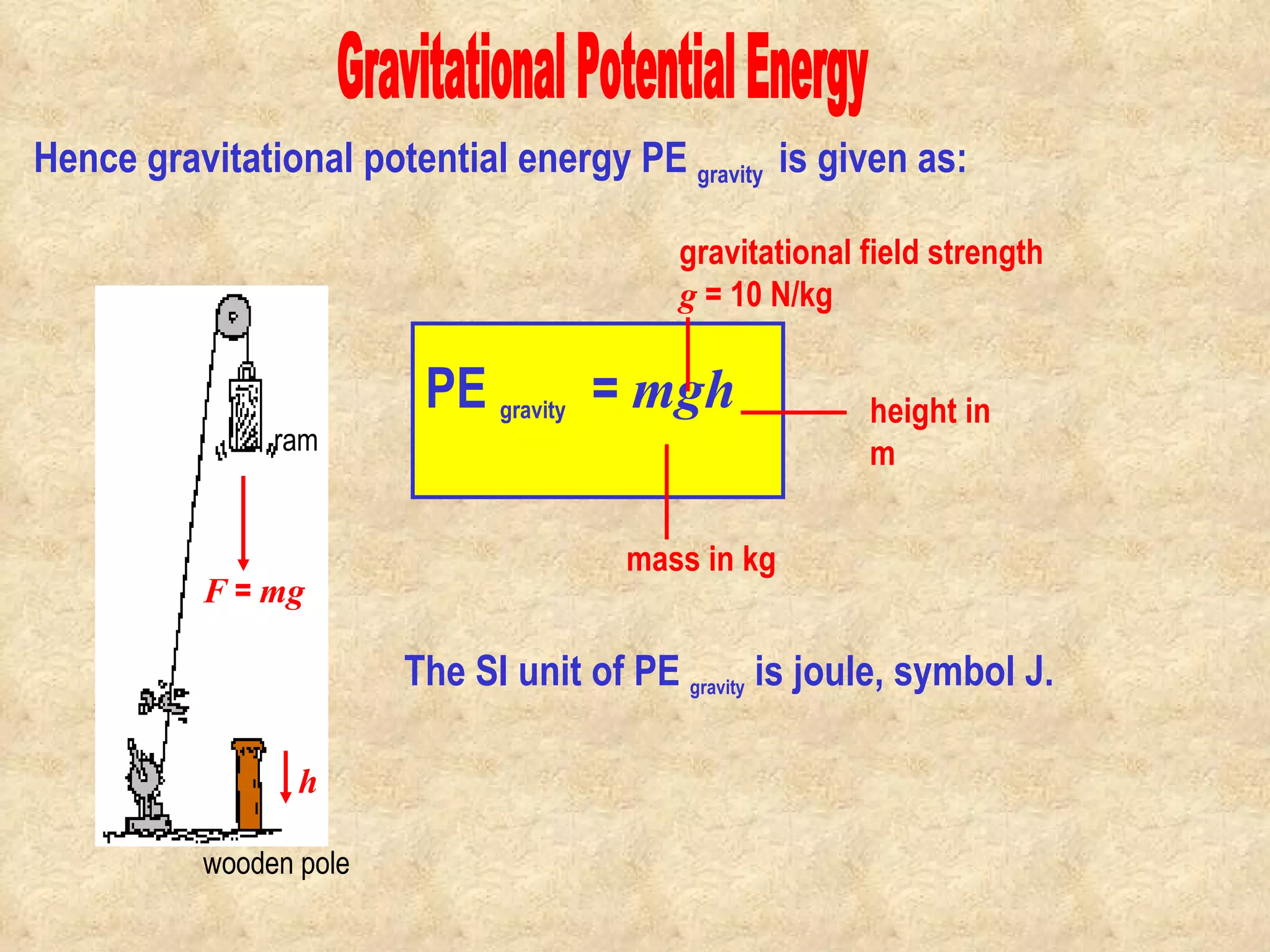
Gravitational Potential Energy ram wooden pole PE  gravity   =  mgh Hence gravitational potential energy PE  gravity  is given as: mass in kg gravitational field strength  g  = 10 N/kg height in m The SI unit of PE  gravity  is joule, symbol J.                                            F  =  mg h
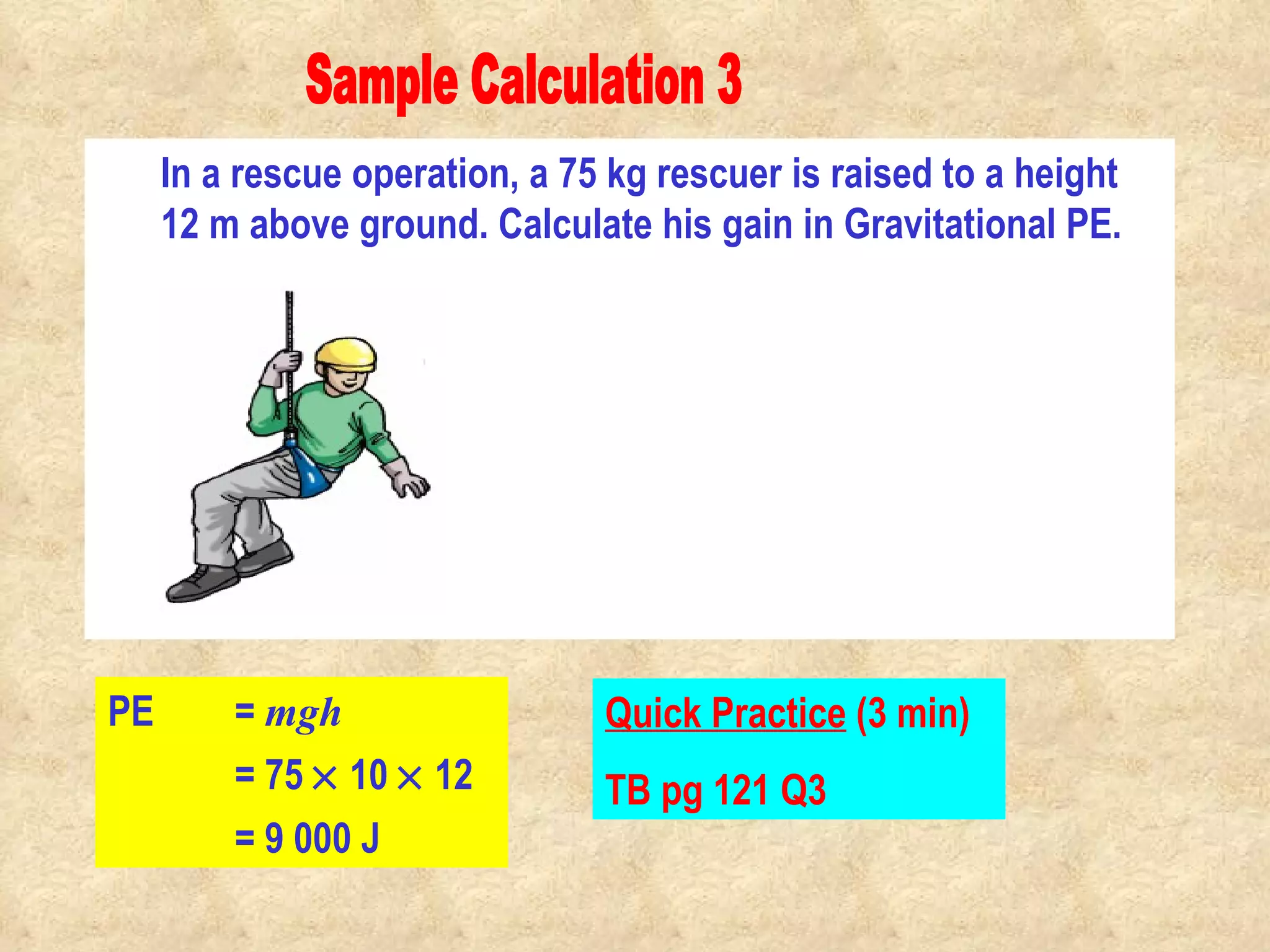
Sample Calculation 3 In a rescue operation, a 75 kg rescuer is raised to a height 12 m above ground. Calculate his gain in Gravitational PE. PE  =  mgh Quick Practice  (3 min) TB pg 121 Q3 = 75    10    12  = 9 000 J                                                                                        
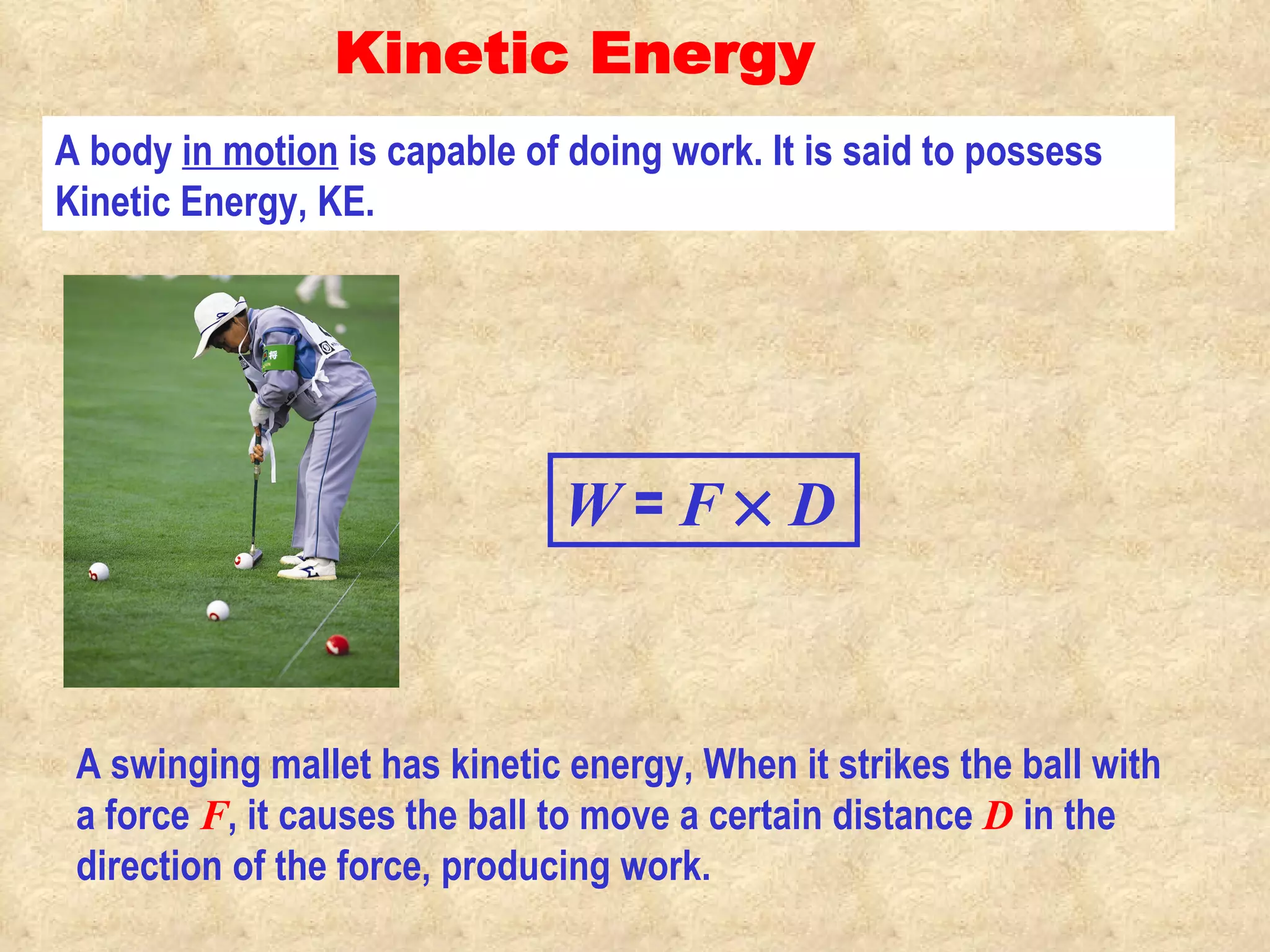
Kinetic Energy A body  in motion  is capable of doing work. It is said to possess Kinetic Energy, KE. A swinging mallet has kinetic energy, When it strikes the ball with a force  F , it causes the ball to move a certain distance  D  in the direction of the force, producing work. W  =  F      D
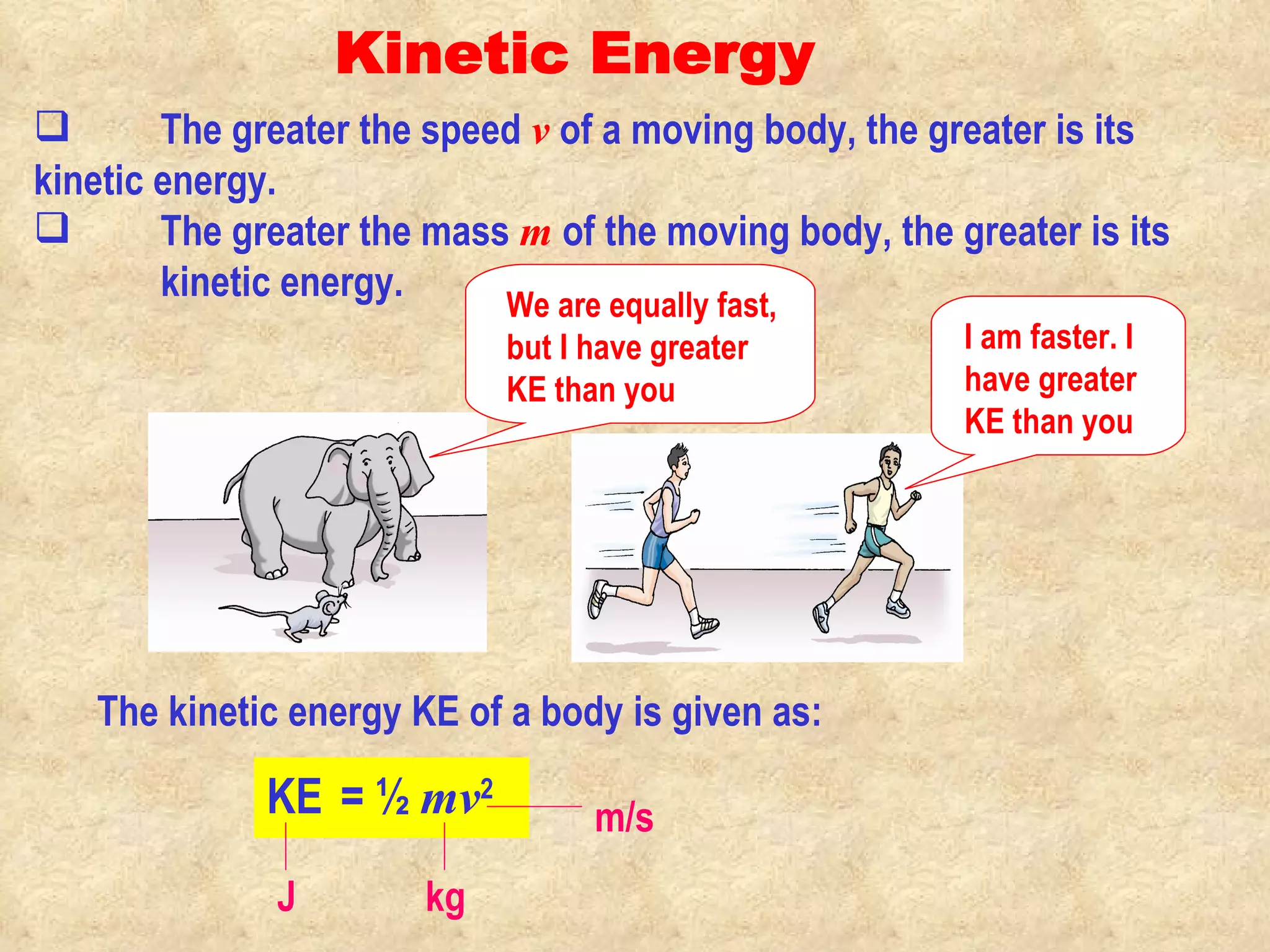
Kinetic Energy The kinetic energy KE of a body is given as: KE   = ½  mv 2 The greater the speed  v   of a moving body, the greater is its  kinetic energy.  The greater the mass  m   of the moving body, the greater is its  kinetic energy. J kg m/s We are equally fast, but I have greater KE than you I am faster. I have greater  KE than you
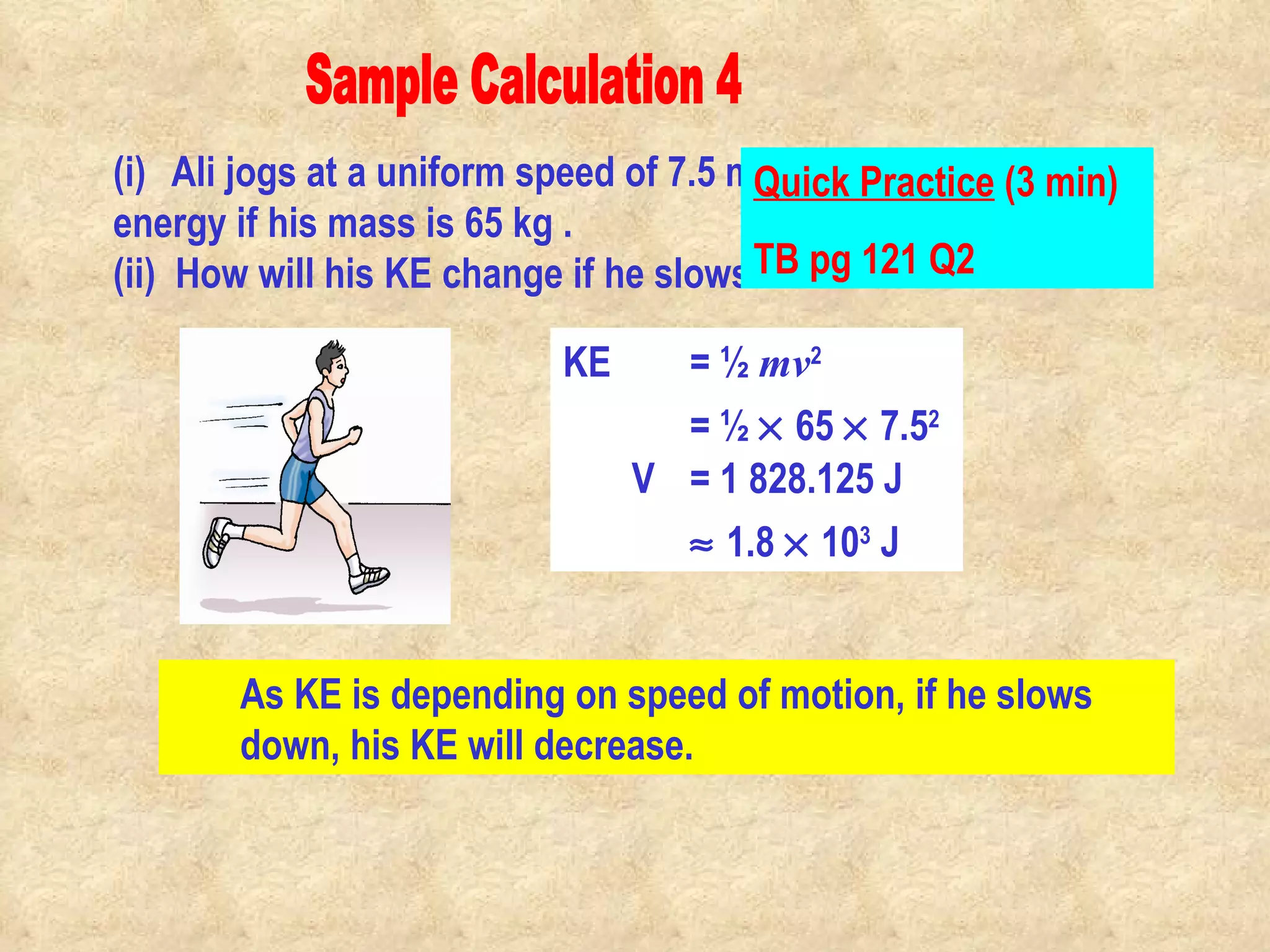
Sample Calculation 4 (i)  Ali jogs at a uniform speed of 7.5 m/s. Calculate his kinetic energy if his mass is 65 kg .    (ii)  How will his KE change if he slows down his motion? As KE is depending on speed of motion, if he slows down, his KE will decrease. KE  = ½  mv 2   = ½    65    7.5 2 V = 1 828.125 J    1.8    10 3  J Quick Practice  (3 min) TB pg 121 Q2                                                                                        
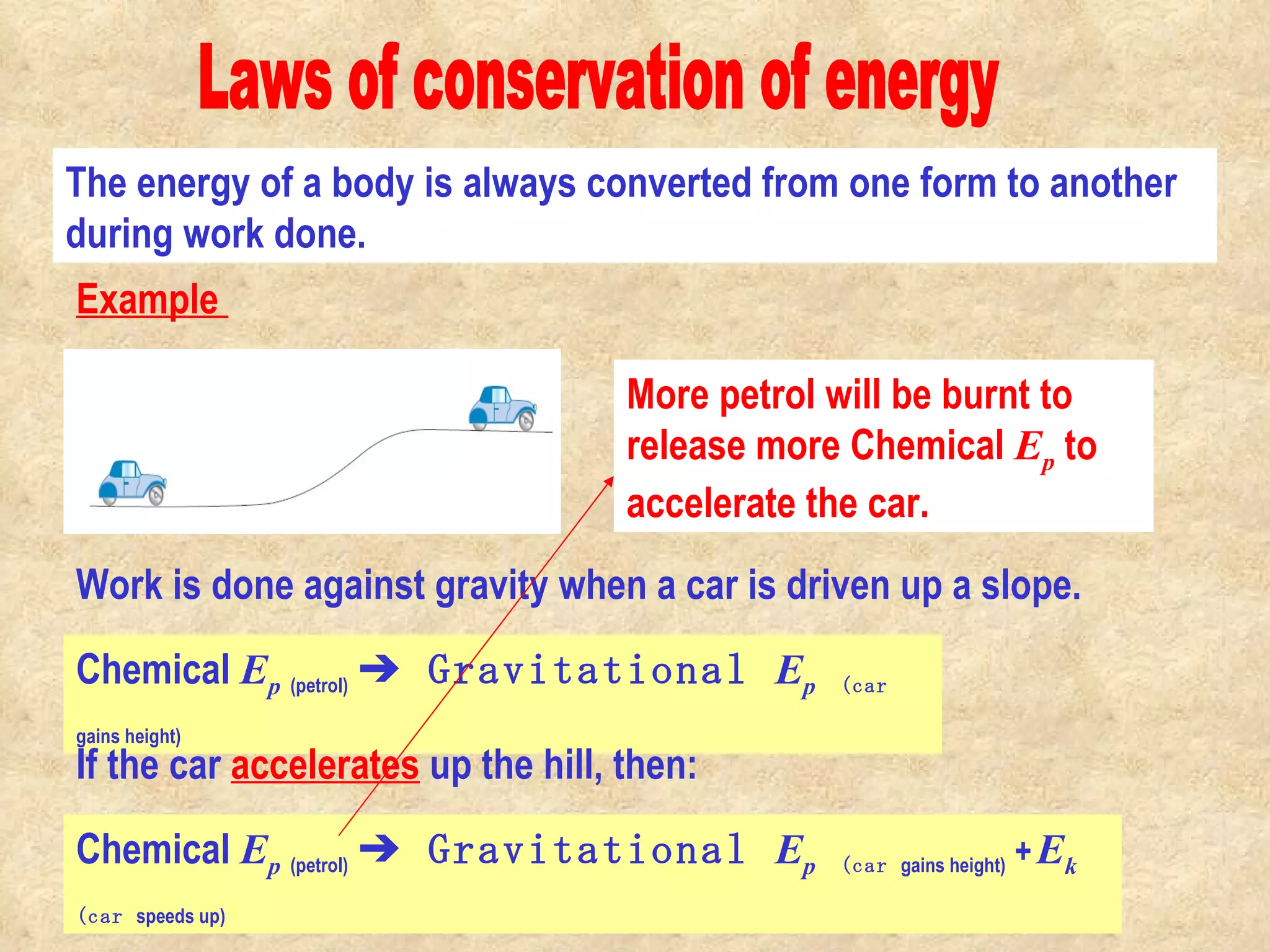
Laws of conservation of energy The energy of a body is always converted from one form to another during work done. Work is done against gravity when a car is driven up a slope.  Chemical  E p   (petrol)   ➔ Gravitational  E p   (car  gains height) If the car  accelerates  up the hill, then: Chemical  E p   (petrol)   ➔ Gravitational  E p   (car  gains height)  +   E k   (car  speeds up) More petrol will be burnt to release more Chemical  E p  to accelerate the car.                                                                                          Example
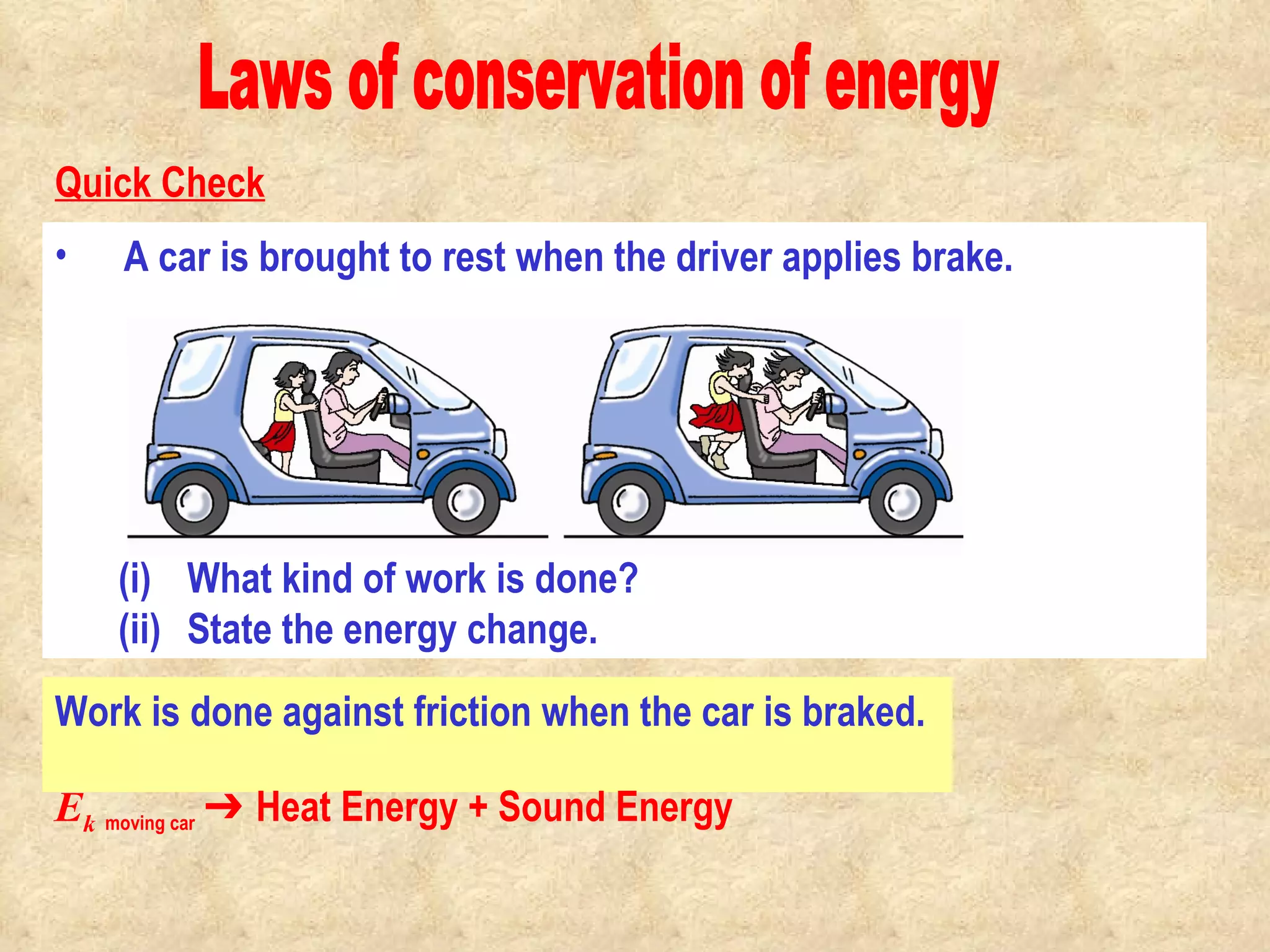
Laws of conservation of energy A car is brought to rest when the driver applies brake.  What kind of work is done? State the energy change. Work is done against friction when the car is braked. Quick Check E k   moving car   ➔ Heat Energy + Sound Energy                                           
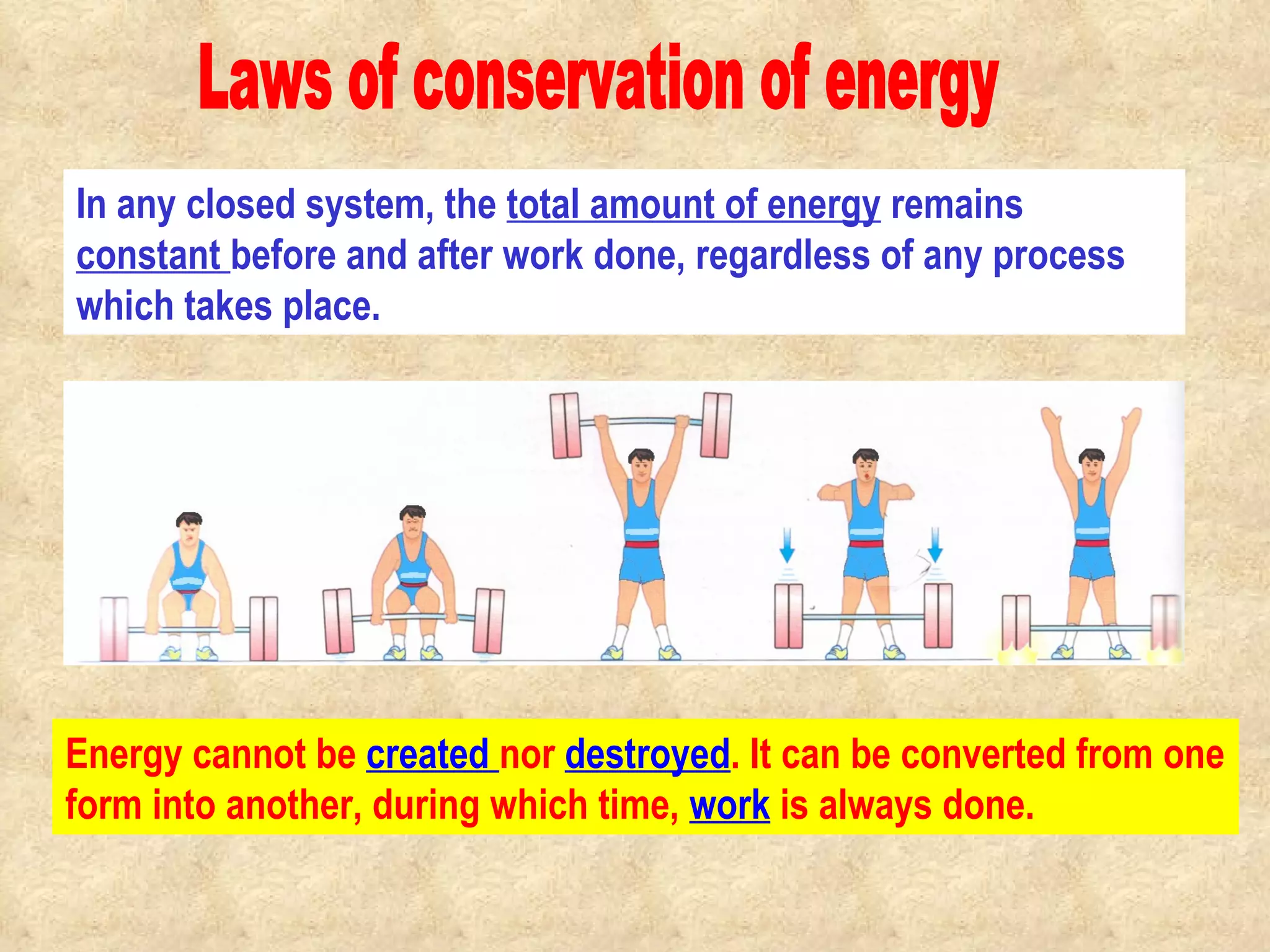
Laws of conservation of energy Energy cannot be  created  nor  destroyed . It can be converted from one form into another, during which time,  work  is always done. In any closed system, the  total amount of energy  remains  constant  before and after work done, regardless of any process which takes place.                                                                                        
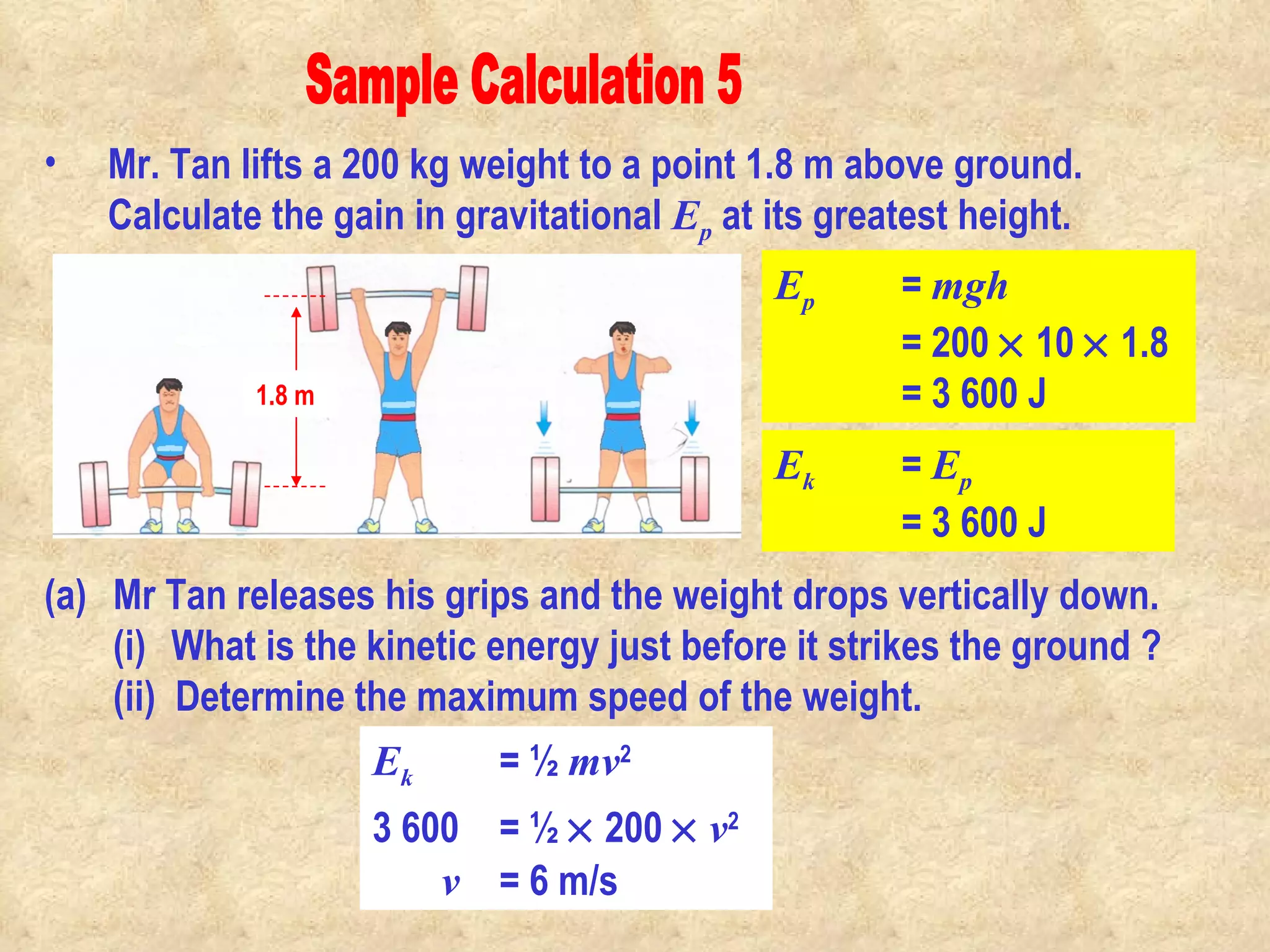
Sample Calculation 5 Mr. Tan lifts a 200 kg weight to a point 1.8 m above ground. Calculate the gain in gravitational  E p  at its greatest height. Mr Tan releases his grips and the weight drops vertically down.  (i) What is the kinetic energy just before it strikes the ground ?  (ii)  Determine the maximum speed of the weight. E p   =  mgh = 200    10    1.8 = 3 600 J 1.8 m E k   =  E p = 3 600 J E k   = ½  mv 2   3 600 = ½    200     v 2 v = 6 m/s                                                                                        
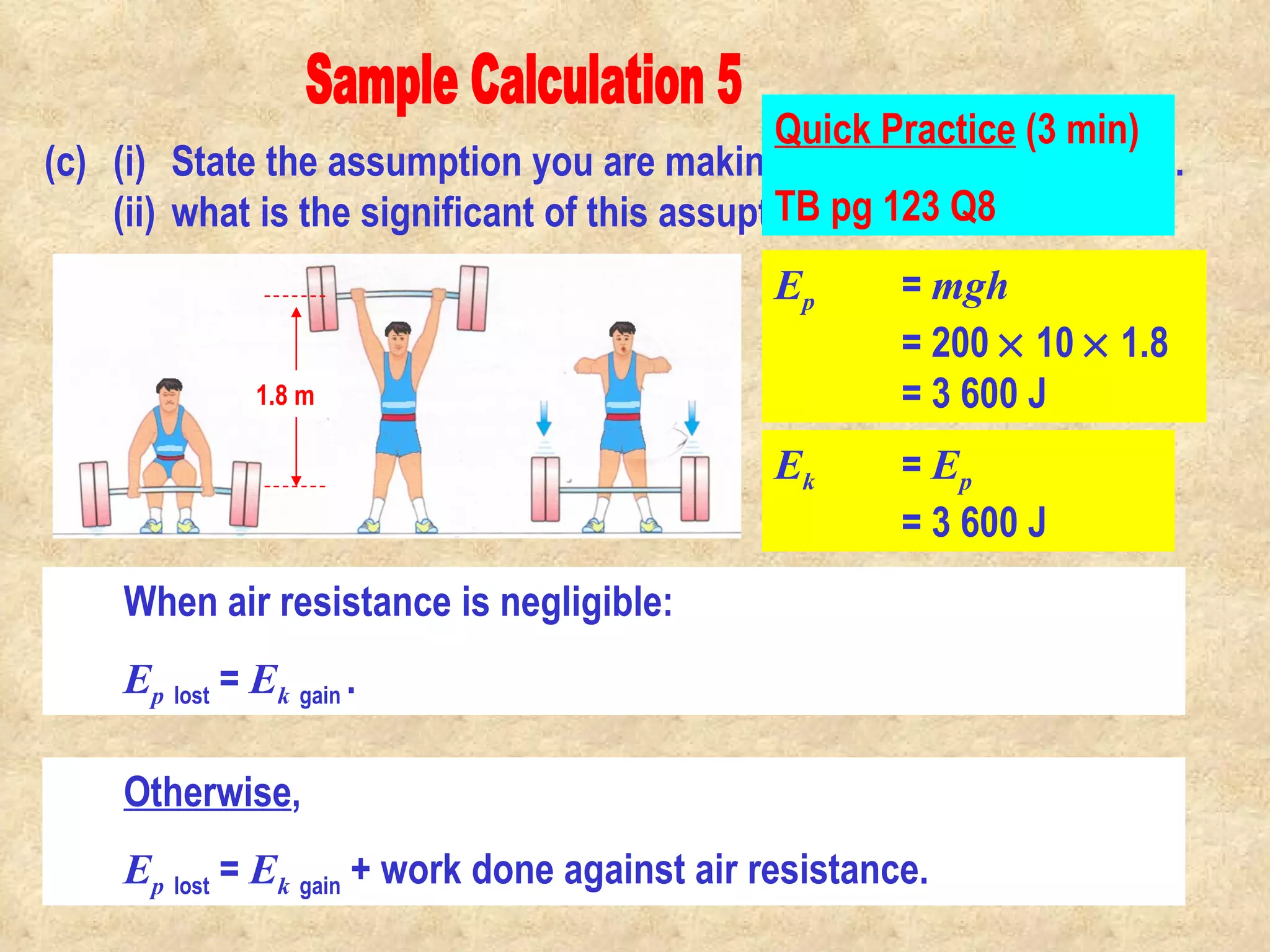
Sample Calculation 5 (c) (i) State the assumption you are making in the calculation in (b). (ii) what is the significant of this assuption? E p   =  mgh = 200    10    1.8 = 3 600 J 1.8 m E k   =  E p   = 3 600 J We assume that air resistance is negligible, no work is done to overcome air resistance.  When air resistance is negligible:  E p   lost  =  E k   gain  .  Otherwise ,  E p   lost  =  E k   gain  + work done against air resistance. Quick Practice  (3 min) TB pg 123 Q8                                                                                        
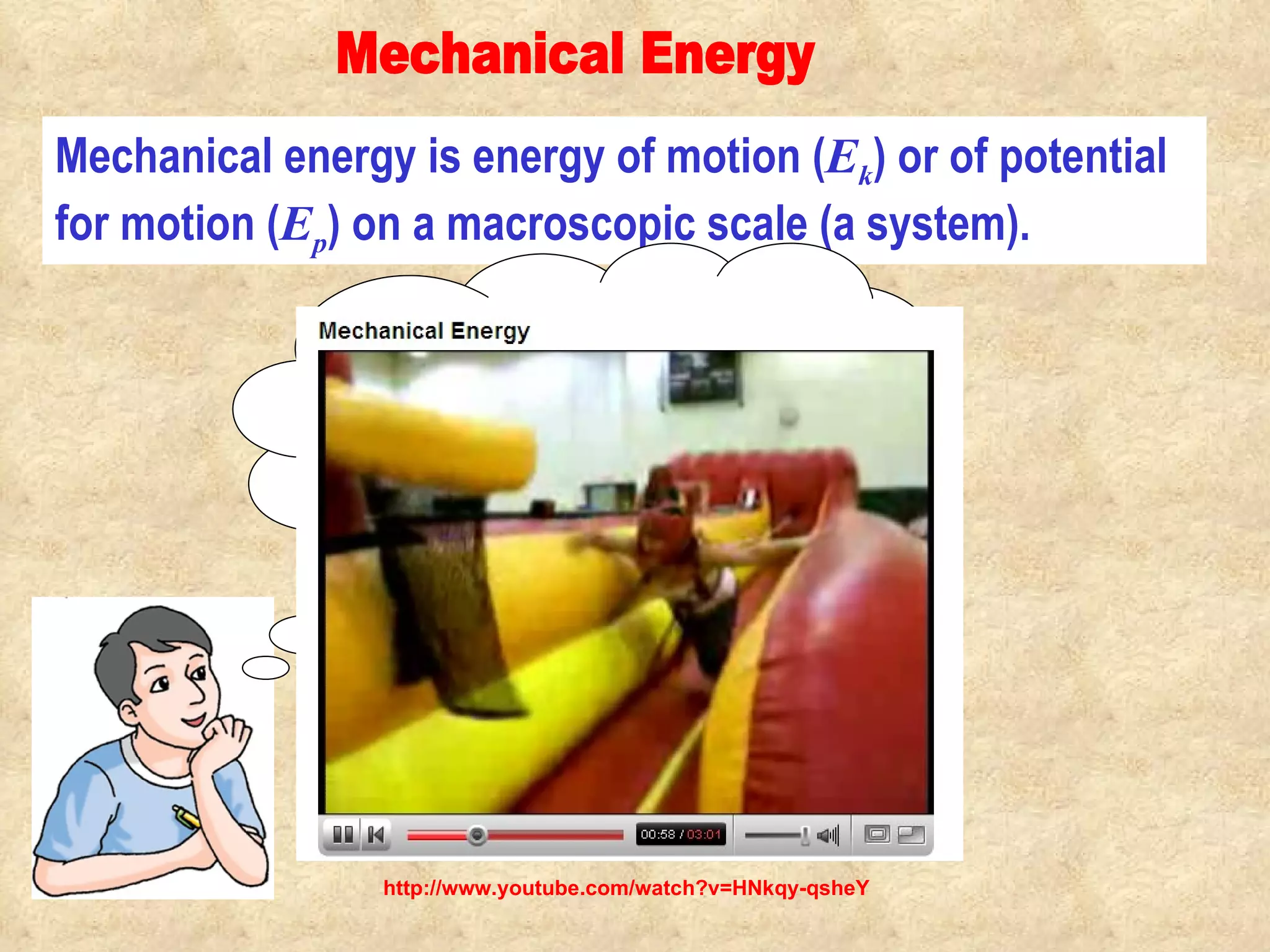
Mechanical energy is energy of motion ( E k ) or of potential for motion ( E p ) on a macroscopic scale (a system).  Mechanical Energy                                            A catapult flying through air has  E k  and  E p . Is there a special name for such a body possessing two such energies simultaneously? http://www.youtube.com/watch?v=HNkqy-qsheY
Pupils should be able to Recall the relationship  power = work done    time taken . apply the relationship between  power, work done  and  time taken  to new situations or to solve related problems. Work, Energy & Power                                                                                         Lesson objectives
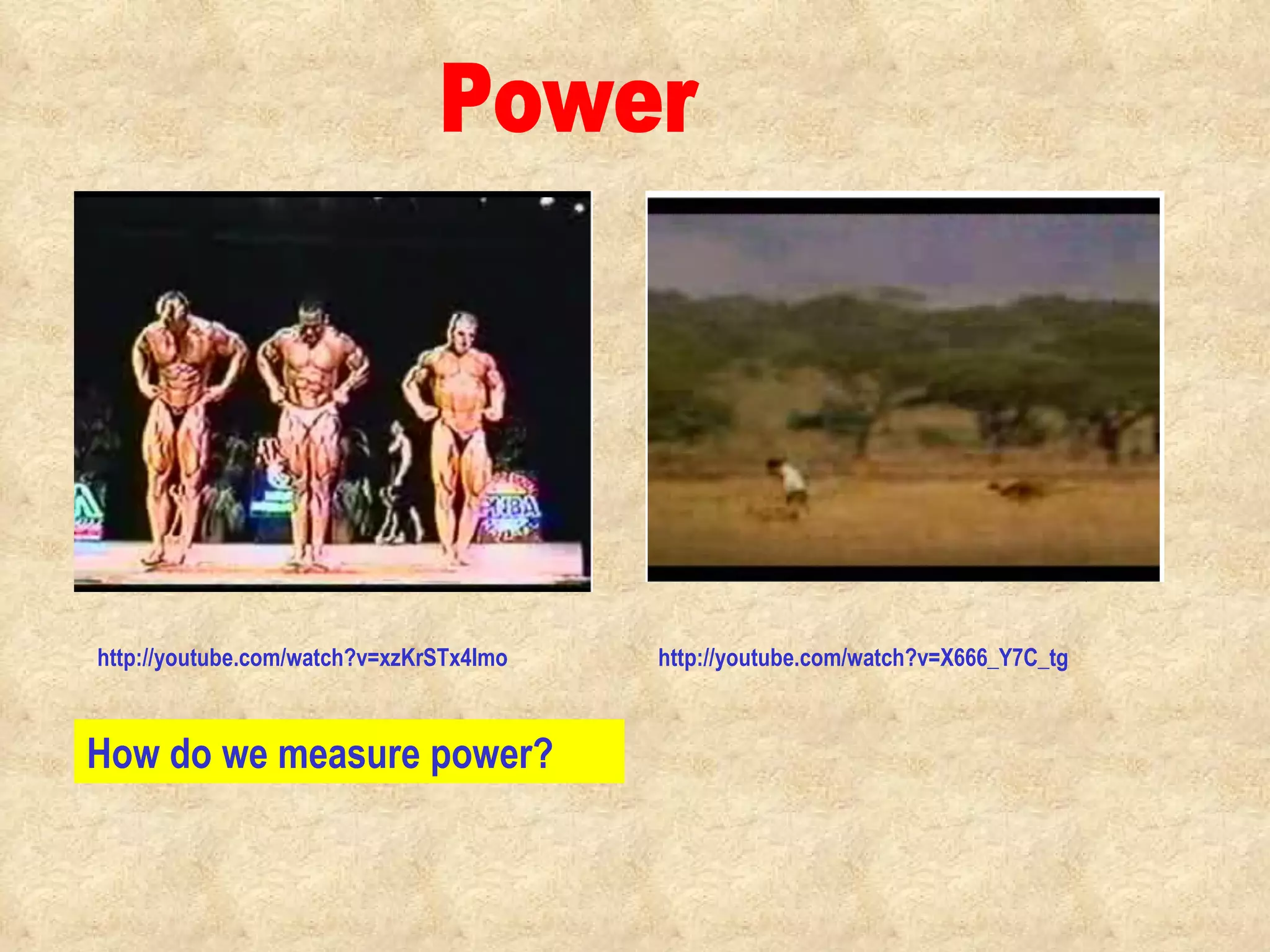
Power http://youtube.com/watch?v=xzKrSTx4Imo http://youtube.com/watch?v=X666_Y7C_tg How do we measure power?                                                                                        
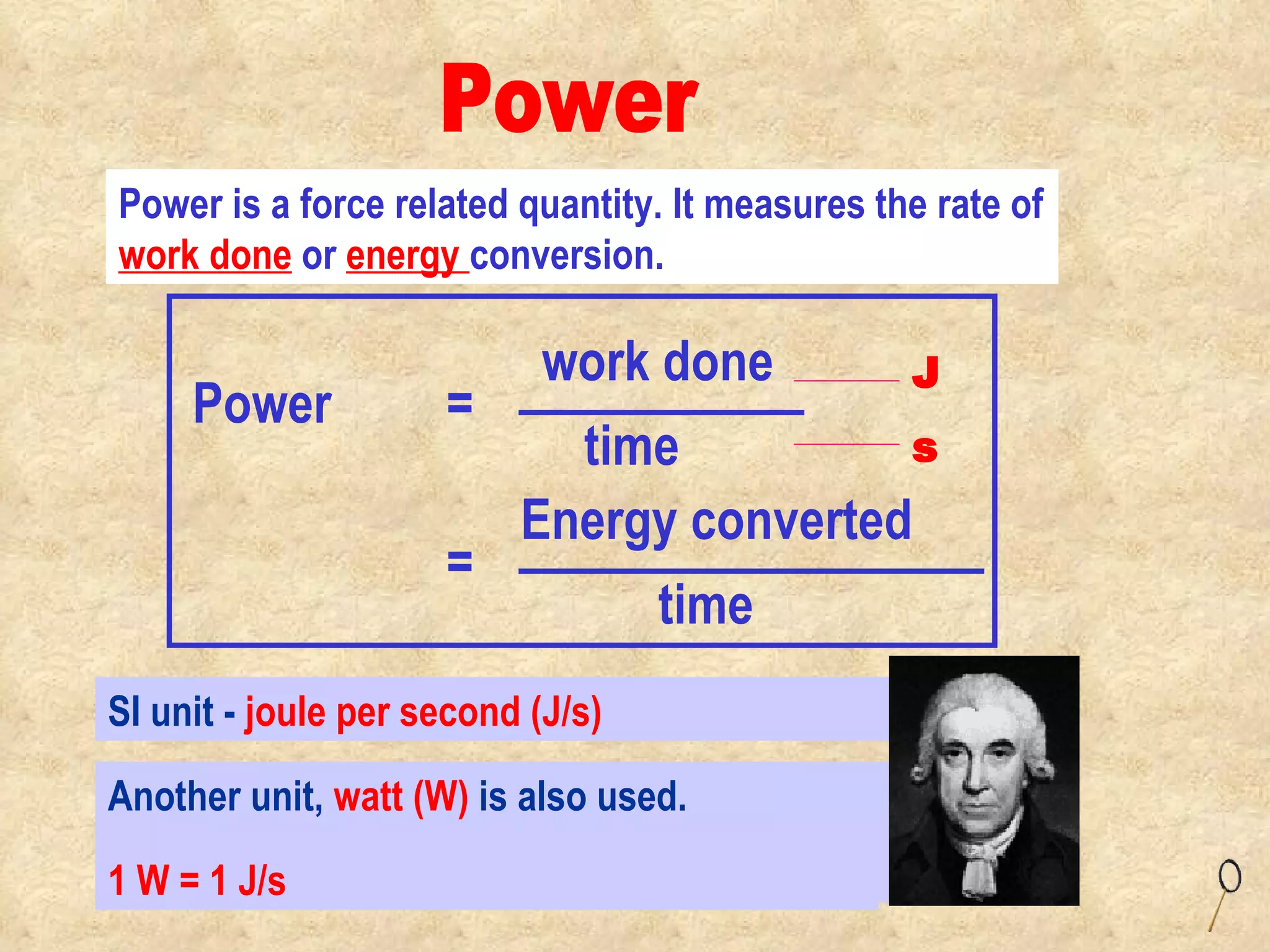
SI unit -  joule per second (J/s)   Power is a force related quantity. It measures the rate of  work done  or  energy  conversion. Power Another unit,  watt (W)  is also used.  1 W = 1 J/s Power  = work done time Energy converted time = J s
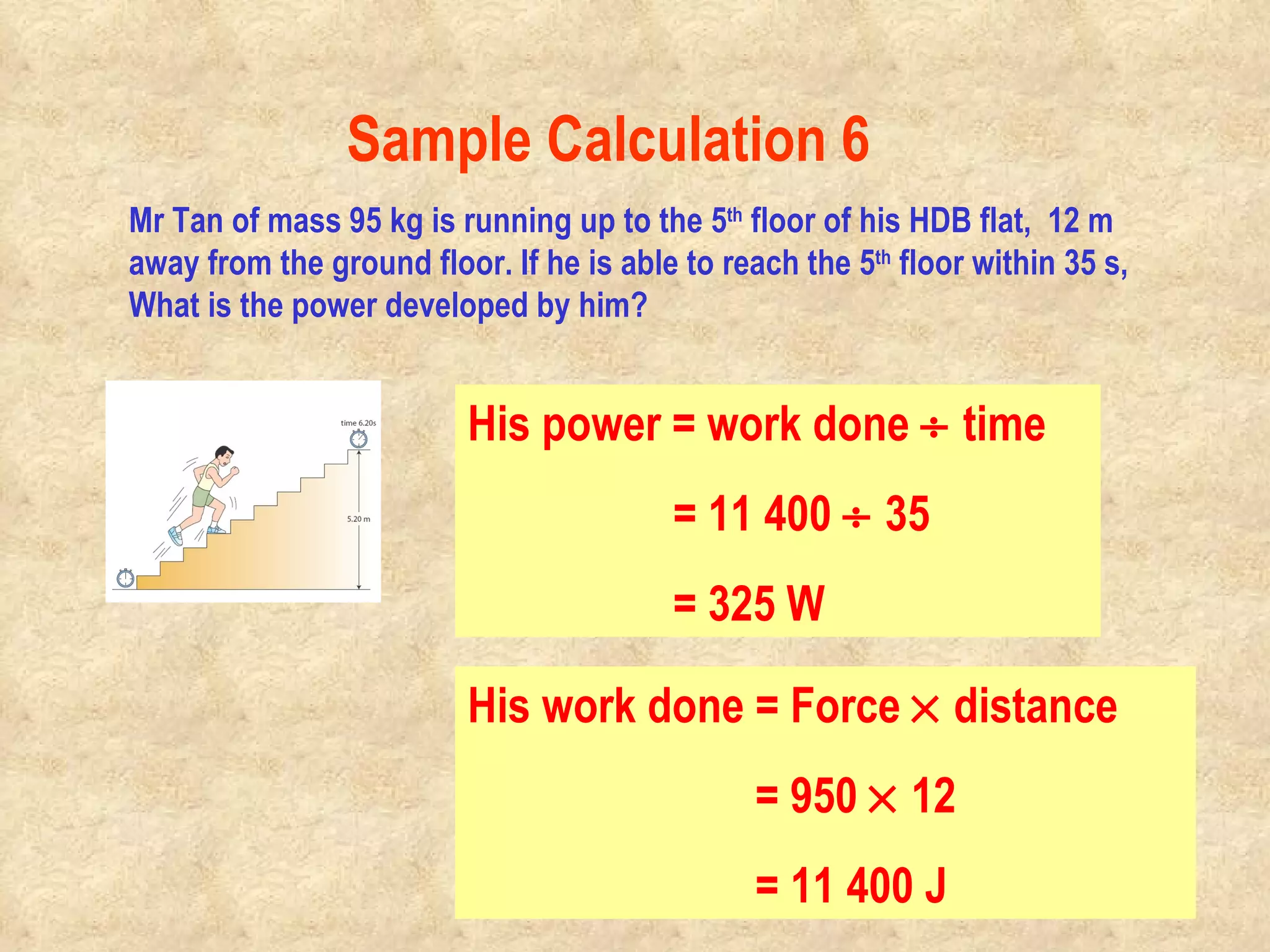
Mr Tan of mass 95 kg is running up to the 5 th  floor of his HDB flat,  12 m away from the ground floor. If he is able to reach the 5 th  floor within 35 s, What is the power developed by him? Mr Tan is moving up against gravity. He has to apply a force of at least equal to his body weight to overcome the pull of gravity. His work done = Force    distance   = 950    12   = 11 400 J His power = work done    time   = 11 400    35   = 325 W Sample Calculation 6                                                                                        
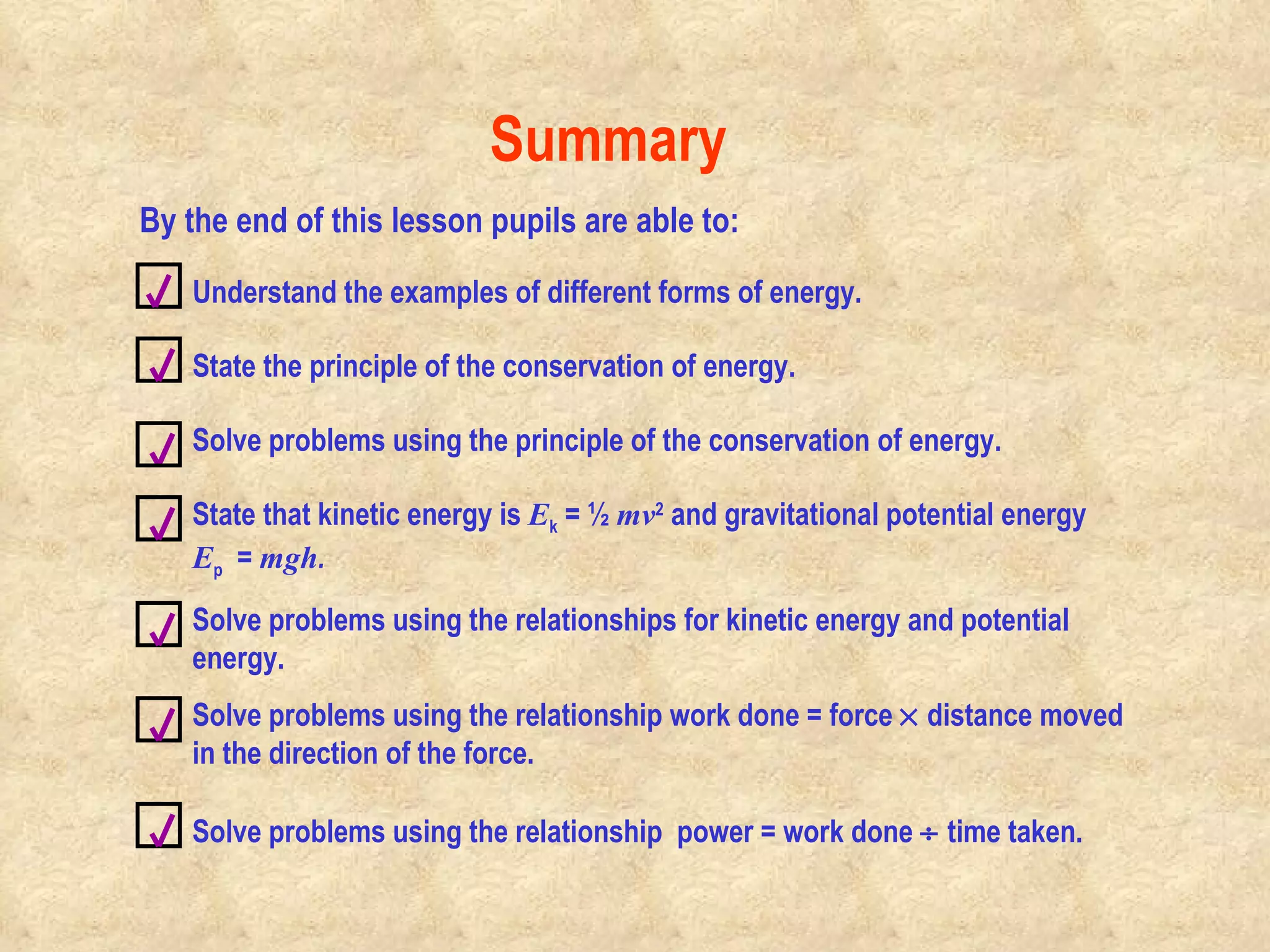
Summary Understand the examples of different forms of energy. By the end of this lesson pupils are able to: State the principle of the conservation of energy. Solve problems using the principle of the conservation of energy.  State that kinetic energy is  E k  = ½  mv 2  and gravitational potential energy  E p   =  mgh . Solve problems using the relationships for kinetic energy and potential energy. Solve problems using the relationship work done = force    distance moved in the direction of the force. Solve problems using the relationship  power = work done    time taken.

Sc(phys) chapter 7 work, energy and power

  • 1.
  • 2.
    Before we moveon, We have… Representing the video clips available Representing the websites available Representing the applets available
  • 3.
    Pupils should beable to define work done as work done = force  distance moved in the direction of the force. apply the relationship between work done, force and distance moved in the direction of the force to new situations or to solve related problems. Work, Energy & Power                                                                                   Lesson objectives
  • 4.
    Lesson Trigger Class,have you done your work? I have done my work, Teacher.                                                                                  
  • 5.
    Work is aforce related quantity. Understanding work done A force MUST be applied on an object in order for work to be done.                                         Applying a force to strike the tennis ball – you are doing work on the ball. Applying a force to lift your body weight up the stairs – you are doing work against gravity. Pulling you down during a dive – the Earth is doing work on you. Applying a force to drag the bag – you are doing work against friction.
  • 6.
    (a) youpush against the wall (b) a man carries a bag of gold on his hand and SLIDES across the room. No work is done when…                                         100 N A force is applied but the object does not move. A force is applied, but the object does not move in the direction of the applied force.
  • 7.
    The SI unitfor work is the joule (J). To a scientist, work W is done whenever a force F makes an object move a certain distance D in the direction of the force. The greater the force, and the further it moves, the more work is done . Defining Work 1 joule is defined as the amount of work done when a force of 1 N moves an object 1 m in the direction applied force.                                         W ork = F orce  D istance in the direction of applied force 1 J = 1 N m N m
  • 8.
    (a) Work doneagainst friction Work is done against friction when a force is applied to move an object in contact with a surface over a certain distance. Need to apply a force = 28 N to overcome friction. Nature of Work Done Need to apply a force = weight of the load to overcome gravitational pull. (b) Work done against gravity Work is done against gravity when a force is applied to lift an object to greater height in a gravitational field. 1.5 m 200 N
  • 9.
    A piece oflog is dragged 1.5 m along a slope with a pulling force of 1 600 N. Friction between the log and the slope surface is 1 200 N. Calculate the work done against friction. State and explain whether the log will move up the slope with a uniform speed. W friction = Friction  distance = 1 200  1.5 = 1 800 J Sample Calculation 1 The log should accelerate up the slope, as there is a net force acting on it. F net = 1 600 – 1 200 = 400 N
  • 10.
    Mr Tan ofmass 95 kg is running up to the 5 th floor of his HDB flat, 12.0 m away from the ground floor. How much work does he do against gravity? Mr Tan is moving up against gravity. He has to apply a force = his body weight to overcome the pull of gravity. WD gravity = Force  distance = weight  distance = 950  12.0 = 11 400 J Sample Calculation 2                                                                                  
  • 11.
    Pupils should beable to understand that kinetic energy, elastic potential energy, gravitational potential energy; chemical potential energy and thermal energy are different forms of energy. state and apply the principle of the conservation of energy. state that kinetic energy is E k = ½ mv 2 and gravitational potential energy E p = mgh (for potential energy changes near the Earth’s surface). apply the relationship for kinetic and potential energy to new situations or to solve related problems. Work, Energy & Power                                                                                   Lesson objectives
  • 12.
    Think about andwrite down what you know about any kind of energy. Write down whatever that comes to your mind when you think about the term energy. Lesson Trigger Energy Kinetic energy – energy due to motion, – all moving objects have it. Potential energy Electrical energy Nuclear energy Sound energy Heat energy Mechanical energy internal energy
  • 13.
    Energy is definedas the ability to do work . You make use of different types of energy to help you do work in your everyday life. Defining Energy The SI unit of energy is joule , symbol J .                                        
  • 14.
    Potential energy isdefined as stored up energy, waiting to be used. When released, it is capable of doing work. Potential Energy                                         Potential energy Elastic potential energy Chemical potential energy Gravitational potential energy gravitational potential energy elastic potential energy chemical potential energy
  • 15.
    When an objectstores energy as the result of its position in a gravitational force field , the object is said to possess Gravitational Potential energy, PE gravity The ram of a pile driver possesses gravitational potential energy. It is capable of doing work on the wooden pole. When released, it applies a force F to move the wooden pole a distance h into the ground. Work done = F  D = mgh = mg Gravitational Potential Energy Example ram wooden pole h F
  • 16.
    Gravitational Potential Energyram wooden pole PE gravity = mgh Hence gravitational potential energy PE gravity is given as: mass in kg gravitational field strength g = 10 N/kg height in m The SI unit of PE gravity is joule, symbol J.                                         F = mg h
  • 17.
    Sample Calculation 3In a rescue operation, a 75 kg rescuer is raised to a height 12 m above ground. Calculate his gain in Gravitational PE. PE = mgh Quick Practice (3 min) TB pg 121 Q3 = 75  10  12 = 9 000 J                                                                                  
  • 18.
    Kinetic Energy Abody in motion is capable of doing work. It is said to possess Kinetic Energy, KE. A swinging mallet has kinetic energy, When it strikes the ball with a force F , it causes the ball to move a certain distance D in the direction of the force, producing work. W = F  D
  • 19.
    Kinetic Energy Thekinetic energy KE of a body is given as: KE = ½ mv 2 The greater the speed v of a moving body, the greater is its kinetic energy. The greater the mass m of the moving body, the greater is its kinetic energy. J kg m/s We are equally fast, but I have greater KE than you I am faster. I have greater KE than you
  • 20.
    Sample Calculation 4(i) Ali jogs at a uniform speed of 7.5 m/s. Calculate his kinetic energy if his mass is 65 kg . (ii) How will his KE change if he slows down his motion? As KE is depending on speed of motion, if he slows down, his KE will decrease. KE = ½ mv 2 = ½  65  7.5 2 V = 1 828.125 J  1.8  10 3 J Quick Practice (3 min) TB pg 121 Q2                                                                                  
  • 21.
    Laws of conservationof energy The energy of a body is always converted from one form to another during work done. Work is done against gravity when a car is driven up a slope. Chemical E p (petrol) ➔ Gravitational E p (car gains height) If the car accelerates up the hill, then: Chemical E p (petrol) ➔ Gravitational E p (car gains height) + E k (car speeds up) More petrol will be burnt to release more Chemical E p to accelerate the car.                                                                                   Example
  • 22.
    Laws of conservationof energy A car is brought to rest when the driver applies brake. What kind of work is done? State the energy change. Work is done against friction when the car is braked. Quick Check E k moving car ➔ Heat Energy + Sound Energy                                        
  • 23.
    Laws of conservationof energy Energy cannot be created nor destroyed . It can be converted from one form into another, during which time, work is always done. In any closed system, the total amount of energy remains constant before and after work done, regardless of any process which takes place.                                                                                  
  • 24.
    Sample Calculation 5Mr. Tan lifts a 200 kg weight to a point 1.8 m above ground. Calculate the gain in gravitational E p at its greatest height. Mr Tan releases his grips and the weight drops vertically down. (i) What is the kinetic energy just before it strikes the ground ? (ii) Determine the maximum speed of the weight. E p = mgh = 200  10  1.8 = 3 600 J 1.8 m E k = E p = 3 600 J E k = ½ mv 2 3 600 = ½  200  v 2 v = 6 m/s                                                                                  
  • 25.
    Sample Calculation 5(c) (i) State the assumption you are making in the calculation in (b). (ii) what is the significant of this assuption? E p = mgh = 200  10  1.8 = 3 600 J 1.8 m E k = E p = 3 600 J We assume that air resistance is negligible, no work is done to overcome air resistance. When air resistance is negligible: E p lost = E k gain . Otherwise , E p lost = E k gain + work done against air resistance. Quick Practice (3 min) TB pg 123 Q8                                                                                  
  • 26.
    Mechanical energy isenergy of motion ( E k ) or of potential for motion ( E p ) on a macroscopic scale (a system). Mechanical Energy                                         A catapult flying through air has E k and E p . Is there a special name for such a body possessing two such energies simultaneously? http://www.youtube.com/watch?v=HNkqy-qsheY
  • 27.
    Pupils should beable to Recall the relationship power = work done  time taken . apply the relationship between power, work done and time taken to new situations or to solve related problems. Work, Energy & Power                                                                                   Lesson objectives
  • 28.
    Power http://youtube.com/watch?v=xzKrSTx4Imo http://youtube.com/watch?v=X666_Y7C_tgHow do we measure power?                                                                                  
  • 29.
    SI unit - joule per second (J/s) Power is a force related quantity. It measures the rate of work done or energy conversion. Power Another unit, watt (W) is also used. 1 W = 1 J/s Power = work done time Energy converted time = J s
  • 30.
    Mr Tan ofmass 95 kg is running up to the 5 th floor of his HDB flat, 12 m away from the ground floor. If he is able to reach the 5 th floor within 35 s, What is the power developed by him? Mr Tan is moving up against gravity. He has to apply a force of at least equal to his body weight to overcome the pull of gravity. His work done = Force  distance = 950  12 = 11 400 J His power = work done  time = 11 400  35 = 325 W Sample Calculation 6                                                                                  
  • 31.
    Summary Understand theexamples of different forms of energy. By the end of this lesson pupils are able to: State the principle of the conservation of energy. Solve problems using the principle of the conservation of energy. State that kinetic energy is E k = ½ mv 2 and gravitational potential energy E p = mgh . Solve problems using the relationships for kinetic energy and potential energy. Solve problems using the relationship work done = force  distance moved in the direction of the force. Solve problems using the relationship power = work done  time taken.