Work done bya constant force and a variable
force; kinetic energy, work-energy theorem,
power.
Notion of potential energy, potential energy of a
spring,
conservative forces: conservation of mechanical
energy (kinetic and potential energies); non-
conservative forces: motion in a vertical circle;
elastic and inelastic collisions in one and two
dimensions.
Revised syllabus -CORONA
PANDEMIC
2020
work, energy and power
3.
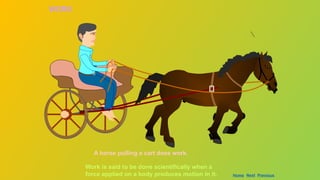
A horse pullinga cart does work.
WORK
Home Next Previous
Work is said to be done scientifically when a
force applied on a body produces motion in it.
4.
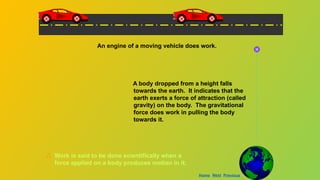
A body droppedfrom a height falls
towards the earth. It indicates that the
earth exerts a force of attraction (called
gravity) on the body. The gravitational
force does work in pulling the body
towards it.
An engine of a moving vehicle does work.
Work is said to be done scientifically when a
force applied on a body produces motion in it.
Home Next Previous
5.
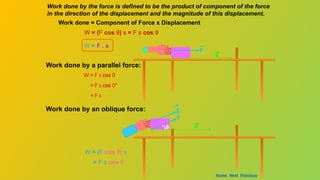
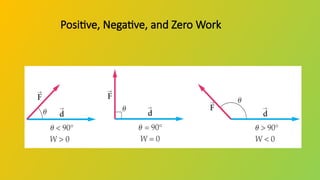
Work done bythe force is defined to be the product of component of the force
in the direction of the displacement and the magnitude of this displacement.
Work done = Component of Force x Displacement
W = (F cos θ) s = F s cos θ
F
s
F
s
F
θ
W = F s cos θ
= F s cos 0°
= F s
W = (F cos θ) s
= F s cos θ
Work done by an oblique force:
Work done by a parallel force:
F . s
W =
Home Next Previous
6.
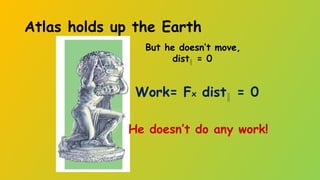
Atlas holds upthe Earth
But he doesn’t move,
dist∥ = 0
Work= Fx dist∥ = 0
He doesn’t do any work!
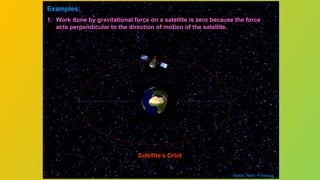
Earth
Satellite’s Orbit
1. Workdone by gravitational force on a satellite is zero because the force
acts perpendicular to the direction of motion of the satellite.
Examples:
Home Next Previous
10.
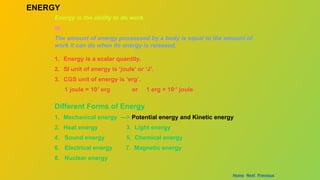
ENERGY
Energy is theability to do work.
or
The amount of energy possessed by a body is equal to the amount of
work it can do when its energy is released.
1. Energy is a scalar quantity.
2. SI unit of energy is ‘joule’ or ‘J’.
3. CGS unit of energy is ‘erg’.
1 joule = 107
erg or 1 erg = 10-7
joule
Different Forms of Energy
1. Mechanical energy ---> Potential energy and Kinetic energy
2. Heat energy 3. Light energy
4. Sound energy 5. Chemical energy
6. Electrical energy 7. Magnetic energy
8. Nuclear energy
Home Next Previous
11.
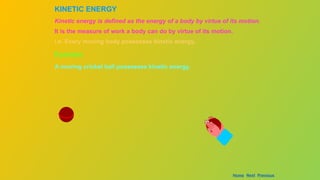
KINETIC ENERGY
Kinetic energyis defined as the energy of a body by virtue of its motion.
It is the measure of work a body can do by virtue of its motion.
i.e. Every moving body possesses kinetic energy.
Example:
A moving cricket ball possesses kinetic energy.
Home Next Previous
12.
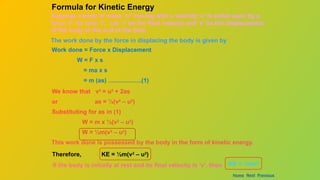
Suppose a bodyof mass ‘m’ moving with a velocity ‘u’ is acted upon by a
force ‘F’ for time ‘t’. Let ‘v’ be the final velocity and ‘s’ be the displacement
of the body at the end of the time.
The work done by the force in displacing the body is given by
Work done = Force x Displacement
W = F x s
= ma x s
= m (as) ……………..(1)
We know that v2
= u2
+ 2as
or as = ½(v2
– u2
)
Substituting for as in (1)
W = m x ½(v2
– u2
)
W = ½m(v2
– u2
)
This work done is possessed by the body in the form of kinetic energy.
Formula for Kinetic Energy
Therefore, KE = ½m(v2
– u2
)
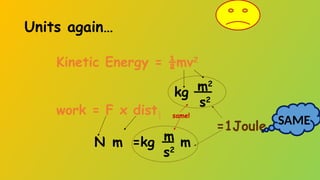
KE = ½mv2
If the body is initially at rest and its final velocity is ‘v’, then
Home Next Previous
13.
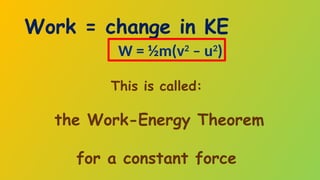
Work = changein KE
This is called:
the Work-Energy Theorem
for a constant force
W = ½m(v2
– u2
)
Note:
1. Kinetic energyis
i) directly proportional to the mass of the body, and
ii) directly proportional to the square of velocity of the body.
If mass is doubled, KE is doubled and if the mass is halved, KE is also
halved.
If velocity is doubled, KE increases four times and if the mass is halved,
KE reduces to ¼ of its original value.
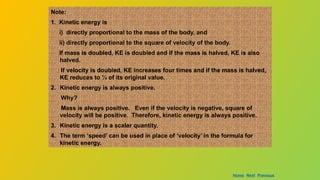
2. Kinetic energy is always positive.
Why?
Mass is always positive. Even if the velocity is negative, square of
velocity will be positive. Therefore, kinetic energy is always positive.
3. Kinetic energy is a scalar quantity.
4. The term ‘speed’ can be used in place of ‘velocity’ in the formula for
kinetic energy.
Home Next Previous
16.
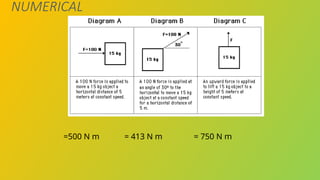
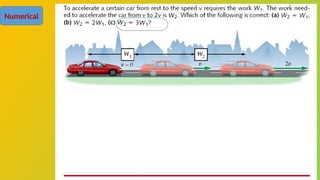
Numerical
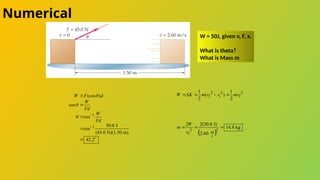
W = 50J,given v, F, x.
What is theta?
What is Mass m
1
1
(cos )
cos
cos
50.0 J
cos
(45.0 N)(1.50 m)
42.2
W F d
W
Fd
W
Fd
2 2 2
f i f
1 1
( )
2 2
W K m v v mv
2 2
m
f
s
2 2(50.0 J)
14.8 kg
2.60
W
m
v
17.
O
F(x)
x
Work
xi xf
Δx
Work doneby a variable
force
O
F(x)
Area = ΔA = F(x) Δx = ΔW
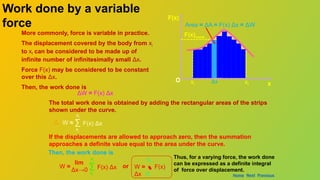
More commonly, force is variable in practice.
The displacement covered by the body from xi
to xf can be considered to be made up of
infinite number of infinitesimally small Δx.
Force F(x) may be considered to be constant
over this Δx.
Then, the work done is
ΔW = F(x) Δx
The total work done is obtained by adding the rectangular areas of the strips
shown under the curve.
F(x) Δx
∑
xi
xf
W ≈
If the displacements are allowed to approach zero, then the summation
approaches a definite value equal to the area under the curve.
xi xf
Then, the work done is
F(x) Δx
∑
xi
xf
W =
lim
Δx→0
Thus, for a varying force, the work done
can be expressed as a definite integral
of force over displacement.
F(x)const
x
W = F(x)
Δx xi
xf
or
Home Next Previous
18.
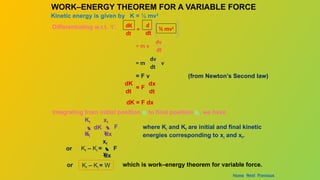
WORK–ENERGY THEOREM FORA VARIABLE FORCE
Kinetic energy is given by K = ½ mv2
Differentiating w.r.t. ‘t’, dK
dt
=
d
dt
½ mv2
= m v
dv
dt
= m
dv
dt
v
= F v (from Newton’s Second law)
= F
dx
dt
dK
dt
dK = F dx
Integrating from initial position xi to final position xf, we have
F
dx
xi
xf
dK
=
Ki
Kf
where Ki and Kf are initial and final kinetic
energies corresponding to xi and xf.
or F
dx
xi
xf
Kf – Ki =
Kf – Ki = W
or which is work–energy theorem for variable force.
Home Next Previous
19.
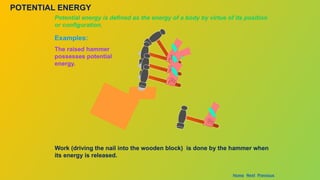
POTENTIAL ENERGY
Potential energyis defined as the energy of a body by virtue of its position
or configuration.
Examples:
Work (driving the nail into the wooden block) is done by the hammer when
its energy is released.
The raised hammer
possesses potential
energy.
Home Next Previous
20.
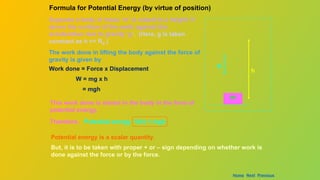
Suppose a bodyof mass ‘m’ is raised to a height ‘h’
above the surface of the earth against the
acceleration due to gravity ‘g’. (Here, g is taken
constant as h << RE.)
The work done in lifting the body against the force of
gravity is given by
m
h
g
Work done = Force x Displacement
W = mg x h
= mgh
This work done is stored in the body in the form of
potential energy.
Formula for Potential Energy (by virtue of position)
Potential energy is a scalar quantity.
But, it is to be taken with proper + or – sign depending on whether work is
done against the force or by the force.
Therefore, Potential energy V(h) = mgh
Home Next Previous
21.
F
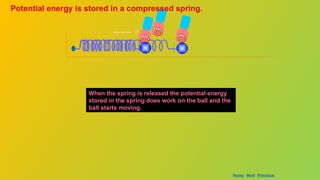
When the springis released the potential energy
stored in the spring does work on the ball and the
ball starts moving.
Home Next Previous
Potential energy is stored in a compressed spring.
22.
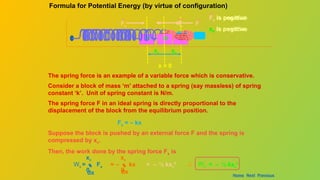
Formula for PotentialEnergy (by virtue of configuration)
m m
F
Fs Fs
m
F
x = 0
xc xe
The spring force is an example of a variable force which is conservative.
Consider a block of mass ‘m’ attached to a spring (say massless) of spring
constant ‘k’. Unit of spring constant is N/m.
The spring force F in an ideal spring is directly proportional to the
displacement of the block from the equilibrium position.
Fs = – kx
Suppose the block is pushed by an external force F and the spring is
compressed by xc.
Then, the work done by the spring force Fs is
Fs
dx
0
xc
Ws = kx
dx
0
xc
= – ½ kxc
2
= – Ws ½ kxc
2
= –
Home Next Previous
Fs is positive
xc is negative
Fs is negative
xe is positive
23.
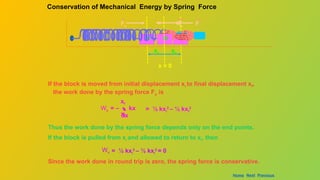
If the blockis moved from initial displacement xi to final displacement xf,
the work done by the spring force Fs is
Ws kx
dx
xi
xf
= – = ½ kxi
2
– ½ kxf
2
Thus the work done by the spring force depends only on the end points.
If the block is pulled from xi and allowed to return to xi, then
Ws = ½ kxi
2
– ½ kxi
2
= 0
Since the work done in round trip is zero, the spring force is conservative.
Conservation of Mechanical Energy by Spring Force
m m
F
Fs Fs
m
F
x = 0
xc xe
Home Next Previous
24.
Energy
E = K+ V
O
P.E
(V)
K.E
(K)
x
xe
– xe
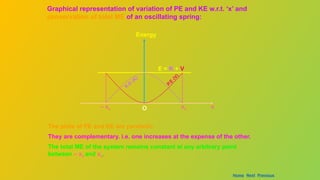
Graphical representation of variation of PE and KE w.r.t. ‘x’ and
conservation of total ME of an oscillating spring:
The plots of PE and KE are parabolic.
They are complementary. i.e. one increases at the expense of the other.
The total ME of the system remains constant at any arbitrary point
between – xe and xe.
Home Next Previous
25.
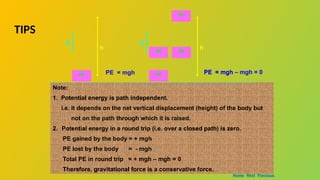
Note:
1. Potential energyis path independent.
i.e. it depends on the net vertical displacement (height) of the body but
not on the path through which it is raised.
2. Potential energy in a round trip (i.e. over a closed path) is zero.
PE gained by the body = + mgh
PE lost by the body = - mgh
Total PE in round trip = + mgh – mgh = 0
Therefore, gravitational force is a conservative force.
m
h
g
m
h
g
m m
m
PE = mgh
PE = mgh PE = mgh – mgh = 0
Home Next Previous
TIPS
26.
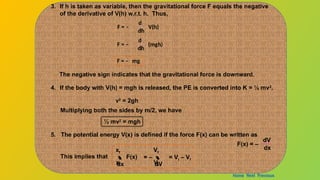
3. If his taken as variable, then the gravitational force F equals the negative
of the derivative of V(h) w.r.t. h. Thus,
F = –
d
dh
V(h)
F = –
d
dh
(mgh)
F = – mg
The negative sign indicates that the gravitational force is downward.
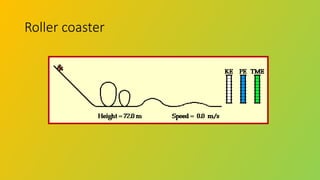
4. If the body with V(h) = mgh is released, the PE is converted into K = ½ mv2
.
v2
= 2gh
Multiplying both the sides by m/2, we have
½ mv2
= mgh
5. The potential energy V(x) is defined if the force F(x) can be written as
F(x) = –
dV
dx
This implies that F(x)
dx
xi
xf
dV
Vi
Vf
= – = Vi – Vf
Home Next Previous
27.
LAW OF CONSERVATIONOF ENERGY
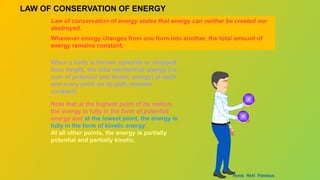
Law of conservation of energy states that energy can neither be created nor
destroyed.
Whenever energy changes from one form into another, the total amount of
energy remains constant.
When a body is thrown upwards or dropped
from height, the total mechanical energy (i.e.
sum of potential and kinetic energy) at each
and every point on its path remains
constant.
Note that at the highest point of its motion,
the energy is fully in the form of potential
energy and at the lowest point, the energy is
fully in the form of kinetic energy.
At all other points, the energy is partially
potential and partially kinetic.
Home Next Previous
28.
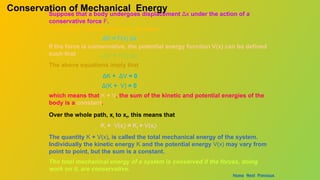
Suppose that abody undergoes displacement Δx under the action of a
conservative force F.
From work – energy theorem, we have
ΔK = F(x) Δx
If the force is conservative, the potential energy function V(x) can be defined
such that – ΔV = F(x) Δx
The above equations imply that
ΔK + ΔV = 0
Δ(K + V) = 0
Conservation of Mechanical Energy
which means that K + V, the sum of the kinetic and potential energies of the
body is a constant.
Over the whole path, xi to xf, this means that
Ki + V(xi) = Kf + V(xf)
The quantity K + V(x), is called the total mechanical energy of the system.
Individually the kinetic energy K and the potential energy V(x) may vary from
point to point, but the sum is a constant.
The total mechanical energy of a system is conserved if the forces, doing
work on it, are conservative.
Home Next Previous
29.
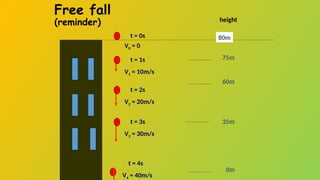
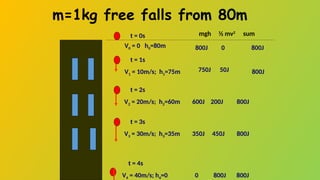
Free fall
(reminder)
V0 =0
t = 0s
V1 = 10m/s
t = 1s
V2 = 20m/s
t = 2s
V3 = 30m/s
t = 3s
V4 = 40m/s
t = 4s
75m
60m
35m
0m
height
80m
30.
m=1kg free fallsfrom 80m
V0 = 0 h0=80m
t = 0s
V1 = 10m/s; h1=75m
t = 1s
V2 = 20m/s; h2=60m 600J 200J 800J
t = 2s
V3 = 30m/s; h3=35m 350J 450J 800J
t = 3s
V4 = 40m/s; h4=0 0 800J 800J
t = 4s
mgh ½ mv2
sum
800J 0 800J
750J 50J 800J
31.
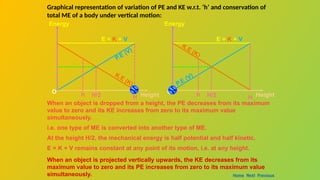
Energy
P.E (V)
E =K + V
O
Height
K.E (K)
H
H/2
Graphical representation of variation of PE and KE w.r.t. ‘h’ and conservation of
total ME of a body under vertical motion:
When an object is dropped from a height, the PE decreases from its maximum
value to zero and its KE increases from zero to its maximum value
simultaneously.
i.e. one type of ME is converted into another type of ME.
At the height H/2, the mechanical energy is half potential and half kinetic.
E = K + V remains constant at any point of its motion, i.e. at any height.
h
Energy
P.E (V)
E = K + V
O
Height
K.E (K)
H
H/2
h
When an object is projected vertically upwards, the KE decreases from its
maximum value to zero and its PE increases from zero to its maximum value
simultaneously.
m m
Home Next Previous
32.
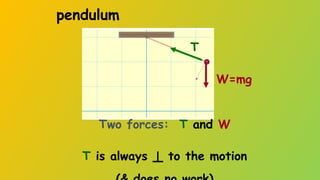
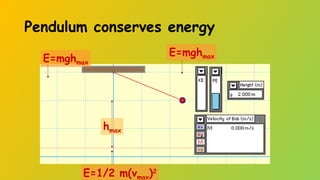
Potential energy ismaximum and kinetic energy is zero at extreme positions.
Kinetic energy is maximum and potential energy is minimum at the mean
position.
Home Next Previous
Conservative Force
Aforce F(x) is conservative if it can be derived from a scalar quantity V(x)
by the relation ΔV = – F(x) Δx.
(The 3-dimensional generalisation requires the use of a vector
derivative.)
The work done by the conservative force depends only on the end points.
This can be seen from the relation, W = Kf – Ki = V(xi) – V(xf), which
depends on the end points.
The work done by this force in a closed path is zero. This is once again
apparent from W = Kf – Ki = V(xi) – V(xf) since xi = xf.
Non - Conservative Force
The work done by the non-conservative force depends on the path in
which it is done.
The work done by this force in a closed path is non - zero.
Friction is an example for non-conservative force.
The heat energy produced by friction gets dissipated and hence can not
be converted back into original form of energy.
Home Next Previous
37.
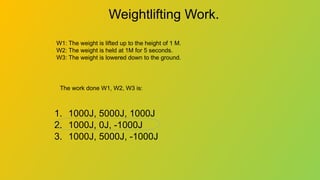
Weightlifting Work.
1. 1000J,5000J, 1000J
2. 1000J, 0J, -1000J
3. 1000J, 5000J, -1000J
W1: The weight is lifted up to the height of 1 M.
W2: The weight is held at 1M for 5 seconds.
W3: The weight is lowered down to the ground.
The work done W1, W2, W3 is:
COLLISIONS
Elastic Collision
In elasticcollision,
1. The total linear momentum is conserved,
2. The total kinetic energy of the system is also conserved and
3. After the collision, the bodies completely regain from their deformities.
Inelastic Collision
In inelastic collision,
1. The total linear momentum is conserved,
2. The total kinetic energy of the system is not conserved and
3. After the collision, the bodies partly regain from their deformities and some of he
initial KE is lost.
Completely Inelastic Collision
In completely inelastic collision,
1. The total linear momentum is conserved,
2. The total kinetic energy of the system is not conserved and
3. After the collision, the bodies stick together and move with common velocity.
Home Next Previous
40.
Note:
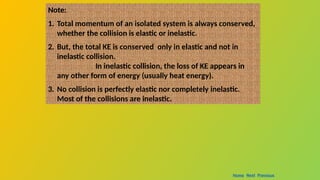
1. Total momentumof an isolated system is always conserved,
whether the collision is elastic or inelastic.
2. But, the total KE is conserved only in elastic and not in
inelastic collision.
In inelastic collision, the loss of KE appears in
any other form of energy (usually heat energy).
3. No collision is perfectly elastic nor completely inelastic.
Most of the collisions are inelastic.
Home Next Previous
41.
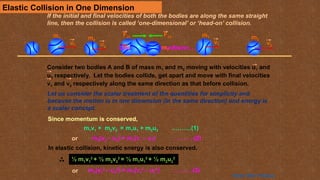
Elastic Collision inOne Dimension
Click to see the collision…
u1 u2
v1 v2
F21 F12
m1 m2
m1 m2
m1 m2
Consider two bodies A and B of mass m1 and m2 moving with velocities u1 and
u2 respectively. Let the bodies collide, get apart and move with final velocities
v1 and v2 respectively along the same direction as that before collision.
Let us consider the scalar treatment of the quantities for simplicity and
because the motion is in one dimension (in the same direction) and energy is
a scalar concept.
m1v1 + m2v2 = m1u1 + m2u2 ……….(1)
Since momentum is conserved,
m2(v2 – u2) = m1(v1 – u1) ……….(2)
or
In elastic collision, kinetic energy is also conserved.
½ m1v1
2
+ ½ m2v2
2
= ½ m1u1
2
+ ½ m2u2
2
m2(v2
2
– u2
2
) = m1(v1
2
– u1
2
) ……….(3)
or
If the initial and final velocities of both the bodies are along the same straight
line, then the collision is called ‘one-dimensional’ or ‘head-on’ collision.
Home Next Previous
42.
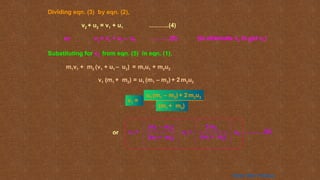
v2 + u2= v1 + u1 ……….(4)
Dividing eqn. (3) by eqn. (2),
or v2 = v1 + u1 – u2 ……….(5) (to eliminate v2 to get v1)
Substituting for v2 from eqn. (5) in eqn. (1),
m1v1 + m2 (v1 + u1 – u2) = m1u1 + m2u2
v1 (m1 + m2) = u1 (m1 – m2) + 2 m2u2
v1 =
(m1 + m2)
u1 (m1 – m2) + 2 m2u2
……….(6)
v1 =
(m1 + m2)
(m1 – m2)
u1 +
2 m2
u2
(m1 + m2)
or
Home Next Previous
43.
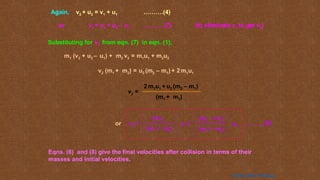
Substituting for v1from eqn. (7) in eqn. (1),
m1 (v2 + u2 – u1) + m2 v2 = m1u1 + m2u2
v2 (m1 + m2) = u2 (m2 – m1) + 2 m1u1
v2 =
(m1 + m2)
2 m1u1 + u2 (m2 – m1)
Again, v2 + u2 = v1 + u1 ……….(4)
or v1 = v2 + u2 – u1 ……….(7) (to eliminate v1 to get v2)
Eqns. (6) and (8) give the final velocities after collision in terms of their
masses and initial velocities.
or v2 =
(m1 + m2)
(m2 – m1)
u2
2 m1
u1 +
(m1 + m2)
……….(8)
Home Next Previous
44.
Special Cases:
v2 =
(m1+ m2)
(m2 – m1)
u2
2 m1
u1 +
(m1 + m2)
……….(8)
……….(6)
v1 =
(m1 + m2)
(m1 – m2)
u1 +
2 m2
u2
(m1 + m2)
Case I:
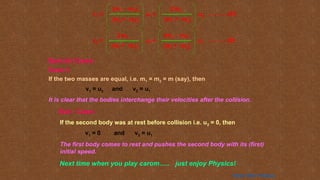
If the two masses are equal, i.e. m1 = m2 = m (say), then
v1 = u2 and v2 = u1
It is clear that the bodies interchange their velocities after the collision.
Sub - Case:
If the second body was at rest before collision i.e. u2 = 0, then
v1 = 0 and v2 = u1
The first body comes to rest and pushes the second body with its (first)
initial speed.
Next time when you play carom….. just enjoy Physics!
Home Next Previous
45.
v2 =
(m1 +m2)
(m2 – m1)
u2
2 m1
u1 +
(m1 + m2)
……….(8)
……….(6)
v1 =
(m1 + m2)
(m1 – m2)
u1 +
2 m2
u2
(m1 + m2)
Case II:
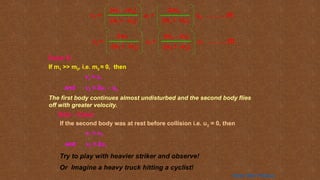
If m1 >> m2, i.e. m2 ≈ 0, then
v1 ≈ u1
and v2 ≈ 2u1 – u2
The first body continues almost undisturbed and the second body flies
off with greater velocity.
Sub - Case:
If the second body was at rest before collision i.e. u2 = 0, then
Try to play with heavier striker and observe!
v1 ≈ u1
and v2 ≈ 2u1
Or Imagine a heavy truck hitting a cyclist!
Home Next Previous
46.
Completely Inelastic Collisionin One Dimension
Click to see the collision…
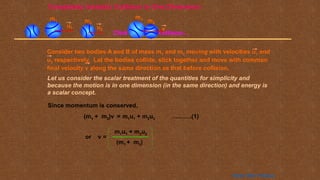
Consider two bodies A and B of mass m1 and m2 moving with velocities u1 and
u2 respectively. Let the bodies collide, stick together and move with common
final velocity v along the same direction as that before collision.
Let us consider the scalar treatment of the quantities for simplicity and
because the motion is in one dimension (in the same direction) and energy is
a scalar concept.
(m1 + m2)v = m1u1 + m2u2 ……….(1)
Since momentum is conserved,
u1
m1
u2
m2
m1
m2
v
v =
(m1 + m2)
m1u1 + m2u2
or
Home Next Previous
47.
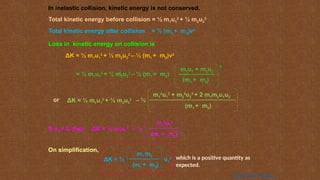
In inelastic collision,kinetic energy is not conserved.
Total kinetic energy before collision = ½ m1u1
2
+ ½ m2u2
2
Total kinetic energy after collision = ½ (m1 + m2)v2
Loss in kinetic energy on collision is
ΔK = ½ m1u1
2
+ ½ m2u2
2
– ½ (m1 + m2)v2
= ½ m1u1
2
+ ½ m2u2
2
– ½ (m1 + m2)
(m1 + m2)
m1u1 + m2u2
2
or – ½
ΔK = ½ m1u1
2
+ ½ m2u2
2
m1
2
u1
2
+ m2
2
u2
2
+ 2 m1m2u1u2
(m1 + m2)
If u2 = 0, then – ½
ΔK = ½ m1u1
2
m1
2
u1
2
(m1 + m2)
On simplification,
which is a positive quantity as
expected.
ΔK = ½
m1 m2
(m1 + m2)
u1
2
Home Next Previous
48.
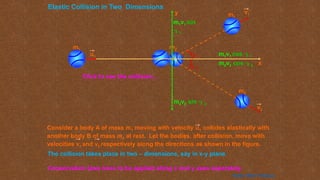
Elastic Collision inTwo Dimensions
Click to see the collision…
v2
u1
m1 m2
m2
v1
m1
1
2
x
y
m2v2 cos 2
m1v1 cos 1
m1v1 sin
1
m2v2 sin 2
Consider a body A of mass m1 moving with velocity u1 collides elastically with
another body B of mass m2 at rest. Let the bodies, after collision, move with
velocities v1 and v2 respectively along the directions as shown in the figure.
The collision takes place in two – dimensions, say in x-y plane.
Conservation laws have to be applied along x and y axes separately.
Home Next Previous
49.
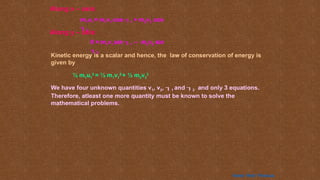
Along x –axis:
m1u1 = m1v1 cos 1 + m2v2 cos
2
0 = m1v1 sin 1 – m2v2 sin
2
Along y – axis:
Kinetic energy is a scalar and hence, the law of conservation of energy is
given by
½ m1u1
2
= ½ m1v1
2
+ ½ m2v2
2
We have four unknown quantities v1, v2, 1 and 2 and only 3 equations.
Therefore, atleast one more quantity must be known to solve the
mathematical problems.
Home Next Previous
50.
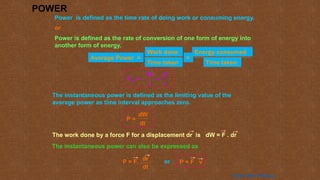
POWER
Power is definedas the time rate of doing work or consuming energy.
or
Power is defined as the rate of conversion of one form of energy into
another form of energy.
Average Power =
Time taken
Work done
=
Time taken
Energy consumed
=
E
t
Pav =
W
t
The instantaneous power is defined as the limiting value of the
average power as time interval approaches zero.
P =
dW
dt
The work done by a force F for a displacement dr is dW = F . dr
The instantaneous power can also be expressed as
P = F.
dr
dt
or P = F . v
Home Next Previous
51.
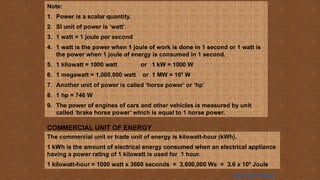
Note:
1. Power isa scalar quantity.
2. SI unit of power is ‘watt’.
3. 1 watt = 1 joule per second
4. 1 watt is the power when 1 joule of work is done in 1 second or 1 watt is
the power when 1 joule of energy is consumed in 1 second.
5. 1 kilowatt = 1000 watt or 1 kW = 1000 W
6. 1 megawatt = 1,000,000 watt or 1 MW = 106
W
7. Another unit of power is called ‘horse power’ or ‘hp’
8. 1 hp = 746 W
9. The power of engines of cars and other vehicles is measured by unit
called ‘brake horse power’ which is equal to 1 horse power.
COMMERCIAL UNIT OF ENERGY
The commercial unit or trade unit of energy is kilowatt-hour (kWh).
1 kWh is the amount of electrical energy consumed when an electrical appliance
having a power rating of 1 kilowatt is used for 1 hour.
1 kilowatt-hour = 1000 watt x 3600 seconds = 3,600,000 Ws = 3.6 x 10⁶
Joule
Home Next Previous