4/22/2021
1
CHAPTER 8
TRAIN THE TRAINER
PERCEPTION AND TRAINING
AIDS
4/22/2021
2
Training Aids
Perception
• It is worth remembering that while a number of
people can look at end and see the same
picture /object/event they do not always see
what we see.
• We all tend to see things against a
background of our experience
PERCEPTION AND
TRAINING AIDS
4/22/2021
3
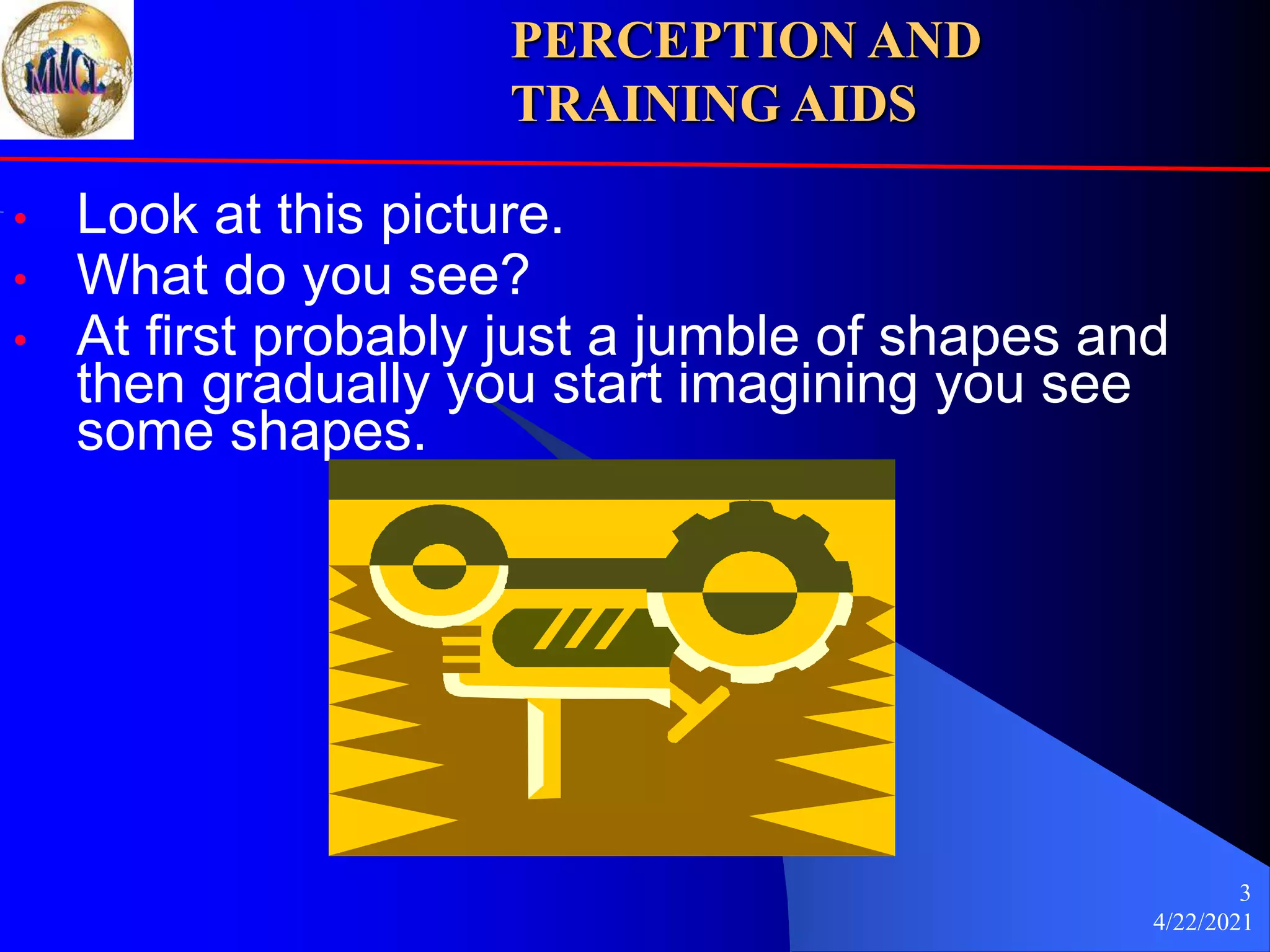
• Look at this picture.
• What do you see?
• At first probably just a jumble of shapes and
then gradually you start imagining you see
some shapes.
PERCEPTION AND
TRAINING AIDS
4/22/2021
4
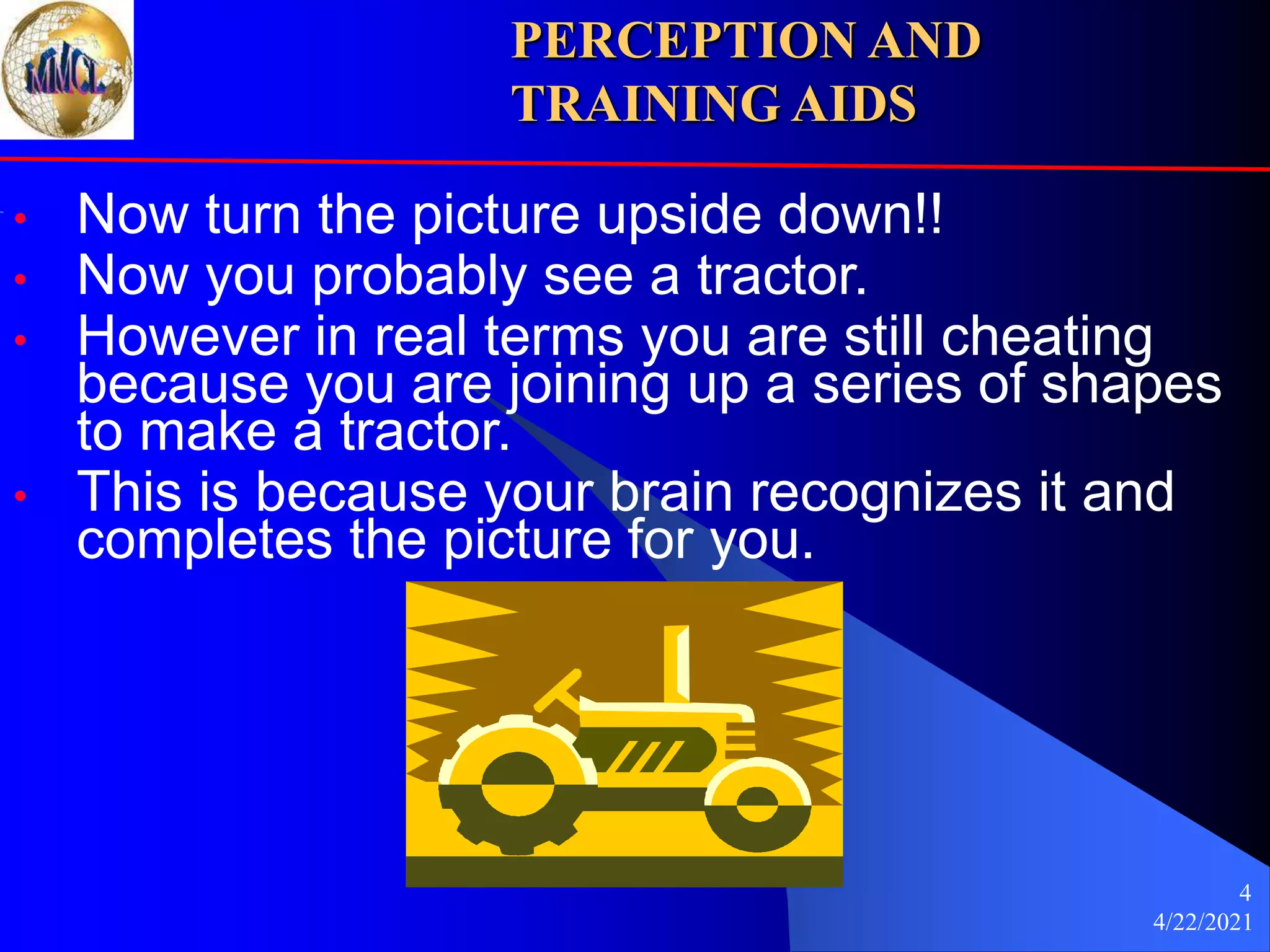
• Now turn the picture upside down!!
• Now you probably see a tractor.
• However in real terms you are still cheating
because you are joining up a series of shapes
to make a tractor.
• This is because your brain recognizes it and
completes the picture for you.
PERCEPTION AND
TRAINING AIDS
4/22/2021
5
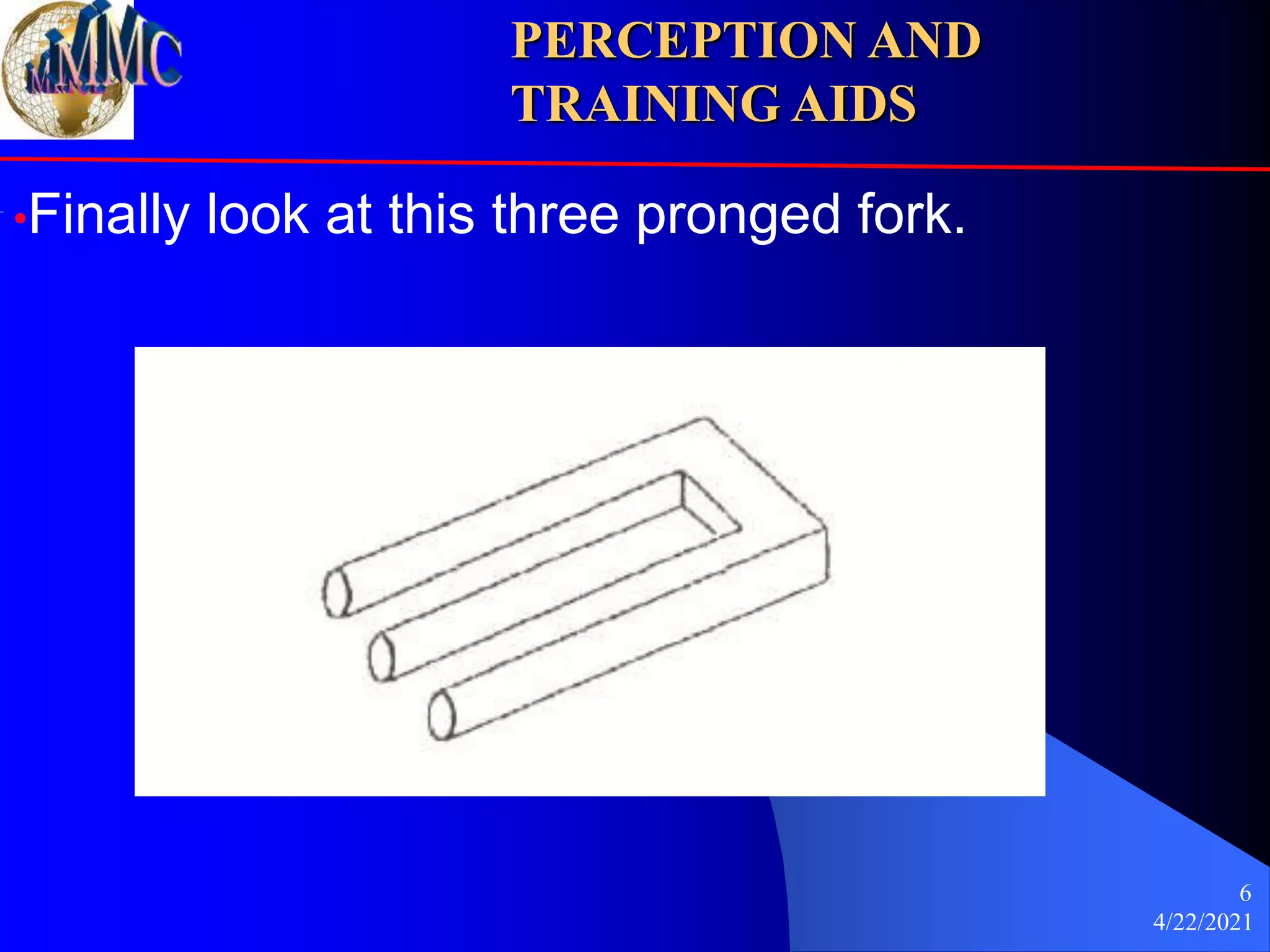
Consider the diagram in the next slide.
• What do you see this time?
• You probably got it right first time because
you are familiar with what to expect but
• Your brain is still filling in the blanks from
experience.
PERCEPTION AND
TRAINING AIDS
4/22/2021
6
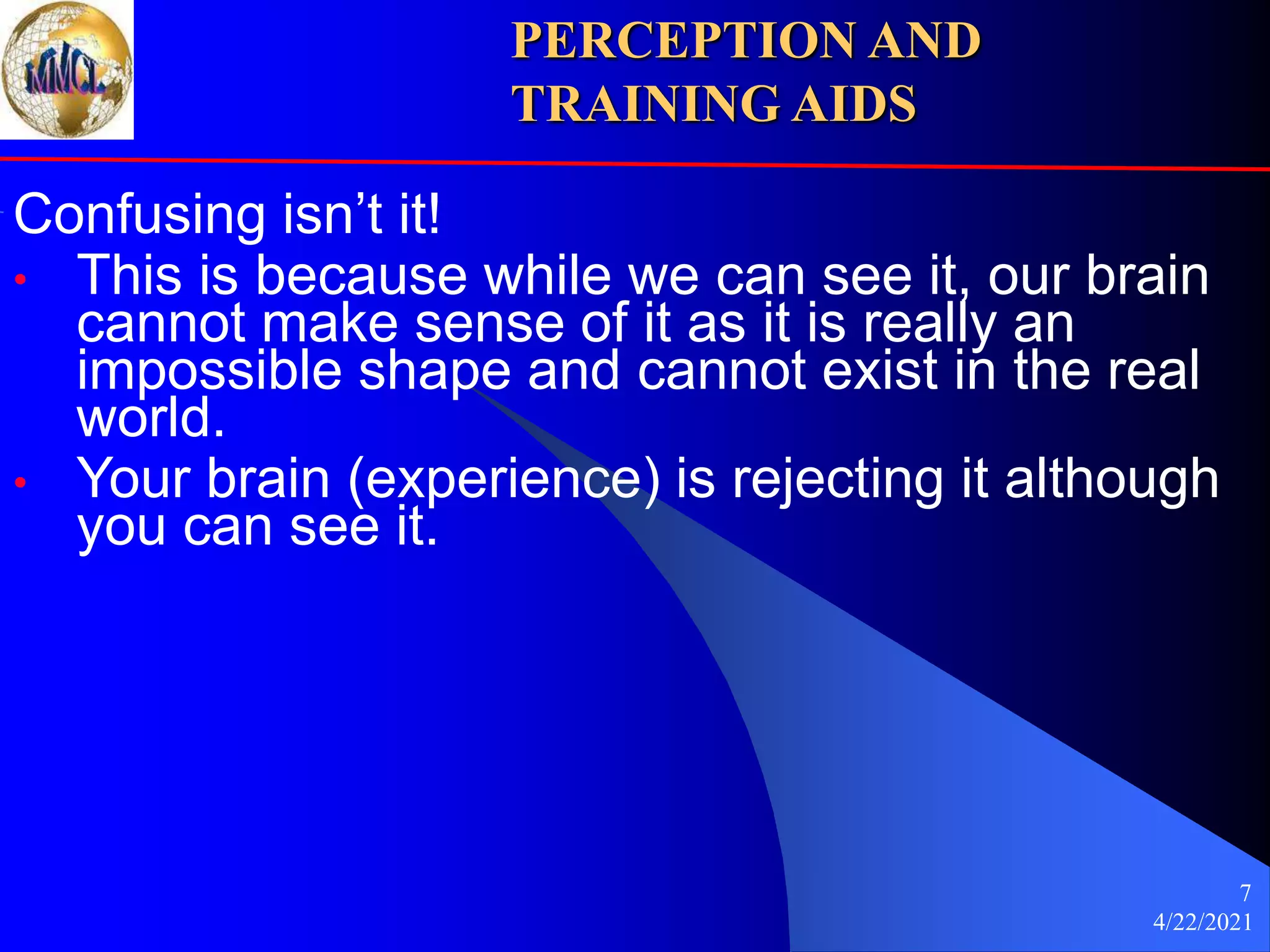
•Finally look at this three pronged fork.
PERCEPTION AND
TRAINING AIDS
4/22/2021
7
Confusing isn’t it!
• This is because while we can see it, our brain
cannot make sense of it as it is really an
impossible shape and cannot exist in the real
world.
• Your brain (experience) is rejecting it although
you can see it.
PERCEPTION AND
TRAINING AIDS
4/22/2021
8
From these examples we learn that it is essential
that
• Trainers choose their visual aids carefully and
also checks with Q & A that what the trainee
perceive is what the trainer wants them to see
when looking at a picture, diagram or real
example
PERCEPTION AND
TRAINING AIDS
4/22/2021
9
Common Training Aids and how to use them
effectively
• Below we have identified the most common
training aids (or learning aids as they are often
called now as their real purpose is to help
leaning process).
PERCEPTION AND
TRAINING AIDS
4/22/2021
10
The main purpose of these is to make trainee
learning easier and interesting by;
Simplifying complicated concepts
Providing real or substitute experience
Aiding reflection on real experience
Improving understanding and conceptualization
Raising and maintaining interest
Providing a focus for Q & A and discussion.
The purposes of this section it to identify the most useful
aids that you might use in training and highlight some of
the important aspects of their use.
PERCEPTION AND
TRAINING AIDS
4/22/2021
11
Real materials
The best learning aids are real materials. Why
use a drawings or slide of a sprayer when your
trainees could see and handle the real thing?
It is essential that wherever possible you should
ensure that trainees experience and see what is
being discussed.
PERCEPTION AND
TRAINING AIDS
4/22/2021
12
• If you have samples of real material then it is
important that they are big enough for all to
see or ... you have enough samples to give
everybody one
• Don’t ask participants to hand round a sample
–you will lose the attention of different
participants at different times and, if it
something delicate, it may not survive the tour!
PERCEPTION AND
TRAINING AIDS
4/22/2021
13
• Presentation Surfaces
• Chalk boards, white boards, flip charts.
• If properly used, these are a very simple and
flexible group of aids but you must plan and
prepare their use as carefully as any other aid.
• Don’t just use it as a scribble pad- most trainers
do!
Things you should do:
 Carefully plan use to develop key points or
show overview of session
PERCEPTION AND
TRAINING AIDS
4/22/2021
14
Add main heading & key points as the session
develops
Keep diagrams very simple –especially if you
expect trainees to copy
Clean it for the next user or session
Make sure your writing is large enough for the
room size (min 25 mm high)- walk to the back to
check
Things not to do:
* Scribble calculations and notes all over the
board-this confuses the trainees
PERCEPTION AND
TRAINING AIDS
4/22/2021
15
Charts and flipcharts
Charts: extremely useful for providing visual aids
for field-based training. You can prepare them in
advance, transport them easily and use them
again and again.
They are also cheap and require no special
equipment or electricity to use.
PERCEPTION AND
TRAINING AIDS
4/22/2021
16
• Flip charts: use them like a marker board but
being able to flip over each sheet, makes them
useful for keeping a record of list and other
points.
• They are good to use for keeping a record of
reports and feedback from group work and
assignments.
PERCEPTION AND
TRAINING AIDS
4/22/2021
17
Things you should do:
Keep diagrams simple –especially if you want
trainees to copy
Use broad-tipped marker pens to ensure lines
are visible
Ensure letter are large enough for the furthest
trainee (min 25mm high)
Use colours for impact, clarity and coding parts
diagrams but limit to 4-5 colours
PERCEPTION AND
TRAINING AIDS
4/22/2021
18
Things not to do:
*Include a lot of written notes or detail
*Place headings and label across the diagram
PERCEPTION AND
TRAINING AIDS
4/22/2021
19
• You do not need to be an artist to produce an
effective chart.
• You can trace from published diagrams (as
long as you are not infringing copyright).
PERCEPTION AND
TRAINING AIDS
4/22/2021
20
Overhead Projector
• The overhead projector can be used to do the
same things that you might do on charts and
chalkboards.
• However it cost more money and cannot be
used in the field.
• On the other hand it has special
advantages: the stimulus created by the
projected image is very attractive if properly
used, and you can use the projector whilst still
facing your trainees and maintaining contact
with them.
PERCEPTION AND
TRAINING AIDS
4/22/2021
21
• Things you should do:
Use spirit-based pens to create a permanent
transparency
Use water-based pens when you need to
remove and reuse the slide
Put lined paper under the transparency when
preparing slides
Ensure the letters (a, e, i, o, u) fill the space
between paper lines to ensure they are large
enough (min 5mm high)
PERCEPTION AND
TRAINING AIDS
4/22/2021
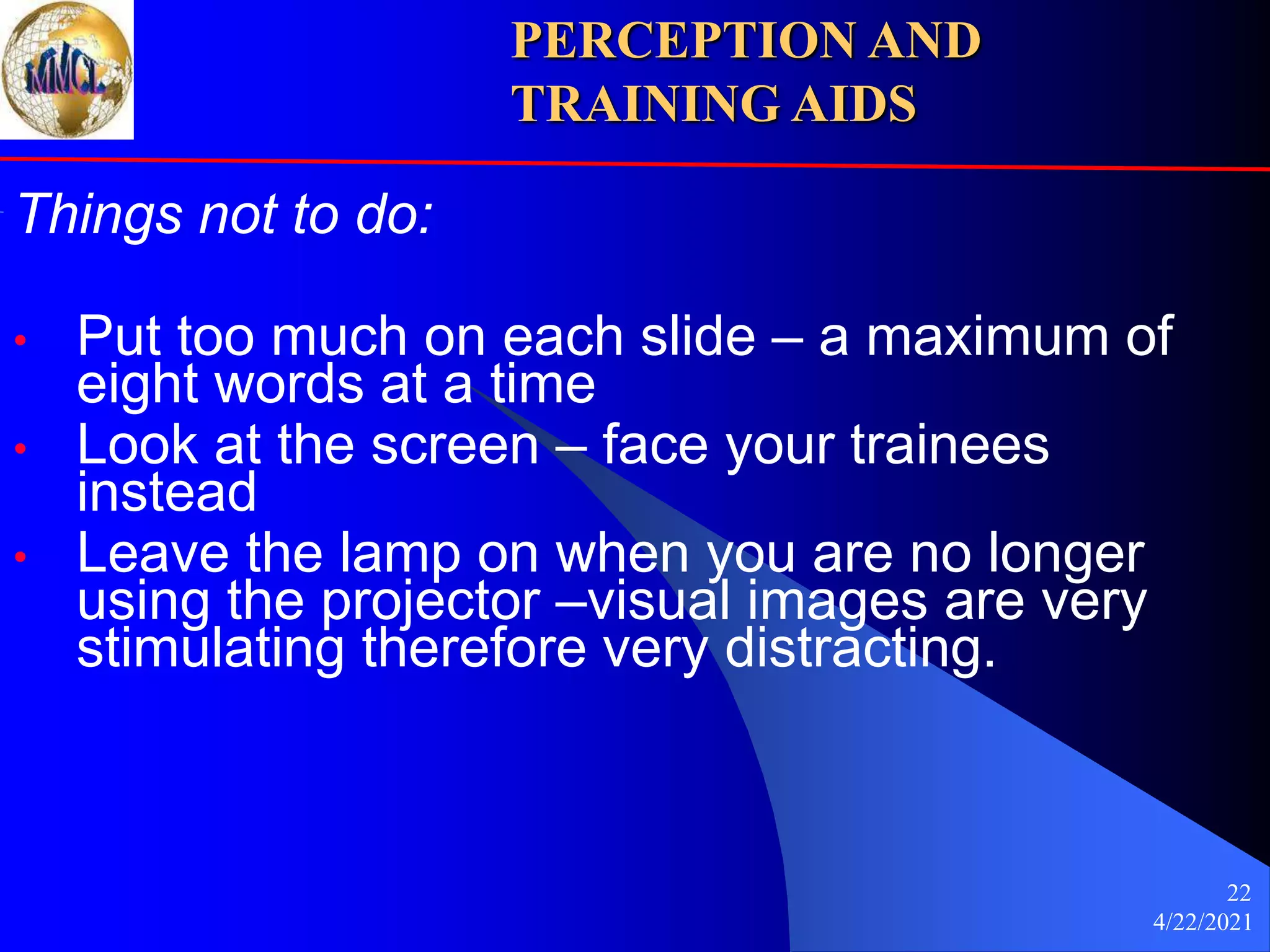
22
Things not to do:
• Put too much on each slide – a maximum of
eight words at a time
• Look at the screen – face your trainees
instead
• Leave the lamp on when you are no longer
using the projector –visual images are very
stimulating therefore very distracting.
PERCEPTION AND
TRAINING AIDS
4/22/2021
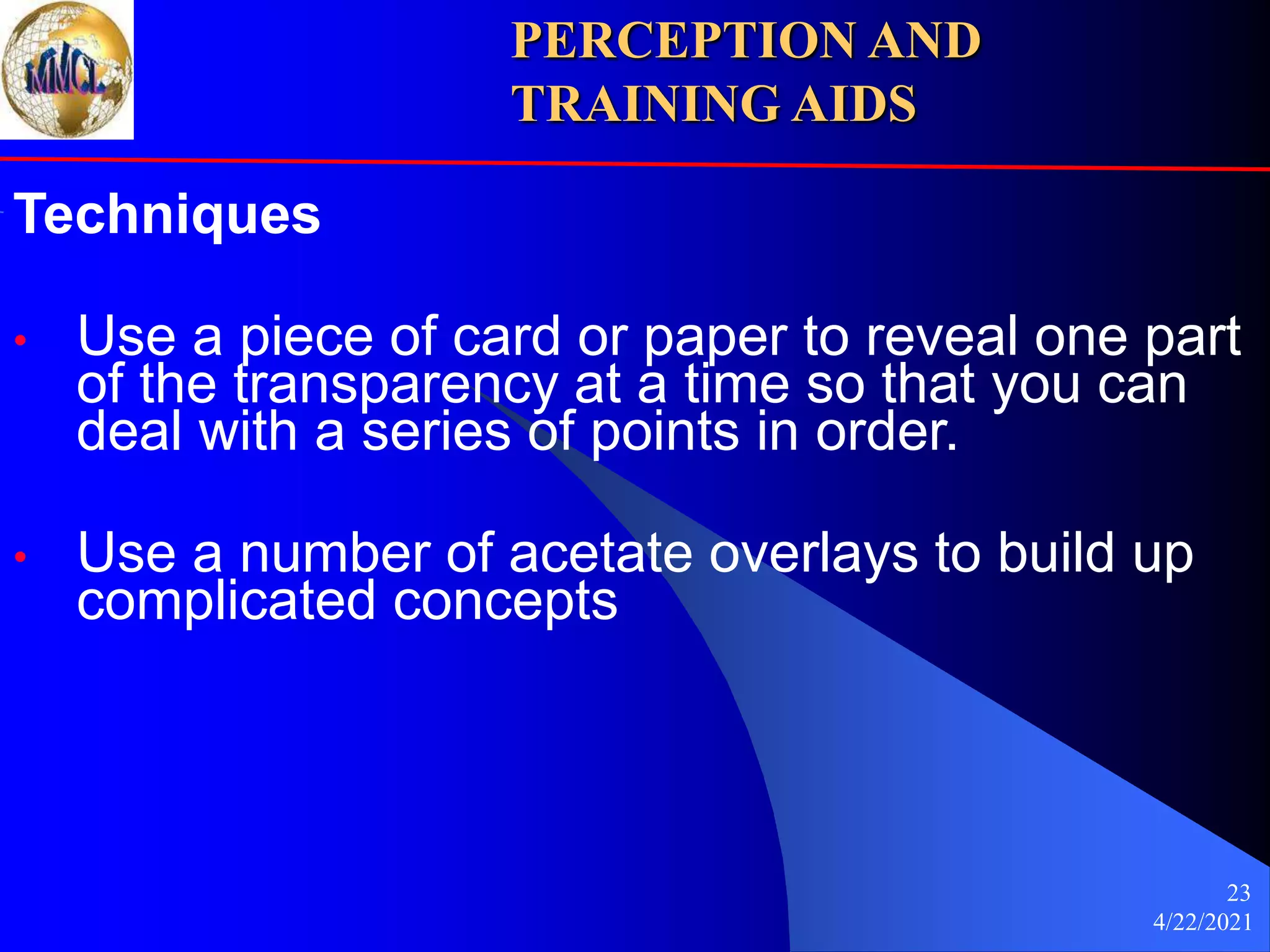
23
Techniques
• Use a piece of card or paper to reveal one part
of the transparency at a time so that you can
deal with a series of points in order.
• Use a number of acetate overlays to build up
complicated concepts
PERCEPTION AND
TRAINING AIDS
4/22/2021
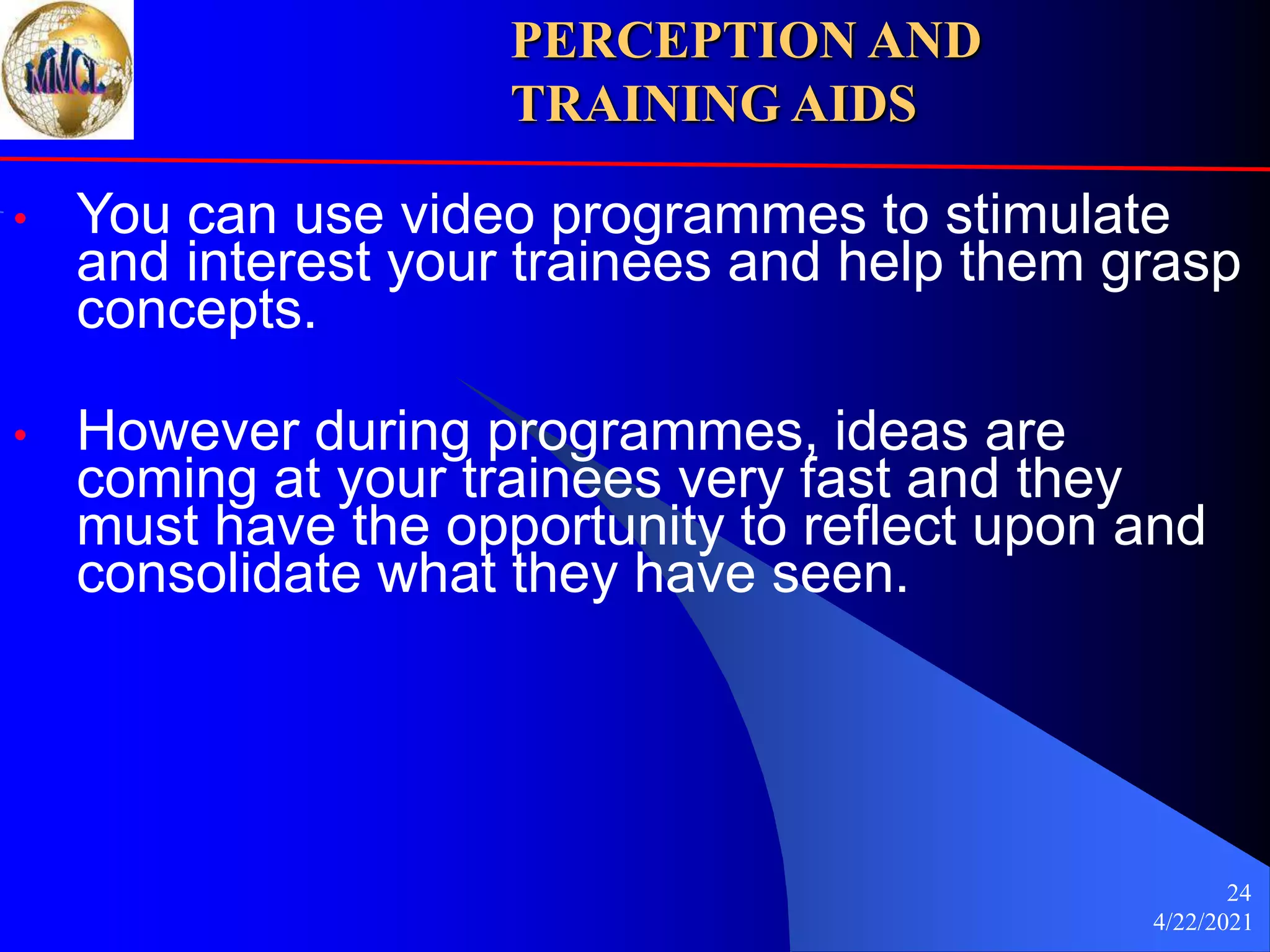
24
• You can use video programmes to stimulate
and interest your trainees and help them grasp
concepts.
• However during programmes, ideas are
coming at your trainees very fast and they
must have the opportunity to reflect upon and
consolidate what they have seen.
PERCEPTION AND
TRAINING AIDS
4/22/2021
25
Things to do:
Brief participants on what they are about to see
Brainstorm key points that they might look for
Ask them to note down key points
Ask them identify key points afterwards and
note on a flipchart or boards.
Develop the main points you want to get out of
the session by Q&A.
PERCEPTION AND
TRAINING AIDS
4/22/2021
26
Things not to do:
× show videos unless they relate directly to
teaching points in your programme.
× don’t show the whole video if you only need to
show a short part to cover the point you are
teaching.
PERCEPTION AND
TRAINING AIDS
4/22/2021
27
Golden Rules for Learning Aids
The most appropriate room layout is in a
semicircle
(perhaps around a table ) so no-one is in front
and no-one behind
PERCEPTION AND
TRAINING AIDS
4/22/2021
28
Visibility
Make sure everybody
can see!
• Don’t stand in front of the screen or board.
• Site the overhead projector (OHP) screen in
the corner and angle it down to avoid
‘keystone’ images .
• Make sure that the writing and images are big
enough for the most distant trainee.
PERCEPTION AND
TRAINING AIDS
4/22/2021
29
Use the learning aid at the right moment.
• Aids should be used to focus attention on
particular teaching points.
• They should be used like “hand holds” to take
the trainees step by step though the session.
• They should help to structure and ‘paragraph’
the session and be removed when no longer
needed.
PERCEPTION AND
TRAINING AIDS

Chapter 8: Perception and Visual Aids

  • 1.
    4/22/2021 1 CHAPTER 8 TRAIN THETRAINER PERCEPTION AND TRAINING AIDS
  • 2.
    4/22/2021 2 Training Aids Perception • Itis worth remembering that while a number of people can look at end and see the same picture /object/event they do not always see what we see. • We all tend to see things against a background of our experience PERCEPTION AND TRAINING AIDS
  • 3.
    4/22/2021 3 • Look atthis picture. • What do you see? • At first probably just a jumble of shapes and then gradually you start imagining you see some shapes. PERCEPTION AND TRAINING AIDS
  • 4.
    4/22/2021 4 • Now turnthe picture upside down!! • Now you probably see a tractor. • However in real terms you are still cheating because you are joining up a series of shapes to make a tractor. • This is because your brain recognizes it and completes the picture for you. PERCEPTION AND TRAINING AIDS
  • 5.
    4/22/2021 5 Consider the diagramin the next slide. • What do you see this time? • You probably got it right first time because you are familiar with what to expect but • Your brain is still filling in the blanks from experience. PERCEPTION AND TRAINING AIDS
  • 6.
    4/22/2021 6 •Finally look atthis three pronged fork. PERCEPTION AND TRAINING AIDS
  • 7.
    4/22/2021 7 Confusing isn’t it! •This is because while we can see it, our brain cannot make sense of it as it is really an impossible shape and cannot exist in the real world. • Your brain (experience) is rejecting it although you can see it. PERCEPTION AND TRAINING AIDS
  • 8.
    4/22/2021 8 From these exampleswe learn that it is essential that • Trainers choose their visual aids carefully and also checks with Q & A that what the trainee perceive is what the trainer wants them to see when looking at a picture, diagram or real example PERCEPTION AND TRAINING AIDS
  • 9.
    4/22/2021 9 Common Training Aidsand how to use them effectively • Below we have identified the most common training aids (or learning aids as they are often called now as their real purpose is to help leaning process). PERCEPTION AND TRAINING AIDS
  • 10.
    4/22/2021 10 The main purposeof these is to make trainee learning easier and interesting by; Simplifying complicated concepts Providing real or substitute experience Aiding reflection on real experience Improving understanding and conceptualization Raising and maintaining interest Providing a focus for Q & A and discussion. The purposes of this section it to identify the most useful aids that you might use in training and highlight some of the important aspects of their use. PERCEPTION AND TRAINING AIDS
  • 11.
    4/22/2021 11 Real materials The bestlearning aids are real materials. Why use a drawings or slide of a sprayer when your trainees could see and handle the real thing? It is essential that wherever possible you should ensure that trainees experience and see what is being discussed. PERCEPTION AND TRAINING AIDS
  • 12.
    4/22/2021 12 • If youhave samples of real material then it is important that they are big enough for all to see or ... you have enough samples to give everybody one • Don’t ask participants to hand round a sample –you will lose the attention of different participants at different times and, if it something delicate, it may not survive the tour! PERCEPTION AND TRAINING AIDS
  • 13.
    4/22/2021 13 • Presentation Surfaces •Chalk boards, white boards, flip charts. • If properly used, these are a very simple and flexible group of aids but you must plan and prepare their use as carefully as any other aid. • Don’t just use it as a scribble pad- most trainers do! Things you should do:  Carefully plan use to develop key points or show overview of session PERCEPTION AND TRAINING AIDS
  • 14.
    4/22/2021 14 Add main heading& key points as the session develops Keep diagrams very simple –especially if you expect trainees to copy Clean it for the next user or session Make sure your writing is large enough for the room size (min 25 mm high)- walk to the back to check Things not to do: * Scribble calculations and notes all over the board-this confuses the trainees PERCEPTION AND TRAINING AIDS
  • 15.
    4/22/2021 15 Charts and flipcharts Charts:extremely useful for providing visual aids for field-based training. You can prepare them in advance, transport them easily and use them again and again. They are also cheap and require no special equipment or electricity to use. PERCEPTION AND TRAINING AIDS
  • 16.
    4/22/2021 16 • Flip charts:use them like a marker board but being able to flip over each sheet, makes them useful for keeping a record of list and other points. • They are good to use for keeping a record of reports and feedback from group work and assignments. PERCEPTION AND TRAINING AIDS
  • 17.
    4/22/2021 17 Things you shoulddo: Keep diagrams simple –especially if you want trainees to copy Use broad-tipped marker pens to ensure lines are visible Ensure letter are large enough for the furthest trainee (min 25mm high) Use colours for impact, clarity and coding parts diagrams but limit to 4-5 colours PERCEPTION AND TRAINING AIDS
  • 18.
    4/22/2021 18 Things not todo: *Include a lot of written notes or detail *Place headings and label across the diagram PERCEPTION AND TRAINING AIDS
  • 19.
    4/22/2021 19 • You donot need to be an artist to produce an effective chart. • You can trace from published diagrams (as long as you are not infringing copyright). PERCEPTION AND TRAINING AIDS
  • 20.
    4/22/2021 20 Overhead Projector • Theoverhead projector can be used to do the same things that you might do on charts and chalkboards. • However it cost more money and cannot be used in the field. • On the other hand it has special advantages: the stimulus created by the projected image is very attractive if properly used, and you can use the projector whilst still facing your trainees and maintaining contact with them. PERCEPTION AND TRAINING AIDS
  • 21.
    4/22/2021 21 • Things youshould do: Use spirit-based pens to create a permanent transparency Use water-based pens when you need to remove and reuse the slide Put lined paper under the transparency when preparing slides Ensure the letters (a, e, i, o, u) fill the space between paper lines to ensure they are large enough (min 5mm high) PERCEPTION AND TRAINING AIDS
  • 22.
    4/22/2021 22 Things not todo: • Put too much on each slide – a maximum of eight words at a time • Look at the screen – face your trainees instead • Leave the lamp on when you are no longer using the projector –visual images are very stimulating therefore very distracting. PERCEPTION AND TRAINING AIDS
  • 23.
    4/22/2021 23 Techniques • Use apiece of card or paper to reveal one part of the transparency at a time so that you can deal with a series of points in order. • Use a number of acetate overlays to build up complicated concepts PERCEPTION AND TRAINING AIDS
  • 24.
    4/22/2021 24 • You canuse video programmes to stimulate and interest your trainees and help them grasp concepts. • However during programmes, ideas are coming at your trainees very fast and they must have the opportunity to reflect upon and consolidate what they have seen. PERCEPTION AND TRAINING AIDS
  • 25.
    4/22/2021 25 Things to do: Briefparticipants on what they are about to see Brainstorm key points that they might look for Ask them to note down key points Ask them identify key points afterwards and note on a flipchart or boards. Develop the main points you want to get out of the session by Q&A. PERCEPTION AND TRAINING AIDS
  • 26.
    4/22/2021 26 Things not todo: × show videos unless they relate directly to teaching points in your programme. × don’t show the whole video if you only need to show a short part to cover the point you are teaching. PERCEPTION AND TRAINING AIDS
  • 27.
    4/22/2021 27 Golden Rules forLearning Aids The most appropriate room layout is in a semicircle (perhaps around a table ) so no-one is in front and no-one behind PERCEPTION AND TRAINING AIDS
  • 28.
    4/22/2021 28 Visibility Make sure everybody cansee! • Don’t stand in front of the screen or board. • Site the overhead projector (OHP) screen in the corner and angle it down to avoid ‘keystone’ images . • Make sure that the writing and images are big enough for the most distant trainee. PERCEPTION AND TRAINING AIDS
  • 29.
    4/22/2021 29 Use the learningaid at the right moment. • Aids should be used to focus attention on particular teaching points. • They should be used like “hand holds” to take the trainees step by step though the session. • They should help to structure and ‘paragraph’ the session and be removed when no longer needed. PERCEPTION AND TRAINING AIDS