Course #:  LD123 Title:  Train the Trainer Scheduled For:  Monday, Round Two, 2:15-3:15 pm Presented By:  William L. Ware,  CMDSM     Oce Business Services
Training Today As important as training is these days, many organizations can’t afford the luxury of having experienced trainers on staff. Or, if they do, their trainers can’t keep up with the increasing demands as jobs change and re-training becomes necessary. As a result, those who never had the opportunity to develop professional training skills are occasionally being required to develop and conduct training sessions.
Principles of Training Becoming aware of what constitutes a good teacher/trainer Learning how to teach adults and others Developing a rich learning experience using various methods Learning how to create a lesson plan/teaching guide Exploring icebreakers and learning how to use them effectively Learning how to create presentations and present them properly Learning how to time a lesson
Training Workshop The essential workshop for those who wish to present workshops and training classes for adults.
Workshop Outline What is the goal of the Trainer? A Good Teacher is … How do we teach adults? Teaching to the brain How will I teach? How to create an engaging atmosphere Create a teaching guide How will you begin your class? Icebreakers Create your presentation Present the presentation End your presentation on time Prepare for Disruptors Checklist before and day of training
Training Program How To: Conduct a needs assessment Identify their training style Design their instructional plan Use active training techniques Deliver their training Evaluate their training
Train the Trainer Introduction Psychology of Learning Prepare the Lesson Plan Instructional Methods How to Conduct Classroom Presentations The Use of Transitions Advantage of Questions Quick List of Hints for Good Instruction
1. Introduction Effective instruction requires planning The instructor must know what he wants his students to learn
2.  Psychology of Learning Characteristics of Learning Learning Concepts & Generalizations Laws of Learning
A. Characteristics of Learning Learning comes through experience Learning is multifaceted Learning is an active process
B. Learning Concepts & Generalizations Concept  formation Foundations of generalization & concepts Tips for the instructor
C. Laws of Learning Law of Readiness Law of Exercise Law of Effect Law of Primacy Law of Intensity Law of Recency
Psychology’s Rules of Learning Stimulate Students Recognize Individual Differences Understanding and Repetition Aid Retention Distributed Practice Aids Retention Show It Like It Is First and Last Impressions Are Retained Exotic Experience is Remembered Showing Errors Can Aid Learning Rewards Aid Learning Recognition is Easier Than Recall
Psychology’s Rules of Learning Much is Forgotten Rapidly Known Authorities Are Believed Exact Repetition Effective Fear Is Effective In Small Doses Success Begets Further Success Tie-In Is Essential To Learning “ Belongingness” and “Satisfiers” Aid Learning Old and Strong Ideas Are Best Retained Active Practice Is Best New Learning May Detract From Previous Learning
3. Prepare The Lesson Plan Research the Topic Writing Objectives Lesson Plan Sections Lesson Plan Cover Page
A. Research the Topic Instructional research is getting all available materials on the subject together and reading or looking at it for relevant information. All supporting material and training aids must be checked for accuracy and usefulness.
B. Writing Objectives A training objective must state the task to be done, the condition under which behavior will take place and be observed, and the standards the behavior should meet. A complete objective will contain a Task, a Condition, and a Standard.
B. Writing Objectives Description of Performance (TASK) Conditions Under Which the Behavior is to be Observed Job Aids, Handouts, Instructions, Pre-printed Forms, other Written Documents Standards the Student Must Meet
C. Lesson Plan Sections Introduction Explanation/Demonstration/Application Evaluation
C. Lesson Plan Sections Introduction Reason / Motivation Objective Procedures Lesson Plan Paragraph Format
Evaluation The Purpose of the Student Evaluation Monitor Student Achievement Identify Problem Areas Secondary Evaluation Function Lets you know if you were successful teaching your objectives. Allows you to make decisions about the instructional methods and/or materials. Judging student progress. Facilitating student learning.
D. Lesson Plan Coverage Page Instructional Unit Instructor Names Type Time Required training Aids Handouts Objective Purpose Tie-In
4. Instructional Methods Lecture Method Demonstration Method Practical Exercise Controlled Practical Exercise Practice Method Case Study or team Practice Coach and Pupil Independent
How to Develop a Teaching Point From  Simple to Complex From  Known to Unknown From  Most Frequently Used to  Least Frequently Used From  Past to Present
5. How to Conduct Classroom Presentations Knowledge of the Subject to be Taught Effective Communication
A. Knowledge of the Subject to be Taught An instructor’s communication of thought, concept, skill, or teaching must be based on a foundation of subject mastery.
B. Effective Communication Physical Vitality Contact Vitality Voice Vitality Word Vitality
6. The Use of Transition s Refer to the subject Use frequent summaries Use rhetorical questions Use connective words and phrases Number points
7. Advantage of Questions Increases Student Interest Stimulates Student Thinking Reveals Student Attitudes Permits Student Contribution Provides Emphasis and Reinforcement of Main Points Checks the Effectiveness of the Instruction
Questioning Techniques Specific Purpose Clarity Require a Definite Answer Emphasize One Point
8. List of Hints for Instructors The Introduction The Delivery The Summary Classroom Management Demonstrations Application Practical Exercises Evaluations
Effective Training Techniques Preparing new employees to perform their jobs Developing employees to be more efficient and productive Preparing employees for advancement to more responsible positions
Developing a Training Program Identifying training needs Establishing objectives Analyzing the target audience Developing lesson plans Conducting the training sessions Evaluating the training program
1. Identifying Training Needs Employees may indicate training needs by asking questions or by expressing a desire to learn more about something. Supervisors and managers will become aware of training needs through daily observation, assessments of the effect of change, and clues provided by internal records and reports. Immediate needs may be identified through internal reports of deficiencies and recommendations of regulatory and accrediting agencies. Evaluations of the effectiveness of previous training programs may identify needs for retraining or follow-up.
2. Establishing Objectives Specifying for participants what they will learn and what they will be expected to do as a result of their learning. Serving as a guide for planning and structuring the content of the training session. Selecting and sequencing the development of topics or units of study. Identifying and selecting appropriate instructional techniques and materials. Providing a basis for determining how and when to evaluate participant achievement.
3. Analyzing the Target Audience Who will be in attendance at the meeting? What does the audience know? What does the audience want to know?
Analyzing the Target Audience People learn at different speeds. Anxiety and nervousness are natural. Peaks and valleys in the rate of learning are common. Trainees may become discouraged.
4. Developing Lesson Plans Introduction Subject Matter Demonstration and Audiovisuals Training Methods
A. Introduction Statement of the objectives Explanation of the value Definitions of the terms Descriptions of equipment Duration – length of class
B. Subject Matter Present 3 – 5 major points Points in logical order Present one point at a time
C. Demonstration and Audiovisuals Blackboard or Chalkboard Chart Pads Charts Overhead Transparency Projector Slide/Filmstrip Projectors Motion Picture Projector Model or Mock-up Tape Recorder Handouts Video Tape Recorder
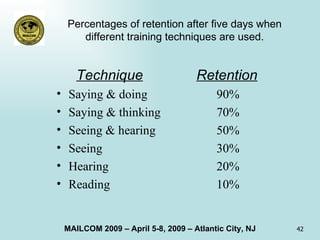
Percentages of retention after five days when different training techniques are used. Technique   Retention Saying & doing 90% Saying & thinking 70% Seeing & hearing 50% Seeing 30% Hearing 20% Reading 10%
D. Training Meth ods Lecture Demonstration Life Line Work Group Buzz Group Shot Gun Questions Rifle Shot Questions Role Playing Case Studies Testing Summarize
5. Conducting the Training Session Prepare Project Self-confidence Encourage Participation Keep Control
6. Evaluating the Training Session Identify participants’ attitudes about learning to create a responsive learning environment. Identify participants’ experiences and abilities to shape program content. Identify participants’ learning difficulties to discover areas that may require review or re-teaching. Assess the effectiveness of instruction to determine the appropriateness of teaching materials and techniques.
The Five “Ps” of Successful Training Plan  Your Session Prepare  Your Trainee Present  the Job Prove  Understanding Practice  Time
Train the Trainer Thank  You
Contact  Information William L. Ware ,  CMDSM Senior Site Manager Oce Business Services, Inc. AllianceBernstein, LLC 1345 Avenue of the Americas, 9 th  flr New York, NY 10105 212-969-6951  office E-mail – william.ware@alliancebernstein.com

MailCom 2009 Train The Trainer

  • 1.
    Course #: LD123 Title: Train the Trainer Scheduled For: Monday, Round Two, 2:15-3:15 pm Presented By: William L. Ware, CMDSM Oce Business Services
  • 2.
    Training Today Asimportant as training is these days, many organizations can’t afford the luxury of having experienced trainers on staff. Or, if they do, their trainers can’t keep up with the increasing demands as jobs change and re-training becomes necessary. As a result, those who never had the opportunity to develop professional training skills are occasionally being required to develop and conduct training sessions.
  • 3.
    Principles of TrainingBecoming aware of what constitutes a good teacher/trainer Learning how to teach adults and others Developing a rich learning experience using various methods Learning how to create a lesson plan/teaching guide Exploring icebreakers and learning how to use them effectively Learning how to create presentations and present them properly Learning how to time a lesson
  • 4.
    Training Workshop Theessential workshop for those who wish to present workshops and training classes for adults.
  • 5.
    Workshop Outline Whatis the goal of the Trainer? A Good Teacher is … How do we teach adults? Teaching to the brain How will I teach? How to create an engaging atmosphere Create a teaching guide How will you begin your class? Icebreakers Create your presentation Present the presentation End your presentation on time Prepare for Disruptors Checklist before and day of training
  • 6.
    Training Program HowTo: Conduct a needs assessment Identify their training style Design their instructional plan Use active training techniques Deliver their training Evaluate their training
  • 7.
    Train the TrainerIntroduction Psychology of Learning Prepare the Lesson Plan Instructional Methods How to Conduct Classroom Presentations The Use of Transitions Advantage of Questions Quick List of Hints for Good Instruction
  • 8.
    1. Introduction Effectiveinstruction requires planning The instructor must know what he wants his students to learn
  • 9.
    2. Psychologyof Learning Characteristics of Learning Learning Concepts & Generalizations Laws of Learning
  • 10.
    A. Characteristics ofLearning Learning comes through experience Learning is multifaceted Learning is an active process
  • 11.
    B. Learning Concepts& Generalizations Concept formation Foundations of generalization & concepts Tips for the instructor
  • 12.
    C. Laws ofLearning Law of Readiness Law of Exercise Law of Effect Law of Primacy Law of Intensity Law of Recency
  • 13.
    Psychology’s Rules ofLearning Stimulate Students Recognize Individual Differences Understanding and Repetition Aid Retention Distributed Practice Aids Retention Show It Like It Is First and Last Impressions Are Retained Exotic Experience is Remembered Showing Errors Can Aid Learning Rewards Aid Learning Recognition is Easier Than Recall
  • 14.
    Psychology’s Rules ofLearning Much is Forgotten Rapidly Known Authorities Are Believed Exact Repetition Effective Fear Is Effective In Small Doses Success Begets Further Success Tie-In Is Essential To Learning “ Belongingness” and “Satisfiers” Aid Learning Old and Strong Ideas Are Best Retained Active Practice Is Best New Learning May Detract From Previous Learning
  • 15.
    3. Prepare TheLesson Plan Research the Topic Writing Objectives Lesson Plan Sections Lesson Plan Cover Page
  • 16.
    A. Research theTopic Instructional research is getting all available materials on the subject together and reading or looking at it for relevant information. All supporting material and training aids must be checked for accuracy and usefulness.
  • 17.
    B. Writing ObjectivesA training objective must state the task to be done, the condition under which behavior will take place and be observed, and the standards the behavior should meet. A complete objective will contain a Task, a Condition, and a Standard.
  • 18.
    B. Writing ObjectivesDescription of Performance (TASK) Conditions Under Which the Behavior is to be Observed Job Aids, Handouts, Instructions, Pre-printed Forms, other Written Documents Standards the Student Must Meet
  • 19.
    C. Lesson PlanSections Introduction Explanation/Demonstration/Application Evaluation
  • 20.
    C. Lesson PlanSections Introduction Reason / Motivation Objective Procedures Lesson Plan Paragraph Format
  • 21.
    Evaluation The Purposeof the Student Evaluation Monitor Student Achievement Identify Problem Areas Secondary Evaluation Function Lets you know if you were successful teaching your objectives. Allows you to make decisions about the instructional methods and/or materials. Judging student progress. Facilitating student learning.
  • 22.
    D. Lesson PlanCoverage Page Instructional Unit Instructor Names Type Time Required training Aids Handouts Objective Purpose Tie-In
  • 23.
    4. Instructional MethodsLecture Method Demonstration Method Practical Exercise Controlled Practical Exercise Practice Method Case Study or team Practice Coach and Pupil Independent
  • 24.
    How to Developa Teaching Point From Simple to Complex From Known to Unknown From Most Frequently Used to Least Frequently Used From Past to Present
  • 25.
    5. How toConduct Classroom Presentations Knowledge of the Subject to be Taught Effective Communication
  • 26.
    A. Knowledge ofthe Subject to be Taught An instructor’s communication of thought, concept, skill, or teaching must be based on a foundation of subject mastery.
  • 27.
    B. Effective CommunicationPhysical Vitality Contact Vitality Voice Vitality Word Vitality
  • 28.
    6. The Useof Transition s Refer to the subject Use frequent summaries Use rhetorical questions Use connective words and phrases Number points
  • 29.
    7. Advantage ofQuestions Increases Student Interest Stimulates Student Thinking Reveals Student Attitudes Permits Student Contribution Provides Emphasis and Reinforcement of Main Points Checks the Effectiveness of the Instruction
  • 30.
    Questioning Techniques SpecificPurpose Clarity Require a Definite Answer Emphasize One Point
  • 31.
    8. List ofHints for Instructors The Introduction The Delivery The Summary Classroom Management Demonstrations Application Practical Exercises Evaluations
  • 32.
    Effective Training TechniquesPreparing new employees to perform their jobs Developing employees to be more efficient and productive Preparing employees for advancement to more responsible positions
  • 33.
    Developing a TrainingProgram Identifying training needs Establishing objectives Analyzing the target audience Developing lesson plans Conducting the training sessions Evaluating the training program
  • 34.
    1. Identifying TrainingNeeds Employees may indicate training needs by asking questions or by expressing a desire to learn more about something. Supervisors and managers will become aware of training needs through daily observation, assessments of the effect of change, and clues provided by internal records and reports. Immediate needs may be identified through internal reports of deficiencies and recommendations of regulatory and accrediting agencies. Evaluations of the effectiveness of previous training programs may identify needs for retraining or follow-up.
  • 35.
    2. Establishing ObjectivesSpecifying for participants what they will learn and what they will be expected to do as a result of their learning. Serving as a guide for planning and structuring the content of the training session. Selecting and sequencing the development of topics or units of study. Identifying and selecting appropriate instructional techniques and materials. Providing a basis for determining how and when to evaluate participant achievement.
  • 36.
    3. Analyzing theTarget Audience Who will be in attendance at the meeting? What does the audience know? What does the audience want to know?
  • 37.
    Analyzing the TargetAudience People learn at different speeds. Anxiety and nervousness are natural. Peaks and valleys in the rate of learning are common. Trainees may become discouraged.
  • 38.
    4. Developing LessonPlans Introduction Subject Matter Demonstration and Audiovisuals Training Methods
  • 39.
    A. Introduction Statementof the objectives Explanation of the value Definitions of the terms Descriptions of equipment Duration – length of class
  • 40.
    B. Subject MatterPresent 3 – 5 major points Points in logical order Present one point at a time
  • 41.
    C. Demonstration andAudiovisuals Blackboard or Chalkboard Chart Pads Charts Overhead Transparency Projector Slide/Filmstrip Projectors Motion Picture Projector Model or Mock-up Tape Recorder Handouts Video Tape Recorder
  • 42.
    Percentages of retentionafter five days when different training techniques are used. Technique Retention Saying & doing 90% Saying & thinking 70% Seeing & hearing 50% Seeing 30% Hearing 20% Reading 10%
  • 43.
    D. Training Methods Lecture Demonstration Life Line Work Group Buzz Group Shot Gun Questions Rifle Shot Questions Role Playing Case Studies Testing Summarize
  • 44.
    5. Conducting theTraining Session Prepare Project Self-confidence Encourage Participation Keep Control
  • 45.
    6. Evaluating theTraining Session Identify participants’ attitudes about learning to create a responsive learning environment. Identify participants’ experiences and abilities to shape program content. Identify participants’ learning difficulties to discover areas that may require review or re-teaching. Assess the effectiveness of instruction to determine the appropriateness of teaching materials and techniques.
  • 46.
    The Five “Ps”of Successful Training Plan Your Session Prepare Your Trainee Present the Job Prove Understanding Practice Time
  • 47.
  • 48.
    Contact InformationWilliam L. Ware , CMDSM Senior Site Manager Oce Business Services, Inc. AllianceBernstein, LLC 1345 Avenue of the Americas, 9 th flr New York, NY 10105 212-969-6951 office E-mail – william.ware@alliancebernstein.com