4/22/2021
1
CHAPTER 3
TRAIN THE
TRAINER LEARNING
PROCESS, STYLES
OF TRAINING & SIOM
4/22/2021
2
LEARNING PROCESS
(INTRODUCTION)
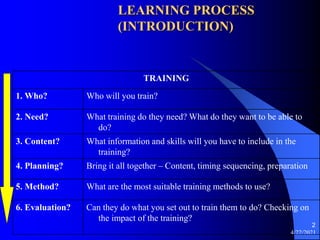
TRAINING
1. Who? Who will you train?
2. Need? What training do they need? What do they want to be able to
do?
3. Content? What information and skills will you have to include in the
training?
4. Planning? Bring it all together – Content, timing sequencing, preparation
5. Method? What are the most suitable training methods to use?
6. Evaluation? Can they do what you set out to train them to do? Checking on
the impact of the training?
4/22/2021
3
These simple steps are explained in more detail
below
 STEP1. WHO?
LEARNING PROCESS
(INTRODUCTION)
4/22/2021
4
Training action
 Get a clear picture/description (profile) of the
people you will be training. We call this our
Target Group Profile
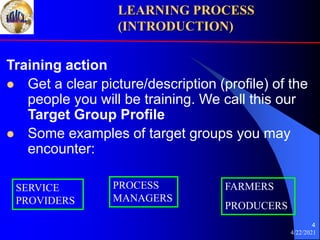
 Some examples of target groups you may
encounter:
LEARNING PROCESS
(INTRODUCTION)
SERVICE
PROVIDERS
PROCESS
MANAGERS
FARMERS
PRODUCERS
4/22/2021
5
 The experience and ability of individual and
groups will be different and these differences
need to be accurately identified so that
planning and the choice of training methods
can closely match the learner’s needs.
LEARNING PROCESS
(INTRODUCTION)
4/22/2021
6
STEP 2. Need?
Training action
 Once a target group profile has been
developed the trainer can progress to
carrying out a Training Needs Analysis
(TNA).
 The TNA helps the trainer to find out what
the trainees already know and what
training they need to reach the level of
performance required to do their work
successively.
LEARNING PROCESS
(INTRODUCTION)
4/22/2021
7
In simple terms we try to get the answers to two
questions. These are;
 What can our target group do now? (Before
training)
 What it is we want our target group to do?
(After training)
LEARNING PROCESS
(INTRODUCTION)
4/22/2021
8
 By comparing these answers we will be able
to identify the target group training or
performance gaps.
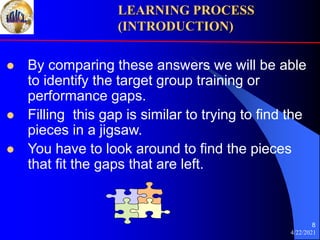
 Filling this gap is similar to trying to find the
pieces in a jigsaw.
 You have to look around to find the pieces
that fit the gaps that are left.
LEARNING PROCESS
(INTRODUCTION)
4/22/2021
9
STEP 3. Contents?
 When you have specified your target
group and decided the new abilities you
want them to develop.
 (What new things they will have to be able
to do), you can then work on identifying
what new knowledge, skills and attitudes
they will have to develop to achieve these
new abilities.
LEARNING PROCESS
(INTRODUCTION)
4/22/2021
10
 We describe what we want the trainees to do
(achieve) in a certain way. These are
Learning Objectives
 An example is:
 The trainee will identify the main stages in
the life cycle of the Diamond Black Moth and
describe the main physical features of each
stage.
LEARNING PROCESS
(INTRODUCTION)
4/22/2021
11
STEP 4. Planning?
 Planning is a central process in training.
 Planning allows us to bring together all the
information gathered in steps one to three.
 The main purpose of planning is to decide
how the training is to be structured and
delivered. Usually this will mean:
LEARNING PROCESS
(INTRODUCTION)
4/22/2021
12
 Usually this will mean:
 Deciding the overall time that can be
allocated to the training
 Deciding how to allocate that time to the
topics to be covered
 Deciding where and when the training is to
be carried out
 Deciding what facilities and equipment are
needed
LEARNING PROCESS
(INTRODUCTION)
4/22/2021
13
 Developing a detailed programme which
states the overall objectives and allocate
objectives to each sub-section or session in
the training course
 Specifying objectives to achieve the
programme
 Ensuring that the programme is logical and
each session is building on the previous
session
LEARNING PROCESS
(INTRODUCTION)
4/22/2021
14
The trainer uses objectives as the starting point
in developing the ‘Training Plan’.
Planning is often difficult as it is usually
necessary to make compromises where there is
not enough time to cover all the topics, where
there is a shortage of resources, where the
target group is from a very wide background and
many similar restrictions.
LEARNING PROCESS
(INTRODUCTION)
4/22/2021
15
Most trainers try to cover too much in the time
available and that is why it is essential to have
clear objectives and to stick to these when
planning and delivering training sessions. In
planning each session we begin by stating what
we want our trainees to do (the objective).
LEARNING PROCESS
(INTRODUCTION)
4/22/2021
16
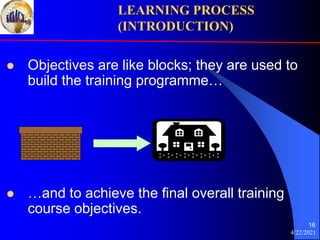
 Objectives are like blocks; they are used to
build the training programme…
 …and to achieve the final overall training
course objectives.
LEARNING PROCESS
(INTRODUCTION)
4/22/2021
17
 Once you have developed the session
objective (s) from the information contained
in the target group profile and the training
needs analysis.
 You can then consider what technical content
and structure of the session you should have
to enable the trainees to successfully achieve
the objective.
LEARNING PROCESS
(INTRODUCTION)
4/22/2021
18
STEP 5. METHOD?
 Choosing effective training methods can
be quite difficult for new trainees.
 However, with practice, their skills in
using training methods will grow and their
impact as trainers will improve.
 The action verb in the objectives gives
trainers some good direction on what
training methods and approaches to use.
LEARNING PROCESS
(INTRODUCTION)
4/22/2021
19
 Training methods may include explanation,
discussion, question and answer, diagrams
and visual aids, models, real examples and
material, problem solving, group work,
demonstrations and practice.
 The training methods you choose will have to
fit closely with the target group you are
training and what you are trying to teach. If it
is a practical process or task you will have to
ensure that trainees are given enough
practice after demonstration.
LEARNING PROCESS
(INTRODUCTION)
4/22/2021
20
 If it is a complicated concept you may need
to prepare simple diagram to help
understanding.
 If it is new ideas or methods you are trying to
promote, you will have to include discussion
sessions and group work so that trainees
have time to explore the new ideas and the
implications of change for them
LEARNING PROCESS
(INTRODUCTION)
4/22/2021
21
STEP 6. EVALUATION?
 Finally, like any process that you want to
improve, you must try to assess and evaluate
your training so that you can use the
feedback to improve the training process and
the trainee learning.
 Check if your trainees have achieved your
objectives in each session is an effective way
of testing your effectiveness as trainer.
LEARNING PROCESS
(INTRODUCTION)
4/22/2021
22
 However the improvement and longer term
impact of training also needs to be looked at
in terms of its impact on the quality of work
trainees achieve in the longer term.
 Trainers needs to work together on
continuously evaluating their work and
trainee success so that training is accurately
matching the needs of the trainee and is
achieving improvements in the area in which
trainees are working.
LEARNING PROCESS
(INTRODUCTION)
4/22/2021
23
 It is also necessary to remember that
training cannot always succeed if the
trainees work environment is not good.
 New skills cannot be applied if there are
insufficient resources to support
improvement or managers are unable to
support new working approaches.
 The environment to which trainees will return
after training also needs to be considered if
training is to be effective.
 Remember the 5 “P” steps in training.
LEARNING PROCESS
(INTRODUCTION)
4/22/2021
24
 Planning
 Preparation
 Presentation
 Participation
 Practice
LEARNING PROCESS
(INTRODUCTION)
4/22/2021
25
STYLES OF
TRAINING
4/22/2021
26
Three styles of training will be presented:
 Teaching
 Demonstration
 Discovery
STYLES OF TRAINING
4/22/2021
27
Teaching
This method is recommended to allow the
student to identify the stages of the process
What I do
1. Make a detailed plan;
2. Restrict the presentation to 20 minutes;
3. Use concrete examples;
4. Ask questions to focus the trainee’s attention.
STYLES OF TRAINING
4/22/2021
28
Principles
1. Use of presentations to transmit knowledge;
2. Makes time management easier and permit
the maximum amount of information to be
transmitted in the minimum amount of time.
What the student does
• Listens
• Thinks
• Reacts to my questions
STYLES OF TRAINING
4/22/2021
29
Note of caution
 Put a time limit on the presentation.
 Use it to summarize following active student
participation.
 Use visual material, examples, stories,
anecdotes.
STYLES OF TRAINING
4/22/2021
30
Demonstration
– This method is recommended in a situation where
training is done on site
What I do
 1. I show and the student observes;
 2. I ask the trainee to say what he or she has
understood;
 3. I do, the trainee copies what I have done
and explains the way of doing it. I check and
correct.
 4. I ask the trainee to say what he or she has
done
STYLES OF TRAINING
4/22/2021
31
Principles
 1. Show
 2. Make the students do
 3. Make the students tell
What the student does
 •observes
 • Listens
 • Repeats
 • Copies
 • Does, tests
 • Asks
STYLES OF TRAINING
4/22/2021
32
Note of caution
 This is an effective method for teaching a
specific technique.
 The trainer and the trainee are in a situation of
security.
STYLES OF TRAINING
4/22/2021
33
Discovery
This method is recommended when the
audience is far from the subject
What I do
 1. I provide instructions and essential
information for solving the next problem;
 2. I provide the tools;
 3. I am available. I am a “resource person”
during the task;
 4. I make a summary based on the solutions
suggested by the trainee.
STYLES OF TRAINING
4/22/2021
34
Principles
 1. To teach through trial and error;
 2. To use the trainee’s personal experience to
understand a situation and solve a problem
What the student does
 • Thinks
 •Finds out for himself
 • Tests his solutions
Note of caution
 Provide information and advice in careful doses.
 Avoid feeling “trapped”.
STYLES OF TRAINING
4/22/2021
35
 Determine in advance any difficulty in the
proposed exercise.
 Set aside time to summarize.
STYLES OF TRAINING
4/22/2021
36
SIOM =
 S = SUBJECT,
 I = INTRODUCTION,
 O = OBJECTIVE,
 M = METHODOLOGY.
THE SIOM
4/22/2021
37
The SIOM is a framework that must
systematically be used to prepare a training
programme and, in particular, each training
session.
 It will serve as a basis to moderate the
different training stages, particularly when
you introduce each training sequence.
 Topic of the training (Subject)
 It is the theme that will be developed during
the training course.
 For example: developing OPRPs for
receiving of raw materials
THE SIOM
4/22/2021
38
Benefit of the training (Introduction)
 It is the benefit that the individual trainees or
the group as a whole can draw from the
training.
THE SIOM
4/22/2021
39
Objective of the training
 It is the result to be achieved at the end of
the training course.
THE SIOM
4/22/2021
40
Method
 You must design a series of steps to achieve the objectives
you have defined, to set an approximate duration for each
step in order to comply with your schedule.
 For example:
 1. Lecture on OPRP (20 minutes),
 2. DEVELOPING A HACCP PLAN (20 minutes),
 3. Lecture on HAZARDS AND RISKS (20 minutes),
 4. Practical exercise on a selected site (180 minutes);
 5. General debriefing and evaluating the session of the day
(20 minutes).
THE SIOM
4/22/2021
41
Example of a training method: Lecture-based
method: choosing a training technique
The lecture
 Lecturing is an indispensable method in addressing
an audience.
 It consists:
Communicating something to someone in a
specific context
 This particular communication situation involves
two stages in time:
 Preparation
 Presentation
THE SIOM
4/22/2021
42
Organize the content of the lecture
A. Introduction
Introduce yourself:
– Define your role and specify the global context of your action.
“Hook” your audience: Establish a rapport
– Establish a contact with listeners
– Draw their attention
– Arouse their curiosity
– Deliver the basic message
– Initiate a collective thought process
– Present the objectives, the structure and the schedule
– Give the audience an orientation
– Define a framework
– Provide a general idea of the different themes that will be addressed
THE SIOM
4/22/2021
43
B. Development
 Hold the attention of your audience
 Be concrete (real)
 Illustrations, examples, structural or
provocative questions
 Keep interacting with your audience
 Involve the audience
 Remain within the framework of your
objective
 Present a logical structure following – for
example -- a chronological, a thematic, a
problem-solution plan, a spatial or causal
THE SIOM
4/22/2021
44
C. Conclusion
 Provide a synthesis (summary)
 Repeat your basic message
 Motivate the audience
 Leave a lasting impression on your audience
 Spark off a special moment of close contact
with your audience
 End your intervention
THE SIOM

CHAPTER 3 INTRODUCTION TO LEARNING PROCESS

  • 1.
    4/22/2021 1 CHAPTER 3 TRAIN THE TRAINERLEARNING PROCESS, STYLES OF TRAINING & SIOM
  • 2.
    4/22/2021 2 LEARNING PROCESS (INTRODUCTION) TRAINING 1. Who?Who will you train? 2. Need? What training do they need? What do they want to be able to do? 3. Content? What information and skills will you have to include in the training? 4. Planning? Bring it all together – Content, timing sequencing, preparation 5. Method? What are the most suitable training methods to use? 6. Evaluation? Can they do what you set out to train them to do? Checking on the impact of the training?
  • 3.
    4/22/2021 3 These simple stepsare explained in more detail below  STEP1. WHO? LEARNING PROCESS (INTRODUCTION)
  • 4.
    4/22/2021 4 Training action  Geta clear picture/description (profile) of the people you will be training. We call this our Target Group Profile  Some examples of target groups you may encounter: LEARNING PROCESS (INTRODUCTION) SERVICE PROVIDERS PROCESS MANAGERS FARMERS PRODUCERS
  • 5.
    4/22/2021 5  The experienceand ability of individual and groups will be different and these differences need to be accurately identified so that planning and the choice of training methods can closely match the learner’s needs. LEARNING PROCESS (INTRODUCTION)
  • 6.
    4/22/2021 6 STEP 2. Need? Trainingaction  Once a target group profile has been developed the trainer can progress to carrying out a Training Needs Analysis (TNA).  The TNA helps the trainer to find out what the trainees already know and what training they need to reach the level of performance required to do their work successively. LEARNING PROCESS (INTRODUCTION)
  • 7.
    4/22/2021 7 In simple termswe try to get the answers to two questions. These are;  What can our target group do now? (Before training)  What it is we want our target group to do? (After training) LEARNING PROCESS (INTRODUCTION)
  • 8.
    4/22/2021 8  By comparingthese answers we will be able to identify the target group training or performance gaps.  Filling this gap is similar to trying to find the pieces in a jigsaw.  You have to look around to find the pieces that fit the gaps that are left. LEARNING PROCESS (INTRODUCTION)
  • 9.
    4/22/2021 9 STEP 3. Contents? When you have specified your target group and decided the new abilities you want them to develop.  (What new things they will have to be able to do), you can then work on identifying what new knowledge, skills and attitudes they will have to develop to achieve these new abilities. LEARNING PROCESS (INTRODUCTION)
  • 10.
    4/22/2021 10  We describewhat we want the trainees to do (achieve) in a certain way. These are Learning Objectives  An example is:  The trainee will identify the main stages in the life cycle of the Diamond Black Moth and describe the main physical features of each stage. LEARNING PROCESS (INTRODUCTION)
  • 11.
    4/22/2021 11 STEP 4. Planning? Planning is a central process in training.  Planning allows us to bring together all the information gathered in steps one to three.  The main purpose of planning is to decide how the training is to be structured and delivered. Usually this will mean: LEARNING PROCESS (INTRODUCTION)
  • 12.
    4/22/2021 12  Usually thiswill mean:  Deciding the overall time that can be allocated to the training  Deciding how to allocate that time to the topics to be covered  Deciding where and when the training is to be carried out  Deciding what facilities and equipment are needed LEARNING PROCESS (INTRODUCTION)
  • 13.
    4/22/2021 13  Developing adetailed programme which states the overall objectives and allocate objectives to each sub-section or session in the training course  Specifying objectives to achieve the programme  Ensuring that the programme is logical and each session is building on the previous session LEARNING PROCESS (INTRODUCTION)
  • 14.
    4/22/2021 14 The trainer usesobjectives as the starting point in developing the ‘Training Plan’. Planning is often difficult as it is usually necessary to make compromises where there is not enough time to cover all the topics, where there is a shortage of resources, where the target group is from a very wide background and many similar restrictions. LEARNING PROCESS (INTRODUCTION)
  • 15.
    4/22/2021 15 Most trainers tryto cover too much in the time available and that is why it is essential to have clear objectives and to stick to these when planning and delivering training sessions. In planning each session we begin by stating what we want our trainees to do (the objective). LEARNING PROCESS (INTRODUCTION)
  • 16.
    4/22/2021 16  Objectives arelike blocks; they are used to build the training programme…  …and to achieve the final overall training course objectives. LEARNING PROCESS (INTRODUCTION)
  • 17.
    4/22/2021 17  Once youhave developed the session objective (s) from the information contained in the target group profile and the training needs analysis.  You can then consider what technical content and structure of the session you should have to enable the trainees to successfully achieve the objective. LEARNING PROCESS (INTRODUCTION)
  • 18.
    4/22/2021 18 STEP 5. METHOD? Choosing effective training methods can be quite difficult for new trainees.  However, with practice, their skills in using training methods will grow and their impact as trainers will improve.  The action verb in the objectives gives trainers some good direction on what training methods and approaches to use. LEARNING PROCESS (INTRODUCTION)
  • 19.
    4/22/2021 19  Training methodsmay include explanation, discussion, question and answer, diagrams and visual aids, models, real examples and material, problem solving, group work, demonstrations and practice.  The training methods you choose will have to fit closely with the target group you are training and what you are trying to teach. If it is a practical process or task you will have to ensure that trainees are given enough practice after demonstration. LEARNING PROCESS (INTRODUCTION)
  • 20.
    4/22/2021 20  If itis a complicated concept you may need to prepare simple diagram to help understanding.  If it is new ideas or methods you are trying to promote, you will have to include discussion sessions and group work so that trainees have time to explore the new ideas and the implications of change for them LEARNING PROCESS (INTRODUCTION)
  • 21.
    4/22/2021 21 STEP 6. EVALUATION? Finally, like any process that you want to improve, you must try to assess and evaluate your training so that you can use the feedback to improve the training process and the trainee learning.  Check if your trainees have achieved your objectives in each session is an effective way of testing your effectiveness as trainer. LEARNING PROCESS (INTRODUCTION)
  • 22.
    4/22/2021 22  However theimprovement and longer term impact of training also needs to be looked at in terms of its impact on the quality of work trainees achieve in the longer term.  Trainers needs to work together on continuously evaluating their work and trainee success so that training is accurately matching the needs of the trainee and is achieving improvements in the area in which trainees are working. LEARNING PROCESS (INTRODUCTION)
  • 23.
    4/22/2021 23  It isalso necessary to remember that training cannot always succeed if the trainees work environment is not good.  New skills cannot be applied if there are insufficient resources to support improvement or managers are unable to support new working approaches.  The environment to which trainees will return after training also needs to be considered if training is to be effective.  Remember the 5 “P” steps in training. LEARNING PROCESS (INTRODUCTION)
  • 24.
    4/22/2021 24  Planning  Preparation Presentation  Participation  Practice LEARNING PROCESS (INTRODUCTION)
  • 25.
  • 26.
    4/22/2021 26 Three styles oftraining will be presented:  Teaching  Demonstration  Discovery STYLES OF TRAINING
  • 27.
    4/22/2021 27 Teaching This method isrecommended to allow the student to identify the stages of the process What I do 1. Make a detailed plan; 2. Restrict the presentation to 20 minutes; 3. Use concrete examples; 4. Ask questions to focus the trainee’s attention. STYLES OF TRAINING
  • 28.
    4/22/2021 28 Principles 1. Use ofpresentations to transmit knowledge; 2. Makes time management easier and permit the maximum amount of information to be transmitted in the minimum amount of time. What the student does • Listens • Thinks • Reacts to my questions STYLES OF TRAINING
  • 29.
    4/22/2021 29 Note of caution Put a time limit on the presentation.  Use it to summarize following active student participation.  Use visual material, examples, stories, anecdotes. STYLES OF TRAINING
  • 30.
    4/22/2021 30 Demonstration – This methodis recommended in a situation where training is done on site What I do  1. I show and the student observes;  2. I ask the trainee to say what he or she has understood;  3. I do, the trainee copies what I have done and explains the way of doing it. I check and correct.  4. I ask the trainee to say what he or she has done STYLES OF TRAINING
  • 31.
    4/22/2021 31 Principles  1. Show 2. Make the students do  3. Make the students tell What the student does  •observes  • Listens  • Repeats  • Copies  • Does, tests  • Asks STYLES OF TRAINING
  • 32.
    4/22/2021 32 Note of caution This is an effective method for teaching a specific technique.  The trainer and the trainee are in a situation of security. STYLES OF TRAINING
  • 33.
    4/22/2021 33 Discovery This method isrecommended when the audience is far from the subject What I do  1. I provide instructions and essential information for solving the next problem;  2. I provide the tools;  3. I am available. I am a “resource person” during the task;  4. I make a summary based on the solutions suggested by the trainee. STYLES OF TRAINING
  • 34.
    4/22/2021 34 Principles  1. Toteach through trial and error;  2. To use the trainee’s personal experience to understand a situation and solve a problem What the student does  • Thinks  •Finds out for himself  • Tests his solutions Note of caution  Provide information and advice in careful doses.  Avoid feeling “trapped”. STYLES OF TRAINING
  • 35.
    4/22/2021 35  Determine inadvance any difficulty in the proposed exercise.  Set aside time to summarize. STYLES OF TRAINING
  • 36.
    4/22/2021 36 SIOM =  S= SUBJECT,  I = INTRODUCTION,  O = OBJECTIVE,  M = METHODOLOGY. THE SIOM
  • 37.
    4/22/2021 37 The SIOM isa framework that must systematically be used to prepare a training programme and, in particular, each training session.  It will serve as a basis to moderate the different training stages, particularly when you introduce each training sequence.  Topic of the training (Subject)  It is the theme that will be developed during the training course.  For example: developing OPRPs for receiving of raw materials THE SIOM
  • 38.
    4/22/2021 38 Benefit of thetraining (Introduction)  It is the benefit that the individual trainees or the group as a whole can draw from the training. THE SIOM
  • 39.
    4/22/2021 39 Objective of thetraining  It is the result to be achieved at the end of the training course. THE SIOM
  • 40.
    4/22/2021 40 Method  You mustdesign a series of steps to achieve the objectives you have defined, to set an approximate duration for each step in order to comply with your schedule.  For example:  1. Lecture on OPRP (20 minutes),  2. DEVELOPING A HACCP PLAN (20 minutes),  3. Lecture on HAZARDS AND RISKS (20 minutes),  4. Practical exercise on a selected site (180 minutes);  5. General debriefing and evaluating the session of the day (20 minutes). THE SIOM
  • 41.
    4/22/2021 41 Example of atraining method: Lecture-based method: choosing a training technique The lecture  Lecturing is an indispensable method in addressing an audience.  It consists: Communicating something to someone in a specific context  This particular communication situation involves two stages in time:  Preparation  Presentation THE SIOM
  • 42.
    4/22/2021 42 Organize the contentof the lecture A. Introduction Introduce yourself: – Define your role and specify the global context of your action. “Hook” your audience: Establish a rapport – Establish a contact with listeners – Draw their attention – Arouse their curiosity – Deliver the basic message – Initiate a collective thought process – Present the objectives, the structure and the schedule – Give the audience an orientation – Define a framework – Provide a general idea of the different themes that will be addressed THE SIOM
  • 43.
    4/22/2021 43 B. Development  Holdthe attention of your audience  Be concrete (real)  Illustrations, examples, structural or provocative questions  Keep interacting with your audience  Involve the audience  Remain within the framework of your objective  Present a logical structure following – for example -- a chronological, a thematic, a problem-solution plan, a spatial or causal THE SIOM
  • 44.
    4/22/2021 44 C. Conclusion  Providea synthesis (summary)  Repeat your basic message  Motivate the audience  Leave a lasting impression on your audience  Spark off a special moment of close contact with your audience  End your intervention THE SIOM