The document emphasizes the importance of identifying target groups before planning training sessions, as the needs and backgrounds of different trainees can significantly impact the training effectiveness. It outlines various factors to consider when creating trainee profiles, such as number of participants, age range, education, and motivation, to tailor the training content appropriately. Additionally, it highlights that trainers should foster an engaging and inclusive environment, adjust communication for diverse literacy levels, and utilize existing knowledge within the group to enhance the learning experience.

4/22/2021
2
TARGET GROUP
PROFILE
Who arewe training?
• Target groups are the grounds of people we
are aiming our training at – the people we
want to train.
• Always begin your training planning by
identifying who you are going to train
• To emphasize this point consider the following
situations;
• Imagine you are asked to conduct a training
session on the “conducting a hazard analysis”
for the groups given below?
3.
4/22/2021
3
TARGET GROUP
PROFILE
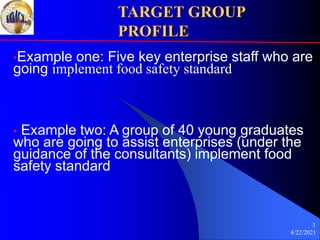
•Example one:Five key enterprise staff who are
going implement food safety standard
• Example two: A group of 40 young graduates
who are going to assist enterprises (under the
guidance of the consultants) implement food
safety standard
4.
4/22/2021
4
TARGET GROUP
PROFILE
Exercise
Form intosmall groups and after discussing the
issues, complete the Table by writing your
answers in the box below.
Example Reason for giving
training
Content
One
Two
5.
4/22/2021
5
TARGET GROUP
PROFILE
• Fromthis exercise it should be
clear that the title of the training
may be the same, the reason
(objective) for the training and the
content would need to be quite
different for each of these trainee
groups
6.
4/22/2021
6
TARGET GROUP
PROFILE
• Acommon mistake made by
inexperienced trainers is to begin their
planning by focusing on the technical
content of the training.
• As illustrated above this is a great mistake
as it usually results in the training not being
relevant to the needs of the trainee group.
• To design training that is suitable and
relevant for specific groups of people you
need to know as much as possible about
them.
7.
4/22/2021
7
TARGET GROUP
PROFILE
Drawing upa trainee group profile
• To develop a useful trainee group profile it is
necessary to be logical and systematic in
collecting that information.
• There are a number of general headings,
which you can use to structure a trainee
group profile.
• The list given below is a good starting point
but obviously you may want to add headings
according to the group you are working with.
8.
4/22/2021
8
TARGET GROUP
PROFILE
• Forexample, you may have a small group of
technicians who have similar qualifications
and experiences and the individuals will
have similar profiles.
• On the other hand you could have a group
that includes the whole regional team with
supervisors, technicians, field staff and
farmers.
• In this second case you will have to widen
the scope of your profile to ensure you have
an accurate picture of the range of
knowledge and experience of this diverse
group
9.
4/22/2021
9
TARGET GROUP
PROFILE
• Afterconsideration you may decide that it is
preferable to divide the group so that the
training can be more accurately matched to
the needs of different subgroups in the
whole group
10.
4/22/2021
10
TARGET GROUP
PROFILE
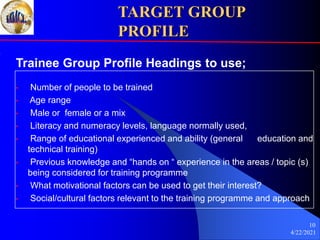
Trainee GroupProfile Headings to use;
• Number of people to be trained
• Age range
• Male or female or a mix
• Literacy and numeracy levels, language normally used,
• Range of educational experienced and ability (general education and
technical training)
• Previous knowledge and “hands on “ experience in the areas / topic (s)
being considered for training programme
• What motivational factors can be used to get their interest?
• Social/cultural factors relevant to the training programme and approach
11.
4/22/2021
11
TARGET GROUP
PROFILE
Gathering informationmeans using a wide range of sources .For
example:
• Interviewing some or the entire trainee group. (Time and
accessibility may limit the numbers that can be interviewed)
• Talking to people who know, and have regular contact with, the
trainee group e.g. extension staff, farmers, supervisor etc.
• Personal records held by employers
• Your own and others experienced of the group
• Report and official surveys
• Sending out a questionnaire (not always successful)
You may have other ideas you can add to this list
12.
4/22/2021
12
TARGET GROUP
PROFILE
Numbers totrain
• Wherever possible, it is better to keep training
groups small and particularly for practical sessions.
• Where more than 10/15 it can be difficult for all
participants to have sufficient hands on practice.
• Watching others is not sufficient.
• With adult groups, it is important that they have an
opportunity to discuss issues and topics, as this is
an important element in the adult learning process.
Small groups allow greater participation and this
makes them more effective
13.
4/22/2021
13
TARGET GROUP
PROFILE
Age oftrainees
• The age of trainees can influence the training approaches
needed in a number of ways.
• In general, younger people are able to grasp new ideas and
concepts more easily than their older counterparts.
• However, this should not be seen as implying that older
people are slow learners.
• It simply means that older people have more experience
and often have to compare new ideas and knowledge being
presented against their existing understandings and
practices before considering adopting new ones.
14.
4/22/2021
14
TARGET GROUP
PROFILE
• Thisis why trainers must allow plenty of time
for explanation and discussion with adult
groups.
• Remember also that older people do not like
to “lose face” so when asking questions try
to present questions they can answer.
• In practical sessions try to structure your
sessions into simple steps and tasks so that
the trainees can be successful at each step.
Success is motivating
Failure makes people frustrated and de-
motivated
15.
4/22/2021
15
TARGET GROUP
PROFILE
Men andWomen
• In general, there is no difference training
men and women but it is important to
remember that their experience and
background may be very different.
• A good trainer (man or woman) will ensure
that an accurate trainee group profile is
developed so that the training programme
meets the needs of all participants.
16.
4/22/2021
16
TARGET GROUP
PROFILE
• Wherethere are considerable differences
and previous training between men and
women it may sometimes be appropriate to
run separate courses.
• The primary guiding rule is that the trainer
must remain sensitive to the needs of all
participants, not just one particular sub-
group.
Training should meet the needs of all trainees
17.
4/22/2021
17
TARGET GROUP
PROFILE
Literacy andnumeracy levels, language
normally used
• Take great care that the terms and written
materials you use in your training are
recognized and understood by your group.
• Many trainers use scientific terms and
complicated concepts when they are
unnecessary and so end up confusing the
trainee group.
• Equally do not use complicated graph,
formulae and calculations unless they are
absolutely essential.
18.
4/22/2021
18
TARGET GROUP
PROFILE
• Alwaystry to use language and terms which
are understood by the entire group.
• Complicated explanations, unfamiliar terms
and complicated words may impress your
group but they are unlikely to help them to
understand new concepts or learn new
skills.
Keep it short, simple and link it to their existing
experience and ability
19.
4/22/2021
19
TARGET GROUP
PROFILE
Education, technicaland practical experience:
• Knowledge of the abilities of a group will allow a
trainer to prepare the training programme at the
right level and to include the right balance of
practice and theory
• A major difficulty experienced by many trainers is
how to deal with a group where individuals have
very different levels of experience and ability in the
topic.
• A good trainer will make use of the trainees who
have a lot of experience by getting them to
contribute to the session by answering the difficult
questions and help others in practical sessions or
acting as group leaders in some of the practical
exercises.
20.
4/22/2021
20
TARGET GROUP
PROFILE
• Trainersshould take full advantage of any
special experience and knowledge available to
them in the group.
• This can also considerably improve the
involvement and motivation of people who may
otherwise feel the course is at too low a level or
not relevant to them.
• Use the experience in the group as a training
resource.
• New trainers often feel that asking assistance from someone
in the group reflects badly on their own expertise.
• Trainees don’t have the same perception and often take
more notice of contributions that come from someone in the
group.
21.
4/22/2021
21
TARGET GROUP
PROFILE
Motivation
• Motivationand enthusiasm are infectious and they
must always start with the trainer.
• Good preparation, a sound knowledge of the
subject and a good understanding of the trainee
group, their experience and their problems are
essential.
• Try to find out what interests them and what
benefits they are hoping to get from the training.
• Remember that it always takes a little time for
trainer and trainees to get to know each other at
the beginning of the course.
• This is a time when a trainer can be anxious and
nervous.
• Good preparation will keep this anxiety to a
minimum.
22.
4/22/2021
22
TARGET GROUP
PROFILE
• Mosttrainees will be keen to learn, providing
the subject matter is relevant to their
situation and needs.
• There will always be a few who will need
encouragement; this can always be
achieved by actively drawing them into
group activities or discussion.
• Letting trainees know that they will have to
complete practical exercises and work on
problem solving exercise usually helps to get
the attention of the less enthusiastic
members of the group.
23.
4/22/2021
23
TARGET GROUP
PROFILE
The interestand motivation of the trainee group will be high if
the training session content is relevant to them and
participatory methods are used actively to involve the group in
the learning process.
• Finally, trainers should remember that even the best trainees
can be easily distracted and de-motivated if the organization
and domestic details of the course (materials, transport,
accommodation, meals, payment of daily allowances, etc.)
are badly arranged.
• This can also include the failure to recognize and make
provision for specific cultural customs and personal needs.