Train the Trainer
Ice breakerWhat is your background?What are your expectations from the course?What has been your greatest achievement to date, and why?
Aims & ObjectivesAt the end of this programme you should:Understand how people learnUnderstand how to create your own trainingUnderstand how to adapt your style for different groupsUnderstand the types of training aidsHave the self confidence to train / presentHave fun!
Aims & ObjectivesAt the end of this session you should:Understand why we trainUnderstand the qualities of a successful trainerUnderstand a training modelAppreciate the limitations of training
Why do we train?Recruitment & retentionEmployees need to know the jobConsistencySafetyMulti-skillingAdapt to changeTechnologyEconomyLegislation
What are the qualities of a successful trainer?Focused on performance improvementAbility to see when training is not the solutionAbility to relate to different cultures and situationsA willingness to learnAbility to create a safe learning environmentAbility to motivateWillingness to use a variety of stylesWillingness to shift focus as needs change
   Exercise 1What issues might a new trainer be faced with, and how can they be addressed/eliminated? (10 mins)
The TrainerTraining is a skill just like any other, there are factors that can combine to reduce your self confidence and being aware of them can help you manage them:PersonalLack of knowledgeSkillSituation
PersonalPersonal factors can be:Lack of confidenceLow self-esteemFeeling inferiorBeing tongue-tiedMaking a msitakeInability to take criticismLack of controlAppearance
KnowledgeKnowledge factors could include:Inability to explain your knowledge in a way the group understandsFeeling that you don’t know enoughNot being up-to-datePoor memory for facts or figuresFear of making errorsConcern about being challenged“Subject expert” in the crowd!
SkillSkill factors are those which affect our ability to put the message across:Speech & deliveryAccentDialectVocabularyClarityTone, pace & pitchPower of voice
SituationSituation factors generally concern the setting or the audience:Size of the groupLevels of knowledge / backgroundSupport / oppositionLighting, heating & ventilationSeating and equipmentDisturbances & noise
Managing yourselfThe key to undertaking any training isPrior Preparation Prevents Pretty Poor Performance!Oh, and….Practice makes perfect!
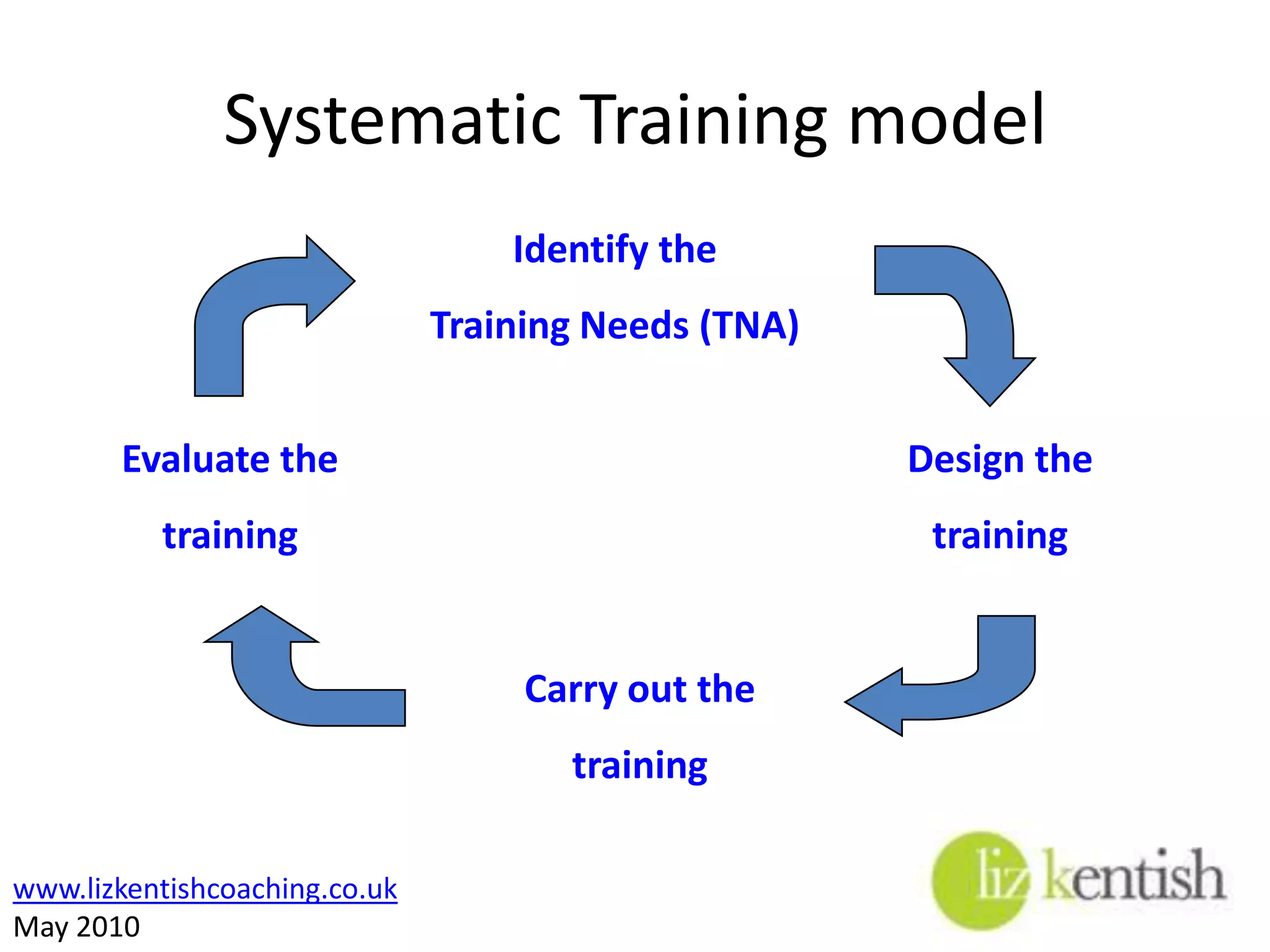
Systematic Training modelIdentify the Training Needs (TNA)Evaluate thetrainingDesign the trainingCarry out thetraining
HASAWA 1974This piece of legislation gave a model that is used in law to recognise competency at work:InformationInstructionTrainingSupervision
What makes training effective?Think of a training experience you have had thatwas effective.What was the context of the learning experience? How was the material presented that made this experience so different? What was the mood of the teacher and students? What impressed you the most? Do you remember what you learned, or the excitement of the learning?
Aims & ObjectivesAt the end of this session you should:Understand the principles of adult learningUnderstand how to judge your target audience Be able to adapt your style to reflect your audience type(s)Be able to deal with difficult situations
Principles of Adult Learning Adults learn best whenThe trainer seeks input from the traineeThe training is recognized by the trainee as being needed to improve a skillThe training is perceived to be practical and providing real life solutions The training builds on the life experiences of the trainee
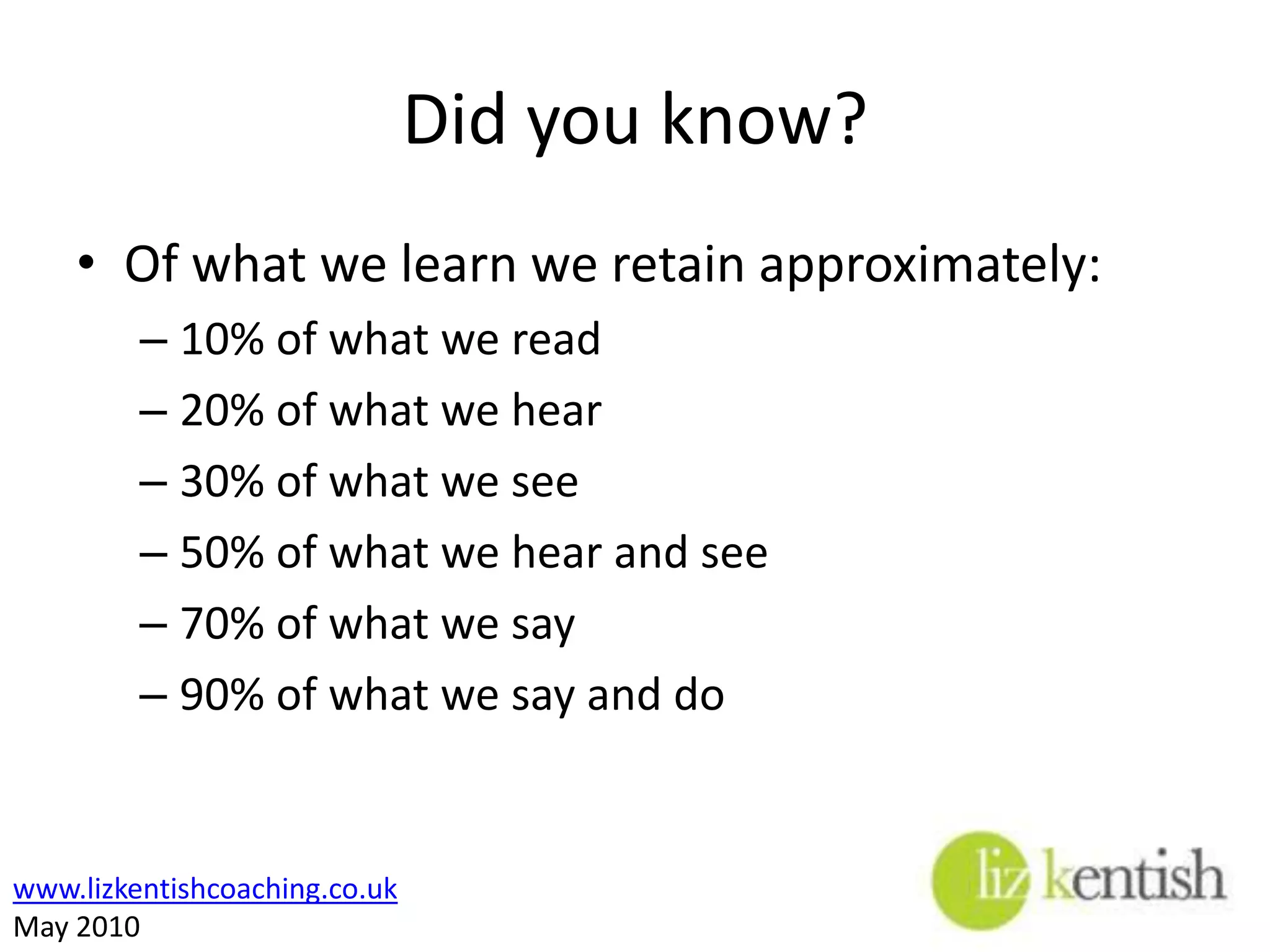
Did you know?Of what we learn we retain approximately:10% of what we read20% of what we hear30% of what we see50% of what we hear and see70% of what we say90% of what we say and do
Exercise 2True or false? – And why? (5 mins)The older one is the less interested that person is in learningTrainees cannot really tell how the Trainer feels about themThe trainee wants to know HOW the information received is necessaryTrainees learn best when they feel safe
Training methodsDemonstrationLectureTeam and individual exercisesSelf-correction
Exercise 3Identify methods of training appropriate to each learning style: (20 mins)Active / ReflectiveSensing / IntuitiveVisual / VerbalSequential / Global
Difficult situationsThere are times when a trainer can be confronted with a difficult situation:“In-company” politicsObstructive peoplePersonality clashesResistance to changeAggression
Aims & ObjectivesAt the end of this session you should:Understand the importance of training needs analysis (TNA)Be able to develop your own lesson plansBe able to deliver high-impact trainingBe able to deal with difficult situations
Training Needs Analysis Identify the problem Gather informationAnalyse the information Develop recommendations
Exercise 4Information sourcesIn undertaking a TNA, how could you gather the necessary information? (5 mins)
Information sourcesObserving and Listening Surveys Interviews Tests Reviewing Company Records
RecommendationsSome questions to askWhat specific skills or information should be taught? Who should be involved in the training? Who should do the training? Is training the answer for this problem?Remember IITS
Sharing the outcome – 1A summary of how the needs analysis was conductedA description of how the information was analysedAn identification of the problem A training recommendation to resolve the problem
Sharing the outcome – 2Why this recommendation is being madeHow this course of action will benefit the company by moving closer to its stated goalsHow the training will benefit employees Limitation of training as a fix-all answer
Exercise 5Developing a training programmeWhat do you need to consider in order to develop a training programme or specific course? (10 mins)Produce a bullet point list and short explanation for each item you choose
Designing the TrainingLearning objectivesCourse outlineAssess current abilitiesAssess available resourcesIdentify specific skills to be taughtDevelop and sequence major topicsLearning environment
Lesson plans – 1Most lesson plans share 4 common elementsObjectives for that particular lessonImportant areas of information to be coveredMethod of teaching to be usedMaterials or training aids to be used in that lesson
Lesson Plans – 2Effective Lesson PlansEncourage interest in the topic with the traineesEnsure an interactive teaching methodology Ensure that a variety of learning styles is used Increase the likelihood of retention of the material being learned
Lesson Plans – 3Other factors to considerSize of the training groupCultural diversity within the group Special needs individuals Venue - room size, acoustics, comfortable chairsTeaching aids
Learning EnvironmentThere are many ways of creating a learning environment:Classroom basedWorkshopsOn the jobWork experienceSpecialist
Exercise 6One of the key skills of a trainer is knowing what environment to create for the type of learning taking place.Pick a subject of training that is needed in your workplace and decide what kind of environment would be most effective and why. (5 mins)
Teaching AidsThere are a variety of training and visual aids that a trainer can use to be more effective:Laptop (PowerPoint)Flip chartsTV & video (CD-Roms / DVDs)Props / PicturesSkills practice (role play)Exercises / gamesMusic
Exercise 7For the training session that you agreed on for exercise 6 (learning environment)Decide a minimum of 3 different teaching aids that you would use to maximise the learningWhat are the advantages and disadvantages of your chosen aid?
Day 2 ActivityWorking together in your group, undertake the followingPrepare a short training session, from the list below, to be delivered tomorrow;Induction for a group of new staffImplementing a new method of workImproving customer careBuilding team relations
Activity - RulesPrepare a short training session, of your choice, to be delivered tomorrow;Evidence of your TNALesson planUse of various teaching aidsEach member of the group has to present and equal amount of the training (20 mins)Some form of evaluation during the sessionAn indication of how you would evaluate the effectiveness of your training afterwards
Activity - GuidancePrepare a short training session, of your choice, to be delivered tomorrow;Set out the room as you see fit according to your lesson planMake use of all the aids availableFeel free to use others!!We can act as advisors but will not alter content, style etcRelax – this is not a pass or fail exercise, we all have to start somewhere!
Aims & ObjectivesAt the end of this session you should:Understand the importance of evaluating all trainingBe able evaluate your trainingBe able to give, and receive, constructive feedbackBe able to deal with difficult situations
Evaluating TrainingThere are four standard levels of evaluationTrainee reactions to the trainingTrainee learning Trainee on-the-job behavioural changesResults of the training for the organisation
Evaluating trainingEvaluations may measure:Results of the training The Trainer’s effectiveness The actual application of training to the job The growth in skills and knowledgeThe effectiveness of the design of the course
Exercise 8For the training session that you agreed on for exercise 6 (learning environment)How would you measure the effectiveness?What are the advantages and disadvantages of your chosen method?
Types of evaluationAllowing trainers to give feedback to the trainees.Allowing trainees to give feedback to the trainers Allowing monitoring of the material being taught for relevance and interest level
Types of evaluationOngoing mini-evaluations help assess if the training is effectiveVerbal quizzes, short written assignments, etc to ensure the teaching methodologies are effective and on target with the Learning ObjectivesAnymore????
Giving Feedback – 1Providing students with feedback during the course of a training programme is an important way of reinforcing learning and correcting misunderstandings, but remember:If the whole group misunderstand what have you done wrong???Must be specificTimely Don’t publicly humiliateConstructive
Giving Feedback – 2Giving feedback can be done through verbal and non-verbal means:Supporting an idea made by a group member PraiseWritten information on assessment papersSmiles Eye contact
Day 2 ActivityWorking together in your group, undertake the followingPrepare a short training session, from the list below, to be delivered tomorrow;Induction for a group of new staffImplementing a new method of workImproving customer careBuilding team relations
Activity - RulesPrepare a short training session, of your choice, to be delivered tomorrow;Evidence of your TNALesson planUse of various teaching aidsEach member of the group has to present and equal amount of the training (20 mins)Some form of evaluation during the sessionAn indication of how you would evaluate the effectiveness of your training afterwards
Activity - GuidancePrepare a short training session, of your choice, to be delivered tomorrow;Set out the room as you see fit according to your lesson planMake use of all the aids availableFeel free to use others!!We can act as advisors but will not alter content, style etcRelax – this is not a pass or fail exercise, we all have to start somewhere!

Train the trainer

  • 1.
  • 2.
    Ice breakerWhat isyour background?What are your expectations from the course?What has been your greatest achievement to date, and why?
  • 3.
    Aims & ObjectivesAtthe end of this programme you should:Understand how people learnUnderstand how to create your own trainingUnderstand how to adapt your style for different groupsUnderstand the types of training aidsHave the self confidence to train / presentHave fun!
  • 4.
    Aims & ObjectivesAtthe end of this session you should:Understand why we trainUnderstand the qualities of a successful trainerUnderstand a training modelAppreciate the limitations of training
  • 5.
    Why do wetrain?Recruitment & retentionEmployees need to know the jobConsistencySafetyMulti-skillingAdapt to changeTechnologyEconomyLegislation
  • 6.
    What are thequalities of a successful trainer?Focused on performance improvementAbility to see when training is not the solutionAbility to relate to different cultures and situationsA willingness to learnAbility to create a safe learning environmentAbility to motivateWillingness to use a variety of stylesWillingness to shift focus as needs change
  • 7.
    Exercise 1What issues might a new trainer be faced with, and how can they be addressed/eliminated? (10 mins)
  • 8.
    The TrainerTraining isa skill just like any other, there are factors that can combine to reduce your self confidence and being aware of them can help you manage them:PersonalLack of knowledgeSkillSituation
  • 9.
    PersonalPersonal factors canbe:Lack of confidenceLow self-esteemFeeling inferiorBeing tongue-tiedMaking a msitakeInability to take criticismLack of controlAppearance
  • 10.
    KnowledgeKnowledge factors couldinclude:Inability to explain your knowledge in a way the group understandsFeeling that you don’t know enoughNot being up-to-datePoor memory for facts or figuresFear of making errorsConcern about being challenged“Subject expert” in the crowd!
  • 11.
    SkillSkill factors arethose which affect our ability to put the message across:Speech & deliveryAccentDialectVocabularyClarityTone, pace & pitchPower of voice
  • 12.
    SituationSituation factors generallyconcern the setting or the audience:Size of the groupLevels of knowledge / backgroundSupport / oppositionLighting, heating & ventilationSeating and equipmentDisturbances & noise
  • 13.
    Managing yourselfThe keyto undertaking any training isPrior Preparation Prevents Pretty Poor Performance!Oh, and….Practice makes perfect!
  • 14.
    Systematic Training modelIdentifythe Training Needs (TNA)Evaluate thetrainingDesign the trainingCarry out thetraining
  • 15.
    HASAWA 1974This pieceof legislation gave a model that is used in law to recognise competency at work:InformationInstructionTrainingSupervision
  • 16.
    What makes trainingeffective?Think of a training experience you have had thatwas effective.What was the context of the learning experience? How was the material presented that made this experience so different? What was the mood of the teacher and students? What impressed you the most? Do you remember what you learned, or the excitement of the learning?
  • 17.
    Aims & ObjectivesAtthe end of this session you should:Understand the principles of adult learningUnderstand how to judge your target audience Be able to adapt your style to reflect your audience type(s)Be able to deal with difficult situations
  • 18.
    Principles of AdultLearning Adults learn best whenThe trainer seeks input from the traineeThe training is recognized by the trainee as being needed to improve a skillThe training is perceived to be practical and providing real life solutions The training builds on the life experiences of the trainee
  • 19.
    Did you know?Ofwhat we learn we retain approximately:10% of what we read20% of what we hear30% of what we see50% of what we hear and see70% of what we say90% of what we say and do
  • 20.
    Exercise 2True orfalse? – And why? (5 mins)The older one is the less interested that person is in learningTrainees cannot really tell how the Trainer feels about themThe trainee wants to know HOW the information received is necessaryTrainees learn best when they feel safe
  • 21.
    Training methodsDemonstrationLectureTeam andindividual exercisesSelf-correction
  • 22.
    Exercise 3Identify methodsof training appropriate to each learning style: (20 mins)Active / ReflectiveSensing / IntuitiveVisual / VerbalSequential / Global
  • 23.
    Difficult situationsThere aretimes when a trainer can be confronted with a difficult situation:“In-company” politicsObstructive peoplePersonality clashesResistance to changeAggression
  • 24.
    Aims & ObjectivesAtthe end of this session you should:Understand the importance of training needs analysis (TNA)Be able to develop your own lesson plansBe able to deliver high-impact trainingBe able to deal with difficult situations
  • 25.
    Training Needs AnalysisIdentify the problem Gather informationAnalyse the information Develop recommendations
  • 26.
    Exercise 4Information sourcesInundertaking a TNA, how could you gather the necessary information? (5 mins)
  • 27.
    Information sourcesObserving andListening Surveys Interviews Tests Reviewing Company Records
  • 28.
    RecommendationsSome questions toaskWhat specific skills or information should be taught? Who should be involved in the training? Who should do the training? Is training the answer for this problem?Remember IITS
  • 29.
    Sharing the outcome– 1A summary of how the needs analysis was conductedA description of how the information was analysedAn identification of the problem A training recommendation to resolve the problem
  • 30.
    Sharing the outcome– 2Why this recommendation is being madeHow this course of action will benefit the company by moving closer to its stated goalsHow the training will benefit employees Limitation of training as a fix-all answer
  • 31.
    Exercise 5Developing atraining programmeWhat do you need to consider in order to develop a training programme or specific course? (10 mins)Produce a bullet point list and short explanation for each item you choose
  • 32.
    Designing the TrainingLearningobjectivesCourse outlineAssess current abilitiesAssess available resourcesIdentify specific skills to be taughtDevelop and sequence major topicsLearning environment
  • 33.
    Lesson plans –1Most lesson plans share 4 common elementsObjectives for that particular lessonImportant areas of information to be coveredMethod of teaching to be usedMaterials or training aids to be used in that lesson
  • 34.
    Lesson Plans –2Effective Lesson PlansEncourage interest in the topic with the traineesEnsure an interactive teaching methodology Ensure that a variety of learning styles is used Increase the likelihood of retention of the material being learned
  • 35.
    Lesson Plans –3Other factors to considerSize of the training groupCultural diversity within the group Special needs individuals Venue - room size, acoustics, comfortable chairsTeaching aids
  • 36.
    Learning EnvironmentThere aremany ways of creating a learning environment:Classroom basedWorkshopsOn the jobWork experienceSpecialist
  • 37.
    Exercise 6One ofthe key skills of a trainer is knowing what environment to create for the type of learning taking place.Pick a subject of training that is needed in your workplace and decide what kind of environment would be most effective and why. (5 mins)
  • 38.
    Teaching AidsThere area variety of training and visual aids that a trainer can use to be more effective:Laptop (PowerPoint)Flip chartsTV & video (CD-Roms / DVDs)Props / PicturesSkills practice (role play)Exercises / gamesMusic
  • 39.
    Exercise 7For thetraining session that you agreed on for exercise 6 (learning environment)Decide a minimum of 3 different teaching aids that you would use to maximise the learningWhat are the advantages and disadvantages of your chosen aid?
  • 40.
    Day 2 ActivityWorkingtogether in your group, undertake the followingPrepare a short training session, from the list below, to be delivered tomorrow;Induction for a group of new staffImplementing a new method of workImproving customer careBuilding team relations
  • 41.
    Activity - RulesPreparea short training session, of your choice, to be delivered tomorrow;Evidence of your TNALesson planUse of various teaching aidsEach member of the group has to present and equal amount of the training (20 mins)Some form of evaluation during the sessionAn indication of how you would evaluate the effectiveness of your training afterwards
  • 42.
    Activity - GuidancePreparea short training session, of your choice, to be delivered tomorrow;Set out the room as you see fit according to your lesson planMake use of all the aids availableFeel free to use others!!We can act as advisors but will not alter content, style etcRelax – this is not a pass or fail exercise, we all have to start somewhere!
  • 43.
    Aims & ObjectivesAtthe end of this session you should:Understand the importance of evaluating all trainingBe able evaluate your trainingBe able to give, and receive, constructive feedbackBe able to deal with difficult situations
  • 44.
    Evaluating TrainingThere arefour standard levels of evaluationTrainee reactions to the trainingTrainee learning Trainee on-the-job behavioural changesResults of the training for the organisation
  • 45.
    Evaluating trainingEvaluations maymeasure:Results of the training The Trainer’s effectiveness The actual application of training to the job The growth in skills and knowledgeThe effectiveness of the design of the course
  • 46.
    Exercise 8For thetraining session that you agreed on for exercise 6 (learning environment)How would you measure the effectiveness?What are the advantages and disadvantages of your chosen method?
  • 47.
    Types of evaluationAllowingtrainers to give feedback to the trainees.Allowing trainees to give feedback to the trainers Allowing monitoring of the material being taught for relevance and interest level
  • 48.
    Types of evaluationOngoingmini-evaluations help assess if the training is effectiveVerbal quizzes, short written assignments, etc to ensure the teaching methodologies are effective and on target with the Learning ObjectivesAnymore????
  • 49.
    Giving Feedback –1Providing students with feedback during the course of a training programme is an important way of reinforcing learning and correcting misunderstandings, but remember:If the whole group misunderstand what have you done wrong???Must be specificTimely Don’t publicly humiliateConstructive
  • 50.
    Giving Feedback –2Giving feedback can be done through verbal and non-verbal means:Supporting an idea made by a group member PraiseWritten information on assessment papersSmiles Eye contact
  • 51.
    Day 2 ActivityWorkingtogether in your group, undertake the followingPrepare a short training session, from the list below, to be delivered tomorrow;Induction for a group of new staffImplementing a new method of workImproving customer careBuilding team relations
  • 52.
    Activity - RulesPreparea short training session, of your choice, to be delivered tomorrow;Evidence of your TNALesson planUse of various teaching aidsEach member of the group has to present and equal amount of the training (20 mins)Some form of evaluation during the sessionAn indication of how you would evaluate the effectiveness of your training afterwards
  • 53.
    Activity - GuidancePreparea short training session, of your choice, to be delivered tomorrow;Set out the room as you see fit according to your lesson planMake use of all the aids availableFeel free to use others!!We can act as advisors but will not alter content, style etcRelax – this is not a pass or fail exercise, we all have to start somewhere!
  • 54.
    Activity - FeedbackAfteryour group session;Evaluate your own performance (Good / Could do better)Prepare and give feedback to your audienceWelcome feedback from your audienceRelax – this is not a pass or fail exercise, we all have to start somewhere!