Prerequisite programmes on food
safety
Part 2: Catering
PRPs-Catering6
MMC/INTAS- ISO 22000:2018 FSMS & PRPS Awareness Training CourseIssue : Apr 2020 MMC/INTAS- ISO 22000:2018 FSMS & PRPS Awareness Training CourseIssue : Apr 2020
PRPs-Catering
MMC/INTAS- ISO 22000:2018 FSMS & PRPS Awareness Training CourseIssue : Apr 2020 MMC/INTAS- ISO 22000:2018 FSMS & PRPS Awareness Training CourseIssue : Apr 2020
6
4 Generic prerequisite programmes
PRPs-Catering
MMC/INTAS- ISO 22000:2018 FSMS & PRPS Awareness Training CourseIssue : Apr 2020 MMC/INTAS- ISO 22000:2018 FSMS & PRPS Awareness Training CourseIssue : Apr 2020
6
4.1 Layout of premises
4.1.1 Infrastructure
The establishment and its facilities shall be of solid construction and
maintained in good condition. All materials shall be such that they do not
transmit any undesirable substances to the food.
PRPs-Catering
MMC/INTAS- ISO 22000:2018 FSMS & PRPS Awareness Training CourseIssue : Apr 2020 MMC/INTAS- ISO 22000:2018 FSMS & PRPS Awareness Training CourseIssue : Apr 2020
6
4.1.2 Workspace
4.1.2.1 General
Different areas shall be designed in order to allow the proper arrangement of
equipment and materials to avoid cross-contamination. For that purpose, work
areas shall be clearly identified and marked, physically or functionally
4.1.2.2 Food-handling areas
Surfaces of walls, floors and ceilings shall be waterproof, non-absorbent,
washable, materials without crevices; in addition, floors shall be made of non-slip
material. Joints between the floors and the walls shall be vaulted or rounded,
where appropriate. Doors shall be non-absorbent, resistant and have a smooth
and undamaged surface. The use of materials that cannot be adequately cleaned
and disinfected shall be avoided.
4.1.3 Lighting and ventilation
All the areas shall be provided with an adequate lighting system. Lighting
systems shall be designed so that they do not adversely affect food. Light fixtures
shall be protected to ensure that materials, product or equipment are not
contaminated in case of breakage. The lighting provided (natural or artificial),
shall allow personnel to operate in a hygienic manner.
PRPs-Catering
MMC/INTAS- ISO 22000:2018 FSMS & PRPS Awareness Training CourseIssue : Apr 2020 MMC/INTAS- ISO 22000:2018 FSMS & PRPS Awareness Training CourseIssue : Apr 2020
6
4.1.4 Personal hygiene facilities and toilets
Personnel hygiene facilities shall be available to ensure that the degree
of personal hygiene required to carry out the operations of the
organization can be maintained safely.
Establishments shall:
a) provide adequate numbers, locations and means for hygienically
washing, drying and, where
required, disinfecting hands;
b) have sinks designated for hand washing,
c) have hygiene facilities for personnel that do not open directly to production,
packing or storage areas;
d) have adequate changing facilities for personnel;
e) have changing facilities sited so as to enable personnel handling food
f) comply with microbiological criteria for water used for hand washing that are in
accordance with potable water;
g) provide hand-washing facilities both inside and outside the food-processing
areas.
PRPs-Catering
MMC/INTAS- ISO 22000:2018 FSMS & PRPS Awareness Training CourseIssue : Apr 2020 MMC/INTAS- ISO 22000:2018 FSMS & PRPS Awareness Training CourseIssue : Apr 2020
6
4.1.5 Maintenance
The building, equipment, utensils, and all the establishment facilities,
including drainage systems,
shall be kept in an appropriate state of maintenance and condition to
facilitate all hygiene procedures; function as intended; and not cause
contamination of food.
The establishment shall ensure that food safety is not affected during
maintenance operations.
A preventive maintenance programme shall be in place.
PRPs-Catering
MMC/INTAS- ISO 22000:2018 FSMS & PRPS Awareness Training CourseIssue : Apr 2020 MMC/INTAS- ISO 22000:2018 FSMS & PRPS Awareness Training CourseIssue : Apr 2020
6
4.2 Water supply
4.2.1 Potable water
Water supply at adequate pressure and temperature shall be provided,
as well as suitable facilities for its storage. The water storage facilities
shall be cleaned and periodically monitored.
4.2.2 Ice
The ice used in direct contact with food or food contact surfaces shall be
made from potable water and be transported, handled, and stored in a
manner that protects it from contamination.
4.2.3 Non-potable water
All non-potable water used in refrigeration, steam production, fire control,
spilling dilution or other
similar activities, shall be carried through adequate pipes thoroughly
separated from those carrying potable water, without any transversal
connections among them or the possibility of non-potable water refluxing
to potable water pipes.
PRPs-Catering
MMC/INTAS- ISO 22000:2018 FSMS & PRPS Awareness Training CourseIssue : Apr 2020 MMC/INTAS- ISO 22000:2018 FSMS & PRPS Awareness Training CourseIssue : Apr 2020
6
4.3 Equipment and utensils
Equipment and utensils shall be made of impervious and corrosion
resistant materials, that does not transfer toxic substances, odour or
flavour to food. The equipment and utensils shall be capable of
withstanding frequent cleaning and disinfection operations, and shall be
smooth and free from holes, crevices or cracks.
PRPs-Catering
MMC/INTAS- ISO 22000:2018 FSMS & PRPS Awareness Training CourseIssue : Apr 2020 MMC/INTAS- ISO 22000:2018 FSMS & PRPS Awareness Training CourseIssue : Apr 2020
6
4.4 Personnel hygiene
4.4.1 General
Responsibility for ensuring compliance by all personnel with all
requirements of 4.4 should be specifically allocated to competent
supervisory personnel.
Visitors, e.g. regulatory inspectors, clients, and maintenance personnel,
shall be given access to the food-handling areas on a restricted basis.
4.4.2 Hygiene training
Adequate, relevant, and continuing training shall be given to all personnel
of the catering establishment in personal hygiene. Training should
include relevant parts of this part of ISO/TS 22002. Records of training
shall be retained.
PRPs-Catering
MMC/INTAS- ISO 22000:2018 FSMS & PRPS Awareness Training CourseIssue : Apr 2020 MMC/INTAS- ISO 22000:2018 FSMS & PRPS Awareness Training CourseIssue : Apr 2020
6
4.4.3 Health status
4.4.3.1 General
The management of the food establishment shall ensure that the health
of the personnel engaged in the activity does not have an adverse effect
on the food. Any individual affected by a contagious illness or exposed
wounds shall not be allowed to work in food-handling areas where there
may be a risk of contamination of food.
4.4.3.2 Medical examination
Medical examination of staff prior to employment in the food catering
shall be carried out if required:
a) by the official agency having jurisdiction;
b) because of epidemiological considerations;
c) medical history of the catering staff;
d) the nature of the food products being prepared.
PRPs-Catering
MMC/INTAS- ISO 22000:2018 FSMS & PRPS Awareness Training CourseIssue : Apr 2020 MMC/INTAS- ISO 22000:2018 FSMS & PRPS Awareness Training CourseIssue : Apr 2020
6
4.4.3.3 Communicable diseases
Catering staff shall not be permitted to enter the area where food is
stored and handled while known or suspected to be suffering from, or to
be a carrier of, a disease likely to be transmitted through food or while
afflicted with infected wounds, skin infections, sores, or with vomiting or
diarrhoea.
4.4.3.4 Injuries
Any person who has a cut or wound shall not continue to handle food or
food contact surfaces until the injury is completely protected by a
waterproof covering which is firmly secured. Adequate first aid facilities
should be provided for this purpose.
PRPs-Catering
MMC/INTAS- ISO 22000:2018 FSMS & PRPS Awareness Training CourseIssue : Apr 2020 MMC/INTAS- ISO 22000:2018 FSMS & PRPS Awareness Training CourseIssue : Apr 2020
6
4.4.4 Personal cleanliness
4.4.4.1 General
Every catering staff engaged in a food-handling area shall maintain a
high degree of personal cleanliness while on duty, and shall wear
suitable protective clothing including hair, moustache and beard covering,
If necessary, suitable footwear should also be used. All protective
clothing should be cleanable unless it is disposable.
4.4.4.2 Hand washing
Catering personnel shall wash their hands frequently and thoroughly with
a soap and/or disinfectant agent under running, potable water while on
duty. Hands shall always be washed before beginning work in food area,
immediately after using the toilet, after handling contaminated material,
and whenever necessary.
PRPs-Catering
MMC/INTAS- ISO 22000:2018 FSMS & PRPS Awareness Training CourseIssue : Apr 2020 MMC/INTAS- ISO 22000:2018 FSMS & PRPS Awareness Training CourseIssue : Apr 2020
6
4.4.4.3 Gloves
Gloves shall be made from materials suitable for food contact and shall
be maintained in clean and hygienic conditions. The wearing of gloves
does not exempt the operator from having thoroughly washed hands.
Torn or punctured gloves shall be discarded.
PRPs-Catering
MMC/INTAS- ISO 22000:2018 FSMS & PRPS Awareness Training CourseIssue : Apr 2020 MMC/INTAS- ISO 22000:2018 FSMS & PRPS Awareness Training CourseIssue : Apr 2020
6
4.4.5 Personal behaviour
Any behaviour which could result in contamination of food, such as
eating, use of tobacco, chewing (e.g. gum, sticks, betel nuts) contacting
with their hair, face, nose, etc. or unhygienic practices such as spitting
shall be prohibited in food-handling areas.
Clothes or personal belongings as well as office materials, tools, etc.,
shall not be placed in the food storage or handling areas.
PRPs-Catering
MMC/INTAS- ISO 22000:2018 FSMS & PRPS Awareness Training CourseIssue : Apr 2020 MMC/INTAS- ISO 22000:2018 FSMS & PRPS Awareness Training CourseIssue : Apr 2020
6
4.5 Purchasing management
4.5.1 Supplier assessment
The catering establishment should set criteria for the evaluation of
suppliers and keep records on their compliance with the established
criteria.
4.5.2 Incoming material requirements (raw materials, ingredients,
and packaging)
The conditions of raw materials, ingredients, and packaging, in addition
to the established criteria, expiration date, and packaging integrity shall
be inspected, verified, and approved at point of receipt.
Raw materials and ingredients requiring special storage conditions (e.g.
temperature), shall be controlled and records should be maintained to
demonstrate that the proper storage conditions were provided.
PRPs-Catering
MMC/INTAS- ISO 22000:2018 FSMS & PRPS Awareness Training CourseIssue : Apr 2020 MMC/INTAS- ISO 22000:2018 FSMS & PRPS Awareness Training CourseIssue : Apr 2020
6
4.6 Storage and transport
4.6.1 Storage
Refrigerated raw materials of animal origin shall be stored at a
temperature less than or equal to
4 °C. Other raw materials requiring refrigeration, e.g. certain vegetables,
shall be stored at the lowest temperature allowing their quality to be
maintained. Stored raw materials or ingredients shall be kept in adequate
conditions to avoid deterioration, protect them from contamination, and
prevent damage.
Stocks of raw materials and ingredients should be subject to effective
stock rotation (e.g. FIFO — first in, first out).
Raw materials, ingredients, and packaging shall be stored off the floor
(e.g. rolls, pallets) and with sufficient space between the material and the
walls to allow inspection and pest control activities to be carried out.
PRPs-Catering
MMC/INTAS- ISO 22000:2018 FSMS & PRPS Awareness Training CourseIssue : Apr 2020 MMC/INTAS- ISO 22000:2018 FSMS & PRPS Awareness Training CourseIssue : Apr 2020
6
4.6.2 Transport
Vehicles and containers intended for the transportation of cooked and/or
cooled food shall be capable of maintaining the required temperatures
and if required be approved by a competent authority.
Food-transporting vehicles and containers shall be designed to maintain
the required temperature.
Records to demonstrate correct transport should be available.
4.6.3 Hazardous substances handling
These products shall be adequately labelled and stored in key-locked
rooms or cabinets exclusively designated for that purpose.
PRPs-Catering
MMC/INTAS- ISO 22000:2018 FSMS & PRPS Awareness Training CourseIssue : Apr 2020 MMC/INTAS- ISO 22000:2018 FSMS & PRPS Awareness Training CourseIssue : Apr 2020
6
4.7 Cleaning and disinfection
Equipment and utensils shall be cleaned as frequently as needed and
disinfected if necessary by using products and methodologies ensuring
their hygiene. Appropriate measures shall be taken when rooms,
equipment, and utensils are being cleaned or disinfected in order to
prevent contamination of the food e.g. by water, washing-up liquids, or
disinfecting agents.
PRPs-Catering
MMC/INTAS- ISO 22000:2018 FSMS & PRPS Awareness Training CourseIssue : Apr 2020 MMC/INTAS- ISO 22000:2018 FSMS & PRPS Awareness Training CourseIssue : Apr 2020
6
4.8 Waste management
4.8.1 Effluent and waste disposal
The establishment shall have collecting bins in adequate numbers and
capacity to contain waste. Where it is not possible to have distinct areas
for food entry and waste exit of waste, different times for the such entry
and exit shall be determined.
The collecting bins used for waste disposal in preparation and storage
areas of food should be provided with hands free covers.
4.8.2 Waste handling
In kitchens or rooms where food is prepared, waste shall be placed in
detachable, impervious and
resistant rubbish bags within properly identified containers. Those
containers shall be kept covered with a lid and removed from the work
area as soon as they are filled or after each work shift and disposed into
covered containers which shall not be stored in the processing area.
PRPs-Catering
MMC/INTAS- ISO 22000:2018 FSMS & PRPS Awareness Training CourseIssue : Apr 2020 MMC/INTAS- ISO 22000:2018 FSMS & PRPS Awareness Training CourseIssue : Apr 2020
6
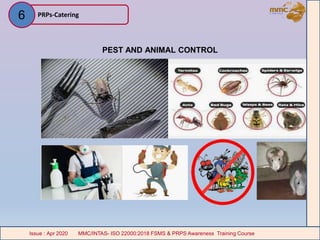
PEST AND ANIMAL CONTROL
PRPs-Catering
MMC/INTAS- ISO 22000:2018 FSMS & PRPS Awareness Training CourseIssue : Apr 2020 MMC/INTAS- ISO 22000:2018 FSMS & PRPS Awareness Training CourseIssue : Apr 2020
6
4.9 Pest and animal control
4.9.1 Pest control
A continuous and effective pest control programme shall be implemented
and documented. The
programme shall include a set of effective and continuous actions to
control the vectors and pests, to prevent their attraction, access, shelter,
and/or proliferation. The establishment and surrounding areas shall be
inspected periodically to ensure there is no infestation. Where pests
invade the building, eradication measures shall be adopted and verified
for effectiveness, and the results shall be recorded.
Buildings shall be well maintained to prevent ingress by pests and all
pest entry points shall be sealed.
4.9.2 Absence of domestic animals
Domestic animals shall be excluded from areas where food is stored and
handled as they are a source of contamination.
PRPs-Catering
MMC/INTAS- ISO 22000:2018 FSMS & PRPS Awareness Training CourseIssue : Apr 2020 MMC/INTAS- ISO 22000:2018 FSMS & PRPS Awareness Training CourseIssue : Apr 2020
6
4.10 Management and supervision
All catering-related activities shall be controlled and supervised by
management, regardless of volume and the type of food involved.
The top management of the catering establishment shall ensure that
good manufacturing practices for food processing are being implemented
effectively in the catering facility. The top management shall also ensure
that the potential hazards are correctly assessed and ensure the effective
supervision of catering operations.
PRPs-Catering
MMC/INTAS- ISO 22000:2018 FSMS & PRPS Awareness Training CourseIssue : Apr 2020 MMC/INTAS- ISO 22000:2018 FSMS & PRPS Awareness Training CourseIssue : Apr 2020
6
4.11 Documentation and records
The catering organization shall keep adequate records.
Records that shall be kept for the appropriate time on procedures relating to:
a) hygiene of water tanks;
b) hygiene of facilities, equipment, furniture and utensils, including cleaning and
disinfection operations;
c) integrated controls of transmission vectors and pests;
d) hygiene, health and training of food handlers;
e) temperature control according to law and establishment procedures (food and
equipment);
f) others as needed or required.
PRPs-Catering
MMC/INTAS- ISO 22000:2018 FSMS & PRPS Awareness Training CourseIssue : Apr 2020 MMC/INTAS- ISO 22000:2018 FSMS & PRPS Awareness Training CourseIssue : Apr 2020
6
4.12 Product recall procedures
Product recall procedures should be established.
PRPs-Catering
MMC/INTAS- ISO 22000:2018 FSMS & PRPS Awareness Training CourseIssue : Apr 2020 MMC/INTAS- ISO 22000:2018 FSMS & PRPS Awareness Training CourseIssue : Apr 2020
6
5 Specific prerequisite programmes
PRPs-Catering
MMC/INTAS- ISO 22000:2018 FSMS & PRPS Awareness Training CourseIssue : Apr 2020 MMC/INTAS- ISO 22000:2018 FSMS & PRPS Awareness Training CourseIssue : Apr 2020
6
5.1 Thawing
The pre-prepared products shall be kept under refrigeration or frozen
conditions, properly protected and identified in an appropriate manner
before it is used or prepared.
When thawing constitutes a separate operation from cooking, it shall be
carried out in:
a) a refrigerator or thawing chamber constructed for that purpose capable
of maintaining a temperature of less than or equal to 4 °C; or
b) any other national or international approved procedure.
Food shall be thawed in conditions which ensure that no part of the food
reaches a temperature above 4 °C. For ready-to-use products, food
should be checked to ensure that thawing is complete and no ice crystals
remain throughout the products prior to service.
Where specified by the manufacturer, some frozen food may be cooked
or served without thawing.
PRPs-Catering
MMC/INTAS- ISO 22000:2018 FSMS & PRPS Awareness Training CourseIssue : Apr 2020 MMC/INTAS- ISO 22000:2018 FSMS & PRPS Awareness Training CourseIssue : Apr 2020
6
5.2 Preparation
5.2.1 Fresh fruits and vegetables
The preparation shall be performed under suitable conditions in a well
illuminated area.
The pre-prepared products shall be kept under suitable conditions (e.g.
refrigeration), and adequately labelled where appropriate.
Depending on the product and its intended use, selected, pre-washed,
and, if necessary, pre-cut fruits and vegetables should be:
a) washed with potable water, with added disinfectant where appropriate
and legally permitted;
b) rinsed with potable water (where appropriate and legally required).
5.2.2 Other raw materials
Depending on the product and its intended use, the product should be:
a) selected and pre-cut, if necessary; and
b) washed with potable water,
PRPs-Catering
MMC/INTAS- ISO 22000:2018 FSMS & PRPS Awareness Training CourseIssue : Apr 2020 MMC/INTAS- ISO 22000:2018 FSMS & PRPS Awareness Training CourseIssue : Apr 2020
6
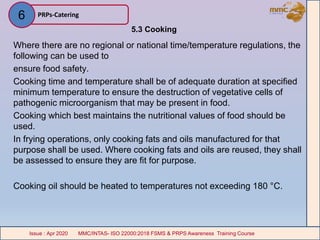
5.3 Cooking
Where there are no regional or national time/temperature regulations, the
following can be used to
ensure food safety.
Cooking time and temperature shall be of adequate duration at specified
minimum temperature to ensure the destruction of vegetative cells of
pathogenic microorganism that may be present in food.
Cooking which best maintains the nutritional values of food should be
used.
In frying operations, only cooking fats and oils manufactured for that
purpose shall be used. Where cooking fats and oils are reused, they shall
be assessed to ensure they are fit for purpose.
Cooking oil should be heated to temperatures not exceeding 180 °C.
PRPs-Catering
MMC/INTAS- ISO 22000:2018 FSMS & PRPS Awareness Training CourseIssue : Apr 2020 MMC/INTAS- ISO 22000:2018 FSMS & PRPS Awareness Training CourseIssue : Apr 2020
6
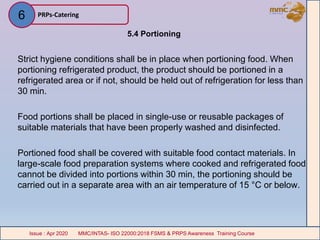
5.4 Portioning
Strict hygiene conditions shall be in place when portioning food. When
portioning refrigerated product, the product should be portioned in a
refrigerated area or if not, should be held out of refrigeration for less than
30 min.
Food portions shall be placed in single-use or reusable packages of
suitable materials that have been properly washed and disinfected.
Portioned food shall be covered with suitable food contact materials. In
large-scale food preparation systems where cooked and refrigerated food
cannot be divided into portions within 30 min, the portioning should be
carried out in a separate area with an air temperature of 15 °C or below.
PRPs-Catering
MMC/INTAS- ISO 22000:2018 FSMS & PRPS Awareness Training CourseIssue : Apr 2020 MMC/INTAS- ISO 22000:2018 FSMS & PRPS Awareness Training CourseIssue : Apr 2020
6
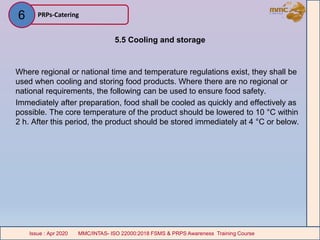
5.5 Cooling and storage
Where regional or national time and temperature regulations exist, they shall be
used when cooling and storing food products. Where there are no regional or
national requirements, the following can be used to ensure food safety.
Immediately after preparation, food shall be cooled as quickly and effectively as
possible. The core temperature of the product should be lowered to 10 °C within
2 h. After this period, the product should be stored immediately at 4 °C or below.
PRPs-Catering
MMC/INTAS- ISO 22000:2018 FSMS & PRPS Awareness Training CourseIssue : Apr 2020 MMC/INTAS- ISO 22000:2018 FSMS & PRPS Awareness Training CourseIssue : Apr 2020
6
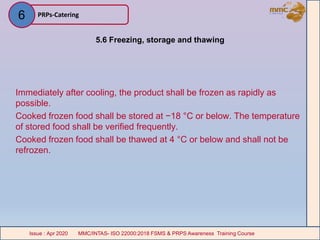
5.6 Freezing, storage and thawing
Immediately after cooling, the product shall be frozen as rapidly as
possible.
Cooked frozen food shall be stored at −18 °C or below. The temperature
of stored food shall be verified frequently.
Cooked frozen food shall be thawed at 4 °C or below and shall not be
refrozen.
PRPs-Catering
MMC/INTAS- ISO 22000:2018 FSMS & PRPS Awareness Training CourseIssue : Apr 2020 MMC/INTAS- ISO 22000:2018 FSMS & PRPS Awareness Training CourseIssue : Apr 2020
6
5.7 Transport
During transportation, food shall be protected from dust and from any
other types of contamination.
The temperature for hot food should be maintained at 63 °C or above.
Food should be kept hot during transport at 63 °C or above.
The temperature for food requiring refrigeration shall be maintained at 4
°C or below. Food should be transferred to the transporting vehicle
already cooled to the temperature at which it is to be transported.
Vehicles and containers intended for transporting cooked frozen food
shall be suitable for that purpose.
Cooked frozen food temperature should be maintained at −18 °C or
below.
PRPs-Catering
MMC/INTAS- ISO 22000:2018 FSMS & PRPS Awareness Training CourseIssue : Apr 2020 MMC/INTAS- ISO 22000:2018 FSMS & PRPS Awareness Training CourseIssue : Apr 2020
6
5.8 Food reheating
Where regional or national time and temperature regulations exist, they
shall be used when reheating food.
Where there are no regional or national requirements, the following can
be used to maintain food safety.
Food reheating shall be carried out rapidly. The reheating process shall
be adequate, and the core temperature of the product shall reach 75 °C
within 1 h after removal from the refrigerator. Lower temperatures may be
used for reheating; suitable time and temperature combinations shall be
used.
Heated food temperature shall be monitored at regular intervals.
PRPs-Catering
MMC/INTAS- ISO 22000:2018 FSMS & PRPS Awareness Training CourseIssue : Apr 2020 MMC/INTAS- ISO 22000:2018 FSMS & PRPS Awareness Training CourseIssue : Apr 2020
6
5.9 Food service
Food that is not to be consumed shall be discarded; therefore it shall be neither
reheated nor returned to cooling units (refrigerator or freezer).
In self-service establishments, the distribution system shall be such that the
products offered are
protected from direct contamination that may derive from the proximity or actions
of the individual who serves and who is served. The food temperature shall be 4
°C or below (for cool-stored food) or 63 °C or above for heated food. Clean
dishes shall be used for new servings. Dishes on which food remains shall not be
used for new servings.
The change or cleaning and disinfection of utensils shall be performed at least
every 4 h if necessary.
New food shall not be mixed with that which is already exposed, unless both are
at a temperature of 63 °C or above or 4 °C or below and there is no food safety
risk.
The decorations or plants shall not contaminate the exposed foods.
The establishments shall keep employees responsible for payment (cash, card,
etc.) in this specific function, without simultaneously handling prepared foods. If
this is unavoidable, then procedures shall be in place to keep food safe.
PRPs-Catering
MMC/INTAS- ISO 22000:2018 FSMS & PRPS Awareness Training CourseIssue : Apr 2020 MMC/INTAS- ISO 22000:2018 FSMS & PRPS Awareness Training CourseIssue : Apr 2020
6
5.10 Identification and hygiene control system
Where regional or national regulations exist, they shall be used to identify
products. Where regional or national regulations are not available, the following
can be used to maintain food safety.
A label indicating preparation date, food type, manufacturing establishment
name, instructions for use, conservation, and “consume before” date should be
present.
Hygiene control procedures shall be carried out by technically competent
personnel who possess an understanding of the principles and practice of food
hygiene.
Samples of meals should be kept available for further investigation if there is a
suspicion of a been consumed. food-borne outbreak associated with their
consumption. When it is not possible to keep samples for all meals, the
establishment shall select meals to be sampled according to specific or potential
hazards of each meal.
Food prepared in the establishment should be subjected to a microbiological
sampling system for quality control and/or investigation purposes if there is
suspicion of food-borne illnesses.
Where appropriate for safety, samples should be kept in a sterile container at 4
°C or below until at least 3 days after that whole lot has
PRPs-Catering
MMC/INTAS- ISO 22000:2018 FSMS & PRPS Awareness Training CourseIssue : Apr 2020 MMC/INTAS- ISO 22000:2018 FSMS & PRPS Awareness Training CourseIssue : Apr 2020
6

CATERING AWARENESS TRAINING

  • 1.
    Prerequisite programmes onfood safety Part 2: Catering PRPs-Catering6 MMC/INTAS- ISO 22000:2018 FSMS & PRPS Awareness Training CourseIssue : Apr 2020 MMC/INTAS- ISO 22000:2018 FSMS & PRPS Awareness Training CourseIssue : Apr 2020
  • 2.
    PRPs-Catering MMC/INTAS- ISO 22000:2018FSMS & PRPS Awareness Training CourseIssue : Apr 2020 MMC/INTAS- ISO 22000:2018 FSMS & PRPS Awareness Training CourseIssue : Apr 2020 6
  • 3.
    4 Generic prerequisiteprogrammes PRPs-Catering MMC/INTAS- ISO 22000:2018 FSMS & PRPS Awareness Training CourseIssue : Apr 2020 MMC/INTAS- ISO 22000:2018 FSMS & PRPS Awareness Training CourseIssue : Apr 2020 6
  • 4.
    4.1 Layout ofpremises 4.1.1 Infrastructure The establishment and its facilities shall be of solid construction and maintained in good condition. All materials shall be such that they do not transmit any undesirable substances to the food. PRPs-Catering MMC/INTAS- ISO 22000:2018 FSMS & PRPS Awareness Training CourseIssue : Apr 2020 MMC/INTAS- ISO 22000:2018 FSMS & PRPS Awareness Training CourseIssue : Apr 2020 6
  • 5.
    4.1.2 Workspace 4.1.2.1 General Differentareas shall be designed in order to allow the proper arrangement of equipment and materials to avoid cross-contamination. For that purpose, work areas shall be clearly identified and marked, physically or functionally 4.1.2.2 Food-handling areas Surfaces of walls, floors and ceilings shall be waterproof, non-absorbent, washable, materials without crevices; in addition, floors shall be made of non-slip material. Joints between the floors and the walls shall be vaulted or rounded, where appropriate. Doors shall be non-absorbent, resistant and have a smooth and undamaged surface. The use of materials that cannot be adequately cleaned and disinfected shall be avoided. 4.1.3 Lighting and ventilation All the areas shall be provided with an adequate lighting system. Lighting systems shall be designed so that they do not adversely affect food. Light fixtures shall be protected to ensure that materials, product or equipment are not contaminated in case of breakage. The lighting provided (natural or artificial), shall allow personnel to operate in a hygienic manner. PRPs-Catering MMC/INTAS- ISO 22000:2018 FSMS & PRPS Awareness Training CourseIssue : Apr 2020 MMC/INTAS- ISO 22000:2018 FSMS & PRPS Awareness Training CourseIssue : Apr 2020 6
  • 6.
    4.1.4 Personal hygienefacilities and toilets Personnel hygiene facilities shall be available to ensure that the degree of personal hygiene required to carry out the operations of the organization can be maintained safely. Establishments shall: a) provide adequate numbers, locations and means for hygienically washing, drying and, where required, disinfecting hands; b) have sinks designated for hand washing, c) have hygiene facilities for personnel that do not open directly to production, packing or storage areas; d) have adequate changing facilities for personnel; e) have changing facilities sited so as to enable personnel handling food f) comply with microbiological criteria for water used for hand washing that are in accordance with potable water; g) provide hand-washing facilities both inside and outside the food-processing areas. PRPs-Catering MMC/INTAS- ISO 22000:2018 FSMS & PRPS Awareness Training CourseIssue : Apr 2020 MMC/INTAS- ISO 22000:2018 FSMS & PRPS Awareness Training CourseIssue : Apr 2020 6
  • 7.
    4.1.5 Maintenance The building,equipment, utensils, and all the establishment facilities, including drainage systems, shall be kept in an appropriate state of maintenance and condition to facilitate all hygiene procedures; function as intended; and not cause contamination of food. The establishment shall ensure that food safety is not affected during maintenance operations. A preventive maintenance programme shall be in place. PRPs-Catering MMC/INTAS- ISO 22000:2018 FSMS & PRPS Awareness Training CourseIssue : Apr 2020 MMC/INTAS- ISO 22000:2018 FSMS & PRPS Awareness Training CourseIssue : Apr 2020 6
  • 8.
    4.2 Water supply 4.2.1Potable water Water supply at adequate pressure and temperature shall be provided, as well as suitable facilities for its storage. The water storage facilities shall be cleaned and periodically monitored. 4.2.2 Ice The ice used in direct contact with food or food contact surfaces shall be made from potable water and be transported, handled, and stored in a manner that protects it from contamination. 4.2.3 Non-potable water All non-potable water used in refrigeration, steam production, fire control, spilling dilution or other similar activities, shall be carried through adequate pipes thoroughly separated from those carrying potable water, without any transversal connections among them or the possibility of non-potable water refluxing to potable water pipes. PRPs-Catering MMC/INTAS- ISO 22000:2018 FSMS & PRPS Awareness Training CourseIssue : Apr 2020 MMC/INTAS- ISO 22000:2018 FSMS & PRPS Awareness Training CourseIssue : Apr 2020 6
  • 9.
    4.3 Equipment andutensils Equipment and utensils shall be made of impervious and corrosion resistant materials, that does not transfer toxic substances, odour or flavour to food. The equipment and utensils shall be capable of withstanding frequent cleaning and disinfection operations, and shall be smooth and free from holes, crevices or cracks. PRPs-Catering MMC/INTAS- ISO 22000:2018 FSMS & PRPS Awareness Training CourseIssue : Apr 2020 MMC/INTAS- ISO 22000:2018 FSMS & PRPS Awareness Training CourseIssue : Apr 2020 6
  • 10.
    4.4 Personnel hygiene 4.4.1General Responsibility for ensuring compliance by all personnel with all requirements of 4.4 should be specifically allocated to competent supervisory personnel. Visitors, e.g. regulatory inspectors, clients, and maintenance personnel, shall be given access to the food-handling areas on a restricted basis. 4.4.2 Hygiene training Adequate, relevant, and continuing training shall be given to all personnel of the catering establishment in personal hygiene. Training should include relevant parts of this part of ISO/TS 22002. Records of training shall be retained. PRPs-Catering MMC/INTAS- ISO 22000:2018 FSMS & PRPS Awareness Training CourseIssue : Apr 2020 MMC/INTAS- ISO 22000:2018 FSMS & PRPS Awareness Training CourseIssue : Apr 2020 6
  • 11.
    4.4.3 Health status 4.4.3.1General The management of the food establishment shall ensure that the health of the personnel engaged in the activity does not have an adverse effect on the food. Any individual affected by a contagious illness or exposed wounds shall not be allowed to work in food-handling areas where there may be a risk of contamination of food. 4.4.3.2 Medical examination Medical examination of staff prior to employment in the food catering shall be carried out if required: a) by the official agency having jurisdiction; b) because of epidemiological considerations; c) medical history of the catering staff; d) the nature of the food products being prepared. PRPs-Catering MMC/INTAS- ISO 22000:2018 FSMS & PRPS Awareness Training CourseIssue : Apr 2020 MMC/INTAS- ISO 22000:2018 FSMS & PRPS Awareness Training CourseIssue : Apr 2020 6
  • 12.
    4.4.3.3 Communicable diseases Cateringstaff shall not be permitted to enter the area where food is stored and handled while known or suspected to be suffering from, or to be a carrier of, a disease likely to be transmitted through food or while afflicted with infected wounds, skin infections, sores, or with vomiting or diarrhoea. 4.4.3.4 Injuries Any person who has a cut or wound shall not continue to handle food or food contact surfaces until the injury is completely protected by a waterproof covering which is firmly secured. Adequate first aid facilities should be provided for this purpose. PRPs-Catering MMC/INTAS- ISO 22000:2018 FSMS & PRPS Awareness Training CourseIssue : Apr 2020 MMC/INTAS- ISO 22000:2018 FSMS & PRPS Awareness Training CourseIssue : Apr 2020 6
  • 13.
    4.4.4 Personal cleanliness 4.4.4.1General Every catering staff engaged in a food-handling area shall maintain a high degree of personal cleanliness while on duty, and shall wear suitable protective clothing including hair, moustache and beard covering, If necessary, suitable footwear should also be used. All protective clothing should be cleanable unless it is disposable. 4.4.4.2 Hand washing Catering personnel shall wash their hands frequently and thoroughly with a soap and/or disinfectant agent under running, potable water while on duty. Hands shall always be washed before beginning work in food area, immediately after using the toilet, after handling contaminated material, and whenever necessary. PRPs-Catering MMC/INTAS- ISO 22000:2018 FSMS & PRPS Awareness Training CourseIssue : Apr 2020 MMC/INTAS- ISO 22000:2018 FSMS & PRPS Awareness Training CourseIssue : Apr 2020 6
  • 14.
    4.4.4.3 Gloves Gloves shallbe made from materials suitable for food contact and shall be maintained in clean and hygienic conditions. The wearing of gloves does not exempt the operator from having thoroughly washed hands. Torn or punctured gloves shall be discarded. PRPs-Catering MMC/INTAS- ISO 22000:2018 FSMS & PRPS Awareness Training CourseIssue : Apr 2020 MMC/INTAS- ISO 22000:2018 FSMS & PRPS Awareness Training CourseIssue : Apr 2020 6
  • 15.
    4.4.5 Personal behaviour Anybehaviour which could result in contamination of food, such as eating, use of tobacco, chewing (e.g. gum, sticks, betel nuts) contacting with their hair, face, nose, etc. or unhygienic practices such as spitting shall be prohibited in food-handling areas. Clothes or personal belongings as well as office materials, tools, etc., shall not be placed in the food storage or handling areas. PRPs-Catering MMC/INTAS- ISO 22000:2018 FSMS & PRPS Awareness Training CourseIssue : Apr 2020 MMC/INTAS- ISO 22000:2018 FSMS & PRPS Awareness Training CourseIssue : Apr 2020 6
  • 16.
    4.5 Purchasing management 4.5.1Supplier assessment The catering establishment should set criteria for the evaluation of suppliers and keep records on their compliance with the established criteria. 4.5.2 Incoming material requirements (raw materials, ingredients, and packaging) The conditions of raw materials, ingredients, and packaging, in addition to the established criteria, expiration date, and packaging integrity shall be inspected, verified, and approved at point of receipt. Raw materials and ingredients requiring special storage conditions (e.g. temperature), shall be controlled and records should be maintained to demonstrate that the proper storage conditions were provided. PRPs-Catering MMC/INTAS- ISO 22000:2018 FSMS & PRPS Awareness Training CourseIssue : Apr 2020 MMC/INTAS- ISO 22000:2018 FSMS & PRPS Awareness Training CourseIssue : Apr 2020 6
  • 17.
    4.6 Storage andtransport 4.6.1 Storage Refrigerated raw materials of animal origin shall be stored at a temperature less than or equal to 4 °C. Other raw materials requiring refrigeration, e.g. certain vegetables, shall be stored at the lowest temperature allowing their quality to be maintained. Stored raw materials or ingredients shall be kept in adequate conditions to avoid deterioration, protect them from contamination, and prevent damage. Stocks of raw materials and ingredients should be subject to effective stock rotation (e.g. FIFO — first in, first out). Raw materials, ingredients, and packaging shall be stored off the floor (e.g. rolls, pallets) and with sufficient space between the material and the walls to allow inspection and pest control activities to be carried out. PRPs-Catering MMC/INTAS- ISO 22000:2018 FSMS & PRPS Awareness Training CourseIssue : Apr 2020 MMC/INTAS- ISO 22000:2018 FSMS & PRPS Awareness Training CourseIssue : Apr 2020 6
  • 18.
    4.6.2 Transport Vehicles andcontainers intended for the transportation of cooked and/or cooled food shall be capable of maintaining the required temperatures and if required be approved by a competent authority. Food-transporting vehicles and containers shall be designed to maintain the required temperature. Records to demonstrate correct transport should be available. 4.6.3 Hazardous substances handling These products shall be adequately labelled and stored in key-locked rooms or cabinets exclusively designated for that purpose. PRPs-Catering MMC/INTAS- ISO 22000:2018 FSMS & PRPS Awareness Training CourseIssue : Apr 2020 MMC/INTAS- ISO 22000:2018 FSMS & PRPS Awareness Training CourseIssue : Apr 2020 6
  • 19.
    4.7 Cleaning anddisinfection Equipment and utensils shall be cleaned as frequently as needed and disinfected if necessary by using products and methodologies ensuring their hygiene. Appropriate measures shall be taken when rooms, equipment, and utensils are being cleaned or disinfected in order to prevent contamination of the food e.g. by water, washing-up liquids, or disinfecting agents. PRPs-Catering MMC/INTAS- ISO 22000:2018 FSMS & PRPS Awareness Training CourseIssue : Apr 2020 MMC/INTAS- ISO 22000:2018 FSMS & PRPS Awareness Training CourseIssue : Apr 2020 6
  • 20.
    4.8 Waste management 4.8.1Effluent and waste disposal The establishment shall have collecting bins in adequate numbers and capacity to contain waste. Where it is not possible to have distinct areas for food entry and waste exit of waste, different times for the such entry and exit shall be determined. The collecting bins used for waste disposal in preparation and storage areas of food should be provided with hands free covers. 4.8.2 Waste handling In kitchens or rooms where food is prepared, waste shall be placed in detachable, impervious and resistant rubbish bags within properly identified containers. Those containers shall be kept covered with a lid and removed from the work area as soon as they are filled or after each work shift and disposed into covered containers which shall not be stored in the processing area. PRPs-Catering MMC/INTAS- ISO 22000:2018 FSMS & PRPS Awareness Training CourseIssue : Apr 2020 MMC/INTAS- ISO 22000:2018 FSMS & PRPS Awareness Training CourseIssue : Apr 2020 6
  • 21.
    PEST AND ANIMALCONTROL PRPs-Catering MMC/INTAS- ISO 22000:2018 FSMS & PRPS Awareness Training CourseIssue : Apr 2020 MMC/INTAS- ISO 22000:2018 FSMS & PRPS Awareness Training CourseIssue : Apr 2020 6
  • 22.
    4.9 Pest andanimal control 4.9.1 Pest control A continuous and effective pest control programme shall be implemented and documented. The programme shall include a set of effective and continuous actions to control the vectors and pests, to prevent their attraction, access, shelter, and/or proliferation. The establishment and surrounding areas shall be inspected periodically to ensure there is no infestation. Where pests invade the building, eradication measures shall be adopted and verified for effectiveness, and the results shall be recorded. Buildings shall be well maintained to prevent ingress by pests and all pest entry points shall be sealed. 4.9.2 Absence of domestic animals Domestic animals shall be excluded from areas where food is stored and handled as they are a source of contamination. PRPs-Catering MMC/INTAS- ISO 22000:2018 FSMS & PRPS Awareness Training CourseIssue : Apr 2020 MMC/INTAS- ISO 22000:2018 FSMS & PRPS Awareness Training CourseIssue : Apr 2020 6
  • 23.
    4.10 Management andsupervision All catering-related activities shall be controlled and supervised by management, regardless of volume and the type of food involved. The top management of the catering establishment shall ensure that good manufacturing practices for food processing are being implemented effectively in the catering facility. The top management shall also ensure that the potential hazards are correctly assessed and ensure the effective supervision of catering operations. PRPs-Catering MMC/INTAS- ISO 22000:2018 FSMS & PRPS Awareness Training CourseIssue : Apr 2020 MMC/INTAS- ISO 22000:2018 FSMS & PRPS Awareness Training CourseIssue : Apr 2020 6
  • 24.
    4.11 Documentation andrecords The catering organization shall keep adequate records. Records that shall be kept for the appropriate time on procedures relating to: a) hygiene of water tanks; b) hygiene of facilities, equipment, furniture and utensils, including cleaning and disinfection operations; c) integrated controls of transmission vectors and pests; d) hygiene, health and training of food handlers; e) temperature control according to law and establishment procedures (food and equipment); f) others as needed or required. PRPs-Catering MMC/INTAS- ISO 22000:2018 FSMS & PRPS Awareness Training CourseIssue : Apr 2020 MMC/INTAS- ISO 22000:2018 FSMS & PRPS Awareness Training CourseIssue : Apr 2020 6
  • 25.
    4.12 Product recallprocedures Product recall procedures should be established. PRPs-Catering MMC/INTAS- ISO 22000:2018 FSMS & PRPS Awareness Training CourseIssue : Apr 2020 MMC/INTAS- ISO 22000:2018 FSMS & PRPS Awareness Training CourseIssue : Apr 2020 6
  • 26.
    5 Specific prerequisiteprogrammes PRPs-Catering MMC/INTAS- ISO 22000:2018 FSMS & PRPS Awareness Training CourseIssue : Apr 2020 MMC/INTAS- ISO 22000:2018 FSMS & PRPS Awareness Training CourseIssue : Apr 2020 6
  • 27.
    5.1 Thawing The pre-preparedproducts shall be kept under refrigeration or frozen conditions, properly protected and identified in an appropriate manner before it is used or prepared. When thawing constitutes a separate operation from cooking, it shall be carried out in: a) a refrigerator or thawing chamber constructed for that purpose capable of maintaining a temperature of less than or equal to 4 °C; or b) any other national or international approved procedure. Food shall be thawed in conditions which ensure that no part of the food reaches a temperature above 4 °C. For ready-to-use products, food should be checked to ensure that thawing is complete and no ice crystals remain throughout the products prior to service. Where specified by the manufacturer, some frozen food may be cooked or served without thawing. PRPs-Catering MMC/INTAS- ISO 22000:2018 FSMS & PRPS Awareness Training CourseIssue : Apr 2020 MMC/INTAS- ISO 22000:2018 FSMS & PRPS Awareness Training CourseIssue : Apr 2020 6
  • 28.
    5.2 Preparation 5.2.1 Freshfruits and vegetables The preparation shall be performed under suitable conditions in a well illuminated area. The pre-prepared products shall be kept under suitable conditions (e.g. refrigeration), and adequately labelled where appropriate. Depending on the product and its intended use, selected, pre-washed, and, if necessary, pre-cut fruits and vegetables should be: a) washed with potable water, with added disinfectant where appropriate and legally permitted; b) rinsed with potable water (where appropriate and legally required). 5.2.2 Other raw materials Depending on the product and its intended use, the product should be: a) selected and pre-cut, if necessary; and b) washed with potable water, PRPs-Catering MMC/INTAS- ISO 22000:2018 FSMS & PRPS Awareness Training CourseIssue : Apr 2020 MMC/INTAS- ISO 22000:2018 FSMS & PRPS Awareness Training CourseIssue : Apr 2020 6
  • 29.
    5.3 Cooking Where thereare no regional or national time/temperature regulations, the following can be used to ensure food safety. Cooking time and temperature shall be of adequate duration at specified minimum temperature to ensure the destruction of vegetative cells of pathogenic microorganism that may be present in food. Cooking which best maintains the nutritional values of food should be used. In frying operations, only cooking fats and oils manufactured for that purpose shall be used. Where cooking fats and oils are reused, they shall be assessed to ensure they are fit for purpose. Cooking oil should be heated to temperatures not exceeding 180 °C. PRPs-Catering MMC/INTAS- ISO 22000:2018 FSMS & PRPS Awareness Training CourseIssue : Apr 2020 MMC/INTAS- ISO 22000:2018 FSMS & PRPS Awareness Training CourseIssue : Apr 2020 6
  • 30.
    5.4 Portioning Strict hygieneconditions shall be in place when portioning food. When portioning refrigerated product, the product should be portioned in a refrigerated area or if not, should be held out of refrigeration for less than 30 min. Food portions shall be placed in single-use or reusable packages of suitable materials that have been properly washed and disinfected. Portioned food shall be covered with suitable food contact materials. In large-scale food preparation systems where cooked and refrigerated food cannot be divided into portions within 30 min, the portioning should be carried out in a separate area with an air temperature of 15 °C or below. PRPs-Catering MMC/INTAS- ISO 22000:2018 FSMS & PRPS Awareness Training CourseIssue : Apr 2020 MMC/INTAS- ISO 22000:2018 FSMS & PRPS Awareness Training CourseIssue : Apr 2020 6
  • 31.
    5.5 Cooling andstorage Where regional or national time and temperature regulations exist, they shall be used when cooling and storing food products. Where there are no regional or national requirements, the following can be used to ensure food safety. Immediately after preparation, food shall be cooled as quickly and effectively as possible. The core temperature of the product should be lowered to 10 °C within 2 h. After this period, the product should be stored immediately at 4 °C or below. PRPs-Catering MMC/INTAS- ISO 22000:2018 FSMS & PRPS Awareness Training CourseIssue : Apr 2020 MMC/INTAS- ISO 22000:2018 FSMS & PRPS Awareness Training CourseIssue : Apr 2020 6
  • 32.
    5.6 Freezing, storageand thawing Immediately after cooling, the product shall be frozen as rapidly as possible. Cooked frozen food shall be stored at −18 °C or below. The temperature of stored food shall be verified frequently. Cooked frozen food shall be thawed at 4 °C or below and shall not be refrozen. PRPs-Catering MMC/INTAS- ISO 22000:2018 FSMS & PRPS Awareness Training CourseIssue : Apr 2020 MMC/INTAS- ISO 22000:2018 FSMS & PRPS Awareness Training CourseIssue : Apr 2020 6
  • 33.
    5.7 Transport During transportation,food shall be protected from dust and from any other types of contamination. The temperature for hot food should be maintained at 63 °C or above. Food should be kept hot during transport at 63 °C or above. The temperature for food requiring refrigeration shall be maintained at 4 °C or below. Food should be transferred to the transporting vehicle already cooled to the temperature at which it is to be transported. Vehicles and containers intended for transporting cooked frozen food shall be suitable for that purpose. Cooked frozen food temperature should be maintained at −18 °C or below. PRPs-Catering MMC/INTAS- ISO 22000:2018 FSMS & PRPS Awareness Training CourseIssue : Apr 2020 MMC/INTAS- ISO 22000:2018 FSMS & PRPS Awareness Training CourseIssue : Apr 2020 6
  • 34.
    5.8 Food reheating Whereregional or national time and temperature regulations exist, they shall be used when reheating food. Where there are no regional or national requirements, the following can be used to maintain food safety. Food reheating shall be carried out rapidly. The reheating process shall be adequate, and the core temperature of the product shall reach 75 °C within 1 h after removal from the refrigerator. Lower temperatures may be used for reheating; suitable time and temperature combinations shall be used. Heated food temperature shall be monitored at regular intervals. PRPs-Catering MMC/INTAS- ISO 22000:2018 FSMS & PRPS Awareness Training CourseIssue : Apr 2020 MMC/INTAS- ISO 22000:2018 FSMS & PRPS Awareness Training CourseIssue : Apr 2020 6
  • 35.
    5.9 Food service Foodthat is not to be consumed shall be discarded; therefore it shall be neither reheated nor returned to cooling units (refrigerator or freezer). In self-service establishments, the distribution system shall be such that the products offered are protected from direct contamination that may derive from the proximity or actions of the individual who serves and who is served. The food temperature shall be 4 °C or below (for cool-stored food) or 63 °C or above for heated food. Clean dishes shall be used for new servings. Dishes on which food remains shall not be used for new servings. The change or cleaning and disinfection of utensils shall be performed at least every 4 h if necessary. New food shall not be mixed with that which is already exposed, unless both are at a temperature of 63 °C or above or 4 °C or below and there is no food safety risk. The decorations or plants shall not contaminate the exposed foods. The establishments shall keep employees responsible for payment (cash, card, etc.) in this specific function, without simultaneously handling prepared foods. If this is unavoidable, then procedures shall be in place to keep food safe. PRPs-Catering MMC/INTAS- ISO 22000:2018 FSMS & PRPS Awareness Training CourseIssue : Apr 2020 MMC/INTAS- ISO 22000:2018 FSMS & PRPS Awareness Training CourseIssue : Apr 2020 6
  • 36.
    5.10 Identification andhygiene control system Where regional or national regulations exist, they shall be used to identify products. Where regional or national regulations are not available, the following can be used to maintain food safety. A label indicating preparation date, food type, manufacturing establishment name, instructions for use, conservation, and “consume before” date should be present. Hygiene control procedures shall be carried out by technically competent personnel who possess an understanding of the principles and practice of food hygiene. Samples of meals should be kept available for further investigation if there is a suspicion of a been consumed. food-borne outbreak associated with their consumption. When it is not possible to keep samples for all meals, the establishment shall select meals to be sampled according to specific or potential hazards of each meal. Food prepared in the establishment should be subjected to a microbiological sampling system for quality control and/or investigation purposes if there is suspicion of food-borne illnesses. Where appropriate for safety, samples should be kept in a sterile container at 4 °C or below until at least 3 days after that whole lot has PRPs-Catering MMC/INTAS- ISO 22000:2018 FSMS & PRPS Awareness Training CourseIssue : Apr 2020 MMC/INTAS- ISO 22000:2018 FSMS & PRPS Awareness Training CourseIssue : Apr 2020 6