Chapter 8 NotesChapter 8 Notes
Cellular Transportation And TheCellular Transportation And The
Cell CycleCell Cycle
Cell TransportationCell Transportation::
2 main types2 main types
1.1. Passive transportPassive transport:: Does notDoes not requirerequire
energy from the cellenergy from the cell
Moves downhill,Moves downhill, withwith the concentrationthe concentration
gradientgradient
Cellular TransportationCellular Transportation
Type 2Type 2
 22.. Active TransportActive Transport:: Requires energyRequires energy toto
occur.occur.
Moves uphill,Moves uphill, againstagainst the concentrationthe concentration
gradient.gradient.
Passive TransportPassive Transport
(No energy required)(No energy required)
3-Types3-Types
11stst
Type Passive TransportType Passive Transport
 Simple DiffusionSimple Diffusion : Movement of any: Movement of any
substance from areas ofsubstance from areas of higher to lowerhigher to lower
concentrationsconcentrations
 diffusion animationdiffusion animation
22ndnd
Type Passive TransportType Passive Transport
 Osmosis:Osmosis: Movement ofMovement of waterwater fromfrom
areas ofareas of higher to lowerhigher to lower concentrationsconcentrations
33rdrd
Type Passive TransportType Passive Transport
 Facilitated diffusionFacilitated diffusion: Movement of: Movement of
substances fromsubstances from higher to lowerhigher to lower
concentration with help from a proteinconcentration with help from a protein
moleculemolecule
Animation: How Facilitated Diffusion WorksAnimation: How Facilitated Diffusion Works
2-Types of Active Transport2-Types of Active Transport
(Energy Required)(Energy Required)
11.. ExocytosisExocytosis: The expulsion of particles: The expulsion of particles
from the cell.from the cell.
2.2. EndocytosisEndocytosis: surrounding and engulfing: surrounding and engulfing
particles.particles.
PinocytosisPinocytosis: Cell drinking – the: Cell drinking – the
cell takes in liquids.cell takes in liquids.
PhagocytosisPhagocytosis: Surrounding and: Surrounding and
taking in of large particles.taking in of large particles.
PhagocytosisPhagocytosis
 Animation:Animation: PhagocytosisPhagocytosis
Solute vs SolventSolute vs Solvent
 SoluteSolute: The dissolved substance in a: The dissolved substance in a
liquid.liquid.
 SolventSolvent: The liquid that the solute is: The liquid that the solute is
dissolved in: Usually waterdissolved in: Usually water
Types of solutionsTypes of solutions
Isotonic solutionIsotonic solution
 Concentrations ofConcentrations of
solute are equal in thesolute are equal in the
cell and the solution.cell and the solution.
(cell=solution)(cell=solution)
 Water moves backWater moves back
and forth at the sameand forth at the same
rate.rate.
 Water in =Water OutWater in =Water Out
Hyp-O-tonic solutionHyp-O-tonic solution
(Hyp-Ohh no I’m swelling-tonic)(Hyp-Ohh no I’m swelling-tonic)
 HypHypOOtonictonic: Concentrations of solute are: Concentrations of solute are
higher in the cell than in the solutionhigher in the cell than in the solution
(cell-higher, solution-lower)(cell-higher, solution-lower)
 Water moves into the cell.Water moves into the cell.
 The cellThe cell swellsswells and can burst.and can burst.
Hypertonic SolutionHypertonic Solution
 Concentrations ofConcentrations of
solute are lower in thesolute are lower in the
cell than in thecell than in the
solution (cell-lower,solution (cell-lower,
solution-higher)solution-higher)
 Water moves out ofWater moves out of
the cellthe cell..
 The cellThe cell shrinksshrinks..
Limits to cell sizeLimits to cell size
 A cells size is limited, so organisms growA cells size is limited, so organisms grow
by cellular division.by cellular division.
 The cells of a baby are the same size asThe cells of a baby are the same size as
the cells of an adult.the cells of an adult.
So… Why Can’t cells just growSo… Why Can’t cells just grow
larger???larger???
Three factors that limit the growthThree factors that limit the growth
of cellsof cells
 1. Diffusion across cell surface.1. Diffusion across cell surface.
 2. Shortage of DNA.2. Shortage of DNA.
 3. Surface to volume ratio.3. Surface to volume ratio.
DiffusionDiffusion
 Diffusion is efficient over short distances,Diffusion is efficient over short distances,
but becomes inefficient and slow overbut becomes inefficient and slow over
large distances.large distances.
 So…cells that are large have a moreSo…cells that are large have a more
difficult time getting nutrients into the celldifficult time getting nutrients into the cell
and waste products out of the cell.and waste products out of the cell.
DNADNA
 A cell cannot survive without sufficientA cell cannot survive without sufficient
amounts of DNA to make necessaryamounts of DNA to make necessary
proteinsproteins
 Unusually large cells must have multipleUnusually large cells must have multiple
nuclei in order to supply needed DNAnuclei in order to supply needed DNA
Surface Area to Volume RatioSurface Area to Volume Ratio
 As a cell’s size increases, its volume increasesAs a cell’s size increases, its volume increases
faster than its surface areafaster than its surface area
Cell ReproductionCell Reproduction
 MitosisMitosis: Asexual reproduction (Cell Cycle): Asexual reproduction (Cell Cycle)
 The process by which one cell divides intoThe process by which one cell divides into
two cells, both identical to the originaltwo cells, both identical to the original
parent cellparent cell
The Dreaded “The Dreaded “CC” Words!” Words!
 ChromatinChromatin
 ChromosomesChromosomes
 ChromatidChromatid
 CentromeresCentromeres
 CentiolesCentioles
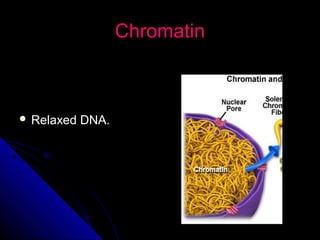
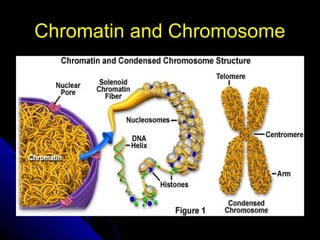
ChromatinChromatin
 Relaxed DNA.Relaxed DNA.
ChromosomesChromosomes
 Condensed DNA.Condensed DNA.
 DNA that is preparingDNA that is preparing
to undergo cellularto undergo cellular
divisiondivision
 Can now be seen withCan now be seen with
a microscope.a microscope.
Chromatids and CentromeresChromatids and Centromeres
 Sister Chromatids: Halves of a duplicatedSister Chromatids: Halves of a duplicated
parent chromosome.parent chromosome.
 Centromeres: The structure that joins twoCentromeres: The structure that joins two
sister chromatids.sister chromatids.
Chromatin and ChromosomeChromatin and Chromosome
Centrioles- Produce the spindleCentrioles- Produce the spindle
and aid in replicationand aid in replication
The Cell CycleThe Cell Cycle
 The process ofThe process of asexuaasexual reproductionl reproduction
(mitosis) of the cell(mitosis) of the cell
 ContainsContains threethree major partsmajor parts
 1. Interphase 2. Mitosis 3. Cytokinesis1. Interphase 2. Mitosis 3. Cytokinesis
The Cell CycleThe Cell Cycle
Part One of the Cell CyclePart One of the Cell Cycle
InterphaseInterphase
 The cell spends the majority of its life inThe cell spends the majority of its life in
interphase.interphase.
 A time in which the cell is preparing forA time in which the cell is preparing for
division.division.
 Chromosomes appear as threadlike coilsChromosomes appear as threadlike coils
(chromatin)(chromatin)
InterphaseInterphase
3-Parts3-Parts
 G-1G-1: Maturation.: Maturation.
 S-PhaseS-Phase: DNA replicates - makes a: DNA replicates - makes a
duplicate copy of itself. (# doubles)duplicate copy of itself. (# doubles)
 G-2G-2: Organelles replicate and final: Organelles replicate and final
preparations for division.preparations for division.
MitosisMitosis
 Division of theDivision of the nucleusnucleus
 4-phases4-phases
PProphaserophase
MMetaphaseetaphase
AAnaphasenaphase
TTelophaseelophase
PMATPMAT
Parts of MitosisParts of Mitosis
ProphaseProphase
 The chromatinThe chromatin
condense to formcondense to form
visible chromosomesvisible chromosomes
 The nuclear envelopeThe nuclear envelope
begins to dissolvebegins to dissolve
 The centrioles divideThe centrioles divide
andand beginbegin to move toto move to
opposite sides of theopposite sides of the
cellcell
Parts of Mitosis Cont…Parts of Mitosis Cont…
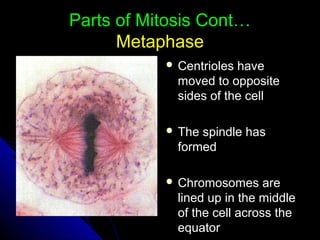
MetaphaseMetaphase
 Centrioles haveCentrioles have
moved to oppositemoved to opposite
sides of the cellsides of the cell
 The spindle hasThe spindle has
formedformed
 Chromosomes areChromosomes are
lined up in the middlelined up in the middle
of the cell across theof the cell across the
equatorequator
Parts of Mitosis Cont…Parts of Mitosis Cont…
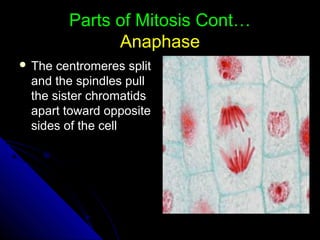
AnaphaseAnaphase
 The centromeres splitThe centromeres split
and the spindles pulland the spindles pull
the sister chromatidsthe sister chromatids
apart toward oppositeapart toward opposite
sides of the cellsides of the cell
Parts of Mitosis Cont…Parts of Mitosis Cont…
TelophaseTelophase
 The chromosomesThe chromosomes
move to oppositemove to opposite
sides of the cell.sides of the cell.
 The nuclear envelopeThe nuclear envelope
begins to reformbegins to reform
around each set ofaround each set of
chromosomes atchromosomes at
opposite sides of theopposite sides of the
cell.cell.
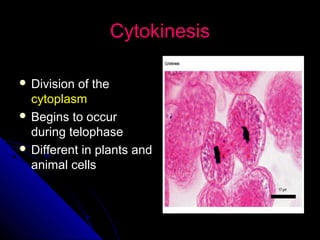
CytokinesisCytokinesis
 Division of theDivision of the
cytoplasmcytoplasm
 Begins to occurBegins to occur
during telophaseduring telophase
 Different in plants andDifferent in plants and
animal cellsanimal cells
Cytokinesis Cont…Cytokinesis Cont…
 Animal cellsAnimal cells: the plasma membrane: the plasma membrane
pinches in to form two separate cellspinches in to form two separate cells
 Plant cellsPlant cells: A rigid cell plate begins to form: A rigid cell plate begins to form
between the two new cells, dividing thembetween the two new cells, dividing them
and becoming a cell wall.and becoming a cell wall.
Mitosis animationMitosis animation
Control of the Cell CycleControl of the Cell Cycle
 The cell cycle is controlled by proteins andThe cell cycle is controlled by proteins and
enzymesenzymes
 Contact with other cells causes cell to stopContact with other cells causes cell to stop
dividing.dividing.
 Cell stop dividing when they lose contactCell stop dividing when they lose contact
with other cellswith other cells
CancerCancer
 Uncontrolled cell growth resulting inUncontrolled cell growth resulting in
tumorstumors
 Metastasis:Metastasis: Cells break lose and travelCells break lose and travel
through the circulatory system spreadingthrough the circulatory system spreading
throughout the body.throughout the body.
Causes of CancerCauses of Cancer
 Environmental factors that damage genes.Environmental factors that damage genes.
Ex: Cigarette smoke, UV rays from the sun,Ex: Cigarette smoke, UV rays from the sun,
air and water pollution, virusesair and water pollution, viruses

Chapter 8 notes bio

  • 1.
    Chapter 8 NotesChapter8 Notes Cellular Transportation And TheCellular Transportation And The Cell CycleCell Cycle
  • 2.
    Cell TransportationCell Transportation:: 2main types2 main types 1.1. Passive transportPassive transport:: Does notDoes not requirerequire energy from the cellenergy from the cell Moves downhill,Moves downhill, withwith the concentrationthe concentration gradientgradient
  • 3.
    Cellular TransportationCellular Transportation Type2Type 2  22.. Active TransportActive Transport:: Requires energyRequires energy toto occur.occur. Moves uphill,Moves uphill, againstagainst the concentrationthe concentration gradient.gradient.
  • 4.
    Passive TransportPassive Transport (Noenergy required)(No energy required) 3-Types3-Types
  • 5.
    11stst Type Passive TransportTypePassive Transport  Simple DiffusionSimple Diffusion : Movement of any: Movement of any substance from areas ofsubstance from areas of higher to lowerhigher to lower concentrationsconcentrations  diffusion animationdiffusion animation
  • 6.
    22ndnd Type Passive TransportTypePassive Transport  Osmosis:Osmosis: Movement ofMovement of waterwater fromfrom areas ofareas of higher to lowerhigher to lower concentrationsconcentrations
  • 7.
    33rdrd Type Passive TransportTypePassive Transport  Facilitated diffusionFacilitated diffusion: Movement of: Movement of substances fromsubstances from higher to lowerhigher to lower concentration with help from a proteinconcentration with help from a protein moleculemolecule Animation: How Facilitated Diffusion WorksAnimation: How Facilitated Diffusion Works
  • 8.
    2-Types of ActiveTransport2-Types of Active Transport (Energy Required)(Energy Required) 11.. ExocytosisExocytosis: The expulsion of particles: The expulsion of particles from the cell.from the cell. 2.2. EndocytosisEndocytosis: surrounding and engulfing: surrounding and engulfing particles.particles. PinocytosisPinocytosis: Cell drinking – the: Cell drinking – the cell takes in liquids.cell takes in liquids. PhagocytosisPhagocytosis: Surrounding and: Surrounding and taking in of large particles.taking in of large particles.
  • 9.
  • 10.
    Solute vs SolventSolutevs Solvent  SoluteSolute: The dissolved substance in a: The dissolved substance in a liquid.liquid.  SolventSolvent: The liquid that the solute is: The liquid that the solute is dissolved in: Usually waterdissolved in: Usually water
  • 11.
    Types of solutionsTypesof solutions Isotonic solutionIsotonic solution  Concentrations ofConcentrations of solute are equal in thesolute are equal in the cell and the solution.cell and the solution. (cell=solution)(cell=solution)  Water moves backWater moves back and forth at the sameand forth at the same rate.rate.  Water in =Water OutWater in =Water Out
  • 12.
    Hyp-O-tonic solutionHyp-O-tonic solution (Hyp-Ohhno I’m swelling-tonic)(Hyp-Ohh no I’m swelling-tonic)  HypHypOOtonictonic: Concentrations of solute are: Concentrations of solute are higher in the cell than in the solutionhigher in the cell than in the solution (cell-higher, solution-lower)(cell-higher, solution-lower)  Water moves into the cell.Water moves into the cell.  The cellThe cell swellsswells and can burst.and can burst.
  • 13.
    Hypertonic SolutionHypertonic Solution Concentrations ofConcentrations of solute are lower in thesolute are lower in the cell than in thecell than in the solution (cell-lower,solution (cell-lower, solution-higher)solution-higher)  Water moves out ofWater moves out of the cellthe cell..  The cellThe cell shrinksshrinks..
  • 14.
    Limits to cellsizeLimits to cell size  A cells size is limited, so organisms growA cells size is limited, so organisms grow by cellular division.by cellular division.  The cells of a baby are the same size asThe cells of a baby are the same size as the cells of an adult.the cells of an adult.
  • 15.
    So… Why Can’tcells just growSo… Why Can’t cells just grow larger???larger???
  • 16.
    Three factors thatlimit the growthThree factors that limit the growth of cellsof cells  1. Diffusion across cell surface.1. Diffusion across cell surface.  2. Shortage of DNA.2. Shortage of DNA.  3. Surface to volume ratio.3. Surface to volume ratio.
  • 17.
    DiffusionDiffusion  Diffusion isefficient over short distances,Diffusion is efficient over short distances, but becomes inefficient and slow overbut becomes inefficient and slow over large distances.large distances.  So…cells that are large have a moreSo…cells that are large have a more difficult time getting nutrients into the celldifficult time getting nutrients into the cell and waste products out of the cell.and waste products out of the cell.
  • 18.
    DNADNA  A cellcannot survive without sufficientA cell cannot survive without sufficient amounts of DNA to make necessaryamounts of DNA to make necessary proteinsproteins  Unusually large cells must have multipleUnusually large cells must have multiple nuclei in order to supply needed DNAnuclei in order to supply needed DNA
  • 19.
    Surface Area toVolume RatioSurface Area to Volume Ratio  As a cell’s size increases, its volume increasesAs a cell’s size increases, its volume increases faster than its surface areafaster than its surface area
  • 20.
    Cell ReproductionCell Reproduction MitosisMitosis: Asexual reproduction (Cell Cycle): Asexual reproduction (Cell Cycle)  The process by which one cell divides intoThe process by which one cell divides into two cells, both identical to the originaltwo cells, both identical to the original parent cellparent cell
  • 21.
    The Dreaded “TheDreaded “CC” Words!” Words!  ChromatinChromatin  ChromosomesChromosomes  ChromatidChromatid  CentromeresCentromeres  CentiolesCentioles
  • 22.
  • 23.
    ChromosomesChromosomes  Condensed DNA.CondensedDNA.  DNA that is preparingDNA that is preparing to undergo cellularto undergo cellular divisiondivision  Can now be seen withCan now be seen with a microscope.a microscope.
  • 24.
    Chromatids and CentromeresChromatidsand Centromeres  Sister Chromatids: Halves of a duplicatedSister Chromatids: Halves of a duplicated parent chromosome.parent chromosome.  Centromeres: The structure that joins twoCentromeres: The structure that joins two sister chromatids.sister chromatids.
  • 25.
  • 26.
    Centrioles- Produce thespindleCentrioles- Produce the spindle and aid in replicationand aid in replication
  • 27.
    The Cell CycleTheCell Cycle  The process ofThe process of asexuaasexual reproductionl reproduction (mitosis) of the cell(mitosis) of the cell  ContainsContains threethree major partsmajor parts  1. Interphase 2. Mitosis 3. Cytokinesis1. Interphase 2. Mitosis 3. Cytokinesis
  • 28.
  • 29.
    Part One ofthe Cell CyclePart One of the Cell Cycle InterphaseInterphase  The cell spends the majority of its life inThe cell spends the majority of its life in interphase.interphase.  A time in which the cell is preparing forA time in which the cell is preparing for division.division.  Chromosomes appear as threadlike coilsChromosomes appear as threadlike coils (chromatin)(chromatin)
  • 30.
    InterphaseInterphase 3-Parts3-Parts  G-1G-1: Maturation.:Maturation.  S-PhaseS-Phase: DNA replicates - makes a: DNA replicates - makes a duplicate copy of itself. (# doubles)duplicate copy of itself. (# doubles)  G-2G-2: Organelles replicate and final: Organelles replicate and final preparations for division.preparations for division.
  • 31.
    MitosisMitosis  Division oftheDivision of the nucleusnucleus  4-phases4-phases PProphaserophase MMetaphaseetaphase AAnaphasenaphase TTelophaseelophase PMATPMAT
  • 32.
    Parts of MitosisPartsof Mitosis ProphaseProphase  The chromatinThe chromatin condense to formcondense to form visible chromosomesvisible chromosomes  The nuclear envelopeThe nuclear envelope begins to dissolvebegins to dissolve  The centrioles divideThe centrioles divide andand beginbegin to move toto move to opposite sides of theopposite sides of the cellcell
  • 33.
    Parts of MitosisCont…Parts of Mitosis Cont… MetaphaseMetaphase  Centrioles haveCentrioles have moved to oppositemoved to opposite sides of the cellsides of the cell  The spindle hasThe spindle has formedformed  Chromosomes areChromosomes are lined up in the middlelined up in the middle of the cell across theof the cell across the equatorequator
  • 34.
    Parts of MitosisCont…Parts of Mitosis Cont… AnaphaseAnaphase  The centromeres splitThe centromeres split and the spindles pulland the spindles pull the sister chromatidsthe sister chromatids apart toward oppositeapart toward opposite sides of the cellsides of the cell
  • 35.
    Parts of MitosisCont…Parts of Mitosis Cont… TelophaseTelophase  The chromosomesThe chromosomes move to oppositemove to opposite sides of the cell.sides of the cell.  The nuclear envelopeThe nuclear envelope begins to reformbegins to reform around each set ofaround each set of chromosomes atchromosomes at opposite sides of theopposite sides of the cell.cell.
  • 36.
    CytokinesisCytokinesis  Division oftheDivision of the cytoplasmcytoplasm  Begins to occurBegins to occur during telophaseduring telophase  Different in plants andDifferent in plants and animal cellsanimal cells
  • 37.
    Cytokinesis Cont…Cytokinesis Cont… Animal cellsAnimal cells: the plasma membrane: the plasma membrane pinches in to form two separate cellspinches in to form two separate cells  Plant cellsPlant cells: A rigid cell plate begins to form: A rigid cell plate begins to form between the two new cells, dividing thembetween the two new cells, dividing them and becoming a cell wall.and becoming a cell wall.
  • 39.
  • 40.
    Control of theCell CycleControl of the Cell Cycle  The cell cycle is controlled by proteins andThe cell cycle is controlled by proteins and enzymesenzymes  Contact with other cells causes cell to stopContact with other cells causes cell to stop dividing.dividing.  Cell stop dividing when they lose contactCell stop dividing when they lose contact with other cellswith other cells
  • 41.
    CancerCancer  Uncontrolled cellgrowth resulting inUncontrolled cell growth resulting in tumorstumors  Metastasis:Metastasis: Cells break lose and travelCells break lose and travel through the circulatory system spreadingthrough the circulatory system spreading throughout the body.throughout the body.
  • 42.
    Causes of CancerCausesof Cancer  Environmental factors that damage genes.Environmental factors that damage genes. Ex: Cigarette smoke, UV rays from the sun,Ex: Cigarette smoke, UV rays from the sun, air and water pollution, virusesair and water pollution, viruses