Chapter 3 Forces
Newton’s Second Law of Motion States that  FORCE ,  MASS  and  ACCELERATION  are related
Force and Acceleration As the force acting upon an object is  increased , the acceleration of the object is  increased .
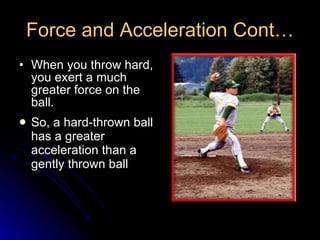
Force and Acceleration Cont… When you throw hard, you exert a much greater force on the ball. So, a hard-thrown ball has a greater acceleration than a gently thrown ball
Mass and Acceleration As the mass of an object is  increased , the acceleration of the object is  decreased .
If you throw a softball and a baseball as hard as you can, why don’t they have the same speed?   The difference is due to their  masses .   The acceleration of an object depends on its mass as well as the force exerted on it. Force, Mass and Acceleration are Related
Can be calculated from the following equation: Newton’s Second Law
Friction The force that opposes the sliding motion of two surfaces that are touching each other.   Depends on 2 factors: 1.  The kinds of surfaces 2.  The force pressing the surfaces  together
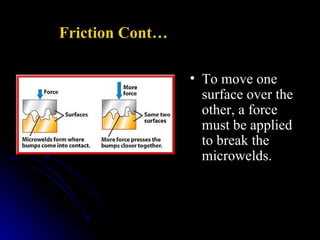
What Causes Friction??? Tiny Microwelds (bumps) on the surfaces causes them to stick together.
Friction Cont… To move one surface over the other, a force must be applied to break the microwelds.
3-Types of Friction  Static Friction :  T he frictional force that prevents two surfaces from sliding past each other.   Sliding Friction :  T he force that opposes the motion of two surfaces sliding past each other.   Rolling Friction :  The frictional force between a rolling object and the surface it rolls on.  :
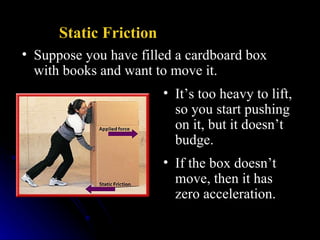
Suppose you have filled a cardboard box with books and want to move it. Static Friction   It’s too heavy to lift, so you start pushing on it, but it doesn’t budge.   If the box doesn’t move, then it has zero acceleration.
Sliding Friction You ask a friend to help you move the box. Together you are able to supply enough force to break the microwelds between the floor and the bottom of the box.
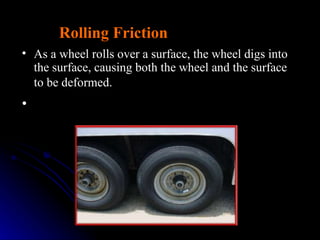
Rolling Friction   As a wheel rolls over a surface, the wheel digs into the surface, causing both the wheel and the surface to be deformed.
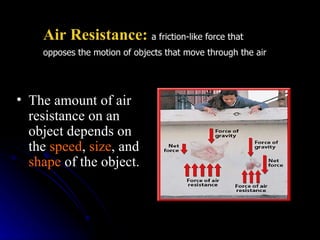
The amount of air resistance on an object depends on the  speed ,  size , and  shape  of the object. Air Resistance:  a friction-like force that opposes the motion of objects that move through the air
4-Forces Gravity electromagnetic force strong nuclear force  weak nuclear force.
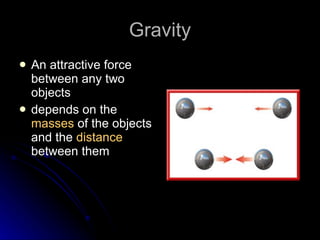
Gravity An attractive force between any two objects depends on the  masses  of the objects and the  distance  between them
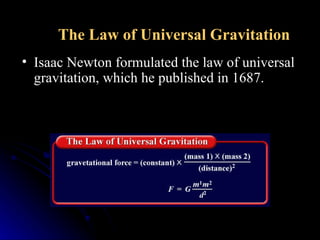
Isaac Newton formulated the law of universal gravitation, which he published in 1687.  The Law of Universal Gravitation
Weight and mass are not the same. Weight and Mass   Weight is a force and mass is a measure of the amount of matter an object contains.  Weight and mass are related.  Weight increases as mass increases.
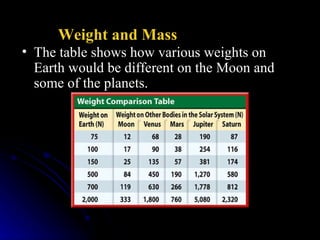
The table shows how various weights on Earth would be different on the Moon and some of the planets. Weight and Mass
Acceleration toward the center of a curved or circular path . Centripetal Acceleration
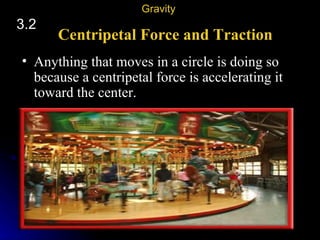
Anything that moves in a circle is doing so because a centripetal force is accelerating it toward the center.   3.2 Gravity Centripetal Force and Traction
Newton’s Third Law   When one object exerts a force on a second object, the second one exerts a force on the first that is  equal  in strength and  opposite  in direction.
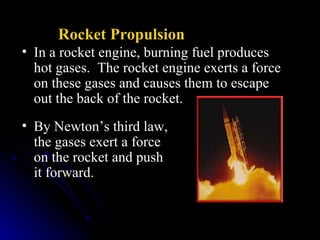
Rocket Propulsion In a rocket engine, burning fuel produces hot gases.  The rocket engine exerts a force on these gases and causes them to escape out the back of the rocket. By Newton’s third law, the gases exert a force on the rocket and push it forward.
Momentum A property that is related to how much force is needed to change its motion. The  momentum  of an object is the product of its  mass  and  velocity .
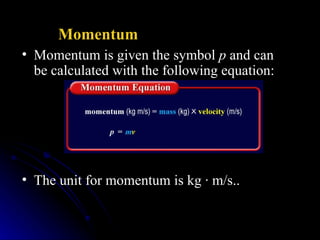
Momentum Momentum is given the symbol  p  and can  be calculated with the following equation:   The unit for momentum is kg · m/s..
Law of Conservation of Momentum   The momentum of an object doesn’t change unless its mass, velocity, or both change. Momentum can be transferred from one object to another.   If a group of objects exerts forces only on each other, their total momentum doesn’t change.
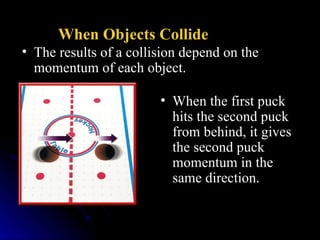
When Objects Collide   The results of a collision depend on the momentum of each object.   When the first puck hits the second puck from behind, it gives the second puck momentum in the same direction.
When Objects Collide   If the pucks are speeding toward each other with the same speed, the total momentum is zero.

Chapter 3 Physical Science

  • 1.
  • 2.
    Newton’s Second Lawof Motion States that FORCE , MASS and ACCELERATION are related
  • 3.
    Force and AccelerationAs the force acting upon an object is increased , the acceleration of the object is increased .
  • 4.
    Force and AccelerationCont… When you throw hard, you exert a much greater force on the ball. So, a hard-thrown ball has a greater acceleration than a gently thrown ball
  • 5.
    Mass and AccelerationAs the mass of an object is increased , the acceleration of the object is decreased .
  • 6.
    If you throwa softball and a baseball as hard as you can, why don’t they have the same speed? The difference is due to their masses . The acceleration of an object depends on its mass as well as the force exerted on it. Force, Mass and Acceleration are Related
  • 7.
    Can be calculatedfrom the following equation: Newton’s Second Law
  • 8.
    Friction The forcethat opposes the sliding motion of two surfaces that are touching each other. Depends on 2 factors: 1. The kinds of surfaces 2. The force pressing the surfaces together
  • 9.
    What Causes Friction???Tiny Microwelds (bumps) on the surfaces causes them to stick together.
  • 10.
    Friction Cont… Tomove one surface over the other, a force must be applied to break the microwelds.
  • 11.
    3-Types of Friction Static Friction : T he frictional force that prevents two surfaces from sliding past each other. Sliding Friction : T he force that opposes the motion of two surfaces sliding past each other. Rolling Friction : The frictional force between a rolling object and the surface it rolls on. :
  • 12.
    Suppose you havefilled a cardboard box with books and want to move it. Static Friction It’s too heavy to lift, so you start pushing on it, but it doesn’t budge. If the box doesn’t move, then it has zero acceleration.
  • 13.
    Sliding Friction Youask a friend to help you move the box. Together you are able to supply enough force to break the microwelds between the floor and the bottom of the box.
  • 14.
    Rolling Friction As a wheel rolls over a surface, the wheel digs into the surface, causing both the wheel and the surface to be deformed.
  • 15.
    The amount ofair resistance on an object depends on the speed , size , and shape of the object. Air Resistance: a friction-like force that opposes the motion of objects that move through the air
  • 16.
    4-Forces Gravity electromagneticforce strong nuclear force weak nuclear force.
  • 17.
    Gravity An attractiveforce between any two objects depends on the masses of the objects and the distance between them
  • 18.
    Isaac Newton formulatedthe law of universal gravitation, which he published in 1687. The Law of Universal Gravitation
  • 19.
    Weight and massare not the same. Weight and Mass Weight is a force and mass is a measure of the amount of matter an object contains. Weight and mass are related. Weight increases as mass increases.
  • 20.
    The table showshow various weights on Earth would be different on the Moon and some of the planets. Weight and Mass
  • 21.
    Acceleration toward thecenter of a curved or circular path . Centripetal Acceleration
  • 22.
    Anything that movesin a circle is doing so because a centripetal force is accelerating it toward the center. 3.2 Gravity Centripetal Force and Traction
  • 23.
    Newton’s Third Law When one object exerts a force on a second object, the second one exerts a force on the first that is equal in strength and opposite in direction.
  • 24.
    Rocket Propulsion Ina rocket engine, burning fuel produces hot gases. The rocket engine exerts a force on these gases and causes them to escape out the back of the rocket. By Newton’s third law, the gases exert a force on the rocket and push it forward.
  • 25.
    Momentum A propertythat is related to how much force is needed to change its motion. The momentum of an object is the product of its mass and velocity .
  • 26.
    Momentum Momentum isgiven the symbol p and can be calculated with the following equation: The unit for momentum is kg · m/s..
  • 27.
    Law of Conservationof Momentum The momentum of an object doesn’t change unless its mass, velocity, or both change. Momentum can be transferred from one object to another. If a group of objects exerts forces only on each other, their total momentum doesn’t change.
  • 28.
    When Objects Collide The results of a collision depend on the momentum of each object. When the first puck hits the second puck from behind, it gives the second puck momentum in the same direction.
  • 29.
    When Objects Collide If the pucks are speeding toward each other with the same speed, the total momentum is zero.

Editor's Notes

  • #14 Pushing together, the box moves. Together you and your friend have exerted enough force to break the microwelds between the floor and the bottom of the box.
  • #16 Air resistance, not the object’s mass, is why feathers, leaves, and pieces of paper fall more slowly than pennies, acorns, and apples
  • #18 a friction-like force called air resistance opposes the motion of objects that move through the air.