WIRELESS NETWORKS

CH3: MEDIA ACCESS CONTROL
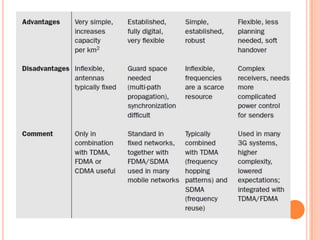
 This chapter aims to explain why special MACs are
  needed in the wireless domain and why standard
  MAC schemes known from wired networks often
  fail.
 CSMA/CD is not really interested in collisions at the
  sender, but rather in those at the receiver.
 The signal should reach the receiver without
  collisions. But the sender is the one detecting
  collisions.
 This is not a problem using a wire, as more or less
  the same signal strength can be assumed all over
  the wire if the length of the wire stays within certain
  often standardized limits.
 If a collision occurs somewhere in the
  wire, everybody will notice it.
 The situation is different in wireless networks.
 the strength of a signal decreases proportionally to the
  square of the distance to the sender.
 The sender may now apply carrier sense and detect
  on idle medium.
 The sender starts sending – but a collision happens at
  the receiver due to a second sender.
 The sender detects no collision and assumes that the
  data has been transmitted without errors, but a
  collision might actually have destroyed the data at the
  receiver.
 Collision detection is very difficult in wireless scenarios
  as the transmission power in the area of the
  transmitting antenna is several magnitudes higher
  than the receiving power.
 So, this MAC scheme from wired network fails in a
  wireless scenario.
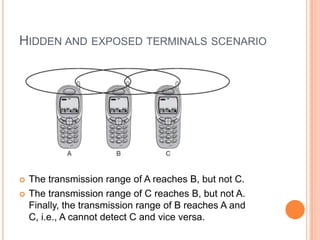
HIDDEN AND EXPOSED TERMINALS SCENARIO


   The transmission range of A reaches B, but not C.
   The transmission range of C reaches B, but not A.
    Finally, the transmission range of B reaches A and
    C, i.e., A cannot detect C and vice versa.
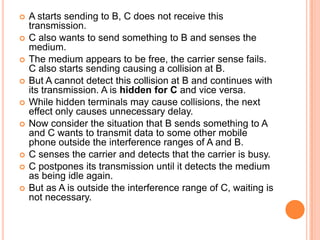
   A starts sending to B, C does not receive this
    transmission.
   C also wants to send something to B and senses the
    medium.
   The medium appears to be free, the carrier sense fails.
    C also starts sending causing a collision at B.
   But A cannot detect this collision at B and continues with
    its transmission. A is hidden for C and vice versa.
   While hidden terminals may cause collisions, the next
    effect only causes unnecessary delay.
   Now consider the situation that B sends something to A
    and C wants to transmit data to some other mobile
    phone outside the interference ranges of A and B.
   C senses the carrier and detects that the carrier is busy.
   C postpones its transmission until it detects the medium
    as being idle again.
   But as A is outside the interference range of C, waiting is
    not necessary.
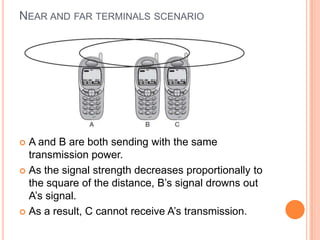
NEAR AND FAR TERMINALS SCENARIO


 A and B are both sending with the same
  transmission power.
 As the signal strength decreases proportionally to
  the square of the distance, B’s signal drowns out
  A’s signal.
 As a result, C cannot receive A’s transmission.
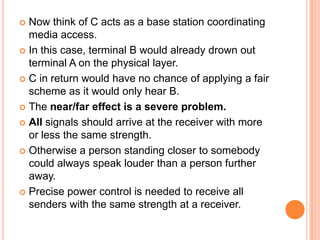
 Now think of C acts as a base station coordinating
  media access.
 In this case, terminal B would already drown out
  terminal A on the physical layer.
 C in return would have no chance of applying a fair
  scheme as it would only hear B.
 The near/far effect is a severe problem.

 All signals should arrive at the receiver with more
  or less the same strength.
 Otherwise a person standing closer to somebody
  could always speak louder than a person further
  away.
 Precise power control is needed to receive all
  senders with the same strength at a receiver.
SDMA
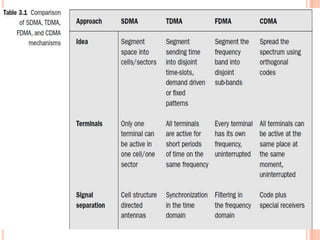
   Space Division Multiple Access (SDMA) is used for
    allocating a separated space to users in wireless
    networks.
   A typical application involves assigning an optimal base
    station to a mobile phone user.
   The mobile phone may receive several base stations
    with different quality.
   A MAC algorithm could now decide which base station is
    best, taking into account which frequencies (FDM), time
    slots (TDM) or code (CDM) are still available.
   Typically, SDMA is never used in isolation but always in
    combination with one or more other schemes.
   The basis for the SDMA algorithm is formed by cells and
    sectorized antennas which constitute the infrastructure
    implementing space division multiplexing
FDMA
   Frequency division multiple access (FDMA)
    comprises all algorithms allocating frequencies to
    transmission channels according to the frequency
    division multiplexing (FDM) scheme.
   Allocation can either be fixed or dynamic.
   Channels can be assigned to the same frequency at all
    times, i.e., pure FDMA, or change frequencies according
    to a certain pattern i.e., FDMA combined with TDMA.
   FDM is often used for simultaneous access to the
    medium by base station and mobile station in cellular
    networks.
   Here the two partners typically establish a duplex
    channel, i.e., a channel that allows for simultaneous
    transmission in both directions. The two
    directions, mobile station to base station and vice versa
    are now separated using different frequencies.
   This scheme is then called frequency division duplex
    (FDD).
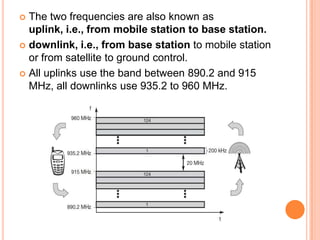
 The two frequencies are also known as
  uplink, i.e., from mobile station to base station.
 downlink, i.e., from base station to mobile station
  or from satellite to ground control.
 All uplinks use the band between 890.2 and 915
  MHz, all downlinks use 935.2 to 960 MHz.
 the base station, shown on the right side, allocates
  a certain frequency for up- and downlink to
  establish a duplex channel with a mobile phone.
 Up- and downlink have a fixed relation.

 If the uplink frequency is

   fu = 890 MHz + n·0.2 MHz,
   the downlink frequency is
   fd = fu +45 MHz, i.e.,
   fd = 935 MHz + n·0.2 MHz
   for a certain channel n.
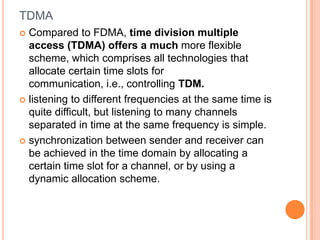
TDMA
 Compared to FDMA, time division multiple
  access (TDMA) offers a much more flexible
  scheme, which comprises all technologies that
  allocate certain time slots for
  communication, i.e., controlling TDM.
 listening to different frequencies at the same time is
  quite difficult, but listening to many channels
  separated in time at the same frequency is simple.
 synchronization between sender and receiver can
  be achieved in the time domain by allocating a
  certain time slot for a channel, or by using a
  dynamic allocation scheme.
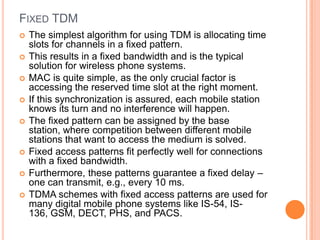
FIXED TDM
   The simplest algorithm for using TDM is allocating time
    slots for channels in a fixed pattern.
   This results in a fixed bandwidth and is the typical
    solution for wireless phone systems.
   MAC is quite simple, as the only crucial factor is
    accessing the reserved time slot at the right moment.
   If this synchronization is assured, each mobile station
    knows its turn and no interference will happen.
   The fixed pattern can be assigned by the base
    station, where competition between different mobile
    stations that want to access the medium is solved.
   Fixed access patterns fit perfectly well for connections
    with a fixed bandwidth.
   Furthermore, these patterns guarantee a fixed delay –
    one can transmit, e.g., every 10 ms.
   TDMA schemes with fixed access patterns are used for
    many digital mobile phone systems like IS-54, IS-
    136, GSM, DECT, PHS, and PACS.
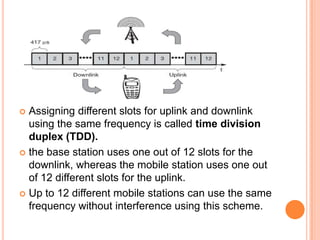
 Assigning different slots for uplink and downlink
  using the same frequency is called time division
  duplex (TDD).
 the base station uses one out of 12 slots for the
  downlink, whereas the mobile station uses one out
  of 12 different slots for the uplink.
 Up to 12 different mobile stations can use the same
  frequency without interference using this scheme.
 Classical Aloha
 Slotted Aloha

 Carrier sense multiple access

 Demand assigned multiple access

 PRMA packet reservation multiple access

 Reservation TDMA

 Multiple access with collision avoidance

 Polling

 Inhibit sense multiple access

 CDMA

 Spread Aloha multiple access
ALOHA: PURE ALOHA
 The basic idea of an ALOHA system is simple: let users
  transmit whenever they have data to be sent.
 There will be collisions, of course, and the colliding frames
  will be damaged.
 However, due to the feedback property of broadcasting, a
  sender can always find out whether its frame was
  destroyed by listening to the channel.
 If listening while transmitting is not possible for some
  reason, acknowledgements are needed.
 If the frame was destroyed, the sender just waits a random
  amount of time and sends it again.
 The waiting time must be random or the same frames will
  collide over and over, in lockstep.
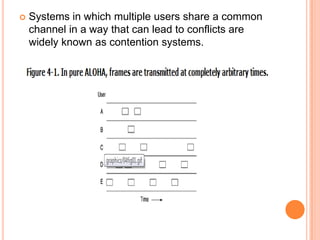
   Systems in which multiple users share a common
    channel in a way that can lead to conflicts are
    widely known as contention systems.
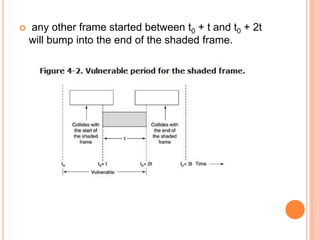
   If the first bit of a new frame overlaps with just the
    last bit of a frame almost finished, both frames will
    be totally destroyed and both will have to be
    retransmitted later.

   Let t be the time required to send a frame. If any
    other user has generated a frame between time t0
    and t0 + t, the end of that frame will collide with the
    beginning of the shaded one.

   In pure ALOHA a station does not listen to the
    channel before transmitting, it has no way of
    knowing that another frame was already underway.
   any other frame started between t0 + t and t0 + 2t
    will bump into the end of the shaded frame.
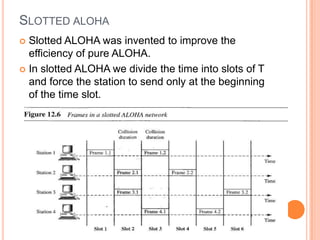
SLOTTED ALOHA
 Slotted ALOHA was invented to improve the
  efficiency of pure ALOHA.
 In slotted ALOHA we divide the time into slots of T
  and force the station to send only at the beginning
  of the time slot.
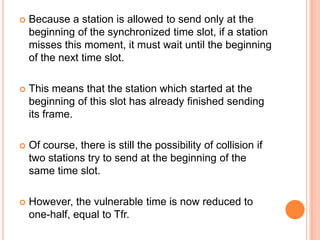
   Because a station is allowed to send only at the
    beginning of the synchronized time slot, if a station
    misses this moment, it must wait until the beginning
    of the next time slot.

   This means that the station which started at the
    beginning of this slot has already finished sending
    its frame.

   Of course, there is still the possibility of collision if
    two stations try to send at the beginning of the
    same time slot.

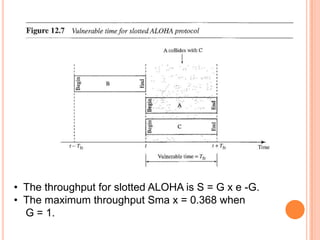
   However, the vulnerable time is now reduced to
    one-half, equal to Tfr.
• The throughput for slotted ALOHA is S = G x e -G.
• The maximum throughput Sma x = 0.368 when
  G = 1.
CARRIER SENSE MULTIPLE ACCESS (CSMA)

 To minimize the chance of collision
  and, therefore, increase the performance, the
  CSMA method was developed.
 The chance of collision can be reduced if a station
  senses the medium before trying to use it.
 In other words, CSMA is based on the principle
  "sense before transmit" or "listen before talk."
 CSMA can reduce the possibility of collision, but it
  cannot eliminate it.
 The possibility of collision still exists because of
  propagation delay.
 when a station sends a frame, it still takes time for
  the first bit to reach every station and for every
  station to sense it.
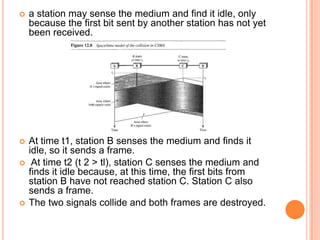
   a station may sense the medium and find it idle, only
    because the first bit sent by another station has not yet
    been received.


   At time t1, station B senses the medium and finds it
    idle, so it sends a frame.
    At time t2 (t 2 > tl), station C senses the medium and
    finds it idle because, at this time, the first bits from
    station B have not reached station C. Station C also
    sends a frame.
   The two signals collide and both frames are destroyed.
 Vulnerable Time :
 The vulnerable time for CSMA is the propagation time
  Tp. This is the time needed for a signal to propagate
  from one end of the medium to the other.

   But if the first bit of the frame reaches the end of the
    medium, every station will already have heard the bit
    and will refrain from sending.

 Persistence Methods
 What should a station do if the channel is busy?

 What should a station do if the channel is idle?
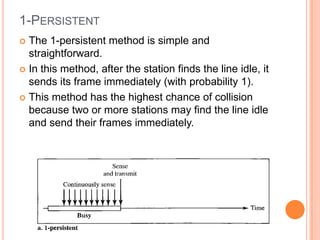
1-PERSISTENT
 The 1-persistent method is simple and
  straightforward.
 In this method, after the station finds the line idle, it
  sends its frame immediately (with probability 1).
 This method has the highest chance of collision
  because two or more stations may find the line idle
  and send their frames immediately.
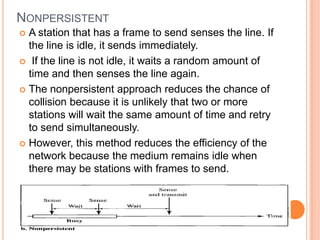
NONPERSISTENT
 A station that has a frame to send senses the line. If
  the line is idle, it sends immediately.
 If the line is not idle, it waits a random amount of
  time and then senses the line again.
 The nonpersistent approach reduces the chance of
  collision because it is unlikely that two or more
  stations will wait the same amount of time and retry
  to send simultaneously.
 However, this method reduces the efficiency of the
  network because the medium remains idle when
  there may be stations with frames to send.
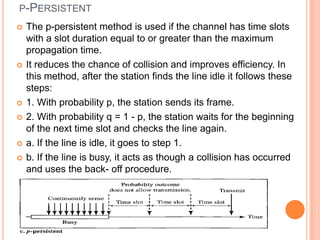
P-PERSISTENT
   The p-persistent method is used if the channel has time slots
    with a slot duration equal to or greater than the maximum
    propagation time.
   It reduces the chance of collision and improves efficiency. In
    this method, after the station finds the line idle it follows these
    steps:
   1. With probability p, the station sends its frame.
   2. With probability q = 1 - p, the station waits for the beginning
    of the next time slot and checks the line again.
   a. If the line is idle, it goes to step 1.
   b. If the line is busy, it acts as though a collision has occurred
    and uses the back- off procedure.
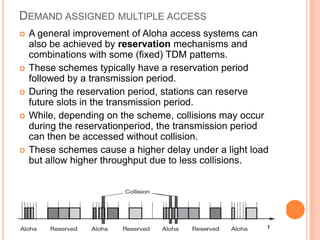
DEMAND ASSIGNED MULTIPLE ACCESS
   A general improvement of Aloha access systems can
    also be achieved by reservation mechanisms and
    combinations with some (fixed) TDM patterns.
   These schemes typically have a reservation period
    followed by a transmission period.
   During the reservation period, stations can reserve
    future slots in the transmission period.
   While, depending on the scheme, collisions may occur
    during the reservationperiod, the transmission period
    can then be accessed without collision.
   These schemes cause a higher delay under a light load
    but allow higher throughput due to less collisions.
   demand assigned multiple access (DAMA) also called
    reservation Aloha, a scheme typical for satellite systems.
   DAMA has two modes.
   During a contention phase following the slotted Aloha
    scheme, all stations can try to reserve future slots.
   For example, different stations on earth try to reserve access
    time for satellite transmission.
   Collisions during the reservation phase do not destroy data
    transmission, but only the short requests for data
    transmission.
   If successful, a time slot in the future is reserved, and no other
    station is allowed to transmit during this slot.
   Therefore, the satellite collects all successful requests and
    sends back a reservation list indicating access rights for future
    slots.
    All ground stations have to obey this list.
   To maintain the fixed TDM pattern of reservation and
    transmission, the stations have to be synchronized from time
    to time.
   DAMA is an explicit reservation scheme. Each
    transmission slot has to bereserved explicitly.
PRMA PACKET RESERVATION MULTIPLE
ACCESS


   An example for an implicit reservation scheme is
    packet reservation multiple access (PRMA).
   Here, slots can be reserved implicitly according to
    the following scheme.
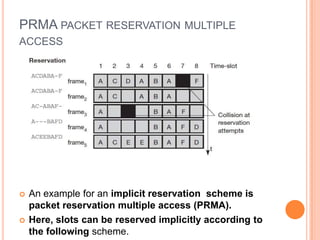
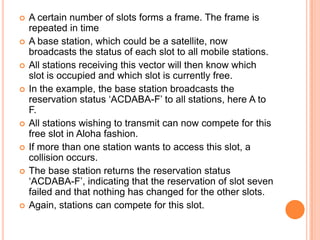
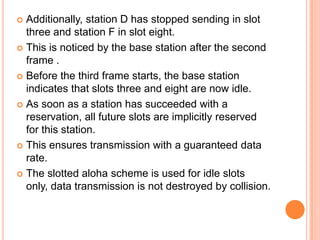
   A certain number of slots forms a frame. The frame is
    repeated in time
   A base station, which could be a satellite, now
    broadcasts the status of each slot to all mobile stations.
   All stations receiving this vector will then know which
    slot is occupied and which slot is currently free.
   In the example, the base station broadcasts the
    reservation status ‘ACDABA-F’ to all stations, here A to
    F.
   All stations wishing to transmit can now compete for this
    free slot in Aloha fashion.
   If more than one station wants to access this slot, a
    collision occurs.
   The base station returns the reservation status
    ‘ACDABA-F’, indicating that the reservation of slot seven
    failed and that nothing has changed for the other slots.
   Again, stations can compete for this slot.
 Additionally, station D has stopped sending in slot
  three and station F in slot eight.
 This is noticed by the base station after the second
  frame .
 Before the third frame starts, the base station
  indicates that slots three and eight are now idle.
 As soon as a station has succeeded with a
  reservation, all future slots are implicitly reserved
  for this station.
 This ensures transmission with a guaranteed data
  rate.
 The slotted aloha scheme is used for idle slots
  only, data transmission is not destroyed by collision.
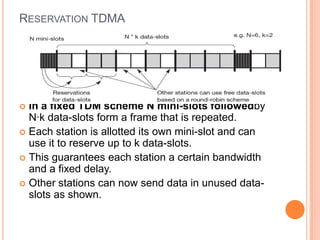
RESERVATION TDMA


 In a fixed TDM scheme N mini-slots followedby
  N·k data-slots form a frame that is repeated.
 Each station is allotted its own mini-slot and can
  use it to reserve up to k data-slots.
 This guarantees each station a certain bandwidth
  and a fixed delay.
 Other stations can now send data in unused data-
  slots as shown.
MULTIPLE ACCESS WITH COLLISION
AVOIDANCE

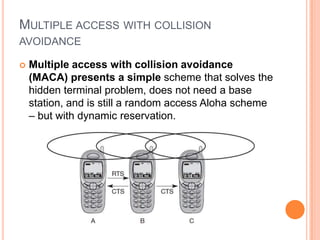
   Multiple access with collision avoidance
    (MACA) presents a simple scheme that solves the
    hidden terminal problem, does not need a base
    station, and is still a random access Aloha scheme
    – but with dynamic reservation.
 With MACA, A does not start its transmission at
  once, but sends a request to send (RTS) first.
 B receives the RTS that contains the name of
  sender and receiver, as well as the length of the
  future transmission.
 This RTS is not heard by C, but triggers an
  acknowledgement from B, called clear to send
  (CTS).
 The CTS again contains the names of sender (A)
  and receiver (B) of the user data, and the length of
  the future transmission.
 This CTS is now heard by C and the medium for
  future use by A is now reserved for the duration of
  the transmission.
 After receiving a CTS, C is not allowed to send
  anything for the duration indicated in the CTS
  toward B.
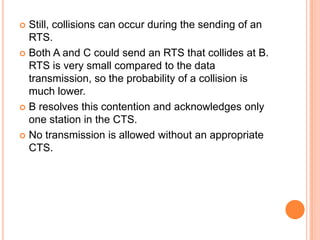
 Still, collisions can occur during the sending of an
  RTS.
 Both A and C could send an RTS that collides at B.
  RTS is very small compared to the data
  transmission, so the probability of a collision is
  much lower.
 B resolves this contention and acknowledges only
  one station in the CTS.
 No transmission is allowed without an appropriate
  CTS.
MACA ALSO HELP TO SOLVE THE ‘EXPOSED
TERMINAL’ PROBLEM
   With MACA, B has to transmit an RTS first containing
    the name of the receiver (A) and the sender (B).
   C does not react to this message as it is not the
    receiver, but A acknowledges using a CTS which
    identifies
   B as the sender and A as the receiver of the following
    data transmission.
   C does not receive this CTS and concludes that A is
    outside the detection range.
   C can start its transmission assuming it will not cause a
    collision at A.
   The problem with exposed terminals is solved without
    fixed access patterns or a base station.
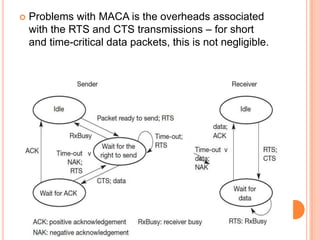
   Problems with MACA is the overheads associated
    with the RTS and CTS transmissions – for short
    and time-critical data packets, this is not negligible.
POLLING
 Where one station is to be heard by all others
  (e.g., the base station of a mobile phone network or
  any other dedicated station), polling schemes can
  be applied.
 Polling is a strictly centralized scheme with one
  master station and several slave stations.
 The master can poll the slaves according to many
  schemes: round robin ,randomly, according to
  reservations etc.
 The master could also establish a list of stations
  wishing to transmit during a contention phase.
 After this phase, the station polls each station on
  the list.
 Similar schemes are used, e.g., in the Bluetooth
  wireless LAN
INHIBIT SENSE MULTIPLE ACCESS

 This scheme, which is used for the packet data
  transmission service, is also known as digital
  sense multiple access (DSMA).
 Here, the base station only signals a busy medium
  via a busy tone on the downlink.
 After the busy tone stops, accessing the uplink is
  not coordinated any further.
 The base station acknowledges successful
  transmissions.
 A mobile station detects a collision only via the
  missing positive acknowledgement.
 In case of collisions, additional back-off and
  retransmission mechanisms are implemented.
CODE-DIVISION MULTIPLE ACCESS (CDMA)
 In CDMA, one channel carries all transmissions
  simultaneously.
 CDMA differs from FDMA because only one
  channel occupies the entire bandwidth of the link.
 It differs from TDMA because all stations can send
  data simultaneously; there is no timesharing.
 CDMA simply means communication with different
  codes.
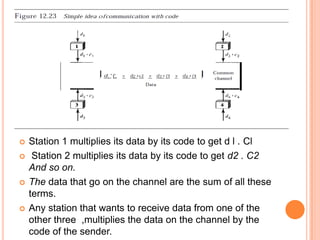
 Let us assume we have four stations 1, 2, 3, and 4
  connected to the same channel.
 The data from station 1 are d l , from station 2 are
  d2, and so on.
 The code assigned to the first station is c1, to the
  second is c2, and so on.
 We assume that the assigned codes have two
  properties.
 1. If we multiply each code by another, we get O.

 2. If we multiply each code by itself, we get 4 (the
  number of stations).
 With these two properties in mind, let us see how
  the above four stations can send data using the
  same common channel,
   Station 1 multiplies its data by its code to get d l . Cl
    Station 2 multiplies its data by its code to get d2 . C2
    And so on.
   The data that go on the channel are the sum of all these
    terms.
   Any station that wants to receive data from one of the
    other three ,multiplies the data on the channel by the
    code of the sender.
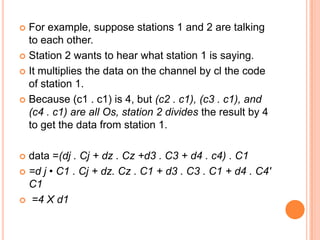
 For example, suppose stations 1 and 2 are talking
  to each other.
 Station 2 wants to hear what station 1 is saying.

 It multiplies the data on the channel by cl the code
  of station 1.
 Because (c1 . c1) is 4, but (c2 . c1), (c3 . c1), and
  (c4 . c1) are all Os, station 2 divides the result by 4
  to get the data from station 1.

 data =(dj . Cj + dz . Cz +d3 . C3 + d4 . c4) . C1
 =d j • C1 . Cj + dz. Cz . C1 + d3 . C3 . C1 + d4 . C4'
  C1
 =4 X d1
   CDMA is based on coding theory. Each station is
    assigned a code, which is a sequence of numbers called
    chips.
   They are called orthogonal sequences and have the
    following properties:
   1. Each sequence is made of N elements, where N is
    the number of stations.

   2. If we multiply a sequence by a number, every element
    in the sequence is multiplied by that element. This is
    called multiplication of a sequence by a scalar.
   For example, 2. [+1 +1-1-1]=[+2+2-2-2]

   3. If we multiply two equal sequences, element by
    element, and add the results, we get N, where N is the
    number of elements in the each sequence.
 This is called the inner product of two equal
  sequences. For example,
 [+1 +1-1 -1]· [+1 +1 -1 -1] = 1 + 1 + 1 + 1 = 4


 4. If we multiply two different sequences, element by
  element, and add the results, we get O. This is called
  inner product of two different sequences.
 For example,
 [+1 +1 -1 -1] • [+1 +1 +1 +1] = 1 + 1 - 1 - 1 = 0


 5. Adding two sequences means adding the
  corresponding elements. The result is another
  sequence.
 For example,
 [+1+1-1-1]+[+1+1+1+1]=[+2+2 00]
DATA REPRESENTATION
   We follow these rules for encoding: If a station needs to
    send a 0 bit, it encodes it as -1;
   if it needs to send a 1 bit, it encodes it as +1. When a
    station is idle, it sends no signal,
   which is interpreted as a O
   Encoding and Decoding
   We assume that stations 1 and 2 are sending a 0 bit and
    channel 4 is sending a 1 bit. Station 3 is silent.
   The data at the sender site are translated to -1, -
    1, 0, and +1.
   Each station multiplies the corresponding number by its
    chip.
    The result is a new sequence which is sent to the
    channel.
   For simplicity, we assume that all stations send the
    resulting sequences at the same time.
   The sequence on the channel is the sum of all four
    sequences as defined before


 Now imagine station 3, which we said is silent, is
  listening to station 2.
 Station 3 multiplies the total data on the channel by
  the code for station 2, which is [+1 -1 +1-1], to get
Wierless networks ch3 (1)

Wierless networks ch3 (1)

  • 1.
  • 2.
     This chapteraims to explain why special MACs are needed in the wireless domain and why standard MAC schemes known from wired networks often fail.  CSMA/CD is not really interested in collisions at the sender, but rather in those at the receiver.  The signal should reach the receiver without collisions. But the sender is the one detecting collisions.  This is not a problem using a wire, as more or less the same signal strength can be assumed all over the wire if the length of the wire stays within certain often standardized limits.  If a collision occurs somewhere in the wire, everybody will notice it.
  • 3.
     The situationis different in wireless networks.  the strength of a signal decreases proportionally to the square of the distance to the sender.  The sender may now apply carrier sense and detect on idle medium.  The sender starts sending – but a collision happens at the receiver due to a second sender.  The sender detects no collision and assumes that the data has been transmitted without errors, but a collision might actually have destroyed the data at the receiver.  Collision detection is very difficult in wireless scenarios as the transmission power in the area of the transmitting antenna is several magnitudes higher than the receiving power.  So, this MAC scheme from wired network fails in a wireless scenario.
  • 4.
    HIDDEN AND EXPOSEDTERMINALS SCENARIO  The transmission range of A reaches B, but not C.  The transmission range of C reaches B, but not A. Finally, the transmission range of B reaches A and C, i.e., A cannot detect C and vice versa.
  • 5.
    A starts sending to B, C does not receive this transmission.  C also wants to send something to B and senses the medium.  The medium appears to be free, the carrier sense fails. C also starts sending causing a collision at B.  But A cannot detect this collision at B and continues with its transmission. A is hidden for C and vice versa.  While hidden terminals may cause collisions, the next effect only causes unnecessary delay.  Now consider the situation that B sends something to A and C wants to transmit data to some other mobile phone outside the interference ranges of A and B.  C senses the carrier and detects that the carrier is busy.  C postpones its transmission until it detects the medium as being idle again.  But as A is outside the interference range of C, waiting is not necessary.
  • 6.
    NEAR AND FARTERMINALS SCENARIO  A and B are both sending with the same transmission power.  As the signal strength decreases proportionally to the square of the distance, B’s signal drowns out A’s signal.  As a result, C cannot receive A’s transmission.
  • 7.
     Now thinkof C acts as a base station coordinating media access.  In this case, terminal B would already drown out terminal A on the physical layer.  C in return would have no chance of applying a fair scheme as it would only hear B.  The near/far effect is a severe problem.  All signals should arrive at the receiver with more or less the same strength.  Otherwise a person standing closer to somebody could always speak louder than a person further away.  Precise power control is needed to receive all senders with the same strength at a receiver.
  • 8.
    SDMA  Space Division Multiple Access (SDMA) is used for allocating a separated space to users in wireless networks.  A typical application involves assigning an optimal base station to a mobile phone user.  The mobile phone may receive several base stations with different quality.  A MAC algorithm could now decide which base station is best, taking into account which frequencies (FDM), time slots (TDM) or code (CDM) are still available.  Typically, SDMA is never used in isolation but always in combination with one or more other schemes.  The basis for the SDMA algorithm is formed by cells and sectorized antennas which constitute the infrastructure implementing space division multiplexing
  • 9.
    FDMA  Frequency division multiple access (FDMA) comprises all algorithms allocating frequencies to transmission channels according to the frequency division multiplexing (FDM) scheme.  Allocation can either be fixed or dynamic.  Channels can be assigned to the same frequency at all times, i.e., pure FDMA, or change frequencies according to a certain pattern i.e., FDMA combined with TDMA.  FDM is often used for simultaneous access to the medium by base station and mobile station in cellular networks.  Here the two partners typically establish a duplex channel, i.e., a channel that allows for simultaneous transmission in both directions. The two directions, mobile station to base station and vice versa are now separated using different frequencies.  This scheme is then called frequency division duplex (FDD).
  • 10.
     The twofrequencies are also known as uplink, i.e., from mobile station to base station.  downlink, i.e., from base station to mobile station or from satellite to ground control.  All uplinks use the band between 890.2 and 915 MHz, all downlinks use 935.2 to 960 MHz.
  • 11.
     the basestation, shown on the right side, allocates a certain frequency for up- and downlink to establish a duplex channel with a mobile phone.  Up- and downlink have a fixed relation.  If the uplink frequency is fu = 890 MHz + n·0.2 MHz, the downlink frequency is fd = fu +45 MHz, i.e., fd = 935 MHz + n·0.2 MHz for a certain channel n.
  • 12.
    TDMA  Compared toFDMA, time division multiple access (TDMA) offers a much more flexible scheme, which comprises all technologies that allocate certain time slots for communication, i.e., controlling TDM.  listening to different frequencies at the same time is quite difficult, but listening to many channels separated in time at the same frequency is simple.  synchronization between sender and receiver can be achieved in the time domain by allocating a certain time slot for a channel, or by using a dynamic allocation scheme.
  • 13.
    FIXED TDM  The simplest algorithm for using TDM is allocating time slots for channels in a fixed pattern.  This results in a fixed bandwidth and is the typical solution for wireless phone systems.  MAC is quite simple, as the only crucial factor is accessing the reserved time slot at the right moment.  If this synchronization is assured, each mobile station knows its turn and no interference will happen.  The fixed pattern can be assigned by the base station, where competition between different mobile stations that want to access the medium is solved.  Fixed access patterns fit perfectly well for connections with a fixed bandwidth.  Furthermore, these patterns guarantee a fixed delay – one can transmit, e.g., every 10 ms.  TDMA schemes with fixed access patterns are used for many digital mobile phone systems like IS-54, IS- 136, GSM, DECT, PHS, and PACS.
  • 14.
     Assigning differentslots for uplink and downlink using the same frequency is called time division duplex (TDD).  the base station uses one out of 12 slots for the downlink, whereas the mobile station uses one out of 12 different slots for the uplink.  Up to 12 different mobile stations can use the same frequency without interference using this scheme.
  • 15.
     Classical Aloha Slotted Aloha  Carrier sense multiple access  Demand assigned multiple access  PRMA packet reservation multiple access  Reservation TDMA  Multiple access with collision avoidance  Polling  Inhibit sense multiple access  CDMA  Spread Aloha multiple access
  • 16.
    ALOHA: PURE ALOHA The basic idea of an ALOHA system is simple: let users transmit whenever they have data to be sent.  There will be collisions, of course, and the colliding frames will be damaged.  However, due to the feedback property of broadcasting, a sender can always find out whether its frame was destroyed by listening to the channel.  If listening while transmitting is not possible for some reason, acknowledgements are needed.  If the frame was destroyed, the sender just waits a random amount of time and sends it again.  The waiting time must be random or the same frames will collide over and over, in lockstep.
  • 17.
    Systems in which multiple users share a common channel in a way that can lead to conflicts are widely known as contention systems.
  • 18.
    If the first bit of a new frame overlaps with just the last bit of a frame almost finished, both frames will be totally destroyed and both will have to be retransmitted later.  Let t be the time required to send a frame. If any other user has generated a frame between time t0 and t0 + t, the end of that frame will collide with the beginning of the shaded one.  In pure ALOHA a station does not listen to the channel before transmitting, it has no way of knowing that another frame was already underway.
  • 19.
    any other frame started between t0 + t and t0 + 2t will bump into the end of the shaded frame.
  • 20.
    SLOTTED ALOHA  SlottedALOHA was invented to improve the efficiency of pure ALOHA.  In slotted ALOHA we divide the time into slots of T and force the station to send only at the beginning of the time slot.
  • 21.
    Because a station is allowed to send only at the beginning of the synchronized time slot, if a station misses this moment, it must wait until the beginning of the next time slot.  This means that the station which started at the beginning of this slot has already finished sending its frame.  Of course, there is still the possibility of collision if two stations try to send at the beginning of the same time slot.  However, the vulnerable time is now reduced to one-half, equal to Tfr.
  • 22.
    • The throughputfor slotted ALOHA is S = G x e -G. • The maximum throughput Sma x = 0.368 when G = 1.
  • 23.
    CARRIER SENSE MULTIPLEACCESS (CSMA)  To minimize the chance of collision and, therefore, increase the performance, the CSMA method was developed.  The chance of collision can be reduced if a station senses the medium before trying to use it.  In other words, CSMA is based on the principle "sense before transmit" or "listen before talk."  CSMA can reduce the possibility of collision, but it cannot eliminate it.  The possibility of collision still exists because of propagation delay.  when a station sends a frame, it still takes time for the first bit to reach every station and for every station to sense it.
  • 24.
    a station may sense the medium and find it idle, only because the first bit sent by another station has not yet been received.  At time t1, station B senses the medium and finds it idle, so it sends a frame.  At time t2 (t 2 > tl), station C senses the medium and finds it idle because, at this time, the first bits from station B have not reached station C. Station C also sends a frame.  The two signals collide and both frames are destroyed.
  • 25.
     Vulnerable Time:  The vulnerable time for CSMA is the propagation time Tp. This is the time needed for a signal to propagate from one end of the medium to the other.  But if the first bit of the frame reaches the end of the medium, every station will already have heard the bit and will refrain from sending.  Persistence Methods  What should a station do if the channel is busy?  What should a station do if the channel is idle?
  • 26.
    1-PERSISTENT  The 1-persistentmethod is simple and straightforward.  In this method, after the station finds the line idle, it sends its frame immediately (with probability 1).  This method has the highest chance of collision because two or more stations may find the line idle and send their frames immediately.
  • 27.
    NONPERSISTENT  A stationthat has a frame to send senses the line. If the line is idle, it sends immediately.  If the line is not idle, it waits a random amount of time and then senses the line again.  The nonpersistent approach reduces the chance of collision because it is unlikely that two or more stations will wait the same amount of time and retry to send simultaneously.  However, this method reduces the efficiency of the network because the medium remains idle when there may be stations with frames to send.
  • 28.
    P-PERSISTENT  The p-persistent method is used if the channel has time slots with a slot duration equal to or greater than the maximum propagation time.  It reduces the chance of collision and improves efficiency. In this method, after the station finds the line idle it follows these steps:  1. With probability p, the station sends its frame.  2. With probability q = 1 - p, the station waits for the beginning of the next time slot and checks the line again.  a. If the line is idle, it goes to step 1.  b. If the line is busy, it acts as though a collision has occurred and uses the back- off procedure.
  • 29.
    DEMAND ASSIGNED MULTIPLEACCESS  A general improvement of Aloha access systems can also be achieved by reservation mechanisms and combinations with some (fixed) TDM patterns.  These schemes typically have a reservation period followed by a transmission period.  During the reservation period, stations can reserve future slots in the transmission period.  While, depending on the scheme, collisions may occur during the reservationperiod, the transmission period can then be accessed without collision.  These schemes cause a higher delay under a light load but allow higher throughput due to less collisions.
  • 30.
    demand assigned multiple access (DAMA) also called reservation Aloha, a scheme typical for satellite systems.  DAMA has two modes.  During a contention phase following the slotted Aloha scheme, all stations can try to reserve future slots.  For example, different stations on earth try to reserve access time for satellite transmission.  Collisions during the reservation phase do not destroy data transmission, but only the short requests for data transmission.  If successful, a time slot in the future is reserved, and no other station is allowed to transmit during this slot.  Therefore, the satellite collects all successful requests and sends back a reservation list indicating access rights for future slots.  All ground stations have to obey this list.  To maintain the fixed TDM pattern of reservation and transmission, the stations have to be synchronized from time to time.  DAMA is an explicit reservation scheme. Each transmission slot has to bereserved explicitly.
  • 31.
    PRMA PACKET RESERVATIONMULTIPLE ACCESS  An example for an implicit reservation scheme is packet reservation multiple access (PRMA).  Here, slots can be reserved implicitly according to the following scheme.
  • 32.
    A certain number of slots forms a frame. The frame is repeated in time  A base station, which could be a satellite, now broadcasts the status of each slot to all mobile stations.  All stations receiving this vector will then know which slot is occupied and which slot is currently free.  In the example, the base station broadcasts the reservation status ‘ACDABA-F’ to all stations, here A to F.  All stations wishing to transmit can now compete for this free slot in Aloha fashion.  If more than one station wants to access this slot, a collision occurs.  The base station returns the reservation status ‘ACDABA-F’, indicating that the reservation of slot seven failed and that nothing has changed for the other slots.  Again, stations can compete for this slot.
  • 33.
     Additionally, stationD has stopped sending in slot three and station F in slot eight.  This is noticed by the base station after the second frame .  Before the third frame starts, the base station indicates that slots three and eight are now idle.  As soon as a station has succeeded with a reservation, all future slots are implicitly reserved for this station.  This ensures transmission with a guaranteed data rate.  The slotted aloha scheme is used for idle slots only, data transmission is not destroyed by collision.
  • 34.
    RESERVATION TDMA  Ina fixed TDM scheme N mini-slots followedby N·k data-slots form a frame that is repeated.  Each station is allotted its own mini-slot and can use it to reserve up to k data-slots.  This guarantees each station a certain bandwidth and a fixed delay.  Other stations can now send data in unused data- slots as shown.
  • 35.
    MULTIPLE ACCESS WITHCOLLISION AVOIDANCE  Multiple access with collision avoidance (MACA) presents a simple scheme that solves the hidden terminal problem, does not need a base station, and is still a random access Aloha scheme – but with dynamic reservation.
  • 36.
     With MACA,A does not start its transmission at once, but sends a request to send (RTS) first.  B receives the RTS that contains the name of sender and receiver, as well as the length of the future transmission.  This RTS is not heard by C, but triggers an acknowledgement from B, called clear to send (CTS).  The CTS again contains the names of sender (A) and receiver (B) of the user data, and the length of the future transmission.  This CTS is now heard by C and the medium for future use by A is now reserved for the duration of the transmission.  After receiving a CTS, C is not allowed to send anything for the duration indicated in the CTS toward B.
  • 37.
     Still, collisionscan occur during the sending of an RTS.  Both A and C could send an RTS that collides at B. RTS is very small compared to the data transmission, so the probability of a collision is much lower.  B resolves this contention and acknowledges only one station in the CTS.  No transmission is allowed without an appropriate CTS.
  • 38.
    MACA ALSO HELPTO SOLVE THE ‘EXPOSED TERMINAL’ PROBLEM  With MACA, B has to transmit an RTS first containing the name of the receiver (A) and the sender (B).  C does not react to this message as it is not the receiver, but A acknowledges using a CTS which identifies  B as the sender and A as the receiver of the following data transmission.  C does not receive this CTS and concludes that A is outside the detection range.  C can start its transmission assuming it will not cause a collision at A.  The problem with exposed terminals is solved without fixed access patterns or a base station.
  • 39.
    Problems with MACA is the overheads associated with the RTS and CTS transmissions – for short and time-critical data packets, this is not negligible.
  • 40.
    POLLING  Where onestation is to be heard by all others (e.g., the base station of a mobile phone network or any other dedicated station), polling schemes can be applied.  Polling is a strictly centralized scheme with one master station and several slave stations.  The master can poll the slaves according to many schemes: round robin ,randomly, according to reservations etc.  The master could also establish a list of stations wishing to transmit during a contention phase.  After this phase, the station polls each station on the list.  Similar schemes are used, e.g., in the Bluetooth wireless LAN
  • 41.
    INHIBIT SENSE MULTIPLEACCESS  This scheme, which is used for the packet data transmission service, is also known as digital sense multiple access (DSMA).  Here, the base station only signals a busy medium via a busy tone on the downlink.  After the busy tone stops, accessing the uplink is not coordinated any further.  The base station acknowledges successful transmissions.  A mobile station detects a collision only via the missing positive acknowledgement.  In case of collisions, additional back-off and retransmission mechanisms are implemented.
  • 42.
    CODE-DIVISION MULTIPLE ACCESS(CDMA)  In CDMA, one channel carries all transmissions simultaneously.  CDMA differs from FDMA because only one channel occupies the entire bandwidth of the link.  It differs from TDMA because all stations can send data simultaneously; there is no timesharing.  CDMA simply means communication with different codes.
  • 43.
     Let usassume we have four stations 1, 2, 3, and 4 connected to the same channel.  The data from station 1 are d l , from station 2 are d2, and so on.  The code assigned to the first station is c1, to the second is c2, and so on.  We assume that the assigned codes have two properties.  1. If we multiply each code by another, we get O.  2. If we multiply each code by itself, we get 4 (the number of stations).  With these two properties in mind, let us see how the above four stations can send data using the same common channel,
  • 44.
    Station 1 multiplies its data by its code to get d l . Cl  Station 2 multiplies its data by its code to get d2 . C2 And so on.  The data that go on the channel are the sum of all these terms.  Any station that wants to receive data from one of the other three ,multiplies the data on the channel by the code of the sender.
  • 45.
     For example,suppose stations 1 and 2 are talking to each other.  Station 2 wants to hear what station 1 is saying.  It multiplies the data on the channel by cl the code of station 1.  Because (c1 . c1) is 4, but (c2 . c1), (c3 . c1), and (c4 . c1) are all Os, station 2 divides the result by 4 to get the data from station 1.  data =(dj . Cj + dz . Cz +d3 . C3 + d4 . c4) . C1  =d j • C1 . Cj + dz. Cz . C1 + d3 . C3 . C1 + d4 . C4' C1  =4 X d1
  • 46.
    CDMA is based on coding theory. Each station is assigned a code, which is a sequence of numbers called chips.  They are called orthogonal sequences and have the following properties:  1. Each sequence is made of N elements, where N is the number of stations.  2. If we multiply a sequence by a number, every element in the sequence is multiplied by that element. This is called multiplication of a sequence by a scalar.  For example, 2. [+1 +1-1-1]=[+2+2-2-2]  3. If we multiply two equal sequences, element by element, and add the results, we get N, where N is the number of elements in the each sequence.
  • 47.
     This iscalled the inner product of two equal sequences. For example,  [+1 +1-1 -1]· [+1 +1 -1 -1] = 1 + 1 + 1 + 1 = 4  4. If we multiply two different sequences, element by element, and add the results, we get O. This is called inner product of two different sequences.  For example,  [+1 +1 -1 -1] • [+1 +1 +1 +1] = 1 + 1 - 1 - 1 = 0  5. Adding two sequences means adding the corresponding elements. The result is another sequence.  For example,  [+1+1-1-1]+[+1+1+1+1]=[+2+2 00]
  • 48.
    DATA REPRESENTATION  We follow these rules for encoding: If a station needs to send a 0 bit, it encodes it as -1;  if it needs to send a 1 bit, it encodes it as +1. When a station is idle, it sends no signal,  which is interpreted as a O  Encoding and Decoding  We assume that stations 1 and 2 are sending a 0 bit and channel 4 is sending a 1 bit. Station 3 is silent.  The data at the sender site are translated to -1, - 1, 0, and +1.  Each station multiplies the corresponding number by its chip.  The result is a new sequence which is sent to the channel.  For simplicity, we assume that all stations send the resulting sequences at the same time.
  • 49.
    The sequence on the channel is the sum of all four sequences as defined before  Now imagine station 3, which we said is silent, is listening to station 2.  Station 3 multiplies the total data on the channel by the code for station 2, which is [+1 -1 +1-1], to get