MULTIPLE ACCESS TECHNIQUES FOR
WIRELESS COMMUNICATION
Presented To: Dr Imran
Presented By : Syed Sajid Ali
Reg No: 11-MDTLC-0513
Class No: 37
INTRODUCTION
• Multiple access schemes are used to allow
many users to share simultaneously a finite
amount of radio spectrum resources.
• For high quality communication this sharing
of spectrum should not degrade performance
of the system
 high performance
 duplexing generally required
 frequency domain
 time domain
DUPLEXING
 What is Duplexing?
 to talk and listen simultaneously is called duplexing.
 Classification of communication systems
according to their connectivity.
 Simplex
 Half-duplex
 Duplex
A B
A B
A B
 Duplexing may be done using
 frequency domain technique
 time domain technique
Frequency division duplexing (FDD)
 two bands of frequencies for every user
 forward band ( for traffic from Base station to
mobile unit)
 reverse band (for traffic from mobile unit to
Base station)
• frequency separation between forward band
and reverse band is constant throughout the
system
Time division duplexing (TDD)
 uses different time slots for forward and
reverse link
 forward time slot
 reverse time slot
 Communication is not full-duplex
TYPES OF MULTIPLE ACCESS
 Frequency division multiple access (FDMA)
 Time division multiple access (TDMA)
 Code division multiple access (CDMA)
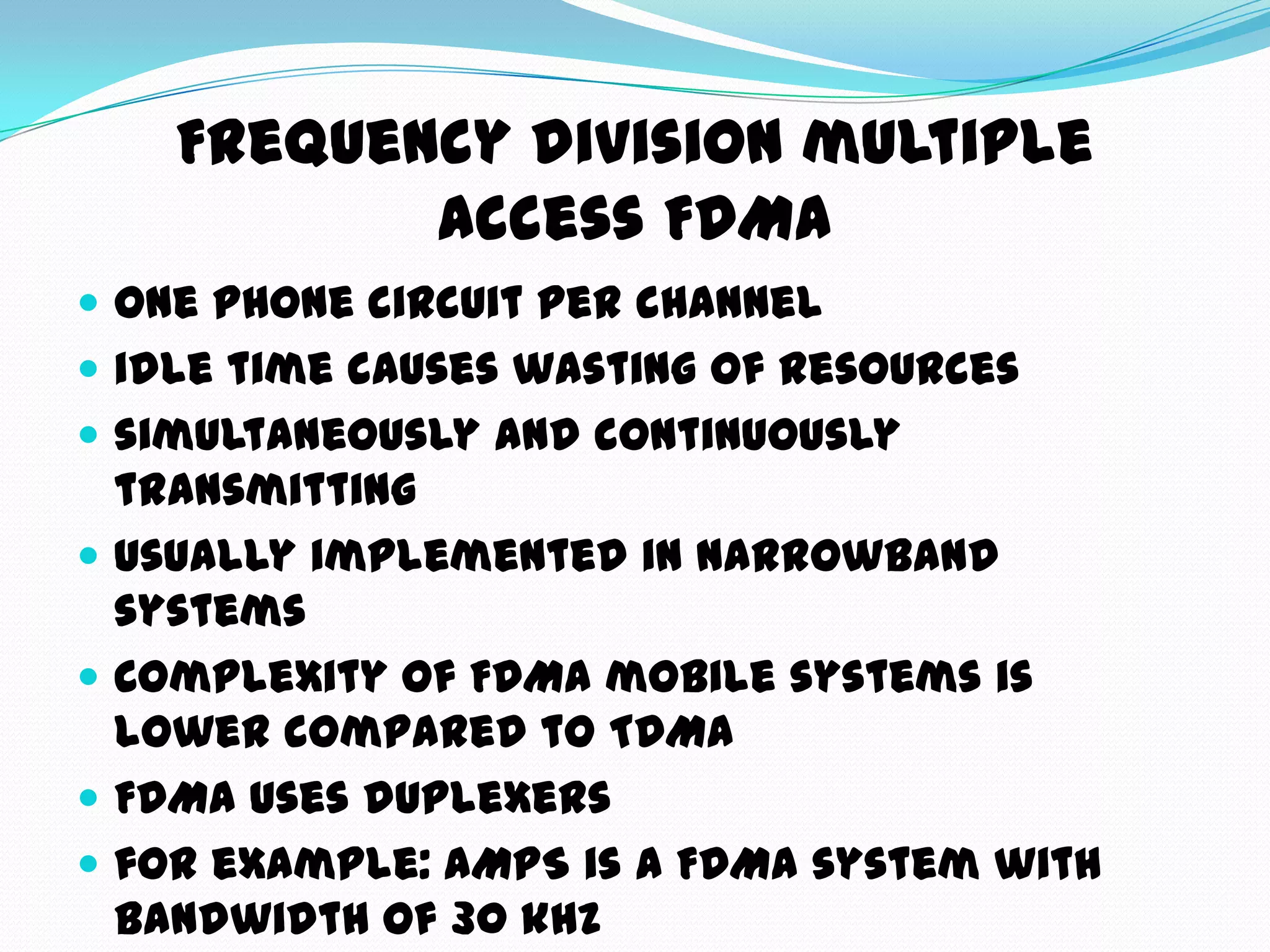
Frequency division multiple access
FDMA
 one phone circuit per channel
 idle time causes wasting of resources
 simultaneously and continuously transmitting
 usually implemented in narrowband systems
 Complexity of FDMA mobile systems is lower
compared to TDMA
 FDMA uses duplexers
 for example: AMPS is a FDMA system with
bandwidth of 30 kHz
FDMA
power
Example: Advanced Mobile Phone System
Time Division Multiple Access
 Time slots
 one user per slot
 Buffer and burst method
 Non-continuous transmission
Advantage:
Total bandwidth is utilized
Disadvantage:
Strict Burst Timing is required at the earth
station
TDMA
power
Example: Global System for Mobile (GSM)
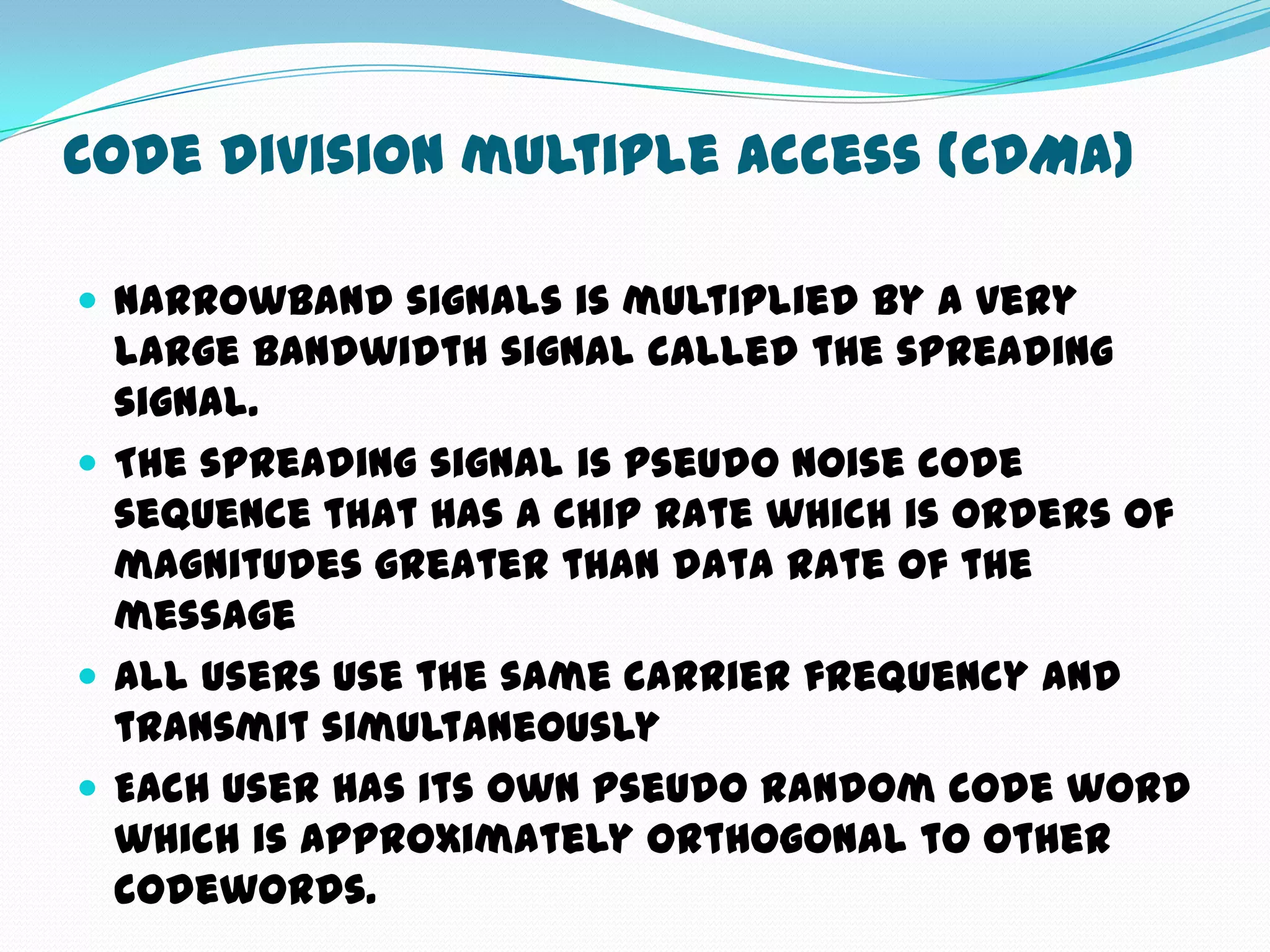
Code division multiple access (CDMA)
 Narrowband signals is multiplied by a very large
bandwidth signal called the spreading signal.
 The spreading signal is pseudo noise code
sequence that has a chip rate which is orders of
magnitudes greater than data rate of the
message
 All users use the same carrier frequency and
transmit simultaneously
 Each user has its own pseudo random code word
which is approximately orthogonal to other
codewords.
 Receiver performs time co-relation
 All other codewords appear as noise
 Receiver needs to know the code word used
by transmitter
CDMA
power
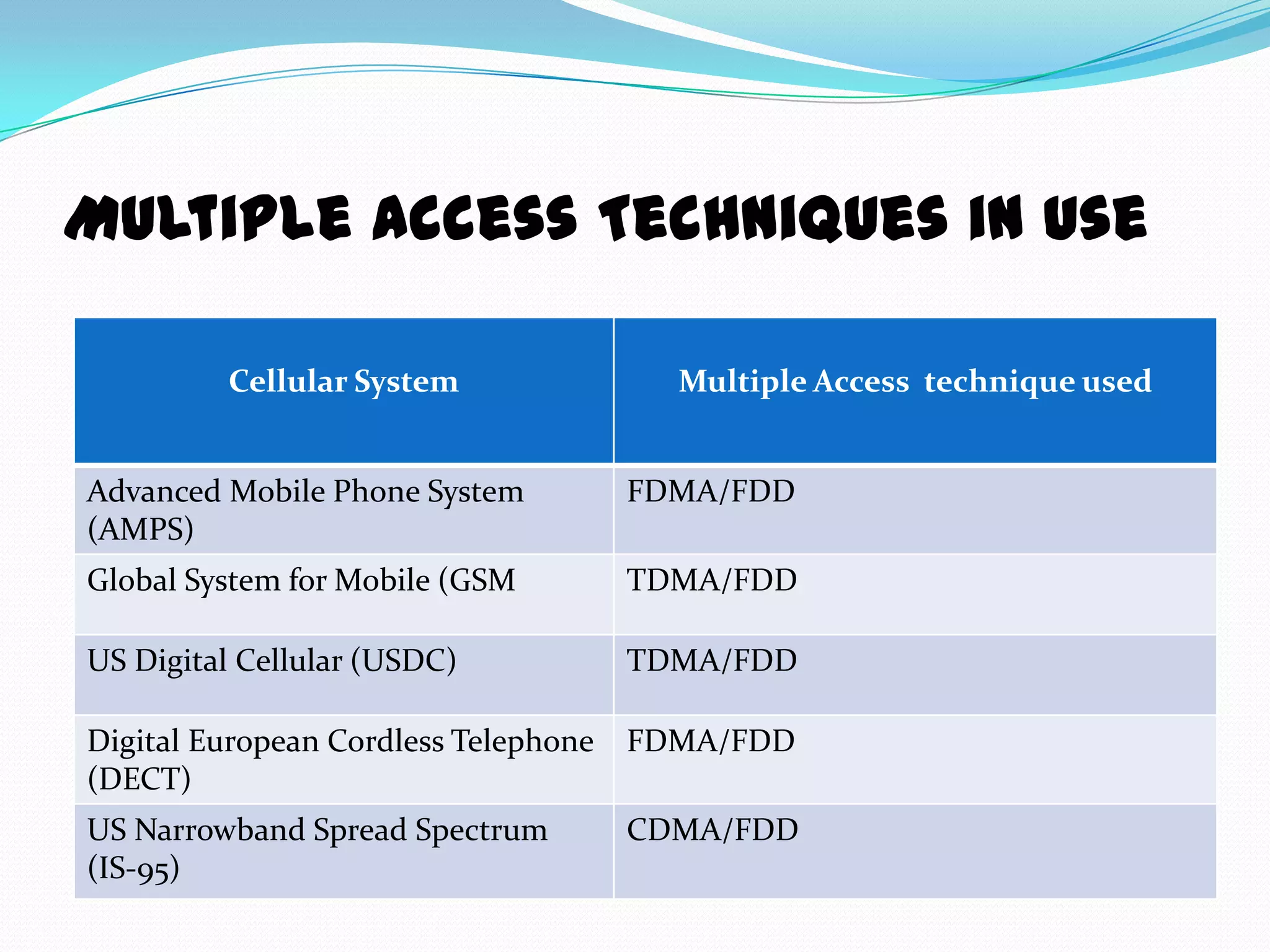
Multiple Access Techniques in use
Cellular System Multiple Access technique used
Advanced Mobile Phone System
(AMPS)
FDMA/FDD
Global System for Mobile (GSM TDMA/FDD
US Digital Cellular (USDC) TDMA/FDD
Digital European Cordless Telephone
(DECT)
FDMA/FDD
US Narrowband Spread Spectrum
(IS-95)
CDMA/FDD
Q..??

multiple access techniques used in wireless communication

  • 1.
    MULTIPLE ACCESS TECHNIQUESFOR WIRELESS COMMUNICATION
  • 2.
    Presented To: DrImran Presented By : Syed Sajid Ali Reg No: 11-MDTLC-0513 Class No: 37
  • 3.
    INTRODUCTION • Multiple accessschemes are used to allow many users to share simultaneously a finite amount of radio spectrum resources. • For high quality communication this sharing of spectrum should not degrade performance of the system  high performance  duplexing generally required  frequency domain  time domain
  • 4.
    DUPLEXING  What isDuplexing?  to talk and listen simultaneously is called duplexing.  Classification of communication systems according to their connectivity.  Simplex  Half-duplex  Duplex A B A B A B
  • 5.
     Duplexing maybe done using  frequency domain technique  time domain technique
  • 6.
    Frequency division duplexing(FDD)  two bands of frequencies for every user  forward band ( for traffic from Base station to mobile unit)  reverse band (for traffic from mobile unit to Base station) • frequency separation between forward band and reverse band is constant throughout the system
  • 7.
    Time division duplexing(TDD)  uses different time slots for forward and reverse link  forward time slot  reverse time slot  Communication is not full-duplex
  • 8.
    TYPES OF MULTIPLEACCESS  Frequency division multiple access (FDMA)  Time division multiple access (TDMA)  Code division multiple access (CDMA)
  • 9.
    Frequency division multipleaccess FDMA  one phone circuit per channel  idle time causes wasting of resources  simultaneously and continuously transmitting  usually implemented in narrowband systems  Complexity of FDMA mobile systems is lower compared to TDMA  FDMA uses duplexers  for example: AMPS is a FDMA system with bandwidth of 30 kHz
  • 10.
  • 11.
    Time Division MultipleAccess  Time slots  one user per slot  Buffer and burst method  Non-continuous transmission Advantage: Total bandwidth is utilized Disadvantage: Strict Burst Timing is required at the earth station
  • 12.
  • 13.
    Code division multipleaccess (CDMA)  Narrowband signals is multiplied by a very large bandwidth signal called the spreading signal.  The spreading signal is pseudo noise code sequence that has a chip rate which is orders of magnitudes greater than data rate of the message  All users use the same carrier frequency and transmit simultaneously  Each user has its own pseudo random code word which is approximately orthogonal to other codewords.
  • 14.
     Receiver performstime co-relation  All other codewords appear as noise  Receiver needs to know the code word used by transmitter
  • 15.
  • 16.
    Multiple Access Techniquesin use Cellular System Multiple Access technique used Advanced Mobile Phone System (AMPS) FDMA/FDD Global System for Mobile (GSM TDMA/FDD US Digital Cellular (USDC) TDMA/FDD Digital European Cordless Telephone (DECT) FDMA/FDD US Narrowband Spread Spectrum (IS-95) CDMA/FDD
  • 17.