“Marketing mix is the set of marketing tools that the
     firm uses to pursue its marketing objectives in the
                                               market”
     Marketing mix is a combination for the variables.
                Product is the most important variables.
        Price, Promotion & place of distribution are the
supporting variables. The marketing manager must use
FEATURES
 Combination of marketing variables
 Used by business & non – business organization
 Organizations objectives (goals)
 Dynamic concept
 Focus on customer
 Variables are interrelated
 Proper mixing of variables needs
  imagination, intelligence, etc
 Interaction between marketing mix & environment variables
IMPORTANCE
   Helps to achieve companies Objectives
   Customer Satisfaction
   Helps to face competition
   It builds Brand loyalty
   It builds corporate Image
   It helps Business Expansion
   Helps to improve Brand image
   Optimum utilization of Resources
   Increases profit & maximizes shareholders wealth
   Helps to fulfill social Responsibilities
PRODUCT MIX

 Product mix refers to the set of     MANAGEMENT OF PRODUCTION MIX :
 products which are offered for
 sale by a company.                      Continuous Strategy
 Product mix consist of many             Product Modification Strategy
 product lines                           Additional (Expansion) Strategy
 Product line is a group of related      Internal Resources
 products which share common             External Resources
 characteristics, channels, custom
                                         Product Elimination Strategy
 ers or users
                                         Additional – Cum – Elimination Strategy

 BREATH & DEPTH OF                    REASONS FOR PRODUCT MIX :
 PRODUCT MIX :
                                       Take Advantage of Brand Loyalty
 Breath means number of product        To balance the seasonal sales
 lines in product mix, depth
                                       To face the challenges of the competitors
 means the number of products in
 each product                          To meet the demands of the customers
                                       Use companies resources & capabilities more effectively
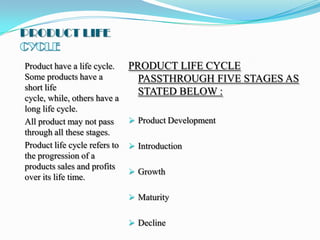
PRODUCT LIFE

Product have a life cycle.     PRODUCT LIFE CYCLE
Some products have a             PASSTHROUGH FIVE STAGES AS
short life                       STATED BELOW :
cycle, while, others have a
long life cycle.
All product may not pass        Product Development
through all these stages.
Product life cycle refers to    Introduction
the progression of a
products sales and profits
                                Growth
over its life time.

                                Maturity


                                Decline
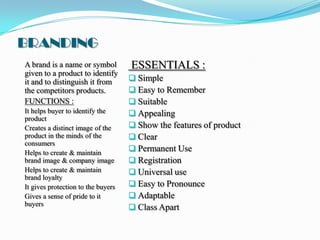
BRANDING
A brand is a name or symbol         ESSENTIALS :
given to a product to identify
it and to distinguish it from        Simple
the competitors products.            Easy to Remember
FUNCTIONS :                          Suitable
It helps buyer to identify the       Appealing
product
Creates a distinct image of the      Show the features of product
product in the minds of the          Clear
consumers
Helps to create & maintain
                                     Permanent Use
brand image & company image          Registration
Helps to create & maintain           Universal use
brand loyalty
It gives protection to the buyers    Easy to Pronounce
Gives a sense of pride to it         Adaptable
buyers
                                     Class Apart
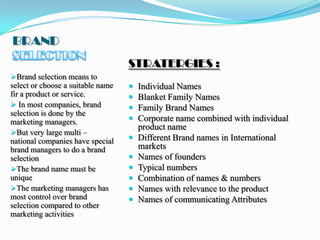
BRAND
                                   STRATERGIES :
Brand selection means to
select or choose a suitable name      Individual Names
fir a product or service.             Blanket Family Names
 In most companies, brand            Family Brand Names
selection is done by the
marketing managers.                   Corporate name combined with individual
                                       product name
But very large multi –
national companies have special       Different Brand names in International
brand managers to do a brand           markets
selection                             Names of founders
The brand name must be               Typical numbers
unique                                Combination of names & numbers
The marketing managers has           Names with relevance to the product
most control over brand               Names of communicating Attributes
selection compared to other
marketing activities
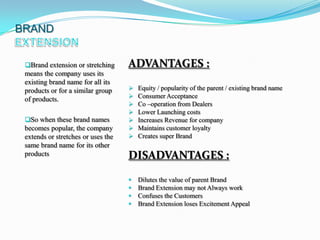
BRAND


 Brand extension or stretching     ADVANTAGES :
 means the company uses its
 existing brand name for all its
 products or for a similar group       Equity / popularity of the parent / existing brand name
                                       Consumer Acceptance
 of products.
                                       Co –operation from Dealers
                                       Lower Launching costs
 So when these brand names            Increases Revenue for company
 becomes popular, the company          Maintains customer loyalty
 extends or stretches or uses the      Creates super Brand
 same brand name for its other
 products                           DISADVANTAGES :
                                       Dilutes the value of parent Brand
                                       Brand Extension may not Always work
                                       Confuses the Customers
                                       Brand Extension loses Excitement Appeal
 STEPS IN BRAND POSITIONING :

BRAND                            Identify competitive difference
                                 Product difference
                                 Service difference
 Brand positioning means to
                                 Selecting important differences
 give a position to the brand
                                 Delivery Positioning Strategy
 in the minds of the
                                 Communicating the companies positioning
 consumers.
                                 Follow – up of positioning

 The best brand is given
 first position & the worst      POSITIONING STRATEGY :
 brand is given last position
                                 Using specific product features
                                 Positioning by price & quality
 The brand position is
                                 Positioning by use
 given by the consumers
                                 Positioning by competitor
                                 Positioning by product benefits
 It is done by two parties :    Positioning by category user
 a) manufacturer (b)             Positioning by product class
 Consumer
                                 Positioning by cultural symbols / names
BRAND
 Brand equity is the value of the
 business above the value of
                                        FACTORS DETERMINING
 physical assets.                        BRAND EQUITY :
 So if the value of the business is    Brand loyalty
 rs. 10 lakhs & the value of its        Brand Awareness
 physical assets like land and
 building are Rs. 8 lakhs then the      Perceived Quality of the Brand
 brand equity is 2 lakhs
                                        Brand Association
 The brand equity is wider than        Brand Assets
 the term brand personality & brand    ADVANTAGES OF BRAND EQUITY :
 image . Brand equity covers all
 factors                               TO CONSUMER : a) consumer can purchase branded
                                         products with confidence (b) they get full information about the
                                         branded products (c)they get full satisfaction, pleasure & pride
 Today people do not buy                from the branded products.
 products they buy brand names. So
 the brand equity is a very valuable   TO MANUFACTURER : a) he can increase the price
 asset of the company                    of his product (b)he will earn profits (c)he can do brand
                                         extension (d)he can easily fight competition
PRICE MIXING OR

  Pricing means fixing the price    FACTORS INFLUENCING PRICE :
  of a product or service
  Pricing is the base of the full
  marketing system. Marketing           Price of competitors Goods
  management & market demand            Government control
  depends on pricing.
  In the present money
                                        Market Situation
  economy, goods & services are         Aims & objectives of the company
  purchased for money therefore         Characteristics of the consumer
  both buyers & sellers give great
                                        Cost of production, selling & distribution
  importance to pricing.
  Buyers & sellers have                Demand
  different ideas about pricing         Channels of distribution
  Buyer wants the prices to be         Other factors
  low while sellers want it to be       Fashion
  high
                                        Availability of substitutes
  However it should be
  reasonable                            Climatic Conditions
                                        Elasticity of Demand
PRICING
 Below-cost pricing
 Pricing as per customer ability to pay
 Pricing above the leaders
 Pricing below the leaders
 One price policy
 Variable price policy
 Target oriented pricing
 Psychological pricing
 Cost plus pricing
 Follow the leader pricing
 Skimming the cream policy
 Market penetration policy

Chapter 5 marketing mix i

  • 1.
    “Marketing mix isthe set of marketing tools that the firm uses to pursue its marketing objectives in the market” Marketing mix is a combination for the variables. Product is the most important variables. Price, Promotion & place of distribution are the supporting variables. The marketing manager must use
  • 2.
    FEATURES  Combination ofmarketing variables  Used by business & non – business organization  Organizations objectives (goals)  Dynamic concept  Focus on customer  Variables are interrelated  Proper mixing of variables needs imagination, intelligence, etc  Interaction between marketing mix & environment variables
  • 3.
    IMPORTANCE  Helps to achieve companies Objectives  Customer Satisfaction  Helps to face competition  It builds Brand loyalty  It builds corporate Image  It helps Business Expansion  Helps to improve Brand image  Optimum utilization of Resources  Increases profit & maximizes shareholders wealth  Helps to fulfill social Responsibilities
  • 4.
    PRODUCT MIX Productmix refers to the set of MANAGEMENT OF PRODUCTION MIX : products which are offered for sale by a company.  Continuous Strategy Product mix consist of many  Product Modification Strategy product lines  Additional (Expansion) Strategy Product line is a group of related  Internal Resources products which share common  External Resources characteristics, channels, custom  Product Elimination Strategy ers or users  Additional – Cum – Elimination Strategy BREATH & DEPTH OF REASONS FOR PRODUCT MIX : PRODUCT MIX :  Take Advantage of Brand Loyalty Breath means number of product  To balance the seasonal sales lines in product mix, depth  To face the challenges of the competitors means the number of products in each product  To meet the demands of the customers  Use companies resources & capabilities more effectively
  • 5.
    PRODUCT LIFE Product havea life cycle. PRODUCT LIFE CYCLE Some products have a PASSTHROUGH FIVE STAGES AS short life STATED BELOW : cycle, while, others have a long life cycle. All product may not pass  Product Development through all these stages. Product life cycle refers to  Introduction the progression of a products sales and profits  Growth over its life time.  Maturity  Decline
  • 6.
    BRANDING A brand isa name or symbol ESSENTIALS : given to a product to identify it and to distinguish it from  Simple the competitors products.  Easy to Remember FUNCTIONS :  Suitable It helps buyer to identify the  Appealing product Creates a distinct image of the  Show the features of product product in the minds of the  Clear consumers Helps to create & maintain  Permanent Use brand image & company image  Registration Helps to create & maintain  Universal use brand loyalty It gives protection to the buyers  Easy to Pronounce Gives a sense of pride to it  Adaptable buyers  Class Apart
  • 7.
    BRAND STRATERGIES : Brand selection means to select or choose a suitable name  Individual Names fir a product or service.  Blanket Family Names  In most companies, brand  Family Brand Names selection is done by the marketing managers.  Corporate name combined with individual product name But very large multi – national companies have special  Different Brand names in International brand managers to do a brand markets selection  Names of founders The brand name must be  Typical numbers unique  Combination of names & numbers The marketing managers has  Names with relevance to the product most control over brand  Names of communicating Attributes selection compared to other marketing activities
  • 8.
    BRAND Brand extensionor stretching ADVANTAGES : means the company uses its existing brand name for all its products or for a similar group  Equity / popularity of the parent / existing brand name  Consumer Acceptance of products.  Co –operation from Dealers  Lower Launching costs So when these brand names  Increases Revenue for company becomes popular, the company  Maintains customer loyalty extends or stretches or uses the  Creates super Brand same brand name for its other products DISADVANTAGES :  Dilutes the value of parent Brand  Brand Extension may not Always work  Confuses the Customers  Brand Extension loses Excitement Appeal
  • 9.
     STEPS INBRAND POSITIONING : BRAND  Identify competitive difference  Product difference  Service difference Brand positioning means to  Selecting important differences give a position to the brand  Delivery Positioning Strategy in the minds of the  Communicating the companies positioning consumers.  Follow – up of positioning The best brand is given first position & the worst  POSITIONING STRATEGY : brand is given last position  Using specific product features  Positioning by price & quality The brand position is  Positioning by use given by the consumers  Positioning by competitor  Positioning by product benefits It is done by two parties :  Positioning by category user a) manufacturer (b)  Positioning by product class Consumer  Positioning by cultural symbols / names
  • 10.
    BRAND Brand equityis the value of the business above the value of  FACTORS DETERMINING physical assets. BRAND EQUITY : So if the value of the business is  Brand loyalty rs. 10 lakhs & the value of its  Brand Awareness physical assets like land and building are Rs. 8 lakhs then the  Perceived Quality of the Brand brand equity is 2 lakhs  Brand Association The brand equity is wider than  Brand Assets the term brand personality & brand ADVANTAGES OF BRAND EQUITY : image . Brand equity covers all factors TO CONSUMER : a) consumer can purchase branded products with confidence (b) they get full information about the branded products (c)they get full satisfaction, pleasure & pride Today people do not buy from the branded products. products they buy brand names. So the brand equity is a very valuable TO MANUFACTURER : a) he can increase the price asset of the company of his product (b)he will earn profits (c)he can do brand extension (d)he can easily fight competition
  • 11.
    PRICE MIXING OR Pricing means fixing the price FACTORS INFLUENCING PRICE : of a product or service Pricing is the base of the full marketing system. Marketing  Price of competitors Goods management & market demand  Government control depends on pricing. In the present money  Market Situation economy, goods & services are  Aims & objectives of the company purchased for money therefore  Characteristics of the consumer both buyers & sellers give great  Cost of production, selling & distribution importance to pricing. Buyers & sellers have  Demand different ideas about pricing  Channels of distribution Buyer wants the prices to be  Other factors low while sellers want it to be  Fashion high  Availability of substitutes However it should be reasonable  Climatic Conditions  Elasticity of Demand
  • 12.
    PRICING  Below-cost pricing Pricing as per customer ability to pay  Pricing above the leaders  Pricing below the leaders  One price policy  Variable price policy  Target oriented pricing  Psychological pricing  Cost plus pricing  Follow the leader pricing  Skimming the cream policy  Market penetration policy