The document discusses audit planning procedures and documentation. It explains that audit planning involves planning the scope, depth, and resources needed to effectively and efficiently conduct the audit. Factors like complexity, client environment, and previous experience inform the audit plan. The document also outlines advantages and disadvantages of audit programs, the contents and purpose of audit notebooks, sampling methods and evaluation, and other audit planning considerations like discussion with the client and overall audit approach.
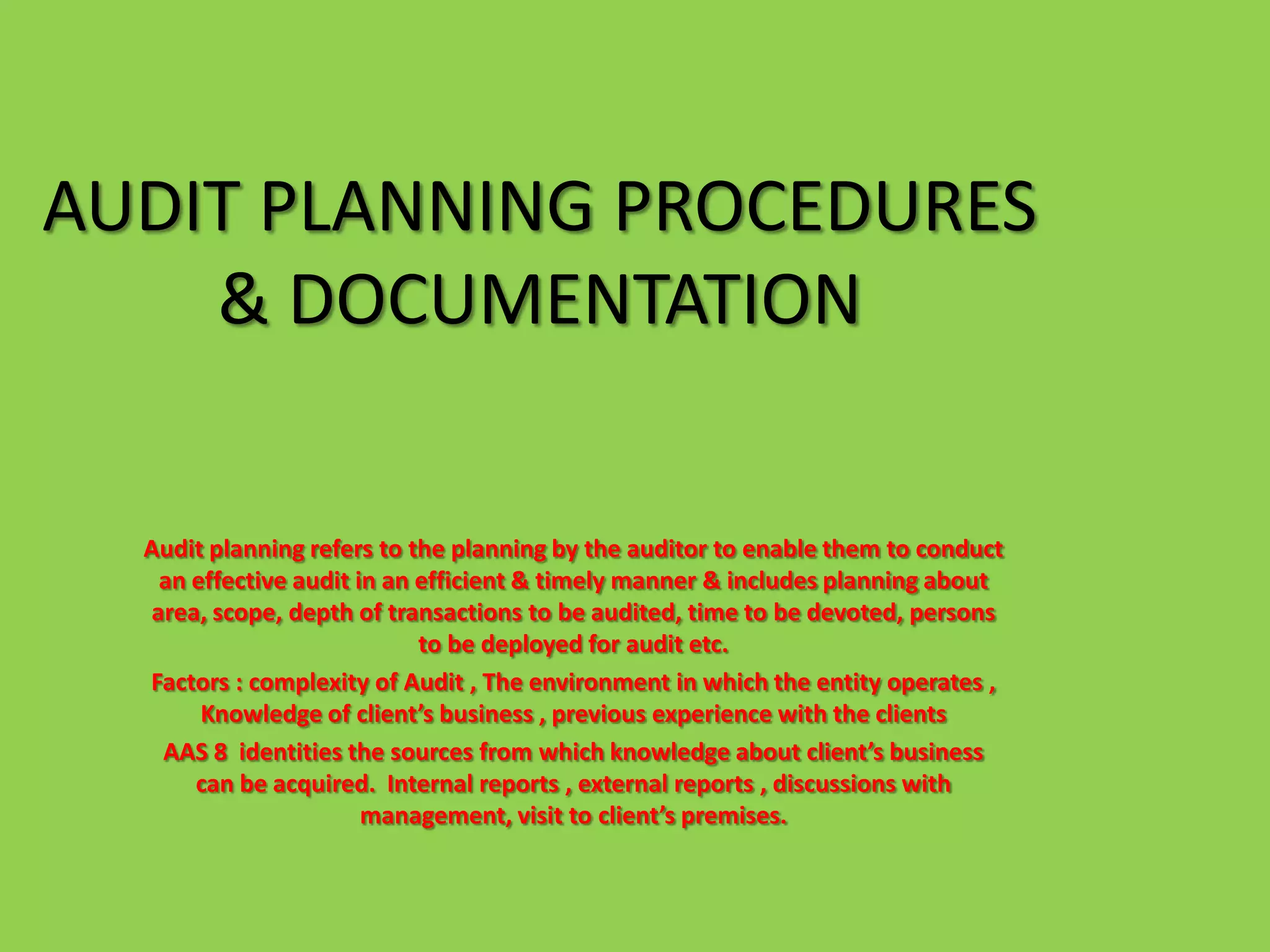
AUDIT PLANNING PROCEDURES
& DOCUMENTATION
Audit planning refers to the planning by the auditor to enable them to conduct
an effective audit in an efficient & timely manner & includes planning about
area, scope, depth of transactions to be audited, time to be devoted, persons
to be deployed for audit etc.
Factors : complexity of Audit , The environment in which the entity operates ,
Knowledge of client’s business , previous experience with the clients
AAS 8 identities the sources from which knowledge about client’s business
can be acquired. Internal reports , external reports , discussions with
management, visit to client’s premises.
2.
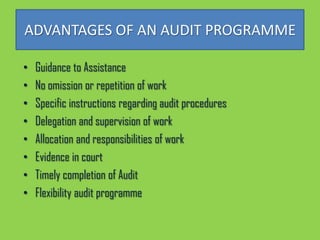
ADVANTAGES OF ANAUDIT PROGRAMME
• Guidance to Assistance
• No omission or repetition of work
• Specific instructions regarding audit procedures
• Delegation and supervision of work
• Allocation and responsibilities of work
• Evidence in court
• Timely completion of Audit
• Flexibility audit programme
3.
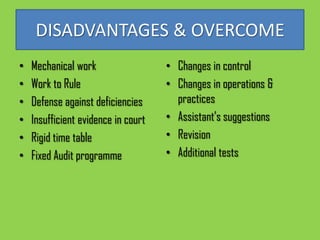
DISADVANTAGES & OVERCOME
• Mechanical work • Changes in control
• Work to Rule • Changes in operations &
• Defense against deficiencies practices
• Insufficient evidence in court • Assistant’s suggestions
• Rigid time table • Revision
• Fixed Audit programme • Additional tests
4.
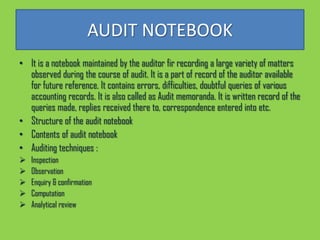
AUDIT NOTEBOOK
• Itis a notebook maintained by the auditor fir recording a large variety of matters
observed during the course of audit. It is a part of record of the auditor available
for future reference. It contains errors, difficulties, doubtful queries of various
accounting records. It is also called as Audit memoranda. It is written record of the
queries made, replies received there to, correspondence entered into etc.
• Structure of the audit notebook
• Contents of audit notebook
• Auditing techniques :
Inspection
Observation
Enquiry & confirmation
Computation
Analytical review
5.
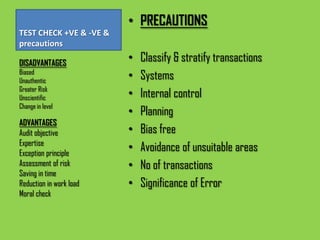
• PRECAUTIONS
TEST CHECK+VE & -VE &
precautions
DISADVANTAGES
• Classify & stratify transactions
Biased
Unauthentic
• Systems
Greater Risk
Unscientific • Internal control
Change in level
• Planning
ADVANTAGES
Audit objective • Bias free
Expertise
Exception principle
• Avoidance of unsuitable areas
Assessment of risk • No of transactions
Saving in time
Reduction in work load • Significance of Error
Moral check
6.
AUDIT SAMPLE • EVALUATION OF SAMPLE
According to AAS – 15 audit sampling means the
RESULT
application of audit procedures to less than 100%
of the items within an account balance or class of • Analysis of errors in the sample
transactions to enable the auditor to obtain &
evaluate audit evidence about some characteristic • Projection of errors
of the items selected in order to form or assist in
forming conclusion concerning the population.
• Reassessing sampling risk
FACTORS:
Audit Objectives
Population
Audit evidence
METHODS OF SELECTING SAMPLE ITEMS:
Random selection
Systematic selection
Haphazard selection
7.
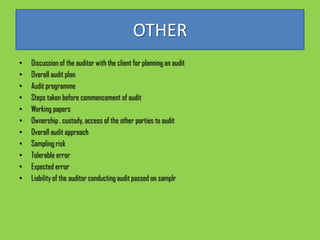
OTHER
• Discussion of the auditor with the client for planning an audit
• Overall audit plan
• Audit programme
• Steps taken before commencement of audit
• Working papers
• Ownership , custody, access of the other parties to audit
• Overall audit approach
• Sampling risk
• Tolerable error
• Expected error
• Liability of the auditor conducting audit passed on samplr