MODULE 5 SEGMENTING, TARGETING,  POSITIONING AND PRODUCT STRATEGY PRESENTED BY PRAVEEN PRABHU  AND PARTHA SARTHI CHATTERJEE
Introduction With the increase in population and with the increased target groups undifferentiated products for an undifferentiated market is a thing of the past. Initially, marketers in India concentrated on segmenting the urban market only as it contributed to 75% of the revenue. With the saturation of the urban market in recent years and the growing demand in rural markets simultaneously, the need to segment the market is being felt increasingly. As economies evolve, consumer choice and requirements become more focused. This calls for Segmenting, Targeting and Positioning (STP).
Segmenting, Targeting and Positioning. Decision Actions Segmenting Identifying various bases for segmenting markets Developing profiles of market segments Targeting Evaluating the market segments for their attractiveness Deciding the market coverage strategy Positioning Identifying a set of possible competitive advantages of the brand Selecting the right competitive advantage Communicating the chosen competitive advantage to the target customers.
Segmentation Segmentation is the process of dividing a heterogeneous market, into several sub-markets or segments, each of which tends to be homogeneous in all significant aspects. According to Philip Kotler, “Market Segmentation os dividing  a market  into distinct groups of buyers who have distinct needs, characteristics, or behaviuor and who might require separate products or marketing mixes.
Segmentation Market Segment:  A group of consumers who respond in a similar way to a given set of marketing efforts. Market Segments helps distinguish one customer profile from another within a given market. Segmentation facilitates in understanding the needs of target buyers.
Segmentation 75% of people in rural India are engaged in agriculture, but they cannot all be clubbed under one omnibus category of farmers. There are;  large farmers,  medium farmers,  small farmers,  marginal farmers and  agricultural labourers. Their income levels, lifestyles and behaviour are different from each other.
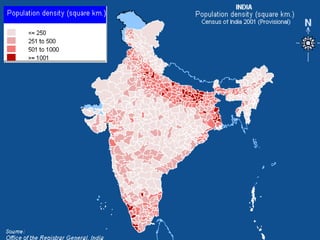
Segmentation Heterogeneity of the Rural Market: There are a number of factors that display the heterogeneity of the rural market; Socio-cultural differences across regions Variation in population size and population density Difference in levels of infrastructural development  Variations in literacy levels Differences in income levels and patterns of income flow Family structure
Segmentation Prerequisites for Effective Segmentation: Measurable Accessible Differentiable Substantiable Homogeneity Largeness
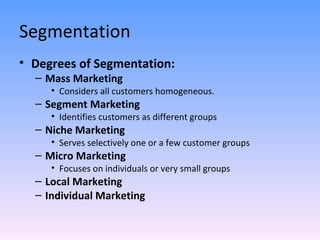
Segmentation Degrees of Segmentation: Mass Marketing Considers all customers homogeneous. Segment Marketing Identifies customers as different groups Niche Marketing Serves selectively one or a few customer groups Micro Marketing Focuses on individuals or very small groups Local Marketing Individual Marketing
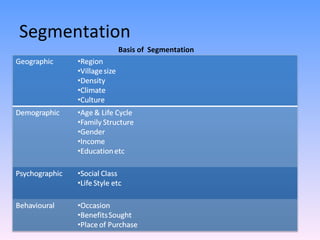
Segmentation Basis of Segmentation and Approaches to Rural Segmentation: Geographic Segmentation Regions Village population and density Culture
Segmentation Demographic Segmentation Age & Life Cycle Family Structure Income Landownership Occupation Education and House Type Religion & Caste
Segmentation Psychographic Segmentation Social Class Lifestyle
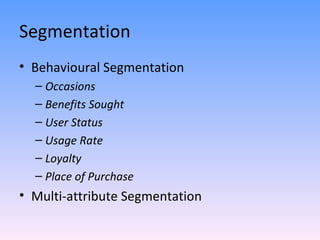
Segmentation Behavioural Segmentation Occasions Benefits Sought User Status Usage Rate Loyalty Place of Purchase Multi-attribute Segmentation
Segmentation Basis of  Segmentation
 
Targeting  Targeting involves evaluating various segments and selecting how many and which one to target. The three aspects of targeting are evaluating, selection and coverage
Targeting Evaluation : -  Evaluation and selection of segment:   The two main factors to be considered here are: the overall attractiveness of each segment and company’s objectives. -  Overall attractiveness :  Size of the marketing may be huge but the purchasing power is limited.
Targeting -  Company objective and resource  competencies: Selection of segment : Selection of the segment can be made by rating them on predetermined scale(low, medium, high) in respect of the evaluation factors
Targeting Coverage of segments: -  Undifferentiated Marketing : It takes into consideration what is common among consumers and tries to include it in the offer. Hence, it relies on mass distribution and mass advertisement. Due to this the company can afford to set its price low.
Targeting - Differentiated Marketing : It investigates and identifies differences between segments and tries to match the market offer to the desires and expectation of each segment. This strategy results in strong identification of the company in the product category, higher sales and can get more loyal consumers.
Targeting -  Concentrated Strategy : It is important for them to have multi-segment strategy  rather than a single  segment strategy to ensure adequate Return On Investment and to avoid the risk of change in preference of the consumers.
Positioning Positioning is the act of designing the company’s offering and image so that it occupies a distinctive place in the mind of the target segment.
Positioning Identifying the positioning concept Product differentiation Service differentiation People  Image  Selection of positioning concept Developing the concept
Positioning Communicating the concept - Deciding how many differences to promote - Deciding which positioning to promote
Product Strategy For transferring  a marketing strategy into a marketing  program the marketer needs to decide on the  Marketing Mix  that is to pursue the marketing objective in the rural market.
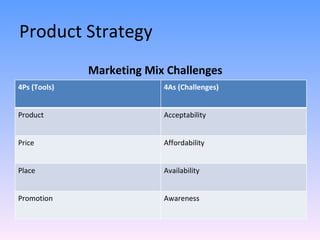
Product Strategy Marketing Mix Challenges 4Ps (Tools) 4As (Challenges) Product Acceptability Price Affordability Place Availability Promotion Awareness
Product Strategy Product Concepts and Classification: A marketer should keep the following aspects ion mind while taking the products to rural markets. Products intended for rural markets should be: Simple Easy to use Visually identifiable Affordable
Product Strategy Five Levels Of Products: Core Benefit Basic Product Expected Product Augmented Product Potential Product
Product Strategy Rural Product Categories: FMCG Consumer Durables Agri Products Services
Thank You

Rural segmentation

  • 1.
    MODULE 5 SEGMENTING,TARGETING, POSITIONING AND PRODUCT STRATEGY PRESENTED BY PRAVEEN PRABHU AND PARTHA SARTHI CHATTERJEE
  • 2.
    Introduction With theincrease in population and with the increased target groups undifferentiated products for an undifferentiated market is a thing of the past. Initially, marketers in India concentrated on segmenting the urban market only as it contributed to 75% of the revenue. With the saturation of the urban market in recent years and the growing demand in rural markets simultaneously, the need to segment the market is being felt increasingly. As economies evolve, consumer choice and requirements become more focused. This calls for Segmenting, Targeting and Positioning (STP).
  • 3.
    Segmenting, Targeting andPositioning. Decision Actions Segmenting Identifying various bases for segmenting markets Developing profiles of market segments Targeting Evaluating the market segments for their attractiveness Deciding the market coverage strategy Positioning Identifying a set of possible competitive advantages of the brand Selecting the right competitive advantage Communicating the chosen competitive advantage to the target customers.
  • 4.
    Segmentation Segmentation isthe process of dividing a heterogeneous market, into several sub-markets or segments, each of which tends to be homogeneous in all significant aspects. According to Philip Kotler, “Market Segmentation os dividing a market into distinct groups of buyers who have distinct needs, characteristics, or behaviuor and who might require separate products or marketing mixes.
  • 5.
    Segmentation Market Segment: A group of consumers who respond in a similar way to a given set of marketing efforts. Market Segments helps distinguish one customer profile from another within a given market. Segmentation facilitates in understanding the needs of target buyers.
  • 6.
    Segmentation 75% ofpeople in rural India are engaged in agriculture, but they cannot all be clubbed under one omnibus category of farmers. There are; large farmers, medium farmers, small farmers, marginal farmers and agricultural labourers. Their income levels, lifestyles and behaviour are different from each other.
  • 7.
    Segmentation Heterogeneity ofthe Rural Market: There are a number of factors that display the heterogeneity of the rural market; Socio-cultural differences across regions Variation in population size and population density Difference in levels of infrastructural development Variations in literacy levels Differences in income levels and patterns of income flow Family structure
  • 8.
    Segmentation Prerequisites forEffective Segmentation: Measurable Accessible Differentiable Substantiable Homogeneity Largeness
  • 9.
    Segmentation Degrees ofSegmentation: Mass Marketing Considers all customers homogeneous. Segment Marketing Identifies customers as different groups Niche Marketing Serves selectively one or a few customer groups Micro Marketing Focuses on individuals or very small groups Local Marketing Individual Marketing
  • 10.
    Segmentation Basis ofSegmentation and Approaches to Rural Segmentation: Geographic Segmentation Regions Village population and density Culture
  • 11.
    Segmentation Demographic SegmentationAge & Life Cycle Family Structure Income Landownership Occupation Education and House Type Religion & Caste
  • 12.
  • 13.
    Segmentation Behavioural SegmentationOccasions Benefits Sought User Status Usage Rate Loyalty Place of Purchase Multi-attribute Segmentation
  • 14.
    Segmentation Basis of Segmentation
  • 15.
  • 16.
    Targeting Targetinginvolves evaluating various segments and selecting how many and which one to target. The three aspects of targeting are evaluating, selection and coverage
  • 17.
    Targeting Evaluation :- Evaluation and selection of segment: The two main factors to be considered here are: the overall attractiveness of each segment and company’s objectives. - Overall attractiveness : Size of the marketing may be huge but the purchasing power is limited.
  • 18.
    Targeting - Company objective and resource competencies: Selection of segment : Selection of the segment can be made by rating them on predetermined scale(low, medium, high) in respect of the evaluation factors
  • 19.
    Targeting Coverage ofsegments: - Undifferentiated Marketing : It takes into consideration what is common among consumers and tries to include it in the offer. Hence, it relies on mass distribution and mass advertisement. Due to this the company can afford to set its price low.
  • 20.
    Targeting - DifferentiatedMarketing : It investigates and identifies differences between segments and tries to match the market offer to the desires and expectation of each segment. This strategy results in strong identification of the company in the product category, higher sales and can get more loyal consumers.
  • 21.
    Targeting - Concentrated Strategy : It is important for them to have multi-segment strategy rather than a single segment strategy to ensure adequate Return On Investment and to avoid the risk of change in preference of the consumers.
  • 22.
    Positioning Positioning isthe act of designing the company’s offering and image so that it occupies a distinctive place in the mind of the target segment.
  • 23.
    Positioning Identifying thepositioning concept Product differentiation Service differentiation People Image Selection of positioning concept Developing the concept
  • 24.
    Positioning Communicating theconcept - Deciding how many differences to promote - Deciding which positioning to promote
  • 25.
    Product Strategy Fortransferring a marketing strategy into a marketing program the marketer needs to decide on the Marketing Mix that is to pursue the marketing objective in the rural market.
  • 26.
    Product Strategy MarketingMix Challenges 4Ps (Tools) 4As (Challenges) Product Acceptability Price Affordability Place Availability Promotion Awareness
  • 27.
    Product Strategy ProductConcepts and Classification: A marketer should keep the following aspects ion mind while taking the products to rural markets. Products intended for rural markets should be: Simple Easy to use Visually identifiable Affordable
  • 28.
    Product Strategy FiveLevels Of Products: Core Benefit Basic Product Expected Product Augmented Product Potential Product
  • 29.
    Product Strategy RuralProduct Categories: FMCG Consumer Durables Agri Products Services
  • 30.