INTRODUCTION TO BRANDING
Chao O
20/12/2012
Why Brand?
๏‚งWhy do companies such as Coca-Cola,
 Microsoft, IBM and Disney seem to achieve
 global marketing success so easily? Why does it
 seem such an effort for others?
๏‚งWhy do we, as consumers, feel loyal to such
 brands that the mere sight of their logo has us
 reaching into our pockets to buy their
 products?
The meaning of brands
๏‚งBrands are a means of differentiating a
 companyโ€™s products and services from those of
 its competitors.
๏‚งThere is plenty of evidence to prove that
 customers will pay a substantial price premium
 for a good brand and remain loyal to that
 brand. It is important, therefore, to understand
 what brands are and why they are important.
The Importance of Brands

๏‚งMcDonalds sums this up nicely in the following
 quote emphasizing the importance of brands:
๏‚งโ€œโ€ฆit is not factories that make profits, but
 relationships with customers, and it is company
 and brand names which secure those relationshipsโ€
๏‚งBusinesses that invest in and sustain leading brands
 prosper whereas those that fail are left to fight for
 the lower profits available in commodity markets.
Coca-Cola
๏‚ง โ€œIf Coca-Cola were to lose all of its production-related
  assets in a disaster, the company would survive. By
  contrast, if all consumers were to have a sudden lapse
  of memory and forget everything related to Coca-Cola
  the company would go out of business.โ€

๏‚ง Coca-Cola
What is a brand?
๏‚งOne definition of a brand is as follows:
๏‚งโ€œA name, term, sign, symbol or design, or a
 combination of these, that is intended to identify
 the goods and services of one business or group of
 businesses and to differentiate them from those of
 competitorsโ€.
๏‚งInterbrand - a leading branding consultancy - define
 a brand in this way:
๏‚งโ€œA mixture of tangible and intangible attributes
 symbolized in a trademark, which, if properly
 managed, creates influence and generates valueโ€.
Brand Equity

๏‚ง โ€œBrand equityโ€ refers to the value of a brand. Brand equity is
  based on the extent to which the brand has high brand
  loyalty, name awareness, perceived quality and strong product
  associations. Brand equity also includes other โ€œintangibleโ€ assets
  such as patents, trademarks and channel relationships.
Brand image

๏‚งโ€œBrand imageโ€ refers to the set of beliefs that
 customers hold about a particular brand. These
 are important to develop well since a negative
 brand image can be very difficult to shake off.
Brand extension

๏‚ง โ€œBrand extensionโ€ refers to the use of a successful
  brand name to launch a new or modified product in a
  new market. Virgin is perhaps the best example of how
  brand extension can be applied into quite diverse and
  distinct markets.
Branding gives the seller several
advantages

๏‚งSellerโ€™s brand name and trademark provide legal
 protection of unique product features
๏‚งBranding gives the seller the opportunity to attract a
 loyal and profitable set of customers.
๏‚งBranding helps the seller segment markets.
๏‚งStrong brands help build corporate image, making it
 easier to launch new brands and gain acceptance by
 distributors and consumers.
Benefits of Branding to A BUYER
๏‚ง Help buyers identify the product that they like/dislike.
๏‚ง Identify marketer
๏‚ง Helps reduce the time needed for purchase.
๏‚ง Helps buyers evaluate quality of products especially if
  unable to judge a products characteristics.
๏‚ง Helps reduce buyers perceived risk of purchase.
๏‚ง Buyer may derive a psychological reward from owning the
  brand, IE Rolex or Mercedes.
BRANDS - BUILDING A BRAND

๏‚งWhat factors are important in building brand
 value?
๏‚งProfessor David Jobber identifies seven main
 factors in building successful brands, as given next:
Quality

๏‚ง Quality is a vital ingredient of a good brand. Remember the
  โ€œcore benefitsโ€ โ€“ the things consumers expect. These must
  be delivered well and consistently. The branded washing
  machine that leaks, or the training shoe that often falls
  apart when wet, or a watch which needs frequent
  adjustments will never develop brand equity.
๏‚ง Research confirms that, statistically, higher quality brands
  achieve a higher market share and higher profitability than
  that of their inferior competitors.
Positioning

๏‚ง Positioning is about the position a brand occupies in a
  market in the minds of consumers. Strong brands have a
  clear, often unique position in the target market.
๏‚ง Positioning can be achieved through several means,
  including brand name, image, service standards, product
  guarantees, packaging and the way in which it is
  delivered. In fact, successful positioning usually requires a
  combination of these things.
Repositioning
๏‚งRepositioning occurs when a brand tries to
 change its market position to reflect a
 change in consumerโ€™s tastes. This is often
 required when a brand has become
 tired, perhaps because its original market
 has matured or has gone into decline.
Communications
๏‚ง Communications also play a key role in building a
  successful brand. We suggested that brand
  positioning is essentially about customer
  perceptions โ€“ with the objective to build a clearly
  defined position in the minds of the target
  audience.
๏‚ง All elements of the promotional mix need to be
  used to develop and sustain customer perceptions.
  Initially, the challenge is to build awareness, then to
  develop the brand personality and reinforce the
  perception.
First-mover advantage
๏‚งBusiness strategists often talk about first-
 mover advantage. In terms of brand
 development, by โ€œfirst-moverโ€ they mean
 that it is possible for the first successful
 brand in a market to create a clear
 positioning in the minds of target customers
 before the competition enters the market.
 There is plenty of evidence to support this.
Long-term perspective
๏‚งThe need to invest in the brand over the long-
 term is utmost essential. Building customer
 awareness, communicating the brandโ€™s
 message and creating customer loyalty takes
 time. This means that management must
 โ€œinvestโ€ in a brand, perhaps at the expense of
 short-term profitability.
Internal Marketing
๏‚งFinally, management should ensure that the brand is
 marketed โ€œinternallyโ€ as well as externally. By this we
 mean that the whole business should understand the
 brand values and positioning. This is particularly
 important in service businesses where a critical part of
 the brand value is the type and quality of service that a
 customer receives.
๏‚งThink of the brands that you value in the
 restaurant, hotel and retail sectors. It is likely that your
 favorite brands invest heavily in staff training so that the
 face-to-face contact that you have with the brand helps
 secure your loyalty.
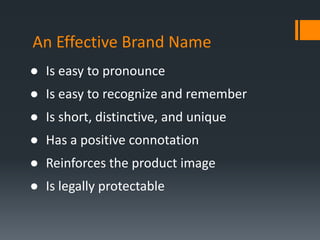
An Effective Brand Name
โ— Is easy to pronounce
โ— Is easy to recognize and remember
โ— Is short, distinctive, and unique
โ— Has a positive connotation
โ— Reinforces the product image
โ— Is legally protectable
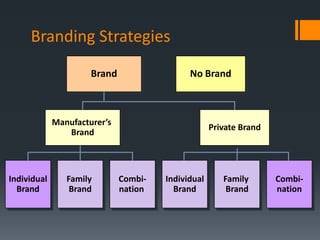
Branding Strategies
                      Brand                  No Brand


             Manufacturerโ€™s
                                                    Private Brand
                Brand


Individual      Family        Combi-   Individual      Family       Combi-
  Brand          Brand        nation     Brand          Brand       nation
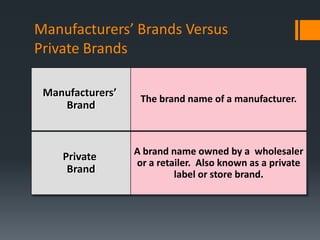
Manufacturersโ€™ Brands Versus
Private Brands

 Manufacturersโ€™
                   The brand name of a manufacturer.
    Brand


                  A brand name owned by a wholesaler
    Private
                  or a retailer. Also known as a private
     Brand                 label or store brand.
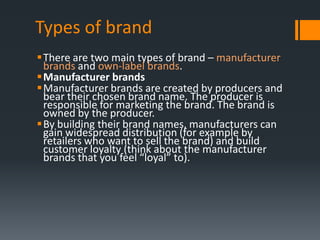
Types of brand
๏‚งThere are two main types of brand โ€“ manufacturer
 brands and own-label brands.
๏‚งManufacturer brands
๏‚งManufacturer brands are created by producers and
 bear their chosen brand name. The producer is
 responsible for marketing the brand. The brand is
 owned by the producer.
๏‚งBy building their brand names, manufacturers can
 gain widespread distribution (for example by
 retailers who want to sell the brand) and build
 customer loyalty (think about the manufacturer
 brands that you feel โ€œloyalโ€ to).
Private Label brands
๏‚ง Own-label brands are created and owned by businesses
  that operate in the distribution channel โ€“ often referred
  to as โ€œdistributorsโ€.
๏‚ง Often these distributors are retailers, but not exclusively.
  Sometimes the retailerโ€™s entire product range will be own-
  label. Own-label branding โ€“ if well carried out โ€“ can often
  offer the consumer excellent value for money and provide
  the distributor with additional bargaining power when it
  comes to negotiating prices and terms with manufacturer
  brands.
Advantages of Private Brands
๏‚ง Earn higher profits
๏‚ง Less pressure to mark down prices
๏‚ง Ties customer to wholesaler or
  retailer
Advantages of Manufacturersโ€™ Brands

 ๏‚งDevelop customer loyalty
 ๏‚งAttract new customers
 ๏‚งEnhance prestige
 ๏‚งEnsure dealer loyalty
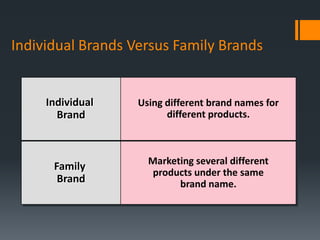
Individual Brands Versus Family Brands


     Individual    Using different brand names for
       Brand             different products.


                     Marketing several different
      Family
                      products under the same
       Brand               brand name.
Branding Policies
๏‚ง First question is whether to brand or not to brand.
  Homogenous products are difficult to brand Branding
  policies are:
๏‚ง Individual Branding: Naming each product differently P&G,
  facilitates market segmentation and no overlap.
๏‚ง Overall Family Branding: All products are branded with the
  same name, or part of a name, IE Nokia, promotion of one
  item also promotes other items.
๏‚ง Line Family Branding: Within one product line.
๏‚ง Brand Extension Branding: Use one of its existing brand
  names as part of a brand for an improved or new product,
  usually in the same product category.
  75% new products are brand extensions!!
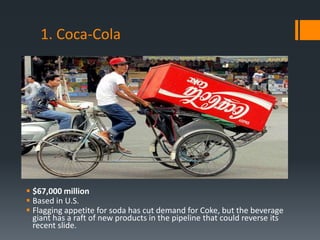
1. Coca-Cola


๏‚ง $67,000 million
๏‚ง Based in U.S.
๏‚ง Flagging appetite for soda has cut demand for Coke, but the beverage
  giant has a raft of new products in the pipeline that could reverse its
  recent slide.
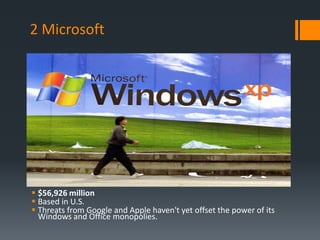
2 Microsoft


๏‚ง $56,926 million
๏‚ง Based in U.S.
๏‚ง Threats from Google and Apple haven't yet offset the power of its
  Windows and Office monopolies.
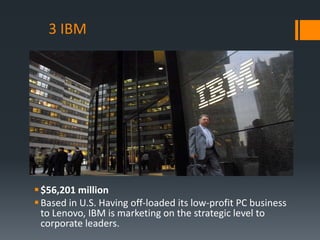
3 IBM


๏‚ง $56,201 million
๏‚ง Based in U.S. Having off-loaded its low-profit PC business
  to Lenovo, IBM is marketing on the strategic level to
  corporate leaders.
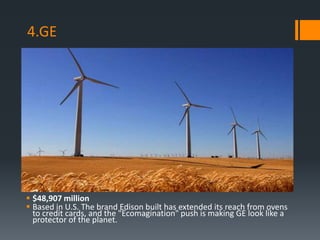
4.GE


๏‚ง $48,907 million
๏‚ง Based in U.S. The brand Edison built has extended its reach from ovens
  to credit cards, and the "Ecomagination" push is making GE look like a
  protector of the planet.
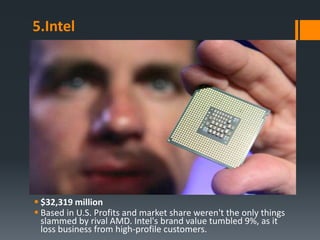
5.Intel


๏‚ง $32,319 million
๏‚ง Based in U.S. Profits and market share weren't the only things
  slammed by rival AMD. Intel's brand value tumbled 9%, as it
  loss business from high-profile customers.
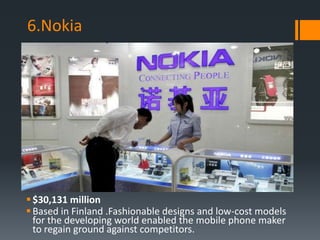
6.Nokia


๏‚ง $30,131 million
๏‚ง Based in Finland .Fashionable designs and low-cost models
  for the developing world enabled the mobile phone maker
  to regain ground against competitors.
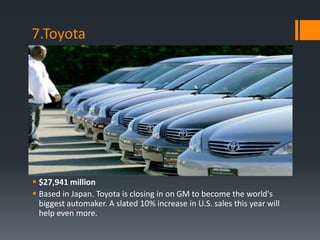
7.Toyota


๏‚ง $27,941 million
๏‚ง Based in Japan. Toyota is closing in on GM to become the world's
  biggest automaker. A slated 10% increase in U.S. sales this year will
  help even more.
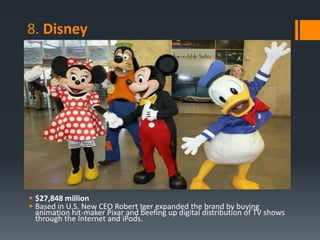
8. Disney


๏‚ง $27,848 million
๏‚ง Based in U.S. New CEO Robert Iger expanded the brand by buying
  animation hit-maker Pixar and beefing up digital distribution of TV shows
  through the Internet and iPods.
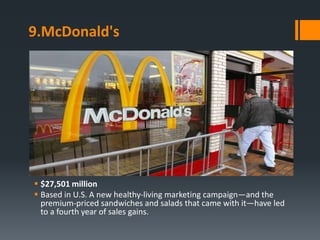
9.McDonald's


๏‚ง $27,501 million
๏‚ง Based in U.S. A new healthy-living marketing campaignโ€”and the
  premium-priced sandwiches and salads that came with itโ€”have led
  to a fourth year of sales gains.
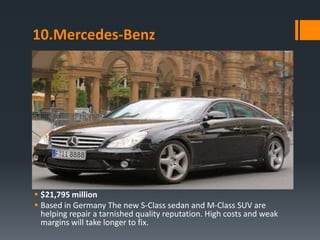
10.Mercedes-Benz


๏‚ง $21,795 million
๏‚ง Based in Germany The new S-Class sedan and M-Class SUV are
  helping repair a tarnished quality reputation. High costs and weak
  margins will take longer to fix.
Here's how we calculate the power in
a name
๏‚งINTERBRAND TAKES lots of ingredients into account
 when ranking the world's most valuable brands. To
 even qualify for the list, each brand must derive
 about a third of its earnings outside its home
 country, be recognizable outside of its base of
 customers, and have publicly available marketing
 and financial data. One or more of those criteria
 eliminate such heavyweights as Visa, Wal-
 Mart, Mars, and CNN. Interbrand doesn't rank
 parent companies, which explains why Procter &
 Gamble doesn't show up. And airlines are not
 ranked because it's too hard to separate their
 brands' impact on sales from factors such as routes
 and schedules.
Evaluation
๏‚ง BUSINESSWEEK CHOSE Interbrand's methodology because it
  evaluates brands much the way analysts value other assets:
  on the basis of how much they're likely to earn in the future.
  The projected profits are then discounted to a present
  value, taking into account the likelihood that those earnings
  will actually materialize.
๏‚ง THE FIRST STEP IS figuring out what percentage of a
  company's revenues can be credited to a brand. (The brand
  may be almost the entire company, as with McDonald's
  Corp., or just a portion, as it is for Marlboro.) Based on
  reports from analysts at J.P. Morgan Chase, Citigroup, and
  Morgan Stanley, Interbrand projects five years of earnings
  and sales for the brand. It then deducts operating
  costs, taxes, and a charge for the capital employed to arrive
  at the intangible earnings. The company strips out intangibles
  such as patents and management strength to assess what
  portion of those earnings can be attributed to the brand.
Summary
๏‚งFINALLY, THE BRAND'S strength is assessed to
 determine the risk profile of those earnings
 forecasts. Considerations include market
 leadership, stability, and global reachโ€”or the
 ability to cross both geographic and cultural
 borders. That generates a discount rate, which is
 applied to brand earnings to get a net present
 value. BusinessWeek and Interbrand believe this
 figure comes closest to representing a brand's true
 economic worth.

Types of brand

  • 1.
  • 2.
    Why Brand? ๏‚งWhy docompanies such as Coca-Cola, Microsoft, IBM and Disney seem to achieve global marketing success so easily? Why does it seem such an effort for others? ๏‚งWhy do we, as consumers, feel loyal to such brands that the mere sight of their logo has us reaching into our pockets to buy their products?
  • 3.
    The meaning ofbrands ๏‚งBrands are a means of differentiating a companyโ€™s products and services from those of its competitors. ๏‚งThere is plenty of evidence to prove that customers will pay a substantial price premium for a good brand and remain loyal to that brand. It is important, therefore, to understand what brands are and why they are important.
  • 4.
    The Importance ofBrands ๏‚งMcDonalds sums this up nicely in the following quote emphasizing the importance of brands: ๏‚งโ€œโ€ฆit is not factories that make profits, but relationships with customers, and it is company and brand names which secure those relationshipsโ€ ๏‚งBusinesses that invest in and sustain leading brands prosper whereas those that fail are left to fight for the lower profits available in commodity markets.
  • 5.
    Coca-Cola ๏‚ง โ€œIf Coca-Colawere to lose all of its production-related assets in a disaster, the company would survive. By contrast, if all consumers were to have a sudden lapse of memory and forget everything related to Coca-Cola the company would go out of business.โ€ ๏‚ง Coca-Cola
  • 6.
    What is abrand? ๏‚งOne definition of a brand is as follows: ๏‚งโ€œA name, term, sign, symbol or design, or a combination of these, that is intended to identify the goods and services of one business or group of businesses and to differentiate them from those of competitorsโ€. ๏‚งInterbrand - a leading branding consultancy - define a brand in this way: ๏‚งโ€œA mixture of tangible and intangible attributes symbolized in a trademark, which, if properly managed, creates influence and generates valueโ€.
  • 7.
    Brand Equity ๏‚ง โ€œBrandequityโ€ refers to the value of a brand. Brand equity is based on the extent to which the brand has high brand loyalty, name awareness, perceived quality and strong product associations. Brand equity also includes other โ€œintangibleโ€ assets such as patents, trademarks and channel relationships.
  • 8.
    Brand image ๏‚งโ€œBrand imageโ€refers to the set of beliefs that customers hold about a particular brand. These are important to develop well since a negative brand image can be very difficult to shake off.
  • 9.
    Brand extension ๏‚ง โ€œBrandextensionโ€ refers to the use of a successful brand name to launch a new or modified product in a new market. Virgin is perhaps the best example of how brand extension can be applied into quite diverse and distinct markets.
  • 10.
    Branding gives theseller several advantages ๏‚งSellerโ€™s brand name and trademark provide legal protection of unique product features ๏‚งBranding gives the seller the opportunity to attract a loyal and profitable set of customers. ๏‚งBranding helps the seller segment markets. ๏‚งStrong brands help build corporate image, making it easier to launch new brands and gain acceptance by distributors and consumers.
  • 11.
    Benefits of Brandingto A BUYER ๏‚ง Help buyers identify the product that they like/dislike. ๏‚ง Identify marketer ๏‚ง Helps reduce the time needed for purchase. ๏‚ง Helps buyers evaluate quality of products especially if unable to judge a products characteristics. ๏‚ง Helps reduce buyers perceived risk of purchase. ๏‚ง Buyer may derive a psychological reward from owning the brand, IE Rolex or Mercedes.
  • 12.
    BRANDS - BUILDINGA BRAND ๏‚งWhat factors are important in building brand value? ๏‚งProfessor David Jobber identifies seven main factors in building successful brands, as given next:
  • 13.
    Quality ๏‚ง Quality isa vital ingredient of a good brand. Remember the โ€œcore benefitsโ€ โ€“ the things consumers expect. These must be delivered well and consistently. The branded washing machine that leaks, or the training shoe that often falls apart when wet, or a watch which needs frequent adjustments will never develop brand equity. ๏‚ง Research confirms that, statistically, higher quality brands achieve a higher market share and higher profitability than that of their inferior competitors.
  • 14.
    Positioning ๏‚ง Positioning isabout the position a brand occupies in a market in the minds of consumers. Strong brands have a clear, often unique position in the target market. ๏‚ง Positioning can be achieved through several means, including brand name, image, service standards, product guarantees, packaging and the way in which it is delivered. In fact, successful positioning usually requires a combination of these things.
  • 15.
    Repositioning ๏‚งRepositioning occurs whena brand tries to change its market position to reflect a change in consumerโ€™s tastes. This is often required when a brand has become tired, perhaps because its original market has matured or has gone into decline.
  • 16.
    Communications ๏‚ง Communications alsoplay a key role in building a successful brand. We suggested that brand positioning is essentially about customer perceptions โ€“ with the objective to build a clearly defined position in the minds of the target audience. ๏‚ง All elements of the promotional mix need to be used to develop and sustain customer perceptions. Initially, the challenge is to build awareness, then to develop the brand personality and reinforce the perception.
  • 17.
    First-mover advantage ๏‚งBusiness strategistsoften talk about first- mover advantage. In terms of brand development, by โ€œfirst-moverโ€ they mean that it is possible for the first successful brand in a market to create a clear positioning in the minds of target customers before the competition enters the market. There is plenty of evidence to support this.
  • 18.
    Long-term perspective ๏‚งThe needto invest in the brand over the long- term is utmost essential. Building customer awareness, communicating the brandโ€™s message and creating customer loyalty takes time. This means that management must โ€œinvestโ€ in a brand, perhaps at the expense of short-term profitability.
  • 19.
    Internal Marketing ๏‚งFinally, managementshould ensure that the brand is marketed โ€œinternallyโ€ as well as externally. By this we mean that the whole business should understand the brand values and positioning. This is particularly important in service businesses where a critical part of the brand value is the type and quality of service that a customer receives. ๏‚งThink of the brands that you value in the restaurant, hotel and retail sectors. It is likely that your favorite brands invest heavily in staff training so that the face-to-face contact that you have with the brand helps secure your loyalty.
  • 20.
    An Effective BrandName โ— Is easy to pronounce โ— Is easy to recognize and remember โ— Is short, distinctive, and unique โ— Has a positive connotation โ— Reinforces the product image โ— Is legally protectable
  • 21.
    Branding Strategies Brand No Brand Manufacturerโ€™s Private Brand Brand Individual Family Combi- Individual Family Combi- Brand Brand nation Brand Brand nation
  • 22.
    Manufacturersโ€™ Brands Versus PrivateBrands Manufacturersโ€™ The brand name of a manufacturer. Brand A brand name owned by a wholesaler Private or a retailer. Also known as a private Brand label or store brand.
  • 23.
    Types of brand ๏‚งThereare two main types of brand โ€“ manufacturer brands and own-label brands. ๏‚งManufacturer brands ๏‚งManufacturer brands are created by producers and bear their chosen brand name. The producer is responsible for marketing the brand. The brand is owned by the producer. ๏‚งBy building their brand names, manufacturers can gain widespread distribution (for example by retailers who want to sell the brand) and build customer loyalty (think about the manufacturer brands that you feel โ€œloyalโ€ to).
  • 24.
    Private Label brands ๏‚งOwn-label brands are created and owned by businesses that operate in the distribution channel โ€“ often referred to as โ€œdistributorsโ€. ๏‚ง Often these distributors are retailers, but not exclusively. Sometimes the retailerโ€™s entire product range will be own- label. Own-label branding โ€“ if well carried out โ€“ can often offer the consumer excellent value for money and provide the distributor with additional bargaining power when it comes to negotiating prices and terms with manufacturer brands.
  • 25.
    Advantages of PrivateBrands ๏‚ง Earn higher profits ๏‚ง Less pressure to mark down prices ๏‚ง Ties customer to wholesaler or retailer
  • 26.
    Advantages of Manufacturersโ€™Brands ๏‚งDevelop customer loyalty ๏‚งAttract new customers ๏‚งEnhance prestige ๏‚งEnsure dealer loyalty
  • 27.
    Individual Brands VersusFamily Brands Individual Using different brand names for Brand different products. Marketing several different Family products under the same Brand brand name.
  • 28.
    Branding Policies ๏‚ง Firstquestion is whether to brand or not to brand. Homogenous products are difficult to brand Branding policies are: ๏‚ง Individual Branding: Naming each product differently P&G, facilitates market segmentation and no overlap. ๏‚ง Overall Family Branding: All products are branded with the same name, or part of a name, IE Nokia, promotion of one item also promotes other items. ๏‚ง Line Family Branding: Within one product line. ๏‚ง Brand Extension Branding: Use one of its existing brand names as part of a brand for an improved or new product, usually in the same product category. 75% new products are brand extensions!!
  • 29.
    1. Coca-Cola ๏‚ง $67,000million ๏‚ง Based in U.S. ๏‚ง Flagging appetite for soda has cut demand for Coke, but the beverage giant has a raft of new products in the pipeline that could reverse its recent slide.
  • 30.
    2 Microsoft ๏‚ง $56,926million ๏‚ง Based in U.S. ๏‚ง Threats from Google and Apple haven't yet offset the power of its Windows and Office monopolies.
  • 31.
    3 IBM ๏‚ง $56,201million ๏‚ง Based in U.S. Having off-loaded its low-profit PC business to Lenovo, IBM is marketing on the strategic level to corporate leaders.
  • 32.
    4.GE ๏‚ง $48,907 million ๏‚งBased in U.S. The brand Edison built has extended its reach from ovens to credit cards, and the "Ecomagination" push is making GE look like a protector of the planet.
  • 33.
    5.Intel ๏‚ง $32,319 million ๏‚งBased in U.S. Profits and market share weren't the only things slammed by rival AMD. Intel's brand value tumbled 9%, as it loss business from high-profile customers.
  • 34.
    6.Nokia ๏‚ง $30,131 million ๏‚งBased in Finland .Fashionable designs and low-cost models for the developing world enabled the mobile phone maker to regain ground against competitors.
  • 35.
    7.Toyota ๏‚ง $27,941 million ๏‚งBased in Japan. Toyota is closing in on GM to become the world's biggest automaker. A slated 10% increase in U.S. sales this year will help even more.
  • 36.
    8. Disney ๏‚ง $27,848million ๏‚ง Based in U.S. New CEO Robert Iger expanded the brand by buying animation hit-maker Pixar and beefing up digital distribution of TV shows through the Internet and iPods.
  • 37.
    9.McDonald's ๏‚ง $27,501 million ๏‚งBased in U.S. A new healthy-living marketing campaignโ€”and the premium-priced sandwiches and salads that came with itโ€”have led to a fourth year of sales gains.
  • 38.
    10.Mercedes-Benz ๏‚ง $21,795 million ๏‚งBased in Germany The new S-Class sedan and M-Class SUV are helping repair a tarnished quality reputation. High costs and weak margins will take longer to fix.
  • 39.
    Here's how wecalculate the power in a name ๏‚งINTERBRAND TAKES lots of ingredients into account when ranking the world's most valuable brands. To even qualify for the list, each brand must derive about a third of its earnings outside its home country, be recognizable outside of its base of customers, and have publicly available marketing and financial data. One or more of those criteria eliminate such heavyweights as Visa, Wal- Mart, Mars, and CNN. Interbrand doesn't rank parent companies, which explains why Procter & Gamble doesn't show up. And airlines are not ranked because it's too hard to separate their brands' impact on sales from factors such as routes and schedules.
  • 40.
    Evaluation ๏‚ง BUSINESSWEEK CHOSEInterbrand's methodology because it evaluates brands much the way analysts value other assets: on the basis of how much they're likely to earn in the future. The projected profits are then discounted to a present value, taking into account the likelihood that those earnings will actually materialize. ๏‚ง THE FIRST STEP IS figuring out what percentage of a company's revenues can be credited to a brand. (The brand may be almost the entire company, as with McDonald's Corp., or just a portion, as it is for Marlboro.) Based on reports from analysts at J.P. Morgan Chase, Citigroup, and Morgan Stanley, Interbrand projects five years of earnings and sales for the brand. It then deducts operating costs, taxes, and a charge for the capital employed to arrive at the intangible earnings. The company strips out intangibles such as patents and management strength to assess what portion of those earnings can be attributed to the brand.
  • 41.
    Summary ๏‚งFINALLY, THE BRAND'Sstrength is assessed to determine the risk profile of those earnings forecasts. Considerations include market leadership, stability, and global reachโ€”or the ability to cross both geographic and cultural borders. That generates a discount rate, which is applied to brand earnings to get a net present value. BusinessWeek and Interbrand believe this figure comes closest to representing a brand's true economic worth.