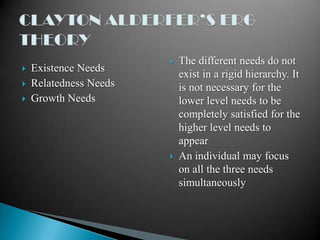
   The different needs do not
   Existence Needs
                            exist in a rigid hierarchy. It
   Relatedness Needs       is not necessary for the
   Growth Needs            lower level needs to be
                            completely satisfied for the
                            higher level needs to
                            appear
                           An individual may focus
                            on all the three needs
                            simultaneously
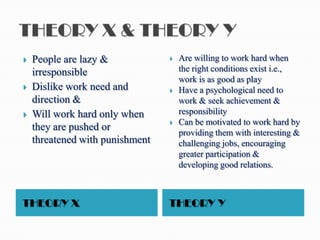
   People are lazy &               Are willing to work hard when
    irresponsible                    the right conditions exist i.e.,
                                     work is as good as play
   Dislike work need and           Have a psychological need to
    direction &                      work & seek achievement &
   Will work hard only when         responsibility
                                    Can be motivated to work hard by
    they are pushed or
                                     providing them with interesting &
    threatened with punishment       challenging jobs, encouraging
                                     greater participation &
                                     developing good relations.


THEORY X                         THEORY Y
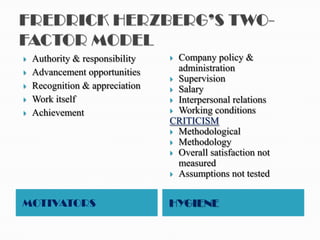
   Authority & responsibility    Company policy &
   Advancement opportunities      administration
                                  Supervision
   Recognition & appreciation    Salary
   Work itself                   Interpersonal relations
   Achievement                   Working conditions
                                 CRITICISM
                                  Methodological
                                  Methodology
                                  Overall satisfaction not
                                   measured
                                  Assumptions not tested


MOTIVATORS                       HYGIENE
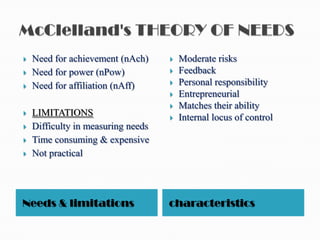
   Need for achievement (nAch)        Moderate risks
   Need for power (nPow)              Feedback
   Need for affiliation (nAff)        Personal responsibility
                                       Entrepreneurial
                                       Matches their ability
   LIMITATIONS                        Internal locus of control
   Difficulty in measuring needs
   Time consuming & expensive
   Not practical


Needs & limitations                 characteristics
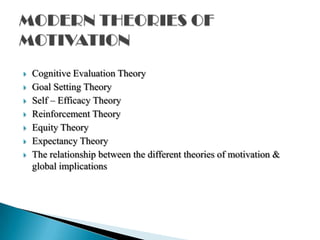
   Cognitive Evaluation Theory
   Goal Setting Theory
   Self – Efficacy Theory
   Reinforcement Theory
   Equity Theory
   Expectancy Theory
   The relationship between the different theories of motivation &
    global implications

Chapter 3 motivation concepts

  • 3.
    The different needs do not  Existence Needs exist in a rigid hierarchy. It  Relatedness Needs is not necessary for the  Growth Needs lower level needs to be completely satisfied for the higher level needs to appear  An individual may focus on all the three needs simultaneously
  • 4.
    People are lazy &  Are willing to work hard when irresponsible the right conditions exist i.e., work is as good as play  Dislike work need and  Have a psychological need to direction & work & seek achievement &  Will work hard only when responsibility  Can be motivated to work hard by they are pushed or providing them with interesting & threatened with punishment challenging jobs, encouraging greater participation & developing good relations. THEORY X THEORY Y
  • 5.
    Authority & responsibility  Company policy &  Advancement opportunities administration  Supervision  Recognition & appreciation  Salary  Work itself  Interpersonal relations  Achievement  Working conditions CRITICISM  Methodological  Methodology  Overall satisfaction not measured  Assumptions not tested MOTIVATORS HYGIENE
  • 6.
    Need for achievement (nAch)  Moderate risks  Need for power (nPow)  Feedback  Need for affiliation (nAff)  Personal responsibility  Entrepreneurial  Matches their ability  LIMITATIONS  Internal locus of control  Difficulty in measuring needs  Time consuming & expensive  Not practical Needs & limitations characteristics
  • 7.
    Cognitive Evaluation Theory  Goal Setting Theory  Self – Efficacy Theory  Reinforcement Theory  Equity Theory  Expectancy Theory  The relationship between the different theories of motivation & global implications