Brand Audit
Establishing Brand Mantras


                             3.1
Brand Positioning Guidelines
   Two key issues in arriving at the optimal
    competitive brand positioning are:
       Defining and communicating the competitive
        frame of reference
       Choosing and establishing points-of-parity and
        points-of-difference


                                                         3.2
Defining and Communicating the
      Competitive Frame of Reference
   Determine category membership.
   State its point of difference in relationship to
    other category members.


                                                       3.3
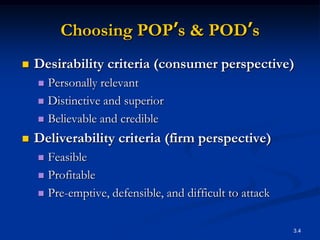
Choosing POP’s & POD’s
   Desirability criteria (consumer perspective)
     Personally relevant
     Distinctive and superior

     Believable and credible

   Deliverability criteria (firm perspective)
     Feasible
     Profitable

     Pre-emptive, defensible, and difficult to attack


                                                         3.4
Competitor films
What is the differentiation in each
              brand?


                                      3.5
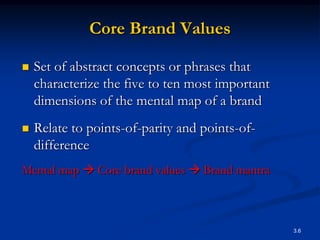
Core Brand Values

   Set of abstract concepts or phrases that
    characterize the five to ten most important
    dimensions of the mental map of a brand
   Relate to points-of-parity and points-of-
    difference
Mental map  Core brand values  Brand mantra


                                                  3.6
Brand Mantras
   An articulation of the “heart and soul” of the brand

   Short three- to five-word phrases that capture the
    irrefutable essence or spirit of the brand
    positioning and brand values


                                                    3.7
Designing the Brand Mantra
   The term brand functions describes the nature of
    the product or service or the type of experiences
    or benefits the brand provides.
   The descriptive modifier further clarifies its nature.
   The emotional modifier provides another
    qualifier—how exactly does the brand provide
    benefits, and in what way?


                                                        3.8
Designing the Brand Mantra

         Emotional    Descriptive    Brand
          Modifier     Modifier     Functions


          Authentic     Athletic    Performance
Nike


            Fun         Family      Entertainment
Disney


            Fun          Folks         Food

                                                3.9
Internal Branding
   Members of the organization are properly aligned
    with the brand and what it represents.
   Crucial for service companies


                                                  3.10
Brand Audit
   Externally, consumer-focused assessment

   A comprehensive examination to assess the health
    of the brand, uncover its sources of equity, and
    suggest ways to improve and leverage that equity


                                                 3.11
Brand Audit
It includes:
 brand vision

 mission

 Promise

 values

 position

 personality

 performance


                               3.12
Importance of Brand Audits
   Understand sources of brand equity
       Firm perspective
       Consumer perspective
   Set strategic direction for the brand
   Recommend marketing programs to maximize
    long-term brand equity


                                               3.13
Brand Audit Steps

   Brand inventory (supply side)

   Brand exploratory (demand side)


                                      3.14
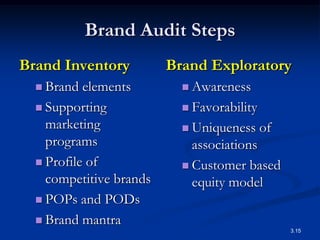
Brand Audit Steps
Brand Inventory          Brand Exploratory
   Brand  elements         Awareness

   Supporting              Favorability
    marketing               Uniqueness     of
    programs                 associations
   Profile of              Customer based
    competitive brands       equity model
   POPs and PODs

   Brand mantra
                                                 3.15
Brand Audit
Brand Inventory                       Brand Exploratory
   Suggests the bases for               Uncovers knowledge
    positioning the brand
                                          structures for the core
   Offers insights to how brand
    equity may be better                  brand as well as its
    managed                               competitors
   Assesses consistency in message
    among activities, brand
    extensions, and sub-brands in
    order to avoid redundancies,
    overlaps, and consumer
    confusion
                                                               3.16
Suggested Brand Audit Outline
   Brand audit objectives, scope, and approach
   Background about the brand (self-analysis)
   Background about the industries
   Consumer analysis (trends, motivation, perceptions, needs,
    segmentation, behavior)
   Brand inventory
       Elements, current marketing programs, POPs, PODs
       Branding strategies (extensions, sub-brands, etc.)
       Brand portfolio analysis
       Competitors’ brand inventory
       Strengths and weaknesses                             3.17
Brand Audit Outline (Cont.)
   Brand exploratory
       Brand associations
       Brand positioning analysis
       Consumer perceptions analysis (vs. competition)
   Summary of competitor analysis
   SWOT analysis
   Brand equity evaluation
   Strategic brand management recommendations


                                                          3.18
Guidelines for Building Brand Equity
   Mix and match brand elements
   Create a rich brand image and high perceived
    quality
   Adopt value-based pricing strategy
   Consider a range of distribution options
   Mix marketing communication options
   Leverage secondary associations


                                                   15.19
Guidelines for Measuring Brand Equity
   Formalize the firm’s view of brand equity
   Conduct brand inventories
   Conduct consumer tracking studies
   Assemble results of outcome measures
   Establish a department to oversee the
    implementation


                                                15.20
Guidelines for Managing Brand Equity
   Define brand hierarchy
   Create global associations
   Introduce brand extensions
   Clearly establish the roles of brands in the
    portfolio
   Reinforce brand equity over time
   Enhance brand equity over time
   Identify differences in consumer behavior in
    different market segments

                                                   15.21
Characteristics of Strong Brands
                  Managers
   Understand brand meaning and market appropriate products in an
    appropriate manner
   Properly position the brand
   Provide superior delivery of desired benefits
   Employ a full range of complementary brand elements and
    supporting marketing activities
   Embrace integrated marketing communications and communicate
    with a consistent voice
   Measure consumer perceptions of value and develop a pricing
    strategy accordingly
   Establish credibility and appropriate brand personality and imagery
   Maintain innovation and relevance for the brand
   Strategically design and implement a brand hierarchy and brand
    portfolio
   Implement a brand equity management system to ensure that
    marketing actions properly reflect the brand equity concept     15.22
Seven Deadly Sins of Brand Management
 1.   Failure to understand the full meaning of the
      brand
 2.   Failure to live up to the brand promise
 3.   Failure to adequately support the brand
 4.   Failure to be patient with the brand
 5.   Failure to adequately control the brand
 6.   Failure to properly balance consistency and
      change with the brand
 7.   Failure to understand complexity of brand
      equity measurement and management
                                                      15.23
Industrial and B2B Branding
   Adopt a corporate or family branding strategy
   Link non-product-related imagery associations
   Employ full range of marketing communication
    options
   Leverage equity of other companies that are
    customers
   Segment markets carefully and develop tailored
    branding and marketing programs

                                                 15.24
Guidelines for High-Tech Branding
   Establish brand awareness and rich brand image
   Create corporate credibility associations
   Leverage secondary associations of quality
   Avoid overbranding products
   Selectively introduce new products as new
    brands and clearly identify the nature of brand
    extensions


                                                 15.25
Guidelines for Service Branding
   Maximize service quality
   Employ a full range of brand elements to enhance
    brand recall
   Create and communicate strong organizational
    associations
   Design corporate communication programs that
    augment consumers’ service encounters and
    experiences
   Establish a brand hierarchy using distinct family or
    individual brands as well as meaningful ingredient
    brands
                                                     15.26
Guidelines for Branding Retailers
   Create a brand hierarchy consisting of the store
    as a whole as well as individual departments
   Enhance the manufacturer’s brand equity by
    communicating PODs
   Establish brand equity at all levels of the brand
    hierarchy
   Create multichannel shopping experience
   Avoid overbranding

                                                    15.27
Guidelines for Small Business Branding
   Emphasize building one or two strong brands
   Focus the marketing program on one or two key
    associations
   Employ a well-integrated set of brand elements that
    enhances both brand awareness and image
   Design creative brand-building push campaigns
   Leverage as many secondary associations as
    possible

                                                   15.28
Guidelines for Online Branding
   Don’t forget the brand building basics
   Create strong brand identity
   Generate strong consumer pull
   Selectively choose brand partnerships
   Maximize relationship marketing


                                             15.29
Future Brand Priorities
   How will branding change in the coming years?
    What are the biggest branding challenges? What
    will make a successful “twenty-first-century
    brand”?


                                                15.30
Measuring Brand Equity
   Marketers of successful twenty-first-century
    brands will create formalized measurement
    approaches and processes that ensure they
    continually monitor their sources of brand
    equity and those of competitors.


                                                   15.31
Managing Brand Equity
   It will be essential in building strong twenty-first-
    century brands to align internal and external brand
    management.
       Internal brand management ensures that employees and
        marketing partners appreciate and understand basic branding
        notions and how they can affect the equity of brands.
       External brand management requires understanding the needs,
        wants, and desires of consumers and creating brand
        marketing programs that fulfill and even surpass consumer
        expectations.
   Companies must also align bottom-up and top-down
    marketing management .


                                                                15.32

Brand audit

  • 1.
  • 2.
    Brand Positioning Guidelines  Two key issues in arriving at the optimal competitive brand positioning are:  Defining and communicating the competitive frame of reference  Choosing and establishing points-of-parity and points-of-difference 3.2
  • 3.
    Defining and Communicatingthe Competitive Frame of Reference  Determine category membership.  State its point of difference in relationship to other category members. 3.3
  • 4.
    Choosing POP’s &POD’s  Desirability criteria (consumer perspective)  Personally relevant  Distinctive and superior  Believable and credible  Deliverability criteria (firm perspective)  Feasible  Profitable  Pre-emptive, defensible, and difficult to attack 3.4
  • 5.
    Competitor films What isthe differentiation in each brand? 3.5
  • 6.
    Core Brand Values  Set of abstract concepts or phrases that characterize the five to ten most important dimensions of the mental map of a brand  Relate to points-of-parity and points-of- difference Mental map  Core brand values  Brand mantra 3.6
  • 7.
    Brand Mantras  An articulation of the “heart and soul” of the brand  Short three- to five-word phrases that capture the irrefutable essence or spirit of the brand positioning and brand values 3.7
  • 8.
    Designing the BrandMantra  The term brand functions describes the nature of the product or service or the type of experiences or benefits the brand provides.  The descriptive modifier further clarifies its nature.  The emotional modifier provides another qualifier—how exactly does the brand provide benefits, and in what way? 3.8
  • 9.
    Designing the BrandMantra Emotional Descriptive Brand Modifier Modifier Functions Authentic Athletic Performance Nike Fun Family Entertainment Disney Fun Folks Food 3.9
  • 10.
    Internal Branding  Members of the organization are properly aligned with the brand and what it represents.  Crucial for service companies 3.10
  • 11.
    Brand Audit  Externally, consumer-focused assessment  A comprehensive examination to assess the health of the brand, uncover its sources of equity, and suggest ways to improve and leverage that equity 3.11
  • 12.
    Brand Audit It includes: brand vision  mission  Promise  values  position  personality  performance 3.12
  • 13.
    Importance of BrandAudits  Understand sources of brand equity  Firm perspective  Consumer perspective  Set strategic direction for the brand  Recommend marketing programs to maximize long-term brand equity 3.13
  • 14.
    Brand Audit Steps  Brand inventory (supply side)  Brand exploratory (demand side) 3.14
  • 15.
    Brand Audit Steps BrandInventory Brand Exploratory  Brand elements  Awareness  Supporting  Favorability marketing  Uniqueness of programs associations  Profile of  Customer based competitive brands equity model  POPs and PODs  Brand mantra 3.15
  • 16.
    Brand Audit Brand Inventory Brand Exploratory  Suggests the bases for  Uncovers knowledge positioning the brand structures for the core  Offers insights to how brand equity may be better brand as well as its managed competitors  Assesses consistency in message among activities, brand extensions, and sub-brands in order to avoid redundancies, overlaps, and consumer confusion 3.16
  • 17.
    Suggested Brand AuditOutline  Brand audit objectives, scope, and approach  Background about the brand (self-analysis)  Background about the industries  Consumer analysis (trends, motivation, perceptions, needs, segmentation, behavior)  Brand inventory  Elements, current marketing programs, POPs, PODs  Branding strategies (extensions, sub-brands, etc.)  Brand portfolio analysis  Competitors’ brand inventory  Strengths and weaknesses 3.17
  • 18.
    Brand Audit Outline(Cont.)  Brand exploratory  Brand associations  Brand positioning analysis  Consumer perceptions analysis (vs. competition)  Summary of competitor analysis  SWOT analysis  Brand equity evaluation  Strategic brand management recommendations 3.18
  • 19.
    Guidelines for BuildingBrand Equity  Mix and match brand elements  Create a rich brand image and high perceived quality  Adopt value-based pricing strategy  Consider a range of distribution options  Mix marketing communication options  Leverage secondary associations 15.19
  • 20.
    Guidelines for MeasuringBrand Equity  Formalize the firm’s view of brand equity  Conduct brand inventories  Conduct consumer tracking studies  Assemble results of outcome measures  Establish a department to oversee the implementation 15.20
  • 21.
    Guidelines for ManagingBrand Equity  Define brand hierarchy  Create global associations  Introduce brand extensions  Clearly establish the roles of brands in the portfolio  Reinforce brand equity over time  Enhance brand equity over time  Identify differences in consumer behavior in different market segments 15.21
  • 22.
    Characteristics of StrongBrands Managers  Understand brand meaning and market appropriate products in an appropriate manner  Properly position the brand  Provide superior delivery of desired benefits  Employ a full range of complementary brand elements and supporting marketing activities  Embrace integrated marketing communications and communicate with a consistent voice  Measure consumer perceptions of value and develop a pricing strategy accordingly  Establish credibility and appropriate brand personality and imagery  Maintain innovation and relevance for the brand  Strategically design and implement a brand hierarchy and brand portfolio  Implement a brand equity management system to ensure that marketing actions properly reflect the brand equity concept 15.22
  • 23.
    Seven Deadly Sinsof Brand Management 1. Failure to understand the full meaning of the brand 2. Failure to live up to the brand promise 3. Failure to adequately support the brand 4. Failure to be patient with the brand 5. Failure to adequately control the brand 6. Failure to properly balance consistency and change with the brand 7. Failure to understand complexity of brand equity measurement and management 15.23
  • 24.
    Industrial and B2BBranding  Adopt a corporate or family branding strategy  Link non-product-related imagery associations  Employ full range of marketing communication options  Leverage equity of other companies that are customers  Segment markets carefully and develop tailored branding and marketing programs 15.24
  • 25.
    Guidelines for High-TechBranding  Establish brand awareness and rich brand image  Create corporate credibility associations  Leverage secondary associations of quality  Avoid overbranding products  Selectively introduce new products as new brands and clearly identify the nature of brand extensions 15.25
  • 26.
    Guidelines for ServiceBranding  Maximize service quality  Employ a full range of brand elements to enhance brand recall  Create and communicate strong organizational associations  Design corporate communication programs that augment consumers’ service encounters and experiences  Establish a brand hierarchy using distinct family or individual brands as well as meaningful ingredient brands 15.26
  • 27.
    Guidelines for BrandingRetailers  Create a brand hierarchy consisting of the store as a whole as well as individual departments  Enhance the manufacturer’s brand equity by communicating PODs  Establish brand equity at all levels of the brand hierarchy  Create multichannel shopping experience  Avoid overbranding 15.27
  • 28.
    Guidelines for SmallBusiness Branding  Emphasize building one or two strong brands  Focus the marketing program on one or two key associations  Employ a well-integrated set of brand elements that enhances both brand awareness and image  Design creative brand-building push campaigns  Leverage as many secondary associations as possible 15.28
  • 29.
    Guidelines for OnlineBranding  Don’t forget the brand building basics  Create strong brand identity  Generate strong consumer pull  Selectively choose brand partnerships  Maximize relationship marketing 15.29
  • 30.
    Future Brand Priorities  How will branding change in the coming years? What are the biggest branding challenges? What will make a successful “twenty-first-century brand”? 15.30
  • 31.
    Measuring Brand Equity  Marketers of successful twenty-first-century brands will create formalized measurement approaches and processes that ensure they continually monitor their sources of brand equity and those of competitors. 15.31
  • 32.
    Managing Brand Equity  It will be essential in building strong twenty-first- century brands to align internal and external brand management.  Internal brand management ensures that employees and marketing partners appreciate and understand basic branding notions and how they can affect the equity of brands.  External brand management requires understanding the needs, wants, and desires of consumers and creating brand marketing programs that fulfill and even surpass consumer expectations.  Companies must also align bottom-up and top-down marketing management . 15.32