PRODUCT AND ITS CLASSIFICATIONS By: group 6
WHAT IS A PRODUCT? “ …  the need satisfying offering of a firm …” what you buy, that satisfies what you want to be able to do
CONT… It can be “good feeling” cause you bought some cosmetics and someone said you looked pretty It could be a happy stomach cause you bought a meal that tasted great It could be easier homework cause you bought new software for your computer
CONT.. “ Most customers think about product in terms of the total satisfaction …” this can lead to statements such as “we don’t sell cars, we sell safety ! “ we don’t sell houses, we sell homes
PRODUCT MIX / PRODUCT LINES PRODUCT MIX “ A product mix is all the product lines … that the company sells…” The combination of product lines offered by the manufacturer
CONT.. PRODUCT  LINES A series of related products  a group of products that are physically similar in performance, use or features and intended for a similar market “…  a set of products that are closely related…”
SERVICE PROVIDER Service   providers have product lines and product mixes as well. Standard Chartered Credit Card banks Telephone services ISPs - internet service providers Airlines, first class, economy class
CONSUMER GOODS CLASSIFICATION 1. Convenience 2. Shopping 3. Specialty 4. Unsought Products
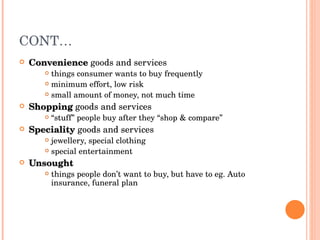
CONT… Convenience   goods and services things consumer wants to buy frequently minimum effort, low risk small amount of money, not much time Shopping   goods and services “ stuff” people buy after they “shop & compare” Speciality   goods and services jewellery, special clothing special entertainment Unsought things people don’t want to buy, but have to eg. Auto insurance, funeral plan
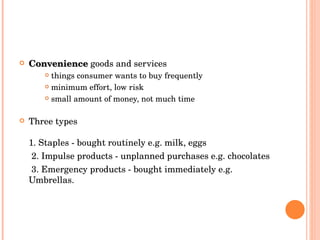
Convenience   goods and services things consumer wants to buy frequently minimum effort, low risk small amount of money, not much time Three types 1. Staples - bought routinely  e.g. milk, eggs  2. Impulse products - unplanned purchases  e.g. chocolates  3. Emergency products - bought immediately  e.g. Umbrellas.
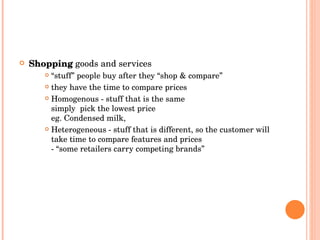
Shopping   goods and services “ stuff” people buy after they “shop & compare” they have the time to compare prices Homogenous - stuff that is the same simply  pick the lowest price eg. Condensed milk,  Heterogeneous - stuff that is different, so the customer will take time to compare features and prices - “some retailers carry competing brands”
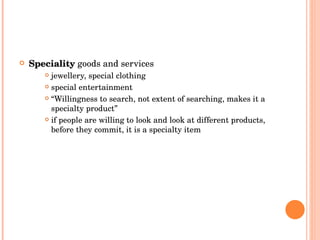
Speciality   goods and services jewellery, special clothing special entertainment “ Willingness to search, not extent of searching, makes it a specialty product” if people are willing to look and look at different products, before they commit, it is a specialty item
Unsought things people don’t want to buy, but have to eg. Auto insurance. The only way to sell this is to convince people of the benefit because the benefit is not easily seen by the average person.
DISTRIBUTION STRATEGIES Various factors govern the choice of appropriate channels. These  include:  Type of products  Experience of the company  Marketing facilities available within the company  Availability of middlemen  Finance and cost.
The various possibilities of distributing products currently adopted fall very much along the lines of various basic channel patterns. They are as follows:  M-A-W-R-C  M-W-R-C  M-A-R-C  M-R-C  M-A-C  M-C  M-Direct Selling Organisation-C  M-Manufacturer; A-Agent; W-Wholesaler; R-Retailer; C-Consurner.
CONT… Convenience Goods  These are used more or less regularly by large number of consumers e.g. detergents, soap, soft drinks and many other household items. Manufacturers usually adopt an intensive and extensive distribution strategy  Usuallly adopt M-A-W-R-C or  M-W-R-C pattern. e.g. Vicks, Pepsi,
CONT… Shopping Goods  These are purchased not so regularly as convenience goods, therefore, fewer retail outlets are necessary e.g. cosmetics, shoes, watches and electrical goods like TV, refrigerators, fans etc. The manufacturer usually adopts a selective distribution strategy, that is, by selecting only a limited number of retail outlets in each area   Usually adopt M-R-C pattern. e.g. VIP luggage, Whirlpool refrigerators
Specialty Goods  These items are very infrequently purchased. The manufacturer may appoint an exclusive agent in each territory or town to sell to consumers.  Usually adopt  M-A-C or  M-R-C pattern. e.g. Cars or air travel tickets by travel agents.

Product And Its Classifications

  • 1.
    PRODUCT AND ITSCLASSIFICATIONS By: group 6
  • 2.
    WHAT IS APRODUCT? “ … the need satisfying offering of a firm …” what you buy, that satisfies what you want to be able to do
  • 3.
    CONT… It canbe “good feeling” cause you bought some cosmetics and someone said you looked pretty It could be a happy stomach cause you bought a meal that tasted great It could be easier homework cause you bought new software for your computer
  • 4.
    CONT.. “ Mostcustomers think about product in terms of the total satisfaction …” this can lead to statements such as “we don’t sell cars, we sell safety ! “ we don’t sell houses, we sell homes
  • 5.
    PRODUCT MIX /PRODUCT LINES PRODUCT MIX “ A product mix is all the product lines … that the company sells…” The combination of product lines offered by the manufacturer
  • 6.
    CONT.. PRODUCT LINES A series of related products a group of products that are physically similar in performance, use or features and intended for a similar market “… a set of products that are closely related…”
  • 7.
    SERVICE PROVIDER Service providers have product lines and product mixes as well. Standard Chartered Credit Card banks Telephone services ISPs - internet service providers Airlines, first class, economy class
  • 8.
    CONSUMER GOODS CLASSIFICATION1. Convenience 2. Shopping 3. Specialty 4. Unsought Products
  • 9.
    CONT… Convenience goods and services things consumer wants to buy frequently minimum effort, low risk small amount of money, not much time Shopping goods and services “ stuff” people buy after they “shop & compare” Speciality goods and services jewellery, special clothing special entertainment Unsought things people don’t want to buy, but have to eg. Auto insurance, funeral plan
  • 10.
    Convenience goods and services things consumer wants to buy frequently minimum effort, low risk small amount of money, not much time Three types 1. Staples - bought routinely e.g. milk, eggs 2. Impulse products - unplanned purchases e.g. chocolates 3. Emergency products - bought immediately e.g. Umbrellas.
  • 11.
    Shopping goods and services “ stuff” people buy after they “shop & compare” they have the time to compare prices Homogenous - stuff that is the same simply pick the lowest price eg. Condensed milk, Heterogeneous - stuff that is different, so the customer will take time to compare features and prices - “some retailers carry competing brands”
  • 12.
    Speciality goods and services jewellery, special clothing special entertainment “ Willingness to search, not extent of searching, makes it a specialty product” if people are willing to look and look at different products, before they commit, it is a specialty item
  • 13.
    Unsought things peopledon’t want to buy, but have to eg. Auto insurance. The only way to sell this is to convince people of the benefit because the benefit is not easily seen by the average person.
  • 14.
    DISTRIBUTION STRATEGIES Variousfactors govern the choice of appropriate channels. These include: Type of products Experience of the company Marketing facilities available within the company Availability of middlemen Finance and cost.
  • 15.
    The various possibilitiesof distributing products currently adopted fall very much along the lines of various basic channel patterns. They are as follows: M-A-W-R-C M-W-R-C M-A-R-C M-R-C M-A-C M-C M-Direct Selling Organisation-C M-Manufacturer; A-Agent; W-Wholesaler; R-Retailer; C-Consurner.
  • 16.
    CONT… Convenience Goods These are used more or less regularly by large number of consumers e.g. detergents, soap, soft drinks and many other household items. Manufacturers usually adopt an intensive and extensive distribution strategy Usuallly adopt M-A-W-R-C or M-W-R-C pattern. e.g. Vicks, Pepsi,
  • 17.
    CONT… Shopping Goods These are purchased not so regularly as convenience goods, therefore, fewer retail outlets are necessary e.g. cosmetics, shoes, watches and electrical goods like TV, refrigerators, fans etc. The manufacturer usually adopts a selective distribution strategy, that is, by selecting only a limited number of retail outlets in each area Usually adopt M-R-C pattern. e.g. VIP luggage, Whirlpool refrigerators
  • 18.
    Specialty Goods These items are very infrequently purchased. The manufacturer may appoint an exclusive agent in each territory or town to sell to consumers. Usually adopt M-A-C or M-R-C pattern. e.g. Cars or air travel tickets by travel agents.