INTRODUCTION TO AUDITING
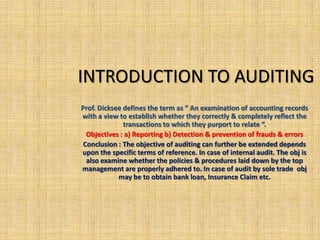
Prof. Dicksee defines the term as “ An examination of accounting records
with a view to establish whether they correctly & completely reflect the
              transactions to which they purport to relate “.
  Objectives : a) Reporting b) Detection & prevention of frauds & errors
 Conclusion : The objective of auditing can further be extended depends
upon the specific terms of reference. In case of internal audit. The obj is
  also examine whether the policies & procedures laid down by the top
management are properly adhered to. In case of audit by sole trade obj
            may be to obtain bank loan, Insurance Claim etc.
WRITE SHORT NOTES ON FINANCIAL STATEMENT &
           USER OF FINANCIAL STATEMENTS
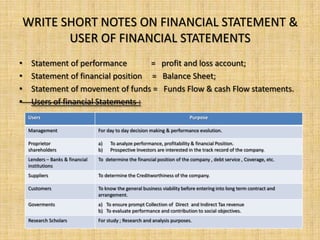
•    Statement of performance        = profit and loss account;
•    Statement of financial position = Balance Sheet;
•    Statement of movement of funds = Funds Flow & cash Flow statements.
•    Users of financial Statements :
    Users                                                                   Purpose

    Management                    For day to day decision making & performance evolution.

    Proprietor                    a)   To analyze performance, profitability & financial Position.
    shareholders                  b)   Prospective Investors are interested in the track record of the company.
    Lenders – Banks & financial   To determine the financial position of the company , debt service , Coverage, etc.
    institutions
    Suppliers                     To determine the Creditworthiness of the company.

    Customers                     To know the general business viability before entering into long term contract and
                                  arrangement.
    Goverments                    a) To ensure prompt Collection of Direct and Indirect Tax revenue
                                  b) To evaluate performance and contribution to social objectives.
    Research Scholars             For study ; Research and analysis purposes.
WRITE SHORTNOTE ON INHERENT LIMITATIONS OF
                     AUDIT
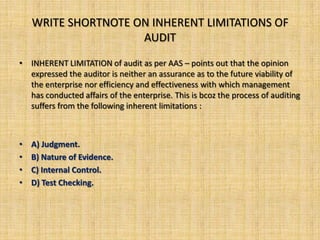
• INHERENT LIMITATION of audit as per AAS – points out that the opinion
  expressed the auditor is neither an assurance as to the future viability of
  the enterprise nor efficiency and effectiveness with which management
  has conducted affairs of the enterprise. This is bcoz the process of auditing
  suffers from the following inherent limitations :


•   A) Judgment.
•   B) Nature of Evidence.
•   C) Internal Control.
•   D) Test Checking.
WHAT IS ERROR ? EXPLAIN DIFFERENT TYPES OF
                        ERRORS
•   Innocent mistakes in bookkeeping & accountancy are called as ERRORS.
•   An error can be defined as “ unintentional mis-statement or mis- description made
    in the books of accounts or records”.
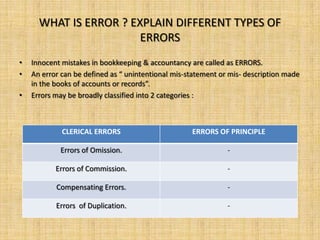
•   Errors may be broadly classified into 2 categories :


             CLERICAL ERRORS                        ERRORS OF PRINCIPLE

            Errors of Omission.                                -

           Errors of Commission.                               -

           Compensating Errors.                                -

           Errors of Duplication.                              -
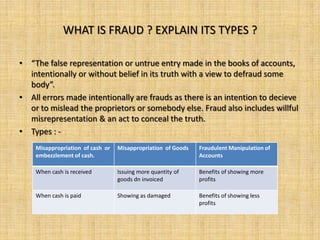
WHAT IS FRAUD ? EXPLAIN ITS TYPES ?

• “The false representation or untrue entry made in the books of accounts,
  intentionally or without belief in its truth with a view to defraud some
  body”.
• All errors made intentionally are frauds as there is an intention to decieve
  or to mislead the proprietors or somebody else. Fraud also includes willful
  misrepresentation & an act to conceal the truth.
• Types : -
    Misappropriation of cash or   Misappropriation of Goods   Fraudulent Manipulation of
    embezzlement of cash.                                     Accounts

    When cash is received         Issuing more quantity of    Benefits of showing more
                                  goods dn invoiced           profits

    When cash is paid             Showing as damaged          Benefits of showing less
                                                              profits
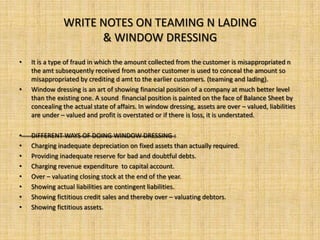
WRITE NOTES ON TEAMING N LADING
                     & WINDOW DRESSING
•   It is a type of fraud in which the amount collected from the customer is misappropriated n
    the amt subsequently received from another customer is used to conceal the amount so
    misappropriated by crediting d amt to the earlier customers. (teaming and lading).
•   Window dressing is an art of showing financial position of a company at much better level
    than the existing one. A sound financial position is painted on the face of Balance Sheet by
    concealing the actual state of affairs. In window dressing, assets are over – valued, liabilities
    are under – valued and profit is overstated or if there is loss, it is understated.

•   DIFFERENT WAYS OF DOING WINDOW DRESSING :
•   Charging inadequate depreciation on fixed assets than actually required.
•   Providing inadequate reserve for bad and doubtful debts.
•   Charging revenue expenditure to capital account.
•   Over – valuating closing stock at the end of the year.
•   Showing actual liabilities are contingent liabilities.
•   Showing fictitious credit sales and thereby over – valuating debtors.
•   Showing fictitious assets.
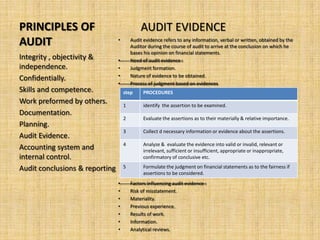
PRINCIPLES OF                               AUDIT EVIDENCE
AUDIT                           •       Audit evidence refers to any information, verbal or written, obtained by the
                                        Auditor during the course of audit to arrive at the conclusion on which he
                                        bases his opinion on financial statements.
Integrity , objectivity &       •       Need of audit evidence :
independence.                   •       Judgment formation.
                                •       Nature of evidence to be obtained.
Confidentially.
                                •       Process of judgment based on evidences
Skills and competence.              step      PROCEDURES
Work preformed by others.           1         identify the assertion to be examined.
Documentation.
                                    2         Evaluate the assertions as to their materially & relative importance.
Planning.
                                    3         Collect d necessary information or evidence about the assertions.
Audit Evidence.
                                    4         Analyze & evaluate the evidence into valid or invalid, relevant or
Accounting system and                         irrelevant, sufficient or insufficient, appropriate or inappropriate,
internal control.                             confirmatory of conclusive etc.

Audit conclusions & reporting       5         Formulate the judgment on financial statements as to the fairness if
                                              assertions to be considered.
                                •       Factors influencing audit evidence :
                                •       Risk of misstatement.
                                •       Materiality.
                                •       Previous experience.
                                •       Results of work.
                                •       Information.
                                •       Analytical reviews.
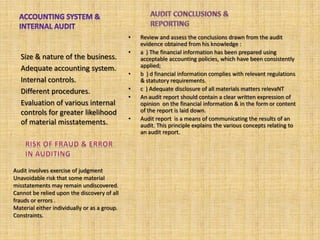
•   Review and assess the conclusions drawn from the audit
                                                  evidence obtained from his knowledge :
                                              •   a ) The financial information has been prepared using
   Size & nature of the business.                 acceptable accounting policies, which have been consistently
   Adequate accounting system.                    applied;
                                              •   b ) d financial information complies with relevant regulations
   Internal controls.                             & statutory requirements.
   Different procedures.                      •   c ) Adequate disclosure of all materials matters relevaNT
                                              •   An audit report should contain a clear written expression of
   Evaluation of various internal                 opinion on the financial information & in the form or content
   controls for greater likelihood                of the report is laid down.
                                              •   Audit report is a means of communicating the results of an
   of material misstatements.                     audit. This principle explains the various concepts relating to
                                                  an audit report.


Audit involves exercise of judgment
Unavoidable risk that some material
misstatements may remain undiscovered.
Cannot be relied upon the discovery of all
frauds or errors .
Material either individually or as a group.
Constraints.
A continuous audit is one in             Balance sheet audit means verification of all the items
which audit works is carried out         appearing in the balance sheet such as assets, capital
almost simultaneously with the           reserves & liabilities of the business. Under the
recording of the transactions.           balance sheet audit the auditor commence audit on
Under this, auditor visits his           the basis of the balance sheet and he works back to
clients throughout the year is           the books of original entry and other evidence bcoz
periodical intervals, which may be       balance of profit & loss account appears In the balance
regular say monthly or two               sheet. Thus, in balance sheet audit all the d items
monthly or weekly or fortnight.          contained in d balance sheet and other related items
                                         are verified completely.


Interim audit is one, which is
conducted between the two
annual audits in order to            •   Final audit is one which is undertaken at the
ascertain profit to declare              close of the financial year when the final
interim dividend. It involves a          accounts are ready. In annual or final audit visits
complete examination and                 his clients only once a year and the entire audit
review of the accounts and               work is completed in one time ir in a single
records of business upto the             uninterrupted session.
date of interim audit. It may be
ordered for six months.
QUALITIES OF AUDITOR

CONCURRENT AUDIT                 •   Expert in fundamental principles and theory of
                                     accounting.
                                 •   Knowledge of the company law and mercantile law.
Concurrent audit is a
                                 •   Knowledge of industrial management, financial
comprehensive, continuous
                                     administration & Business Organisation.
and systematic examination of
                                 •   Honest & tactful and always exercise reasonable skill &
all transactions of an entity,
                                     care in duty.
by a person other than
                                 •   Not adopt the attitude of suspicion.
involved in the operations, to
                                 •   Intelligent questions to his clients.
ensure accuracy , authenticity
& due compliance with the        •   Not influenced directly or indirectly.
internal systems, procedures     •   Not disclose secrets of his clients to others.
& guidelines.                    •   Necessary courage and ability to write his report
                                     correctly.
                                 •   Knowledge of the principles of economics and
INFERENCE :                          economic laws.
Concurrent audit is a            •   Possess a pleasing personality and other qualities like
management process and               tact, judgment, self control, dignity and diligence.
looks into the establishment     •   Methodical, hardworking and accurate.
of sound internal functions      •   Knowledge of principles of accounting.
and effective control systems.   •   Possess knowledge of computer.
ADVANTAGES OF INDEPENDENT AUDIT
TRUE AND FAIR VIEW                       OR USE OF AUDIT ACCOUNT
AS PER THE SECTION 227(2) of         •    Protection of Interest.
the companies act, 1956 the
auditor of a limited company has     •    Moral Check.
to report to the shareholders        •    Tax Liability.
whether the accounts, give true
                                     •    Credit Negotiation.
and fair view.
1) In case of the balance sheet      •    Trade Dispute Settlement.
     of the state of company’s       •    Control over Inefficiency.
     affairs at the end of the       •    Funds in Trust.
     financial year.
                                     •    Arbitration.
2) In case of the profit and loss
     account of the profit or loss   •    Appraisal.
     for the financial year.         •    Partnership cases.
 section 209 (3) states that the     •    Assistance to Government.
     books of accounts would be
     so kept as are necessary to
     give a true and fair view of
     the state of affairs of the
     company or its branch office,
     as the case may be and to
     explain its transactions.
GOING CONCERN                            MATERIALITY


THE GOING CONCERN IS THE             •   MATERIAL MEANS IMPORTANT OR ESSENTIAL.
BASIC IDEA THAT THE BUSINESS             The convention of materiality is the common rule
WILL COONTINUE FOR A LONG                followed by all accountants of separately
TIME, followed by all accountants,
                                         recording and reporting the material details of
while recording and reporting the
business transactions. The going         business transactions. Many business decisions
concern concept is known as the          are based on the details available in the
concept of continuity.                   accounts. Material details mean details which
A business may be set up for a           might influence a business decision. Thus what Is
particular work                          material depends upon the facts of each case.
Going concern concept assumes        •   Effect on Accounts.
that the business would continue     •   Recording only material details.
for a long time.
The accounts are kept on the
                                     •   Separate Record in Individual Accounts.
basis that business will go on and   •   Reporting only Material Details.
on and will not be closed down or
stopped in the near future.

Chapter 1.

  • 1.
    INTRODUCTION TO AUDITING Prof.Dicksee defines the term as “ An examination of accounting records with a view to establish whether they correctly & completely reflect the transactions to which they purport to relate “. Objectives : a) Reporting b) Detection & prevention of frauds & errors Conclusion : The objective of auditing can further be extended depends upon the specific terms of reference. In case of internal audit. The obj is also examine whether the policies & procedures laid down by the top management are properly adhered to. In case of audit by sole trade obj may be to obtain bank loan, Insurance Claim etc.
  • 2.
    WRITE SHORT NOTESON FINANCIAL STATEMENT & USER OF FINANCIAL STATEMENTS • Statement of performance = profit and loss account; • Statement of financial position = Balance Sheet; • Statement of movement of funds = Funds Flow & cash Flow statements. • Users of financial Statements : Users Purpose Management For day to day decision making & performance evolution. Proprietor a) To analyze performance, profitability & financial Position. shareholders b) Prospective Investors are interested in the track record of the company. Lenders – Banks & financial To determine the financial position of the company , debt service , Coverage, etc. institutions Suppliers To determine the Creditworthiness of the company. Customers To know the general business viability before entering into long term contract and arrangement. Goverments a) To ensure prompt Collection of Direct and Indirect Tax revenue b) To evaluate performance and contribution to social objectives. Research Scholars For study ; Research and analysis purposes.
  • 3.
    WRITE SHORTNOTE ONINHERENT LIMITATIONS OF AUDIT • INHERENT LIMITATION of audit as per AAS – points out that the opinion expressed the auditor is neither an assurance as to the future viability of the enterprise nor efficiency and effectiveness with which management has conducted affairs of the enterprise. This is bcoz the process of auditing suffers from the following inherent limitations : • A) Judgment. • B) Nature of Evidence. • C) Internal Control. • D) Test Checking.
  • 4.
    WHAT IS ERROR? EXPLAIN DIFFERENT TYPES OF ERRORS • Innocent mistakes in bookkeeping & accountancy are called as ERRORS. • An error can be defined as “ unintentional mis-statement or mis- description made in the books of accounts or records”. • Errors may be broadly classified into 2 categories : CLERICAL ERRORS ERRORS OF PRINCIPLE Errors of Omission. - Errors of Commission. - Compensating Errors. - Errors of Duplication. -
  • 5.
    WHAT IS FRAUD? EXPLAIN ITS TYPES ? • “The false representation or untrue entry made in the books of accounts, intentionally or without belief in its truth with a view to defraud some body”. • All errors made intentionally are frauds as there is an intention to decieve or to mislead the proprietors or somebody else. Fraud also includes willful misrepresentation & an act to conceal the truth. • Types : - Misappropriation of cash or Misappropriation of Goods Fraudulent Manipulation of embezzlement of cash. Accounts When cash is received Issuing more quantity of Benefits of showing more goods dn invoiced profits When cash is paid Showing as damaged Benefits of showing less profits
  • 6.
    WRITE NOTES ONTEAMING N LADING & WINDOW DRESSING • It is a type of fraud in which the amount collected from the customer is misappropriated n the amt subsequently received from another customer is used to conceal the amount so misappropriated by crediting d amt to the earlier customers. (teaming and lading). • Window dressing is an art of showing financial position of a company at much better level than the existing one. A sound financial position is painted on the face of Balance Sheet by concealing the actual state of affairs. In window dressing, assets are over – valued, liabilities are under – valued and profit is overstated or if there is loss, it is understated. • DIFFERENT WAYS OF DOING WINDOW DRESSING : • Charging inadequate depreciation on fixed assets than actually required. • Providing inadequate reserve for bad and doubtful debts. • Charging revenue expenditure to capital account. • Over – valuating closing stock at the end of the year. • Showing actual liabilities are contingent liabilities. • Showing fictitious credit sales and thereby over – valuating debtors. • Showing fictitious assets.
  • 7.
    PRINCIPLES OF AUDIT EVIDENCE AUDIT • Audit evidence refers to any information, verbal or written, obtained by the Auditor during the course of audit to arrive at the conclusion on which he bases his opinion on financial statements. Integrity , objectivity & • Need of audit evidence : independence. • Judgment formation. • Nature of evidence to be obtained. Confidentially. • Process of judgment based on evidences Skills and competence. step PROCEDURES Work preformed by others. 1 identify the assertion to be examined. Documentation. 2 Evaluate the assertions as to their materially & relative importance. Planning. 3 Collect d necessary information or evidence about the assertions. Audit Evidence. 4 Analyze & evaluate the evidence into valid or invalid, relevant or Accounting system and irrelevant, sufficient or insufficient, appropriate or inappropriate, internal control. confirmatory of conclusive etc. Audit conclusions & reporting 5 Formulate the judgment on financial statements as to the fairness if assertions to be considered. • Factors influencing audit evidence : • Risk of misstatement. • Materiality. • Previous experience. • Results of work. • Information. • Analytical reviews.
  • 8.
    Review and assess the conclusions drawn from the audit evidence obtained from his knowledge : • a ) The financial information has been prepared using Size & nature of the business. acceptable accounting policies, which have been consistently Adequate accounting system. applied; • b ) d financial information complies with relevant regulations Internal controls. & statutory requirements. Different procedures. • c ) Adequate disclosure of all materials matters relevaNT • An audit report should contain a clear written expression of Evaluation of various internal opinion on the financial information & in the form or content controls for greater likelihood of the report is laid down. • Audit report is a means of communicating the results of an of material misstatements. audit. This principle explains the various concepts relating to an audit report. Audit involves exercise of judgment Unavoidable risk that some material misstatements may remain undiscovered. Cannot be relied upon the discovery of all frauds or errors . Material either individually or as a group. Constraints.
  • 9.
    A continuous auditis one in Balance sheet audit means verification of all the items which audit works is carried out appearing in the balance sheet such as assets, capital almost simultaneously with the reserves & liabilities of the business. Under the recording of the transactions. balance sheet audit the auditor commence audit on Under this, auditor visits his the basis of the balance sheet and he works back to clients throughout the year is the books of original entry and other evidence bcoz periodical intervals, which may be balance of profit & loss account appears In the balance regular say monthly or two sheet. Thus, in balance sheet audit all the d items monthly or weekly or fortnight. contained in d balance sheet and other related items are verified completely. Interim audit is one, which is conducted between the two annual audits in order to • Final audit is one which is undertaken at the ascertain profit to declare close of the financial year when the final interim dividend. It involves a accounts are ready. In annual or final audit visits complete examination and his clients only once a year and the entire audit review of the accounts and work is completed in one time ir in a single records of business upto the uninterrupted session. date of interim audit. It may be ordered for six months.
  • 10.
    QUALITIES OF AUDITOR CONCURRENTAUDIT • Expert in fundamental principles and theory of accounting. • Knowledge of the company law and mercantile law. Concurrent audit is a • Knowledge of industrial management, financial comprehensive, continuous administration & Business Organisation. and systematic examination of • Honest & tactful and always exercise reasonable skill & all transactions of an entity, care in duty. by a person other than • Not adopt the attitude of suspicion. involved in the operations, to • Intelligent questions to his clients. ensure accuracy , authenticity & due compliance with the • Not influenced directly or indirectly. internal systems, procedures • Not disclose secrets of his clients to others. & guidelines. • Necessary courage and ability to write his report correctly. • Knowledge of the principles of economics and INFERENCE : economic laws. Concurrent audit is a • Possess a pleasing personality and other qualities like management process and tact, judgment, self control, dignity and diligence. looks into the establishment • Methodical, hardworking and accurate. of sound internal functions • Knowledge of principles of accounting. and effective control systems. • Possess knowledge of computer.
  • 11.
    ADVANTAGES OF INDEPENDENTAUDIT TRUE AND FAIR VIEW OR USE OF AUDIT ACCOUNT AS PER THE SECTION 227(2) of • Protection of Interest. the companies act, 1956 the auditor of a limited company has • Moral Check. to report to the shareholders • Tax Liability. whether the accounts, give true • Credit Negotiation. and fair view. 1) In case of the balance sheet • Trade Dispute Settlement. of the state of company’s • Control over Inefficiency. affairs at the end of the • Funds in Trust. financial year. • Arbitration. 2) In case of the profit and loss account of the profit or loss • Appraisal. for the financial year. • Partnership cases. section 209 (3) states that the • Assistance to Government. books of accounts would be so kept as are necessary to give a true and fair view of the state of affairs of the company or its branch office, as the case may be and to explain its transactions.
  • 12.
    GOING CONCERN MATERIALITY THE GOING CONCERN IS THE • MATERIAL MEANS IMPORTANT OR ESSENTIAL. BASIC IDEA THAT THE BUSINESS The convention of materiality is the common rule WILL COONTINUE FOR A LONG followed by all accountants of separately TIME, followed by all accountants, recording and reporting the material details of while recording and reporting the business transactions. The going business transactions. Many business decisions concern concept is known as the are based on the details available in the concept of continuity. accounts. Material details mean details which A business may be set up for a might influence a business decision. Thus what Is particular work material depends upon the facts of each case. Going concern concept assumes • Effect on Accounts. that the business would continue • Recording only material details. for a long time. The accounts are kept on the • Separate Record in Individual Accounts. basis that business will go on and • Reporting only Material Details. on and will not be closed down or stopped in the near future.