CHAPTER 1:
BRANDS & BRAND MANAGEMENT


       Kevin Lane Keller
     Tuck School of Business
       Dartmouth College


                               1.1
What is a brand?

   For the American Marketing Association (AMA), a brand is a
    “name, term, sign, symbol, or design, or a combination of them,
    intended to identify the goods and services of one seller or group
    of sellers and to differentiate them from those of competition.”
   These different components of a brand that identify and
    differentiate it are brand elements.


                                                      1.2
What is a brand?

   Many practicing managers refer to a brand as more than that—
    as something that has actually created a certain amount of
    awareness, reputation, prominence, and so on in the marketplace.
   We can make a distinction between the AMA definition of a
    “brand” with a small b and the industry’s concept of a “Brand”
    with a capital b.


                                                     1.3
Brands vs. Products

   A product is anything we can offer to a market for
    attention, acquisition, use, or consumption that might
    satisfy a need or want.
   A product may be a physical good, a service, a retail
    outlet, a person, an organization, a place, or even an
    idea.


                                              1.4
Five Levels of Meaning for a Product
   The core benefit level is the fundamental need or want that
    consumers satisfy by consuming the product or service.
   The generic product level is a basic version of the product containing
    only those attributes or characteristics absolutely necessary for its
    functioning but with no distinguishing features. This is basically a
    stripped-down, no-frills version of the product that adequately
    performs the product function.
   The expected product level is a set of attributes or characteristics that
    buyers normally expect and agree to when they purchase a
    product.
   The augmented product level includes additional product attributes,
    benefits, or related services that distinguish the product from
    competitors.
   The potential product level includes all the augmentations and
    transformations that a product might ultimately undergo in the
    future.                                                1.5
   A brand is therefore more than a product, as it
    can have dimensions that differentiate it in some
    way from other products designed to satisfy the
    same need.


                                        1.6
   Some brands create competitive advantages with
    product performance; other brands create
    competitive advantages through non-product-
    related means.


                                      1.7
Why do brands matter?
   What functions do brands perform that make
    them so valuable to marketers?


                                     1.8
Importance of Brands to Consumers
   Identification of the source of the product
   Assignment of responsibility to product maker
   Risk reducer
   Search cost reducer
   Promise, bond, or pact with product maker
   Symbolic device
   Signal of quality

                                       1.9
Reducing the Risks in Product Decisions
   Consumers may perceive many different types of risks in buying
    and consuming a product:
   Functional risk—The product does not perform up to
    expectations.
   Physical risk—The product poses a threat to the physical well-
    being or health of the user or others.
   Financial risk—The product is not worth the price paid.
   Social risk—The product results in embarrassment from others.
   Psychological risk—The product affects the mental well-being of
    the user.
   Time risk—The failure of the product results in an opportunity
    cost of finding another satisfactory product.

                                                    1.10
Importance of Brands to Firms
   To firms, brands represent enormously valuable
    pieces of legal property, capable of influencing
    consumer behavior, being bought and sold, and
    providing the security of sustained future
    revenues.


                                        1.11
Importance of Brands to Firms
   Identification to simplify handling or tracing
   Legally protecting unique features
   Signal of quality level
   Endowing products with unique associations
   Source of competitive advantage
   Source of financial returns


                                         1.12
Can everything be branded?
   Ultimately a brand is something that resides in
    the minds of consumers.
   The key to branding is that consumers perceive
    differences among brands in a product category.
   Even commodities can be branded:
       Coffee (Maxwell House), bath soap (Ivory), flour
        (Gold Medal), beer (Budweiser), salt (Morton),
        oatmeal (Quaker), pickles (Vlasic), bananas
        (Chiquita), chickens (Perdue), pineapples (Dole), and
        even water (Perrier)
                                               1.13
An Example of Branding a Commodity

   De Beers Group added the phrase “A Diamond
    Is Forever”


                                   1.14
What is branded?
   Physical goods
   Services
   Retailers and distributors
   Online products and services
   People and organizations
   Sports, arts, and entertainment
   Geographic locations
   Ideas and causes
                                      1.15
Source of Brands Strength
   “The real causes of enduring market leadership
    are vision and will. Enduring market leaders have a
    revolutionary and inspiring vision of the mass
    market, and they exhibit an indomitable will to
    realize that vision. They persist under adversity,
    innovate relentlessly, commit financial resources,
    and leverage assets to realize their vision.”
            Gerald J. Tellis and Peter N. Golder, “First to Market, First to
            Fail? Real Causes of Enduring Market Leadership,” MIT Sloan
            Management Review, 1 January 1996

                                                          1.16
Importance of Brand Management
   The bottom line is that any brand—no matter
    how strong at one point in time—is vulnerable,
    and susceptible to poor brand management.


                                       1.17
What are the strongest brands?
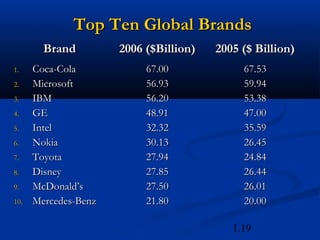
Top Ten Global Brands
        Brand         2006 ($Billion)   2005 ($ Billion)
1.    Coca-Cola            67.00             67.53
2.    Microsoft            56.93             59.94
3.    IBM                  56.20             53.38
4.    GE                   48.91             47.00
5.    Intel                32.32             35.59
6.    Nokia                30.13             26.45
7.    Toyota               27.94             24.84
8.    Disney               27.85             26.44
9.    McDonald’s           27.50             26.01
10.   Mercedes-Benz        21.80             20.00

                                           1.19
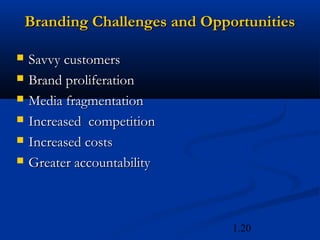
Branding Challenges and Opportunities

   Savvy customers
   Brand proliferation
   Media fragmentation
   Increased competition
   Increased costs
   Greater accountability


                                1.20
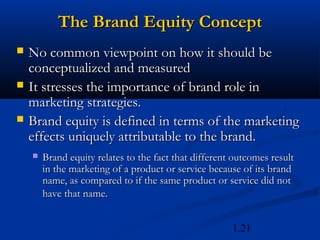
The Brand Equity Concept
   No common viewpoint on how it should be
    conceptualized and measured
   It stresses the importance of brand role in
    marketing strategies.
   Brand equity is defined in terms of the marketing
    effects uniquely attributable to the brand.
       Brand equity relates to the fact that different outcomes result
        in the marketing of a product or service because of its brand
        name, as compared to if the same product or service did not
        have that name.


                                                       1.21
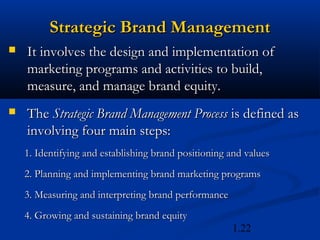
Strategic Brand Management
   It involves the design and implementation of
    marketing programs and activities to build,
    measure, and manage brand equity.
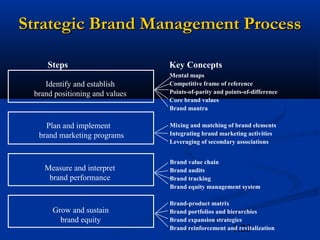
   The Strategic Brand Management Process is defined as
    involving four main steps:
    1. Identifying and establishing brand positioning and values
    2. Planning and implementing brand marketing programs
    3. Measuring and interpreting brand performance
    4. Growing and sustaining brand equity
                                                      1.22
Strategic Brand Management Process

     Steps                      Key Concepts
                                Mental maps
    Identify and establish      Competitive frame of reference
 brand positioning and values   Points-of-parity and points-of-difference
                                Core brand values
                                Brand mantra

    Plan and implement          Mixing and matching of brand elements
  brand marketing programs      Integrating brand marketing activities
                                Leveraging of secondary associations


                                Brand value chain
    Measure and interpret       Brand audits
     brand performance          Brand tracking
                                Brand equity management system

                                Brand-product matrix
      Grow and sustain          Brand portfolios and hierarchies
        brand equity            Brand expansion strategies
                                                       1.23
                                Brand reinforcement and revitalization

Keller sbm3 01

  • 1.
    CHAPTER 1: BRANDS &BRAND MANAGEMENT Kevin Lane Keller Tuck School of Business Dartmouth College 1.1
  • 2.
    What is abrand?  For the American Marketing Association (AMA), a brand is a “name, term, sign, symbol, or design, or a combination of them, intended to identify the goods and services of one seller or group of sellers and to differentiate them from those of competition.”  These different components of a brand that identify and differentiate it are brand elements. 1.2
  • 3.
    What is abrand?  Many practicing managers refer to a brand as more than that— as something that has actually created a certain amount of awareness, reputation, prominence, and so on in the marketplace.  We can make a distinction between the AMA definition of a “brand” with a small b and the industry’s concept of a “Brand” with a capital b. 1.3
  • 4.
    Brands vs. Products  A product is anything we can offer to a market for attention, acquisition, use, or consumption that might satisfy a need or want.  A product may be a physical good, a service, a retail outlet, a person, an organization, a place, or even an idea. 1.4
  • 5.
    Five Levels ofMeaning for a Product  The core benefit level is the fundamental need or want that consumers satisfy by consuming the product or service.  The generic product level is a basic version of the product containing only those attributes or characteristics absolutely necessary for its functioning but with no distinguishing features. This is basically a stripped-down, no-frills version of the product that adequately performs the product function.  The expected product level is a set of attributes or characteristics that buyers normally expect and agree to when they purchase a product.  The augmented product level includes additional product attributes, benefits, or related services that distinguish the product from competitors.  The potential product level includes all the augmentations and transformations that a product might ultimately undergo in the future. 1.5
  • 6.
    A brand is therefore more than a product, as it can have dimensions that differentiate it in some way from other products designed to satisfy the same need. 1.6
  • 7.
    Some brands create competitive advantages with product performance; other brands create competitive advantages through non-product- related means. 1.7
  • 8.
    Why do brandsmatter?  What functions do brands perform that make them so valuable to marketers? 1.8
  • 9.
    Importance of Brandsto Consumers  Identification of the source of the product  Assignment of responsibility to product maker  Risk reducer  Search cost reducer  Promise, bond, or pact with product maker  Symbolic device  Signal of quality 1.9
  • 10.
    Reducing the Risksin Product Decisions  Consumers may perceive many different types of risks in buying and consuming a product:  Functional risk—The product does not perform up to expectations.  Physical risk—The product poses a threat to the physical well- being or health of the user or others.  Financial risk—The product is not worth the price paid.  Social risk—The product results in embarrassment from others.  Psychological risk—The product affects the mental well-being of the user.  Time risk—The failure of the product results in an opportunity cost of finding another satisfactory product. 1.10
  • 11.
    Importance of Brandsto Firms  To firms, brands represent enormously valuable pieces of legal property, capable of influencing consumer behavior, being bought and sold, and providing the security of sustained future revenues. 1.11
  • 12.
    Importance of Brandsto Firms  Identification to simplify handling or tracing  Legally protecting unique features  Signal of quality level  Endowing products with unique associations  Source of competitive advantage  Source of financial returns 1.12
  • 13.
    Can everything bebranded?  Ultimately a brand is something that resides in the minds of consumers.  The key to branding is that consumers perceive differences among brands in a product category.  Even commodities can be branded:  Coffee (Maxwell House), bath soap (Ivory), flour (Gold Medal), beer (Budweiser), salt (Morton), oatmeal (Quaker), pickles (Vlasic), bananas (Chiquita), chickens (Perdue), pineapples (Dole), and even water (Perrier) 1.13
  • 14.
    An Example ofBranding a Commodity  De Beers Group added the phrase “A Diamond Is Forever” 1.14
  • 15.
    What is branded?  Physical goods  Services  Retailers and distributors  Online products and services  People and organizations  Sports, arts, and entertainment  Geographic locations  Ideas and causes 1.15
  • 16.
    Source of BrandsStrength  “The real causes of enduring market leadership are vision and will. Enduring market leaders have a revolutionary and inspiring vision of the mass market, and they exhibit an indomitable will to realize that vision. They persist under adversity, innovate relentlessly, commit financial resources, and leverage assets to realize their vision.” Gerald J. Tellis and Peter N. Golder, “First to Market, First to Fail? Real Causes of Enduring Market Leadership,” MIT Sloan Management Review, 1 January 1996 1.16
  • 17.
    Importance of BrandManagement  The bottom line is that any brand—no matter how strong at one point in time—is vulnerable, and susceptible to poor brand management. 1.17
  • 18.
    What are thestrongest brands?
  • 19.
    Top Ten GlobalBrands Brand 2006 ($Billion) 2005 ($ Billion) 1. Coca-Cola 67.00 67.53 2. Microsoft 56.93 59.94 3. IBM 56.20 53.38 4. GE 48.91 47.00 5. Intel 32.32 35.59 6. Nokia 30.13 26.45 7. Toyota 27.94 24.84 8. Disney 27.85 26.44 9. McDonald’s 27.50 26.01 10. Mercedes-Benz 21.80 20.00 1.19
  • 20.
    Branding Challenges andOpportunities  Savvy customers  Brand proliferation  Media fragmentation  Increased competition  Increased costs  Greater accountability 1.20
  • 21.
    The Brand EquityConcept  No common viewpoint on how it should be conceptualized and measured  It stresses the importance of brand role in marketing strategies.  Brand equity is defined in terms of the marketing effects uniquely attributable to the brand.  Brand equity relates to the fact that different outcomes result in the marketing of a product or service because of its brand name, as compared to if the same product or service did not have that name. 1.21
  • 22.
    Strategic Brand Management  It involves the design and implementation of marketing programs and activities to build, measure, and manage brand equity.  The Strategic Brand Management Process is defined as involving four main steps: 1. Identifying and establishing brand positioning and values 2. Planning and implementing brand marketing programs 3. Measuring and interpreting brand performance 4. Growing and sustaining brand equity 1.22
  • 23.
    Strategic Brand ManagementProcess Steps Key Concepts Mental maps Identify and establish Competitive frame of reference brand positioning and values Points-of-parity and points-of-difference Core brand values Brand mantra Plan and implement Mixing and matching of brand elements brand marketing programs Integrating brand marketing activities Leveraging of secondary associations Brand value chain Measure and interpret Brand audits brand performance Brand tracking Brand equity management system Brand-product matrix Grow and sustain Brand portfolios and hierarchies brand equity Brand expansion strategies 1.23 Brand reinforcement and revitalization

Editor's Notes