Section 2 Molecules of Life
   Chapter 3

Objectives
• Distinguish between monosaccharides, disaccharides,and
  polysaccharides.

• Explain the relationship between amino acids and protein
  structure.

• Describe the induced fit model of enzyme action.

• Compare the structure and function of each of the different
  types of lipids.

• Compare the nucleic acids DNA and RNA.
Section 2 Molecules of Life
   Chapter 3

Carbohydrates
• Carbohydrates are organic compounds composed
  of carbon, hydrogen, and oxygen in a ratio of about
  one carbon to two hydrogen atoms to one oxygen
  atom (1C:2H:1O)

• Carbohydrates are a source of energy and are used
  as structural materials in organisms.
Section 2 Molecules of Life
  Chapter 3

Carbohydrates


  Click below to watch the Visual Concept.


                   Visual Concept
Section 2 Molecules of Life
  Chapter 3

Carbohydrates, continued
• Monosaccharides
  – Carbohydrates are made up of monomers called
    monosaccharides (or simple sugars).
  – Contains carbon, hydrogen, and oxygen in a ratio
    of 1:2:1
  – General formula is (CH20)n
Monosaccharides
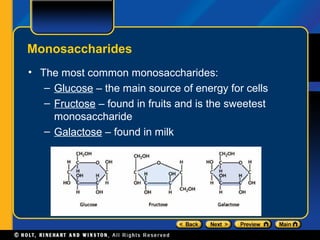
• The most common monosaccharides:
   – Glucose – the main source of energy for cells
   – Fructose – found in fruits and is the sweetest
     monosaccharide
   – Galactose – found in milk
Monosaccharides
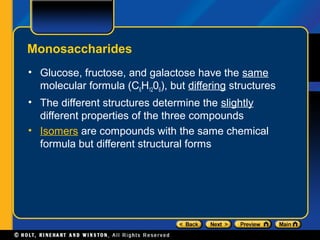
• Glucose, fructose, and galactose have the same
  molecular formula (C6H1206), but differing structures
• The different structures determine the slightly
  different properties of the three compounds
• Isomers are compounds with the same chemical
  formula but different structural forms
Section 2 Molecules of Life
  Chapter 3

Carbohydrates, continued
• Disaccharides and Polysaccharides
   – Two monosaccharides join in a condensation
     reaction to form a double sugar called a
     disaccharide.
   – A complex sugar, or polysaccharide, is made of
     three or more monosaccharides.
Polysaccharides
• Animals store    • Plants store glucose
  glucose as the     as the
  polysaccharide     polysaccharide
  glycogen           starch
                   • Plants also make
                     the polysaccharide
                     cellulose (gives
                     strength and rigidity
                     to plant cells)
Section 2 Molecules of Life
  Chapter 3

Disaccharides


  Click below to watch the Visual Concept.


                   Visual Concept
Section 2 Molecules of Life
   Chapter 3

Proteins
• Proteins are organic compounds composed mainly
  of carbon, hydrogen, oxygen, and nitrogen.

• Proteins have many functions including structural,
  defensive, and catalytic roles.
Section 2 Molecules of Life
  Chapter 3

Proteins, continued
• Amino Acids
   – Proteins are made up of monomers called amino
     acids. The sequence of amino acids determines a
     protein’s shape and function.
Amino Acids
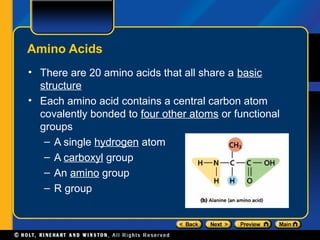
• There are 20 amino acids that all share a basic
  structure
• Each amino acid contains a central carbon atom
  covalently bonded to four other atoms or functional
  groups
   – A single hydrogen atom
   – A carboxyl group
   – An amino group
   – R group
Section 2 Molecules of Life
  Chapter 3

Amino Acids


  Click below to watch the Visual Concept.


                   Visual Concept
Section 2 Molecules of Life
  Chapter 3

Proteins, continued
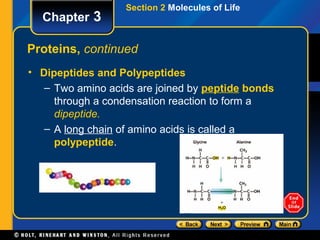
• Dipeptides and Polypeptides
   – Two amino acids are joined by peptide bonds
     through a condensation reaction to form a
     dipeptide.
   – A long chain of amino acids is called a
     polypeptide.
Section 2 Molecules of Life
  Chapter 3

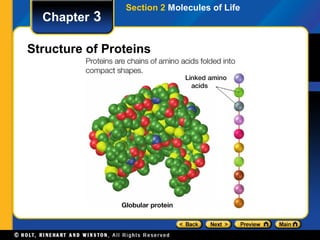
Structure of Proteins
Section 2 Molecules of Life
  Chapter 3

Proteins, continued
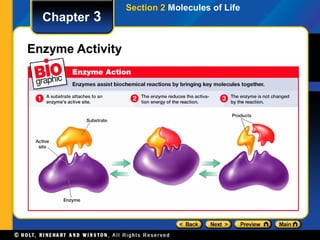
• Enzymes
   – Enzymes speed up chemical reactions and bind
     to specific substrates.
   – The binding of a substrate with an enzyme causes
     a change in the enzyme’s shape and reduces the
     activation energy of the reaction.
Section 2 Molecules of Life
  Chapter 3

Enzyme Activity
Enzymes
• To learn more about the function of enzymes, you are
  going to do a virtual experiment

• PHSchool.com
• cbp-1024
Section 2 Molecules of Life
  Chapter 3

Lipids
• Lipids are nonpolar molecules that store energy and
  are an important part of cell membranes.
Section 2 Molecules of Life
  Chapter 3

Lipids, continued
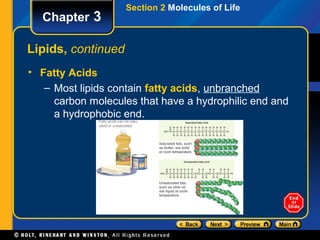
• Fatty Acids
   – Most lipids contain fatty acids, unbranched
     carbon molecules that have a hydrophilic end and
     a hydrophobic end.
Section 2 Molecules of Life
  Chapter 3

Fatty Acids


   Click below to watch the Visual Concept.


                    Visual Concept
Section 2 Molecules of Life
   Chapter 3

Lipids, continued
• Triglycerides
   – Triglycerides consist of three fatty acids and one
     molecule of glycerol.
Section 2 Molecules of Life
  Chapter 3

Lipids, continued
• Phospholipids
   – Phospholipids, which make up cell membranes,
     consist of two fatty acids and one glycerol
     molecule.
Section 2 Molecules of Life
  Chapter 3

Lipids, continued
• Waxes
  – A wax is made of one long fatty acid chain joined
    to one long alcohol.

• Steroids
   – A steroid is composed of four fused carbon rings.
Section 2 Molecules of Life
   Chapter 3

Nucleic Acids
• A nucleic acid is a large and complex organic
  molecule that stores and transports information.
Section 2 Molecules of Life
  Chapter 3

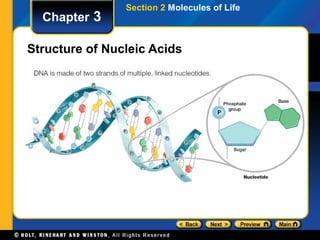
Structure of Nucleic Acids
Section 2 Molecules of Life
  Chapter 3

Nucleic Acids


  Click below to watch the Visual Concept.


                   Visual Concept
Section 2 Molecules of Life
   Chapter 3

Nucleic Acids, continued
• The nucleic acid deoxyribonucleic acid (DNA)
  contains genetic information for cell activities.

• Ribonucleic acid (RNA) molecules play many key
  roles in building of proteins and can act as enzymes.

Chapter 3 - Section 2 - Molecules of Life

  • 1.
    Section 2 Moleculesof Life Chapter 3 Objectives • Distinguish between monosaccharides, disaccharides,and polysaccharides. • Explain the relationship between amino acids and protein structure. • Describe the induced fit model of enzyme action. • Compare the structure and function of each of the different types of lipids. • Compare the nucleic acids DNA and RNA.
  • 2.
    Section 2 Moleculesof Life Chapter 3 Carbohydrates • Carbohydrates are organic compounds composed of carbon, hydrogen, and oxygen in a ratio of about one carbon to two hydrogen atoms to one oxygen atom (1C:2H:1O) • Carbohydrates are a source of energy and are used as structural materials in organisms.
  • 3.
    Section 2 Moleculesof Life Chapter 3 Carbohydrates Click below to watch the Visual Concept. Visual Concept
  • 4.
    Section 2 Moleculesof Life Chapter 3 Carbohydrates, continued • Monosaccharides – Carbohydrates are made up of monomers called monosaccharides (or simple sugars). – Contains carbon, hydrogen, and oxygen in a ratio of 1:2:1 – General formula is (CH20)n
  • 5.
    Monosaccharides • The mostcommon monosaccharides: – Glucose – the main source of energy for cells – Fructose – found in fruits and is the sweetest monosaccharide – Galactose – found in milk
  • 6.
    Monosaccharides • Glucose, fructose,and galactose have the same molecular formula (C6H1206), but differing structures • The different structures determine the slightly different properties of the three compounds • Isomers are compounds with the same chemical formula but different structural forms
  • 7.
    Section 2 Moleculesof Life Chapter 3 Carbohydrates, continued • Disaccharides and Polysaccharides – Two monosaccharides join in a condensation reaction to form a double sugar called a disaccharide. – A complex sugar, or polysaccharide, is made of three or more monosaccharides.
  • 8.
    Polysaccharides • Animals store • Plants store glucose glucose as the as the polysaccharide polysaccharide glycogen starch • Plants also make the polysaccharide cellulose (gives strength and rigidity to plant cells)
  • 9.
    Section 2 Moleculesof Life Chapter 3 Disaccharides Click below to watch the Visual Concept. Visual Concept
  • 10.
    Section 2 Moleculesof Life Chapter 3 Proteins • Proteins are organic compounds composed mainly of carbon, hydrogen, oxygen, and nitrogen. • Proteins have many functions including structural, defensive, and catalytic roles.
  • 11.
    Section 2 Moleculesof Life Chapter 3 Proteins, continued • Amino Acids – Proteins are made up of monomers called amino acids. The sequence of amino acids determines a protein’s shape and function.
  • 12.
    Amino Acids • Thereare 20 amino acids that all share a basic structure • Each amino acid contains a central carbon atom covalently bonded to four other atoms or functional groups – A single hydrogen atom – A carboxyl group – An amino group – R group
  • 13.
    Section 2 Moleculesof Life Chapter 3 Amino Acids Click below to watch the Visual Concept. Visual Concept
  • 14.
    Section 2 Moleculesof Life Chapter 3 Proteins, continued • Dipeptides and Polypeptides – Two amino acids are joined by peptide bonds through a condensation reaction to form a dipeptide. – A long chain of amino acids is called a polypeptide.
  • 15.
    Section 2 Moleculesof Life Chapter 3 Structure of Proteins
  • 16.
    Section 2 Moleculesof Life Chapter 3 Proteins, continued • Enzymes – Enzymes speed up chemical reactions and bind to specific substrates. – The binding of a substrate with an enzyme causes a change in the enzyme’s shape and reduces the activation energy of the reaction.
  • 17.
    Section 2 Moleculesof Life Chapter 3 Enzyme Activity
  • 18.
    Enzymes • To learnmore about the function of enzymes, you are going to do a virtual experiment • PHSchool.com • cbp-1024
  • 19.
    Section 2 Moleculesof Life Chapter 3 Lipids • Lipids are nonpolar molecules that store energy and are an important part of cell membranes.
  • 20.
    Section 2 Moleculesof Life Chapter 3 Lipids, continued • Fatty Acids – Most lipids contain fatty acids, unbranched carbon molecules that have a hydrophilic end and a hydrophobic end.
  • 21.
    Section 2 Moleculesof Life Chapter 3 Fatty Acids Click below to watch the Visual Concept. Visual Concept
  • 22.
    Section 2 Moleculesof Life Chapter 3 Lipids, continued • Triglycerides – Triglycerides consist of three fatty acids and one molecule of glycerol.
  • 23.
    Section 2 Moleculesof Life Chapter 3 Lipids, continued • Phospholipids – Phospholipids, which make up cell membranes, consist of two fatty acids and one glycerol molecule.
  • 24.
    Section 2 Moleculesof Life Chapter 3 Lipids, continued • Waxes – A wax is made of one long fatty acid chain joined to one long alcohol. • Steroids – A steroid is composed of four fused carbon rings.
  • 25.
    Section 2 Moleculesof Life Chapter 3 Nucleic Acids • A nucleic acid is a large and complex organic molecule that stores and transports information.
  • 26.
    Section 2 Moleculesof Life Chapter 3 Structure of Nucleic Acids
  • 27.
    Section 2 Moleculesof Life Chapter 3 Nucleic Acids Click below to watch the Visual Concept. Visual Concept
  • 28.
    Section 2 Moleculesof Life Chapter 3 Nucleic Acids, continued • The nucleic acid deoxyribonucleic acid (DNA) contains genetic information for cell activities. • Ribonucleic acid (RNA) molecules play many key roles in building of proteins and can act as enzymes.