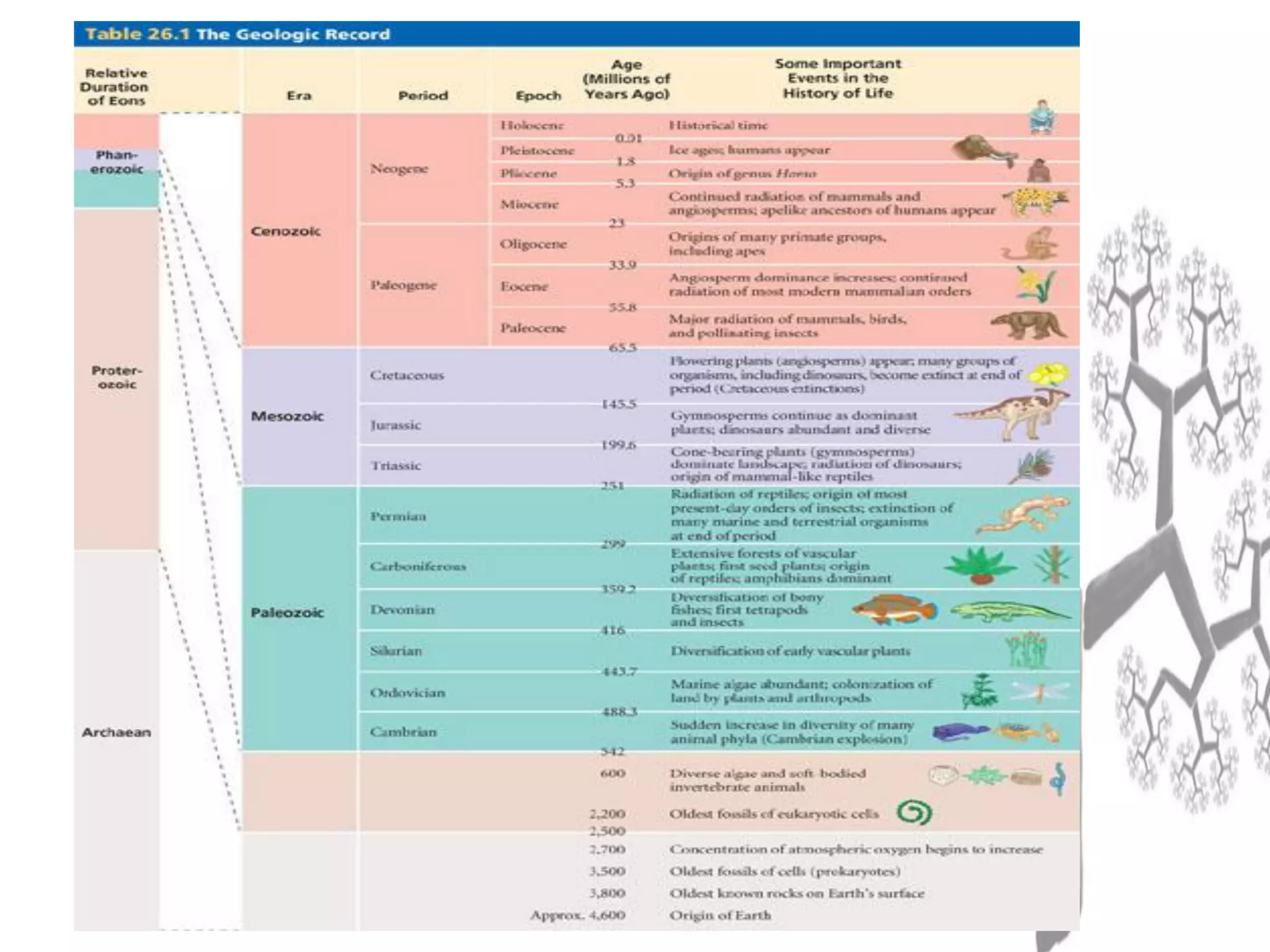
Geologic time scale
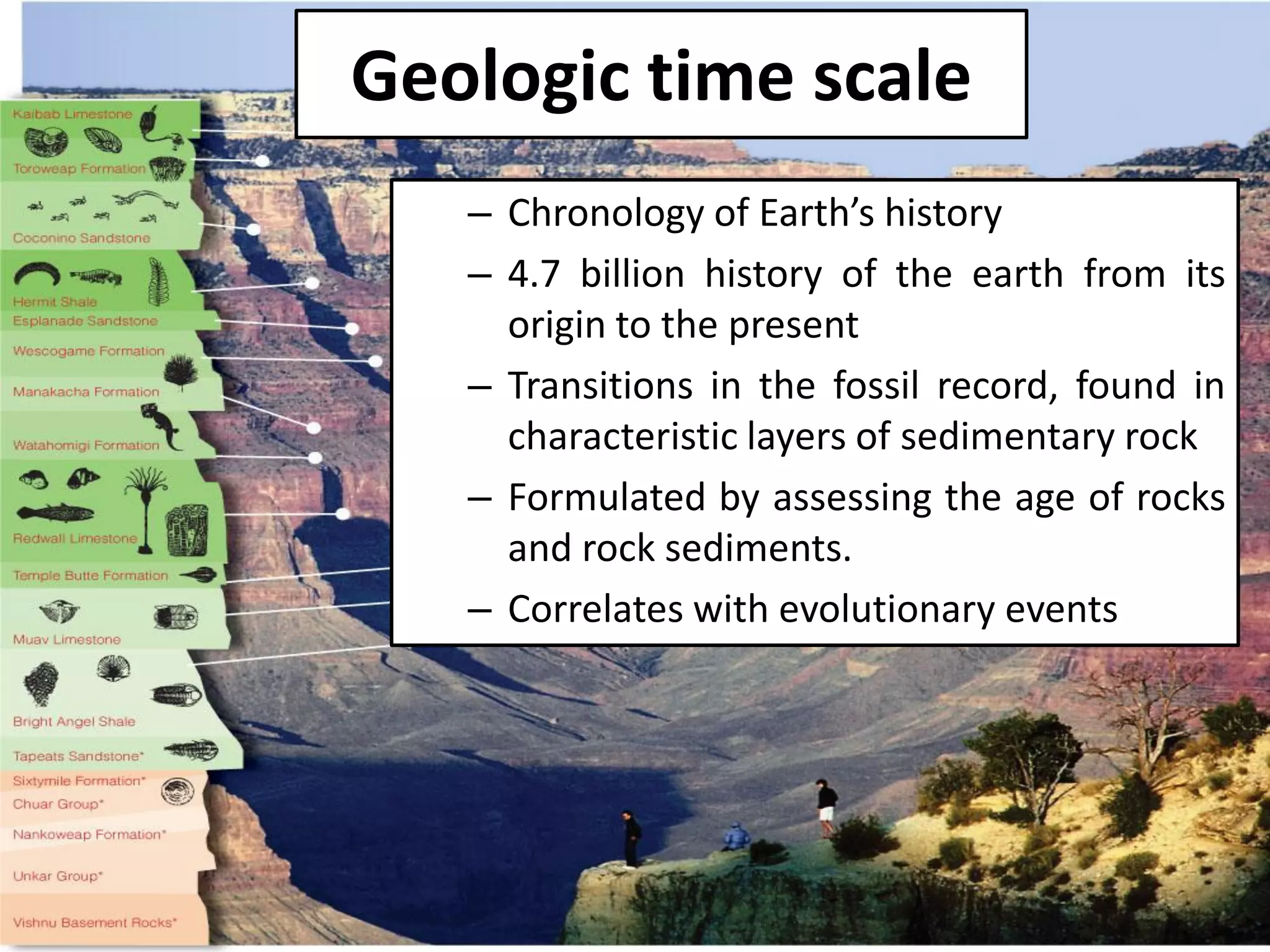
– Chronology of Earth’s history
– 4.7 billion history of the earth from its
origin to the present
– Transitions in the fossil record, found in
characteristic layers of sedimentary rock
– Formulated by assessing the age of rocks
and rock sediments.
– Correlates with evolutionary events
Geologic time scale
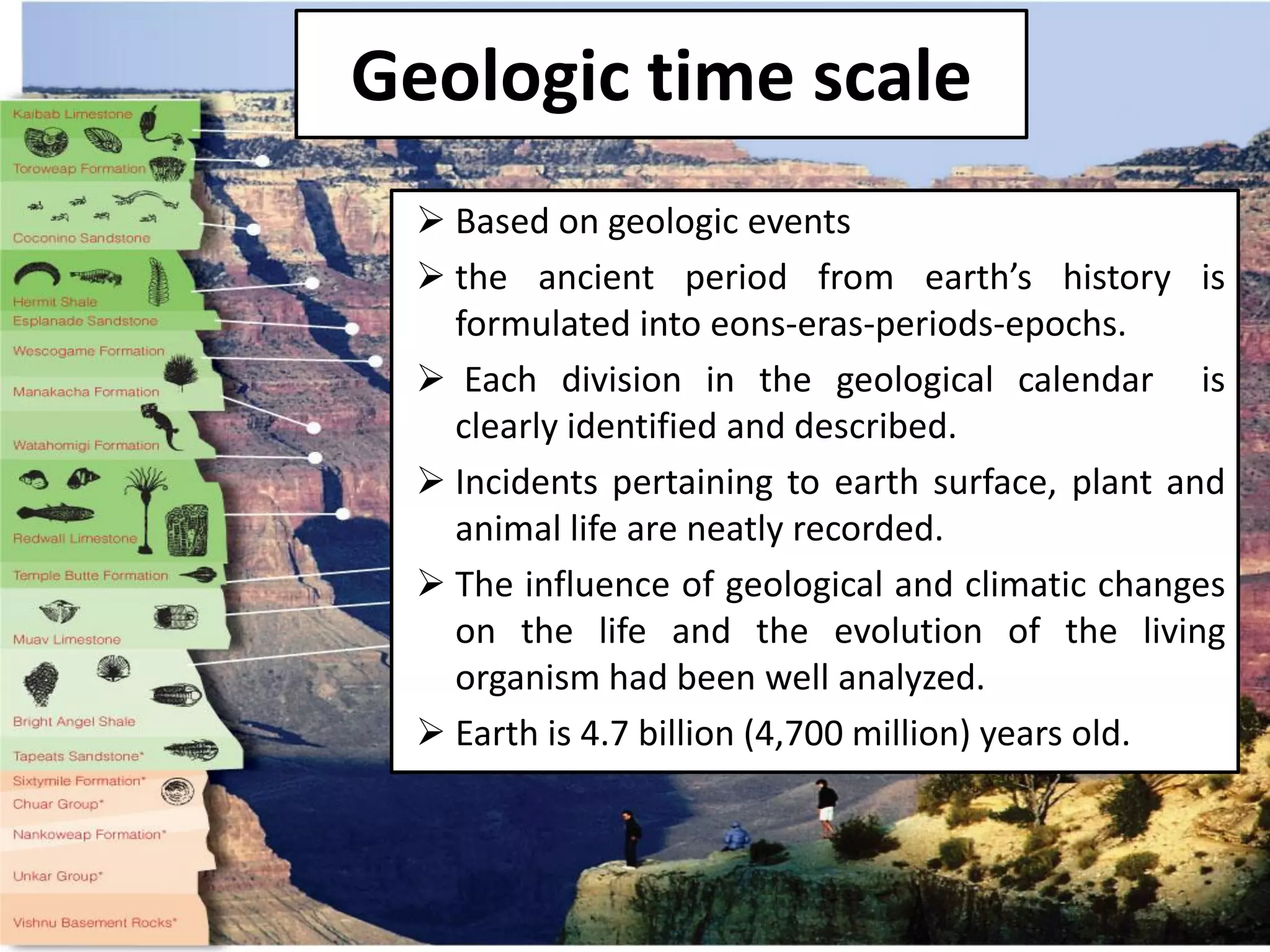
 Based on geologic events
 the ancient period from earth’s history is
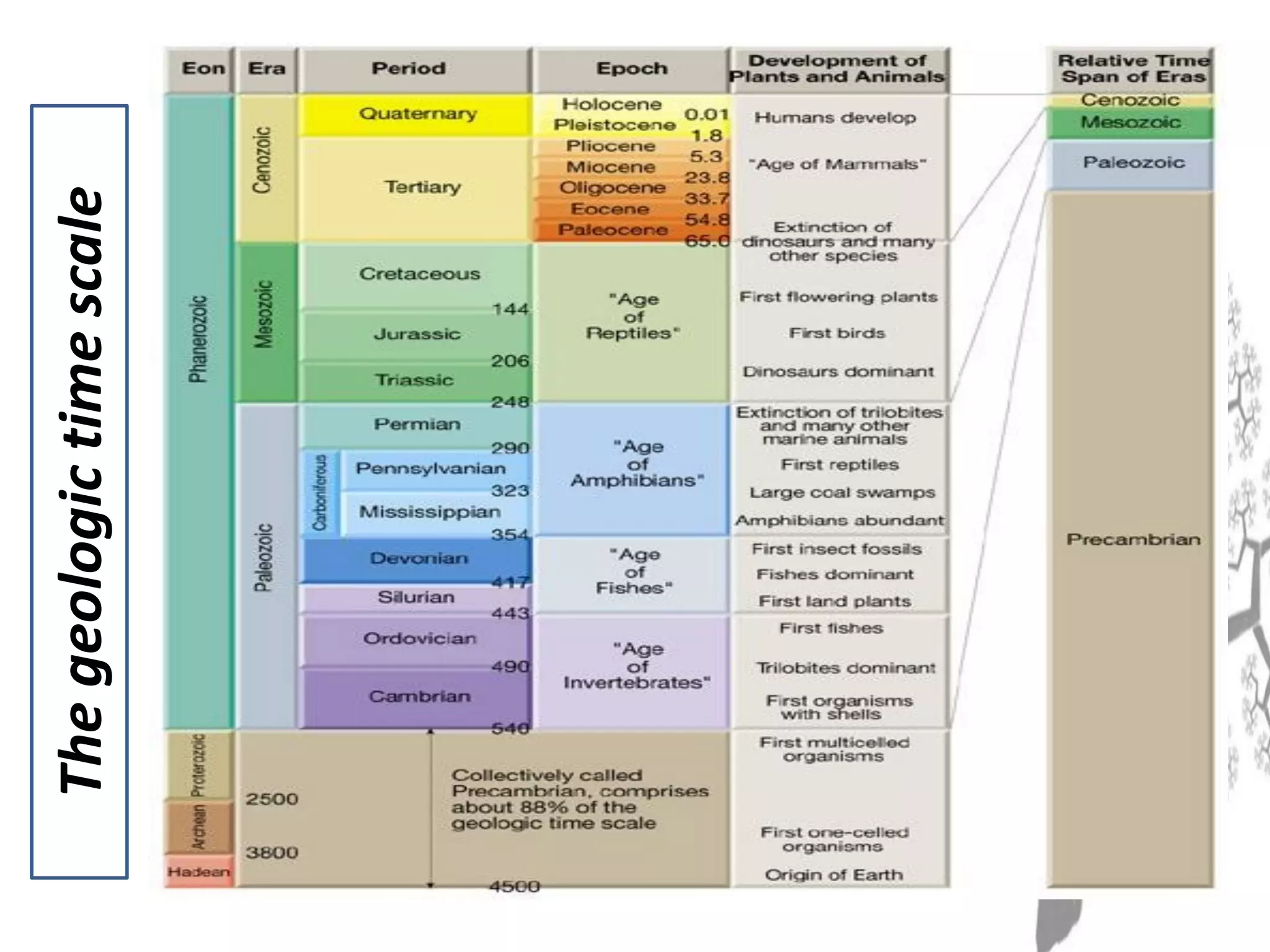
formulated into eons-eras-periods-epochs.
 Each division in the geological calendar is
clearly identified and described.
 Incidents pertaining to earth surface, plant and
animal life are neatly recorded.
 The influence of geological and climatic changes
on the life and the evolution of the living
organism had been well analyzed.
 Earth is 4.7 billion (4,700 million) years old.
Geologic time (4.7 billion/4,700 million)
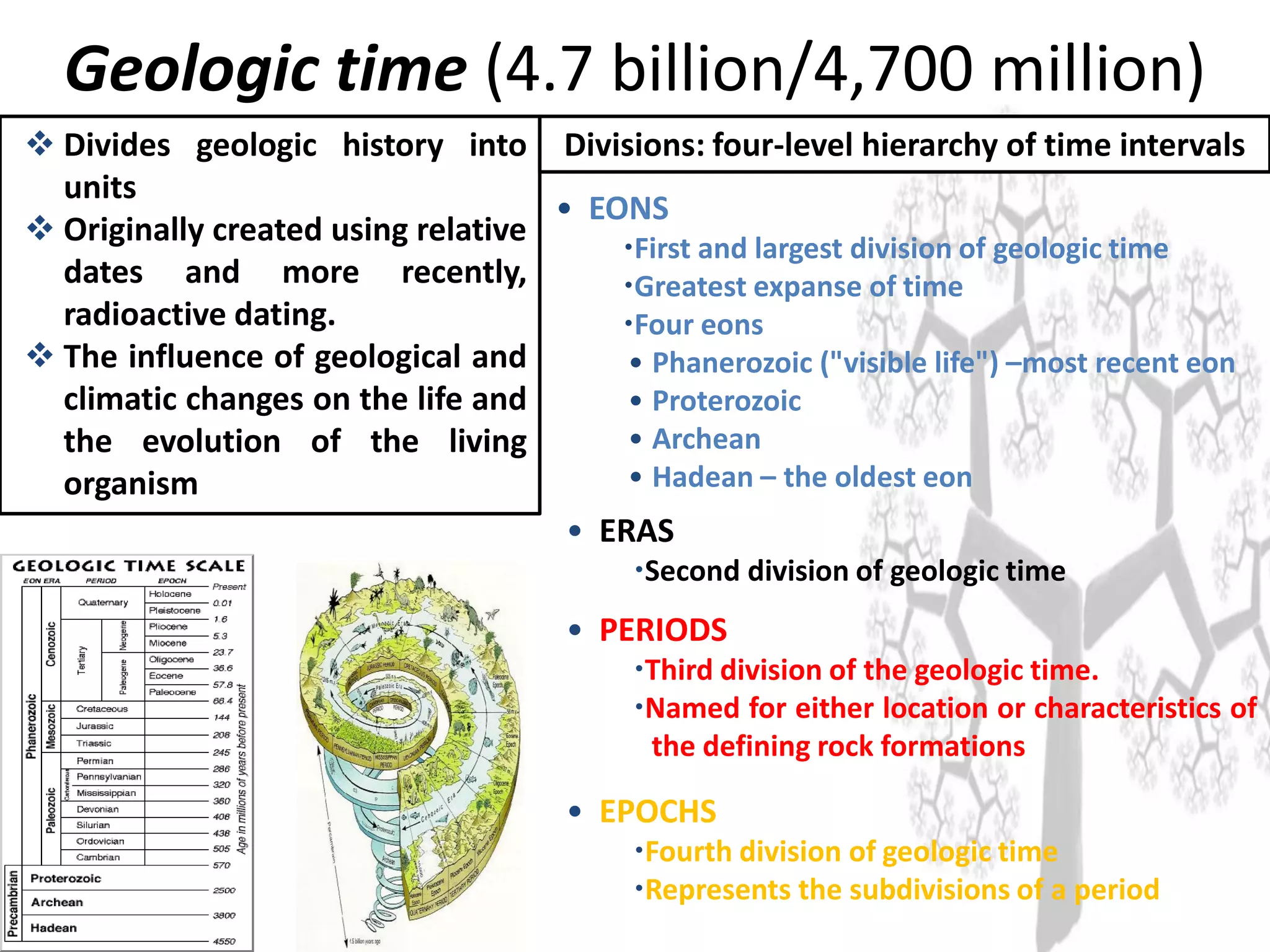
 Divides geologic history into
units
 Originally created using relative
dates and more recently,
radioactive dating.
 The influence of geological and
climatic changes on the life and
the evolution of the living
organism
Divisions: four-level hierarchy of time intervals
• EONS
First and largest division of geologic time
Greatest expanse of time
Four eons
• Phanerozoic ("visible life") –most recent eon
• Proterozoic
• Archean
• Hadean – the oldest eon
• ERAS
Second division of geologic time
• PERIODS
Third division of the geologic time.
Named for either location or characteristics of
the defining rock formations
• EPOCHS
Fourth division of geologic time
Represents the subdivisions of a period
.Thegeologictimescale
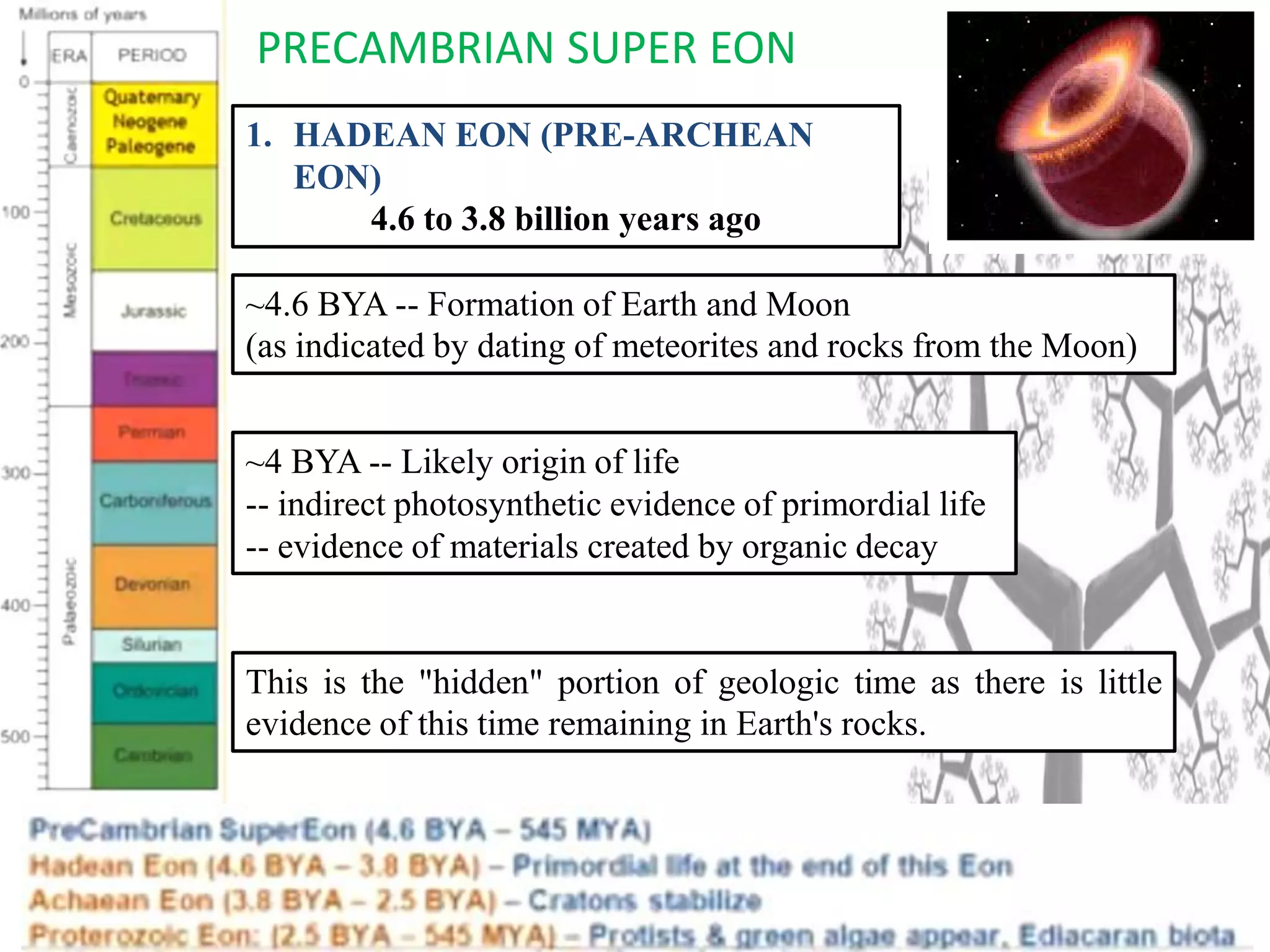
PRECAMBRIAN SUPER EON
1. HADEAN EON (PRE-ARCHEAN
EON)
4.6 to 3.8 billion years ago
~4.6 BYA -- Formation of Earth and Moon
(as indicated by dating of meteorites and rocks from the Moon)
~4 BYA -- Likely origin of life
-- indirect photosynthetic evidence of primordial life
-- evidence of materials created by organic decay
This is the "hidden" portion of geologic time as there is little
evidence of this time remaining in Earth's rocks.
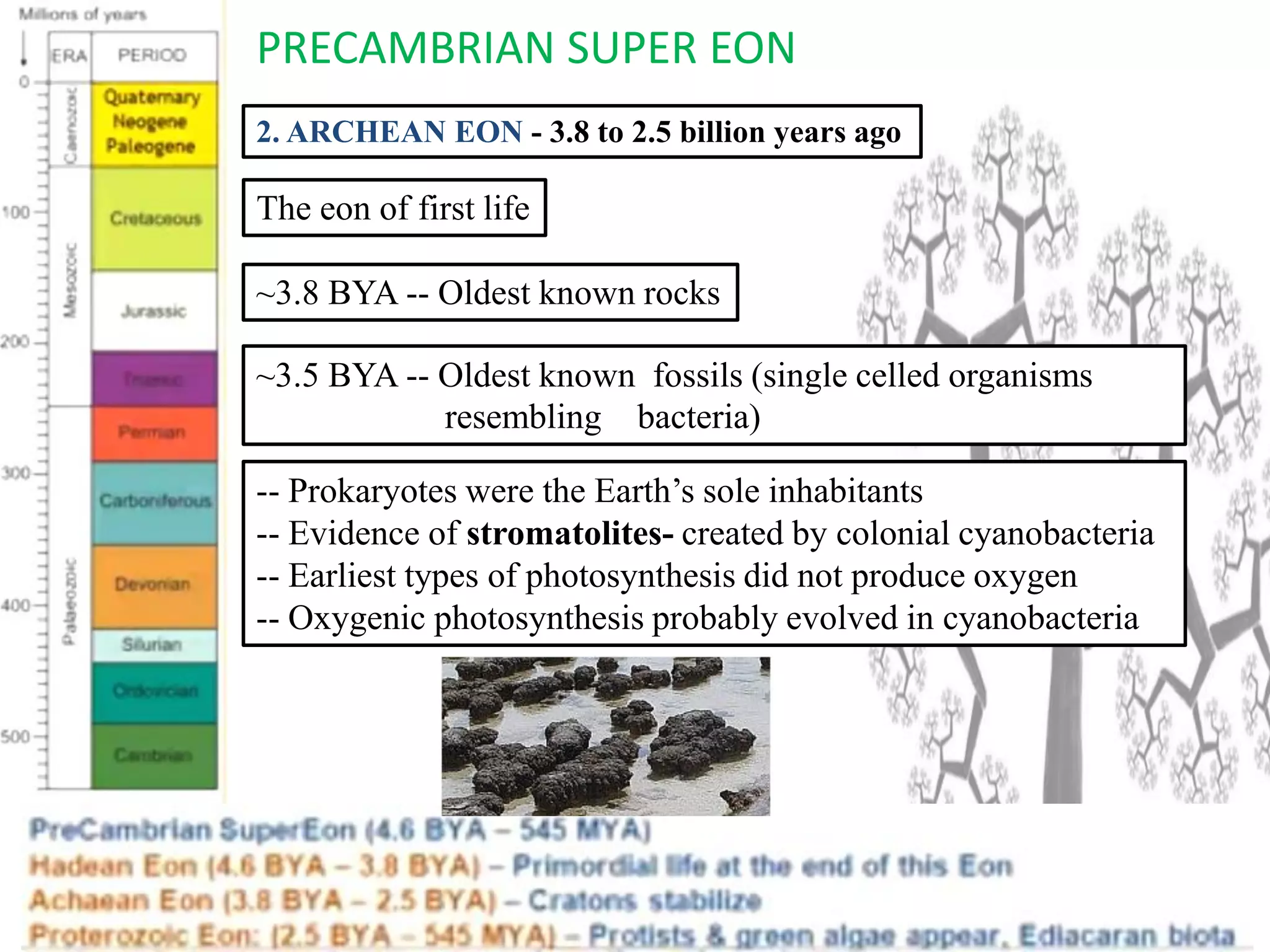
PRECAMBRIAN SUPER EON
2. ARCHEAN EON - 3.8 to 2.5 billion years ago
The eon of first life
~3.8 BYA -- Oldest known rocks
~3.5 BYA -- Oldest known fossils (single celled organisms
resembling bacteria)
-- Prokaryotes were the Earth’s sole inhabitants
-- Evidence of stromatolites- created by colonial cyanobacteria
-- Earliest types of photosynthesis did not produce oxygen
-- Oxygenic photosynthesis probably evolved in cyanobacteria
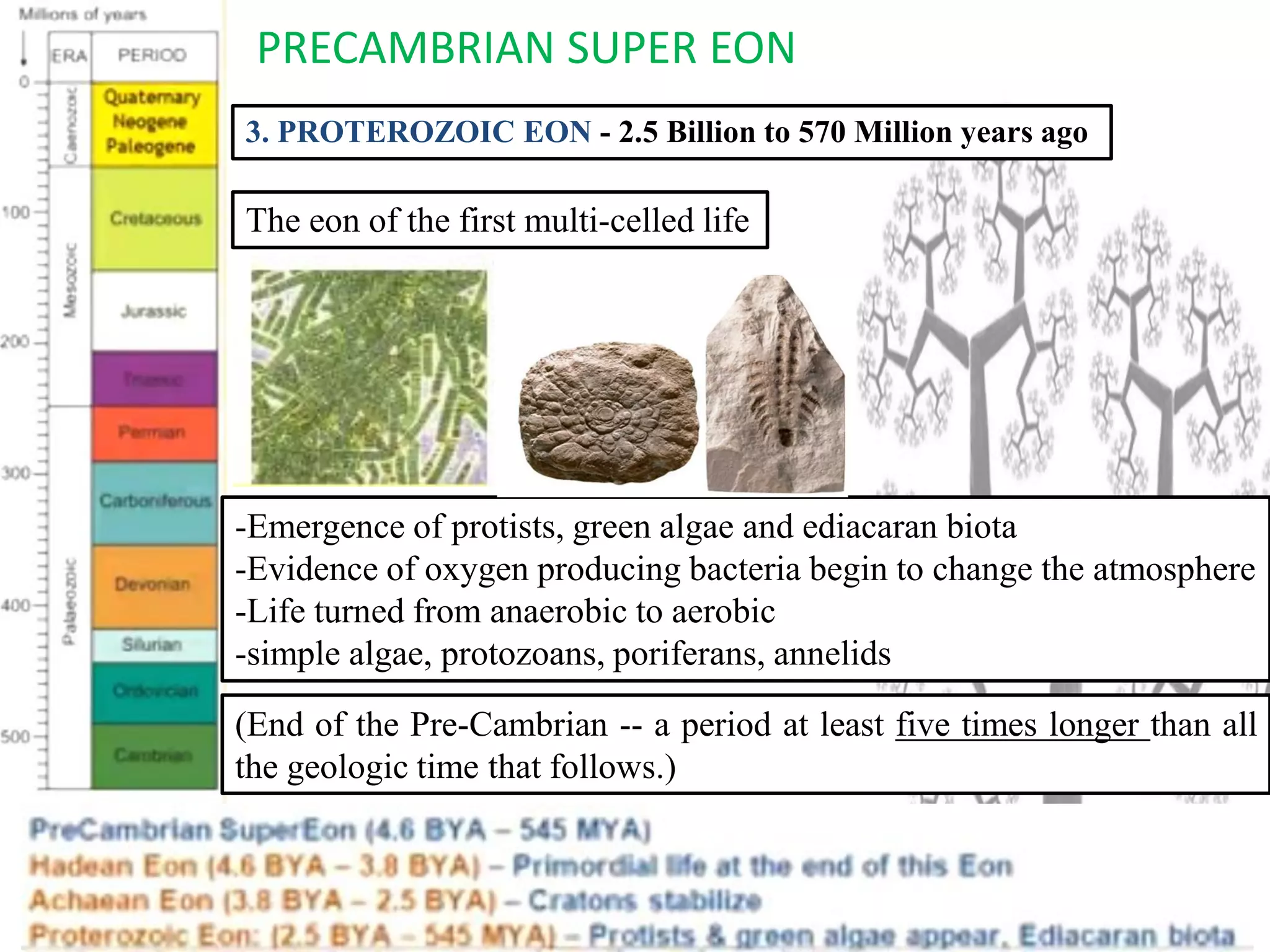
PRECAMBRIAN SUPER EON
3. PROTEROZOIC EON - 2.5 Billion to 570 Million years ago
The eon of the first multi-celled life
-Emergence of protists, green algae and ediacaran biota
-Evidence of oxygen producing bacteria begin to change the atmosphere
-Life turned from anaerobic to aerobic
-simple algae, protozoans, poriferans, annelids
(End of the Pre-Cambrian -- a period at least five times longer than all
the geologic time that follows.)
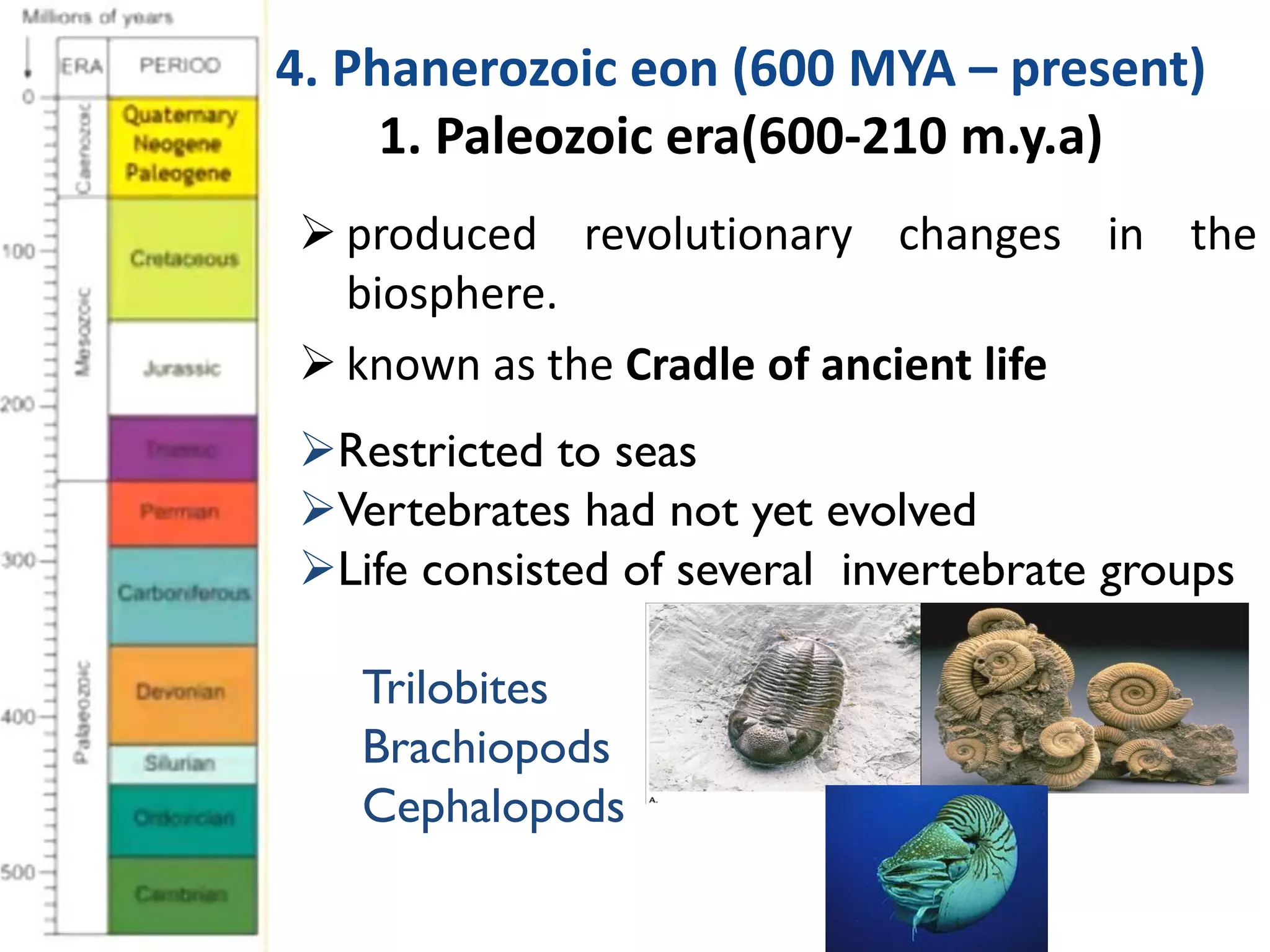
 produced revolutionary changes in the
biosphere.
 known as the Cradle of ancient life
Restricted to seas
Vertebrates had not yet evolved
Life consisted of several invertebrate groups
Trilobites
Brachiopods
Cephalopods
4. Phanerozoic eon (600 MYA – present)
1. Paleozoic era(600-210 m.y.a)
4. Phanerozoic eon (600 MYA – present)
1. Paleozoic era(600-210 m.y.a)
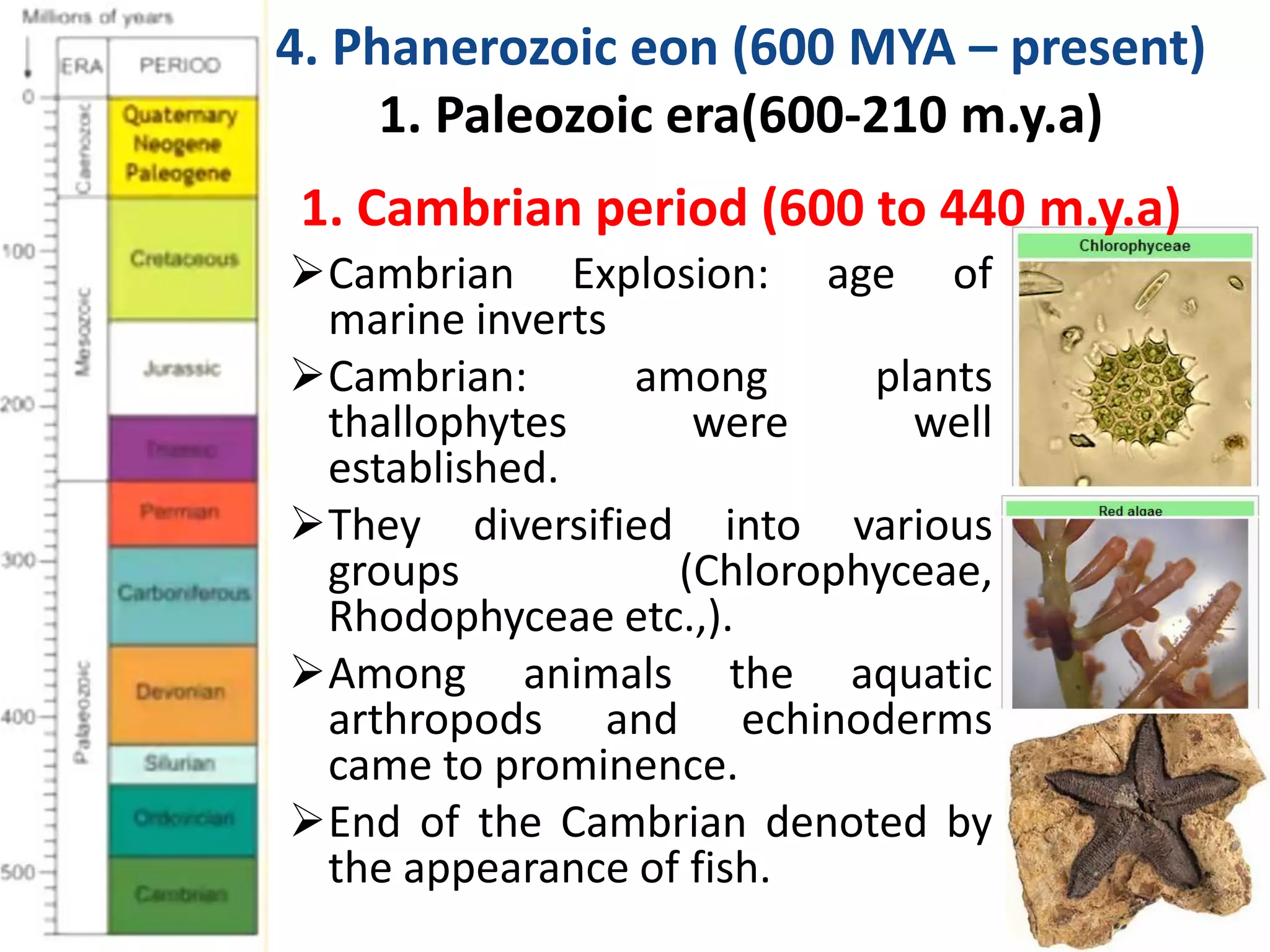
Cambrian Explosion: age of
marine inverts
Cambrian: among plants
thallophytes were well
established.
They diversified into various
groups (Chlorophyceae,
Rhodophyceae etc.,).
Among animals the aquatic
arthropods and echinoderms
came to prominence.
End of the Cambrian denoted by
the appearance of fish.
1. Cambrian period (600 to 440 m.y.a)
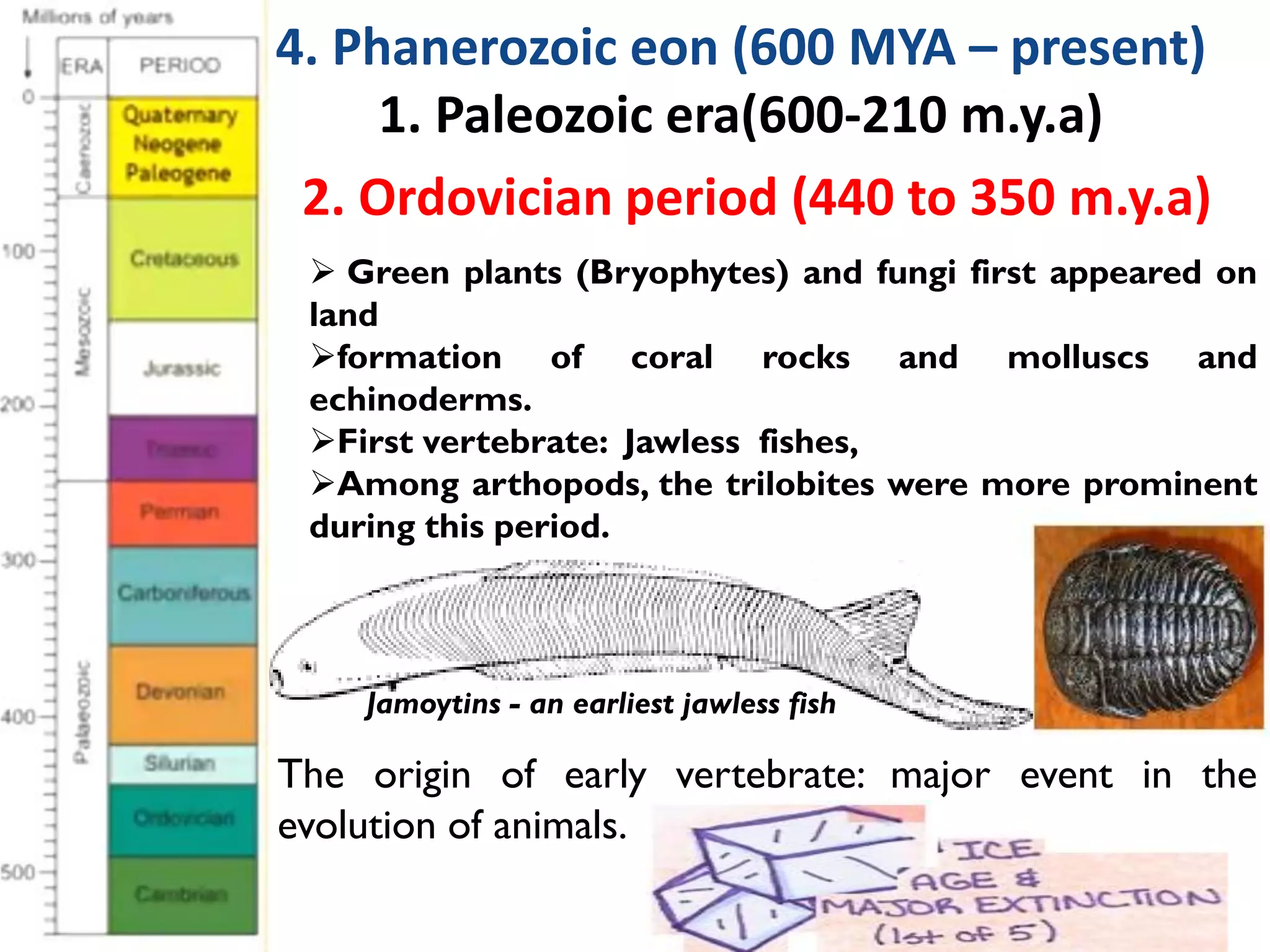
2. Ordovician period (440 to 350 m.y.a)
Jamoytins - an earliest jawless fish
 Green plants (Bryophytes) and fungi first appeared on
land
formation of coral rocks and molluscs and
echinoderms.
First vertebrate: Jawless fishes,
Among arthopods, the trilobites were more prominent
during this period.
The origin of early vertebrate: major event in the
evolution of animals.
4. Phanerozoic eon (600 MYA – present)
1. Paleozoic era(600-210 m.y.a)
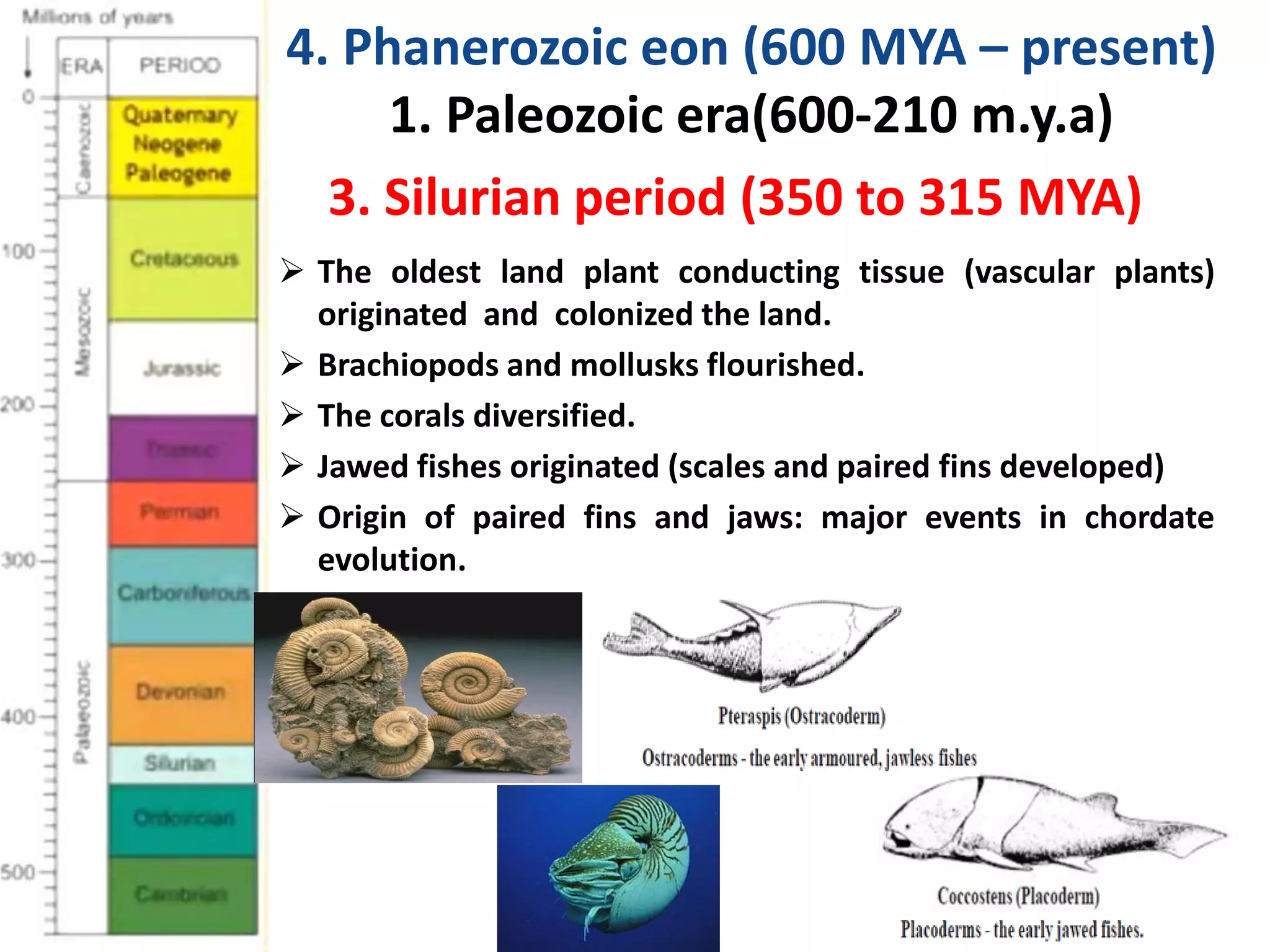
 The oldest land plant conducting tissue (vascular plants)
originated and colonized the land.
 Brachiopods and mollusks flourished.
 The corals diversified.
 Jawed fishes originated (scales and paired fins developed)
 Origin of paired fins and jaws: major events in chordate
evolution.
4. Phanerozoic eon (600 MYA – present)
1. Paleozoic era(600-210 m.y.a)
3. Silurian period (350 to 315 MYA)
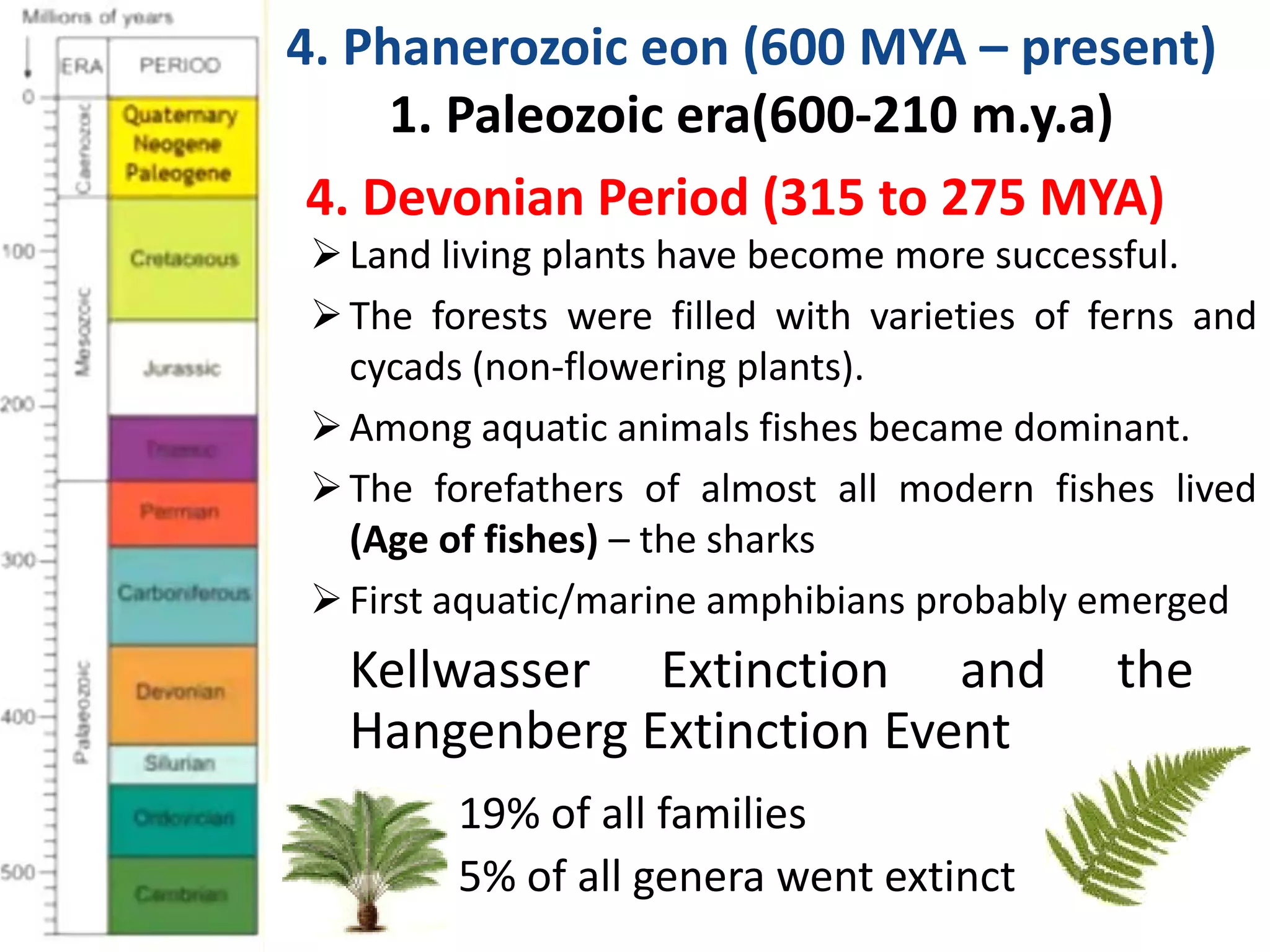
Land living plants have become more successful.
The forests were filled with varieties of ferns and
cycads (non-flowering plants).
Among aquatic animals fishes became dominant.
The forefathers of almost all modern fishes lived
(Age of fishes) – the sharks
First aquatic/marine amphibians probably emerged
4. Phanerozoic eon (600 MYA – present)
1. Paleozoic era(600-210 m.y.a)
4. Devonian Period (315 to 275 MYA)
Kellwasser Extinction and the
Hangenberg Extinction Event
19% of all families
5% of all genera went extinct
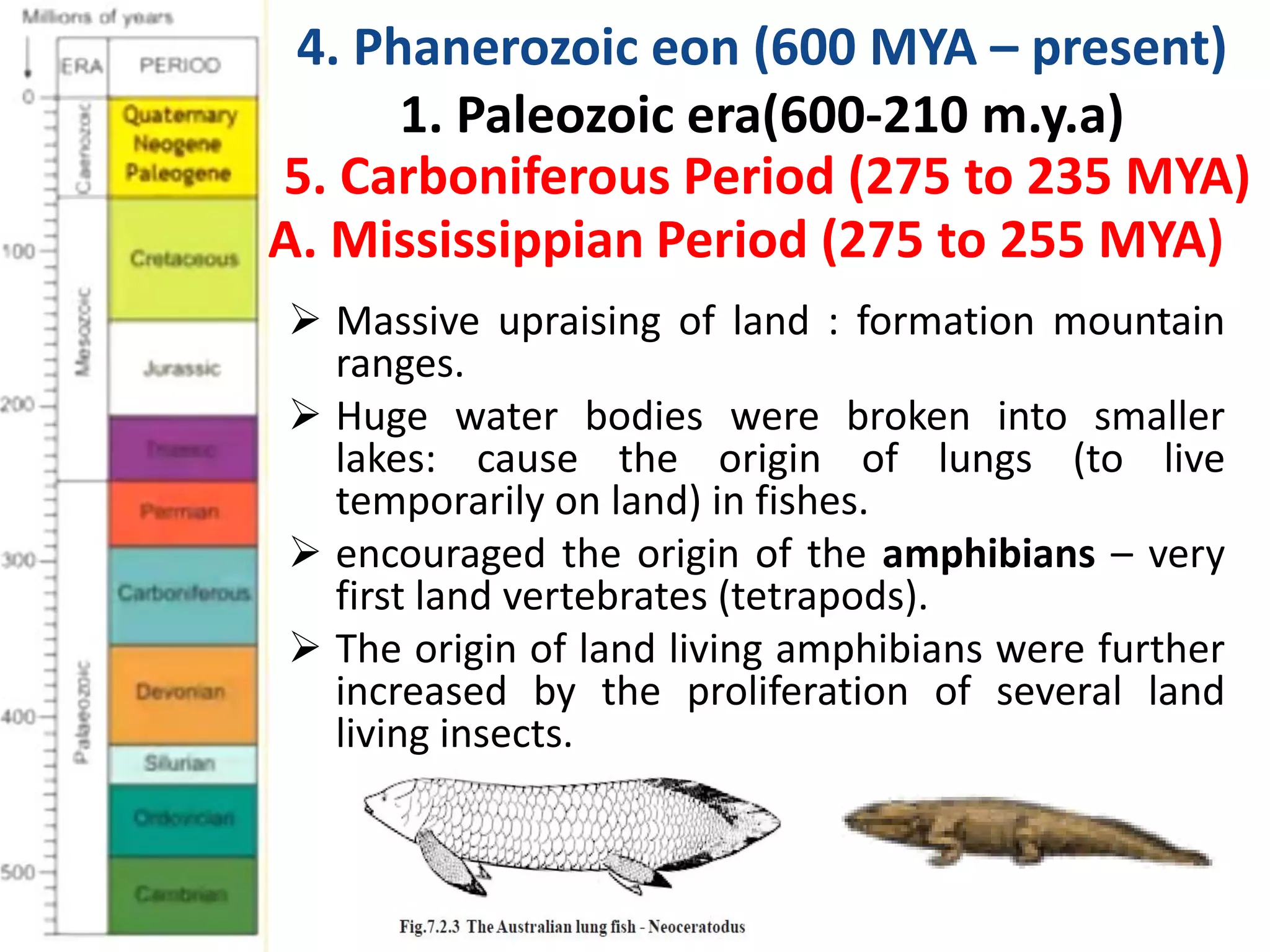
 Massive upraising of land : formation mountain
ranges.
 Huge water bodies were broken into smaller
lakes: cause the origin of lungs (to live
temporarily on land) in fishes.
 encouraged the origin of the amphibians – very
first land vertebrates (tetrapods).
 The origin of land living amphibians were further
increased by the proliferation of several land
living insects.
4. Phanerozoic eon (600 MYA – present)
1. Paleozoic era(600-210 m.y.a)
5. Carboniferous Period (275 to 235 MYA)
A. Mississippian Period (275 to 255 MYA)
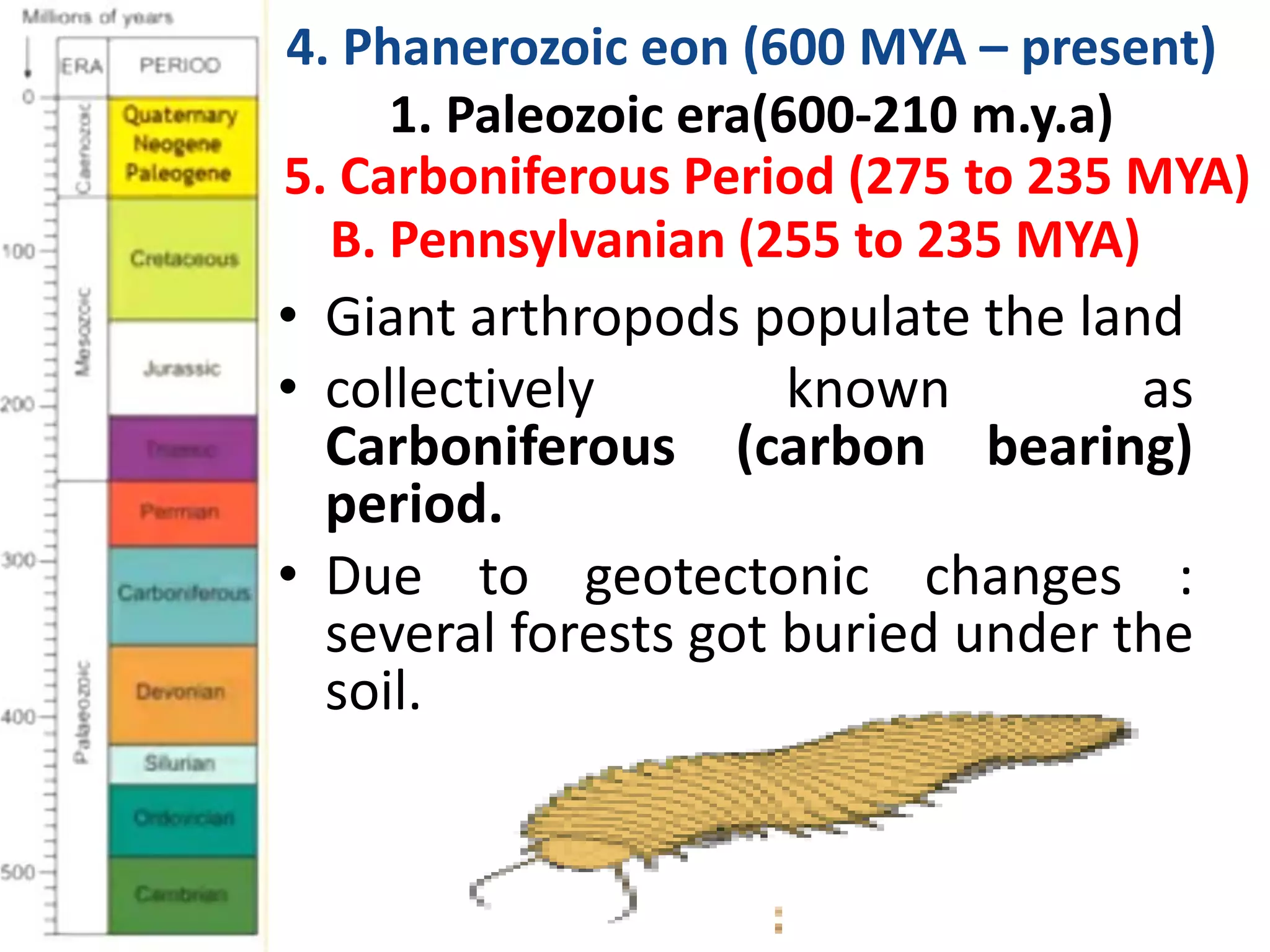
• Giant arthropods populate the land
• collectively known as
Carboniferous (carbon bearing)
period.
• Due to geotectonic changes :
several forests got buried under the
soil.
4. Phanerozoic eon (600 MYA – present)
1. Paleozoic era(600-210 m.y.a)
5. Carboniferous Period (275 to 235 MYA)
B. Pennsylvanian (255 to 235 MYA)
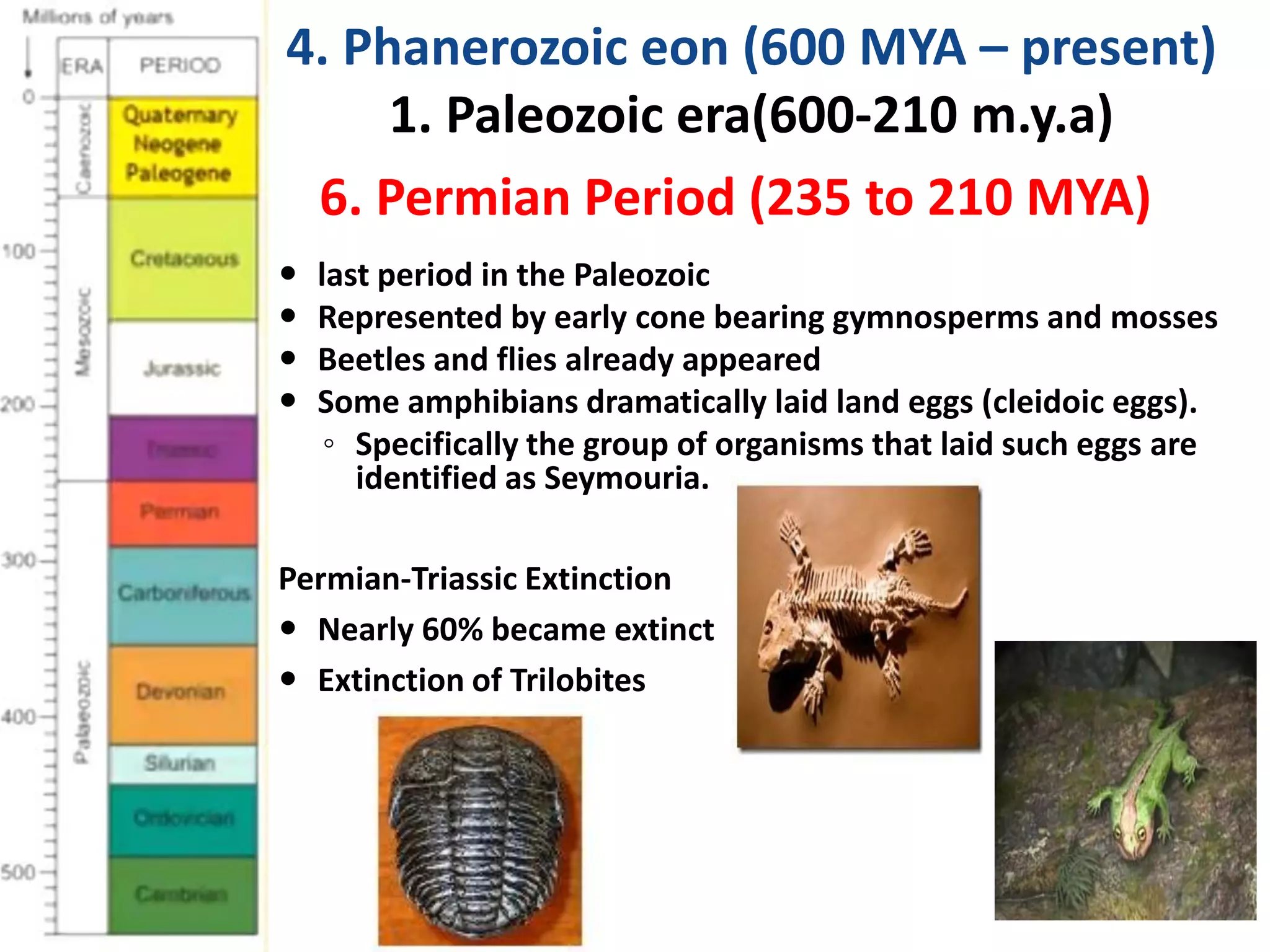
 last period in the Paleozoic
 Represented by early cone bearing gymnosperms and mosses
 Beetles and flies already appeared
 Some amphibians dramatically laid land eggs (cleidoic eggs).
◦ Specifically the group of organisms that laid such eggs are
identified as Seymouria.
6. Permian Period (235 to 210 MYA)
4. Phanerozoic eon (600 MYA – present)
1. Paleozoic era(600-210 m.y.a)
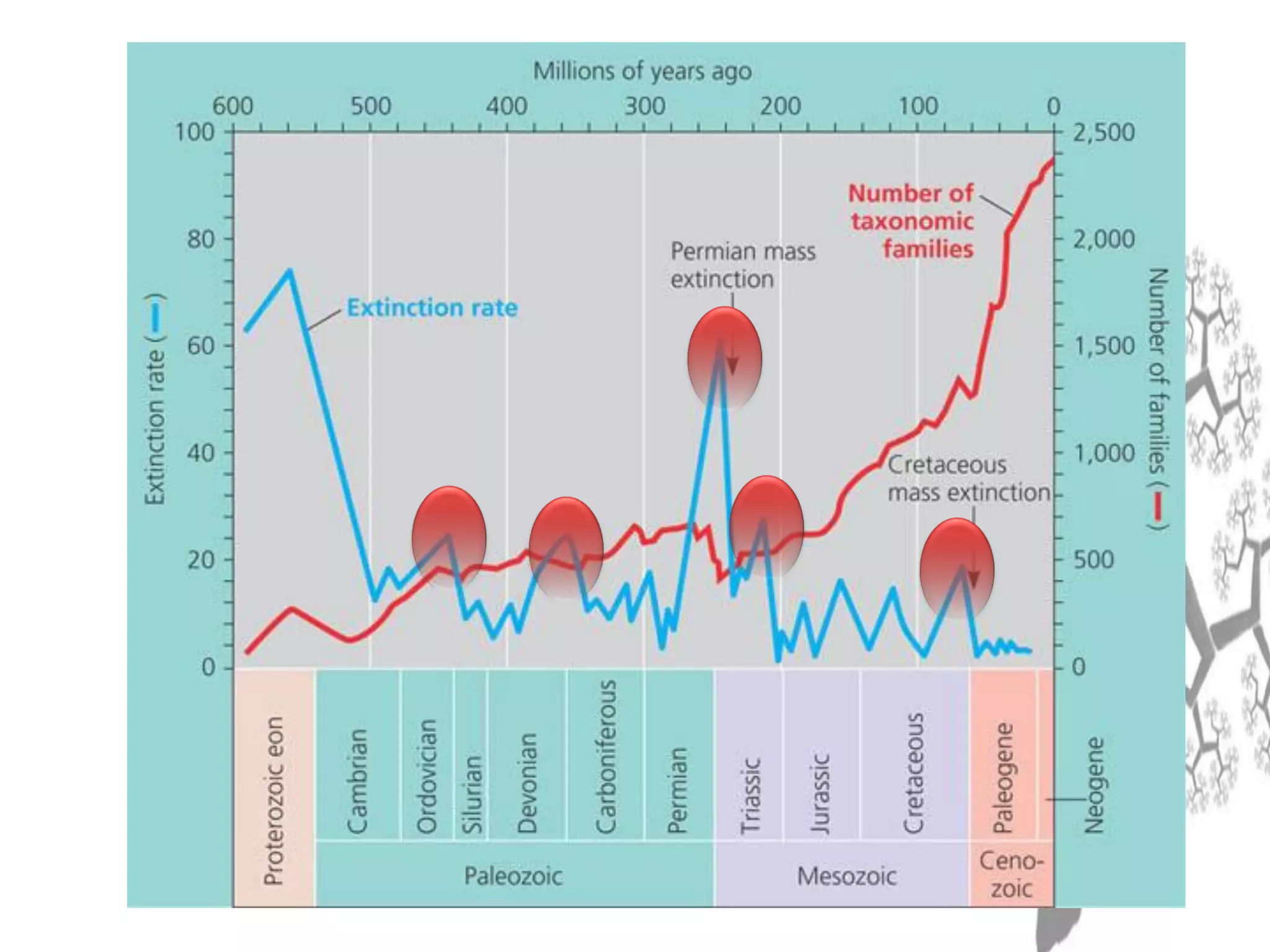
Permian-Triassic Extinction
 Nearly 60% became extinct
 Extinction of Trilobites
4. Phanerozoic eon (600 MYA – present)
2. Mesozoic era (210-65 m.y.a)
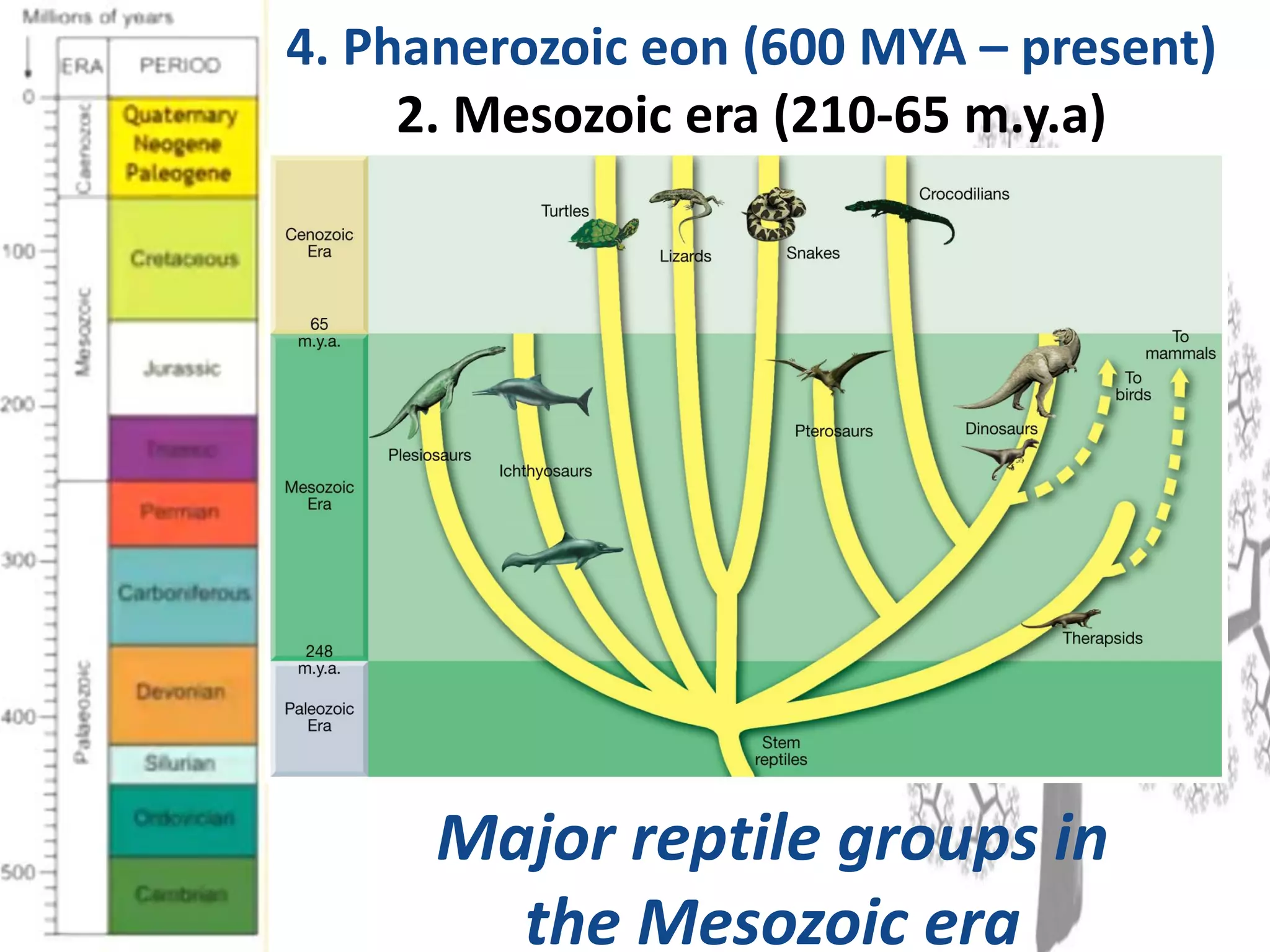
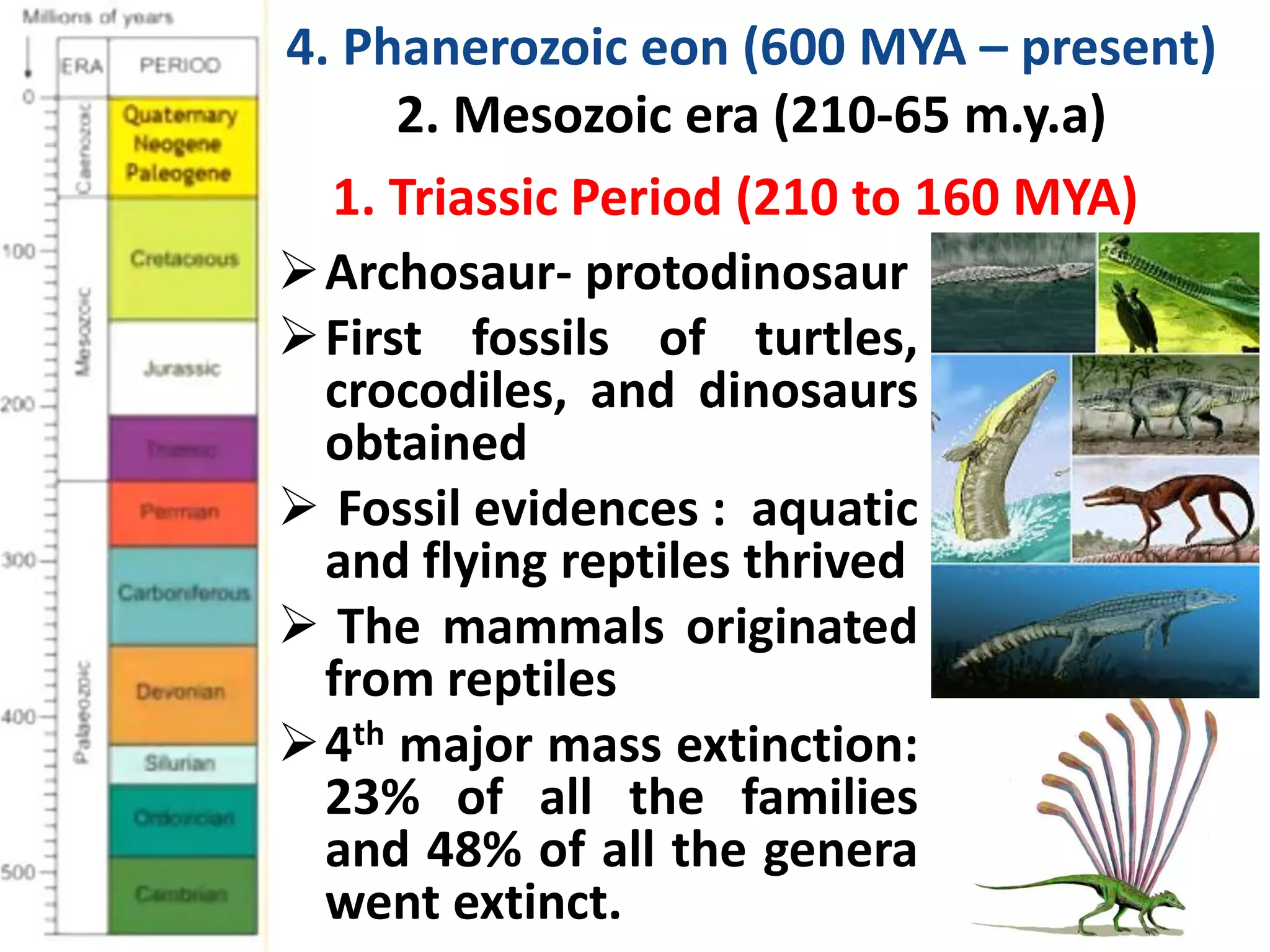
Major reptile groups in
the Mesozoic era
Archosaur- protodinosaur
First fossils of turtles,
crocodiles, and dinosaurs
obtained
 Fossil evidences : aquatic
and flying reptiles thrived
 The mammals originated
from reptiles
4th major mass extinction:
23% of all the families
and 48% of all the genera
went extinct.
1. Triassic Period (210 to 160 MYA)
4. Phanerozoic eon (600 MYA – present)
2. Mesozoic era (210-65 m.y.a)
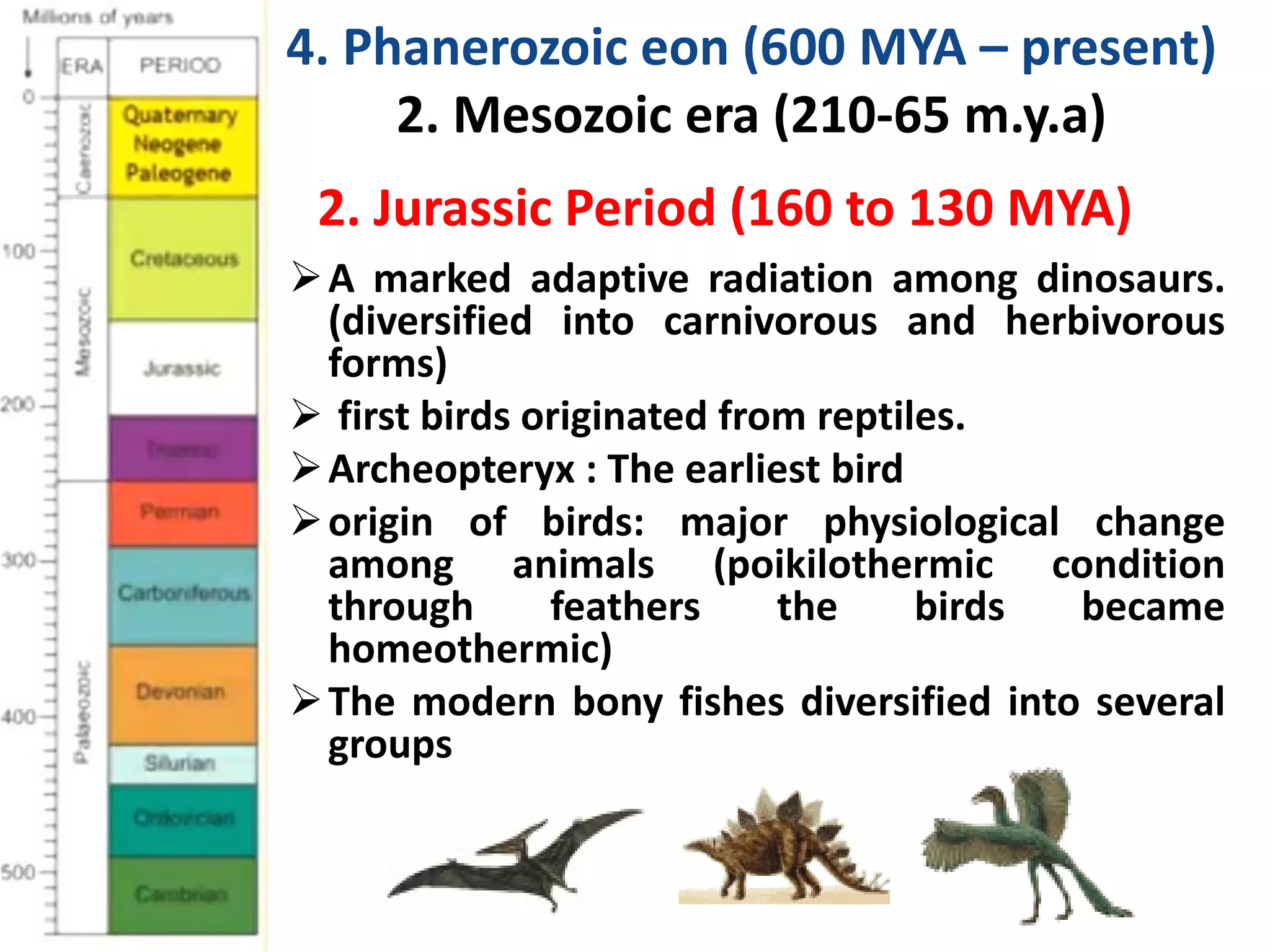
A marked adaptive radiation among dinosaurs.
(diversified into carnivorous and herbivorous
forms)
 first birds originated from reptiles.
Archeopteryx : The earliest bird
origin of birds: major physiological change
among animals (poikilothermic condition
through feathers the birds became
homeothermic)
The modern bony fishes diversified into several
groups
2. Jurassic Period (160 to 130 MYA)
4. Phanerozoic eon (600 MYA – present)
2. Mesozoic era (210-65 m.y.a)
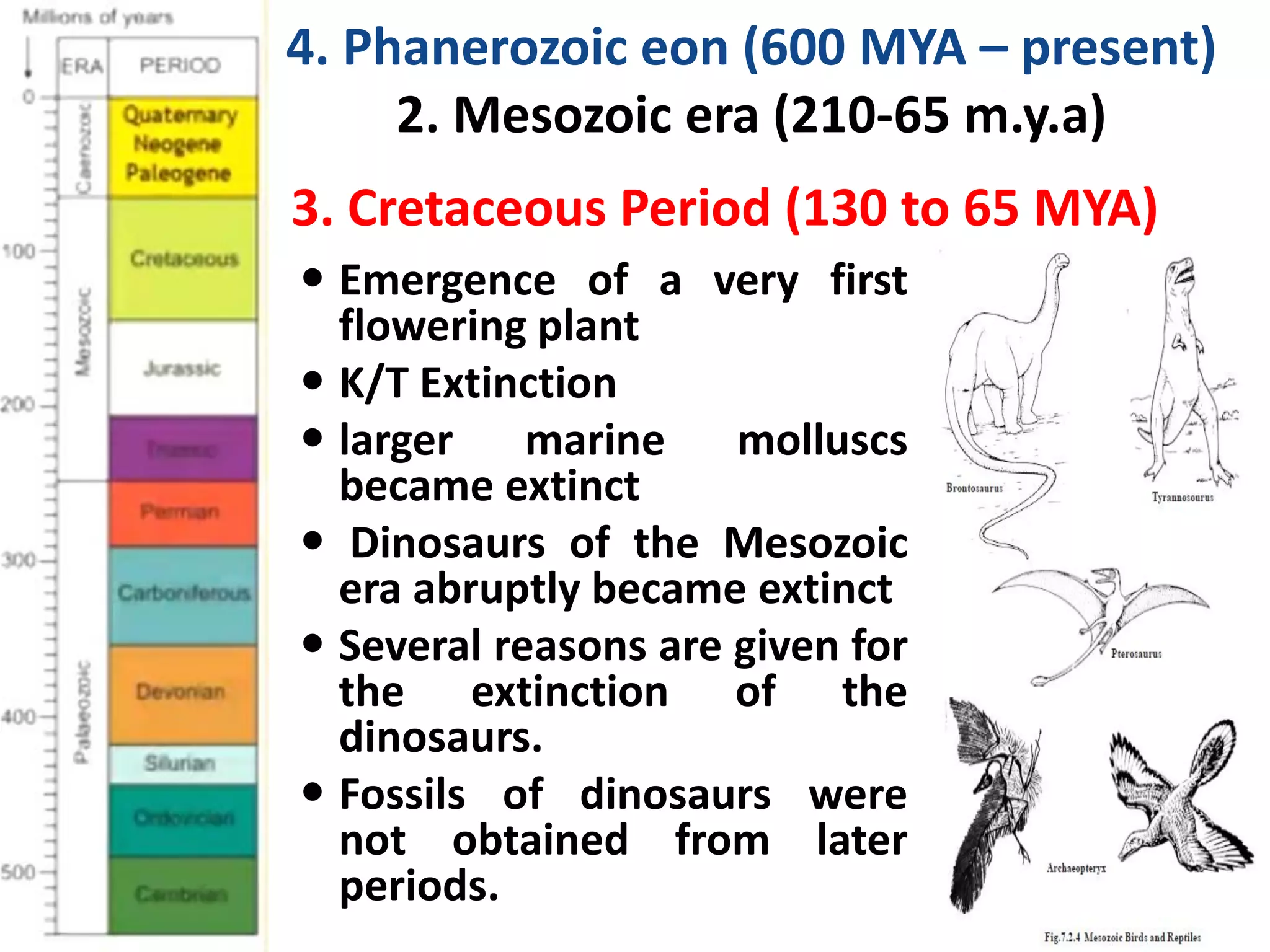
 Emergence of a very first
flowering plant
 K/T Extinction
 larger marine molluscs
became extinct
 Dinosaurs of the Mesozoic
era abruptly became extinct
 Several reasons are given for
the extinction of the
dinosaurs.
 Fossils of dinosaurs were
not obtained from later
periods.
3. Cretaceous Period (130 to 65 MYA)
4. Phanerozoic eon (600 MYA – present)
2. Mesozoic era (210-65 m.y.a)
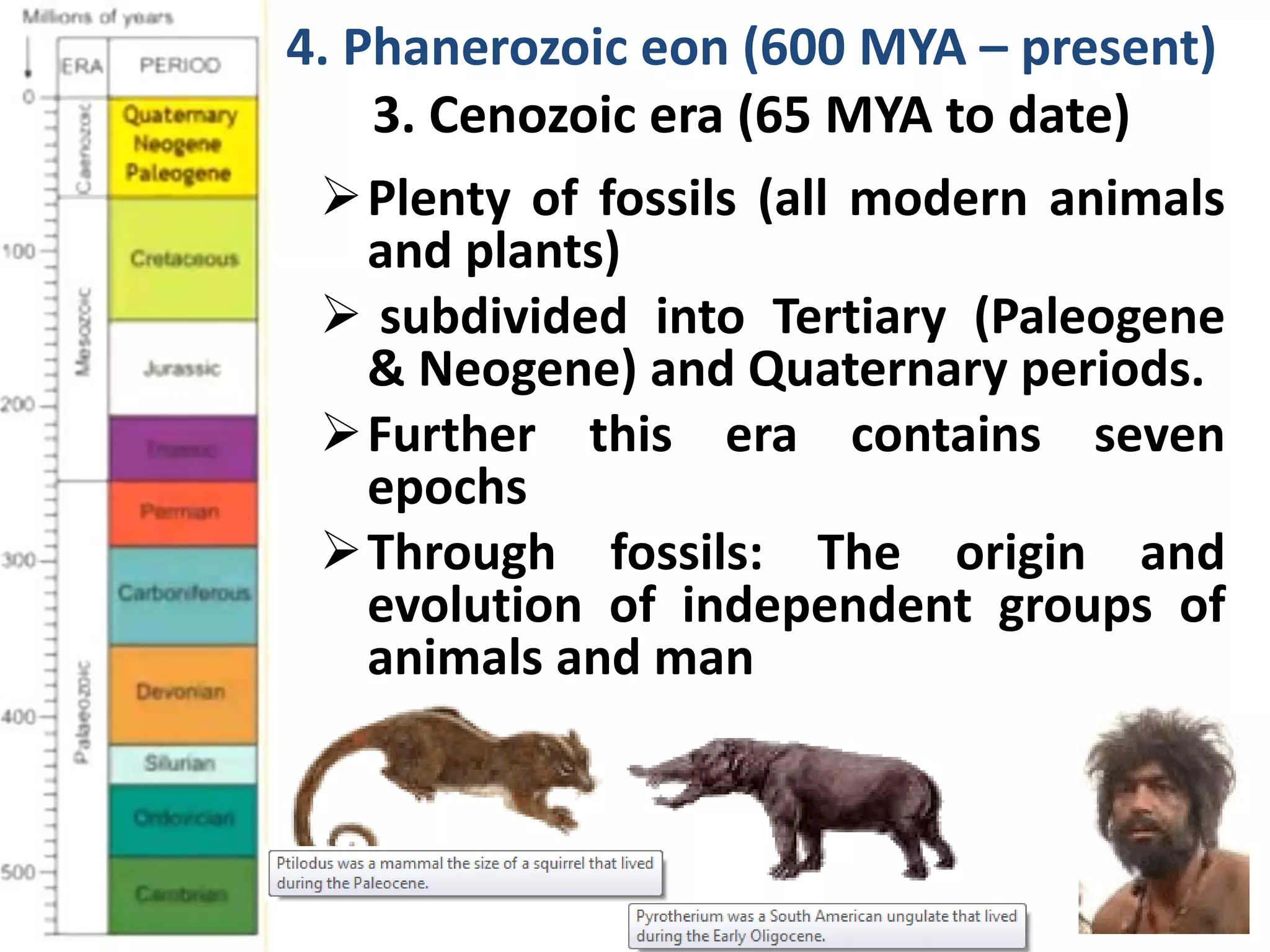
Plenty of fossils (all modern animals
and plants)
 subdivided into Tertiary (Paleogene
& Neogene) and Quaternary periods.
Further this era contains seven
epochs
Through fossils: The origin and
evolution of independent groups of
animals and man
4. Phanerozoic eon (600 MYA – present)
3. Cenozoic era (65 MYA to date)
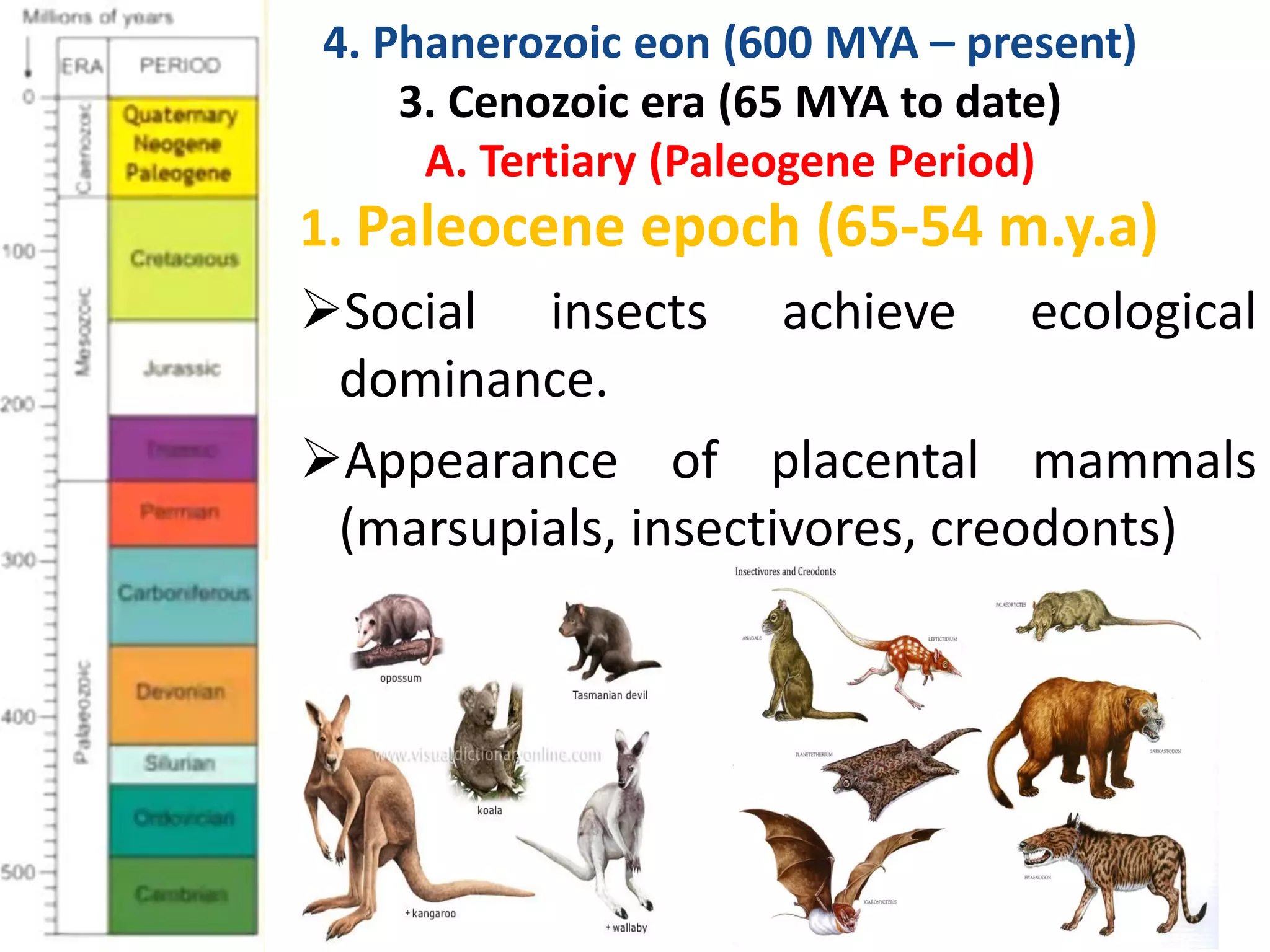
1. Paleocene epoch (65-54 m.y.a)
Social insects achieve ecological
dominance.
Appearance of placental mammals
(marsupials, insectivores, creodonts)
4. Phanerozoic eon (600 MYA – present)
3. Cenozoic era (65 MYA to date)
A. Tertiary (Paleogene Period)
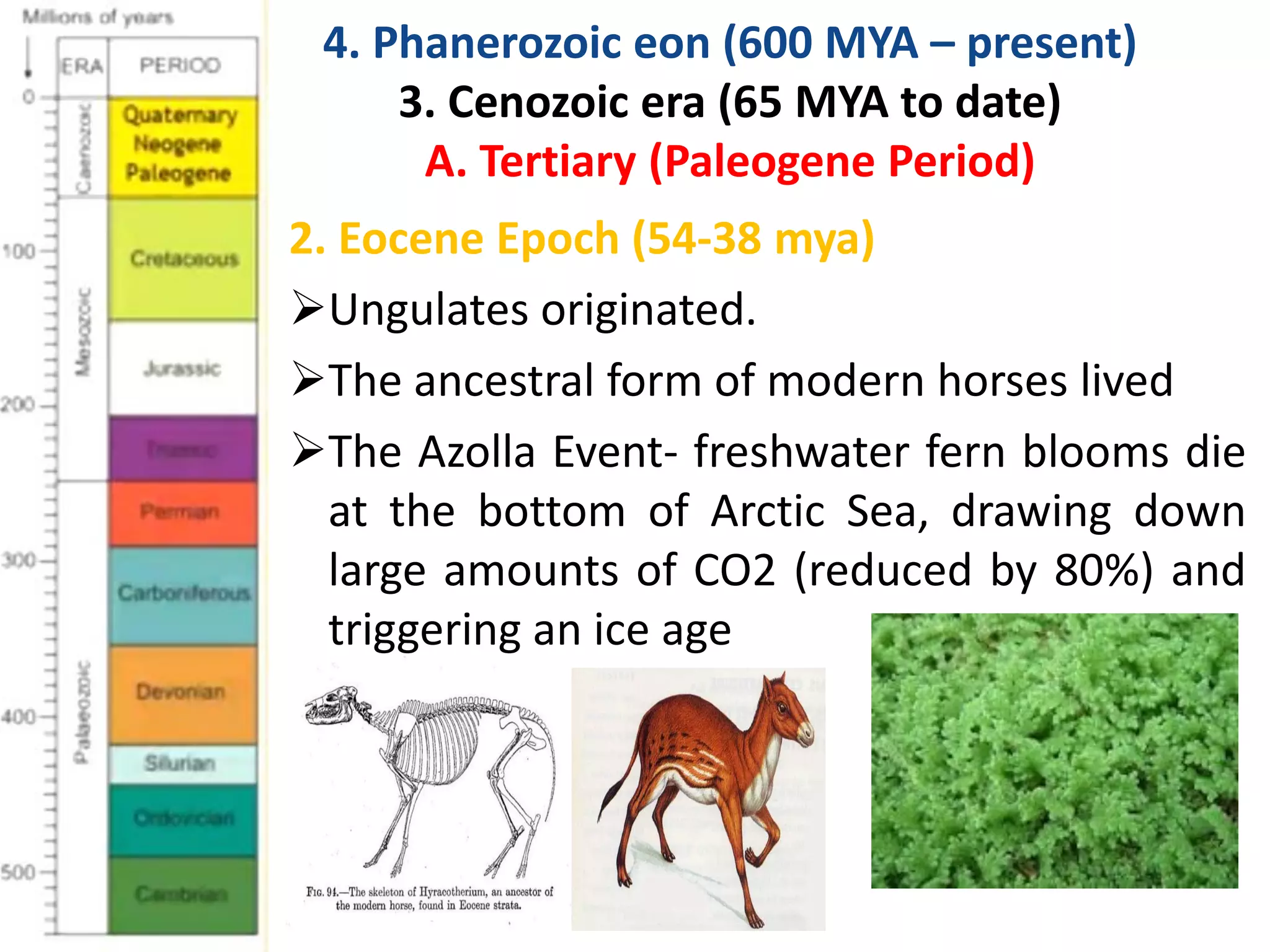
2. Eocene Epoch (54-38 mya)
Ungulates originated.
The ancestral form of modern horses lived
The Azolla Event- freshwater fern blooms die
at the bottom of Arctic Sea, drawing down
large amounts of CO2 (reduced by 80%) and
triggering an ice age
4. Phanerozoic eon (600 MYA – present)
3. Cenozoic era (65 MYA to date)
A. Tertiary (Paleogene Period)
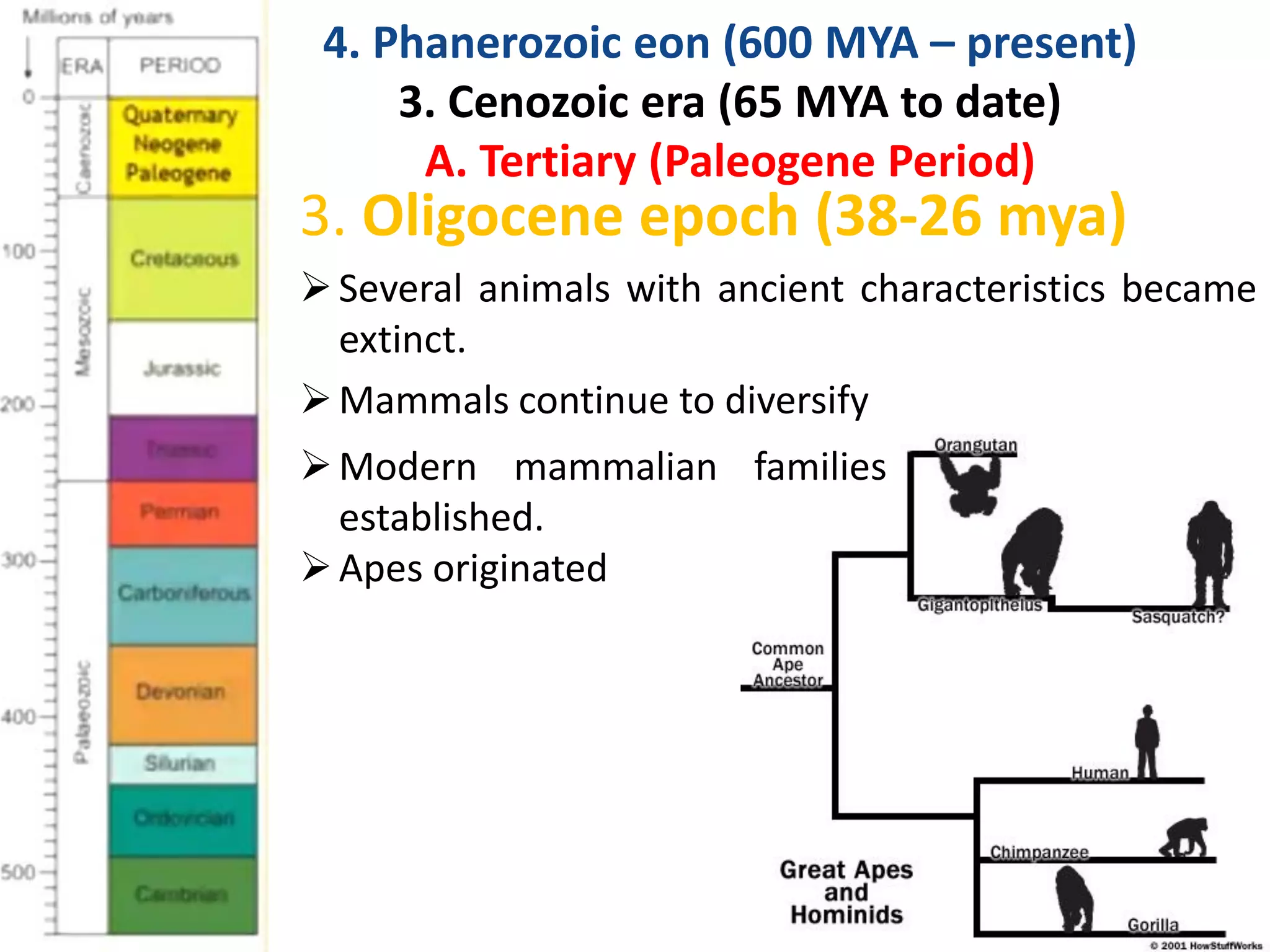
3. Oligocene epoch (38-26 mya)
Several animals with ancient characteristics became
extinct.
Mammals continue to diversify
4. Phanerozoic eon (600 MYA – present)
3. Cenozoic era (65 MYA to date)
A. Tertiary (Paleogene Period)
Modern mammalian families
established.
Apes originated
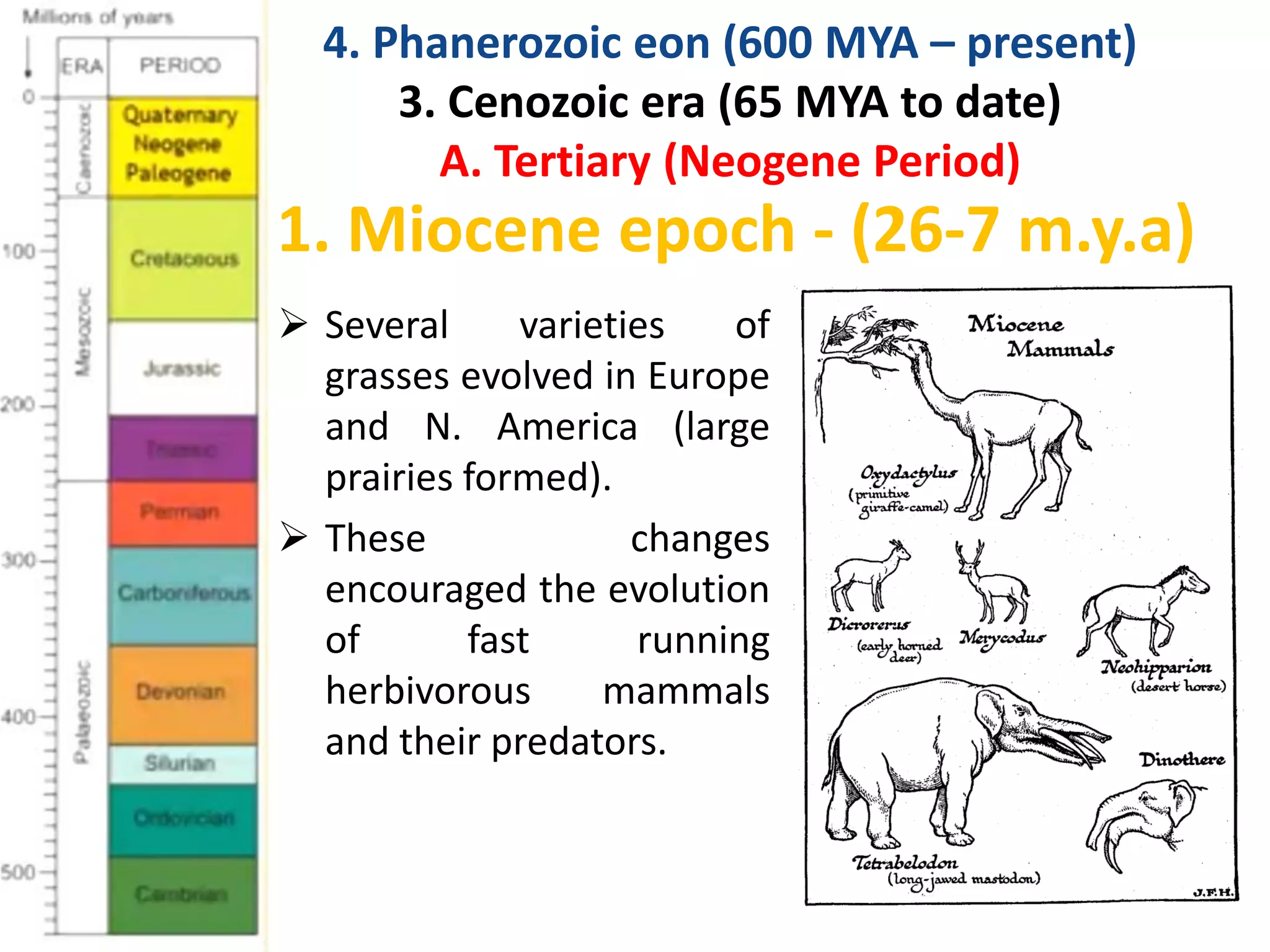
1. Miocene epoch - (26-7 m.y.a)
 Several varieties of
grasses evolved in Europe
and N. America (large
prairies formed).
 These changes
encouraged the evolution
of fast running
herbivorous mammals
and their predators.
4. Phanerozoic eon (600 MYA – present)
3. Cenozoic era (65 MYA to date)
A. Tertiary (Neogene Period)
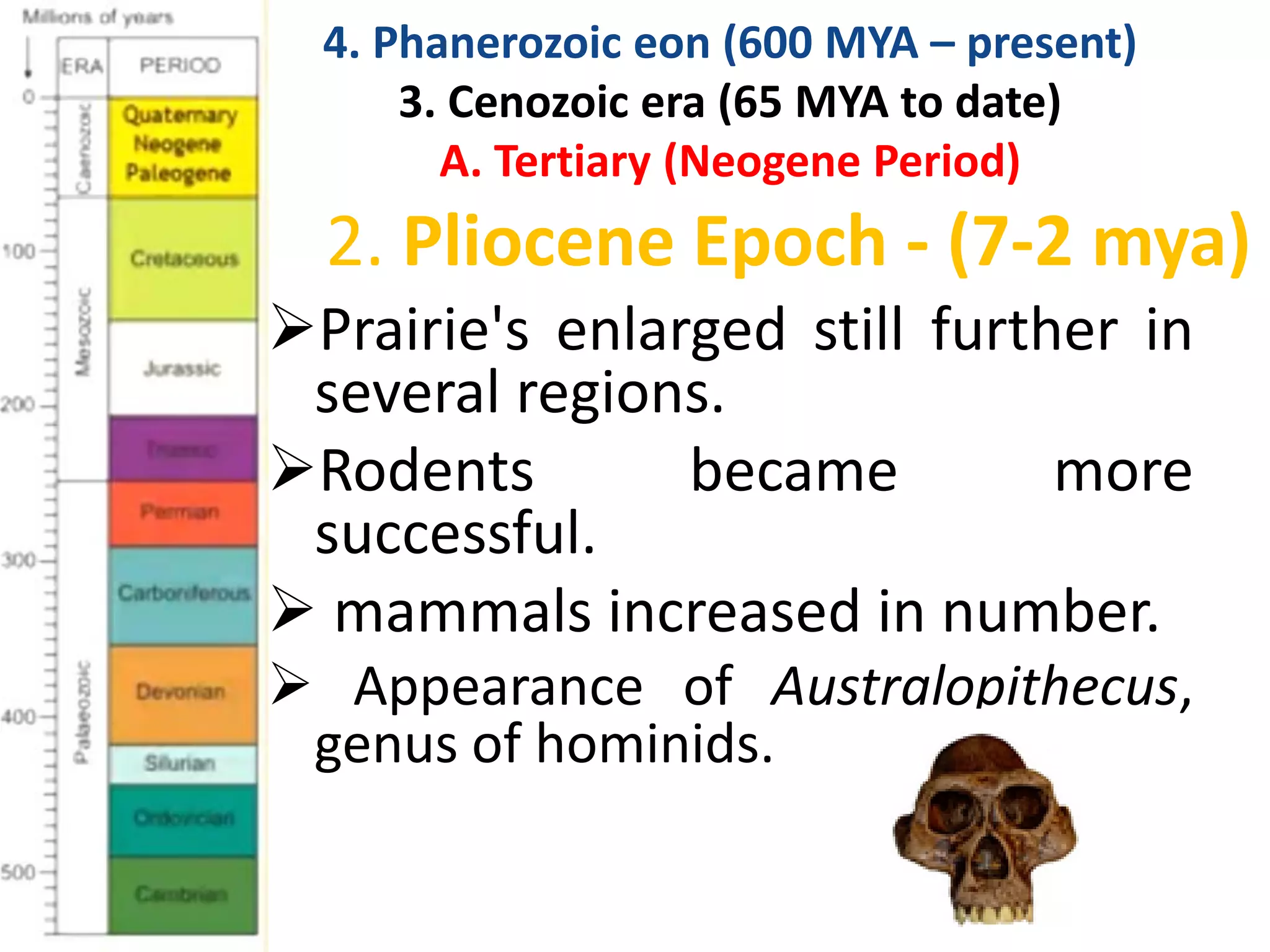
2. Pliocene Epoch - (7-2 mya)
Prairie's enlarged still further in
several regions.
Rodents became more
successful.
 mammals increased in number.
 Appearance of Australopithecus,
genus of hominids.
4. Phanerozoic eon (600 MYA – present)
3. Cenozoic era (65 MYA to date)
A. Tertiary (Neogene Period)
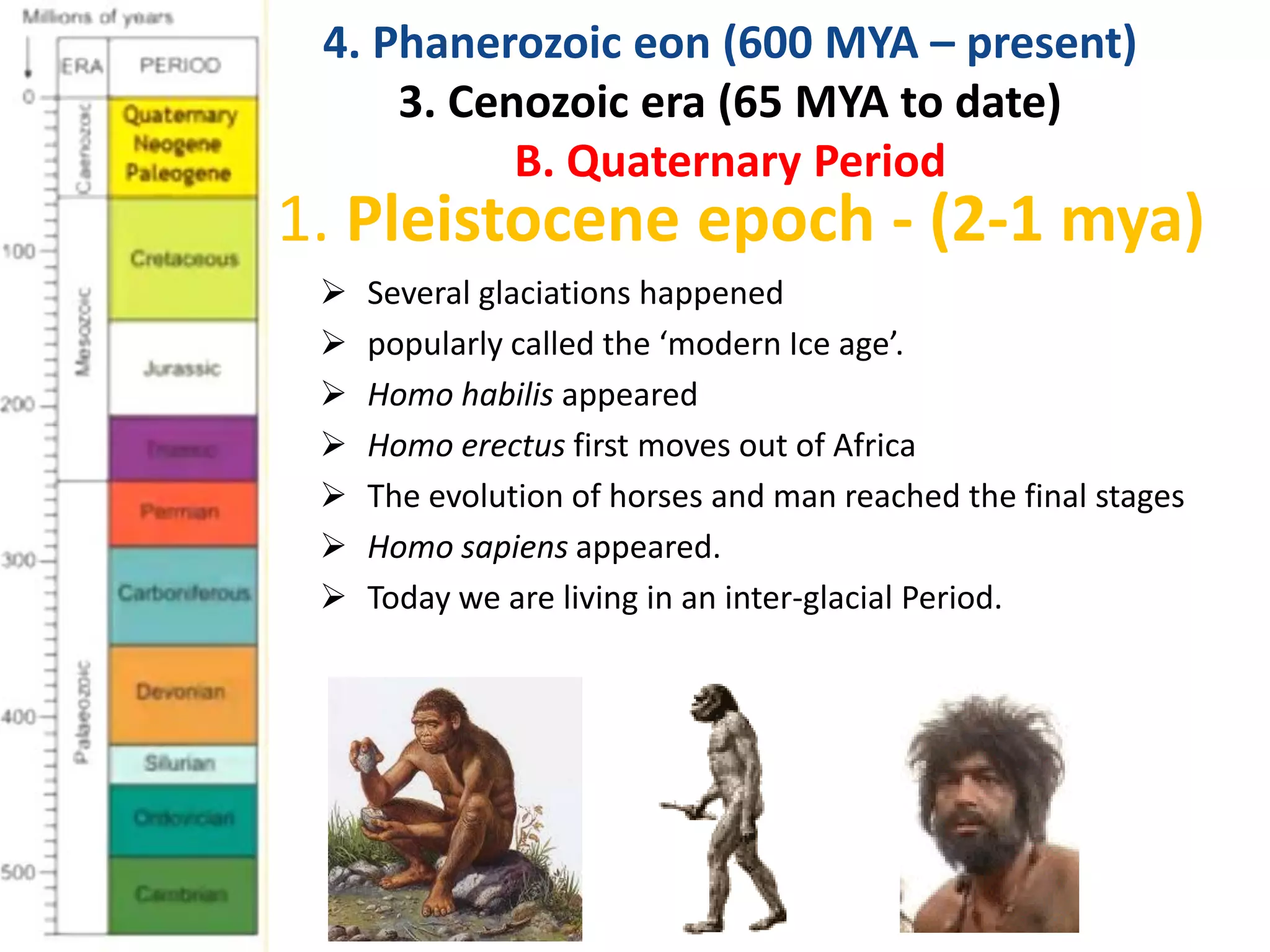
1. Pleistocene epoch - (2-1 mya)
 Several glaciations happened
 popularly called the ‘modern Ice age’.
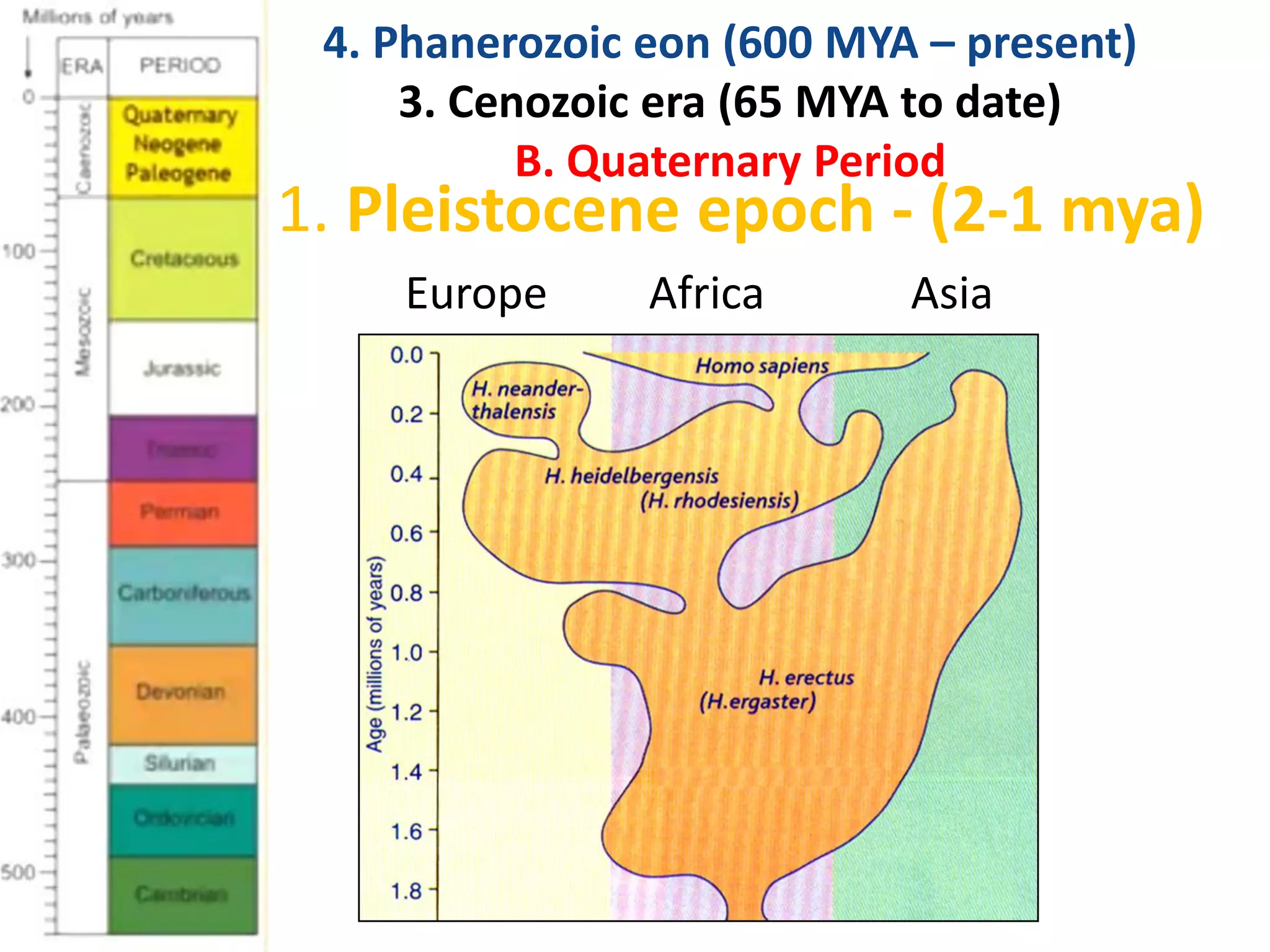
 Homo habilis appeared
 Homo erectus first moves out of Africa
 The evolution of horses and man reached the final stages
 Homo sapiens appeared.
 Today we are living in an inter-glacial Period.
4. Phanerozoic eon (600 MYA – present)
3. Cenozoic era (65 MYA to date)
B. Quaternary Period
Europe Africa Asia
1. Pleistocene epoch - (2-1 mya)
4. Phanerozoic eon (600 MYA – present)
3. Cenozoic era (65 MYA to date)
B. Quaternary Period
1. Holocene epoch : (1 mya-present)
THE MODERN WORLD
4. Phanerozoic eon (600 MYA – present)
3. Cenozoic era (65 MYA to date)
B. Quaternary Period
- Development of agriculture.
- Domestication of animals.
- 250 yrs ago: Start of the Industrial Revolution
- 50 yrs ago: Space travel
Humans walk on the surface of the moon (1969).
- Animal cloning (Dolly the sheep)
- Animal and Plant hybridization
- Improved communication
- Health care development
- Biotechnology
Extinction
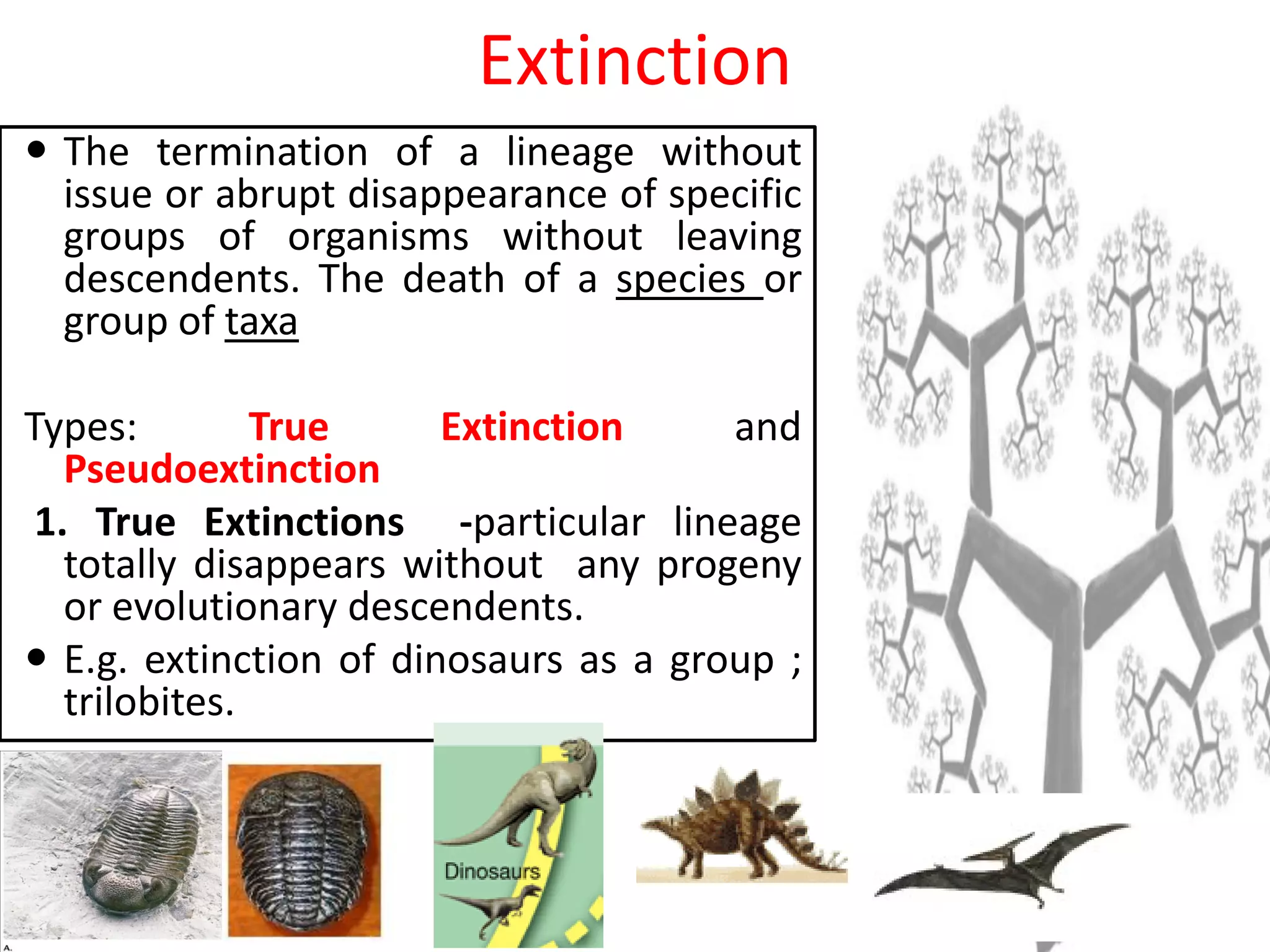
 The termination of a lineage without
issue or abrupt disappearance of specific
groups of organisms without leaving
descendents. The death of a species or
group of taxa
Types: True Extinction and
Pseudoextinction
1. True Extinctions -particular lineage
totally disappears without any progeny
or evolutionary descendents.
 E.g. extinction of dinosaurs as a group ;
trilobites.
Extinction
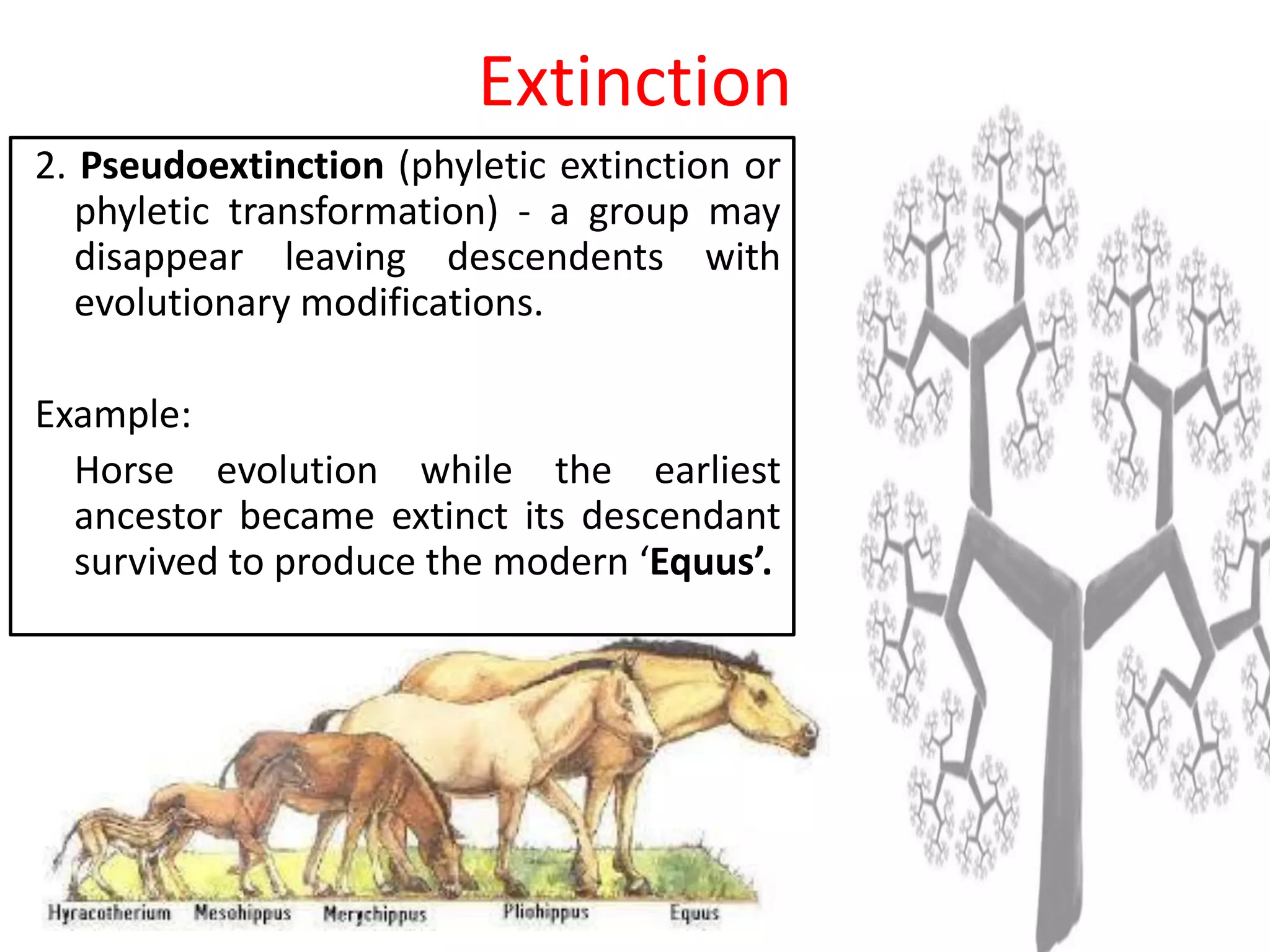
2. Pseudoextinction (phyletic extinction or
phyletic transformation) - a group may
disappear leaving descendents with
evolutionary modifications.
Example:
Horse evolution while the earliest
ancestor became extinct its descendant
survived to produce the modern ‘Equus’.
Pattern of extinction
Major groups of herbivorous
vertebrates are more susceptible than
the carnivorous vertebrates
Larger organisms easily became
extinct.
VanValen (1973) recorded a constancy
in the rate of extinction in a number of
groups.
Explained using ‘Mac Arthor’s law’ -
“every new adaptation encourages the
survival of a possessor it also decreases a
fitness of other species of that area”.
Causes of extinction
(1) A mass extinction: due to drastic
changes in the environmental
conditions.
(2) Any adaptive advance in one
species decreases the fitness of all
other species.
 Red Queen’s hypothesis : you have
to keep running pretty fast, just in
order to stay in the same place.
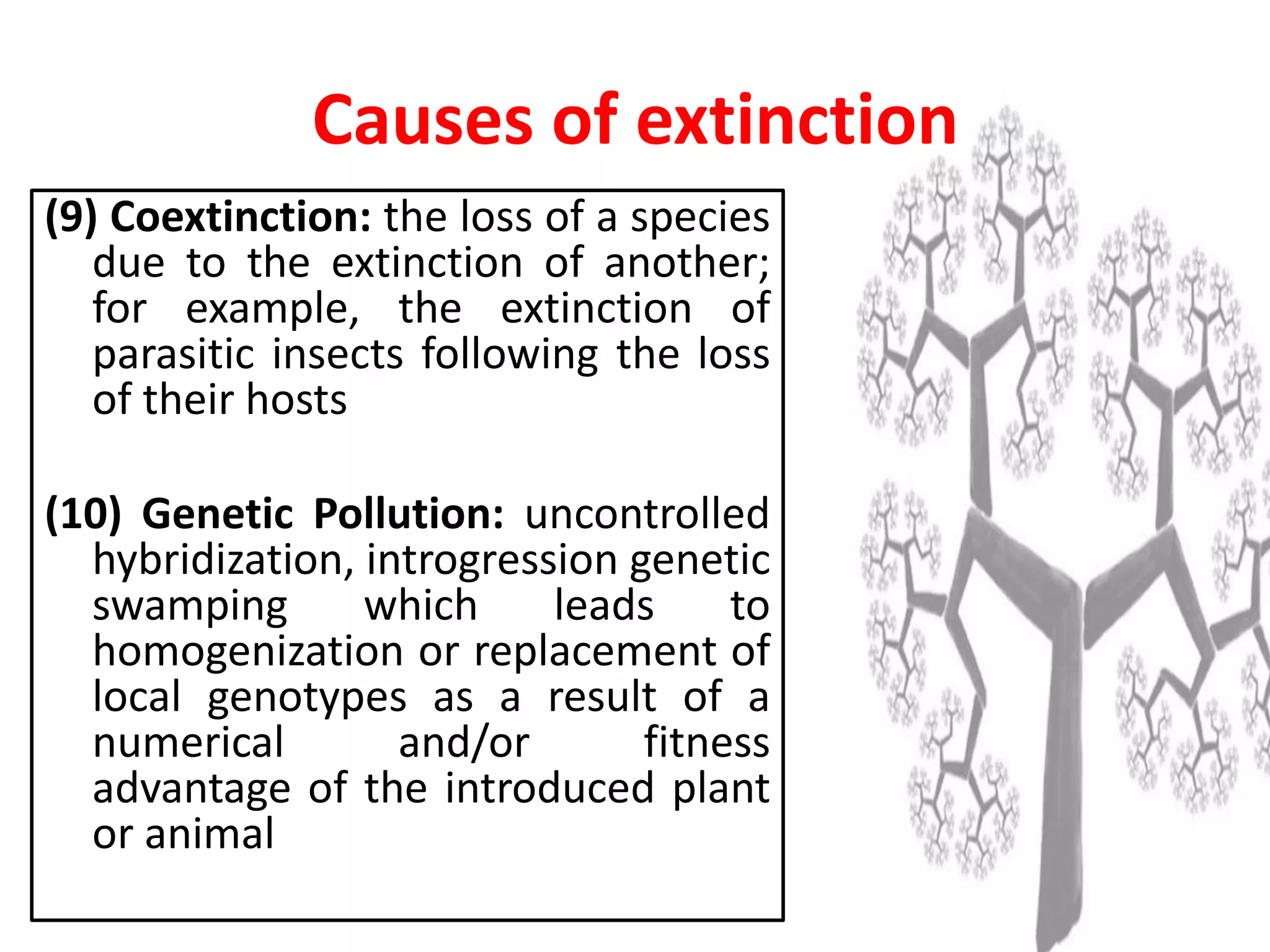
(3) Over specialization to a specific
situation may cause extinction
(ex. Antlers)
(4) The spread of an epidemic
disease without any control can
cause extinction.
(5) An increase in the population
strength of herbivorous animals
cause rapid food shortage and
cause extinction for several inter-
related groups (Predation,
competition)
Causes of extinction
(6) A sudden cosmic radiation can
cause the death of large
organisms.
(7) A dust storm formed due to
falling of a meteorite is commonly
mentioned as a cause for the
disappearance of dinosaurs.
(8) Habitat degradation: The
degradation of a species' habitat
may alter the fitness landscape or
such an extent that the species is
no longer able to survive and
becomes extinct.
Causes of extinction
(9) Coextinction: the loss of a species
due to the extinction of another;
for example, the extinction of
parasitic insects following the loss
of their hosts
(10) Genetic Pollution: uncontrolled
hybridization, introgression genetic
swamping which leads to
homogenization or replacement of
local genotypes as a result of a
numerical and/or fitness
advantage of the introduced plant
or animal
Causes of extinction
In the recorded history of earth,
extinctions of major groups of
organisms were due to natural
causes.
By end of Permian period of the
Paleozoic Era, nearly 60% of the
varieties then existed, became
extinct.
Similar large scale extinctions
have been observed by the end
of Mesozoic era
Causes of extinction
At present …
 mostly due to human interference.
 The realization of such a cause lead to
starting of several international voluntary
agencies to monitor and control
extinctions.
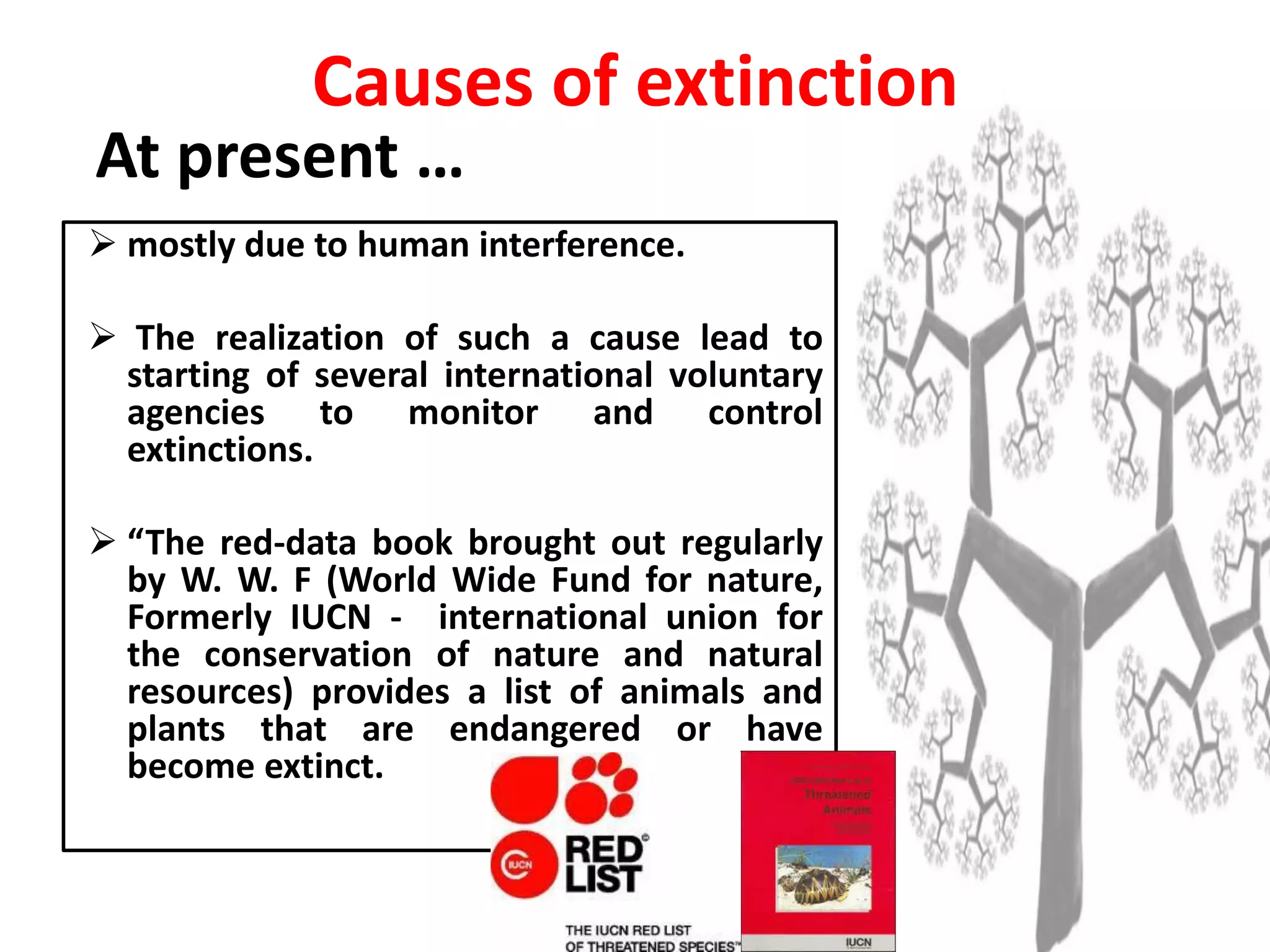
 “The red-data book brought out regularly
by W. W. F (World Wide Fund for nature,
Formerly IUCN - international union for
the conservation of nature and natural
resources) provides a list of animals and
plants that are endangered or have
become extinct.
Causes of extinction

Geologic time scale and extinction

  • 1.
    Geologic time scale –Chronology of Earth’s history – 4.7 billion history of the earth from its origin to the present – Transitions in the fossil record, found in characteristic layers of sedimentary rock – Formulated by assessing the age of rocks and rock sediments. – Correlates with evolutionary events
  • 2.
    Geologic time scale Based on geologic events  the ancient period from earth’s history is formulated into eons-eras-periods-epochs.  Each division in the geological calendar is clearly identified and described.  Incidents pertaining to earth surface, plant and animal life are neatly recorded.  The influence of geological and climatic changes on the life and the evolution of the living organism had been well analyzed.  Earth is 4.7 billion (4,700 million) years old.
  • 3.
    Geologic time (4.7billion/4,700 million)  Divides geologic history into units  Originally created using relative dates and more recently, radioactive dating.  The influence of geological and climatic changes on the life and the evolution of the living organism Divisions: four-level hierarchy of time intervals • EONS First and largest division of geologic time Greatest expanse of time Four eons • Phanerozoic ("visible life") –most recent eon • Proterozoic • Archean • Hadean – the oldest eon • ERAS Second division of geologic time • PERIODS Third division of the geologic time. Named for either location or characteristics of the defining rock formations • EPOCHS Fourth division of geologic time Represents the subdivisions of a period
  • 4.
  • 5.
    PRECAMBRIAN SUPER EON 1.HADEAN EON (PRE-ARCHEAN EON) 4.6 to 3.8 billion years ago ~4.6 BYA -- Formation of Earth and Moon (as indicated by dating of meteorites and rocks from the Moon) ~4 BYA -- Likely origin of life -- indirect photosynthetic evidence of primordial life -- evidence of materials created by organic decay This is the "hidden" portion of geologic time as there is little evidence of this time remaining in Earth's rocks.
  • 6.
    PRECAMBRIAN SUPER EON 2.ARCHEAN EON - 3.8 to 2.5 billion years ago The eon of first life ~3.8 BYA -- Oldest known rocks ~3.5 BYA -- Oldest known fossils (single celled organisms resembling bacteria) -- Prokaryotes were the Earth’s sole inhabitants -- Evidence of stromatolites- created by colonial cyanobacteria -- Earliest types of photosynthesis did not produce oxygen -- Oxygenic photosynthesis probably evolved in cyanobacteria
  • 7.
    PRECAMBRIAN SUPER EON 3.PROTEROZOIC EON - 2.5 Billion to 570 Million years ago The eon of the first multi-celled life -Emergence of protists, green algae and ediacaran biota -Evidence of oxygen producing bacteria begin to change the atmosphere -Life turned from anaerobic to aerobic -simple algae, protozoans, poriferans, annelids (End of the Pre-Cambrian -- a period at least five times longer than all the geologic time that follows.)
  • 8.
     produced revolutionarychanges in the biosphere.  known as the Cradle of ancient life Restricted to seas Vertebrates had not yet evolved Life consisted of several invertebrate groups Trilobites Brachiopods Cephalopods 4. Phanerozoic eon (600 MYA – present) 1. Paleozoic era(600-210 m.y.a)
  • 9.
    4. Phanerozoic eon(600 MYA – present) 1. Paleozoic era(600-210 m.y.a) Cambrian Explosion: age of marine inverts Cambrian: among plants thallophytes were well established. They diversified into various groups (Chlorophyceae, Rhodophyceae etc.,). Among animals the aquatic arthropods and echinoderms came to prominence. End of the Cambrian denoted by the appearance of fish. 1. Cambrian period (600 to 440 m.y.a)
  • 10.
    2. Ordovician period(440 to 350 m.y.a) Jamoytins - an earliest jawless fish  Green plants (Bryophytes) and fungi first appeared on land formation of coral rocks and molluscs and echinoderms. First vertebrate: Jawless fishes, Among arthopods, the trilobites were more prominent during this period. The origin of early vertebrate: major event in the evolution of animals. 4. Phanerozoic eon (600 MYA – present) 1. Paleozoic era(600-210 m.y.a)
  • 11.
     The oldestland plant conducting tissue (vascular plants) originated and colonized the land.  Brachiopods and mollusks flourished.  The corals diversified.  Jawed fishes originated (scales and paired fins developed)  Origin of paired fins and jaws: major events in chordate evolution. 4. Phanerozoic eon (600 MYA – present) 1. Paleozoic era(600-210 m.y.a) 3. Silurian period (350 to 315 MYA)
  • 12.
    Land living plantshave become more successful. The forests were filled with varieties of ferns and cycads (non-flowering plants). Among aquatic animals fishes became dominant. The forefathers of almost all modern fishes lived (Age of fishes) – the sharks First aquatic/marine amphibians probably emerged 4. Phanerozoic eon (600 MYA – present) 1. Paleozoic era(600-210 m.y.a) 4. Devonian Period (315 to 275 MYA) Kellwasser Extinction and the Hangenberg Extinction Event 19% of all families 5% of all genera went extinct
  • 13.
     Massive upraisingof land : formation mountain ranges.  Huge water bodies were broken into smaller lakes: cause the origin of lungs (to live temporarily on land) in fishes.  encouraged the origin of the amphibians – very first land vertebrates (tetrapods).  The origin of land living amphibians were further increased by the proliferation of several land living insects. 4. Phanerozoic eon (600 MYA – present) 1. Paleozoic era(600-210 m.y.a) 5. Carboniferous Period (275 to 235 MYA) A. Mississippian Period (275 to 255 MYA)
  • 14.
    • Giant arthropodspopulate the land • collectively known as Carboniferous (carbon bearing) period. • Due to geotectonic changes : several forests got buried under the soil. 4. Phanerozoic eon (600 MYA – present) 1. Paleozoic era(600-210 m.y.a) 5. Carboniferous Period (275 to 235 MYA) B. Pennsylvanian (255 to 235 MYA)
  • 15.
     last periodin the Paleozoic  Represented by early cone bearing gymnosperms and mosses  Beetles and flies already appeared  Some amphibians dramatically laid land eggs (cleidoic eggs). ◦ Specifically the group of organisms that laid such eggs are identified as Seymouria. 6. Permian Period (235 to 210 MYA) 4. Phanerozoic eon (600 MYA – present) 1. Paleozoic era(600-210 m.y.a) Permian-Triassic Extinction  Nearly 60% became extinct  Extinction of Trilobites
  • 16.
    4. Phanerozoic eon(600 MYA – present) 2. Mesozoic era (210-65 m.y.a) Major reptile groups in the Mesozoic era
  • 17.
    Archosaur- protodinosaur First fossilsof turtles, crocodiles, and dinosaurs obtained  Fossil evidences : aquatic and flying reptiles thrived  The mammals originated from reptiles 4th major mass extinction: 23% of all the families and 48% of all the genera went extinct. 1. Triassic Period (210 to 160 MYA) 4. Phanerozoic eon (600 MYA – present) 2. Mesozoic era (210-65 m.y.a)
  • 18.
    A marked adaptiveradiation among dinosaurs. (diversified into carnivorous and herbivorous forms)  first birds originated from reptiles. Archeopteryx : The earliest bird origin of birds: major physiological change among animals (poikilothermic condition through feathers the birds became homeothermic) The modern bony fishes diversified into several groups 2. Jurassic Period (160 to 130 MYA) 4. Phanerozoic eon (600 MYA – present) 2. Mesozoic era (210-65 m.y.a)
  • 19.
     Emergence ofa very first flowering plant  K/T Extinction  larger marine molluscs became extinct  Dinosaurs of the Mesozoic era abruptly became extinct  Several reasons are given for the extinction of the dinosaurs.  Fossils of dinosaurs were not obtained from later periods. 3. Cretaceous Period (130 to 65 MYA) 4. Phanerozoic eon (600 MYA – present) 2. Mesozoic era (210-65 m.y.a)
  • 20.
    Plenty of fossils(all modern animals and plants)  subdivided into Tertiary (Paleogene & Neogene) and Quaternary periods. Further this era contains seven epochs Through fossils: The origin and evolution of independent groups of animals and man 4. Phanerozoic eon (600 MYA – present) 3. Cenozoic era (65 MYA to date)
  • 21.
    1. Paleocene epoch(65-54 m.y.a) Social insects achieve ecological dominance. Appearance of placental mammals (marsupials, insectivores, creodonts) 4. Phanerozoic eon (600 MYA – present) 3. Cenozoic era (65 MYA to date) A. Tertiary (Paleogene Period)
  • 22.
    2. Eocene Epoch(54-38 mya) Ungulates originated. The ancestral form of modern horses lived The Azolla Event- freshwater fern blooms die at the bottom of Arctic Sea, drawing down large amounts of CO2 (reduced by 80%) and triggering an ice age 4. Phanerozoic eon (600 MYA – present) 3. Cenozoic era (65 MYA to date) A. Tertiary (Paleogene Period)
  • 23.
    3. Oligocene epoch(38-26 mya) Several animals with ancient characteristics became extinct. Mammals continue to diversify 4. Phanerozoic eon (600 MYA – present) 3. Cenozoic era (65 MYA to date) A. Tertiary (Paleogene Period) Modern mammalian families established. Apes originated
  • 24.
    1. Miocene epoch- (26-7 m.y.a)  Several varieties of grasses evolved in Europe and N. America (large prairies formed).  These changes encouraged the evolution of fast running herbivorous mammals and their predators. 4. Phanerozoic eon (600 MYA – present) 3. Cenozoic era (65 MYA to date) A. Tertiary (Neogene Period)
  • 25.
    2. Pliocene Epoch- (7-2 mya) Prairie's enlarged still further in several regions. Rodents became more successful.  mammals increased in number.  Appearance of Australopithecus, genus of hominids. 4. Phanerozoic eon (600 MYA – present) 3. Cenozoic era (65 MYA to date) A. Tertiary (Neogene Period)
  • 26.
    1. Pleistocene epoch- (2-1 mya)  Several glaciations happened  popularly called the ‘modern Ice age’.  Homo habilis appeared  Homo erectus first moves out of Africa  The evolution of horses and man reached the final stages  Homo sapiens appeared.  Today we are living in an inter-glacial Period. 4. Phanerozoic eon (600 MYA – present) 3. Cenozoic era (65 MYA to date) B. Quaternary Period
  • 27.
    Europe Africa Asia 1.Pleistocene epoch - (2-1 mya) 4. Phanerozoic eon (600 MYA – present) 3. Cenozoic era (65 MYA to date) B. Quaternary Period
  • 28.
    1. Holocene epoch: (1 mya-present) THE MODERN WORLD 4. Phanerozoic eon (600 MYA – present) 3. Cenozoic era (65 MYA to date) B. Quaternary Period - Development of agriculture. - Domestication of animals. - 250 yrs ago: Start of the Industrial Revolution - 50 yrs ago: Space travel Humans walk on the surface of the moon (1969). - Animal cloning (Dolly the sheep) - Animal and Plant hybridization - Improved communication - Health care development - Biotechnology
  • 30.
    Extinction  The terminationof a lineage without issue or abrupt disappearance of specific groups of organisms without leaving descendents. The death of a species or group of taxa Types: True Extinction and Pseudoextinction 1. True Extinctions -particular lineage totally disappears without any progeny or evolutionary descendents.  E.g. extinction of dinosaurs as a group ; trilobites.
  • 31.
    Extinction 2. Pseudoextinction (phyleticextinction or phyletic transformation) - a group may disappear leaving descendents with evolutionary modifications. Example: Horse evolution while the earliest ancestor became extinct its descendant survived to produce the modern ‘Equus’.
  • 32.
    Pattern of extinction Majorgroups of herbivorous vertebrates are more susceptible than the carnivorous vertebrates Larger organisms easily became extinct. VanValen (1973) recorded a constancy in the rate of extinction in a number of groups. Explained using ‘Mac Arthor’s law’ - “every new adaptation encourages the survival of a possessor it also decreases a fitness of other species of that area”.
  • 33.
    Causes of extinction (1)A mass extinction: due to drastic changes in the environmental conditions. (2) Any adaptive advance in one species decreases the fitness of all other species.  Red Queen’s hypothesis : you have to keep running pretty fast, just in order to stay in the same place.
  • 34.
    (3) Over specializationto a specific situation may cause extinction (ex. Antlers) (4) The spread of an epidemic disease without any control can cause extinction. (5) An increase in the population strength of herbivorous animals cause rapid food shortage and cause extinction for several inter- related groups (Predation, competition) Causes of extinction
  • 35.
    (6) A suddencosmic radiation can cause the death of large organisms. (7) A dust storm formed due to falling of a meteorite is commonly mentioned as a cause for the disappearance of dinosaurs. (8) Habitat degradation: The degradation of a species' habitat may alter the fitness landscape or such an extent that the species is no longer able to survive and becomes extinct. Causes of extinction
  • 36.
    (9) Coextinction: theloss of a species due to the extinction of another; for example, the extinction of parasitic insects following the loss of their hosts (10) Genetic Pollution: uncontrolled hybridization, introgression genetic swamping which leads to homogenization or replacement of local genotypes as a result of a numerical and/or fitness advantage of the introduced plant or animal Causes of extinction
  • 37.
    In the recordedhistory of earth, extinctions of major groups of organisms were due to natural causes. By end of Permian period of the Paleozoic Era, nearly 60% of the varieties then existed, became extinct. Similar large scale extinctions have been observed by the end of Mesozoic era Causes of extinction
  • 39.
    At present … mostly due to human interference.  The realization of such a cause lead to starting of several international voluntary agencies to monitor and control extinctions.  “The red-data book brought out regularly by W. W. F (World Wide Fund for nature, Formerly IUCN - international union for the conservation of nature and natural resources) provides a list of animals and plants that are endangered or have become extinct. Causes of extinction