Atomic Chem General Chem Water Chem

Energy

Misc.

5 pt

5 pt

5 pt

5 pt

5 pt

10 pt

10 pt

10 pt

10 pt

10 pt

15 pt

15 pt

15 pt

15 pt

15 pt

20 pt

20 pt

20 pt

20 pt

20 pt

25 pt

25 pt

25 pt

25 pt

25 1
pt
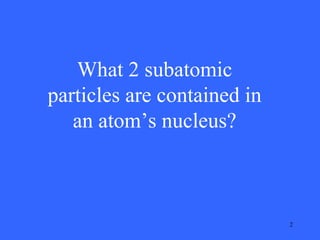
What 2 subatomic
particles are contained in
an atom’s nucleus?

2
Protons and Neutrons

3
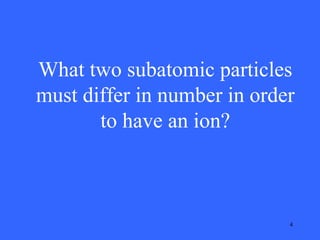
What two subatomic particles
must differ in number in order
to have an ion?

4
Protons and Electrons

5
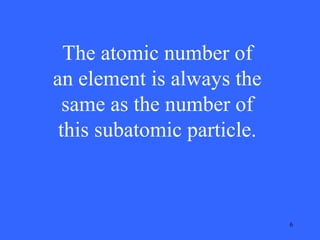
The atomic number of
an element is always the
same as the number of
this subatomic particle.

6
Protons = Atomic Number
This is why you look for the
number of protons when you are
identifying an atom on a drawing

7
What do you call atoms of an
element that contain different
numbers of neutrons?
Example: carbon-12 and
carbon-14

8
Isotopes

9
Strontium (Sr) has a mass
number of 88. Give the
number of protons, electrons,
and neutrons in an atom of
Strontium.

10
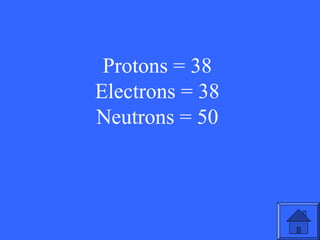
Protons = 38
Electrons = 38
Neutrons = 50

11
How many valence
electrons does an atom
of phosphorus (P) have?

12
5 valence electrons
(Remember: Phosphorus is
found in Group or Column VA)

13
_______________ are
made up of atoms of
two or more elements in
fixed proportions.

14
Compounds

15
Why are the noble gases stable?

16
A noble gas is stable because its
outer electron energy level is
full (has maximum number of
valence electrons).

17
Na2CO3 is the chemical formula
for sodium carbonate. How
many atoms of each element
are present in sodium
carbonate?

18
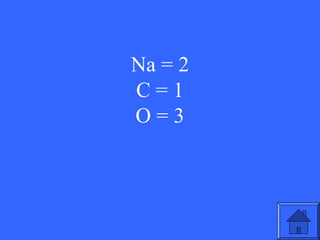
Na = 2
C=1
O=3

19
Differentiate between covalent
and ionic bonds. Hint: What
is going on with the electrons
in each type of bond?

20
•In covalent bonds, electrons are
shared.
•In ionic bonds, one atom donates
its electrons, becoming a positive
ion. The other atom accepts the
electrons, becoming a negative ion.
The ions of opposite charges are
then attracted to one another.
21
Water is referred to as a
__________ molecule because
it has an unequal distribution of
electrical charge.

22
polar

23
What is the term for water
molecules being attracted to any
other substance? Hint: This is
what happened when we
dropped water on the glass slide.
24
Adhesion

25
Do lipids dissolve in water?

26
No! Lipids do not dissolve in
water because they are nonpolar.
Ionic compounds and polar
molecules dissolve best in water.
27
Did the paperclip float?
Explain what water properties
contributed to the results we
saw in the lab.

28
It did not float. It sat on top of
the water due to water’s surface
tension. Surface tension is the
result of cohesion between
water molecules. Cohesion or
sticking together of water
molecules is caused by
hydrogen bonding.
29
Differentiate between acids and
bases. Hint: What ions are
released in water and what are
their pH values.

30
•Acids form H+ when dissolved in
water which combine with H2O to
+
+
form H3O . Acids have more H3O
than OH . They have pH values
below 7.
•Bases form OH- ions when
dissolved in water. Bases have more
OH- than H3O+. They have pH values
above 7.
31
Define energy

32
The ability to do work.

33
What is the name for the
starting materials in chemical
reactions?
What is the name of the newly
formed substances in chemical
reactions?
34
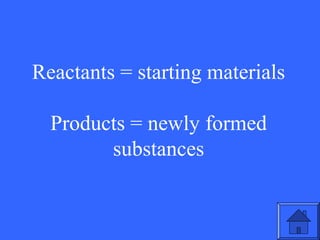
Reactants = starting materials
Products = newly formed
substances

35
What name is given to the
energy needed to start a
chemical reaction?

36
Activation energy

37
Define an enzyme
(what does it do?)

38
Enzymes are biological
catalysts that increase the speed
of chemical reactions.
Catalysts reduce the activation
energy of a chemical reaction.

39
Name the 4 types of Energy in
Biological Systems

40
Chemical Energy
Thermal Energy
Electrical Energy
Mechanical Energy
41
What is defined as, “anything
that occupies space and has
mass”?

42
Matter

43
What are the weak
interactions that allow water
to cohere and adhere?

44
Hydrogen Bonds

45
What is a strong bond in which
valence electrons are shared?
Name the 3 types of these
bonds
46
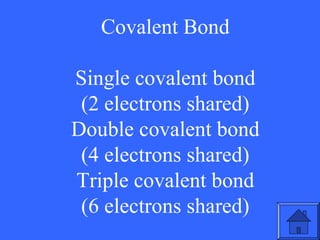
Covalent Bond
Single covalent bond
(2 electrons shared)
Double covalent bond
(4 electrons shared)
Triple covalent bond
(6 electrons shared)
47
Describe the difference between
the 3 isotopes of Carbon
Carbon-12
Carbon-13
Carbon-14
48
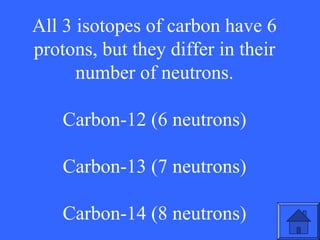
All 3 isotopes of carbon have 6
protons, but they differ in their
number of neutrons.
Carbon-12 (6 neutrons)
Carbon-13 (7 neutrons)
Carbon-14 (8 neutrons)

49
Study the pH scale below. Which drink is
more acidic, apple juice (pH of 3) or black
coffee (pH of 5) and how many more times
acidic is it?

50
Apple Juice is 100x more acidic
than Black Coffee
Remember: The pH scale is a
Logarithmic scale (tenfold change
per number)
Difference of 2 pH levels
10 x 10 = 100 times more acidic

51

Chapter 2 Jeopardy Review 2013

  • 1.
    Atomic Chem GeneralChem Water Chem Energy Misc. 5 pt 5 pt 5 pt 5 pt 5 pt 10 pt 10 pt 10 pt 10 pt 10 pt 15 pt 15 pt 15 pt 15 pt 15 pt 20 pt 20 pt 20 pt 20 pt 20 pt 25 pt 25 pt 25 pt 25 pt 25 1 pt
  • 2.
    What 2 subatomic particlesare contained in an atom’s nucleus? 2
  • 3.
  • 4.
    What two subatomicparticles must differ in number in order to have an ion? 4
  • 5.
  • 6.
    The atomic numberof an element is always the same as the number of this subatomic particle. 6
  • 7.
    Protons = AtomicNumber This is why you look for the number of protons when you are identifying an atom on a drawing 7
  • 8.
    What do youcall atoms of an element that contain different numbers of neutrons? Example: carbon-12 and carbon-14 8
  • 9.
  • 10.
    Strontium (Sr) hasa mass number of 88. Give the number of protons, electrons, and neutrons in an atom of Strontium. 10
  • 11.
    Protons = 38 Electrons= 38 Neutrons = 50 11
  • 12.
    How many valence electronsdoes an atom of phosphorus (P) have? 12
  • 13.
    5 valence electrons (Remember:Phosphorus is found in Group or Column VA) 13
  • 14.
    _______________ are made upof atoms of two or more elements in fixed proportions. 14
  • 15.
  • 16.
    Why are thenoble gases stable? 16
  • 17.
    A noble gasis stable because its outer electron energy level is full (has maximum number of valence electrons). 17
  • 18.
    Na2CO3 is thechemical formula for sodium carbonate. How many atoms of each element are present in sodium carbonate? 18
  • 19.
  • 20.
    Differentiate between covalent andionic bonds. Hint: What is going on with the electrons in each type of bond? 20
  • 21.
    •In covalent bonds,electrons are shared. •In ionic bonds, one atom donates its electrons, becoming a positive ion. The other atom accepts the electrons, becoming a negative ion. The ions of opposite charges are then attracted to one another. 21
  • 22.
    Water is referredto as a __________ molecule because it has an unequal distribution of electrical charge. 22
  • 23.
  • 24.
    What is theterm for water molecules being attracted to any other substance? Hint: This is what happened when we dropped water on the glass slide. 24
  • 25.
  • 26.
    Do lipids dissolvein water? 26
  • 27.
    No! Lipids donot dissolve in water because they are nonpolar. Ionic compounds and polar molecules dissolve best in water. 27
  • 28.
    Did the paperclipfloat? Explain what water properties contributed to the results we saw in the lab. 28
  • 29.
    It did notfloat. It sat on top of the water due to water’s surface tension. Surface tension is the result of cohesion between water molecules. Cohesion or sticking together of water molecules is caused by hydrogen bonding. 29
  • 30.
    Differentiate between acidsand bases. Hint: What ions are released in water and what are their pH values. 30
  • 31.
    •Acids form H+when dissolved in water which combine with H2O to + + form H3O . Acids have more H3O than OH . They have pH values below 7. •Bases form OH- ions when dissolved in water. Bases have more OH- than H3O+. They have pH values above 7. 31
  • 32.
  • 33.
    The ability todo work. 33
  • 34.
    What is thename for the starting materials in chemical reactions? What is the name of the newly formed substances in chemical reactions? 34
  • 35.
    Reactants = startingmaterials Products = newly formed substances 35
  • 36.
    What name isgiven to the energy needed to start a chemical reaction? 36
  • 37.
  • 38.
    Define an enzyme (whatdoes it do?) 38
  • 39.
    Enzymes are biological catalyststhat increase the speed of chemical reactions. Catalysts reduce the activation energy of a chemical reaction. 39
  • 40.
    Name the 4types of Energy in Biological Systems 40
  • 41.
    Chemical Energy Thermal Energy ElectricalEnergy Mechanical Energy 41
  • 42.
    What is definedas, “anything that occupies space and has mass”? 42
  • 43.
  • 44.
    What are theweak interactions that allow water to cohere and adhere? 44
  • 45.
  • 46.
    What is astrong bond in which valence electrons are shared? Name the 3 types of these bonds 46
  • 47.
    Covalent Bond Single covalentbond (2 electrons shared) Double covalent bond (4 electrons shared) Triple covalent bond (6 electrons shared) 47
  • 48.
    Describe the differencebetween the 3 isotopes of Carbon Carbon-12 Carbon-13 Carbon-14 48
  • 49.
    All 3 isotopesof carbon have 6 protons, but they differ in their number of neutrons. Carbon-12 (6 neutrons) Carbon-13 (7 neutrons) Carbon-14 (8 neutrons) 49
  • 50.
    Study the pHscale below. Which drink is more acidic, apple juice (pH of 3) or black coffee (pH of 5) and how many more times acidic is it? 50
  • 51.
    Apple Juice is100x more acidic than Black Coffee Remember: The pH scale is a Logarithmic scale (tenfold change per number) Difference of 2 pH levels 10 x 10 = 100 times more acidic 51