The Molecules of Life-
Introduction to the Structure and
Function of Large Biological
Molecules (1)
Learning Objectives
• Revise the basic biochemical reactions, elements and type of bonds relevant to
biomolecules
• Enumerate the functional groups present in biomolecules.
• List the difference between monomers and polymers.
• Explain the reactions for synthesis and breakdown of biopolymers
• For each group of biomolecules learn the name of its generic monomer (simple
unit) and polymer (complex structure) and their function.
• Identify the chemical elements and the difference between simple sugars and
complex carbohydrates
• Identify the chemical elements of lipids and learn their property of insolubility in
water.
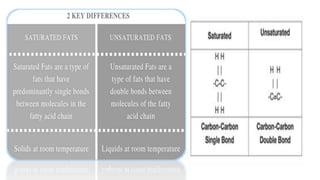
• Compare and contrast saturated, mono-unsaturated, and poly-unsaturated fatty
acids.
Atoms
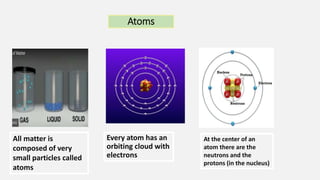
All matter is
composed of very
small particles called
atoms
Every atom has an
orbiting cloud with
electrons
At the center of an
atom there are the
neutrons and the
protons (in the nucleus)
Atoms
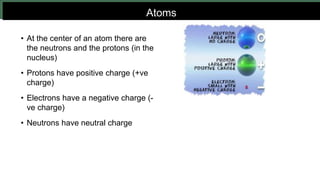
• At the center of an atom there are
the neutrons and the protons (in the
nucleus)
• Protons have positive charge (+ve
charge)
• Electrons have a negative charge (-
ve charge)
• Neutrons have neutral charge
What is an ION?
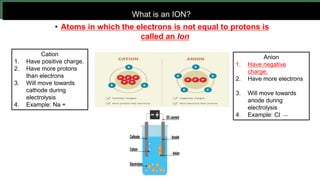
• Atoms in which the electrons is not equal to protons is
called an Ion
Cation
1. Have positive charge.
2. Have more protons
than electrons
3. Will move towards
cathode during
electrolysis
4. Example: Na +
Anion
1. Have negative
charge.
2. Have more electrons
3. Will move towards
anode during
electrolysis
4. Example: Cl __
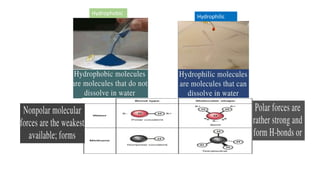
Hydrophobic
Hydrophilic
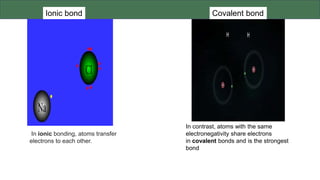
Covalent bond
In contrast, atoms with the same
electronegativity share electrons
in covalent bonds and is the strongest
bond
Ionic bond
In ionic bonding, atoms transfer
electrons to each other.
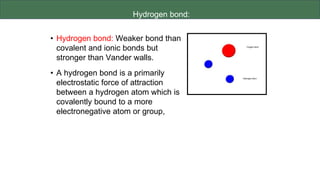
Hydrogen bond:
• Hydrogen bond: Weaker bond than
covalent and ionic bonds but
stronger than Vander walls.
• A hydrogen bond is a primarily
electrostatic force of attraction
between a hydrogen atom which is
covalently bound to a more
electronegative atom or group,
Chemical bonds and interactions
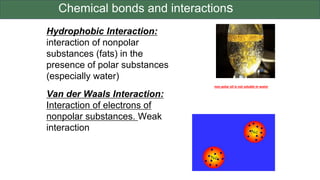
Hydrophobic Interaction:
interaction of nonpolar
substances (fats) in the
presence of polar substances
(especially water)
Van der Waals Interaction:
Interaction of electrons of
nonpolar substances. Weak
interaction
non polar oil is not soluble in water
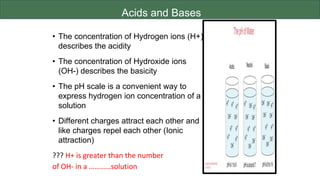
Acids and Bases
• The concentration of Hydrogen ions (H+)
describes the acidity
• The concentration of Hydroxide ions
(OH-) describes the basicity
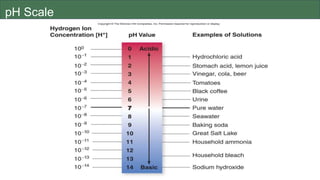
• The pH scale is a convenient way to
express hydrogen ion concentration of a
solution
• Different charges attract each other and
like charges repel each other (Ionic
attraction)
??? H+ is greater than the number
of OH- in a …………solution
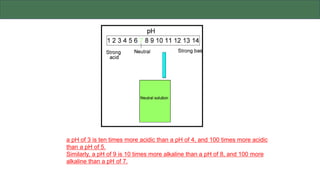
a pH of 3 is ten times more acidic than a pH of 4, and 100 times more acidic
than a pH of 5.
Similarly, a pH of 9 is 10 times more alkaline than a pH of 8, and 100 more
alkaline than a pH of 7.
pH Scale
Acids and Bases
The Molecules of Life
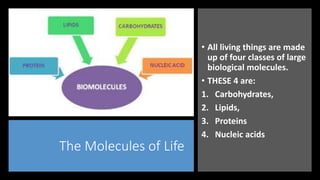
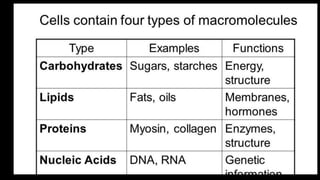
• All living things are made
up of four classes of large
biological molecules.
• THESE 4 are:
1. Carbohydrates,
2. Lipids,
3. Proteins
4. Nucleic acids
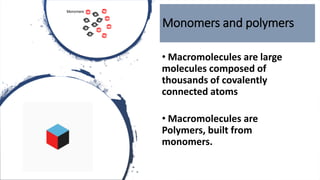
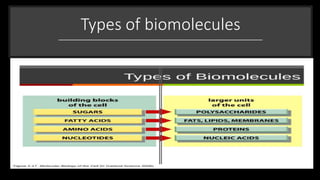
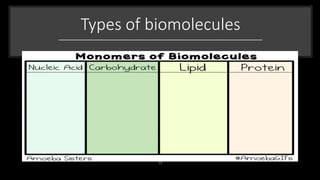
Monomers and polymers
• Macromolecules are large
molecules composed of
thousands of covalently
connected atoms
• Macromolecules are
Polymers, built from
monomers.
Types of biomolecules
Carbon is the central element
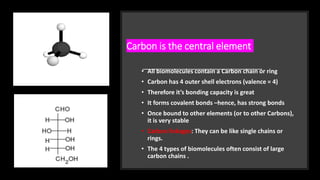
• All biomolecules contain a Carbon chain or ring
• Carbon has 4 outer shell electrons (valence = 4)
• Therefore it’s bonding capacity is great
• It forms covalent bonds –hence, has strong bonds
• Once bound to other elements (or to other Carbons),
it is very stable
• Carbon linkages: They can be like single chains or
rings.
• The 4 types of biomolecules often consist of large
carbon chains .
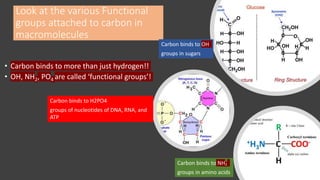
Look at the various Functional
groups attached to carbon in
macromolecules
• Carbon binds to more than just hydrogen!!
• OH, NH2, PO4 are called ‘functional groups’!
Carbon binds to NH2
groups in amino acids
Carbon binds to OH
groups in sugars
Carbon binds to H2PO4
groups of nucleotides of DNA, RNA, and
ATP
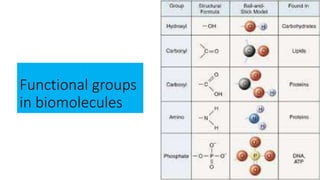
Functional groups
in biomolecules
The Synthesis (making) and
Breakdown of Polymers
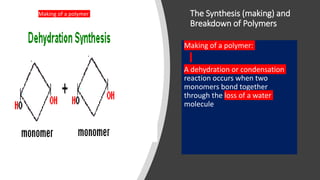
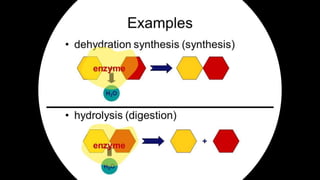
Making of a polymer:
A dehydration or condensation
reaction occurs when two
monomers bond together
through the loss of a water
molecule
Making of a polymer
The Synthesis (making) and
Breakdown of Polymers
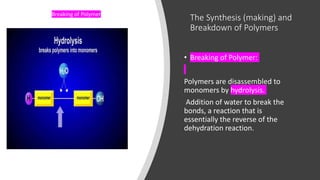
• Breaking of Polymer:
Polymers are disassembled to
monomers by hydrolysis.
Addition of water to break the
bonds, a reaction that is
essentially the reverse of the
dehydration reaction.
Breaking of Polymer
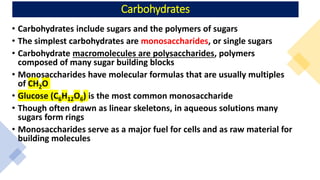
Carbohydrates
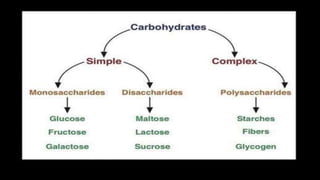
• Carbohydrates include sugars and the polymers of sugars
• The simplest carbohydrates are monosaccharides, or single sugars
• Carbohydrate macromolecules are polysaccharides, polymers
composed of many sugar building blocks
• Monosaccharides have molecular formulas that are usually multiples
of CH2O
• Glucose (C6H12O6) is the most common monosaccharide
• Though often drawn as linear skeletons, in aqueous solutions many
sugars form rings
• Monosaccharides serve as a major fuel for cells and as raw material for
building molecules
Simple sugars
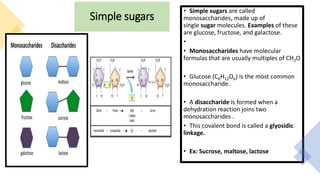
• Simple sugars are called
monosaccharides, made up of
single sugar molecules. Examples of these
are glucose, fructose, and galactose.
•
• Monosaccharides have molecular
formulas that are usually multiples of CH2O
• Glucose (C6H12O6) is the most common
monosaccharide.
• A disaccharide is formed when a
dehydration reaction joins two
monosaccharides .
• This covalent bond is called a glyosidic
linkage.
• Ex: Sucrose, maltose, lactose
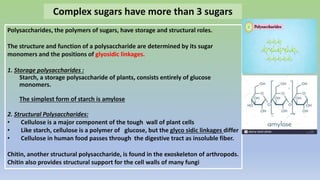
Polysaccharides, the polymers of sugars, have storage and structural roles.
The structure and function of a polysaccharide are determined by its sugar
monomers and the positions of glyosidic linkages.
1. Storage polysaccharides :
Starch, a storage polysaccharide of plants, consists entirely of glucose
monomers.
The simplest form of starch is amylose
2. Structural Polysaccharides:
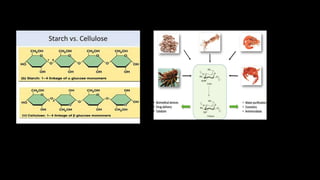
• Cellulose is a major component of the tough wall of plant cells
• Like starch, cellulose is a polymer of glucose, but the glyco sidic linkages differ
• Cellulose in human food passes through the digestive tract as insoluble fiber.
Chitin, another structural polysaccharide, is found in the exoskeleton of arthropods.
Chitin also provides structural support for the cell walls of many fungi
Complex sugars have more than 3 sugars
2. Lipids
Hydrophobic
molecules
Lipids – rich source of energy (ATP)
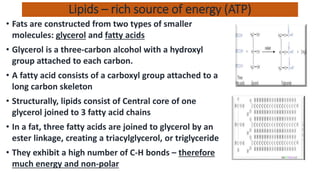
• Fats are constructed from two types of smaller
molecules: glycerol and fatty acids
• Glycerol is a three-carbon alcohol with a hydroxyl
group attached to each carbon.
• A fatty acid consists of a carboxyl group attached to a
long carbon skeleton
• Structurally, lipids consist of Central core of one
glycerol joined to 3 fatty acid chains
• In a fat, three fatty acids are joined to glycerol by an
ester linkage, creating a triacylglycerol, or triglyceride
• They exhibit a high number of C-H bonds – therefore
much energy and non-polar
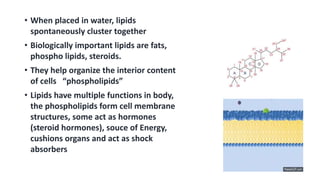
• When placed in water, lipids
spontaneously cluster together
• Biologically important lipids are fats,
phospho lipids, steroids.
• They help organize the interior content
of cells “phospholipids”
• Lipids have multiple functions in body,
the phospholipids form cell membrane
structures, some act as hormones
(steroid hormones), souce of Energy,
cushions organs and act as shock
absorbers
What are steroids and phospholipids?
Phospholipids?
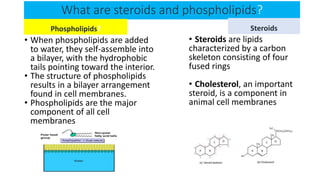
• When phospholipids are added
to water, they self-assemble into
a bilayer, with the hydrophobic
tails pointing toward the interior.
• The structure of phospholipids
results in a bilayer arrangement
found in cell membranes.
• Phospholipids are the major
component of all cell
membranes
Steroids
• Steroids are lipids
characterized by a carbon
skeleton consisting of four
fused rings
• Cholesterol, an important
steroid, is a component in
animal cell membranes
Lipids do not
form true
polymers ?
Lipids are mainly made up
of hydrocarbons which form
non polar covalent bonds.
Structurally, lipids consist of
Central core of one glycerol
joined to 3 fatty acid chains
ESSENTIAL FATTY ACIDS:
• Certain unsaturated fatty acids are not synthesized
in the human body ; these must be supplied in the
diet. These essential fatty acids include the omega-
3 fatty acids, required for normal growth, and
thought to provide protection against
cardiovascular disease
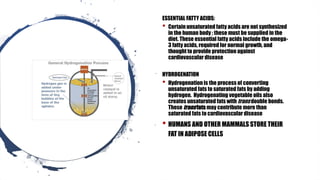
HYDROGENATION
• Hydrogenation is the process of converting
unsaturated fats to saturated fats by adding
hydrogen. Hydrogenating vegetable oils also
creates unsaturated fats with trans double bonds.
These transfats may contribute more than
saturated fats to cardiovascular disease
• HUMANS AND OTHER MAMMALS STORE THEIR
FAT IN ADIPOSE CELLS
Introduction to basic chemistry of biomolecules

Introduction to basic chemistry of biomolecules

  • 1.
    The Molecules ofLife- Introduction to the Structure and Function of Large Biological Molecules (1)
  • 2.
    Learning Objectives • Revisethe basic biochemical reactions, elements and type of bonds relevant to biomolecules • Enumerate the functional groups present in biomolecules. • List the difference between monomers and polymers. • Explain the reactions for synthesis and breakdown of biopolymers • For each group of biomolecules learn the name of its generic monomer (simple unit) and polymer (complex structure) and their function. • Identify the chemical elements and the difference between simple sugars and complex carbohydrates • Identify the chemical elements of lipids and learn their property of insolubility in water. • Compare and contrast saturated, mono-unsaturated, and poly-unsaturated fatty acids.
  • 3.
    Atoms All matter is composedof very small particles called atoms Every atom has an orbiting cloud with electrons At the center of an atom there are the neutrons and the protons (in the nucleus)
  • 4.
    Atoms • At thecenter of an atom there are the neutrons and the protons (in the nucleus) • Protons have positive charge (+ve charge) • Electrons have a negative charge (- ve charge) • Neutrons have neutral charge
  • 5.
    What is anION? • Atoms in which the electrons is not equal to protons is called an Ion Cation 1. Have positive charge. 2. Have more protons than electrons 3. Will move towards cathode during electrolysis 4. Example: Na + Anion 1. Have negative charge. 2. Have more electrons 3. Will move towards anode during electrolysis 4. Example: Cl __
  • 6.
  • 7.
    Covalent bond In contrast,atoms with the same electronegativity share electrons in covalent bonds and is the strongest bond Ionic bond In ionic bonding, atoms transfer electrons to each other.
  • 8.
    Hydrogen bond: • Hydrogenbond: Weaker bond than covalent and ionic bonds but stronger than Vander walls. • A hydrogen bond is a primarily electrostatic force of attraction between a hydrogen atom which is covalently bound to a more electronegative atom or group,
  • 9.
    Chemical bonds andinteractions Hydrophobic Interaction: interaction of nonpolar substances (fats) in the presence of polar substances (especially water) Van der Waals Interaction: Interaction of electrons of nonpolar substances. Weak interaction non polar oil is not soluble in water
  • 10.
    Acids and Bases •The concentration of Hydrogen ions (H+) describes the acidity • The concentration of Hydroxide ions (OH-) describes the basicity • The pH scale is a convenient way to express hydrogen ion concentration of a solution • Different charges attract each other and like charges repel each other (Ionic attraction) ??? H+ is greater than the number of OH- in a …………solution
  • 11.
    a pH of3 is ten times more acidic than a pH of 4, and 100 times more acidic than a pH of 5. Similarly, a pH of 9 is 10 times more alkaline than a pH of 8, and 100 more alkaline than a pH of 7.
  • 12.
  • 13.
  • 15.
    The Molecules ofLife • All living things are made up of four classes of large biological molecules. • THESE 4 are: 1. Carbohydrates, 2. Lipids, 3. Proteins 4. Nucleic acids
  • 16.
    Monomers and polymers •Macromolecules are large molecules composed of thousands of covalently connected atoms • Macromolecules are Polymers, built from monomers.
  • 18.
  • 19.
  • 20.
    Carbon is thecentral element • All biomolecules contain a Carbon chain or ring • Carbon has 4 outer shell electrons (valence = 4) • Therefore it’s bonding capacity is great • It forms covalent bonds –hence, has strong bonds • Once bound to other elements (or to other Carbons), it is very stable • Carbon linkages: They can be like single chains or rings. • The 4 types of biomolecules often consist of large carbon chains .
  • 21.
    Look at thevarious Functional groups attached to carbon in macromolecules • Carbon binds to more than just hydrogen!! • OH, NH2, PO4 are called ‘functional groups’! Carbon binds to NH2 groups in amino acids Carbon binds to OH groups in sugars Carbon binds to H2PO4 groups of nucleotides of DNA, RNA, and ATP
  • 22.
  • 24.
    The Synthesis (making)and Breakdown of Polymers Making of a polymer: A dehydration or condensation reaction occurs when two monomers bond together through the loss of a water molecule Making of a polymer
  • 25.
    The Synthesis (making)and Breakdown of Polymers • Breaking of Polymer: Polymers are disassembled to monomers by hydrolysis. Addition of water to break the bonds, a reaction that is essentially the reverse of the dehydration reaction. Breaking of Polymer
  • 28.
    Carbohydrates • Carbohydrates includesugars and the polymers of sugars • The simplest carbohydrates are monosaccharides, or single sugars • Carbohydrate macromolecules are polysaccharides, polymers composed of many sugar building blocks • Monosaccharides have molecular formulas that are usually multiples of CH2O • Glucose (C6H12O6) is the most common monosaccharide • Though often drawn as linear skeletons, in aqueous solutions many sugars form rings • Monosaccharides serve as a major fuel for cells and as raw material for building molecules
  • 30.
    Simple sugars • Simplesugars are called monosaccharides, made up of single sugar molecules. Examples of these are glucose, fructose, and galactose. • • Monosaccharides have molecular formulas that are usually multiples of CH2O • Glucose (C6H12O6) is the most common monosaccharide. • A disaccharide is formed when a dehydration reaction joins two monosaccharides . • This covalent bond is called a glyosidic linkage. • Ex: Sucrose, maltose, lactose
  • 31.
    Polysaccharides, the polymersof sugars, have storage and structural roles. The structure and function of a polysaccharide are determined by its sugar monomers and the positions of glyosidic linkages. 1. Storage polysaccharides : Starch, a storage polysaccharide of plants, consists entirely of glucose monomers. The simplest form of starch is amylose 2. Structural Polysaccharides: • Cellulose is a major component of the tough wall of plant cells • Like starch, cellulose is a polymer of glucose, but the glyco sidic linkages differ • Cellulose in human food passes through the digestive tract as insoluble fiber. Chitin, another structural polysaccharide, is found in the exoskeleton of arthropods. Chitin also provides structural support for the cell walls of many fungi Complex sugars have more than 3 sugars
  • 33.
  • 34.
    Lipids – richsource of energy (ATP) • Fats are constructed from two types of smaller molecules: glycerol and fatty acids • Glycerol is a three-carbon alcohol with a hydroxyl group attached to each carbon. • A fatty acid consists of a carboxyl group attached to a long carbon skeleton • Structurally, lipids consist of Central core of one glycerol joined to 3 fatty acid chains • In a fat, three fatty acids are joined to glycerol by an ester linkage, creating a triacylglycerol, or triglyceride • They exhibit a high number of C-H bonds – therefore much energy and non-polar
  • 35.
    • When placedin water, lipids spontaneously cluster together • Biologically important lipids are fats, phospho lipids, steroids. • They help organize the interior content of cells “phospholipids” • Lipids have multiple functions in body, the phospholipids form cell membrane structures, some act as hormones (steroid hormones), souce of Energy, cushions organs and act as shock absorbers
  • 36.
    What are steroidsand phospholipids? Phospholipids? • When phospholipids are added to water, they self-assemble into a bilayer, with the hydrophobic tails pointing toward the interior. • The structure of phospholipids results in a bilayer arrangement found in cell membranes. • Phospholipids are the major component of all cell membranes Steroids • Steroids are lipids characterized by a carbon skeleton consisting of four fused rings • Cholesterol, an important steroid, is a component in animal cell membranes
  • 38.
    Lipids do not formtrue polymers ? Lipids are mainly made up of hydrocarbons which form non polar covalent bonds. Structurally, lipids consist of Central core of one glycerol joined to 3 fatty acid chains
  • 39.
    ESSENTIAL FATTY ACIDS: •Certain unsaturated fatty acids are not synthesized in the human body ; these must be supplied in the diet. These essential fatty acids include the omega- 3 fatty acids, required for normal growth, and thought to provide protection against cardiovascular disease HYDROGENATION • Hydrogenation is the process of converting unsaturated fats to saturated fats by adding hydrogen. Hydrogenating vegetable oils also creates unsaturated fats with trans double bonds. These transfats may contribute more than saturated fats to cardiovascular disease • HUMANS AND OTHER MAMMALS STORE THEIR FAT IN ADIPOSE CELLS