DNA AND PROTEIN
SYNTHESIS
DNA REPLICATION
DNA carries the genetic information from one
generation to the next
When cells divide, each cell must have a copy of
the organisms DNA
When organisms reproduce their genetic
information is passed on to the offspring via the
DNA.
DNA must be able to replicate itself.
When DNA replications occurs, each new strand of
DNA has one of the old strands plus one new
strand.
This process of DNA replication is called:
semi-conservative replication
SEMI – CONSERVATIVE REPLICATION
& TRANSCRIPTION
mRNA is synthesized from a gene on the DNA
by “semi-conservative replication”
DNA is a double stranded molecule, one of the
strands act as a template to produce a
molecule of RNA for transcription.
In this process the original DNA double helix
unzips exposing the DNA bases (Helicase
Enzyme).
DNA nucleotides that are floating free within
the nucleus link in a complementary manner
with the help of the enzyme DNA Polymerase.
Two new strands are formed, with each strand
having one of the original strands and one
new strand.
When transcription is completed the new
strand is released as a mRNA molecule
moving out of the nucleus through the nuclear
pores into the cytoplasm ready for translation.
The “master” copy of DNA never leaves the
nucleus
GENETIC CODE
The functional unit of information on the
chromosome is the gene
A gene consists of a unique sequence of bases
that code for a polypeptide or an RNA molecule.
For the DNA molecule to influence the activities of
a cell, it has to first be translated into proteins.
One gene codes for a polypeptide or an RNA
molecule.
So how can 4 bases be translated into a sequence
of amino acids when there are 20 possible amino
acids to code for?
TRIPLETS CODONS
If each base coded for one amino acid only 4 amino
acids could be sequenced.
If we had pairs of bases coding for amino acids, how
many combinations would then be possible?
16 still not enough
The answer is to use 3 bases to code for each amino
acid.
With three bases 64 combinations are possible.
More than enough for the 20 amino acids and start
and stop signals.
This is called the Triplet Code.
Experiments have verified that the genetic
code is made up of base triplets.
These base triplets are called codons.
Each triplet codes for an amino acid.
Most amino acids have more than one triplet
codon.
Start (AUG) and Stop (UGA) codons initiate and
terminate polypeptide sequences
MRNA CODONS FOR ALL
AMINO ACIDS
PROTEIN SYNTHESIS
As we have already learnt:
For the DNA molecule to influence the activities of
a cell, it has to first be translated into proteins.
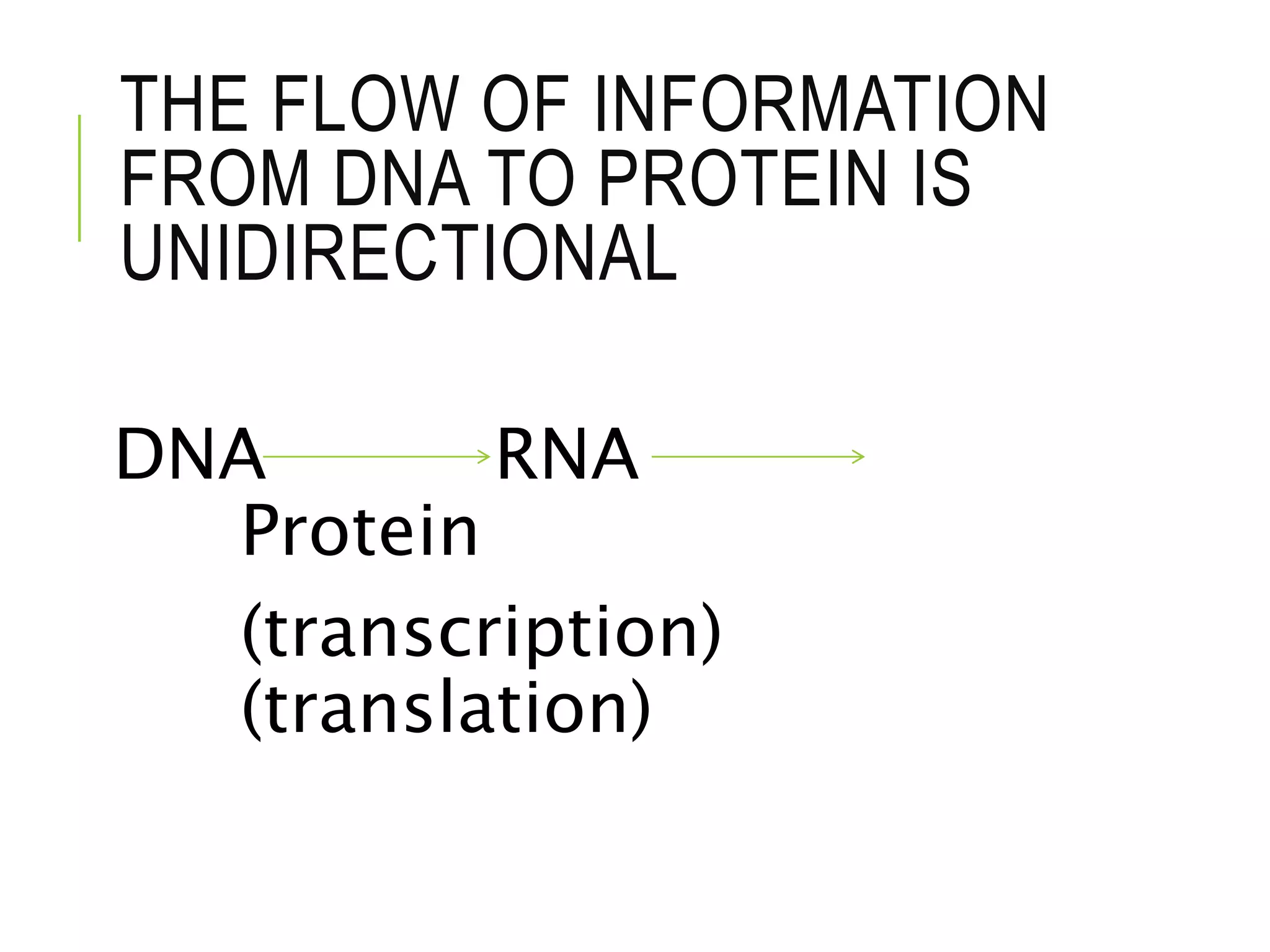
The flow of information for most organisms is
unidirectional.
It only flows in one direction.
DNA  RNA  Protein
There are two main processes involved in Protein
Synthesis:
Transcription
Translation
DNA--> RNA --> PROTEINS
DNA
deoxy ribo
nucleic acid
nitrogen bases
are:
A-T and C- G
RNA
ribo nucleic acid
nitrogen bases
are:
A - U and C
– G
U= uracil
the base which
substitutes for
THE FLOW OF INFORMATION
FROM DNA TO PROTEIN IS
UNIDIRECTIONAL
DNA RNA
Protein
(transcription)
(translation)
COMMON ABBREVIATIONS
FOR AMINO ACIDS
DNA REPLICATION SUMMARY
DNA EXTRACTION PRACTICAL
TRANSCRIPTION
DNA  RNA
Basically it is a process in which the message written
in DNA code is transcribed into a working copy of
mRNA (messenger RNA).
The process is:
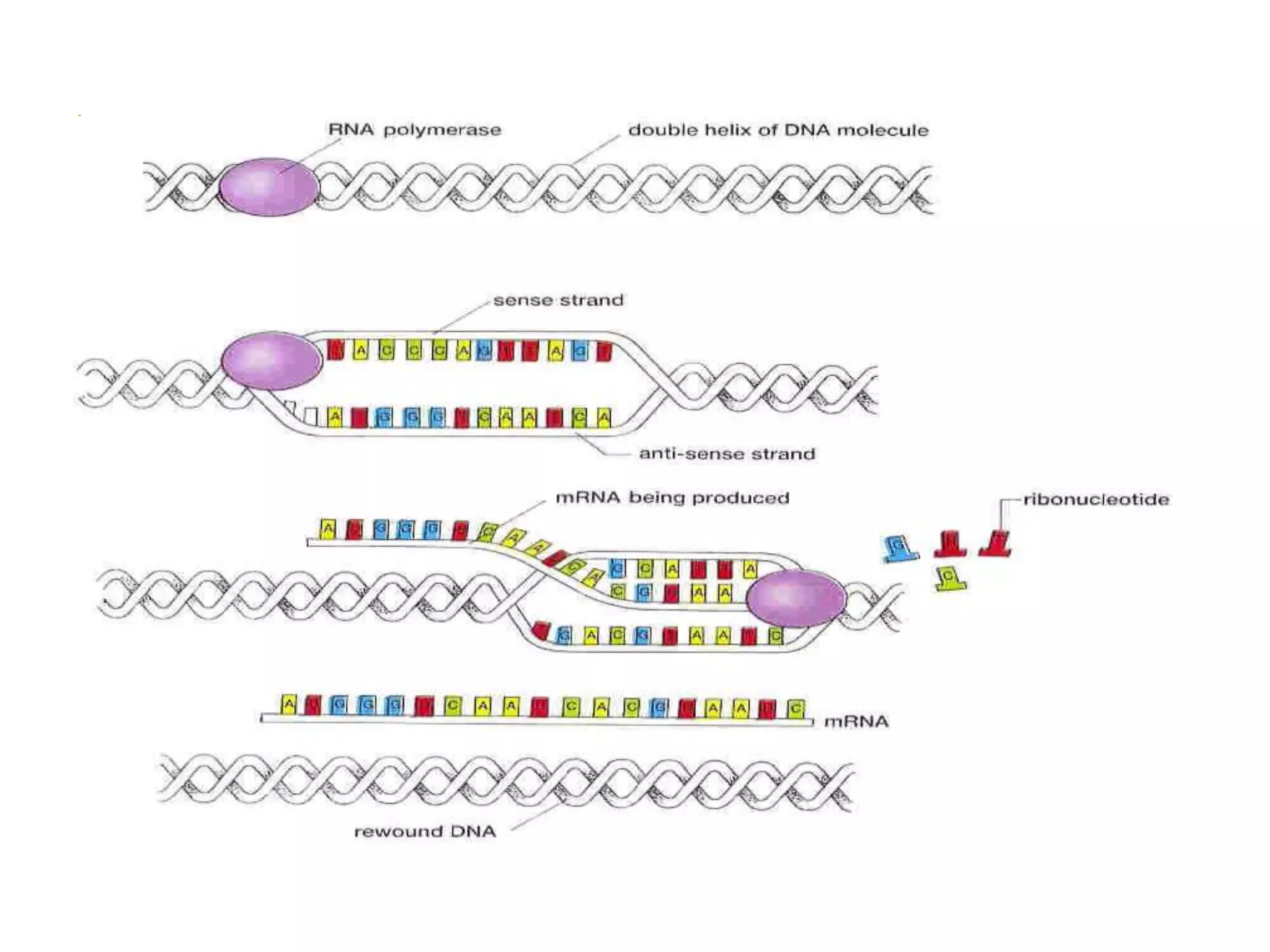
RNA polymerase enzymes separate the two strands
of DNA.
One strand of the DNA is used as a template for
mRNA synthesis
The mRNA molecule forms using Uracil instead of
Thymine
When the mRNA molecule is complete, it breaks away
from the DNA and travels through the nuclear pores
to ribosomes in the cytoplasm
TRANSCRIPTIO
N
TRANSLATION
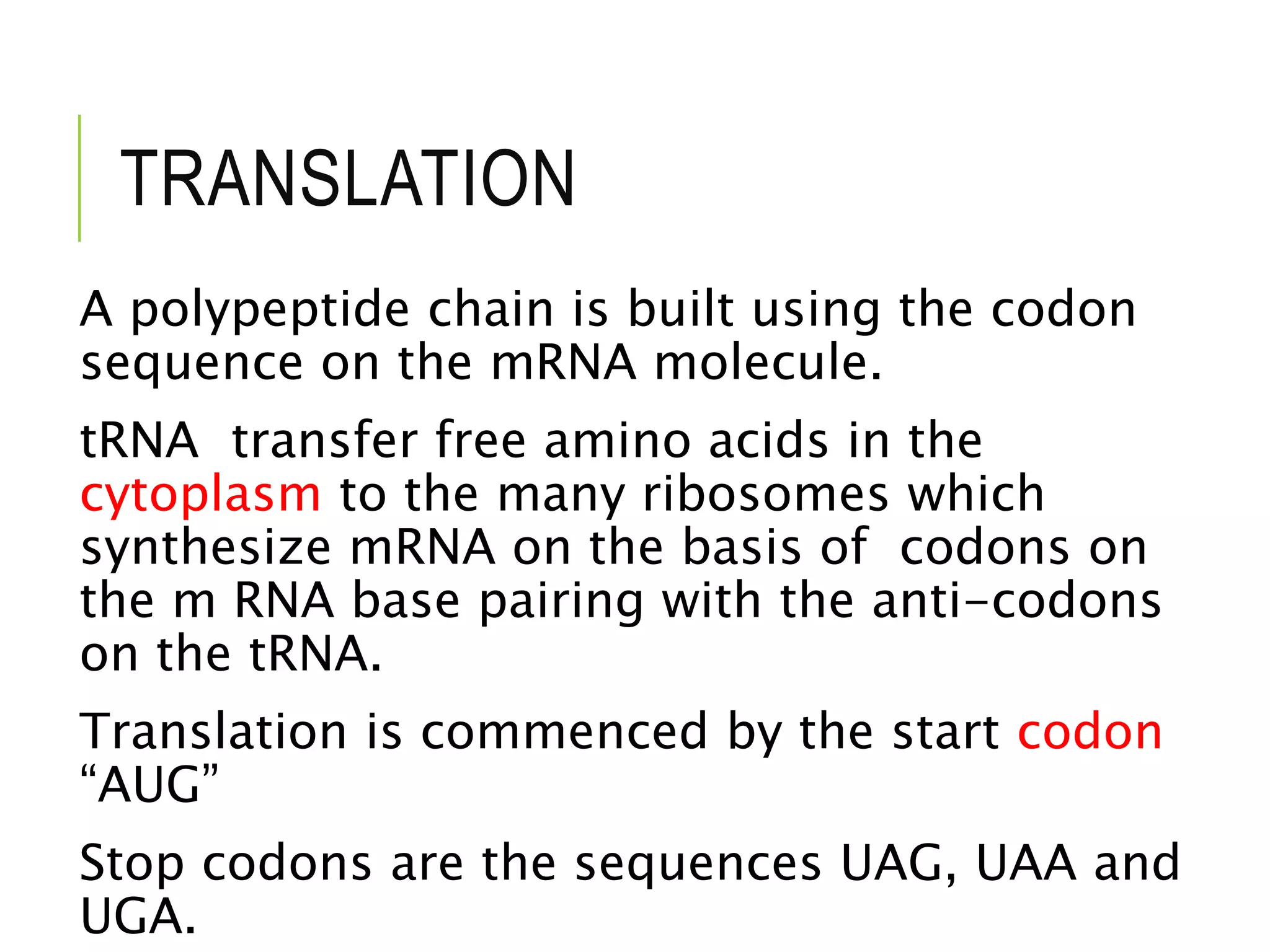
A polypeptide chain is built using the codon
sequence on the mRNA molecule.
tRNA transfer free amino acids in the
cytoplasm to the many ribosomes which
synthesize mRNA on the basis of codons on
the m RNA base pairing with the anti-codons
on the tRNA.
Translation is commenced by the start codon
“AUG”
Stop codons are the sequences UAG, UAA and
UGA.
RNA  PROTEIN
Basically it is a process in which a polypeptide
chain is built from a codon sequence on the
mRNA molecule.
The process is:
The mRNA molecule attaches to a Ribosome.
tRNA molecules bring specific amino acids to
the ribosome according to the codon on the
mRNA. There is a different tRNA molecule for
each of the 20 amino acids.
Each tRNA molecule is about 80 nucleotides
long and is folded into a clover shape. At one
end there is an exposed triplet of bases called
an anticodon and at the other a specific amino
acid.
The anticodon on the tRNA matches the codon
The ribosomes provide the platform
where the tRNA and mRNA are brought
together
As the amino acids are bought
alongside one another they are joined
together by enzymes to form a
polypeptide.
Translation begins with a signal code,
the start codon AUG
AUG codes for the amino acid
Methionine
The ribosome moves along the mRNA
strand one codon at a time.
As the tRNA molecule deposits its
amino acid, it is released back to the
cytoplasm to link with another
amino acid.
When a stop codon is reached,
translation ceases and the
polypeptide chain is completed and
released from the ribosome.
The polypeptide folds into its final
protein shape
If the protein is more than one
polypeptide, the chains link and
form their tertiary structure.
T RNA WITH ATTACHED AMINO
ACID
TRANSLATION
PROCESS OF TRANSLATION
RELATIONSHIP BETWEEN
TRIPLETS, CODONS, ANTI-
CODONS AND AMINO ACIDS
SUMMARY OF PROTEIN SYNTHESIS
Note key points
Do focus questions on p15
Protein synthesis simulation
MODELLING TRANSCIPTION
1. Organise your own DNA code using the
acetate sugar phosphate backbones and
complementary base. Record the DNA base
sequence in your book
2. Unzip the DNA to expose one strand and
use felt tip pen to record the complementary
base on the tabs of the exposed strand.
Record this exposed strand in black/blue
pen
3. Use the exposed DNA strand as a
template to
MODELLING TRANSLATION
3. Use the paper tRNA “molecules’ to
construct the anticodons.
4. Refer to the table of mRNA codons (
pg 8 Key Ideas) choose one coloured ball
to represent each amino acid and
constuct the polypeptide coded for by
your mRNA.
5. Link three different polypeptide
sequences together to form a longer
polypeptide chain.
STRUCTURE OF A CELL
MEMBRANE
MOLECULAR RECOGNITION
An important aspect of life is the capacity of
cells to exchange materials in and out
through their membranes.
The cell membrane has its own unique
collection of proteins that are embedded in
a phospholipid bi-layer
The human red blood cell membrane has
more than 50
Cell membranes need to select molecules to
pass through and recognise signals from
the environment.
PROTEINS IN THE CELL
MEMBRANE
Found on inner and outer surface of cell
membrane.
Many move freely (fluid mosaic model)
while others are fixed.
Act as receptors for chemical messengers
from other cells.
Will display a particular shape to bind to a
specific messenger such as a hormone.
Other proteins act as one-way transport
channels allowing specific molecules
through cell membrane.
EXAMPLES OF MOLECULAR
RECOGNITION INCLUDE:
Cell membrane receptor molecules
Transport proteins in the cell
membrane
Hormone receptors in cell
membranes
Antibodies
enzymes
CELL MEMBRANE
RECEPTORS
These are protein and glycoprotein molecules
embedded in the cell membrane.
They have distinctive shapes so as to allow
cells to recognise each other.
This is critical when cells are differentiating to
form tissues.
COMPLEMENTARY BINDING
TO MEMBRANE CELL
RECEPTOR MOLECULES
TRANSPORT PROTEINS
These are transport proteins embedded in
the cell membrane.
They have specific binding sites for the
substance being transported.
They help with:
facilitated diffusion (moving with the
concentration gradient)
Active transport (moving against the
concentration gradient using energy)
HORMONES
Hormone receptors can be embedded in cell
membranes or in the cytoplasm of the cell.
Hormones are chemical messengers produced by
specialised cells in one part of the body to act on
target cells in another part.
The receptors are protein molecules:
Cell membrane: Insulin
Induces cell to take in more glucose and convert it
to glycogen
Cytoplasm : Steroids
Lipid soluble and pass through the cell membrane
to bind with receptors in the cytoplasm
UPTAKE OF GLUCOSE BY
INSULIN
HORMONES
Adrenalin
Binds to protein receptors on the surface
of liver cells and activates the conversion
of glycogen to glucose which is released
into the bloodstream for energy
provision by aerobic respiration – “fight
or light response”
ANTIGEN – ANTIBODY
BINDING
Antibodies are part of the immune system.
They are protein molecules
(immunoglobulins) with antigen binding
sites that detect and bind to antigens.
Antigens are foreign substances like
bacteria or viruses.
The binding of the two must be
complementary to inactivate the antigen
ANTIBODY STRUCTURE
SELF AND NON-SELF
The immune system is able to
distinguish between foreign molecules
and their own body molecules or cells.
They do this using antigen recognition.
Cancer occurs when the body recognises
cancerous cells as normal cells of the
organism.
The immune system will not attach to
them and destroy them because they
think they are normal body cells.
ENZYMES
Enzymes are globular protein molecules
with an active site that binds to substrate
molecules to catalyse reactions.
The active site is complementary to the
substrate.
Specific shape of active site
Enzymes are specific to a particular
substrate.
Small changes to the shape of the
enzyme may affect the recognition of
ACKNOWLEDGEMENTS
Orange tone tables and images taken from Adelaide
Tuitions Essential textbook for the course.

Dna and protein synthesis

  • 1.
  • 2.
    DNA REPLICATION DNA carriesthe genetic information from one generation to the next When cells divide, each cell must have a copy of the organisms DNA When organisms reproduce their genetic information is passed on to the offspring via the DNA. DNA must be able to replicate itself. When DNA replications occurs, each new strand of DNA has one of the old strands plus one new strand. This process of DNA replication is called: semi-conservative replication
  • 4.
    SEMI – CONSERVATIVEREPLICATION & TRANSCRIPTION mRNA is synthesized from a gene on the DNA by “semi-conservative replication” DNA is a double stranded molecule, one of the strands act as a template to produce a molecule of RNA for transcription. In this process the original DNA double helix unzips exposing the DNA bases (Helicase Enzyme). DNA nucleotides that are floating free within the nucleus link in a complementary manner with the help of the enzyme DNA Polymerase.
  • 5.
    Two new strandsare formed, with each strand having one of the original strands and one new strand. When transcription is completed the new strand is released as a mRNA molecule moving out of the nucleus through the nuclear pores into the cytoplasm ready for translation. The “master” copy of DNA never leaves the nucleus
  • 6.
    GENETIC CODE The functionalunit of information on the chromosome is the gene A gene consists of a unique sequence of bases that code for a polypeptide or an RNA molecule. For the DNA molecule to influence the activities of a cell, it has to first be translated into proteins. One gene codes for a polypeptide or an RNA molecule. So how can 4 bases be translated into a sequence of amino acids when there are 20 possible amino acids to code for?
  • 7.
    TRIPLETS CODONS If eachbase coded for one amino acid only 4 amino acids could be sequenced. If we had pairs of bases coding for amino acids, how many combinations would then be possible? 16 still not enough The answer is to use 3 bases to code for each amino acid. With three bases 64 combinations are possible. More than enough for the 20 amino acids and start and stop signals. This is called the Triplet Code.
  • 8.
    Experiments have verifiedthat the genetic code is made up of base triplets. These base triplets are called codons. Each triplet codes for an amino acid. Most amino acids have more than one triplet codon. Start (AUG) and Stop (UGA) codons initiate and terminate polypeptide sequences
  • 9.
    MRNA CODONS FORALL AMINO ACIDS
  • 10.
    PROTEIN SYNTHESIS As wehave already learnt: For the DNA molecule to influence the activities of a cell, it has to first be translated into proteins. The flow of information for most organisms is unidirectional. It only flows in one direction. DNA  RNA  Protein There are two main processes involved in Protein Synthesis: Transcription Translation
  • 11.
    DNA--> RNA -->PROTEINS DNA deoxy ribo nucleic acid nitrogen bases are: A-T and C- G RNA ribo nucleic acid nitrogen bases are: A - U and C – G U= uracil the base which substitutes for
  • 12.
    THE FLOW OFINFORMATION FROM DNA TO PROTEIN IS UNIDIRECTIONAL DNA RNA Protein (transcription) (translation)
  • 13.
  • 15.
  • 16.
  • 17.
    TRANSCRIPTION DNA  RNA Basicallyit is a process in which the message written in DNA code is transcribed into a working copy of mRNA (messenger RNA). The process is: RNA polymerase enzymes separate the two strands of DNA. One strand of the DNA is used as a template for mRNA synthesis The mRNA molecule forms using Uracil instead of Thymine When the mRNA molecule is complete, it breaks away from the DNA and travels through the nuclear pores to ribosomes in the cytoplasm
  • 18.
  • 20.
    TRANSLATION A polypeptide chainis built using the codon sequence on the mRNA molecule. tRNA transfer free amino acids in the cytoplasm to the many ribosomes which synthesize mRNA on the basis of codons on the m RNA base pairing with the anti-codons on the tRNA. Translation is commenced by the start codon “AUG” Stop codons are the sequences UAG, UAA and UGA.
  • 21.
    RNA  PROTEIN Basicallyit is a process in which a polypeptide chain is built from a codon sequence on the mRNA molecule. The process is: The mRNA molecule attaches to a Ribosome. tRNA molecules bring specific amino acids to the ribosome according to the codon on the mRNA. There is a different tRNA molecule for each of the 20 amino acids. Each tRNA molecule is about 80 nucleotides long and is folded into a clover shape. At one end there is an exposed triplet of bases called an anticodon and at the other a specific amino acid. The anticodon on the tRNA matches the codon
  • 22.
    The ribosomes providethe platform where the tRNA and mRNA are brought together As the amino acids are bought alongside one another they are joined together by enzymes to form a polypeptide. Translation begins with a signal code, the start codon AUG AUG codes for the amino acid Methionine The ribosome moves along the mRNA strand one codon at a time.
  • 23.
    As the tRNAmolecule deposits its amino acid, it is released back to the cytoplasm to link with another amino acid. When a stop codon is reached, translation ceases and the polypeptide chain is completed and released from the ribosome. The polypeptide folds into its final protein shape If the protein is more than one polypeptide, the chains link and form their tertiary structure.
  • 24.
    T RNA WITHATTACHED AMINO ACID
  • 25.
  • 26.
  • 27.
    RELATIONSHIP BETWEEN TRIPLETS, CODONS,ANTI- CODONS AND AMINO ACIDS
  • 28.
  • 29.
    Note key points Dofocus questions on p15 Protein synthesis simulation
  • 30.
    MODELLING TRANSCIPTION 1. Organiseyour own DNA code using the acetate sugar phosphate backbones and complementary base. Record the DNA base sequence in your book 2. Unzip the DNA to expose one strand and use felt tip pen to record the complementary base on the tabs of the exposed strand. Record this exposed strand in black/blue pen 3. Use the exposed DNA strand as a template to
  • 31.
    MODELLING TRANSLATION 3. Usethe paper tRNA “molecules’ to construct the anticodons. 4. Refer to the table of mRNA codons ( pg 8 Key Ideas) choose one coloured ball to represent each amino acid and constuct the polypeptide coded for by your mRNA. 5. Link three different polypeptide sequences together to form a longer polypeptide chain.
  • 32.
    STRUCTURE OF ACELL MEMBRANE
  • 33.
    MOLECULAR RECOGNITION An importantaspect of life is the capacity of cells to exchange materials in and out through their membranes. The cell membrane has its own unique collection of proteins that are embedded in a phospholipid bi-layer The human red blood cell membrane has more than 50 Cell membranes need to select molecules to pass through and recognise signals from the environment.
  • 34.
    PROTEINS IN THECELL MEMBRANE Found on inner and outer surface of cell membrane. Many move freely (fluid mosaic model) while others are fixed. Act as receptors for chemical messengers from other cells. Will display a particular shape to bind to a specific messenger such as a hormone. Other proteins act as one-way transport channels allowing specific molecules through cell membrane.
  • 35.
    EXAMPLES OF MOLECULAR RECOGNITIONINCLUDE: Cell membrane receptor molecules Transport proteins in the cell membrane Hormone receptors in cell membranes Antibodies enzymes
  • 36.
    CELL MEMBRANE RECEPTORS These areprotein and glycoprotein molecules embedded in the cell membrane. They have distinctive shapes so as to allow cells to recognise each other. This is critical when cells are differentiating to form tissues.
  • 37.
    COMPLEMENTARY BINDING TO MEMBRANECELL RECEPTOR MOLECULES
  • 38.
    TRANSPORT PROTEINS These aretransport proteins embedded in the cell membrane. They have specific binding sites for the substance being transported. They help with: facilitated diffusion (moving with the concentration gradient) Active transport (moving against the concentration gradient using energy)
  • 39.
    HORMONES Hormone receptors canbe embedded in cell membranes or in the cytoplasm of the cell. Hormones are chemical messengers produced by specialised cells in one part of the body to act on target cells in another part. The receptors are protein molecules: Cell membrane: Insulin Induces cell to take in more glucose and convert it to glycogen Cytoplasm : Steroids Lipid soluble and pass through the cell membrane to bind with receptors in the cytoplasm
  • 40.
  • 41.
    HORMONES Adrenalin Binds to proteinreceptors on the surface of liver cells and activates the conversion of glycogen to glucose which is released into the bloodstream for energy provision by aerobic respiration – “fight or light response”
  • 42.
    ANTIGEN – ANTIBODY BINDING Antibodiesare part of the immune system. They are protein molecules (immunoglobulins) with antigen binding sites that detect and bind to antigens. Antigens are foreign substances like bacteria or viruses. The binding of the two must be complementary to inactivate the antigen
  • 43.
  • 44.
    SELF AND NON-SELF Theimmune system is able to distinguish between foreign molecules and their own body molecules or cells. They do this using antigen recognition. Cancer occurs when the body recognises cancerous cells as normal cells of the organism. The immune system will not attach to them and destroy them because they think they are normal body cells.
  • 45.
    ENZYMES Enzymes are globularprotein molecules with an active site that binds to substrate molecules to catalyse reactions. The active site is complementary to the substrate. Specific shape of active site Enzymes are specific to a particular substrate. Small changes to the shape of the enzyme may affect the recognition of
  • 46.
    ACKNOWLEDGEMENTS Orange tone tablesand images taken from Adelaide Tuitions Essential textbook for the course.