Welcome to our
Presentation
Group members
1.Md. Mahfuzur Rahman
(171-33-3866)
2.Md. Iqbal Hossain
(171-33-3874)
3.Md. Razib Sarkar
(171-33-3964)
4.Md. Sohel Rana
(171-33-3956)
5. Md. Sanaulla
(171-33-3943)
Our presentation topic :
Photo electric effect &
it’s application
What is photo electric effect?
Each particle of light, called a
photon, collides with an electron
and uses some of its energy to
dislodge the electron. The rest of
the photon's energy transfers to the
free negative charge, called a
photoelectron.
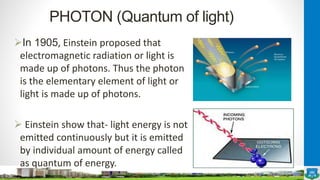
PHOTON (Quantum of light)
In 1905, Einstein proposed that
electromagnetic radiation or light is
made up of photons. Thus the photon
is the elementary element of light or
light is made up of photons.
 Einstein show that- light energy is not
emitted continuously but it is emitted
by individual amount of energy called
as quantum of energy.
Energy of photon
 According to Einstein, each photon of a
light wave of frequency has the energy E
is given by,
• E= hν ………1
 where E= energy of photon(joule)
h= planks constant (6.626 x 10⁻³⁴ J.s)
ν= frequency of photon (Hz)
Properties of photon
A photon does not have any mass.
A photon does not have any charge and are not deflected in electric field
or magnetic field.
All the quantum numbers are zero for a photon
In empty space, the photon moves at speed of light.
In the interaction of radiation with matter, radiation behaves as if it is
made up of particles called photons.
Photon is called as a virtual particles.
Photo electric effect
When a beam of light of sufficiently high frequency onto a
clean metal surface then the light will cause electrons to leave
the surface.
Definition : the phenomenon of emission of electrons by the
metals when they are exposed to light of suitable frequency is
called as the photo electric effect and emitted electrons is
called as photoelectrons
Photoelectric effect- working
when a beam of light fall on photosensitive metal plate
c which is called emitter.
Such a current is known as the photoelectric current
and measured by the micro meter connected in the
ckts.
Characteristic of photoelectric effect
• Photoelectric effect- When light of suitable frequency is
incident on metal surface then electrons are emitted from
surface called as Photoelectric effect.
• Characteristics of photoelectric effect-
1. Threshold frequency is different for different material.
2. Photoelectric current is directly proportional to intensity of
light.
3. Stopping potential is directly proportional to frequency.
4. The process is instantaneous.
Einstein photoelectric equation
Einstein’s photoelectric function- According to
quantum theory, radiation is considered as shower
of particles called photons.
Energy of photon absorbed by the atom (hυ) is
1. Used to detach the electron (W0) and
2. K.E. is given to electron.
hυ= W0 + K.E.
hυ= W0 +
1
2
𝑀𝑉2
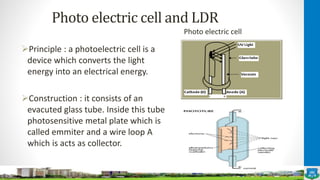
Photo electric cell and LDR
Principle : a photoelectric cell is a
device which converts the light
energy into an electrical energy.
Construction : it consists of an
evacuted glass tube. Inside this tube
photosensitive metal plate which is
called emmiter and a wire loop A
which is acts as collector.
Photo electric cell
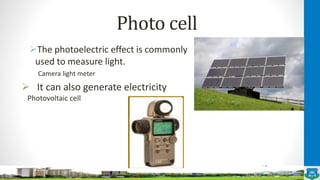
Photo cell
The photoelectric effect is commonly
used to measure light.
Camera light meter
 It can also generate electricity
Photovoltaic cell
Photo resistor (light dependent resistor)
Principle : A photo resistor or LDR is a resistor whose
resistance decreases with increasing incident light
intensity.
Symbol for LDR
CONSTRUCTIONAND OPERATIOIN OFLDR
Construction: a light sensitive material such as cadmium sulphide
(cds) is deposited on a ceramic substrate.
Light is incident on the light sensitive material throught the glass
cap or lens which is added at the top of this assembly.
OPERATION :when light is incident on the photosensitive
semiconductor material, the incident photons collide with the
atoms of light sensitive material and impart energy to them.
Due to this energy, the valence electron will cross the forbidden
energy gap and enters into conduction band.
photo electric effect & it's application

photo electric effect & it's application

  • 1.
  • 2.
    Group members 1.Md. MahfuzurRahman (171-33-3866) 2.Md. Iqbal Hossain (171-33-3874) 3.Md. Razib Sarkar (171-33-3964) 4.Md. Sohel Rana (171-33-3956) 5. Md. Sanaulla (171-33-3943)
  • 3.
    Our presentation topic: Photo electric effect & it’s application
  • 4.
    What is photoelectric effect? Each particle of light, called a photon, collides with an electron and uses some of its energy to dislodge the electron. The rest of the photon's energy transfers to the free negative charge, called a photoelectron.
  • 5.
    PHOTON (Quantum oflight) In 1905, Einstein proposed that electromagnetic radiation or light is made up of photons. Thus the photon is the elementary element of light or light is made up of photons.  Einstein show that- light energy is not emitted continuously but it is emitted by individual amount of energy called as quantum of energy.
  • 6.
    Energy of photon According to Einstein, each photon of a light wave of frequency has the energy E is given by, • E= hν ………1  where E= energy of photon(joule) h= planks constant (6.626 x 10⁻³⁴ J.s) ν= frequency of photon (Hz)
  • 7.
    Properties of photon Aphoton does not have any mass. A photon does not have any charge and are not deflected in electric field or magnetic field. All the quantum numbers are zero for a photon In empty space, the photon moves at speed of light. In the interaction of radiation with matter, radiation behaves as if it is made up of particles called photons. Photon is called as a virtual particles.
  • 8.
    Photo electric effect Whena beam of light of sufficiently high frequency onto a clean metal surface then the light will cause electrons to leave the surface. Definition : the phenomenon of emission of electrons by the metals when they are exposed to light of suitable frequency is called as the photo electric effect and emitted electrons is called as photoelectrons
  • 9.
    Photoelectric effect- working whena beam of light fall on photosensitive metal plate c which is called emitter. Such a current is known as the photoelectric current and measured by the micro meter connected in the ckts.
  • 10.
    Characteristic of photoelectriceffect • Photoelectric effect- When light of suitable frequency is incident on metal surface then electrons are emitted from surface called as Photoelectric effect. • Characteristics of photoelectric effect- 1. Threshold frequency is different for different material. 2. Photoelectric current is directly proportional to intensity of light. 3. Stopping potential is directly proportional to frequency. 4. The process is instantaneous.
  • 11.
    Einstein photoelectric equation Einstein’sphotoelectric function- According to quantum theory, radiation is considered as shower of particles called photons. Energy of photon absorbed by the atom (hυ) is 1. Used to detach the electron (W0) and 2. K.E. is given to electron. hυ= W0 + K.E. hυ= W0 + 1 2 𝑀𝑉2
  • 12.
    Photo electric celland LDR Principle : a photoelectric cell is a device which converts the light energy into an electrical energy. Construction : it consists of an evacuted glass tube. Inside this tube photosensitive metal plate which is called emmiter and a wire loop A which is acts as collector. Photo electric cell
  • 13.
    Photo cell The photoelectriceffect is commonly used to measure light. Camera light meter  It can also generate electricity Photovoltaic cell
  • 14.
    Photo resistor (lightdependent resistor) Principle : A photo resistor or LDR is a resistor whose resistance decreases with increasing incident light intensity. Symbol for LDR
  • 15.
    CONSTRUCTIONAND OPERATIOIN OFLDR Construction:a light sensitive material such as cadmium sulphide (cds) is deposited on a ceramic substrate. Light is incident on the light sensitive material throught the glass cap or lens which is added at the top of this assembly. OPERATION :when light is incident on the photosensitive semiconductor material, the incident photons collide with the atoms of light sensitive material and impart energy to them. Due to this energy, the valence electron will cross the forbidden energy gap and enters into conduction band.