LEEJA S S 
PHYSICAL SCIENCE 
ROLL NO:11
Photoelectric Effect 
Theory
Einstein’s Theory 
 The photoelectric effect is 
interpreted with photons and 
the conservation of energy 
with the equation: 
hf = f + ½ mv2 
hf equals the energy 
of each photon 
Source: http://www.westga.edu/~chem/courses/chem410/410_08/sld017.htm
Kinetic energy of emitted 
electron vs. Light frequency 
 Higher-frequency photons have more energy, so 
they should make the electrons come flying out 
faster; thus, switching to light with the same 
intensity but a higher frequency should increase 
the maximum kinetic energy of the emitted 
electrons. If you leave the frequency the same 
but crank up the intensity, more electrons 
should come out (because there are more 
photons to hit them), but they won't come out 
any faster, because each individual photon still 
has the same energy. And if the frequency is 
low enough, then none of the photons will have 
enough energy to knock an electron out of an 
atom. So if you use really low-frequency light, 
you shouldn't get any electrons, no matter how 
high the intensity is. Whereas if you use a high 
frequency, you should still knock out some 
electrons even if the intensity is very low. 
Source: http://online.cctt.org/physicslab/ 
content/PhyAPB/lessonnotes/dualnature/ 
photoelectric.asp
Simple Photoelectric Experiment 
Source: http://sol.sci.uop.edu/~jfalward/particlesandwaves/phototube.jpg
Photoelectric Effect 
Applications
Applications 
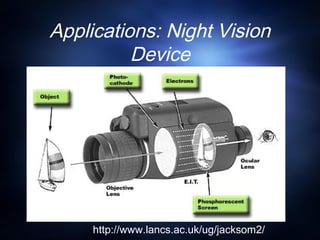
 The Photoelectric effect has numerous applications, for example 
night vision devices take advantage of the effect. Photons entering 
the device strike a plate which causes electrons to be emitted, these 
pass through a disk consisting of millions of channels, the current 
through these are amplified and directed towards a fluorescent 
screen which glows when electrons hit it. Image converters, image 
intensifiers, television camera tubes, and image storage tubes also 
take advantage of the point-by-point emission of the 
photocathode. In these devices an optical image incident on a 
semitransparent photocathode is used to transform the light image 
into an “electron image.” The electrons released by each element 
of the photoemitter are focused by an electron-optical device onto 
a fluorescent screen, reconverting it in the process again into an 
optical image
Applications: Night Vision 
Device 
http://www.lancs.ac.uk/ug/jacksom2/
Photoelectric Effect Applications 
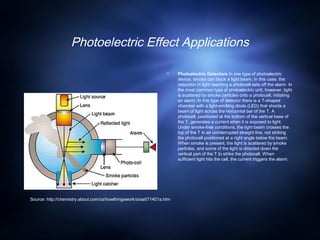
 Photoelectric Detectors In one type of photoelectric 
device, smoke can block a light beam. In this case, the 
reduction in light reaching a photocell sets off the alarm. In 
the most common type of photoelectric unit, however, light 
is scattered by smoke particles onto a photocell, initiating 
an alarm. In this type of detector there is a T-shaped 
chamber with a light-emitting diode (LED) that shoots a 
beam of light across the horizontal bar of the T. A 
photocell, positioned at the bottom of the vertical base of 
the T, generates a current when it is exposed to light. 
Under smoke-free conditions, the light beam crosses the 
top of the T in an uninterrupted straight line, not striking 
the photocell positioned at a right angle below the beam. 
When smoke is present, the light is scattered by smoke 
particles, and some of the light is directed down the 
vertical part of the T to strike the photocell. When 
sufficient light hits the cell, the current triggers the alarm. 
Source: http://chemistry.about.com/cs/howthingswork/a/aa071401a.htm
Photoelectric Smoke Detector 
Source: http://www.bassburglaralarms.com/images_products/d350rpl_addressable_duct_smoke_detector_b10685.jpg
THANK YOU

PHOTOELECTRIC EFFECT

  • 1.
    LEEJA S S PHYSICAL SCIENCE ROLL NO:11
  • 2.
  • 3.
    Einstein’s Theory The photoelectric effect is interpreted with photons and the conservation of energy with the equation: hf = f + ½ mv2 hf equals the energy of each photon Source: http://www.westga.edu/~chem/courses/chem410/410_08/sld017.htm
  • 4.
    Kinetic energy ofemitted electron vs. Light frequency  Higher-frequency photons have more energy, so they should make the electrons come flying out faster; thus, switching to light with the same intensity but a higher frequency should increase the maximum kinetic energy of the emitted electrons. If you leave the frequency the same but crank up the intensity, more electrons should come out (because there are more photons to hit them), but they won't come out any faster, because each individual photon still has the same energy. And if the frequency is low enough, then none of the photons will have enough energy to knock an electron out of an atom. So if you use really low-frequency light, you shouldn't get any electrons, no matter how high the intensity is. Whereas if you use a high frequency, you should still knock out some electrons even if the intensity is very low. Source: http://online.cctt.org/physicslab/ content/PhyAPB/lessonnotes/dualnature/ photoelectric.asp
  • 5.
    Simple Photoelectric Experiment Source: http://sol.sci.uop.edu/~jfalward/particlesandwaves/phototube.jpg
  • 6.
  • 7.
    Applications  ThePhotoelectric effect has numerous applications, for example night vision devices take advantage of the effect. Photons entering the device strike a plate which causes electrons to be emitted, these pass through a disk consisting of millions of channels, the current through these are amplified and directed towards a fluorescent screen which glows when electrons hit it. Image converters, image intensifiers, television camera tubes, and image storage tubes also take advantage of the point-by-point emission of the photocathode. In these devices an optical image incident on a semitransparent photocathode is used to transform the light image into an “electron image.” The electrons released by each element of the photoemitter are focused by an electron-optical device onto a fluorescent screen, reconverting it in the process again into an optical image
  • 8.
    Applications: Night Vision Device http://www.lancs.ac.uk/ug/jacksom2/
  • 9.
    Photoelectric Effect Applications  Photoelectric Detectors In one type of photoelectric device, smoke can block a light beam. In this case, the reduction in light reaching a photocell sets off the alarm. In the most common type of photoelectric unit, however, light is scattered by smoke particles onto a photocell, initiating an alarm. In this type of detector there is a T-shaped chamber with a light-emitting diode (LED) that shoots a beam of light across the horizontal bar of the T. A photocell, positioned at the bottom of the vertical base of the T, generates a current when it is exposed to light. Under smoke-free conditions, the light beam crosses the top of the T in an uninterrupted straight line, not striking the photocell positioned at a right angle below the beam. When smoke is present, the light is scattered by smoke particles, and some of the light is directed down the vertical part of the T to strike the photocell. When sufficient light hits the cell, the current triggers the alarm. Source: http://chemistry.about.com/cs/howthingswork/a/aa071401a.htm
  • 10.
    Photoelectric Smoke Detector Source: http://www.bassburglaralarms.com/images_products/d350rpl_addressable_duct_smoke_detector_b10685.jpg
  • 11.