TRAINING Myriam Vandenbergue
TRAINING AIM Make people acquire skills and knowledge  Make sure these skills and knowledge are profitable on the job (short or medium term)
TRAINING AND LEARNING Training will involve learning Definition of learning : Any relatively permanent change in behaviour that occurs as a result of experience
HOW PEOPLE LEARN Classical conditioning  – people respond to a specific stimulus (Pavlov) Operant conditioning  – desired voluntary behaviour leads to a reward or a punishment
HOW PEOPLE LEARN Social learning  – people can learn through observation and direct experience Reinforcement  – a desired behaviour is reinforced when it is demonstrated
KINDS OF TRAINING ORIENTATION A general overview of an area e.g. conducted by HR for new comers TASKS Can be formal and just-in-time Where to find the reference, the explanation (e.g. how to use the procedure book)
KINDS OF TRAINING TOOLS « things » used to produce the product Related to equipment SKILLS Necessary abilities and behaviours May be applied to a machine or human being
KINDS OF TRAINING PROCESSES Deal with the flow of product creation Actions among departments, areas and .. RULES, POLICIES AND PROCEDURES More specific parts of and orientation e.g. policy on safety rules…
TRAINING STRATEGIES ON THE JOB TRAINING ON THE JOB COACHING OFF-JOB COURSES SECONDMENT AND PROJECTS OPEN LEARNING
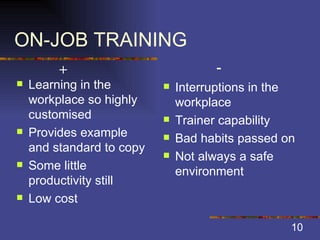
ON-JOB TRAINING Learning in the workplace so highly customised Provides example and standard to copy Some little productivity still Low cost Interruptions in the workplace Trainer capability Bad habits passed on Not always a safe environment + -
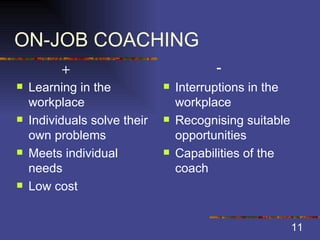
ON-JOB COACHING Learning in the workplace Individuals solve their own problems Meets individual needs Low cost Interruptions in the workplace Recognising suitable opportunities Capabilities of the coach + -
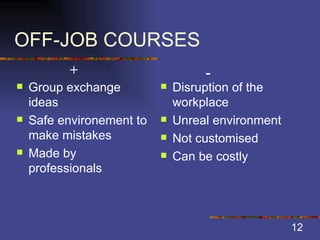
OFF-JOB COURSES Group exchange ideas Safe environement to make mistakes Made by professionals Disruption of the workplace Unreal environment Not customised Can be costly + -
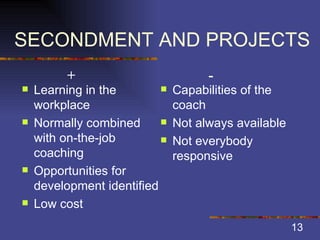
SECONDMENT AND PROJECTS Learning in the workplace Normally combined with on-the-job coaching Opportunities for development identified Low cost Capabilities of the coach Not always available Not everybody responsive + -
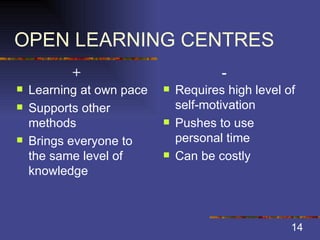
OPEN LEARNING CENTRES Learning at own pace Supports other methods Brings everyone to the same level of knowledge Requires high level of self-motivation Pushes to use personal time Can be costly + -
CHOOSING A STRATEGY Your choice of training strategy should be adapted to the audience and bear in mind the people involved It may therefore reveal some additional training needs. (e.g. coaching)
IDENTIFYING A TRAINING NEED Training needs often appear in front of change Change is a permanent situation in any company A training needs analysis is a useful tool
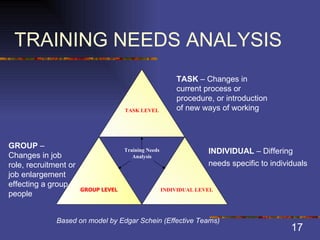
TRAINING NEEDS ANALYSIS TASK  – Changes in current process or procedure, or introduction of new ways of working  Based on model by Edgar Schein (Effective Teams)   GROUP  – Changes in job role, recruitment or job enlargement effecting a group of people   INDIVIDUAL  – Differing needs specific to individuals   Training Needs Analysis TASK LEVEL GROUP LEVEL INDIVIDUAL LEVEL
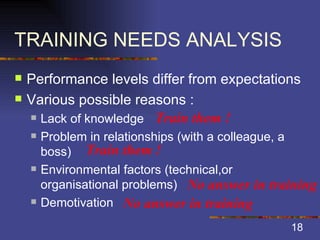
TRAINING NEEDS ANALYSIS Performance levels differ from expectations Various possible reasons : Lack of knowledge Problem in relationships (with a colleague, a boss) Environmental factors (technical,or organisational problems) Demotivation Train them ! Train them ! No answer in training No answer in training
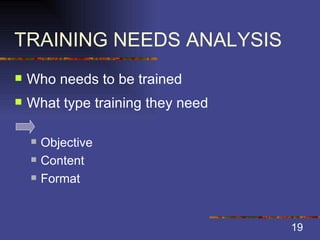
TRAINING NEEDS ANALYSIS Who needs to be trained What type training they need Objective Content Format
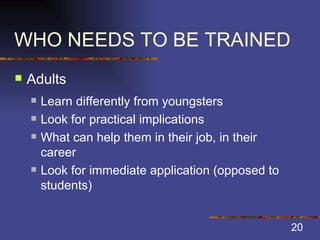
WHO NEEDS TO BE TRAINED Adults Learn differently from youngsters Look for practical implications What can help them in their job, in their career  Look for immediate application (opposed to students)
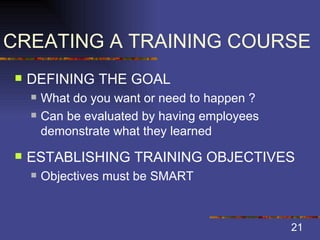
CREATING A TRAINING COURSE DEFINING THE GOAL What do you want or need to happen ? Can be evaluated by having employees demonstrate what they learned ESTABLISHING TRAINING OBJECTIVES Objectives must be SMART
CREATING A TRAINING COURSE DETERMINING THE AUDIENCE Vacationer  « You can’t teach me anything, I’m taking the day off » Prisoner  « You can’t teach me anything, I was told to be there » Graduate  « You can’t teach me anything, I know this stuff already » Student  « I’m here to learn »
DEVELOPING THE TRAINING Don’t re-invent the wheel – look around and collect ideas from peers Remember the full learning cycle : Responding Applying Evaluating
AUDIENCE PARTICIPATION METHODS Passive methods Books Lsitening to presentations Watching Active methods Brainstorming / Guided discussion Case studies Games / Roleplaying
SOME HINTS WE LEARN 1% through taste 1.5% through touch 3.5% through smell 11% through hearing 83% through sight
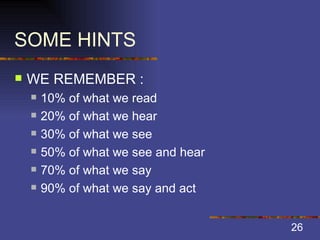
SOME HINTS WE REMEMBER : 10% of what we read 20% of what we hear 30% of what we see 50% of what we see and hear 70% of what we say 90% of what we say and act
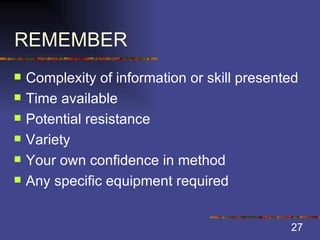
REMEMBER Complexity of information or skill presented Time available Potential resistance Variety Your own confidence in method Any specific equipment required
DELIVERING THE TRAINING Beforehand, practise, practise, practise … Adapt the content as you go ahead
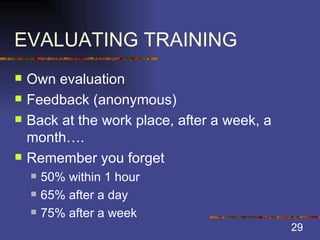
EVALUATING TRAINING Own evaluation Feedback (anonymous) Back at the work place, after a week, a month…. Remember you forget  50% within 1 hour 65% after a day 75% after a week
HAPPY TRAINING !!

Training

  • 1.
  • 2.
    TRAINING AIM Makepeople acquire skills and knowledge Make sure these skills and knowledge are profitable on the job (short or medium term)
  • 3.
    TRAINING AND LEARNINGTraining will involve learning Definition of learning : Any relatively permanent change in behaviour that occurs as a result of experience
  • 4.
    HOW PEOPLE LEARNClassical conditioning – people respond to a specific stimulus (Pavlov) Operant conditioning – desired voluntary behaviour leads to a reward or a punishment
  • 5.
    HOW PEOPLE LEARNSocial learning – people can learn through observation and direct experience Reinforcement – a desired behaviour is reinforced when it is demonstrated
  • 6.
    KINDS OF TRAININGORIENTATION A general overview of an area e.g. conducted by HR for new comers TASKS Can be formal and just-in-time Where to find the reference, the explanation (e.g. how to use the procedure book)
  • 7.
    KINDS OF TRAININGTOOLS « things » used to produce the product Related to equipment SKILLS Necessary abilities and behaviours May be applied to a machine or human being
  • 8.
    KINDS OF TRAININGPROCESSES Deal with the flow of product creation Actions among departments, areas and .. RULES, POLICIES AND PROCEDURES More specific parts of and orientation e.g. policy on safety rules…
  • 9.
    TRAINING STRATEGIES ONTHE JOB TRAINING ON THE JOB COACHING OFF-JOB COURSES SECONDMENT AND PROJECTS OPEN LEARNING
  • 10.
    ON-JOB TRAINING Learningin the workplace so highly customised Provides example and standard to copy Some little productivity still Low cost Interruptions in the workplace Trainer capability Bad habits passed on Not always a safe environment + -
  • 11.
    ON-JOB COACHING Learningin the workplace Individuals solve their own problems Meets individual needs Low cost Interruptions in the workplace Recognising suitable opportunities Capabilities of the coach + -
  • 12.
    OFF-JOB COURSES Groupexchange ideas Safe environement to make mistakes Made by professionals Disruption of the workplace Unreal environment Not customised Can be costly + -
  • 13.
    SECONDMENT AND PROJECTSLearning in the workplace Normally combined with on-the-job coaching Opportunities for development identified Low cost Capabilities of the coach Not always available Not everybody responsive + -
  • 14.
    OPEN LEARNING CENTRESLearning at own pace Supports other methods Brings everyone to the same level of knowledge Requires high level of self-motivation Pushes to use personal time Can be costly + -
  • 15.
    CHOOSING A STRATEGYYour choice of training strategy should be adapted to the audience and bear in mind the people involved It may therefore reveal some additional training needs. (e.g. coaching)
  • 16.
    IDENTIFYING A TRAININGNEED Training needs often appear in front of change Change is a permanent situation in any company A training needs analysis is a useful tool
  • 17.
    TRAINING NEEDS ANALYSISTASK – Changes in current process or procedure, or introduction of new ways of working Based on model by Edgar Schein (Effective Teams) GROUP – Changes in job role, recruitment or job enlargement effecting a group of people INDIVIDUAL – Differing needs specific to individuals Training Needs Analysis TASK LEVEL GROUP LEVEL INDIVIDUAL LEVEL
  • 18.
    TRAINING NEEDS ANALYSISPerformance levels differ from expectations Various possible reasons : Lack of knowledge Problem in relationships (with a colleague, a boss) Environmental factors (technical,or organisational problems) Demotivation Train them ! Train them ! No answer in training No answer in training
  • 19.
    TRAINING NEEDS ANALYSISWho needs to be trained What type training they need Objective Content Format
  • 20.
    WHO NEEDS TOBE TRAINED Adults Learn differently from youngsters Look for practical implications What can help them in their job, in their career Look for immediate application (opposed to students)
  • 21.
    CREATING A TRAININGCOURSE DEFINING THE GOAL What do you want or need to happen ? Can be evaluated by having employees demonstrate what they learned ESTABLISHING TRAINING OBJECTIVES Objectives must be SMART
  • 22.
    CREATING A TRAININGCOURSE DETERMINING THE AUDIENCE Vacationer « You can’t teach me anything, I’m taking the day off » Prisoner « You can’t teach me anything, I was told to be there » Graduate « You can’t teach me anything, I know this stuff already » Student « I’m here to learn »
  • 23.
    DEVELOPING THE TRAININGDon’t re-invent the wheel – look around and collect ideas from peers Remember the full learning cycle : Responding Applying Evaluating
  • 24.
    AUDIENCE PARTICIPATION METHODSPassive methods Books Lsitening to presentations Watching Active methods Brainstorming / Guided discussion Case studies Games / Roleplaying
  • 25.
    SOME HINTS WELEARN 1% through taste 1.5% through touch 3.5% through smell 11% through hearing 83% through sight
  • 26.
    SOME HINTS WEREMEMBER : 10% of what we read 20% of what we hear 30% of what we see 50% of what we see and hear 70% of what we say 90% of what we say and act
  • 27.
    REMEMBER Complexity ofinformation or skill presented Time available Potential resistance Variety Your own confidence in method Any specific equipment required
  • 28.
    DELIVERING THE TRAININGBeforehand, practise, practise, practise … Adapt the content as you go ahead
  • 29.
    EVALUATING TRAINING Ownevaluation Feedback (anonymous) Back at the work place, after a week, a month…. Remember you forget 50% within 1 hour 65% after a day 75% after a week
  • 30.