Refreshment training
for TVET TOT trainers
Teaching Methods
Canopy Hotel, Adama
March 2023
Training outline
• Definition of basic terms
• Tips on Learning theories
• Training Methods
• Training Materials
• Session planning
Definition of basic terms
• Training
• Teaching
• Learning
• Education
• Professional Development
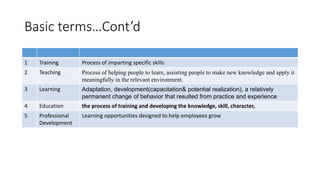
Basic terms…Cont’d
1 Training Process of imparting specific skills
2 Teaching Process of helping people to learn, assisting people to make new knowledge and apply it
meaningfully in the relevant environment.
3 Learning Adaptation, development(capacitation& potential realization), a relatively
permanent change of behavior that resulted from practice and experience
4 Education the process of training and developing the knowledge, skill, character,
5 Professional
Development
Learning opportunities designed to help employees grow
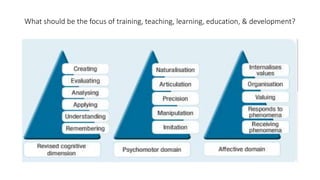
What should be the focus of training, teaching, learning, education, & development?
What are the unique features of an Effective trainer?
• Encourage trainees
• Encourage cooperation among trainees
• Encourage active learning
• Give prompt feedback
• Communicate high expectations
• Respect diverse talents and ways of learning
• Organized and prepared
• Communicate enthusiasm
• Be fair and ethical
Activity
1. Work in groups of five members each and explain the relationship
between the basic terms
2. Describe the levels of the learning domains around which training,
teaching, learning, education, and development should be
organized
3. Elaborate on the unique characteristics of effective training, and
support your elaborations with lived experiences from your
observation (professional life)
Synergy between Devt., Education and
Training
Professional
Development
Education
Training
Learning opportunities
designed to help
employees grow
Theoretical Learning in
the classroom
Process of imparting
specific skills
Tips on theories of Learning
• Behavioural Learning theories
• Cognitive learning theories
• Social Learning theory
• Constructive learning theory
Tips…Cont’d
1) Behavioural learning theories
• ‘Environment plays a decisive role in learning’ is the basic assumption
• Trainer’s role is direct and controls the training process and the trainer
• The trainer passively receives the knowledge/skill/ethics communicated by
the trainer
• Assessment is based on recalling of what has been taught
Tips… Cont’d
2) Cognitive Learning Theories
• Learning is inherently internal processing and resulted of an individual’s effort
• The trainer’s role is not to teach the content but to help trainees learn the
content by themselves (show cognitive strategies)
• Using cognitive strategies, trainees process the learned information to store in
and retrieve the knowledge/skills
• Process assessment is more prioritized than product assessment
Tips…Cont’d
3) Social Learning theory (reciprocal determinism)
• Learning happens through observing others (models)
• Trainer’s role is to bring good models, create models, reinforce models, and
be a good model
• Trainees attentively observe, retain, reproduce the model’s actions, and show
motivation to follow the model
Tips…Cont’d
4) Constructivism Learning theories
• Learning is construction/co-construction of knowledge by the learner
• For meaningful learning to take place, trainees should actively engage in
learning
• Trainer is facilitator/one who guides the learner to construct/co-construct
knowledge
• The training materials are full of learning experiences/job sheets prepared for
trainees to complete
• Assessment is authentic/takes place in real world scenario
Activity
1. Which learning theory/theories should guide our knowledge of
training in the upcoming training? Why?
2. Elicit specific scenarios where you applied the above mentioned
learning theories in your training sessions, and share your
experiences to audiences
3. Assume that an eclectic theory functions best, and work in groups
and identify skills/knowledge/character that should be imparted
using each of the theories
Training Methods
 What is a training method?
 A training method is a "strategy" that we use to deliver the
"content" so that the trainees will achieve the objectives.
 A means through which trainers communicate learning contents
and experiences
 A specific training method may use a variety of techniques to enhance
the effectiveness of the learning process.
 There are two approaches of training
 Trainer-centered (content focused)
 Trainee-centered (interactive/participative)
Methods…Cont’d
1) Trainer-centred approach
• Guided by knowledge from behaviourist learning theories
• Priority is given to transmitting knowledge/skills/character worth of learning
• Trainer is considered master of the knowledge/skill/character transmitted
• Examples of teaching methods
• Lecture method
• Trainer demonstration
• Direct instruction
Methods…Cont’d
2) Trainee-Centred approach
• Guided by knowledge derived mainly from constructivist learning theories
• Priority is given to prior learning/background knowledge/skill character for
constructing/developing new knowledge/skill/character
• Trainer is a ‘senior learner’ but not a purveyor of all the
knowledge/skills/character (he/she is a resource not an authority)
• Examples of teaching methods like
• Role play, drama, group discussion, goldfish bowl, pyramiding, cross-over, hot seating,
jigsaw, case method, project method, inquiry learning etc.
• No approach/method is complete by itself (*blending is important)
Specific Training Methods
• Lecture Method
• Brainstorming
• Role play,
• Drama,
• Group discussion,
• Goldfish bowl,
• Pyramiding,
• Cross-over group,
• Hot seating,
• Jigsaw,
• Case method,
• Project method,
• Inquiry learning
Activity
1. Google and enumerate the merits and demerits of each of the
methods listed above
2. List contents from the trainings you are supposed to provide for,
and then relate the contents with a relevant teaching method.
Explain the rationales why you relate a specific content with specific
training method
3. Do you think there could be a single best training method that is
suitable to train every content? Why/how?
Necessity of Variety of training methods
 To meet and maintain trainees’ interest, preference, and
involvement so as to enhance learning effectiveness.
 There isn’t just one way of delivering a lesson effectively
 Every training method has merits and demerits, using differet
training methods can maximize the merits and minimize the
demeritis
Criteria for selecting training methods
1. Course objectives
2. Equipment needed
3. Time available
4. Degree of participation expected
5. Participant’s level of understanding
6. Facilities available
7. Any previous experience
8. Size of group
9. Financial resources available
Training materials
• Classified into three categories based on the learning style of trainers
• Visual
• Auditory
• Audio-visual
Activity
1. List down the training materials you use while providing trainings
2. Share your experience how you prove that these training methods
can address the learning needs of trainees with diversified learning
styles
Planning Training
• Brainstorm
1. What is a session plan? Why we need it? (To fail to plan is to plan to
fail)
2. How we develop session plans? What are its constituents?
3. Share your experience of session planning
Definition of a plan
• A plan is a guide map for action;
• A plan is an experience in anticipatory teaching;
• A plan is a blue print;
• A plan is a direction for future activities, etc.
Session plans…Cont’d
• Some importance of a session plan
• Gives the trainers and learners clear idea of where they are, where they are
going and what they are doing;
• Enables to record the training sessions that the trainers have completed;
• Gives the trainers a starting point if they have to do the training again with
another learner or group of learners;
• Give the trainers a firm base to review their performance
Session plan…Cont’d
Merits of an instructional plan
• Helps ensure subject mastery;
• Enables to select appropriate instructional methods;
• Develops more confidence;
• Enables to use different instructional media;
• Realizes wise usage of time;
• Fixes the direction of teaching-learning process;
• Helps avoid needles repetition;
• Gives outline to follow as one teaches a lesson;
• Enables to anticipate the implementation of activities;
• Assures the attainability of instructional objectives, etc.
Criteria for a quality lesson plan
• Objectivity: denotes that a session plan
• Logical Sequence: plan should be arranged in logical order. proceed
from simple to difficult, etc.
• Flexibility: plan should be open to make necessary amendments
• Comprehensiveness: a session plan should include the major
elements such as objectives, contents, methods, media, time,
activities, evaluation mechanisms, etc.
• Clarity and Simplicity: an instructional plan should be written in clear
and simple languages.
Fundamental Questions of Instructional
(session) Planning
• Why to teach? Understanding the objectives to be achieved
• What to teach? Knowing and mastering the contents
• How to teach? Selection of appropriate methods
• Whom to teach? refers to the identification of the learnersand background
of the learners.
• When to teach? Knowing the solid number of working days and total
allotted periods for the subject.
• How much to teach? w/c refers to making decision on the amount of
contents and activities within the given time.
• Where to teach? Understanding the environment such as climate, location
of the school and out of the school
Thank you!

Training Methods.pptx

  • 1.
    Refreshment training for TVETTOT trainers Teaching Methods Canopy Hotel, Adama March 2023
  • 2.
    Training outline • Definitionof basic terms • Tips on Learning theories • Training Methods • Training Materials • Session planning
  • 3.
    Definition of basicterms • Training • Teaching • Learning • Education • Professional Development
  • 4.
    Basic terms…Cont’d 1 TrainingProcess of imparting specific skills 2 Teaching Process of helping people to learn, assisting people to make new knowledge and apply it meaningfully in the relevant environment. 3 Learning Adaptation, development(capacitation& potential realization), a relatively permanent change of behavior that resulted from practice and experience 4 Education the process of training and developing the knowledge, skill, character, 5 Professional Development Learning opportunities designed to help employees grow
  • 5.
    What should bethe focus of training, teaching, learning, education, & development?
  • 6.
    What are theunique features of an Effective trainer? • Encourage trainees • Encourage cooperation among trainees • Encourage active learning • Give prompt feedback • Communicate high expectations • Respect diverse talents and ways of learning • Organized and prepared • Communicate enthusiasm • Be fair and ethical
  • 7.
    Activity 1. Work ingroups of five members each and explain the relationship between the basic terms 2. Describe the levels of the learning domains around which training, teaching, learning, education, and development should be organized 3. Elaborate on the unique characteristics of effective training, and support your elaborations with lived experiences from your observation (professional life)
  • 8.
    Synergy between Devt.,Education and Training Professional Development Education Training Learning opportunities designed to help employees grow Theoretical Learning in the classroom Process of imparting specific skills
  • 9.
    Tips on theoriesof Learning • Behavioural Learning theories • Cognitive learning theories • Social Learning theory • Constructive learning theory
  • 10.
    Tips…Cont’d 1) Behavioural learningtheories • ‘Environment plays a decisive role in learning’ is the basic assumption • Trainer’s role is direct and controls the training process and the trainer • The trainer passively receives the knowledge/skill/ethics communicated by the trainer • Assessment is based on recalling of what has been taught
  • 11.
    Tips… Cont’d 2) CognitiveLearning Theories • Learning is inherently internal processing and resulted of an individual’s effort • The trainer’s role is not to teach the content but to help trainees learn the content by themselves (show cognitive strategies) • Using cognitive strategies, trainees process the learned information to store in and retrieve the knowledge/skills • Process assessment is more prioritized than product assessment
  • 12.
    Tips…Cont’d 3) Social Learningtheory (reciprocal determinism) • Learning happens through observing others (models) • Trainer’s role is to bring good models, create models, reinforce models, and be a good model • Trainees attentively observe, retain, reproduce the model’s actions, and show motivation to follow the model
  • 13.
    Tips…Cont’d 4) Constructivism Learningtheories • Learning is construction/co-construction of knowledge by the learner • For meaningful learning to take place, trainees should actively engage in learning • Trainer is facilitator/one who guides the learner to construct/co-construct knowledge • The training materials are full of learning experiences/job sheets prepared for trainees to complete • Assessment is authentic/takes place in real world scenario
  • 14.
    Activity 1. Which learningtheory/theories should guide our knowledge of training in the upcoming training? Why? 2. Elicit specific scenarios where you applied the above mentioned learning theories in your training sessions, and share your experiences to audiences 3. Assume that an eclectic theory functions best, and work in groups and identify skills/knowledge/character that should be imparted using each of the theories
  • 15.
    Training Methods  Whatis a training method?  A training method is a "strategy" that we use to deliver the "content" so that the trainees will achieve the objectives.  A means through which trainers communicate learning contents and experiences  A specific training method may use a variety of techniques to enhance the effectiveness of the learning process.  There are two approaches of training  Trainer-centered (content focused)  Trainee-centered (interactive/participative)
  • 16.
    Methods…Cont’d 1) Trainer-centred approach •Guided by knowledge from behaviourist learning theories • Priority is given to transmitting knowledge/skills/character worth of learning • Trainer is considered master of the knowledge/skill/character transmitted • Examples of teaching methods • Lecture method • Trainer demonstration • Direct instruction
  • 17.
    Methods…Cont’d 2) Trainee-Centred approach •Guided by knowledge derived mainly from constructivist learning theories • Priority is given to prior learning/background knowledge/skill character for constructing/developing new knowledge/skill/character • Trainer is a ‘senior learner’ but not a purveyor of all the knowledge/skills/character (he/she is a resource not an authority) • Examples of teaching methods like • Role play, drama, group discussion, goldfish bowl, pyramiding, cross-over, hot seating, jigsaw, case method, project method, inquiry learning etc. • No approach/method is complete by itself (*blending is important)
  • 18.
    Specific Training Methods •Lecture Method • Brainstorming • Role play, • Drama, • Group discussion, • Goldfish bowl, • Pyramiding, • Cross-over group, • Hot seating, • Jigsaw, • Case method, • Project method, • Inquiry learning
  • 19.
    Activity 1. Google andenumerate the merits and demerits of each of the methods listed above 2. List contents from the trainings you are supposed to provide for, and then relate the contents with a relevant teaching method. Explain the rationales why you relate a specific content with specific training method 3. Do you think there could be a single best training method that is suitable to train every content? Why/how?
  • 20.
    Necessity of Varietyof training methods  To meet and maintain trainees’ interest, preference, and involvement so as to enhance learning effectiveness.  There isn’t just one way of delivering a lesson effectively  Every training method has merits and demerits, using differet training methods can maximize the merits and minimize the demeritis
  • 21.
    Criteria for selectingtraining methods 1. Course objectives 2. Equipment needed 3. Time available 4. Degree of participation expected 5. Participant’s level of understanding 6. Facilities available 7. Any previous experience 8. Size of group 9. Financial resources available
  • 22.
    Training materials • Classifiedinto three categories based on the learning style of trainers • Visual • Auditory • Audio-visual Activity 1. List down the training materials you use while providing trainings 2. Share your experience how you prove that these training methods can address the learning needs of trainees with diversified learning styles
  • 23.
    Planning Training • Brainstorm 1.What is a session plan? Why we need it? (To fail to plan is to plan to fail) 2. How we develop session plans? What are its constituents? 3. Share your experience of session planning
  • 24.
    Definition of aplan • A plan is a guide map for action; • A plan is an experience in anticipatory teaching; • A plan is a blue print; • A plan is a direction for future activities, etc.
  • 25.
    Session plans…Cont’d • Someimportance of a session plan • Gives the trainers and learners clear idea of where they are, where they are going and what they are doing; • Enables to record the training sessions that the trainers have completed; • Gives the trainers a starting point if they have to do the training again with another learner or group of learners; • Give the trainers a firm base to review their performance
  • 26.
    Session plan…Cont’d Merits ofan instructional plan • Helps ensure subject mastery; • Enables to select appropriate instructional methods; • Develops more confidence; • Enables to use different instructional media; • Realizes wise usage of time; • Fixes the direction of teaching-learning process; • Helps avoid needles repetition; • Gives outline to follow as one teaches a lesson; • Enables to anticipate the implementation of activities; • Assures the attainability of instructional objectives, etc.
  • 27.
    Criteria for aquality lesson plan • Objectivity: denotes that a session plan • Logical Sequence: plan should be arranged in logical order. proceed from simple to difficult, etc. • Flexibility: plan should be open to make necessary amendments • Comprehensiveness: a session plan should include the major elements such as objectives, contents, methods, media, time, activities, evaluation mechanisms, etc. • Clarity and Simplicity: an instructional plan should be written in clear and simple languages.
  • 28.
    Fundamental Questions ofInstructional (session) Planning • Why to teach? Understanding the objectives to be achieved • What to teach? Knowing and mastering the contents • How to teach? Selection of appropriate methods • Whom to teach? refers to the identification of the learnersand background of the learners. • When to teach? Knowing the solid number of working days and total allotted periods for the subject. • How much to teach? w/c refers to making decision on the amount of contents and activities within the given time. • Where to teach? Understanding the environment such as climate, location of the school and out of the school
  • 29.