Core Leadership Skills Series
Train the
Trainer
Agenda: Train the Trainer
 Day 1
Welcome
Introduction of Participants , Session Description and Objectives
Analyzing the Need for Training
7 Rules for a Successful Training Program
Break
Exercise: The Worst Training that I Ever Had
Principles of Adult Learning
The Four Basic Stages in the Learning Process
Exercise: Learning Style Inventory
Lunch
Film: TED
Exercise: The Trainer Type Inventory
Planning Training
Break
Identify Your Training Goals
Identify Your Target Audience
Identify Learning Objectives
Exercise: Learning Objectives
Identify Training Content
Homework: Mock Training Exercise
Agenda: Train the Trainer
 Day 2
Welcome
Identify Training Methods/Resources/Activities
Exercise: Brainstorm Training Methods
Identify Learning Evaluation Strategies
Break
Develop a Course Outline
Exercise: Developing a Course Outline
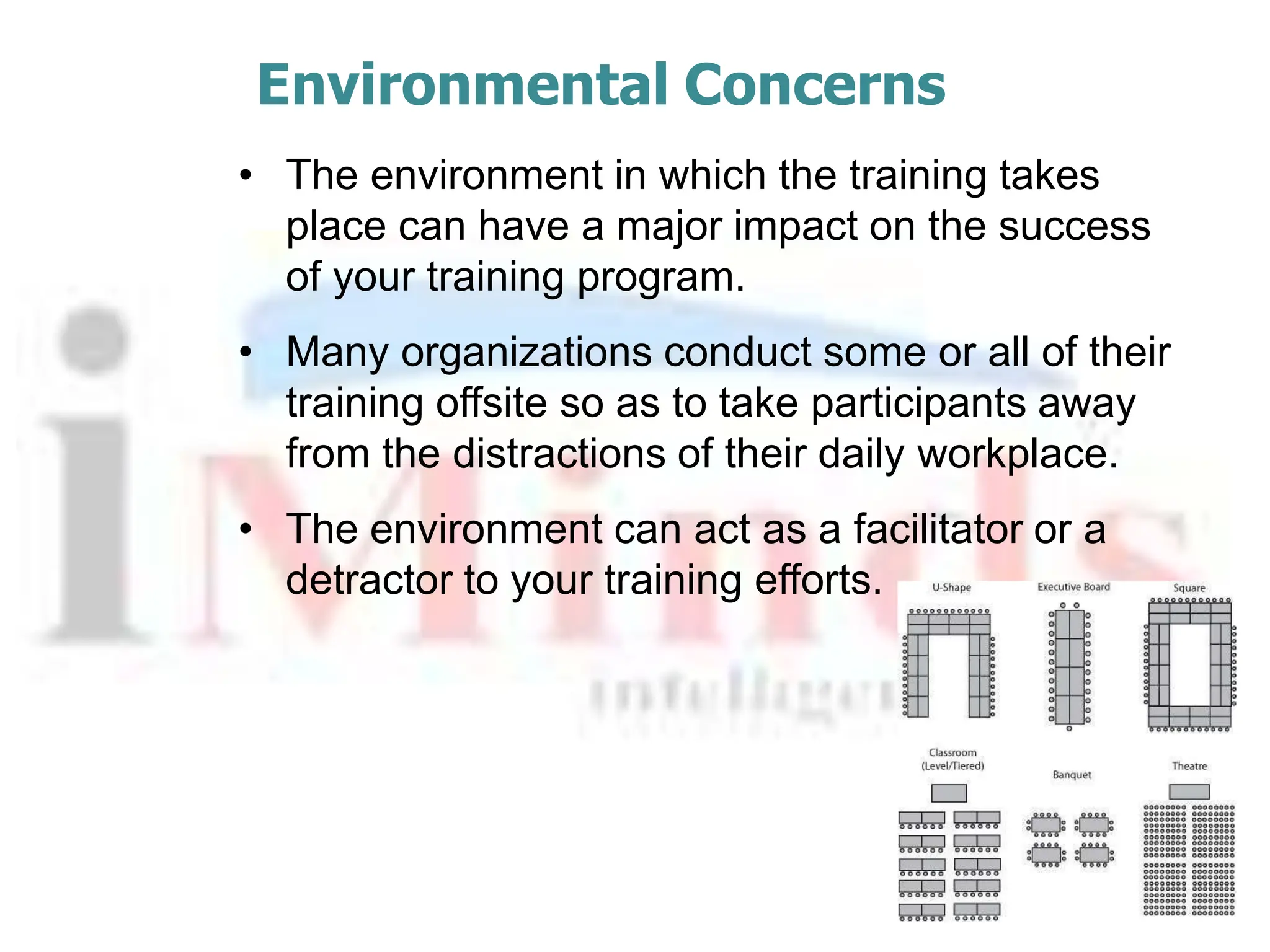
Environmental Concerns
Common Errors in Training
Lunch
Mock Training Presentations
Break
Characteristics of an Effective Trainer
Exercise: Self Analysis
Facilitating Group Discussions
Dealing with Difficult Trainees
Making Training Fun
Exercise: Visual Aids/Brainstorm
Review and Action Plan
Course Evaluation
Group Feedback
Welcome: Day 1
The process of developing new skills should include
the following:
• Identify a needed skill area.
• Agree on a learning method for improvement.
• Practice and receive feedback.
• Increase awareness of the effects of performance on
others.
• Measure change within a well-defined timeframe.
• Recognize and reward skill enhancement.
Introduction of Participants
• Who are you?
• Why are you here?
• What moment in your life would you
like to replay?
• What are five strengths you bring to
this class?
• What would you like to take away
from this session?
Learning Objectives
• Identify the characteristics of an exceptional trainer.
• Explain how adults differ from children in the way they
learn.
• Understand and identify different behavioral styles and
adapt training as necessary.
• Explain what a solid training program looks like.
• Describe a needs analysis and why it is a necessary step
in any training program.
• Explain various methods for making lecture-based
programs active.
• Develop strategies for handling classroom disruptions.
• Point out the highlights and pitfalls of various visual aid
options and classroom seating arrangements.
Learning Objectives
• Present information in a clear, concise, engaging manner.
Participants will demonstrate successful understanding of key
concepts during a practice presentation.
• Recognize the importance of considering the participants and
their training needs, including the different learning styles and
adult learning principles.
• Write objectives and evaluate whether these objectives have
been met at the end of a training session.
• Develop an effective training program using appropriate training
aids and techniques.
• Understand the importance of an instruction guide to help a
trainer prepare and deliver effectively and consistently.
• Conduct group training sessions that incorporates these training
concepts
• Devise an Action Plan on how they may take back their new
found skills back into the workplace.
Promote Lifelong Learning
You can develop lifelong learning traits:
• By showing curiosity about human nature and
how the world works.
• By seeking and valuing diversity.
• By persisting in seeking out new solutions.
• By using your unique talents and intelligence to
promote positive change.
• By learning and applying technology tools to
solve problems.
Show Respect
• Value yourself. Be honest and ethical, and
practice strong moral values.
• Treat all members of the school community and
with politeness and respect.
• Honor the ideas and opinions of others.
• Offer to help.
• Be responsible for keeping an open mind.
Policies
• Bring notebook, textbook, planner, and
appropriate writing tools to class.
• Ask questions at any time.
• Listen to all ideas and opinions.
• Leave for restroom when needed.
• Please be back from lunch and breaks on
time.
• Let us know if the day is not working for you.
Analyzing the Need for Training
• The analysis phase is the building block of a
training program. The basis for who must be
trained, what must be trained, when training will
occur, and where the training will take place are
accomplished in this phase.
Analyzing the Need for Training
7 Rules for a Successful Training Program
• Be Concise
• Be Focused
• Keep Schedule
• Use Experts
• Use Visuals
• Encourage Questions
• Create Reading Materials
Principles of Adult Learning
Adults Prefer Situations Which:
• Are Practical and Problem Centered
• Promote Their Positive Self-Esteem
• Integrate New Ideas with Existing Knowledge
• Maintain Respect for the Learner
• Capitalize on Their Experience
• Allow Choice and Self-Direction
Principles of Adult Learning
• The greater the combination of our senses that are
stimulated in learning, the more successful learning is
likely to be.
Four Basic Stages in the Learning Process
• Unconscious Incompetence
• Conscious Incompetence
• Conscious Competence
• Unconscious Competence
The Learning Style Inventory
• To gain a better understanding of yourself as a
learner, you need to evaluate the way you
prefer to learn or process information.
• The questionnaire in your workbook will allow
you to determine how you best like to learn.
• Answer the 14 questions in your workbook and
complete the scoring as described.
The Trainer Type Inventory
• The manner in which a trainer handles the
participants’ queries and interactions during the
training session has an immense effect on the
whole training. Trainers need to adapt their
approaches or styles depending on the situation
or the entry behavior of learners.
• Follow the instructions in your workbook on
Completing the Trainer Type Inventory.
• Identify which training styles you prefer. Review
the comments for your preferred type. Circle
those which most fit your style.
Planning Training
• A successful training program must be well
thought out in advance. The more complex the
goals are for the training, the more important it
is to have a plan that addresses all the major
points needed to facilitate your learning
objectives.
Planning Training
Planning Training
• Identify your training goals
• Identify your target audience
• Identify learning objectives
• Identify training content
• Identify training methods/resources/activities
• Identify learning evaluation strategies
• Develop a course outline
Identify Your Training Goals
• Many effective training programs will
incorporate multiple approaches. Designing a
training program that uses training approaches
that are appropriate for your organization will
work best when the goals of training are clearly
articulated.
• For Instance: Is the goal to create educators
with better leadership and management skills?
Identify Your Target Audience
• Who needs the training in the Organization?
• What attitudes will the trainees likely hold
towards the training?
• What KSAs do the trainees already possess?
• What specific KSAs would you want the
trainees to obtain?
• How do you collect the above information?
Identify Learning Objectives
• Learning objectives serve as the basis for the
design of the whole instructional plan, including
determining appropriate training content,
methodology, resources needed. They are
used in assessing training outcomes and they
are used to facilitate active learning.
How to Write a Learning Objective
1. Identify when the knowledge or skill is to be
demonstrated
2. Identify who is going to be able to demonstrate
the KDA
3. Provide a description of the expected
performance
4. Describe how well the performance must be
demonstrated
How to Write a Learning Objective
Ideal Learning Objectives Include:
• A Measurable verb
• The Condition to be performed
• The Standard for acceptable performance
Exercise: Learning Objectives
• Your workbook will have several examples of
learning objectives that are poorly written.
• Working in a small group, your task is to rewrite
the objectives so that they are accurate, clear
and concise.
• We will review all objectives when this activity is
completed.
Identify Training Content
• Training Content comes in various forms and
can be delivered in various ways. Training
content is basically the knowledge or
intellectual property behind a training program
or course you take.
• Leadership must be involved in the process of
identifying appropriate training content.
Identify Training Content
o Subject matter experts (Try phoning or emailing them. Many will be
happy to talk to you.) You can research book authors and college professors
who have written about your training topic and then contact them via email,
Facebook, LinkedIn or their websites.
o Books/tapes
o Industry or trade magazines
o Internet
o Lots of free material (A good deal of free material exists on many subjects)
o Lots of proprietary materials (Much material is copyrighted and may only be
available for sale or a licensingfee)
o Data bases available at libraries or universities
o Documentaries/films
o Surveys, questionnaires and reports
o Professional associations
o Trade associations
o Other?
o Other?
Identify Training Content
• Do NOT abuse the attention span
Take Home Assignment
Mock Training Presentation
• A mock training session is a simulated version of an actual
training exercise that you will conduct for the rest of the
class. This session will be held solely for the purpose of
practice, evaluation and feedback.
• The topic for each mock session will be selected by the
presenter. Please refer to your workbook for additional
information on this activity.
• Sessions will be five minutes in length.
Welcome: Day 2
• This is the second day of our 2 day Train the
Trainer program.
• Any comments or feedback on Day 1?
• Brief review of Agenda for Day 2
Identify Training Methods/
Resources/Activities
• When selecting a training method, answer
the following questions:
 Is this method appropriate for the objectives?
 Are there sufficient trainers available to use this
training method?
 Are there resources available to use this training
method?
 What is the projected size of the group to betrained?
 Is a special classroom arrangement required?
 Is this method appropriate for grouptraining,
individualized training, or both?
 What times are available for training?
 What is the background of the participants?
 Will the methods selected stimulate interestand
provide variety?
Exercise: Brainstorm Training
Methods
• In small groups, see how many different ideas
you can list for training methods or activities.
• Divide your list into Passive and Active Methods
• Select a spokesperson to share observations
and insights.
Identify Learning Evaluation
Strategies
A learning evaluation is an evaluation of the skills,
knowledge, or abilities acquired as a result of the
training program.
• Why do we evaluate?
• What do we evaluate?
• When do we evaluate?
• How can we evaluate?
Exercise: Developing a Course
Outline
• Using your workbook, read the scenario on
page 30.
• Working in small groups, you will need to
develop a course outline for the situation
described in the scenario. Be as specific as
you can.
• When you have completed the outline, be
prepared to share your results with the class.
Environmental Concerns
• The environment in which the training takes
place can have a major impact on the success
of your training program.
• Many organizations conduct some or all of their
training offsite so as to take participants away
from the distractions of their daily workplace.
• The environment can act as a facilitator or a
detractor to your training efforts.
Common Errors in Training
• Accepting constraints on how you train
• Training the subject and not the student
• Not listening
• Hiding mistakes
• Proving yourself competent to train
• Answering every question
• Letting ego train
• Missing the other layers
• Keeping rigidly to a script
• Believing the role
Mock Training Presentations
Mock Training Presentation
• Each student will present their training
presentation.
• Observers will be asked to evaluate the
presentation using the evaluation sheet handed
out. A copy is also in your workbook for
reference.
• We will conduct round robins after all evaluations
have been completed to identify pros and cons of
each presentation.
Exercise: Characteristics of an
Effective Trainer
• Refer to the participant workbook for this
activity.
• Review each of the “Characteristics” listed in
the workbook chart.
• Circle the five areas where you think you are
strongest.
• Circle the five areas where you think you are
most in need of improvement.
Facilitation Group Discussions
• Decide on group format in terms of size and
composition.
• Try to insure diversity in each group or team
• Stay neutral, let groups do their work
• Specify time limits for all activities
• Check periodically to see if groups will need
more time.
• Give groups a five minutes heads up before the
time allotted.
• Have groups provide feedback and comments
Dealing with Difficult Trainees
Here are some quick tips for dealing with an
annoying trainee:
• Don’t ignore it
• Empathize
• Let them be heard
• Include
Making Training Fun
• Most lectures are not fun because they do not engage the
participants. Lectures and most didactic methods, this
includes panel discussions, readings, audio and even
many video recordings are passive modes of instruction.
Such methods can be a great way of covering a lot of
material but it is hard to make them engaging and
interesting.
• By a wide margin, trainees seem to enjoy games and
simulations much more than didactic training methods.
Most participants want to be engaged and interactive with
the materials, ideas and contents of the course.
Making Training Fun
Videos
 Keep them relevant: What is the main point you
want the video to make
 Keep them short
 Give students an assignment to do while
watching the video, example: Notice if the actors
or video reflect a diverse population.
 Debrief after the video in terms of what the
participants saw, heard and understood.
Making Training Fun
Some General Rules for Using Games:
• Understand what a training game is
• Understand that games are metaphors
• Facilitate what happens in the game, not what you want
to happen
• Allow the game to work
• Have fun
• Draw out experiences
• Ask questions
• Honor the experience in the room
• Avoid making participants feel wrong
• Use clear verbal and written instructions and
demonstrate as needed.
Making Training Fun
About Debriefing Games:
• Have each group summarize their group or game activity.
If specific worksheets are used, they can do it as a
presentation or put up comments on flip-charts.
• Ask groups for feedback on what happened in the game.
How they participated? What the outcomes were?
• Ask groups what insights they gained from the activity
and how they relate to the class material
• It is always a good idea to have worksheets for trainees
to complete both during and after the game or activity.
Visual Aids
• Visual aids are visual representations which support
presentations in the form of text, cartoons, graphs,
illustrations, photographs.
• These can be PowerPoint slides, handouts, flipcharts,
posters, objects etc. They help to break up the monotony,
providing a visual stimulant to reinforce what the learners
are hearing.
Ice Breakers
• An icebreaker is a facilitation exercise intended to help a
group to begin the process of forming themselves into a
team.
• Icebreakers are commonly presented as a game to
"warm up" the group by helping the members to get to
know each other
Review and Action Plan
• It is always a good idea to get participants to
document what they are going to do differently
as a result of any training. This can be done as
a group flipchart, individual action sheet or a
verbal commitment to a colleague or "buddy".
Exercise: Review and Action Plan
• Using your workbook and the information from
the self-assessment of your strengths and
weaknesses as a trainer, complete one
worksheet for each goal you select to work on.
• Worksheets are in your participant workbook.
Evaluation of Session
• Please complete the course evaluation form in your
workbook. (Train the Trainer Course
Evaluation)
• In small groups, would you please summarize your
conclusions in terms of what worked for you in this
session and what did not. See the worksheet for this
activity in the participant workbook.

Train the Trainer PPT is here to understand the subject

  • 1.
    Core Leadership SkillsSeries Train the Trainer
  • 2.
    Agenda: Train theTrainer  Day 1 Welcome Introduction of Participants , Session Description and Objectives Analyzing the Need for Training 7 Rules for a Successful Training Program Break Exercise: The Worst Training that I Ever Had Principles of Adult Learning The Four Basic Stages in the Learning Process Exercise: Learning Style Inventory Lunch Film: TED Exercise: The Trainer Type Inventory Planning Training Break Identify Your Training Goals Identify Your Target Audience Identify Learning Objectives Exercise: Learning Objectives Identify Training Content Homework: Mock Training Exercise
  • 3.
    Agenda: Train theTrainer  Day 2 Welcome Identify Training Methods/Resources/Activities Exercise: Brainstorm Training Methods Identify Learning Evaluation Strategies Break Develop a Course Outline Exercise: Developing a Course Outline Environmental Concerns Common Errors in Training Lunch Mock Training Presentations Break Characteristics of an Effective Trainer Exercise: Self Analysis Facilitating Group Discussions Dealing with Difficult Trainees Making Training Fun Exercise: Visual Aids/Brainstorm Review and Action Plan Course Evaluation Group Feedback
  • 4.
    Welcome: Day 1 Theprocess of developing new skills should include the following: • Identify a needed skill area. • Agree on a learning method for improvement. • Practice and receive feedback. • Increase awareness of the effects of performance on others. • Measure change within a well-defined timeframe. • Recognize and reward skill enhancement.
  • 5.
    Introduction of Participants •Who are you? • Why are you here? • What moment in your life would you like to replay? • What are five strengths you bring to this class? • What would you like to take away from this session?
  • 6.
    Learning Objectives • Identifythe characteristics of an exceptional trainer. • Explain how adults differ from children in the way they learn. • Understand and identify different behavioral styles and adapt training as necessary. • Explain what a solid training program looks like. • Describe a needs analysis and why it is a necessary step in any training program. • Explain various methods for making lecture-based programs active. • Develop strategies for handling classroom disruptions. • Point out the highlights and pitfalls of various visual aid options and classroom seating arrangements.
  • 7.
    Learning Objectives • Presentinformation in a clear, concise, engaging manner. Participants will demonstrate successful understanding of key concepts during a practice presentation. • Recognize the importance of considering the participants and their training needs, including the different learning styles and adult learning principles. • Write objectives and evaluate whether these objectives have been met at the end of a training session. • Develop an effective training program using appropriate training aids and techniques. • Understand the importance of an instruction guide to help a trainer prepare and deliver effectively and consistently. • Conduct group training sessions that incorporates these training concepts • Devise an Action Plan on how they may take back their new found skills back into the workplace.
  • 8.
    Promote Lifelong Learning Youcan develop lifelong learning traits: • By showing curiosity about human nature and how the world works. • By seeking and valuing diversity. • By persisting in seeking out new solutions. • By using your unique talents and intelligence to promote positive change. • By learning and applying technology tools to solve problems.
  • 9.
    Show Respect • Valueyourself. Be honest and ethical, and practice strong moral values. • Treat all members of the school community and with politeness and respect. • Honor the ideas and opinions of others. • Offer to help. • Be responsible for keeping an open mind.
  • 10.
    Policies • Bring notebook,textbook, planner, and appropriate writing tools to class. • Ask questions at any time. • Listen to all ideas and opinions. • Leave for restroom when needed. • Please be back from lunch and breaks on time. • Let us know if the day is not working for you.
  • 11.
    Analyzing the Needfor Training • The analysis phase is the building block of a training program. The basis for who must be trained, what must be trained, when training will occur, and where the training will take place are accomplished in this phase.
  • 12.
    Analyzing the Needfor Training
  • 13.
    7 Rules fora Successful Training Program • Be Concise • Be Focused • Keep Schedule • Use Experts • Use Visuals • Encourage Questions • Create Reading Materials
  • 14.
    Principles of AdultLearning Adults Prefer Situations Which: • Are Practical and Problem Centered • Promote Their Positive Self-Esteem • Integrate New Ideas with Existing Knowledge • Maintain Respect for the Learner • Capitalize on Their Experience • Allow Choice and Self-Direction
  • 15.
    Principles of AdultLearning • The greater the combination of our senses that are stimulated in learning, the more successful learning is likely to be.
  • 16.
    Four Basic Stagesin the Learning Process • Unconscious Incompetence • Conscious Incompetence • Conscious Competence • Unconscious Competence
  • 17.
    The Learning StyleInventory • To gain a better understanding of yourself as a learner, you need to evaluate the way you prefer to learn or process information. • The questionnaire in your workbook will allow you to determine how you best like to learn. • Answer the 14 questions in your workbook and complete the scoring as described.
  • 18.
    The Trainer TypeInventory • The manner in which a trainer handles the participants’ queries and interactions during the training session has an immense effect on the whole training. Trainers need to adapt their approaches or styles depending on the situation or the entry behavior of learners. • Follow the instructions in your workbook on Completing the Trainer Type Inventory. • Identify which training styles you prefer. Review the comments for your preferred type. Circle those which most fit your style.
  • 19.
    Planning Training • Asuccessful training program must be well thought out in advance. The more complex the goals are for the training, the more important it is to have a plan that addresses all the major points needed to facilitate your learning objectives.
  • 20.
  • 21.
    Planning Training • Identifyyour training goals • Identify your target audience • Identify learning objectives • Identify training content • Identify training methods/resources/activities • Identify learning evaluation strategies • Develop a course outline
  • 22.
    Identify Your TrainingGoals • Many effective training programs will incorporate multiple approaches. Designing a training program that uses training approaches that are appropriate for your organization will work best when the goals of training are clearly articulated. • For Instance: Is the goal to create educators with better leadership and management skills?
  • 23.
    Identify Your TargetAudience • Who needs the training in the Organization? • What attitudes will the trainees likely hold towards the training? • What KSAs do the trainees already possess? • What specific KSAs would you want the trainees to obtain? • How do you collect the above information?
  • 24.
    Identify Learning Objectives •Learning objectives serve as the basis for the design of the whole instructional plan, including determining appropriate training content, methodology, resources needed. They are used in assessing training outcomes and they are used to facilitate active learning.
  • 25.
    How to Writea Learning Objective 1. Identify when the knowledge or skill is to be demonstrated 2. Identify who is going to be able to demonstrate the KDA 3. Provide a description of the expected performance 4. Describe how well the performance must be demonstrated
  • 26.
    How to Writea Learning Objective Ideal Learning Objectives Include: • A Measurable verb • The Condition to be performed • The Standard for acceptable performance
  • 27.
    Exercise: Learning Objectives •Your workbook will have several examples of learning objectives that are poorly written. • Working in a small group, your task is to rewrite the objectives so that they are accurate, clear and concise. • We will review all objectives when this activity is completed.
  • 28.
    Identify Training Content •Training Content comes in various forms and can be delivered in various ways. Training content is basically the knowledge or intellectual property behind a training program or course you take. • Leadership must be involved in the process of identifying appropriate training content.
  • 29.
    Identify Training Content oSubject matter experts (Try phoning or emailing them. Many will be happy to talk to you.) You can research book authors and college professors who have written about your training topic and then contact them via email, Facebook, LinkedIn or their websites. o Books/tapes o Industry or trade magazines o Internet o Lots of free material (A good deal of free material exists on many subjects) o Lots of proprietary materials (Much material is copyrighted and may only be available for sale or a licensingfee) o Data bases available at libraries or universities o Documentaries/films o Surveys, questionnaires and reports o Professional associations o Trade associations o Other? o Other?
  • 30.
    Identify Training Content •Do NOT abuse the attention span
  • 31.
    Take Home Assignment MockTraining Presentation • A mock training session is a simulated version of an actual training exercise that you will conduct for the rest of the class. This session will be held solely for the purpose of practice, evaluation and feedback. • The topic for each mock session will be selected by the presenter. Please refer to your workbook for additional information on this activity. • Sessions will be five minutes in length.
  • 32.
    Welcome: Day 2 •This is the second day of our 2 day Train the Trainer program. • Any comments or feedback on Day 1? • Brief review of Agenda for Day 2
  • 33.
    Identify Training Methods/ Resources/Activities •When selecting a training method, answer the following questions:  Is this method appropriate for the objectives?  Are there sufficient trainers available to use this training method?  Are there resources available to use this training method?  What is the projected size of the group to betrained?  Is a special classroom arrangement required?  Is this method appropriate for grouptraining, individualized training, or both?  What times are available for training?  What is the background of the participants?  Will the methods selected stimulate interestand provide variety?
  • 34.
    Exercise: Brainstorm Training Methods •In small groups, see how many different ideas you can list for training methods or activities. • Divide your list into Passive and Active Methods • Select a spokesperson to share observations and insights.
  • 35.
    Identify Learning Evaluation Strategies Alearning evaluation is an evaluation of the skills, knowledge, or abilities acquired as a result of the training program. • Why do we evaluate? • What do we evaluate? • When do we evaluate? • How can we evaluate?
  • 36.
    Exercise: Developing aCourse Outline • Using your workbook, read the scenario on page 30. • Working in small groups, you will need to develop a course outline for the situation described in the scenario. Be as specific as you can. • When you have completed the outline, be prepared to share your results with the class.
  • 37.
    Environmental Concerns • Theenvironment in which the training takes place can have a major impact on the success of your training program. • Many organizations conduct some or all of their training offsite so as to take participants away from the distractions of their daily workplace. • The environment can act as a facilitator or a detractor to your training efforts.
  • 38.
    Common Errors inTraining • Accepting constraints on how you train • Training the subject and not the student • Not listening • Hiding mistakes • Proving yourself competent to train • Answering every question • Letting ego train • Missing the other layers • Keeping rigidly to a script • Believing the role
  • 39.
    Mock Training Presentations MockTraining Presentation • Each student will present their training presentation. • Observers will be asked to evaluate the presentation using the evaluation sheet handed out. A copy is also in your workbook for reference. • We will conduct round robins after all evaluations have been completed to identify pros and cons of each presentation.
  • 40.
    Exercise: Characteristics ofan Effective Trainer • Refer to the participant workbook for this activity. • Review each of the “Characteristics” listed in the workbook chart. • Circle the five areas where you think you are strongest. • Circle the five areas where you think you are most in need of improvement.
  • 41.
    Facilitation Group Discussions •Decide on group format in terms of size and composition. • Try to insure diversity in each group or team • Stay neutral, let groups do their work • Specify time limits for all activities • Check periodically to see if groups will need more time. • Give groups a five minutes heads up before the time allotted. • Have groups provide feedback and comments
  • 42.
    Dealing with DifficultTrainees Here are some quick tips for dealing with an annoying trainee: • Don’t ignore it • Empathize • Let them be heard • Include
  • 43.
    Making Training Fun •Most lectures are not fun because they do not engage the participants. Lectures and most didactic methods, this includes panel discussions, readings, audio and even many video recordings are passive modes of instruction. Such methods can be a great way of covering a lot of material but it is hard to make them engaging and interesting. • By a wide margin, trainees seem to enjoy games and simulations much more than didactic training methods. Most participants want to be engaged and interactive with the materials, ideas and contents of the course.
  • 44.
    Making Training Fun Videos Keep them relevant: What is the main point you want the video to make  Keep them short  Give students an assignment to do while watching the video, example: Notice if the actors or video reflect a diverse population.  Debrief after the video in terms of what the participants saw, heard and understood.
  • 45.
    Making Training Fun SomeGeneral Rules for Using Games: • Understand what a training game is • Understand that games are metaphors • Facilitate what happens in the game, not what you want to happen • Allow the game to work • Have fun • Draw out experiences • Ask questions • Honor the experience in the room • Avoid making participants feel wrong • Use clear verbal and written instructions and demonstrate as needed.
  • 46.
    Making Training Fun AboutDebriefing Games: • Have each group summarize their group or game activity. If specific worksheets are used, they can do it as a presentation or put up comments on flip-charts. • Ask groups for feedback on what happened in the game. How they participated? What the outcomes were? • Ask groups what insights they gained from the activity and how they relate to the class material • It is always a good idea to have worksheets for trainees to complete both during and after the game or activity.
  • 47.
    Visual Aids • Visualaids are visual representations which support presentations in the form of text, cartoons, graphs, illustrations, photographs. • These can be PowerPoint slides, handouts, flipcharts, posters, objects etc. They help to break up the monotony, providing a visual stimulant to reinforce what the learners are hearing.
  • 48.
    Ice Breakers • Anicebreaker is a facilitation exercise intended to help a group to begin the process of forming themselves into a team. • Icebreakers are commonly presented as a game to "warm up" the group by helping the members to get to know each other
  • 49.
    Review and ActionPlan • It is always a good idea to get participants to document what they are going to do differently as a result of any training. This can be done as a group flipchart, individual action sheet or a verbal commitment to a colleague or "buddy".
  • 50.
    Exercise: Review andAction Plan • Using your workbook and the information from the self-assessment of your strengths and weaknesses as a trainer, complete one worksheet for each goal you select to work on. • Worksheets are in your participant workbook.
  • 51.
    Evaluation of Session •Please complete the course evaluation form in your workbook. (Train the Trainer Course Evaluation) • In small groups, would you please summarize your conclusions in terms of what worked for you in this session and what did not. See the worksheet for this activity in the participant workbook.