
 Meaning
It refers to imparting specific skills, abilities and knowledge.
 Definition
To increase the knowledge and skills of employees.
 Training
Concern with maintaining and improving current job performance; has
short-term perspective.
 Development
Develop competence and skills for future performance; has long-term
perspective.
Training and Development

 Companies goals and objectives
 Requirements of jobs and organisation.
 Import basic knowledge and skills for the performance.
 Exposing them latest concepts, information and techniques.
 Develop potential.
 Ensure smooth and efficient working.
 To bridge the gap b/w “existing performance “ and “desired
performance”.
 To improve organisational climate.
Objectives of Training & Development
 For value of employee because it gives greater job security and opportunity
for advancement.
 Changing Technology :-
Changing at a fast pace.
Learn new technology to advance.
Training in a continuous process.
 Quality Conscious Customers :-
For improvement in continuous training given to the employees.
 Greater Productivity :-
To increase production and to reduce cost.
 Stable Welfare :-
Create feeling of confidence.
Need of Training & Development

 Optimum Utilization of Human Resources
 Helps the employee to achieve the organizational goals as well
as their individual goals.
 Development of skills of employees
 Helps in increasing the job knowledge and skills of employees
at each level.
 Productivity
 Helps in increasing the productivity of the employees that
helps the organization further to achieve its long-term goal.
Importance of Training & Development
 Team Spirit
 Helps in inculcating the sense of team work, team spirit, and
inter-team collaborations.
 Quality
 Helps in improving upon the quality of work and work-life.
 Induction Training
 Introducing a new employee to the organization and its
procedures, rules and regulations. For friendly environment.
 Job Training:
 Training which gives information regarding machines, process
of production, instruction to be followed and so on.
 Internship Training :
 Internships (also called "placements", "work placements" or
"industrial placements") may be part-time or full-time.
 Promotion
 It is the advancement of an employee's rank or position in an
organizational hierarchy system.
Types of Training
 On-The Job Training (“learning by doing”)
1. Coaching
2. Understudy (as assistant)
3. Position Rotation
4. Job Rotation (Interrelationship)
 Off-The Job Training
1. Lecture Cum Discussion (Class-Room Training)
2. Conference Training
 Mentoring ( The Mentor)
 Vestibule Training
Methods of Training

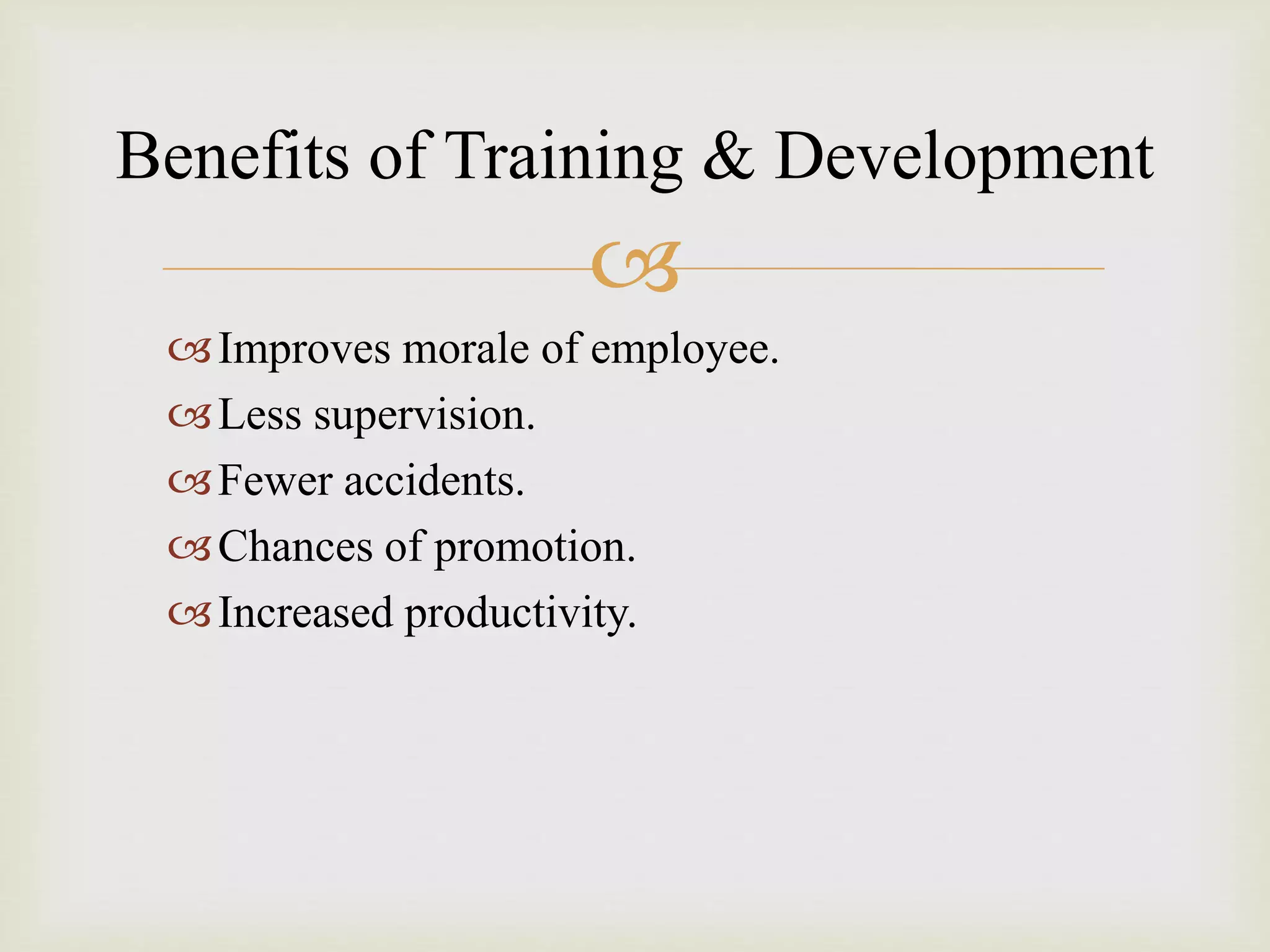
Improves morale of employee.
Less supervision.
Fewer accidents.
Chances of promotion.
Increased productivity.
Benefits of Training & Development

Thank You!

Training and Development

  • 2.
      Meaning It refersto imparting specific skills, abilities and knowledge.  Definition To increase the knowledge and skills of employees.  Training Concern with maintaining and improving current job performance; has short-term perspective.  Development Develop competence and skills for future performance; has long-term perspective. Training and Development
  • 3.
      Companies goalsand objectives  Requirements of jobs and organisation.  Import basic knowledge and skills for the performance.  Exposing them latest concepts, information and techniques.  Develop potential.  Ensure smooth and efficient working.  To bridge the gap b/w “existing performance “ and “desired performance”.  To improve organisational climate. Objectives of Training & Development
  • 4.
     For valueof employee because it gives greater job security and opportunity for advancement.  Changing Technology :- Changing at a fast pace. Learn new technology to advance. Training in a continuous process.  Quality Conscious Customers :- For improvement in continuous training given to the employees.  Greater Productivity :- To increase production and to reduce cost.  Stable Welfare :- Create feeling of confidence. Need of Training & Development
  • 5.
      Optimum Utilizationof Human Resources  Helps the employee to achieve the organizational goals as well as their individual goals.  Development of skills of employees  Helps in increasing the job knowledge and skills of employees at each level.  Productivity  Helps in increasing the productivity of the employees that helps the organization further to achieve its long-term goal. Importance of Training & Development
  • 6.
     Team Spirit Helps in inculcating the sense of team work, team spirit, and inter-team collaborations.  Quality  Helps in improving upon the quality of work and work-life.
  • 7.
     Induction Training Introducing a new employee to the organization and its procedures, rules and regulations. For friendly environment.  Job Training:  Training which gives information regarding machines, process of production, instruction to be followed and so on.  Internship Training :  Internships (also called "placements", "work placements" or "industrial placements") may be part-time or full-time.  Promotion  It is the advancement of an employee's rank or position in an organizational hierarchy system. Types of Training
  • 8.
     On-The JobTraining (“learning by doing”) 1. Coaching 2. Understudy (as assistant) 3. Position Rotation 4. Job Rotation (Interrelationship)  Off-The Job Training 1. Lecture Cum Discussion (Class-Room Training) 2. Conference Training  Mentoring ( The Mentor)  Vestibule Training Methods of Training
  • 9.
     Improves morale ofemployee. Less supervision. Fewer accidents. Chances of promotion. Increased productivity. Benefits of Training & Development
  • 10.