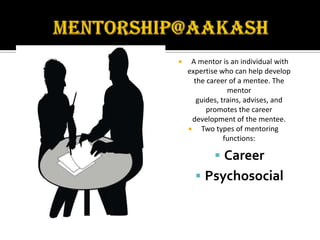
    A mentor is an individual with
    expertise who can help develop
      the career of a mentee. The
                 mentor
       guides, trains, advises, and
          promotes the career
     development of the mentee.
     Two types of mentoring
                functions:

             Career
       Psychosocial
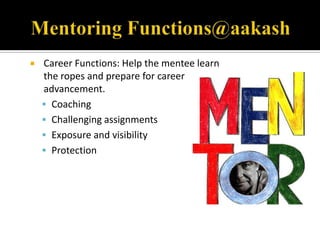
   Career Functions: Help the mentee learn
    the ropes and prepare for career
    advancement.
     Coaching
     Challenging assignments
     Exposure and visibility
     Protection
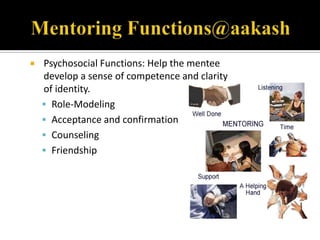
   Psychosocial Functions: Help the mentee
    develop a sense of competence and clarity
    of identity.
     Role-Modeling
     Acceptance and confirmation
     Counseling
     Friendship
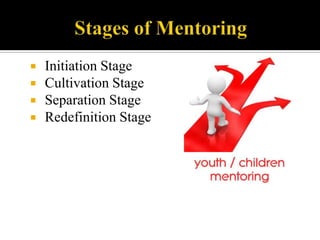
   Initiation Stage
   Cultivation Stage
   Separation Stage
   Redefinition Stage
   Advantages for the mentee:
     Career advancement
     Identification
   Advantages for the mentor:
     Career enhancement
     “Passing the torch to a new generation”
     Learning from mentee – new technologies, new
     developments, important features of next
     generation
    Purpose of program is to help early career
    psychologists establish and develop their
     careers
    Program participation is voluntary
    Matching of mentors and mentees uses input
     from participants
     Interest areas in psychology
     Demographics
     Experiences
   Advocate developmental networks
   Monitoring program: Relationships should end as
    soon as they become dysfunctional
   Evaluation of program
   Little research on formal mentoring programs.
    Available research supports informal mentoring
    as a stronger relationship with better outcomes.
    No current research examining quality of formal
    mentoring programs and their outcomes.
    (Wanberg, Welsh, & Hezlett, 2003)
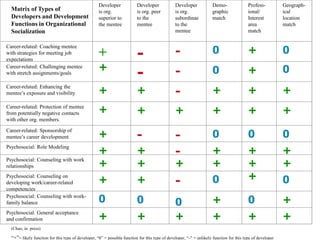
Developer             Developer             Developer            Demo-                Profess-          Geograph-
  Matrix of Types of                                is org.               is org. peer          is org.              graphic              ional/            ical
  Developers and Development                        superior to           to the                subordinae           match                Interest          location
  Functions in Organizational                       the mentee            mentee                to the                                    area              match
  Socialization                                                                                 mentee                                    match


                                                                          -                     -                    0                    +                 0
Career-related: Coaching mentee
with strategies for meeting job
expectations
                                                    +
                                                    +
                                                                          -                     -                    0                    +                 0
Career-related: Challenging mentee
with stretch assignments/goals


                                                    +                     +                     -                    +                    +                 +
Career-related: Enhancing the
mentee’s exposure and visibility

Career-related: Protection of mentee
from potentially negative contacts                  +                     +                     +                    +                    +                 +
with other org. members.


                                                    +                     -                     -                    0                    0                 0
Career-related: Sponsorship of
mentee’s career development

                                                    +                     +                     -                    +                    +                 +
Psychosocial: Role Modeling


                                                    +                     +                     +                    +                    +                 +
Psychosocial: Counseling with work
relationships

                                                    +                     +                                          0                    +
                                                                                                -                                                           0
Psychosocial: Counseling on
developing work/career-related
competencies
Psychosocial: Counseling with work-
family balance                                      0                     0                     0                    +                    0                 +
                                                    +                     +                     +                    +                    +                 +
Psychosocial: General acceptance
and confirmation
  (Chao, in press)

  “+”= likely function for this type of developer, “0” = possible function for this type of developer, “-” = unlikely function for this type of developer
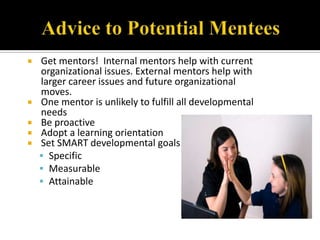
 Get mentors! Internal mentors help with current
  organizational issues. External mentors help with
  larger career issues and future organizational
  moves.
 One mentor is unlikely to fulfill all developmental
  needs
 Be proactive
 Adopt a learning orientation
 Set SMART developmental goals
   Specific
   Measurable
   Attainable
 Seek counsel and advice, not a supervisor who
  directs actions.
 Be aware of potential pitfalls: Overbearing
  mentor, mentor exploitation of mentee’s
  work. Be sensitive to the difference
  between asking for help/advice from your
  mentor and demanding favors from your
  mentor.
 Synthesize lessons learned from all
  mentors – become your own person.
 Recognize dynamics of relationship.
   Recognize that mentee may be uncomfortable
    asking for help – break ice by sharing some of your
    career experiences
   Stay in your zone of expertise/experience
   Be clear that mentee sets pace of relationship
   Advise, do not manage
   Extend mentee’s developmental network – suggest
    additional mentors to address unique needs
   Offer advice that helps mentee develop –
    role is NOT to make decisions for mentee or
    micromanage.

   Train to be efficient. Guidance and advice for one
    mentee may also be appropriate for another.

   Be aware of potential pitfalls: overdependence of
    mentee, mentee exploitation of mentor’s influence.
    Be sensitive to difference between developing a
    mentee and using a mentee.

   Be aware of dynamics of relationship: Developmental
    needs may change.
   How to use e-mail
     Use e-mail to set up meetings (face-to-face or
      phone), clarify plans/goals, pose non-time urgent
      questions, review plans, maintain contact.
     Don’t use e-mail to give critical or complex
      feedback, provide impressions of other’s
      behavior, provide impressions of third
      parties, exchange sensitive information.
   Communication Challenges
     Listen for nonverbal cues (e.g., pregnant pauses, voice
      tone, tempo, volume)
     Push for specific information, clarify meanings
     Summarize agreements

Mentoring

  • 2.
    A mentor is an individual with expertise who can help develop the career of a mentee. The mentor guides, trains, advises, and promotes the career development of the mentee.  Two types of mentoring functions:  Career  Psychosocial
  • 3.
    Career Functions: Help the mentee learn the ropes and prepare for career advancement.  Coaching  Challenging assignments  Exposure and visibility  Protection
  • 4.
    Psychosocial Functions: Help the mentee develop a sense of competence and clarity of identity.  Role-Modeling  Acceptance and confirmation  Counseling  Friendship
  • 6.
    Initiation Stage  Cultivation Stage  Separation Stage  Redefinition Stage
  • 7.
    Advantages for the mentee:  Career advancement  Identification  Advantages for the mentor:  Career enhancement  “Passing the torch to a new generation”  Learning from mentee – new technologies, new developments, important features of next generation
  • 8.
    Purpose of program is to help early career psychologists establish and develop their careers  Program participation is voluntary  Matching of mentors and mentees uses input from participants  Interest areas in psychology  Demographics  Experiences
  • 9.
    Advocate developmental networks  Monitoring program: Relationships should end as soon as they become dysfunctional  Evaluation of program  Little research on formal mentoring programs. Available research supports informal mentoring as a stronger relationship with better outcomes. No current research examining quality of formal mentoring programs and their outcomes. (Wanberg, Welsh, & Hezlett, 2003)
  • 10.
    Developer Developer Developer Demo- Profess- Geograph- Matrix of Types of is org. is org. peer is org. graphic ional/ ical Developers and Development superior to to the subordinae match Interest location Functions in Organizational the mentee mentee to the area match Socialization mentee match - - 0 + 0 Career-related: Coaching mentee with strategies for meeting job expectations + + - - 0 + 0 Career-related: Challenging mentee with stretch assignments/goals + + - + + + Career-related: Enhancing the mentee’s exposure and visibility Career-related: Protection of mentee from potentially negative contacts + + + + + + with other org. members. + - - 0 0 0 Career-related: Sponsorship of mentee’s career development + + - + + + Psychosocial: Role Modeling + + + + + + Psychosocial: Counseling with work relationships + + 0 + - 0 Psychosocial: Counseling on developing work/career-related competencies Psychosocial: Counseling with work- family balance 0 0 0 + 0 + + + + + + + Psychosocial: General acceptance and confirmation (Chao, in press) “+”= likely function for this type of developer, “0” = possible function for this type of developer, “-” = unlikely function for this type of developer
  • 11.
     Get mentors!Internal mentors help with current organizational issues. External mentors help with larger career issues and future organizational moves.  One mentor is unlikely to fulfill all developmental needs  Be proactive  Adopt a learning orientation  Set SMART developmental goals  Specific  Measurable  Attainable
  • 12.
     Seek counseland advice, not a supervisor who directs actions.  Be aware of potential pitfalls: Overbearing mentor, mentor exploitation of mentee’s work. Be sensitive to the difference between asking for help/advice from your mentor and demanding favors from your mentor.  Synthesize lessons learned from all mentors – become your own person.  Recognize dynamics of relationship.
  • 13.
    Recognize that mentee may be uncomfortable asking for help – break ice by sharing some of your career experiences  Stay in your zone of expertise/experience  Be clear that mentee sets pace of relationship  Advise, do not manage  Extend mentee’s developmental network – suggest additional mentors to address unique needs
  • 14.
    Offer advice that helps mentee develop – role is NOT to make decisions for mentee or micromanage.  Train to be efficient. Guidance and advice for one mentee may also be appropriate for another.  Be aware of potential pitfalls: overdependence of mentee, mentee exploitation of mentor’s influence. Be sensitive to difference between developing a mentee and using a mentee.  Be aware of dynamics of relationship: Developmental needs may change.
  • 15.
    How to use e-mail  Use e-mail to set up meetings (face-to-face or phone), clarify plans/goals, pose non-time urgent questions, review plans, maintain contact.  Don’t use e-mail to give critical or complex feedback, provide impressions of other’s behavior, provide impressions of third parties, exchange sensitive information.  Communication Challenges  Listen for nonverbal cues (e.g., pregnant pauses, voice tone, tempo, volume)  Push for specific information, clarify meanings  Summarize agreements