1
Module 2
Structuring The Learning Process
ckby/BasicTTT/18Jul08/Rev6 2
Course outline (Day 1)
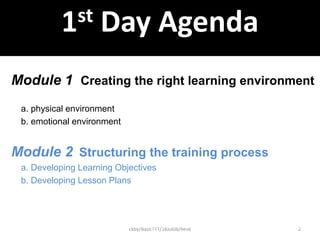
Module 1 Creating the right learning environment
a. physical environment
b. emotional environment
Module 2 Structuring the training process
a. Developing Learning Objectives
b. Developing Lesson Plans
1st Day Agenda
• Kick Boxing
4
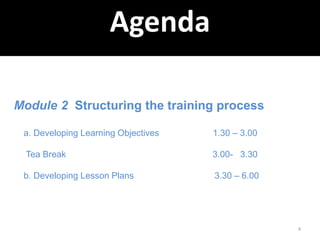
Agenda
Module 2 Structuring the training process
a. Developing Learning Objectives 1.30 – 3.00
Tea Break 3.00- 3.30
b. Developing Lesson Plans 3.30 – 6.00
a. Physical Environment - Infrastructure
b. Emotional Environment - Mood
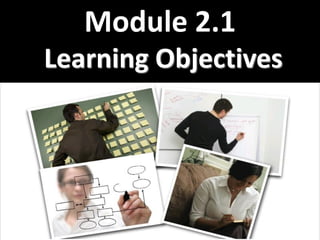
1st ModuleModule 2.1
Learning Objectives
ckby/BasicTTT/18Jul08/Rev6 6
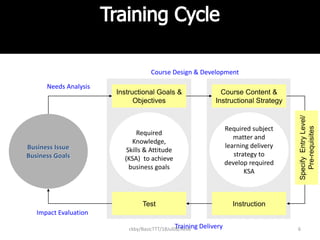
Business Issue
Business Goals
Required
Knowledge,
Skills & Attitude
(KSA) to achieve
business goals
Required subject
matter and
learning delivery
strategy to
develop required
KSA
Instructional Goals &
Objectives
Course Content &
Instructional Strategy
Needs Analysis
Course Design & Development
Impact Evaluation
Test Instruction
Training Delivery
SpecifyEntryLevel/
Pre-requisites
7
Exercise
Flex Your Mind
ckby/BasicTTT/18Jul08/Rev6 8
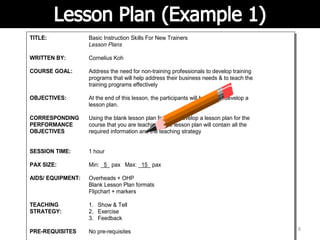
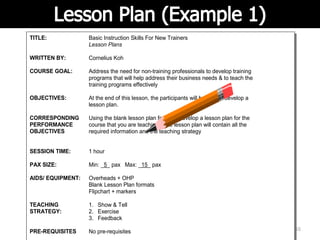
Lesson plan example (part 1)
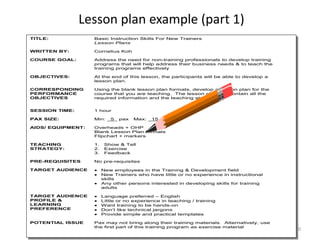
TITLE: Basic Instruction Skills For New Trainers
Lesson Plans
WRITTEN BY: Cornelius Koh
COURSE GOAL: Address the need for non-training professionals to develop training
programs that will help address their business needs & to teach the
training programs effectively
OBJECTIVES:
CORRESPONDING
PERFORMANCE
OBJECTIVES
At the end of this lesson, the participants will be able to develop a
lesson plan.
Using the blank lesson plan formats, develop a lesson plan for the
course that you are teaching. The lesson plan will contain all the
required information and the teaching strategy
SESSION TIME: 1 hour
PAX SIZE: Min: _5_ pax Max: _15_ pax
AIDS/ EQUIPMENT: Overheads + OHP
Blank Lesson Plan formats
Flipchart + markers
TEACHING
STRATEGY:
1. Show & Tell
2. Exercise
3. Feedback
PRE-REQUISITES No pre-requisites
ckby/BasicTTT/18Jul08/Rev6 9
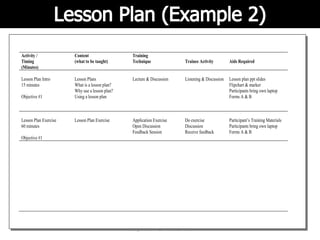
Activity /
Timing
(Minutes)
Content
(what to be taught)
Training
Technique Trainee Activity Aids Required
Lesson Plan Intro
15 minutes
Objective #1
Lesson Plans
What is a lesson plan?
Why use a lesson plan?
Using a lesson plan
Lecture & Discussion Listening & Discussion Lesson plan ppt slides
Flipchart & marker
Participants bring own laptop
Forms A & B
Lesson Plan Exercise
60 minutes
Objective #1
Lesson Plan Exercise Application Exercise
Open Discussion
Feedback Session
Do exercise
Discussion
Receive feedback
Participant’s Training Materials
Participants bring own laptop
Forms A & B
ckby/BasicTTT/18Jul08/Rev6 10
Lesson plan example (part 1)
TITLE: Basic Instruction Skills For New Trainers
Lesson Plans
WRITTEN BY: Cornelius Koh
COURSE GOAL: Address the need for non-training professionals to develop training
programs that will help address their business needs & to teach the
training programs effectively
OBJECTIVES:
CORRESPONDING
PERFORMANCE
OBJECTIVES
At the end of this lesson, the participants will be able to develop a
lesson plan.
Using the blank lesson plan formats, develop a lesson plan for the
course that you are teaching. The lesson plan will contain all the
required information and the teaching strategy
SESSION TIME: 1 hour
PAX SIZE: Min: _5_ pax Max: _15_ pax
AIDS/ EQUIPMENT: Overheads + OHP
Blank Lesson Plan formats
Flipchart + markers
TEACHING
STRATEGY:
1. Show & Tell
2. Exercise
3. Feedback
PRE-REQUISITES No pre-requisites
TARGET AUDIENCE  New employees in the Training & Development field
 New Trainers who have little or no experience in instructional
skills
 Any other persons interested in developing skills for training
adults
TARGET AUDIENCE
PROFILE &
LEARNING
PREFERENCE
 Language preferred – English
 Little or no experience in teaching / training
 Want training to be hands-on
 Don’t like technical jargons
 Provide simple and practical templates
POTENTIAL ISSUE Pax may not bring along their training materials. Alternatively, use
the first part of this training program as exercise material
ckby/BasicTTT/18Jul08/Rev6 11
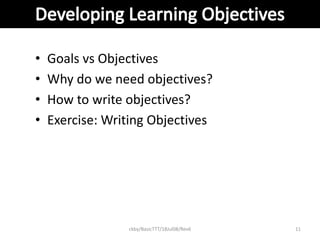
• Goals vs Objectives
• Why do we need objectives?
• How to write objectives?
• Exercise: Writing Objectives
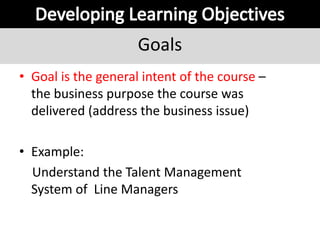
Goals
• Goal is the general intent of the course –
the business purpose the course was
delivered (address the business issue)
• Example:
Understand the Talent Management
System of Line Managers
Objectives
• Learning objectives should be expressed as
outcomes of the training for the participants
• and make use of action verbs (for example, ‘‘At
the end of this session, participants will be able to
. . .’’).
• The outcomes can be specific skills, knowledge
and attitude acquire by the course participants
How to write learning objectives
• Normally expressed in the following manner:
– At the end of this course, you will be able to
• Write learning objectives for the course you are
developing
• Write corresponding performance objectives for each
learning objectives
• Determine whether your objectives are measurable /
observable
Why Performance objectives?
• Performance Objectives enables learners to
be assessed to determine whether they have
achieved the learning objectives
How to write performance objectives
• Components of a performance objective
– Performance: Measurable behaviours /action
verbs- develop, select, assemble, perform (No 6,
Green Book)
– Condition: tools - MS Power Point, ISO, lean
– Standard: How well – 30 minutes, 40 kilos
How to write performance objectives
• Example
Given a car with a flat tire, a spare tyre, and
a lug wrench (conditions), change the flat
tyre (performance) according to the
manufacturer’s instructions and
specifications in fifteen minutes without
injury or damage (standard)
How to write performance objectives
• Example
Given a computer with MS-PowerPoint and
a sample presentation (conditions) the
student will be able to launch PowerPoint,
use the AutoContent Wizard to create a
presentation with the same format and
content (performance) as the sample
presentation within 30 minutes (standard)
ckby/BasicTTT/18Jul08/Rev6 25
Examining the bulls-eye
• What is the purpose of writing performance
objectives?
• What is the most difficult thing about
writing performance objectives?
• What are the things you need to be aware of
when writing performance objectives?
1st ModuleModule 2.2
Lesson Plan
Learning Objectives
ckby/BasicTTT/18Jul08/Rev6 27
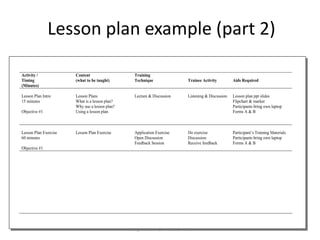
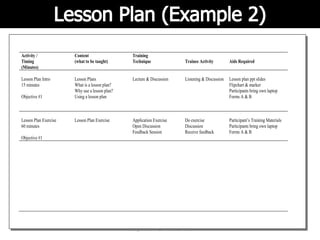
Lesson plan example (part 2)
Activity /
Timing
(Minutes)
Content
(what to be taught)
Training
Technique Trainee Activity Aids Required
Lesson Plan Intro
15 minutes
Objective #1
Lesson Plans
What is a lesson plan?
Why use a lesson plan?
Using a lesson plan
Lecture & Discussion Listening & Discussion Lesson plan ppt slides
Flipchart & marker
Participants bring own laptop
Forms A & B
Lesson Plan Exercise
60 minutes
Objective #1
Lesson Plan Exercise Application Exercise
Open Discussion
Feedback Session
Do exercise
Discussion
Receive feedback
Participant’s Training Materials
Participants bring own laptop
Forms A & B
ckby/BasicTTT/18Jul08/Rev6 29
What is a lesson plan?
Lesson plan is a tool to help the trainer
determine how to teach a particular topic
What is a lesson plan?
– Learning objectives & related content
– Duration of lesson & timing of activities
– Required training aids & equipment
– Teaching method & strategy for lesson
ckby/BasicTTT/18Jul08/Rev6 32
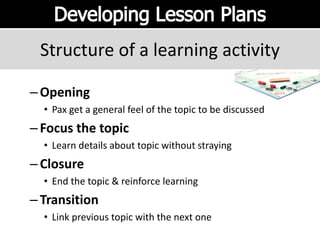
Structure of a learning activity
– Opening
• Pax get a general feel of the topic to be discussed
– Focus the topic
• Learn details about topic without straying
– Closure
• End the topic & reinforce learning
– Transition
• Link previous topic with the next one
Structure of a learning activity
–Opening
• Pax get a general feel of the topic to be discussed
–Focus the topic
• Learn details about topic without straying
–Closure
• End the topic & reinforce learning
–Transition
• Link previous topic with the next one
Structure of a learning activity
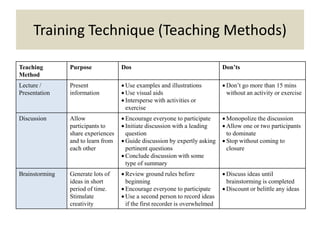
Training Technique (Teaching Methods)
Teaching
Method
Purpose Dos Don’ts
Lecture /
Presentation
Present
information
 Use examples and illustrations
 Use visual aids
 Intersperse with activities or
exercise
 Don’t go more than 15 mins
without an activity or exercise
Discussion Allow
participants to
share experiences
and to learn from
each other
 Encourage everyone to participate
 Initiate discussion with a leading
question
 Guide discussion by expertly asking
pertinent questions
 Conclude discussion with some
type of summary
 Monopolize the discussion
 Allow one or two participants
to dominate
 Stop without coming to
closure
Brainstorming Generate lots of
ideas in short
period of time.
Stimulate
creativity
 Review ground rules before
beginning
 Encourage everyone to participate
 Use a second person to record ideas
if the first recorder is overwhelmed
 Discuss ideas until
brainstorming is completed
 Discount or belittle any ideas
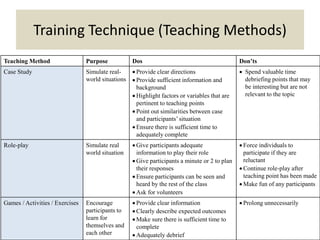
Training Technique (Teaching Methods)
Teaching Method Purpose Dos Don’ts
Case Study Simulate real-
world situations
 Provide clear directions
 Provide sufficient information and
background
 Highlight factors or variables that are
pertinent to teaching points
 Point out similarities between case
and participants’situation
 Ensure there is sufficient time to
adequately complete
 Spend valuable time
debriefing points that may
be interesting but are not
relevant to the topic
Role-play Simulate real
world situation
 Give participants adequate
information to play their role
 Give participants a minute or 2 to plan
their responses
 Ensure participants can be seen and
heard by the rest of the class
 Ask for volunteers
 Force individuals to
participate if they are
reluctant
 Continue role-play after
teaching point has been made
 Make fun of any participants
Games / Activities / Exercises Encourage
participants to
learn for
themselves and
each other
 Provide clear information
 Clearly describe expected outcomes
 Make sure there is sufficient time to
complete
 Adequately debrief
 Prolong unnecessarily
Understanding
ckby/BasicTTT/18Jul08/Rev6 44
Did you really learn your lesson?
• What was the most
difficult thing about
creating a lesson
plan?
ckby/BasicTTT/18Jul08/Rev6 45
Did you really learn your lesson?
• What adult learning
principles are being
incorporated into
the lesson plan?
ckby/BasicTTT/18Jul08/Rev6 46
Did you really learn your lesson?
• Will your lesson plan
suit the needs and
learning style of your
target audience?
ckby/BasicTTT/18Jul08/Rev6 47
Issues in building lesson plans
• Performance Objectives Missed out in many
lesson plans
• Many lesson plans don’t contain activities that
will test for transfer of learning
• Many lesson plans may not put the Adult
Learning Principles into practice (e.g. use only on
lectures but no exercises, practice sessions,
quizzes etc)
• Lesson plans did not contain
– Opening activity
– Closing activity
Creating the right learning
environment
a. Physical Environment - Infrastructure
b. Emotional Environment - Mood
1st ModuleModule 1
ckby/BasicTTT/18Jul08/Rev6 49
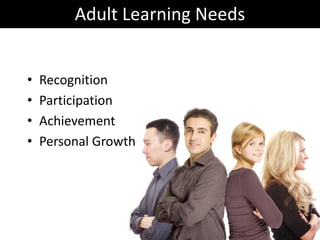
• Recognition
• Participation
• Achievement
• Personal Growth
Adult Learning Needs
participants feel comfortable and safe
Results of comfortable and safe
environment
• try out new ideas,
• learn from others,
• explore new viewpoints,
• change attitudes and behaviors
• respects everyone’s viewpoints, and
ckby/BasicTTT/18Jul08/Rev6 52
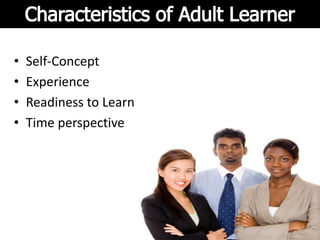
• Self-Concept
• Experience
• Readiness to Learn
• Time perspective
53
Principles of effective learning
Recency
Appropriateness
Motivation
Primacy
2 way communication
Feedback
Active Learning
Multi-sensory Learning
Exercise
a. Physical Environment - Infrastructure
b. Emotional Environment - Mood
1st ModuleModule 2.1
Learning Objectives
ckby/BasicTTT/18Jul08/Rev6 55
Lesson plan example (part 1)
TITLE: Basic Instruction Skills For New Trainers
Lesson Plans
WRITTEN BY: Cornelius Koh
COURSE GOAL: Address the need for non-training professionals to develop training
programs that will help address their business needs & to teach the
training programs effectively
OBJECTIVES:
CORRESPONDING
PERFORMANCE
OBJECTIVES
At the end of this lesson, the participants will be able to develop a
lesson plan.
Using the blank lesson plan formats, develop a lesson plan for the
course that you are teaching. The lesson plan will contain all the
required information and the teaching strategy
SESSION TIME: 1 hour
PAX SIZE: Min: _5_ pax Max: _15_ pax
AIDS/ EQUIPMENT: Overheads + OHP
Blank Lesson Plan formats
Flipchart + markers
TEACHING
STRATEGY:
1. Show & Tell
2. Exercise
3. Feedback
PRE-REQUISITES No pre-requisites
ckby/BasicTTT/18Jul08/Rev6 56
Activity /
Timing
(Minutes)
Content
(what to be taught)
Training
Technique Trainee Activity Aids Required
Lesson Plan Intro
15 minutes
Objective #1
Lesson Plans
What is a lesson plan?
Why use a lesson plan?
Using a lesson plan
Lecture & Discussion Listening & Discussion Lesson plan ppt slides
Flipchart & marker
Participants bring own laptop
Forms A & B
Lesson Plan Exercise
60 minutes
Objective #1
Lesson Plan Exercise Application Exercise
Open Discussion
Feedback Session
Do exercise
Discussion
Receive feedback
Participant’s Training Materials
Participants bring own laptop
Forms A & B
Structure of a learning activity
Review
63
Module 3
Presentation
64
Thank You

Module 2a lesson plan basic instructional skills

  • 1.
  • 2.
    ckby/BasicTTT/18Jul08/Rev6 2 Course outline(Day 1) Module 1 Creating the right learning environment a. physical environment b. emotional environment Module 2 Structuring the training process a. Developing Learning Objectives b. Developing Lesson Plans 1st Day Agenda
  • 3.
  • 4.
    4 Agenda Module 2 Structuringthe training process a. Developing Learning Objectives 1.30 – 3.00 Tea Break 3.00- 3.30 b. Developing Lesson Plans 3.30 – 6.00
  • 5.
    a. Physical Environment- Infrastructure b. Emotional Environment - Mood 1st ModuleModule 2.1 Learning Objectives
  • 6.
    ckby/BasicTTT/18Jul08/Rev6 6 Business Issue BusinessGoals Required Knowledge, Skills & Attitude (KSA) to achieve business goals Required subject matter and learning delivery strategy to develop required KSA Instructional Goals & Objectives Course Content & Instructional Strategy Needs Analysis Course Design & Development Impact Evaluation Test Instruction Training Delivery SpecifyEntryLevel/ Pre-requisites
  • 7.
  • 8.
    ckby/BasicTTT/18Jul08/Rev6 8 Lesson planexample (part 1) TITLE: Basic Instruction Skills For New Trainers Lesson Plans WRITTEN BY: Cornelius Koh COURSE GOAL: Address the need for non-training professionals to develop training programs that will help address their business needs & to teach the training programs effectively OBJECTIVES: CORRESPONDING PERFORMANCE OBJECTIVES At the end of this lesson, the participants will be able to develop a lesson plan. Using the blank lesson plan formats, develop a lesson plan for the course that you are teaching. The lesson plan will contain all the required information and the teaching strategy SESSION TIME: 1 hour PAX SIZE: Min: _5_ pax Max: _15_ pax AIDS/ EQUIPMENT: Overheads + OHP Blank Lesson Plan formats Flipchart + markers TEACHING STRATEGY: 1. Show & Tell 2. Exercise 3. Feedback PRE-REQUISITES No pre-requisites
  • 9.
    ckby/BasicTTT/18Jul08/Rev6 9 Activity / Timing (Minutes) Content (whatto be taught) Training Technique Trainee Activity Aids Required Lesson Plan Intro 15 minutes Objective #1 Lesson Plans What is a lesson plan? Why use a lesson plan? Using a lesson plan Lecture & Discussion Listening & Discussion Lesson plan ppt slides Flipchart & marker Participants bring own laptop Forms A & B Lesson Plan Exercise 60 minutes Objective #1 Lesson Plan Exercise Application Exercise Open Discussion Feedback Session Do exercise Discussion Receive feedback Participant’s Training Materials Participants bring own laptop Forms A & B
  • 10.
    ckby/BasicTTT/18Jul08/Rev6 10 Lesson planexample (part 1) TITLE: Basic Instruction Skills For New Trainers Lesson Plans WRITTEN BY: Cornelius Koh COURSE GOAL: Address the need for non-training professionals to develop training programs that will help address their business needs & to teach the training programs effectively OBJECTIVES: CORRESPONDING PERFORMANCE OBJECTIVES At the end of this lesson, the participants will be able to develop a lesson plan. Using the blank lesson plan formats, develop a lesson plan for the course that you are teaching. The lesson plan will contain all the required information and the teaching strategy SESSION TIME: 1 hour PAX SIZE: Min: _5_ pax Max: _15_ pax AIDS/ EQUIPMENT: Overheads + OHP Blank Lesson Plan formats Flipchart + markers TEACHING STRATEGY: 1. Show & Tell 2. Exercise 3. Feedback PRE-REQUISITES No pre-requisites TARGET AUDIENCE  New employees in the Training & Development field  New Trainers who have little or no experience in instructional skills  Any other persons interested in developing skills for training adults TARGET AUDIENCE PROFILE & LEARNING PREFERENCE  Language preferred – English  Little or no experience in teaching / training  Want training to be hands-on  Don’t like technical jargons  Provide simple and practical templates POTENTIAL ISSUE Pax may not bring along their training materials. Alternatively, use the first part of this training program as exercise material
  • 11.
    ckby/BasicTTT/18Jul08/Rev6 11 • Goalsvs Objectives • Why do we need objectives? • How to write objectives? • Exercise: Writing Objectives
  • 12.
    Goals • Goal isthe general intent of the course – the business purpose the course was delivered (address the business issue) • Example: Understand the Talent Management System of Line Managers
  • 13.
    Objectives • Learning objectivesshould be expressed as outcomes of the training for the participants • and make use of action verbs (for example, ‘‘At the end of this session, participants will be able to . . .’’). • The outcomes can be specific skills, knowledge and attitude acquire by the course participants
  • 14.
    How to writelearning objectives • Normally expressed in the following manner: – At the end of this course, you will be able to • Write learning objectives for the course you are developing • Write corresponding performance objectives for each learning objectives • Determine whether your objectives are measurable / observable
  • 15.
    Why Performance objectives? •Performance Objectives enables learners to be assessed to determine whether they have achieved the learning objectives
  • 16.
    How to writeperformance objectives • Components of a performance objective – Performance: Measurable behaviours /action verbs- develop, select, assemble, perform (No 6, Green Book) – Condition: tools - MS Power Point, ISO, lean – Standard: How well – 30 minutes, 40 kilos
  • 17.
    How to writeperformance objectives • Example Given a car with a flat tire, a spare tyre, and a lug wrench (conditions), change the flat tyre (performance) according to the manufacturer’s instructions and specifications in fifteen minutes without injury or damage (standard)
  • 18.
    How to writeperformance objectives • Example Given a computer with MS-PowerPoint and a sample presentation (conditions) the student will be able to launch PowerPoint, use the AutoContent Wizard to create a presentation with the same format and content (performance) as the sample presentation within 30 minutes (standard)
  • 19.
    ckby/BasicTTT/18Jul08/Rev6 25 Examining thebulls-eye • What is the purpose of writing performance objectives? • What is the most difficult thing about writing performance objectives? • What are the things you need to be aware of when writing performance objectives?
  • 20.
    1st ModuleModule 2.2 LessonPlan Learning Objectives
  • 21.
    ckby/BasicTTT/18Jul08/Rev6 27 Lesson planexample (part 2) Activity / Timing (Minutes) Content (what to be taught) Training Technique Trainee Activity Aids Required Lesson Plan Intro 15 minutes Objective #1 Lesson Plans What is a lesson plan? Why use a lesson plan? Using a lesson plan Lecture & Discussion Listening & Discussion Lesson plan ppt slides Flipchart & marker Participants bring own laptop Forms A & B Lesson Plan Exercise 60 minutes Objective #1 Lesson Plan Exercise Application Exercise Open Discussion Feedback Session Do exercise Discussion Receive feedback Participant’s Training Materials Participants bring own laptop Forms A & B
  • 22.
    ckby/BasicTTT/18Jul08/Rev6 29 What isa lesson plan? Lesson plan is a tool to help the trainer determine how to teach a particular topic
  • 23.
    What is alesson plan? – Learning objectives & related content – Duration of lesson & timing of activities – Required training aids & equipment – Teaching method & strategy for lesson
  • 24.
    ckby/BasicTTT/18Jul08/Rev6 32 Structure ofa learning activity – Opening • Pax get a general feel of the topic to be discussed – Focus the topic • Learn details about topic without straying – Closure • End the topic & reinforce learning – Transition • Link previous topic with the next one
  • 25.
    Structure of alearning activity –Opening • Pax get a general feel of the topic to be discussed –Focus the topic • Learn details about topic without straying –Closure • End the topic & reinforce learning –Transition • Link previous topic with the next one
  • 26.
    Structure of alearning activity
  • 27.
    Structure of alearning activity
  • 28.
    Structure of alearning activity
  • 29.
    Structure of alearning activity
  • 30.
    Structure of alearning activity
  • 31.
    Training Technique (TeachingMethods) Teaching Method Purpose Dos Don’ts Lecture / Presentation Present information  Use examples and illustrations  Use visual aids  Intersperse with activities or exercise  Don’t go more than 15 mins without an activity or exercise Discussion Allow participants to share experiences and to learn from each other  Encourage everyone to participate  Initiate discussion with a leading question  Guide discussion by expertly asking pertinent questions  Conclude discussion with some type of summary  Monopolize the discussion  Allow one or two participants to dominate  Stop without coming to closure Brainstorming Generate lots of ideas in short period of time. Stimulate creativity  Review ground rules before beginning  Encourage everyone to participate  Use a second person to record ideas if the first recorder is overwhelmed  Discuss ideas until brainstorming is completed  Discount or belittle any ideas
  • 32.
    Training Technique (TeachingMethods) Teaching Method Purpose Dos Don’ts Case Study Simulate real- world situations  Provide clear directions  Provide sufficient information and background  Highlight factors or variables that are pertinent to teaching points  Point out similarities between case and participants’situation  Ensure there is sufficient time to adequately complete  Spend valuable time debriefing points that may be interesting but are not relevant to the topic Role-play Simulate real world situation  Give participants adequate information to play their role  Give participants a minute or 2 to plan their responses  Ensure participants can be seen and heard by the rest of the class  Ask for volunteers  Force individuals to participate if they are reluctant  Continue role-play after teaching point has been made  Make fun of any participants Games / Activities / Exercises Encourage participants to learn for themselves and each other  Provide clear information  Clearly describe expected outcomes  Make sure there is sufficient time to complete  Adequately debrief  Prolong unnecessarily
  • 33.
  • 34.
    ckby/BasicTTT/18Jul08/Rev6 44 Did youreally learn your lesson? • What was the most difficult thing about creating a lesson plan?
  • 35.
    ckby/BasicTTT/18Jul08/Rev6 45 Did youreally learn your lesson? • What adult learning principles are being incorporated into the lesson plan?
  • 36.
    ckby/BasicTTT/18Jul08/Rev6 46 Did youreally learn your lesson? • Will your lesson plan suit the needs and learning style of your target audience?
  • 37.
    ckby/BasicTTT/18Jul08/Rev6 47 Issues inbuilding lesson plans • Performance Objectives Missed out in many lesson plans • Many lesson plans don’t contain activities that will test for transfer of learning • Many lesson plans may not put the Adult Learning Principles into practice (e.g. use only on lectures but no exercises, practice sessions, quizzes etc) • Lesson plans did not contain – Opening activity – Closing activity
  • 38.
    Creating the rightlearning environment a. Physical Environment - Infrastructure b. Emotional Environment - Mood 1st ModuleModule 1
  • 39.
    ckby/BasicTTT/18Jul08/Rev6 49 • Recognition •Participation • Achievement • Personal Growth Adult Learning Needs
  • 41.
    participants feel comfortableand safe Results of comfortable and safe environment • try out new ideas, • learn from others, • explore new viewpoints, • change attitudes and behaviors • respects everyone’s viewpoints, and
  • 42.
    ckby/BasicTTT/18Jul08/Rev6 52 • Self-Concept •Experience • Readiness to Learn • Time perspective
  • 43.
    53 Principles of effectivelearning Recency Appropriateness Motivation Primacy 2 way communication Feedback Active Learning Multi-sensory Learning Exercise
  • 44.
    a. Physical Environment- Infrastructure b. Emotional Environment - Mood 1st ModuleModule 2.1 Learning Objectives
  • 45.
    ckby/BasicTTT/18Jul08/Rev6 55 Lesson planexample (part 1) TITLE: Basic Instruction Skills For New Trainers Lesson Plans WRITTEN BY: Cornelius Koh COURSE GOAL: Address the need for non-training professionals to develop training programs that will help address their business needs & to teach the training programs effectively OBJECTIVES: CORRESPONDING PERFORMANCE OBJECTIVES At the end of this lesson, the participants will be able to develop a lesson plan. Using the blank lesson plan formats, develop a lesson plan for the course that you are teaching. The lesson plan will contain all the required information and the teaching strategy SESSION TIME: 1 hour PAX SIZE: Min: _5_ pax Max: _15_ pax AIDS/ EQUIPMENT: Overheads + OHP Blank Lesson Plan formats Flipchart + markers TEACHING STRATEGY: 1. Show & Tell 2. Exercise 3. Feedback PRE-REQUISITES No pre-requisites
  • 46.
    ckby/BasicTTT/18Jul08/Rev6 56 Activity / Timing (Minutes) Content (whatto be taught) Training Technique Trainee Activity Aids Required Lesson Plan Intro 15 minutes Objective #1 Lesson Plans What is a lesson plan? Why use a lesson plan? Using a lesson plan Lecture & Discussion Listening & Discussion Lesson plan ppt slides Flipchart & marker Participants bring own laptop Forms A & B Lesson Plan Exercise 60 minutes Objective #1 Lesson Plan Exercise Application Exercise Open Discussion Feedback Session Do exercise Discussion Receive feedback Participant’s Training Materials Participants bring own laptop Forms A & B
  • 47.
    Structure of alearning activity
  • 48.
    Structure of alearning activity
  • 49.
    Structure of alearning activity
  • 50.
    Structure of alearning activity
  • 51.
    Structure of alearning activity
  • 52.
  • 53.
  • 54.